Monthly Archives: July 2019

The inferential layer of the Word-Pond: Mood and Emotion #amwriting

Today we go a little deeper into the Word-Pond that we call Story. In talking about literature, the word mood is sometimes used interchangeably with atmosphere. Like conjoined twins, mood and atmosphere march along together; separate, but intertwined so closely that they seem as one. Mood is long term in the background and makes the emotions evoked within the story specific. Atmosphere is also long term but is part of world-building. Atmosphere is the aspect of mood that setting conveys.

Emotion is immediate, short term. It exists in the foreground but works best when in conjunction with the overall atmosphere/mood.

Robert McKee, in his video seminars, tells us that emotion is the experience of transition, of the characters moving between a positive and negative.

While emotions are immediate, they can be subtle. I like books where emotions are dynamic, but where the character’s internal struggle becomes personal to me.

Mood is a large word serving several purposes. It is created by the setting (atmosphere), by the exchanges of dialogue (conversation), and the tone of the narrative (word choices, descriptions). It is also affected by (and refers to) the emotional state of the characters—their personal mood.
Emotions that are undermotivated lack credibility and leave us, the reader, feeling as if the story is flat. We have deep, personal reasons for our emotions, and so must our characters.

A woman shoots another woman. Why? Add in the factor of her child having been murdered by this woman, and you have high emotion, high drama. Therefore, motivation for a character’s emotions is fundamental to the motivation for their actions.

Which is more important, mood or emotion? Both and neither. Characters’ emotions affect the overall mood of a story. In turn, the atmosphere of a particular environment may affect the characters’ personal mood. Their individual moods affect the emotional state of the group.

Because emotion is the experience of transition from the negative to the positive and back again, emotion changes a character’s values, and they either grow or devolve. This is part of the inferential layer as the audience must infer (deduce) the experience.

You can’t tell a reader how to feel—they must experience what the character feels and understand (infer) the character on a human level.

What is mood? Wikipedia says:

In literature, mood is the atmosphere of the narrative. Mood is created by means of setting (locale and surroundings in which the narrative takes place), attitude (of the narrator and of the characters in the narrative), and descriptions. Though atmosphere and setting are connected, they may be considered separately to a degree. Atmosphere is the aura of mood that surrounds the story. It is to fiction what the sensory level is to poetry.[1] Mood is established in order to affect the reader emotionally and psychologically and to provide a feeling for the narrative

SO:

Setting can contribute to atmosphere, but in itself, the setting is only a place, not atmosphere.

What is atmosphere? Atmosphere is associated with the environment but is an ambiance that pervades a literary piece with the intention of evoking a certain frame of mind or emotion in the reader. Atmosphere is created as much by odors, scents, ambient sounds, and visuals as it is by the characters’ moods and emotions.

Now we know that atmosphere is environmental, separate but connected to the general emotional mood of a piece. From the first paragraph of a story, we want to establish a feeling of atmosphere, the general mood that will hint at what is to come.

PEDIAA https://pediaa.com/difference-between-mood-and-atmosphere/  says:

Mood vs. Atmosphere

Although the two terms, mood and atmosphere, are usually used as synonyms, there is a subtle difference between mood and atmosphere in a general sense. Mood can refer to the internal feelings and emotions of an individual. However, the term atmosphere is always associated with a venue. But, the mood and atmosphere are interrelated in this aspect as well. For example, a gloomy and dark setting in a play creates an ominous atmosphere. This atmosphere can also affect the mood of the characters as well as the audience.

Difference Between Mood and Atmosphere

  • Mood refers to the internal emotions of an individual.
  • Atmosphere is usually linked to a place.
  • However, both mood and atmosphere are used as synonyms in literature.   
  • They refer to the emotional feelings inspired by a piece of literary work.
  • Mood and atmosphere are created by diction, dialogues, descriptions, tone, setting, etc.

Robert McKee tells us that the mood/dynamic of any story is there to make the emotional experience of our characters specific. Happy, sad, neutral—the overall emotional mood is no substitute for the characters’ emotions, but the two, overall mood and emotion must work together to draw the reader in.

This inferential layer of the Word-Pond we call Story is the place where we realize that creating this pond requires thought on our part. Like a diver seeing an undiscovered shipwreck for the first time, the story is still waiting to be uncovered. The bottom of this pond is still distant, and we have a lot of deep water to travel before we get there. On our way down, we have more denizens of the deep to examine.

Next up: a closer examination of Writing Emotions: the sharks of the Word-Pond.


Credits and Attributions:

Much of my information comes from watching seminar-videos on the craft of writing found on YouTube, and posted by Robert McKee. He is an excellent teacher, and YouTube University is a free resource for the struggling author. His book,  “Story” by Robert McKee, is a core textbook of my personal library. Robert McKee on YouTube

Wikipedia contributors, “Mood (literature),” Wikipedia, The Free Encyclopedia, https://en.wikipedia.org/w/index.php?title=Mood_(literature)&oldid=895686542 (accessed July 7, 2019).

Difference Between Mood and Atmosphere, by Hasa © 2017 PEDIIA https://pediaa.com/difference-between-mood-and-atmosphere/ (accessed July 7, 2019).

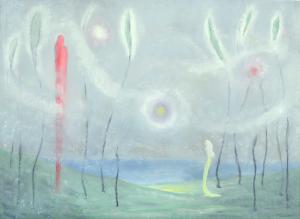
Wikimedia Commons contributors, “File:The Oracle – Hawaiian Symbolist by Marguerite Blasingame.jpg,” Wikimedia Commons, the free media repository, https://commons.wikimedia.org/w/index.php?title=File:The_Oracle_-_Hawaiian_Symbolist_by_Marguerite_Blasingame.jpg&oldid=276120985 (accessed June 27, 2019).

Ruins of the Oybin (Dreamer) – Caspar David Friedrich 1835 [Public domain]
Wikimedia Commons contributors, “File:Caspar David Friedrich 011.jpg,” Wikimedia Commons, the free media repository, https://commons.wikimedia.org/w/index.php?title=File:Caspar_David_Friedrich_011.jpg&oldid=326731449  (accessed May 24, 2019).
3 Comments

Filed under writing

#FineArtFriday: Peter Purves Smith: New York, 1936, and Rickett’s Point, 1937

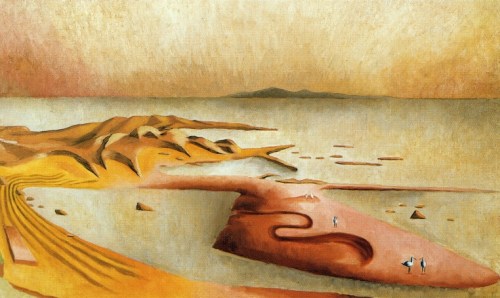
Usually, in literature, surrealism is shown through the thought processes of the characters rather than in alterations of the environment. On the surface, you believe what they say they think, but their perception of the world is skewed toward a hallucinogenic feel.

In art, the surface, the visual layer is what it is all about. Everything is displayed for you to view and interpret as you will.

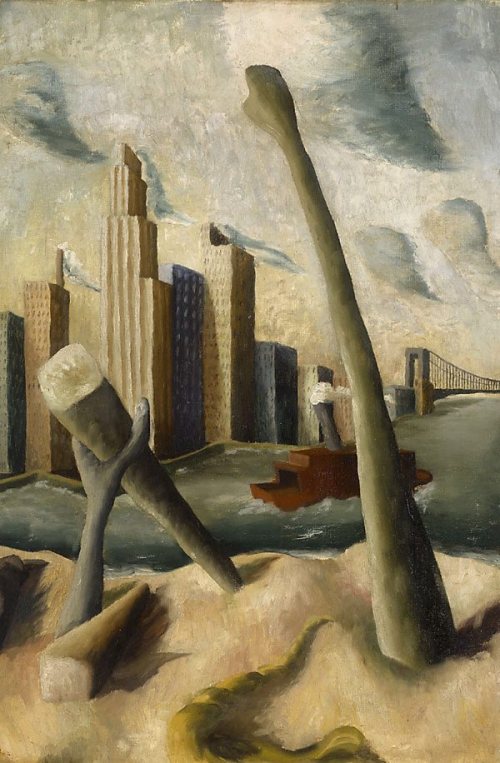
Sometimes surrealism asks you to think deeper. Other times, surrealism says “enjoy the moment.” In “New York” Peter Purves Smith asks you to think deeper about our mania for building densely and tall. Skyscrapers grow like weeds, springing from the earth like dandelions in the lawn. What other concepts does he ask us to consider?

Progress and impermanence. Beauty versus utilitarian requirements. He asks us to think deeply.

In Ricketts Point, he asks you to just enjoy a sunny day at the beach.


Credits and Attributions

Wikimedia Commons contributors, “File:Peter Purves Smith – New York, 1936.jpg,” Wikimedia Commons, the free media repository, https://commons.wikimedia.org/w/index.php?title=File:Peter_Purves_Smith_-_New_York,_1936.jpg&oldid=149235926 (accessed July 4, 2019).

Wikimedia Commons contributors, “File:Peter Purves Smith – Ricketts Point, 1937.jpg,” Wikimedia Commons, the free media repository, https://commons.wikimedia.org/w/index.php?title=File:Peter_Purves_Smith_-_Ricketts_Point,_1937.jpg&oldid=296570789 (accessed July 4, 2019).

Comments Off on #FineArtFriday: Peter Purves Smith: New York, 1936, and Rickett’s Point, 1937

Filed under #FineArtFriday

The Word-Pond – Surface #amwriting

Story is an arc of action, but it is also a deep pond filled with words. Today we are looking at the visible layer, the surface.

When you look at a real pond you will see the effects of the world around it reflected in its surface. On a windless day, the pool will be calm, still. The sky and any overhanging trees will be reflected in it.

Add in a storm and things change. The waters move; ripples and small waves stir the waters, which only reflect the dark gray of stormy sky.

The surface of the Word-Pond is the Literal Layer; the what-you-see-is-what-you-get layer.

The storms that alter the surface are the events and the way our characters move through them.

This surface layer is comprised of

  • Setting,
  • Action and Interaction,
  • All visual/physical experiences of the characters as they go about their lives.

The surface of a story is like a picture. When we look at it we immediately see something recognizable. The surface is comprised of:

Setting – things such as:

  1. Objects the characters see in their immediate environment
  2. Ambient sounds that form the background of the immediate environment
  3. Odors/scents of the immediate environment.
  4. Objects the characters interact with in their immediate environment.
  5. Weapons (swords, guns, phasers)

The still, reflective surface of the word-pond is affected by the breeze that stirs it. As mentioned above, the breeze is made of the action and events that form the arc of the story:

  1. The opening.
  2. The inciting incident.
  3. Rising action and events that evolve from the inciting incident.
  4. The introduction of new characters.
  5. The action that occurs between the protagonist and antagonist as they jockey for position.
  6. The final showdown

These components form the literal layer because they appear to be the story.

How do we shape this literal layer? We can add fantasy elements, or we can stick to as real an environment as is possible.

In Alice’s Adventures in Wonderland, Lewis Carroll showed us that while surrealism is a large, ungainly concept to describe, it can be incorporated into the literal layer. An author might build into the setting an unusual juxtaposition of objects. The characters behave and interact with their environment as if the bizarre things are normal. The setting may have a slightly hallucinogenic feel to it, making the reader wonder if the characters are dreaming. The placement of the unusual objects is deliberate, meant to convey a message or to poke fun at a social norm. Surrealism on the surface level takes what is real and warps it to convey a subtler meaning but doesn’t say “Look what I did!” It tries to pass as “normal.”

Most Sci-fi and some fantasy novels are set in real-world(ish) settings, with a good story and great characters. The settings are familiar, so close to what we know, we could be in that world. That is where good world building creates a literal layer that is immediately accepted by the reader.

SO, we know that the surface layer of our story can contribute to the feeling of depth. Setting, action, interaction—these most obvious components should give the reader a hint that there are deeper aspects of the story, more than what-you-see-is-what-you-get.

While the winds (action and reaction) may ruffle the surface, stir things up on the literal layer, it rarely disturbs the deeper waters of the Word-Pond. A good story has all these components, but it also has soul, makes you think about larger issues. The way our characters interact within this surface layer are influenced by what is going on in the next layer down—the Inferential Layer.

Just below the surface, in the Inferential Layer lies Mood and Emotion. They are not the same and the differences will require a little examination.  Friday’s art post will be a dip into surrealism–but on Monday we will pick this discussion up and talk about Mood vs. Emotion.


Credits and Attributions:

Wikipedia contributors, “American Realism,” Wikipedia, The Free Encyclopedia, https://en.wikipedia.org/w/index.php?title=American_Realism&oldid=902714117  (accessed June 29, 2019).

Wikimedia Commons contributors, “File:Augustus Edwin Mulready Fatigued Minstrels 1883.jpg,” Wikimedia Commons, the free media repository, https://commons.wikimedia.org/w/index.php?title=File:Augustus_Edwin_Mulready_Fatigued_Minstrels_1883.jpg&oldid=335802594 (accessed June 2, 2019).

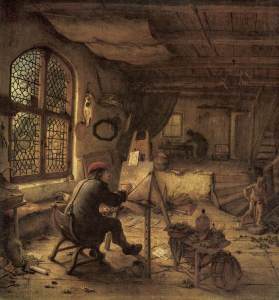
Wikimedia Commons contributors, “File:Adriaen van Ostade – The Painter in His Studio – WGA16748.jpg,” Wikimedia Commons, the free media repository, https://commons.wikimedia.org/w/index.php?title=File:Adriaen_van_Ostade_-_The_Painter_in_His_Studio_-_WGA16748.jpg&oldid=270705051 (accessed May 10, 2018).

4 Comments

Filed under writing

Creating Depth: Layers of the Word-Pond #amwriting

We often talk about the story arc and its component parts and features. But when we want to add depth to a story, we must look at it from a different angle. Yes, “Story” is an arc, but it is also like a pond. It is something vast and deep, set in an enclosed space.

We know it has a beginning and end, a top and bottom, with something murky and mysterious in the middle. We instinctively know the pond is made up of those three layers, although we may not consciously be aware of it or be able to explain it.

Today we will have an overview of Depth, a component of Story that we will be exploring over the next few posts. This is a part of the puzzle that eludes many authors as depth is an advanced concept requiring a great deal of thought to convey.

On our pond, Layer One, the surface layer, is the most obvious. When you look at the pond, it could be calm , or if a storm is brewing, it will be ruffled and moving.

First, we must understand that Story is an immense, unfathomable word-pond.

In Story, Layer One, the surface layer is the Literal Layer; the what-you-see-is-what-you-get layer.

This is the setting, the action, the visual/physical experience of the characters as they go about their lives.

On the surface of a story, when you see something, you immediately recognize what you think is there. You immediately believe you know what is going on. This is the surface meaning. A gun is drawn, the weapon is fired—what happened is clear and obvious.

The ways in which we play with the surface layer are by choosing either Realism or Surrealism, or a blend of the two.

Realism is serious, a depiction of what undisputedly is.

Surrealism seeks to release the creative potential of the unconscious mind, for example by the irrational juxtaposition of images. It takes what is real and warps it to convey a subtler meaning.

This will be a fun layer to explore, with lots of wonderful art to help us along the way.

Back to the pond. Beneath the surface is Layer Two: the middle, the area of unknown quantity where lives are lived, and events happen. Fish hatch, swim, and eat other fish. These are the creatures of the middle, entities who rarely breach the surface layer or see the bottom and who exist independently of them.

Yet their world has limits—they are confined, as we are confined by the sky above us and the soil beneath our feet.

In Story, Layer Two, the wide layer of unknown quantity is the Inferential Layer. This is the layer where Inference and Implication come into play.

We show why the gun is drawn. We imply reasons to show why the weapon was fired. We offer ideas to explain how the shooter comes to the place in the story where they squeezed the trigger.

We make these implications and let the reader draw their own conclusions.

In a good story, the path to the moment the trigger was pulled is complicated. Perhaps no one knows exactly what led to it, but your task is to fill the middle of the pond with clues, hints, and allegations. This is where INFER and IMPLY come into play.

You can only imply something to someone, in our case, the reader.

A speaker (author) implies. One meaning is displayed on the surface, but deeper down, you enclose the true meaning, a secret folded within the story. Take an envelope and write the word “murder” on it.  Then write one word, “avenger,” on a  note and slip it inside the envelope. The message (inference) inside the envelope (story) is conveyed to the listener (reader).

A listener (reader) infers. The listener (reader) deduces or catches the meaning of something that is not said directly. In reading the inferential layer of the story, they open the envelope and draw out the note and deduce the meaning of what is about to happen.

The layer of implication must be done well and deftly because you want the reader to feel as if they have earned the information they are gaining. They must be able to deduce what you imply. As a listener (reader) you can only extrapolate knowledge from information someone or something has offered you.

Serious readers want this layer to mean something on a level that isn’t obvious. They want to experience that feeling of triumph for having caught the meaning. That surge of endorphins keeps them involved and makes them want more of your work.

This layer will be shallower in Romance novels because the point of the book isn’t a deeper meaning—it’s interpersonal relationships on a surface level. However, there will still be some areas of mystery that aren’t spelled out completely because the interpersonal intrigues are the story.

Books for younger readers might also be less deep on this level because they don’t yet have the real-world experience to understand what is implied.

This middle layer is, in my opinion, the toughest layer for an author to get a grip on. We will go to popular literature to find examples that will lead us to draw our own conclusions about this layer.

Below the middle layer is Layer Three, the bottom of the pond. This is the finite layer: Whatever passes from the surface travels through the middle and comes to rest at the bottom.

In Story, Layer Three is the Interpretive Level:

  • Themes
  • Commentary
  • Message
  • Symbolism
  • Archetypes

This layer is sometimes the easiest for me to discuss because we are dealing with finite concepts. Theme is one of my favorite subjects to write about, as is symbolism. Commentary is something I haven’t gone into in depth, nor have I really discussed conveying messages. Archetype is another facet I haven’t gone into in detail, and yet it is a fundamental underpinning of Story.

I am looking forward to gaining more understanding of the subtler, more abstract aspects of writing as I do the research for this series. When I come across a book or website that has some good information, I will share it with you.

In the meantime, a good core textbook is “Story” by Robert McKee. If you haven’t already gotten it, get it.

Another excellent and more affordable textbook for this is “Damn Fine Story” by Chuck Wendig. Chuck delivers his wisdom in pithy, witty, concise packets. If you fear potty-mouth, don’t buy it. However, if you have the courage to be challenged, this is the book for you.

In my next post we will begin at the surface of the Word-Pond: realism and surrealism.


Credits and Attributions:

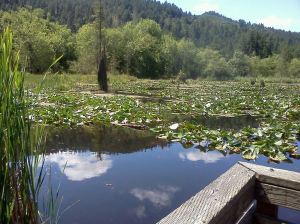
Photograph, McLain Pond in July, © 2018 by Connie J. Jasperson, from the author’s private photos.

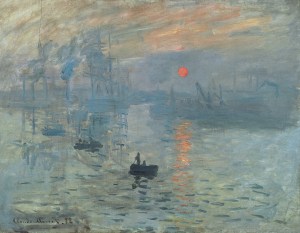
Impression Sunrise, Claude Monet 1872 [Public domain], via Wikimedia Commons

Comments Off on Creating Depth: Layers of the Word-Pond #amwriting

Filed under writing