Monthly Archives: January 2020

Using Pictures and Quotes #amwriting

Quoting other authors verbatim and including it in your book is opening a REAL can of worms. I will touch on that subject further down this post.

First, we’ll talk about blog posts, and why citing sources and crediting images is important.

When we first begin blogging, finding great images seems like no big deal. You google what you want, see what images pop up, right click, copy, and use them, right?

Don’t do it.

You can get into NO END of trouble that way, as is made clear in this article, The $7,500 Blogging Mistake That Every Blogger Needs to Avoid!

I use Wikimedia Commons and Public Domain images. Wikimedia makes it easy for you to get the attributions and licensing for each image. An excellent article on using Creative Commons Images can be found here:

What Is Creative Commons, And Should You Use It?

Another good source is Allthefreestock.com, where you can find hundreds of free stock photos, music, and many other things for your blog and other projects. Make sure you credit the artist!

Sometimes I need images I can only get by paying a small fee for.

I go to Dreamstime or Canstock, and several other reputable sources. For a few dollars, usually only two or three, I then have the right to use the image of my choice, and it’s properly licensed. The proper legal attribution is also there on the seller’s website, clearly written out with the copyright and artist name, so all you need to do is copy and paste it to your footnotes.

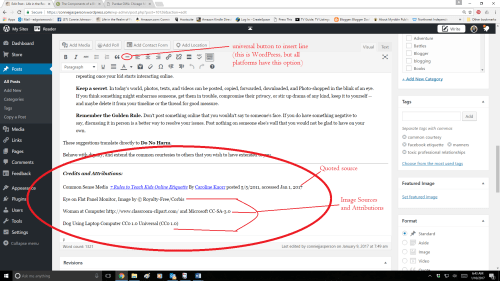
I also insert the attribution into the image details on my website so that when a mouse hovers over the image, curious readers can go to the source. (In WordPress, you must be on the WP Admin dashboard. Click on the image and go to ‘edit details’).
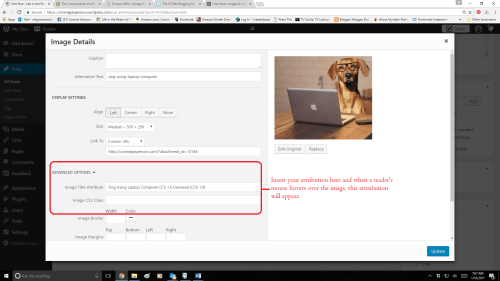
If you can do this, you won’t have to credit them in your footnotes.

We may want to quote another blogger or use the information we have learned from them. However, you will notice that I generally only quote directly from Wikipedia in those posts.

There is a reason, and we will get to that later.

If there is research involved, you should make notes at the bottom of your composition document about the title and URL of the website/article, the author, and what day you accessed it.

Properly citing your sources is your legal obligation, but there is a moral one here too: if some blogger quoted you verbatim, wouldn’t you want to be credited?

Some people will say that blogging isn’t really writing, so WHY bother with footnotes?

First of all, if blogging isn’t writing, what is it?

The footnotes at the bottom of every post tell me where my images are sourced, who created them, and what I used them in.

In my Fine Art Friday posts on art history, I do as wide as search as possible for information on a particular artist and painting. I only use images available from Wikimedia Commons with the share-alike copyright.

Citing sources:

First, I open a document in my word-processing program (I use Word), save it as whatever the title of the post is in that blog’s file folder, and compose my post the way I would write a story.

Composing the body of my post in a document rather than the content area of the blog-template allows me to spellcheck and edit my work before it is posted. Even so, I miss some typos and errors. The truth is, I feel more comfortable writing in a document rather than the content-window.

At the bottom of the page, I list what website I quoted, who the author was, the date of publication, and the date I accessed it. I have found the simplest method is the Chicago Manual of Style method, which looks like this:

Purdue OWL Online Writing Lab,  General Model for Citing Books in the Chicago Notes and Bibliography System, Copyright ©1995-2017 by The Writing Lab & The OWL at Purdue and Purdue University. All rights reserved.

Website: https://owl.english.purdue.edu/owl/resource/717/03 Accessed Jan 10, 2017

When you quote from Wikipedia, you can click on the ‘cite this page’ link in the left-hand column, which is a menu of items pertaining to Wikipedia in general and to that article. ‘Cite this page’ is listed under ‘tools.’ Clicking on this link takes you to a page offering citations for that page in CMoS, APA, or MLA style, whichever suits your needs. All you need to do is copy and paste the one you prefer into your footnotes, and your due diligence has been done.

All this information for your footnotes should be inserted at the BOTTOM of your current document, so everything you need for your blog post is all in one place. When my blog article is complete and ready to post, I will insert a line to separate the body of the post from the credits and attribution notes.

When readers view my blog, if my post were one that I did research for, they would see this at the bottom of the post:
Warning! To use copyrighted material in your book, you MUST contact the publisher.

Follow their guidelines to obtain the right to quote from a published book. This is NOT a simple process, but you must do it if you plan to quote anyone whose work is NOT in the Public Domain.

Chances are, you will be denied, so be prepared to do without that material.

That is why I quote from Wikipedia when it is applicable and when the copyright is Share-Alike.

Plagiarism and quoting are two different things. Plagiarism is lifting entire sections and publishing it as yours. For more on last year’s scandal in the world of “fast-track” publishing, read this article at the Fussy Librarian. Romance authors discover they’ve been plagiarized.

About the share-alike copyright, via Wikipedia:

Share-alike is a copyright licensing term, originally used by the Creative Commons project, to describe works or licences that require copies or adaptations of the work to be released under the same or similar licence as the original.[1] Copyleft licences are free content or free software licences with a share-alike condition.

Two currently-supported Creative Commons licences have the ShareAlike condition: Creative Commons Attribution-ShareAlike (a copyleftfree content licence) and Creative Commons Attribution-NonCommercial-ShareAlike (a proprietary licence).

To wind this rant up – bloggers, photographers and artists are just like those who write novels. They are proud of their work and want to be credited for it. Protect yourself and your work by responsibly sourcing images and giving credit to the authors and artists whose work you use.


Credits and Attributions

Wikipedia contributors, “Share-alike,” Wikipedia, The Free Encyclopedia, https://en.wikipedia.org/w/index.php?title=Share-alike&oldid=929200583 (accessed January 7, 2020).

Share alike icon, Public Domain. Wikimedia Commons contributors, “File:Cc-sa.svg,” Wikimedia Commons, the free media repository, https://commons.wikimedia.org/w/index.php?title=File:Cc-sa.svg&oldid=362413897 (accessed January 7, 2020).

Portions of this article and the screenshots first appeared on the Northwest Independent Writers’ Association  Blog in January of 2017, written by Connie J. Jasperson, © 2017 All Rights Reserved.
Comments Off on Using Pictures and Quotes #amwriting

Filed under writing

Superpowers, Super Weapons, and Magic #amwriting

I am a born skeptic. I gravitate to reading fantasy but find both superpowers and magic to be an area hack authors regularly make least believable.

Many of my own books feature characters who can use magic of one sort or another. In my worlds, all magic is limited by strict parameters and requires both governing and training.

My approach to designing magic and worlds was shaped by my love of early Final Fantasy style RPG games. Everything was logical and believable. The political and religious systems were concrete, as were the technology and magic systems. The enemies were powerful, but no one had unlimited power. If you worked to build your strength and abilities and acquired the best weapons and armor you could get, you grew strong enough to prevail in the ultimate battle.

Later, I used those principles in writing a storyline, world building, and designing magic for an anime-based RPG. The company folded before the game went into full production, but the experience taught me to look at these aspects of genre fiction with a “God’s Eye.”

Anyone who has raised children knows they are born with a sense of self and an instinct for self-preservation. We come into the world aware only of how we feel and what we want. Those two things are the primary drivers of infancy.

Awareness that others also have feelings, needs, and wants comes later. Each human develops compassion for others at a different stage of childhood.

Some children are bullies while still in diapers. They will push and take toys from the weaker member of a group if they aren’t guided in the right direction or severely limited in what they can do. They quickly learn who they can get away with bullying, and that child gets picked on mercilessly.

These little bullies are strong-willed and could become leaders, so guiding them to learn and understand compassion is crucial for the welfare of society.

Some people, even those raised in good families, never develop the ability to care about others.

Most insensitive people aren’t sociopaths. But if a self-centered person has a superpower or a gift for using magic, could you guarantee they won’t use it solely for selfish purposes?

Thus, laws and a school system that trains them in both the use of these powers and what constitutes abuse is essential. There should be consequences for abuse, especially if others are harmed.

In designing a story where superpowers, super weapons, or magic are key elements, you must understand several things.

  1. Super weapons are science based.

Science is not magic. It is logical, rooted in the realm of real theoretical physics. The writer of true science fiction must know the difference, especially when creating possible weapons.

  1. Magic is not science.

However, it should be logical and rooted in solid theories. For me, as a reader, magic should only be possible if certain conditions have been met. This means the author has created a system that regulates what is possible. Magic works

  • if the number of people who can use it is limited.
  • if the ways in which it can be used are limited.
  • if the majority of mages are limited to one or two kinds of magic and only certain mages can use every kind of magic.
  • if there are strict, inviolable rules regarding what each kind of magic can do and the conditions under which it will work.
  • if there are some conditions under which the magic will not work.
  • if the damage it can do as a weapon or the healing it can perform is limited.
  • if the mage or healer pays a physical/emotional price for the use.
  • if the mage or healer pays a hefty price for abusing it.
  • if the learning curve is steep and sometimes lethal.

Satisfying these conditions sets the stage for you to create the Science of Magic. This is an underlying, invisible layer of the world. By creating and following the arbitrary rules of this “science,” your story won’t contradict itself.

  1. Superpowers are both science and something that may seem like magic, but is not.

What challenges does your character have to overcome when learning to wield their magic/superpower or super weapon?

  • Are they unable to fully use their abilities?
  • If not, why?
  • How does their inability affect their companions?
  • How is their self-confidence affected by this inability?
  • Do the companions face learning curves too?
  • What has to happen before your hero can fully realize their abilities?

Magic and superpowers share common ground in one area–genesis, or how the ability occurs:

Is the character born with the ability to use the superpower or was it imposed on them by a scientific means?

Is your magic spell-based or imposed by artifacts and relics? Or is it a biological/empathic ability? Is it a trait children can inherit?

  • If magic is spell-based, can any reasonably intelligent person learn it if they find a teacher or are accepted into a school?

Personal Power and the desire for dominance is where the concepts of science and magic converge.

In all my favorite science fiction and fantasy novels, the enemy has access to equal or better Science/Magic. How the characters overcome the limitations of their science/magic/superpower is the story.

“Struggle” forces the characters out of their comfortable environment. The roadblocks you put up force them to be creative, and through that creativity, your characters become more than they believe they are.

I do suggest that in regard to magic, you take the time to create the rules and write a document for yourself that clearly defines what limits characters face when using their magic.

This means that if the protagonist and their enemy are not from the same “school” of magic or science, you might have written two systems into that story. You should take the time to write out what makes them different and why they don’t converge.

You must also clearly state the limits of science for both the protagonist and antagonist. Take the time to write it out and be sure the logic has no hidden flaws.

In creating science technologies and magic systems, you are creating a hidden framework that will support and advance your plot. Within either system, there can be an occasional exception to a rule, but there must be a good reason for it, and it must be clear to the reader why that exception is acceptable.

An important thing to consider whether using magic or technology: the only time the reader needs to know these systems exist is when it affects the characters and their actions. Write it as a natural part of the environment rather than discussing it in an info dump.

Science and magic are two sides of the personal-power coin. We who write the two radically divergent sides of speculative fiction give this coin to our characters in varying amounts.

My favorite authors explore ambition, the drive to acquire more personal power, and the lengths characters will go to in their efforts to gain an edge over their opponents. They delve deeply into the societal consequences of their characters’ struggle.

How does the emotional toll of seeing that collateral damage affect your characters? Guilt might play a role.

The fundamental tropes of science, magic, or superpowers offer your characters opportunities for success. But to be believable, those opportunities must not be free and unlimited.

Every successful author teaching a seminar will tell you that when writing genre fiction, the struggle is the story. Make your characters work for their successes. Make them and the reader understand the personal cost of acquiring power and the dangers of unbridled ambition.

Use magic, science, or superpowers only as a means to tell a powerful story.

Strong, charismatic characters, powerful struggles, serious consequences for failure–these are the stories I want to read.


Credits and Attributions:

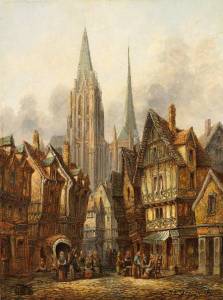
Wikimedia Commons contributors, “File:Dommersen Gothic cathedral in a medieval city.jpg,” Wikimedia Commons, the free media repository, https://commons.wikimedia.org/w/index.php?title=File:Dommersen_Gothic_cathedral_in_a_medieval_city.jpg&oldid=319795786 (accessed May 29, 2019).

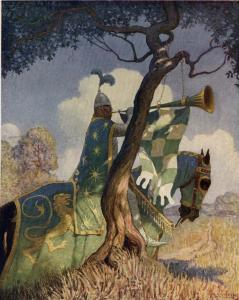
The Green Knight, by N.C,Wyeth [Public domain], via Wikimedia Commons. Wikimedia Commons contributors, “File:Boys King Arthur – N. C. Wyeth – p82.jpg,” Wikimedia Commons, the free media repository, https://commons.wikimedia.org/w/index.php?title=File:Boys_King_Arthur_-_N._C._Wyeth_-_p82.jpg&oldid=304597062  (accessed December 9, 2018).


Comments Off on Superpowers, Super Weapons, and Magic #amwriting

Filed under writing

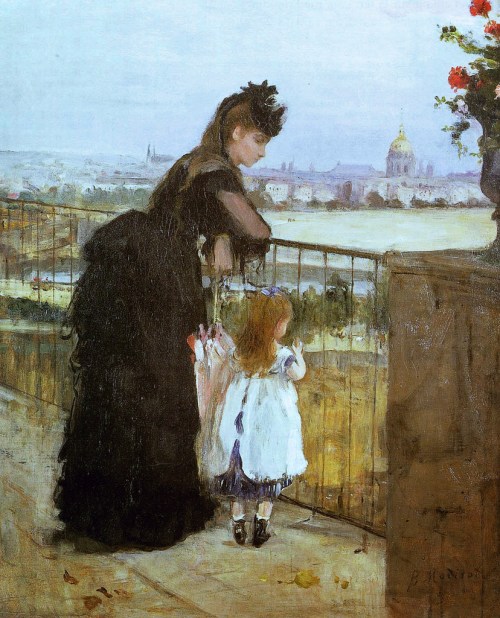
Woman and Child on a Balcony, Berthe Morisot ca. 1872

Title: Woman and Child on a Balcony

Artist: Berthe Morisot  (1841–1895)

Date: 1872

Medium: oil on canvas

Dimensions: Height: 61 cm (24 ″); Width: 50 cm (19.6 ″)

Today, Friday January 3, 2020, my hubby and I are visiting the Tacoma Art Museum, to see an exhibit of Impressionist paintings: Monet, Renoir, Degas, and Their Circle: French Impressionism and the Northwest. I will post about the experience next Friday, and hope to have photographs.

In the meantime, I present you with a female artist, Berthe Morisot, who was the sister-in-law to Eduard Manet. I hope to see her work represented there.

What I love about this painting:

It is only when you stand back from it that you realize how deftly Morisot conveyed the impressions of a pleasant day, a busy harbor, and a curious child. Up close, it is nearly indecipherable, but from a distance—which is how art in the impressionist style should be viewed—it is a delightful image. Is the  young woman a nanny or mother? The small girl seems happy in her company. The two take in the view on a hazy afternoon—there is a sense of affluence and harmony in moment captured by the artist.

About the Artist, vis Wikipedia

Berthe Morisot came from an eminent family, the daughter of a government official and the great-niece of a famous Rococo artist Jean-Honoré Fragonard.  She met her longtime friend and colleague, Édouard Manet, in 1868. Morisot was married to Édouard’s brother, Eugène Manet, in 1874.

Eugene was also a French painter but did not achieve the high reputation of his older brother, Édouard Manet, or his wife, Berthe. He devoted much of his efforts to supporting his wife’s career.

On November 14, 1878, she gave birth to her only child, Julie, who posed frequently for her mother and other Impressionist artists, including Renoir and her uncle Édouard.

It is hard to trace the stages of Morisot’s training and to tell the exact influence of her teachers because she was never pleased with her work and she destroyed nearly all of the artworks she produced before 1869.

Morisot’s mature career began in 1872. She found an audience for her work with Durand-Ruel, the private dealer, who bought twenty-two paintings. In 1877, she was described by the critic for Le Temps as the “one real Impressionist in this group.” She chose to exhibit under her full maiden name instead of using a pseudonym or her married name. As her skill and style improved, many began to rethink their opinion toward Morisot. In the 1880 exhibition, many reviews judged Morisot among the best, even including Le Figaro critic Albert Wolff.

Correspondence between Morisot and Édouard Manet shows warm affection, and Manet gave her an easel as a Christmas present. Morisot often posed for Manet and there are several portrait painting of Morisot such as Repose (Portrait of Berthe Morisot) and Berthe Morisot with a Bouquet. Morisot died on March 2, 1895, in Paris, of pneumonia contracted while attending to her daughter Julie’s similar illness, and thus making her an orphan at the age of 16.


Credits and Attributions:

Wikimedia Commons contributors, “File:Berthe Morisot 001.jpg,” Wikimedia Commons, the free media repository, https://commons.wikimedia.org/w/index.php?title=File:Berthe_Morisot_001.jpg&oldid=359873236 (accessed January 2, 2020).

Wikipedia contributors, “Berthe Morisot,” Wikipedia, The Free Encyclopedia, https://en.wikipedia.org/w/index.php?title=Berthe_Morisot&oldid=931800099 (accessed January 2, 2020).

Wikipedia contributors, “Eugène Manet,” Wikipedia, The Free Encyclopedia, https://en.wikipedia.org/w/index.php?title=Eug%C3%A8ne_Manet&oldid=895506929 (accessed January 2, 2020).

2 Comments

Filed under #FineArtFriday

Winter in the Northern Garden

Winter_berriesIn winter, my Northern garden

Languishes, ragged and shabby,

Unlovely, decaying, and

Uncomfortably aware she’s grown old.


The remains of Summer’s glory beckons,

Begging to be told she is still beautiful,

Still young and fascinating,

Still the object of desire.


Ever the gallant gentleman,

Winter obliges, and with a kiss

Ice crystals decorate each twig and branch

Gracing her with radiant beauty.


Ruby-red berries set against crystalline diamonds,

Ice catching the light, scattering it.

Jewels decorating decrepit limbs,

Dazzled, we bow to her wondrous splendor.


Beneath the litter of leaves dead and brown,

A new Spring waits,

Lurking in the wings, biding her time,

Politely allowing the old dame one last encore.


Credits and Attributions

Winter in the Northern Garden © Connie J. Jasperson 2017, first appeared here on February 17, 2017

Winter Berries, Nick Sarebi [CC BY 2.0 (https://creativecommons.org/licenses/by/2.0)%5D

4 Comments

Filed under #FlashFictionFriday, Poetry, writing