Monthly Archives: August 2020

#FineArtFriday: A Back Road, by Childe Hassam 1884 (reprise)

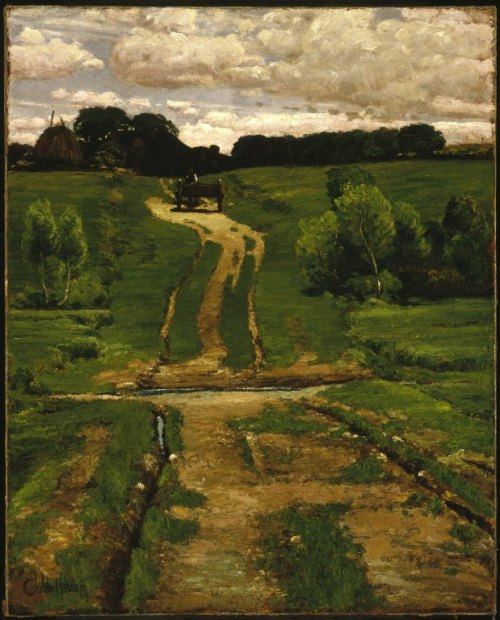
We have been talking about world-building all this week. World-building can be a challenge at times. Some days, we need a visual boost to get our minds working. Historical fiction and fantasy authors have a marvelous resource in the images of great art that has been compiled and is available for viewing on Wikimedia Commons.

For instance, if you want to know what a road looked like to travelers before the advent of blacktop and concrete made the modern freeways and highways possible, turn to art.

The above painting by Frederick Childe Hassam, shows what a good road looked like.  It goes across the land, cut into the earth by the travelers who use it. Along the better roads, such as this one, ditches were dug to enable drainage.

No bridge crosses the small creek–travelers must cross the water on foot or in the wagon. In winter it becomes a mushy, muddy track, and in summer it’s sun baked and hard. In spring, the grass grows green, making it a pleasant place.

A Back Road (1884) was painted in his early years, while Hassam was still influenced by the works of William Morris Hunt, who like the great French landscape painter Jean-Baptiste-Camille Corot, emphasized the Barbizon tradition of working directly from nature.

From Wikipedia: In 1885, a noted critic, in part responding to Hassam’s early oil painting A Back Road (1884), stated that “the Boston taste for landscape painting, founded on this sound French school, is the one vital, positive, productive, and distinctive tendency among our artists today…the truth is poetry enough for these radicals of the new school. It is a healthy, manly muscular kind of art.”

I like the composition of this piece, the way the land is larger than the sky. The grass feels damp and the clouds herald more spring rain–this painting has life.

In his later years, Hassam moved away from realism and became known as one of the best of the American impressionists.


Credits and Attributions:

A Back Road, Childe Hassam 1884 [No restrictions or Public domain], via Wikimedia Commons

Wikipedia contributors, “Childe Hassam,” Wikipedia, The Free Encyclopedia, https://en.wikipedia.org/w/index.php?title=Childe_Hassam&oldid=831999910 (accessed April 6, 2018).

2 Comments

Filed under #FineArtFriday

World-building, part 2: building reality #amwriting

When I write a world that my characters might live in, I want to express more than merely the sights, the sounds, and the smells. I want to convey the emotions that place evokes for me, the author.

The fact is, unless we are there physically, other places don’t really exist for us. For this reason, the only world that really exists in this incarnation is the space we physically occupy as individuals.

The only true reality is the space we can see, hear, smell, and touch. This is our setting, the world in which our life story plays out.

In literary terms, what is setting? It is the environment your characters live and interact with. It is scenery, topography, plants, and animals. The setting is also comprised of a place in time, defined by an era, or a level of technology.

These aspects of the setting are crucial to making a story real to a reader. However, if they are shown as unconnected elements, this setting lacks something. We must inject these elements with the indefinable fantasy thingamajig we call atmosphere.

Perhaps you experience a sense of longing when remembering a particular place.  For me, one place represents a feeling of home and lingers in my heart. When I am writing in my fictional world, I am drawing on the memory of that long-ago place.

That lost time and place has a hold on my emotions and is made brighter and shinier by the false lighting of memory. This is why, despite the fact my childhood home is a real place, it is also a fantasy.

A reader’s perception of a setting’s reality is affected by emotions they aren’t even aware of. We must give the reader something they can subliminally recognize, something they can relate to. We need to convey a sense of familiarity to a place the reader has never been.

“Familiar” does not mean safe or comforting. It means the elements of the environment are recognizable on a subconscious level, something the reader can understand without having experienced it, or being bluntly told.

This is why I draw maps. If your characters must do any traveling in a fantasy world, you probably should make a rudimentary map. The map is my indispensable tool for keeping my story straight.
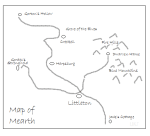
It doesn’t have to be fancy. All that is required is a pencil sketch showing a few lines for roads and the general location of any cities or topographical features that come into the story.

When your characters are traveling great distances, they may pass through villages on their way, and if these places figure in the events of the book, they should be noted on the map. This prevents you from:

  • accidentally naming a second village the same name later in the manuscript
  • misspelling the town’s name later in the narrative
  • forgetting where the characters were in chapter four

Perhaps the land itself will impede your characters. If geologic features are pertinent to the story, you will want to note their location on your map so that you don’t contradict yourself if your party must return the way they came:

  • rivers
  • swamps
  • mountains
  • hills
  • towns
  • forests
  • oceans

Even if your work is wholly set on a space station/ship, consider making a floor plan.
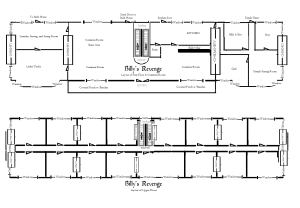
My novel, Billy Ninefingers, is set almost entirely in a wayside inn. I made a drawing of the floorplan for my purposes because that is the world in which the story takes place.

In the narrative, if you are writing fantasy, I suggest you keep the actual distances mushy because some readers will nitpick the details, no matter how accurate you are. Yes, you wrote it, but they don’t see it the way you do.

Using medieval distances won’t help, because they’re not concrete—a league might be three miles or one and a half, depending on the country and era. Some readers will argue that their version of a league is the only real version and blah blah blah….

When it comes to creating reality on paper, a perception of familiarity is everything. Use your memory to visualize the scenery:

Imagine the surface of a pond. On a windless day, the pool will be calm, still. The sky and any overhanging trees will be reflected in it.

Add in a storm, and things change. The waters move. Ripples and small waves stir the surface, which now only reflects the dark gray of the stormy sky.

Atmosphere is the part of a world that is created by colors, scents, ambient sounds, and how the visuals are shown. It is visual and tied to the setting, but the perception of it is affected by the moods and emotions of the characters.

From the first paragraph of a story, we want to use the setting to establish a feeling of atmosphere, the general mood that will hint at what is to come.

We do this by employing lighter or darker descriptions. A dark, gloomy setting created by “weighted words” establishes an ominous atmosphere, which will be reflected in the mood of your characters.

I think of “weighted words” as those with strong descriptive power, and which don’t need a lot of support from adjectives and adverbs to convey their intensity.

Lighter words will create an atmosphere that feels brighter.

We have mentioned before that while the two terms, mood and atmosphere, are usually used as synonyms, they are different from each other. In literature, mood refers to the internal feelings and emotions of an individual as often as it does the overall atmosphere of a piece. The term atmosphere is always associated with a setting.

Many sci-fi and fantasy novels are set in real-world environments. The settings are familiar, so close to what we know, that readers have no trouble accepting that world.
I love books where the author’s gift for world-building creates a layer of reality I can immediately “fall” into. Setting, action, interaction—these most obvious components combine to showcase the more profound aspects of the story.

I have been returning to the works of other authors to see how they create their worlds, how they choose words to build a setting and create atmosphere and mood.

Some of their tricks work, and some not so much, but I keep reading and learning. By figuring out what didn’t work for me in a novel, I hope to avoid those mistakes in my own work.

8 Comments

Filed under writing

World-building, part 1: Place #amwriting

My novel, Mountains of the Moon, was born in 2008. It began life as a storyline for an anime-based RPG that never went past planning into production. The original title was Neveyah, named after the world in which it was set.

MOTM is set in an alternate universe and takes place in an environment that was ground zero for a war between gods. As a result of that battle, the gods were prohibited from acting directly against each other and must now act through their people.

When the story opens, the World of Neveyah has been recovering for a thousand years.

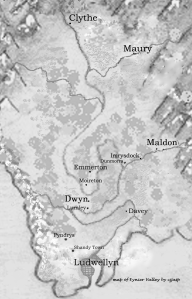
I had created the maps for the role-play game, so before I began writing Wynn’s story as a novel, I knew the topography of his world.

Of course, I got distracted and wrote Tower of Bones, a story set two generations later before I finished MOTM, but that’s how writing works for me.

I went to science to see how long it takes for an environment to recover from cataclysmic events. I took my information from a place I live a two-hour drive away from, the Channeled Scablands of Washington State. This vast desert area is  comprised of the scars of a natural disaster that occurred around 18,000 years ago.

From Wikipedia: The Cordilleran Ice Sheet dammed up Glacial Lake Missoula at the Purcell Trench Lobe.[10] A series of floods occurring over the period of 18,000 to 13,000 years ago swept over the landscape when the ice dam broke. The eroded channels also show an anastomosing, or braided, appearance.

I had to first build and then destroy the ecology for the game. All RPG players will tell you that a hazardous environment and correspondingly dangerous creatures are a core part of a game’s story. Hazards present threats the protagonist must learn to coexist with. Overcoming and surviving danger raises a player’s skills and strength.

That concept of personal growth through action is a feature of all adventure stories.

Thanks to that year of prep-work on the game, when I began writing the book, all the hard work was done. Many hours of work and years of writing is why the world seems so solid from the opening paragraphs.

When we first brainstormed the idea of writing a fun, yet deep and meaningful story and making a computer game out of it, my partner had two requests. He wanted the central character to be under a curse. Also, he wanted Wynn’s arc to take him from the most naïve, sheltered twenty-year-old ever to walk the planet, to a strong adult capable of making a difference in a world that could sometimes be a terrible place.

So, with those requests in mind, I sat down and wrote a 3500-word outline of events, and answered as many questions about the world as I could think of at the time:

  • What is the name (and the meaning of that name) of the worlds involved in the character’s journey?
  • Who are Gods involved, and what is the core of their conflict?
  • This is a portal story, so where was my protagonist, Wynn Farmer, when the story opened? Why was he unaware of the portal before he fell through, and why wouldn’t it take him back to his world?
  • Where was he at the end of the opening chapter? How did the air feel? What scents and odors were common to that place?

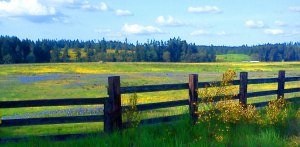
Blue camas and wild mustard on the Violet Prairie, Tenino Washington, in May 2014

The world of Neveyah is an alien environment, yet it’s extremely familiar to me. I based the plants and topography on the world I live in, the Pacific Northwest. The plants and geography are directly pulled from the forested hills and farmlands of Southern Puget Sound and Western Washington State.

Who did he meet (Jules Brendsson)? What did he see, and how did that meeting go?

When he realized he couldn’t go home, how did Wynn react to his new environment?

It was written as a game, so the environment plays a part in the characters’ learning curve. Coping with it is how the characters “level up” or grow in strength. While Wynn didn’t expect to fall into Neveyah, Jules had been sent specifically to meet and instruct him in the use of magic. Wynn and Jules must walk from the meeting place to a town.

As they are walking, Jules must get to know Wynn and teach him how to use a form of magic. What does Jules think about his student? Looking through Wynn’s eyes, what does he see in each scene?

This is where atmosphere comes into world-building, something we’ll go into detail about on Wednesday.

On this original world-building document, I wrote every detail I could think of, from the largest and most dangerous creatures down to the insects. Over the next four years, as I wrote the novel, I added to it whenever I thought of something new.

In the process of building the world that Wynn Farmer fell into, his storyline began to write itself.

The act of designing the immediate scenery builds the entire world in your mind. I go with the familiar, with some strange twists thrown in for fun.

You might tell me that you can’t picture a place you haven’t been to. But what does that really mean?

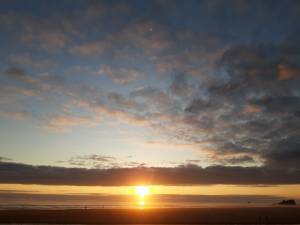
Sunset on Cannon Beach, August 2019

Open your eyes and look around. At this moment you have all the elements you need to create an alien or alternate world. These elements could exist before your eyes, or they exist in your memory.

Use what you know, reshape it, reuse it, and make it yours.

Everyone has a place they want to be more than anywhere else. For me, one place on earth represents my serenity, my creative happy place, and it exists in the real world but is a four-hour drive from my home.

Yet, when I need to, I can pull that place up in my mind. By visualizing my summer retreat, I recharge my serenity-batteries.

Open a new document, one that will be your world-building work sheet. What kind of place seems to build itself in your mind? This is an environment you are mentally connected to. In writing that that place, it will flow from you and convey itself to the reader. Write down the sights, smells, and the emotions you experience when thinking about it.

Perhaps it is a real place, and maybe you experience a sense of longing when remembering that place. If so, write how it makes your physical self feel.

This the point where cosmology and human nature intersect to create atmosphere, and we will continue this discussion on Wednesday.


Credits and Attributions:

Wikipedia contributors, “Channeled Scablands,” Wikipedia, The Free Encyclopedia, https://en.wikipedia.org/w/index.php?title=Channeled_Scablands&oldid=963105167 (accessed August 1, 2020).

All images and maps used in this post are the creation and intellectual property of Connie J. Jasperson.

2 Comments

Filed under writing