
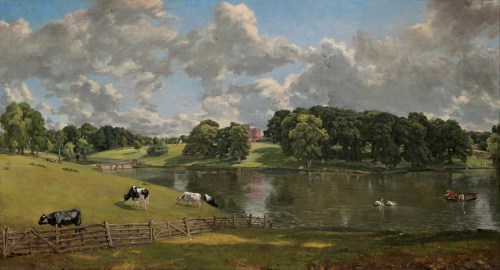
 Artist: John Constable (1776–1837)
Title: Wivenhoe Park, Essex
Genre: landscape art
Date: 1816
Medium: oil on canvas oil on canvas
Dimensions: height: 56.1 cm (22 in); width: 101.2 cm (39.8 in)
Collection: National Gallery of Art
What I love about this image:
This is the painting that made John Constable’s name. It contains everything he idealized about his native country, England. He gives us a deceptively simple image of a summer’s day, with white clouds drifting above a peaceful scene.
So beautifully composed, and so relaxing. When life is crazy, a Zen picture as painted by a master reminds me to slow down and enjoy the scenery.
About this painting, via Wikipedia:
The National Gallery of Art holds this painting as one of its highlights:
A pleasant sense of ease and harmony pervades this landscape of almost photographic clarity. The large areas of brilliant sunshine and cool shade, the rambling line of the fence, and the beautiful balance of trees, meadow, and river are evidence of the artist’s creative synthesis of the actual site.
The painting was commissioned by the owner of Wivenhoe Park, Major General Francis Slater Rebow, who was among the artist’s first patrons, being a close friend of the artist’s father, Golding Constable. Wivenhoe Park is 200 acres (81 ha) of parkland, purchased by the Rebow family before 1734. Slater-Rebow commissioned several paintings from Constable, including a portrait of the general’s seven-year-old daughter in 1812. She also figures in this painting, in a donkey cart to the left. This painting, finished in September 1816, earned the artist enough money to allow him to marry his long-time love, Mary Bicknell. They married in October 1816.
Constable’s art is always penetrated by longing, melancholy and a yearning for the simple, natural life, for a bucolic, pastoral idyll, to rural subjects and aspects of life in the countryside, a “golden age” when people lived together in harmony with nature, a world on its way of disappearing when he painted his landscapes thanks to the beginning of the Industrial Revolution. He was aware of the issue of urban growth, of urban life’s unpleasantness, which he contrasted to life in the countryside. Constable’s art was rather unconventional for his time, and he loved simple things, a natural landscape without the ruins, dramatic effects or exalted, often excessive feelings, like the ones displayed in the paintings of his contemporary, J. M. W. Turner. His landscapes are flooded by a silvery brilliant light in the water and air and in the sky, and are characterised by a special intensity that is such an important feature of this artist’s works. [1]
About the Artist, via Wikipedia:
John Constable RA (11 June 1776 – 31 March 1837) was an English landscape painter in the Romantic tradition. Born in Suffolk, he is known principally for revolutionising the genre of landscape painting, with his pictures of Dedham Vale, the area surrounding his home – now known as “Constable Country” – which he invested with an intensity of affection. “I should paint my own places best”, he wrote to his friend John Fisher in 1821, “painting is but another word for feeling”.[3]
Constable’s most famous paintings include Wivenhoe Park (1816), Dedham Vale (1821) and The Hay Wain (1821). Although his paintings are now among the most popular and valuable in British art, he was never financially successful. He became a member of the establishment after he was elected to the Royal Academy of Arts at the age of 52. His work was embraced in France, where he sold more than in his native England and inspired the Barbizon school. [2]
Credits and Attributions:
[1] Image: Wikipedia contributors, “Wivenhoe Park (painting),” Wikipedia, The Free Encyclopedia, https://en.wikipedia.org/w/index.php?title=Wivenhoe_Park_(painting)&oldid=1163430201 (accessed July 20, 2023).
[2] Wikipedia contributors, “John Constable,” Wikipedia, The Free Encyclopedia, https://en.wikipedia.org/w/index.php?title=John_Constable&oldid=1162727967 (accessed July 20, 2023).


 Life in the Realm of Fantasy
John Constable is a new-to-me artist. The painting is peaceful and relaxing. I can see your admiration for it! Thanks for the introduction! ☺️
LikeLiked by 1 person
Felicia, thank you for stopping by – I’m glad you like it too!
LikeLiked by 1 person
A lovely calming and peaceful scene for our hectic age.
LikeLiked by 1 person
Hello V! I so agree – and thank you for stopping by!
LikeLike