Monthly Archives: January 2024

Tension and asymmetric information #amwriting

All writers begin as readers. As we read, we see an arc to the overall novel. It starts with exposition, where we introduce our characters and their situation. Then, we get to the rising action, where complications for the protagonist are introduced. The middle section is the action’s high point, the narrative’s turning point.
writing craft functions of the sceneAfter we survive the middle crisis, we have falling action. We receive the crucial information, the characters regroup, and we experience the unfolding of events leading to the conclusion. The protagonist’s problems are resolved, and we (the readers) are offered a good ending and closure.

I think of scenes as micro-stories. Each one forms an arch of rising action followed by a conclusion, creating a stable structure that will support the overall arc of the plot.  In my mind, novels are like Gothic Cathedrals–small arches built of stone supporting other arches until you have a structure that can withstand the centuries. Each scene is a tiny arc that supports and strengthens the construct that is our plot.

Each scene has a job and must lead to the next. If we do it right, the novel will succeed.

The key difference in the arc of the scene vs. the overall arc of the novel is this: the end of the scene is the platform from which your next scene launches. Each scene begins at a slightly higher point on the novel’s plot arc than the previous scene, pushing the narrative toward its ultimate conclusion.
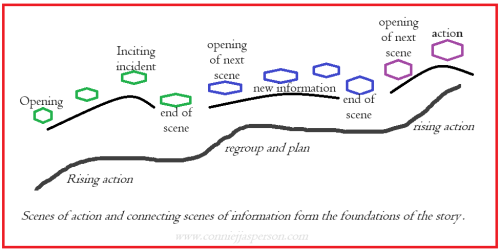
ArcOfScenesLIRF04062024These small arcs of action, reaction, and calm push the plot and ensure it doesn’t stall. Each scene is an opportunity to ratchet up the tension and increase the overall conflict that drives the story.

My writing style in the first stages is more like creating an extensive and detailed outline. I lay down the skeleton of the tale, fleshing out what I can as I go. But there are significant gaps in this early draft of the narrative.

So, once the first draft is finished, I flesh out the story with visuals and action. Those are things I can’t focus on in the first draft, but I do insert notes to myself, such as:

  • Fend off the attack here.
  • Contrast tranquil scenery with turbulent emotions here.

My first drafts are always rough, more like a series of events and conversations than a novel. I will stitch it all together in the second draft and fill in the plot holes.

So, how do I link these disparate scenes together? Conversations and internal dialogs make good transitions, propelling the story forward to the next scene. A conversation can give the reader perspective if there is no silent witness (an omniscient presence). This view is needed to understand the reason for events.
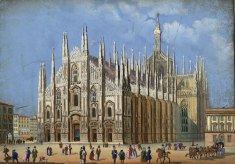
Milano_Duomo_1856Transition scenes must also have an arc supporting the cathedral that is our novel. They will begin, rise to a peak as the necessary information is discussed, and ebb when the characters move on.

Transition scenes inform the reader and the characters, offering knowledge we all must know to understand the forthcoming action.

A certain amount of context can arrive through internal monologue. However, I have two problems with long mental conversations:

  • If you choose to use italics to show characters’ thoughts, be aware that long sections of leaning letters are challenging to read, so keep them brief.
  • Internal dialogue is frequently a thinly veiled cover for an info dump.

An example of this is a novel I recently waited nearly a year for, written by a pair of writers whose work I have enjoyed over the years. I was seriously disappointed by it.

The protagonist’s mental ramblings comprise the first two-thirds of the novel. Fortunately, the authors didn’t use italics for the main character’s mental blather.

This exhausting mental rant contained very little critical knowledge. Ninety percent of what the man ruminated on was fluff—it was all background covered in the broader series and didn’t push the story forward. At the midpoint, I considered not finishing the book.
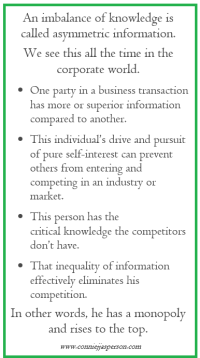
AsymetricInformationLIRF01062024Plots are driven by an imbalance of power. The dark corners of the story are illuminated by the characters who have critical knowledge.  This is called asymmetric information.

The characters must work with a limited understanding of the situation because asymmetric information creates tension. A lack of knowledge creates a crisis.

It’s tempting to waffle on but a conversation scene should be driven by the fact that one person has knowledge the others need. Idle conversations can be had anywhere, and readers don’t want to read about them. Characters should discuss things that advance the plot in such a way that they illuminate their personality.

The reader must get answers at the same time as the other characters, gradually over the length of a novel.

I struggle with this, too. Dispersing small but necessary bits of info at the right moment is tricky because I know it all and must fight the urge to share it too early. Hopefully, all these bumps will have been smoothed out by the end of my second draft.

8ce052b8e7c8182a51dc4999859c1061When we write a story, no matter the length, we hope the narrative will keep our readers interested until the end of the book. We lure readers into the scene and reward them with a tiny dose of new information.

I have no idea whether the novel I’m working on today will be an engaging story for a reader or not. But I’m enjoying writing it.

And that is what writing should be about: writing the story you want to read.
2 Comments

Filed under writing

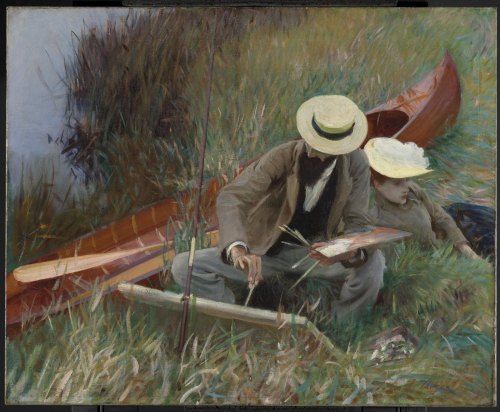
#FineArtFriday: An Out-of-Doors Study by John Singer Sargent (revisited)

Artist: John Singer Sargent  (1856–1925)

Title: An Out-of-Doors Study

Description: English: Paul César Helleu Sketching with his wife Alice

Signature bottom right: John S. Sargent

Date: 1889

Medium: oil on canvas

Dimensions: Height: 65.9 cm (25.9 ″); Width: 80.7 cm (31.7 ″)

The weather has been dark and dreary here in the Pacific Northwest. I need sunny day, and I remembered this image. An Out-of-Doors Study, 1889, is by expatriate American artist, John Singer Sargent. It depicts fellow artist and great friend, Paul César Helleu sketching with his wife Alice Guérin. What a lovely day it was, for them to be sitting on the grass, enjoying a carefree moment in life.

What I love about this painting:

This painting depicts a day in the life of two great artists. The grass looks very like that which grows beside streams in my part of the world. The colors are that mix of green and brown that long grass has when summer is just beginning. The blue sky is reflected in the water. They had taken advantage of a fine day in late May or June perhaps, fortunate to have an outing before high summer turns the meadow grass crisp and brown.

The quality of light that day was perfect for a picnic beside the water. One can imagine the two artists working on their individual projects and chatting, having a relaxing lunch, and then taking a quiet walk. We can even wonder if, later, they might have taken the canoe out.

January has been overcast and rainy with little chance of seeing sunshine. I could use a day like this, a picnic beneath blue skies, and a gathering of friends beside a quiet pond.

About the artist, via Wikipedia:

Sargent’s early enthusiasm was for landscapes, not portraiture, as evidenced by his voluminous sketches full of mountains, seascapes, and buildings. Carolus-Duran’s expertise in portraiture finally influenced Sargent in that direction. Commissions for history paintings were still considered more prestigious, but were much harder to get. Portrait painting, on the other hand, was the best way of promoting an art career, getting exhibited in the Salon, and gaining commissions to earn a livelihood.

In a time when the art world focused, in turn, on ImpressionismFauvism, and Cubism, Sargent practiced his own form of Realism, which made brilliant references to VelázquezVan Dyck, and Gainsborough.


Credits and Attributions:

Wikimedia Commons contributors, “File:Sargent – Paul Helleu Sketching with his Wife.jpg,” Wikimedia Commons, the free media repository, https://commons.wikimedia.org/w/index.php?title=File:Sargent_-_Paul_Helleu_Sketching_with_his_Wife.jpg&oldid=273586527 (accessed December 5, 2019).

Wikipedia contributors, “John Singer Sargent,” Wikipedia, The Free Encyclopedia, https://en.wikipedia.org/w/index.php?title=John_Singer_Sargent&oldid=927728162 (accessed December 5, 2019).

2 Comments

Filed under #FineArtFriday

Version control or how to save your sanity #amwriting

Here we are in the bright new year, and one way to help keep it bright and shiny is to never lose your manuscript.

MyWritingLife2021BIf you have been a computer user for any length of time, you know that hardware failure, virus attacks by hackers, and other computer disasters will happen. They’re like the Chelyabinsk meteor—hard to predict, difficult to recover from, and a horrible surprise when they happen.

Nothing is worse than discovering that all those hours of work on a labor of love were for nothing. A consistent system for saving and backing up the files in each project will save you time and tears.

As a municipal liaison for NaNoWriMo, I met many authors who didn’t know how to properly save files. They were new writers who didn’t understand how important it is to keep the old file and save it as a new one to work out of. They made massive cuts to the storyline, but instead of first renaming the file, they saved it and continued working. Those original sections were gone, along with the ideas and a lot of good prose that could have been reused elsewhere.

USB_DriveThis year, I met a young man who, being new to using a word processing program, forgot how he named his 2022 manuscript. He couldn’t find it when he decided to start writing again. I showed him how to search for files by date, taught him how to name documents, and taught him how to create a master file for all the files generated in the process of writing his book.

Also, keeping an external backup updated is crucial. If the computer dies, months of work won’t be lost forever. You will have a backup.

I generate work in a variety of subgenres, which complicates things. Each project is intended for submission to different places, so I have a large number of files in my writing folder. That’s why I use a cloud-based file hosting service.

  • I can’t misplace or lose it.

fileFolderI work out of Dropbox, so when I save and close a document, my work is automatically saved and backed up to the cloud. My files are always accessible even when working offline, so if the power goes out, I can access my work for as long as my computer’s battery holds out.
Many cost-free storage systems are available for your backup—Google Drive, OneDrive, or even a standard portable USB flash drive. Some people also purchase an external hard drive, which I have done for my images and graphics files.

Most people have never had a reason to learn how to label files consistently. It is a skill I developed, as properly filing things was part of my job. I was responsible for naming and saving my employers’ files in a consistent and manageable way. In 1993, when my office went from paper to PC, those skills transferred easily.

Each book will generate several files.

  • The original first draft manuscript and the subsequent drafts.
  • Documents detailing research and a list of sources and their links.
  • Random notes we generate in the process of creation.

Epic Fails signOne thing I hear from new writers is how surprised they are at how easily something that should be simple can veer out of control. The worst thing that can happen to an author is accidentally saving an old file over the top of your new file or deleting the file entirely.
Version control is a system that enables us to maintain an accurate history of changes to a file (or set of files) over time. We can return to specific versions as needed later, so nothing has been lost. 

The way you structure your filing system will evolve as you discover what works best for you. It will ultimately be centered around:

  • what you’re filing,
  • the number of files you are working with,
  • the various sub-categories (subfolders) your system needs to be broken down into.

A filing system is quite simple. For most documents, my system is a standard office-type system that consists of:

DIRECTORY> FOLDERS> SUB-FOLDERS> DOCUMENTS

My first draft of any manuscript will be given a Master File with a working title. That will be a handle to carry it by.

Within that master file, I have maps and every version of the original manuscript. The subfolders are clearly labeled and contain the old versions and any research that pertains to it.

Why do I keep so many versions of a manuscript? Every draft of that novel has some good things that I had to set aside for the sake of the story arc, but I never delete old files. You never know when you will need something you have already written.

  • The internet says using an underscore ( _ ) instead of a space in file names is a best practice. This is because some applications and computer scripts may not recognize spaces or will process your files differently when using spaces. If you intend to submit your work to a publisher, use the underscore to indicate spaces in the title to label any file you submit to them.

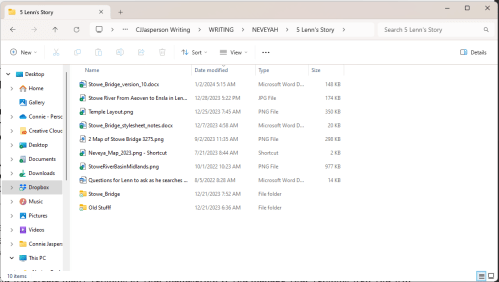
Screenshot_lennsStoryLIRF01022024I make a separate subfolder for my work when it’s in the editing process. That subfolder contains two subfolders, and one is for the chapters my editor sends me in their raw state with all her comments:
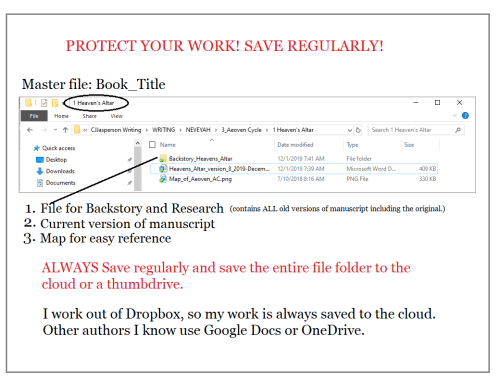
  • My editor saves each individual chapter as a separate new document, giving them a specific name: RoA_edit1_IL_01-10-22. (Ruins of Abeyon, Irene Luvaul edit 1, January 10, 2022.)

She does this because she edits one or two chapters a day and sends them to me that evening, and I save them in the subfolder for the raw edits. The other subfolder is for the finished work with the completed revisions:

  • I make the revisions Irene suggests and then save the chapter into that second folder: RoA_cjj_revised_jan-11-22. (Ruins of Abeyon, Connie J. Jasperson, revised January 11, 2022.)

We don’t lose the order of chapters because we have a reliable system for naming files, which we ALWAYS use. Consistency is critical when labeling files.

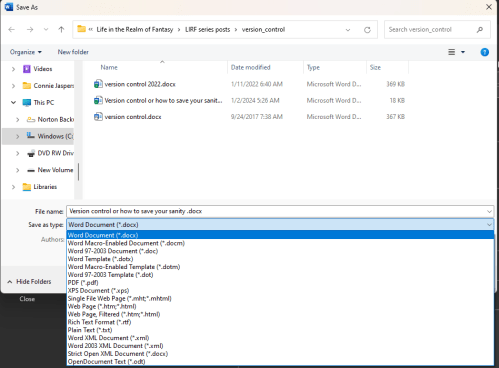
One thing to be aware of is to save it as a Word DOCUMENT and not a Template. If you save it as a template, you will keep getting a warning that the document is read-only and won’t let you save your changes.

screenshot_SaveAsDocumentLIRF01022024

Libraries’ is the screen that opens when you click “Save As” and is where you go to manage your documents, music, pictures, and other files. You can browse your files the same way you would in a folder or view your files arranged by properties like date, type, and author. These pictures, above and below, are of File Explorer libraries (Microsoft Windows file listing browser).

Name your files consistently and save each version in the master folder. Below is the master file for Lenn’s Story, the working title for my 2023 NaNoWriMo project (which still has no title).

You will create many versions of your manuscript. You will find the road much easier if you manage your versions well. And the event of equipment failure, you will have access to the most recent version of your work because it was regularly backed up to the cloud or an external drive.

File_names_save_master_file_screen_shot

4 Comments

Filed under writing

What I #amreading and #amwriting in the #HappyNewYear

Happy first day of 2024! The sun has been rising a few minutes earlier and setting a few later for a few days now, unnoticed because of the gloom and rain of a typical Pacific Northwest winter. Spring must be on the way because the internet says so.

MyWritingLife2021We are at the same latitude as Paris, Zurich, and Montreal but usually get a lot more rain than those cities. The North Pacific can be wild at this time of the year, which makes for some great storm-watching.
I read several books over the Christmas hiatus, two worth the time, and one—not so much.

The first two were written by the late mystery author Jane Haddam (Orania Papazoglou): Not a Creature Was Stirring (published in 1990) and Precious Blood (published in 1991). I had read both of these when they were first published, and let me say that they were every bit as great the second time as I thought they were the first.

The third book I read was on preorder for nearly a year, and I had been eagerly awaiting it. Published by one of the Big Traditional Publishers, it launched the second week of December 2023. The novel was written by one of my favorite fantasy author-duos. I’m not naming names because I don’t feel comfortable writing bad reviews. (That’s also why I don’t review books authors send to me.)

Unfortunately, this book is a masterclass in how NOT to structure a novel.

The book reads like something I might write when my mind is wandering, and I’m trying to figure out what to do next in a first draft. The first two-thirds of the novel is comprised of mental ramblings covering old ground and snippets of history. The lowest point comes when they spend ten pages dressing the main character for an important event, ten more pages covering the event, and three entire pages covering why the valet puts the ceremonial robes and tabards into storage.

CAUTION INFO DUMP ZONE AHEADBy the time the authors got to the meat of the matter (which was late in the second half) I no longer cared. Truthfully, when the fluff is carved away from this book, you might have 20,000 or so words of an interesting story—a novella.
This proves to me that everyone writes a stinker once in a while because we’re all human. I suspect the authors having to meet a firm deadline for completing this novel is why it’s not as good as the previous two in that series.

The Big Traditional Publishers expect great things from their stable of authors, but pushing them to force out two or three novels a year does no one any favors.

Anyone can shove out words at a fast clip when you must set down a certain number of them daily to meet a deadline. But what you have when that deadline is met might only be a pile of words.

Sometimes, a book isn’t a novel. Sometimes, a story works best as a novella, and stretching it just doesn’t work. What are the traditional lengths for novels, novellas, and novelettes?

The internet says: Here are the differences between novels, novellas, and novelettes:

  • A novelette is longer than a short story but shorter than a novella. The word count is usually between 7,500 words to 17,500 words.
  • A novella is longer than a novelette and is sometimes called a long short story or a short novel. It is usually around 20,000 words or more.
  • A novel is longer than a novella and is meant to be read over several days.
  • All tell a complete story within that length.
  • Traditionally, novelettes tended to focus on whimsical, sentimental themes. The modern-day novelette, though, is more like the novella because it can encompass different genres like sci-fi, drama, or historical short fiction.

The internet pulled the above information from this website: Learn the Differences Between Novelettes, Novellas, and Novels – 2023 – MasterClass. I highly recommend clicking on this link for a good article on the length, word count, and expected content of these literary forms. Who knows? You might want to take one of their masterclasses.

Writing long-form stories is a struggle at times. I have a “passel” of short-form stories and plan to format and publish two volumes of short stories, novelettes, and novellas sometime this year.

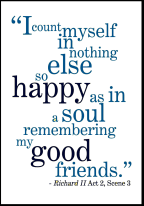
ICountMyself-FriendsI’m planning two volumes because one will feature stories set in the world of Neveyah, and the other will be random speculative short fiction pieces.

The New Year is upon us, and frankly, it’s getting off to a strange start.

Greg and I are in self-imposed quarantine because two days ago, we were exposed to Covid at close quarters.

I had planned to make an Avocado, Tomato, and Cucumber salad to take to last night’s annual New Year’s Eve party. Instead, we sat at home, watched a new episode of Vera, and watched New Year’s at the Space Needle: The Space Needle Dazzles the Pacific Northwest with Lights, Drones, and Fireworks for T-Mobile New Year’s at the Needle (yahoo.com).

The fireworks display over the Space Needle has become a Pacific Northwest tradition, and they went all out this year. The drones were amazing. I managed to stay awake long enough to watch it all.

Regardless of the plague, Greg and I enjoyed the evening. I hope your new year gets off to a great beginning. Wherever you are in this world, I wish you all the good things life can bring!

20191019_180732

8 Comments

Filed under writing