Monthly Archives: May 2024

#FineArtFriday: Gassed by John Singer Sargent 1919 #memorialday

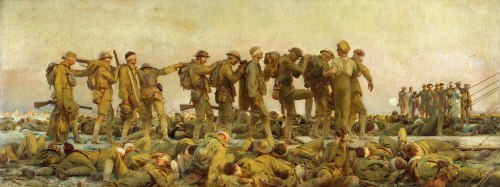
2560px-Sargent,_John_Singer_(RA)_-_Gassed_-_Google_Art_ProjectArtist: John Singer Sargent (1856–1925)

Title: Gassed

Date: 1919

Medium: oil on canvas

Dimensions: Height: 231 cm (90.9 in); Width: 611.1 cm (20 ft)

Traditionally in the US, May 30 was Decoration Day. For my father, it was a paid holiday in the middle of the week. My father would reluctantly take my grandmothers to the cemetery so they could take care of the graves of our family members, some of whom had fought in WWI, the war in which this scene was first conceived.

Dad would have preferred to go fishing. He had fought in WWII and didn’t like raking up bad memories. But it made my grandmothers happy, so he did it, despite the fact the two women didn’t really have anything else in common and had little to say to each other.

Ah, family dynamics.

Gramma Ethel and Gramma Florence were both raised in the Edwardian era and both adhered to a strict code of manners. The civility and politeness emanating from the back seat of the 1965 Chevy Impala station wagon could be overwhelming at times.

About Memorial Day from Wikipedia, the Fount of All Knowledge:

Memorial Day (originally known as Decoration Day[1]) is a federal holiday in the United States for honoring and mourning the U.S. military personnel who died while serving in the United States Armed Forces.[2] From 1868 to 1970, it was observed on May 30.[3] Since 1971, it is observed on the last Monday of May.

Many people visit cemeteries and memorials on Memorial Day to honor and mourn those who died while serving in the U.S. military. Many volunteers place American flags on the graves of military personnel in national cemeteries. Memorial Day is also considered the unofficial beginning of summer.[4]

What I love about this painting:

This painting is a deeply moving antiwar statement. John Singer Sargent was a complicated man, as most artists are. Famous as a portrait artist, he painted landscapes that conveyed a sense of mood and emotion that few of his contemporaries could match.

He was commissioned as a war artist by the British Ministry of Information. He illustrated numerous scenes from the Great War. Sargent had been affected by what he had seen while touring the front in France and by the death of his niece Rose-Marie in the shelling of the St Gervais church, Paris, on Good Friday 1918.

The colors are muted, and even the pastels are dark and dirty. The suffering of the maimed and injured men is laid bare. Through the legs of the walking wounded, the rising moon illuminates the desire of the uninjured to try to find some normalcy. Dwarfing the players and their game, the vast sea of dead and injured stretches as far as the eye can see.

Above, two tiny figures represent the clash of biplanes in the distance, the ever-moving machine of death and inhumanity that is war.

About this painting, via Wikipedia:

[1] Gassed is a very large oil painting completed in March 1919 by John Singer Sargent. It depicts the aftermath of a mustard gas attack during the First World War, with a line of wounded soldiers walking towards a dressing station. Sargent was commissioned by the British War Memorials Committee to document the war and visited the Western Front in July 1918 spending time with the Guards Division near Arras, and then with the American Expeditionary Forces near Ypres. The painting was finished in March 1919 and voted picture of the year by the Royal Academy of Arts in 1919. It is now held by the Imperial War Museum. It visited the US in 1999 for a series of retrospective exhibitions, and then from 2016 to 2018 for exhibitions commemorating the centenary of the First World War.

The painting measures 231.0 by 611.1 centimeters (7 ft 6.9 in × 20 ft 0.6 in). The composition includes a central group of eleven soldiers depicted nearly life-size. Nine wounded soldiers walk in a line, in three groups of three, along a duckboard towards a dressing station, suggested by the guy ropes to the right side of the picture. Their eyes are bandaged, blinded by the effect of the gas, so they are assisted by two medical orderlies. The line of tall, blind soldiers forms a naturalist allegorical frieze, with connotations of a religious procession. Many other dead or wounded soldiers lie around the central group, and a similar train of eight wounded, with two orderlies, advances in the background. Biplanes dogfight in the evening sky above, as a watery setting sun creates a pinkish yellow haze and burnishes the subjects with a golden light. In the background, the moon also rises, and uninjured men play association football in blue and red shirts, seemingly unconcerned at the suffering all around them.

The painting provides a powerful testimony of the effects of chemical weapons, vividly described in Wilfred Owen‘s poem Dulce et Decorum Est. Mustard gas is a persistent vesicant gas, with effects that only become apparent several hours after exposure. It attacks the skin, the eyes and the mucous membranes, causing large skin blisters, blindness, choking and vomiting. Death, although rare, can occur within two days, but suffering may be prolonged over several weeks.

Sargent’s painting refers to Bruegel’s 1568 work The Parable of the Blind, with the blind leading the blind, and it also alludes to Rodin’s Burghers of Calais.

About the Artist, via Wikipedia:

[2] John Singer Sargent (January 12, 1856 – April 14, 1925) was an American expatriate artist, considered the “leading portrait painter of his generation” for his evocations of Edwardian-era luxury. He created roughly 900 oil paintings and more than 2,000 watercolors, as well as countless sketches and charcoal drawings. His oeuvre documents worldwide travel, from Venice to the Tyrol, Corfu, the Middle East, Montana, Maine, and Florida.

Born in Florence to American parents, he was trained in Paris before moving to London, living most of his life in Europe. He enjoyed international acclaim as a portrait painter. An early submission to the Paris Salon in the 1880s, his Portrait of Madame X, was intended to consolidate his position as a society painter in Paris, but instead resulted in scandal. During the next year following the scandal, Sargent departed for England where he continued a successful career as a portrait artist.

From the beginning, Sargent’s work is characterized by remarkable technical facility, particularly in his ability to draw with a brush, which in later years inspired admiration as well as criticism for a supposed superficiality. His commissioned works were consistent with the grand manner of portraiture, while his informal studies and landscape paintings displayed a familiarity with Impressionism. In later life Sargent expressed ambivalence about the restrictions of formal portrait work, and devoted much of his energy to mural painting and working en plein air. Art historians generally ignored artists who painted royalty and “society” – such as Sargent – until the late 20th century. [2]


Credits and Attributions:

[1] Wikipedia contributors, “Gassed (painting),” Wikipedia, The Free Encyclopedia, https://en.wikipedia.org/w/index.php?title=Gassed_(painting)&oldid=1029966714 (accessed July 15, 2021).

[2] Wikipedia contributors, “John Singer Sargent,” Wikipedia, The Free Encyclopedia, https://en.wikipedia.org/w/index.php?title=John_Singer_Sargent&oldid=1032671314 (accessed July 15, 2021).

Image source: File:Sargent, John Singer (RA) – Gassed – Google Art Project.jpg – Wikipedia (accessed July 15, 2021).

2 Comments

Filed under #FineArtFriday

Revisiting the Apostrophe #writing

Some questions have been raised in an online writing group about the use and abuse of apostrophes, so I thought this would be a good day to revisit a post from February of 2019. Nothing has changed, and apostrophes remain as useful and confusing for new writers today as they were then. Hopefully, this rant will clear the murky waters of one of the English grammar’s most useful punctuations, the apostrophe.


The apostrophe has many uses, but I will only delve into the most common ways we use it in creative writing today.

comma or apostropheIn creative writing, the apostrophe is a small morsel of punctuation that, on the surface, seems simple. However, certain common applications can be confusing, so as we get to those I will try to be as concise and clear as possible.

First up, we all know that we use the apostrophe to denote possession:

  • This is George’s cat. (George owns this cat.)
  • This is Jorgensen’s cat. (A person who is going by the surname of Jorgensen owns the cat.)

Where this gets a little tricky is in the possessive form of a surname when it refers to the whole family. In this case, you insert a grammatical article (the) and make the name plural, and then add the apostrophe:

  • This is the Jorgensens’ cat. (The Jorgensen family owns the cat.)

If the Jorgensen family have a sign made for their front porch, they would have it made to read “The Jorgensens’ Home” (not “The Jorgensen’s Home,” as that would imply that only one Jorgensen lives there, and his legal name is “The Jorgensen.”)

When two or more people (or other entities such as businesses) are described as separately owning something, each name should be in the possessive form:

  • “Ralph’s and Janet’s cars are the same model.”

However, if Ralph and Janet share a possession, include an apostrophe and an s after the last name only:

  • “Ralph and Janet’s car is a Prius.”

In some cases, we need to use plurals of abbreviations. In a military thriller, you might need to say, “They disarmed several IEDs.” (We would not use an apostrophe.)

Writing a year numerically has been an area of confusion for me. This is because I rarely have had to write years in this way until recently and the use of an apostrophe for this is now considered outdated. However, this is how they should be written:

  • The tavern culture of the 1600s was flourishing. (1600’s would not be considered incorrect, just old fashioned.)
  • Dresses in the 1960s were shorter than in previous years.

An apostrophe should follow a number only if it is possessive.

  • It was 1985’s worst storm. (Some editors feel this is awkward, but I let it stand when I see it in a client’s manuscript.)

Numbers are frequently written numerically when writing books for middle grade and YA readers, as these stories often center around schools and sports.

A single digit, such as 7, is made plural with the addition of an s: 7s

Insert an apostrophe to denote possession when you must use a number to stand in for a person in an article, such as when an athlete is identified by a uniform number:

  • Number 8’s tackle won the day.

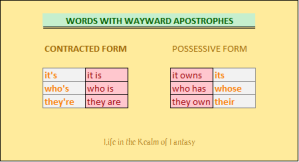
Contractions can be confusing. Two words made into one word are joined by an apostrophe:

  • Do not = don’t
  • We are = we’re
  • You are = you’re
  • They are = they’re

And so on. A list of contractions to watch for can be found at the fount of all knowledge, Wikipedia: Wikipedia: List of English contractions

Conjunctions also can be tricky.  Simply add an s, such as in the phrase “There are no ifs, ands, or buts about it” or “A list of dos and don’ts follows.” We do keep the contractive apostrophe in don’t and simply add an s to make it plural.

Sometimes a single letter looks awkward when we just use an s to indicate plurality.

  • “How many h’s do you spell shh with?” (just writing “hs” would look odd and be confusing.)

When pluralizing capital letters, we don’t use an apostrophe: Mike earned three Ds in English this year but still passed the class.

In a narrative, the two most common missions that apostrophes have are to denote possession or indicate a contraction.

  • Who’s is the contraction of “who is” or, less commonly, “who has.”
  • Whose is the possessive of “who” or, somewhat controversially, “which.”
  • Their(s) is the possessive of “they.” (They’re proud to own it, it’s theirs, and it’s not there.)
  • Its is the possessive of “it,” and “it’s” is a contraction of it is.

Note that for both they and it, there is no apostrophe in the possessive form.

  • The texture of the wall —it’s rough. (contraction: it is rough.)
  • I scratched myself on its surface. (possession: the wall’s surface.)

In most English words an apostrophe indicates possession but can also indicate a contraction. The difficulty arises in the fact that both it and they are frequently part of contracted words.

In the effort to standardize English usage, early linguists made a choice to eliminate the apostrophe in the possessive form. They did this in the (futile) hope of ending confusion.

  • It’s is the contraction of “it is” and sometimes “it has.”
  • Its denotes possession: It owns it.
  • Their: they own it
  • They’re: they are

As with so many things that “seemed like a good idea at the time,” its and it’s will always cause problems for new and beginning writers. Inadvertent misuse happens even for old hands like me when I’m zipping along laying down the first draft of a manuscript.

We have to be vigilant and ensure we have looked for proper usage of its and it’s during revisions. Even the big traditional publishing houses admit sneaky errors like those like to go unnoticed until after publication.

In closing, the most common uses of the apostrophe aren’t too difficult once we learn the rules. Remember, apostrophes are integral parts of the traffic control system, signals that keep your words moving along at the right rate. Using them the way they are intended (and which readers expect) keeps the reader from throwing your book away.

I always suggest you set some time aside for writing new words every day, even if only for fifteen minutes. When we force ourselves to think about and use the basic rules of grammar regularly, we retain what we have learned.


This post first appeared on Life in the Realm of Fantasy on 13 Feb 2019 as The Apostrophe. https://conniejjasperson.com/2019/02/13/the-apostrophe-amwriting/

1 Comment

Filed under writing

#FineArtFriday: a second look at Monet Painting in His Garden by Pierre-Auguste Renoir 1873

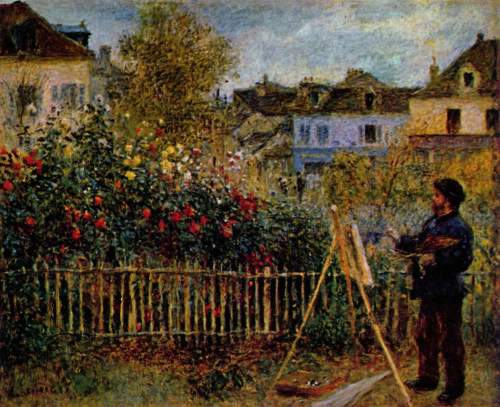
Monet Painting in His Garden by Pierre-Auguste Renoir

Date: 1873

Medium: oil on canvas

Dimensions : Height: 46 cm (18.1 in); Width: 60 cm (23.6 in)

Collection: Wadsworth Atheneum Museum of Art

What I love about this painting:

Renoir shows us that Claude Monet’s Garden is lush and a little wild, like the man who owns it. Yet, although he is the subject of this painting, Monet is completely focused on his work. The colors are vivid, and I would love to spend time in this untamed garden, a place of vivid color and intense life. One can almost hear the humming of bees and the calls of birds as they jockey for the best nesting spots.

Renoir visited his good friend many times during the years Monet lived at Argenteuil, a village on the right bank of the Seine River near Paris. In 1873, Monet purchased a small boat equipped to be used as a floating studio, which must have been a draw for Renoir and his friends.

About the artist (via Wikipedia):

In 1862, Auguste Renoir began studying art under Charles Gleyre in Paris. There he met Alfred SisleyFrédéric Bazille, and Claude Monet.  At times, during the 1860s, he did not have enough money to buy paint. Renoir had his first success at the Salon of 1868 with his painting Lise with a Parasol (1867), which depicted Lise Tréhot, his lover at the time. Although Renoir first started exhibiting paintings at the Paris Salon in 1864, recognition was slow in coming, partly as a result of the turmoil of the Franco-Prussian War.

Renoir was inspired by the style and subject matter of previous modern painters Camille Pissarro and Edouard Manet. After a series of rejections by the Salon juries, he joined forces with Monet, Sisley, Pissarro, and several other artists to mount the first Impressionist exhibition in April 1874, in which Renoir displayed six paintings. Although the critical response to the exhibition was largely unfavorable, Renoir’s work was comparatively well received.  That same year, two of his works were shown with Durand-Ruel in London.  [1]


Credits and Attributions:

Monet Painting in His Garden by Pierre-Auguste Renoir / Public domain

[1] Wikipedia contributors, “Pierre-Auguste Renoir,” Wikipedia, The Free Encyclopedia, https://en.wikipedia.org/w/index.php?title=Pierre-Auguste_Renoir&oldid=949963500 (accessed May 19, 2024).

Wikimedia Commons contributors, “File:Renoir-Monet painting.png,” Wikimedia Commons, the free media repository, https://commons.wikimedia.org/w/index.php?title=File:Renoir-Monet_painting.png&oldid=338421916 (accessed May 19, 2024).

3 Comments

Filed under #FineArtFriday

English – a Language Full of Bothersome Words #writing

I love words. I love the way they rhyme, the way they sound, and the way they feel when they roll off the tongue of a gifted narrator. I love words that sound alike but mean different things, words that describe colors, smells, and sounds.

I love words.

MyWritingLife2021The English language is full of words that mean the same as other words. Even common names are like that. For instance, “Jones” is a surname of Welsh origin that dates back to the Middle Ages. It means “John’s son.” So, Jones is Welsh for Johnson, and the two usages evolved on the same island.

Who knew? Jones seems so dissimilar to Johnson that I (an American) would never have guessed.

In a strange twist of irony, English is also full of words that sound nearly alike and look very similar but mean very different things. Even though many of these words are often used interchangeably in casual conversation, they are NOT alike or similar in meaning.

I always notice when an author confuses near-homophones. That is the technical term for words that sound closely alike, are spelled differently, and have different meanings. When we read widely, we’re more likely to notice the difference between words like accept and except when they are written.

wordsThe different meanings of seldom-used sound-alike words can become blurred among people who have little time to read. They don’t see how a word is written, so they speak it the way they hear it. This is how wrong usage becomes part of everyday English.
For this reason, new and beginning writers often don’t realize the ways in which they habitually misuse common words until they begin to see the differences in how they are written.

Let’s look at two of the most commonly confused words: accept and except. People, even those with some higher education, frequently mix these two words up in their casual conversation.

Accept (definition) to take or receive (something offered); receive with approval or favor.

  • I accept this award.
  • We should accept this proposal.

Except (definition) not including, other than, leave out, exclude.

  • We’re old, present company excepted.
  • Everyone is welcome, with the exclusion of drunks and other miscreants.

Used together in one sentence, they look like this:

We accept that our employees work every day except Sunday.

The following quote is one I have used before, but it’s a good one, so I’ll just repeat myself here.

Farther vs. Further: (Grammar Tips from a Thirty-Eight-Year-Old with an English Degree | The New Yorker by Reuven Perlman, posted February 25, 2021:

Farther describes literal distance; further describes abstract distance. Let’s look at some examples:

  • I’ve tried the whole “new city” thing, each time moving farther away from my hometown, but I can’t move away from . . . myself (if that makes sense?).

  • How is it possible that I’m further from accomplishing my goals now than I was five years ago? Maybe it’s time to change goals? [1]

Consider these three very different words:

  • Ensure
  • Insure
  • Assure

Ensure: When we use these sound-alike words, we want to ensure (make certain something happens) that we are using them correctly.

ozford-american-writers-thesaurusInsure: We insure our home and auto. In other words, we arrange for compensation in the event of damage or loss of property or the injury to (or the death of) someone. We arrange for compensation should the family breadwinner die (life insurance). Also, we arrange to pay in advance for medical care we may need in the future (health insurance).
Assure: We assure our listeners that everything is correct. In other words, we explain things in a way that dispels any doubts our listeners may have. If we have to, we reassure them by explaining it twice.

It never hurts to have a wide vocabulary, but we must know the meaning and correct uses of words. For the moment, let’s not worry about grandiose (magnificent, complex, ostentatious, pretentious) words that only inflate our prose. We who write must learn how to use all our words accurately and in a context that says what we mean.

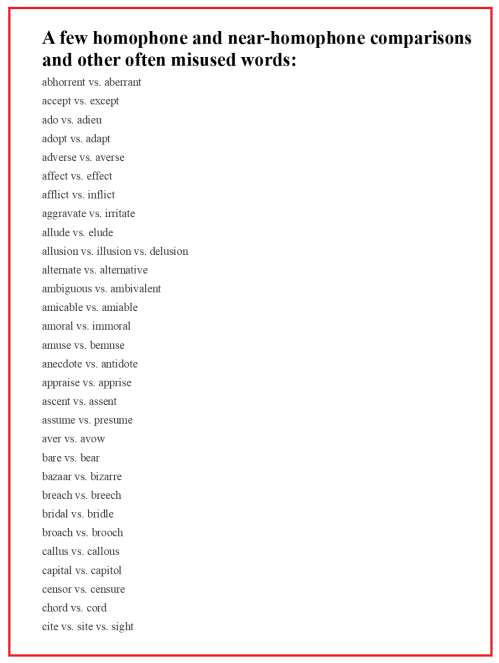
The words listed in the following image are often used interchangeably in common speech, and while it may sound normal when your friend says persecute when she means prosecute, incorrect usage conveys the wrong meaning.

Homophones and near homophones

I think it helps if a writer is also a poet. When writing a narrative, we have room for a lot more words, which can lead to inflated prose. But when writing poetry, we must do more with less, so the words we choose must have a visual, sensory impact.

Isn’t that what we hope to achieve with all our work?

I have one manuscript in the final revision stage and am working on shrinking the prose while conveying the story. The real struggle for me is achieving uninflated yet visual prose.

oxford_synonym_antonymI have a lot of words to choose from, and the Oxford Dictionary of Synonyms and Antonyms to help me out. It’s full to overflowing with lovely, visual, sensory words, and like an addict, I have the urge to use them all.
But I won’t. Today, I will write lean, descriptive prose. If I don’t, my editor will ensure that I pare the fluff down.

Discipline feels good.


Credits and Attributions:

[1] Farther vs. Further: (Grammar Tips from a Thirty-Eight-Year-Old with an English Degree | The New Yorker by Reuven Perlman, posted February 25, 2021 (accessed 18 May 2024).

5 Comments

Filed under writing

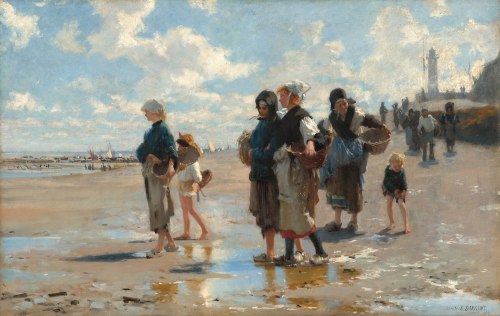
#FineArtFriday – Fishing for Oysters at Cancale by John Singer Sargent 1878

2560px-John_Singer_Sargent_-_CancaleArtist: John Singer Sargent (1856–1925)

Title: En route pour la pêche (Setting Out to Fish) Fishing for Oysters at Cancale

Date: 1878

Medium: oil on canvas

Dimensions: height: 77 cm (30.3 in); width: 121.6 cm (47.8 in)

Inscription: Signed and Dated: John S. Sargent Paris 1878

Collection: National Gallery of Art

What I love about this picture:

This is a perfect summer day, a good day to be out near the water. John Singer Sargent was a complicated man, as most artists are. Famous as a portrait artist, he painted landscapes that conveyed a sense of mood and emotion that few of his contemporaries could match. One of Sargent’s great skills was the ability to convey the sensory impressions of an environment.

He found beauty and drama in the lives of ordinary people and showed his characters outdoors in all the seasons. His paintings of working-class people didn’t romanticize how they dressed, conveyed their moods. Sargent showed the environment they lived and worked in, no matter how good or bad the weather.

Sargent had a gift for painting rare and expensive fabrics, yet no one is dressed in finery in this painting. On the contrary, the women are dressed in shabby clothes that protect them from the sun and salty wind, garments that have seen a great deal of wear. The children are bare-legged and barefoot, while the fishers wear clogs. These women carry baskets and the hope that they will find enough oysters and other shellfish to not only feed their family but have plenty to sell to the fishmonger.

About this picture via MFA Boston: Sargent’s choice of subject was not revolutionary – a similar scene of oyster harvesters had previously won a medal at the Salon. However, his ability to paint the reflections in the tidal pools and the light sparkling on the figures and clouds dazzled viewers, clearly demonstrating that his talents extended beyond portraiture. [1]

About the artist, via Wikipedia:

John Singer Sargent (January 12, 1856 – April 14, 1925) was an American expatriate artist, considered the “leading portrait painter of his generation” for his evocations of Edwardian-era luxury. He created roughly 900 oil paintings and more than 2,000 watercolors, as well as countless sketches and charcoal drawings. His oeuvre documents worldwide travel, from Venice to the TyrolCorfu, Spain, the Middle East, MontanaMaine, and Florida.

Born in Florence to American parents, he was trained in Paris before moving to London, living most of his life in Europe. He enjoyed international acclaim as a portrait painter. An early submission to the Paris Salon in the 1880s, his Portrait of Madame X, was intended to consolidate his position as a society painter in Paris but instead resulted in scandal. During the year following the scandal, Sargent departed for England, where he continued a successful career as a portrait artist.

From the beginning, Sargent’s work is characterized by remarkable technical facility, particularly in his ability to draw with a brush, which in later years inspired admiration as well as criticism for its supposed superficiality. His commissioned works were consistent with the grand manner of portraiture, while his informal studies and landscape paintings displayed a familiarity with Impressionism. In later life, Sargent expressed ambivalence about the restrictions of formal portrait work and devoted much of his energy to mural painting and working en plein air. Art historians generally ignored society artists such as Sargent until the late 20th century.

The exhibition in the 1980s of Sargent’s previously hidden male nudes served to spark a reevaluation of his life and work, and its psychological complexity. In addition to the beauty, sensation and innovation of his oeuvre, his same-sex interests, unconventional friendships with women and engagement with race, gender nonconformity and emerging globalism are now viewed as socially and aesthetically progressive and radical.


Credits and Attributions:

[1] Quote: MFABoston contributors, Fishing for Oysters at Cancale – Works – Museum of Fine Arts, Boston (mfa.org) (accessed May 12, 2024).

[2] Wikipedia contributors, “John Singer Sargent,” Wikipedia, The Free Encyclopedia, https://en.wikipedia.org/w/index.php?title=John_Singer_Sargent&oldid=1223504088 (accessed May 12, 2024).

Comments Off on #FineArtFriday – Fishing for Oysters at Cancale by John Singer Sargent 1878

Filed under #FineArtFriday

#Writing for an Anthology

Once a writer has been bitten by the publishing bug, they begin to seek out publications with open calls and submit their work. Anthologies proposed by various independent writing groups are often the first door that opens to a new author.

WritingCraft_short-storyWriting groups can be quite different in their areas of focus. Some are critique groups, and some are more support groups. No matter what the group focuses on in its meetings, the anthology is meant to showcase that group’s professionalism.
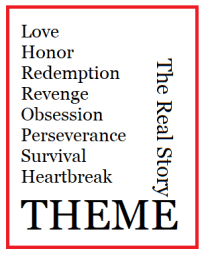
Certain elements will be required of each entry, no matter what genre or theme has been chosen to tie the anthology together.

The story must embody the desired theme, and the editors want the most creative work they can find.

No one wants to publish junk.

I always have a member of my writing group read my work first, acting as a beta reader. Their comments help ensure that my story hits all the marks.

We’re all readers, and we gravitate to specific genres and themes. When the stories are all in the same genre and explore a common theme, the readers who purchase the anthology will most likely stay with the book until the end. They will read and enjoy your work, even if it is featured toward the end of the volume.

Some editors post calls stating, “We want your best work.” What do they mean by that?

theRealStoryLIRF01102021“Your best work” gets off to a great start when the story is written with the central theme of the anthology in mind, a central facet of the story.
A well-planned anthology will contain stories in the same genre and theme but unique, with a wide range of plots and characters. Without a unifying theme, you have a patchwork of disparate tales by random authors. The unifying theme ensures continuity.

All the characters must have fully developed arcs. How does this theme affect the protagonist?

How does the theme drive the story? The story arc must be coherent and logical, with a fully developed beginning, middle, and end. The theme binds everything together.

World building is critical in a short story, so the setting must be clearly shown.

As I mentioned above, a beta reader is critical to ensure all plot holes have been identified and resolved in a way that will satisfy the reader.

Finally, I suggest you let it sit for a few days and then read it aloud to proofread it before submission.

Literary themes, by nature, are common to most stories. The most challenging aspect of this is to think of a unique approach a story that has been told since the dawn of time.

Let’s say we want to submit a story to an imaginary anthology with a theme of facing reality. The working title of the book will be Reality Bites. The genre is sci-fi and the word count limit for each submission is 1500 words, so we have to tell what happened using words with the most impact and do it in a very short space.

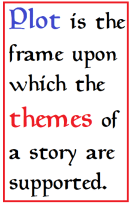
plot is the frame upon which the themes of a story are supportedThe editors have said that one can face the reality of the past, present, or future—it’s up to each author to write their story. We must find ways to layer that theme into the character arcs, plot, and world building.
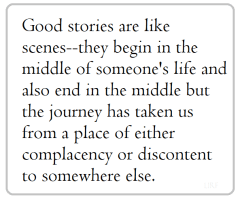
When you sit down to write the first draft of a story meant for a themed anthology, ask several questions of it:

  • What is the inciting incident? How does it relate to the specified theme?
  • What is the goal/objective, the quest the characters must complete? How does it relate to the theme?
  • Have you stayed within the maximum word count? If the guidelines say no more than 1500 words per entry, that is what they mean. Failure to comply will result in rejection.

Once you have edited the piece to the best of your ability, you must format your manuscript for submission according to the guidelines set out by the anthology’s editor.

For most anthologies, editors want the work formatted according to the guidelines as described by William Shunn. Those guidelines are the overall publishing industry standard for submissions and can be found in detail at this website: Classic Manuscript Format | William Shunn

good_stories_LIRFmemeBasically, his guidelines say you must use Times New Roman (or sometimes Courier) .12 font. You must also ensure your manuscript is formatted as follows:
  • It is aligned left (NOT justified).
  • It has 1 in. margins on all sides.
  • Page numbers are in the upper right.
  • It is double-spaced (to allow room for the editor’s comments).
  • The body of the story has formatted indented paragraphs (NOT indents made by hitting the TAB key, as that screws up everything when the manuscript is uploaded to a digital format).
  • The header contains the title and author name—UNLESS otherwise specified.
  • The first page contains the author’s mailing address and contact information in the upper left-hand corner—unless otherwise specified.

If the group with an open call for an anthology has a Facebook page or private chatroom, the formatting guidelines will be posted there.

Sometimes, we find out at the last minute that an opportunity to get a piece into an anthology is open. Some folks might think they can cobble a piece together in a day or two.

I advise against succumbing to this temptation, as it is rare that “best work” emerges when a story is slapped together. Rushing things makes it hard to avoid proofing errors.

steampunk had holding pen smallThe editor of the anthology has posted a public call for the best work that authors can provide, and they will receive a landslide of submissions. They will receive far more stories than they will have room for, and the majority of them will be memorable, wonderful stories.
All but the most outstanding of these great stories will not make the cut because the book will have a total word count limit of around 80,000 words to keep production costs down. Only the best of the best will be accepted.

This is good because you want your work to be included with the best the industry has to offer.

Do NOT rush it. You have a great idea for what could be the best story you have ever written.

Take the time to do it right. Remember, anything you submit to a prospective editor represents you and what you are capable of.

Comments Off on #Writing for an Anthology

Filed under writing

#FineArtFriday: The Pedlar, closed state of The Hay Wain by Hieronymus Bosch ca. 1500

The_Pedlar,_closed_state_of_The_Hay_Wain_by_Hieronymus_BoschArtist: Hieronymus Bosch  (circa 1450–1516)
Title: The Pedlar, Part of The Haywain Tryptich

Genre: religious art Edit this at Wikidata

Date: circa 1500

Medium: oil on panel

Dimensions: height: 147.1 cm (57.9 in)

Collection: Museo del Prado

What I like about this painting:

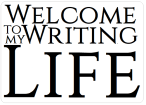
Hieronymus Bosch tells a story in this scene that is the cover of an altar piece. We see a wayfarer walking a path that winds through dangerous territory. Thieves and murderers and carnal temptations tempt him to stop a while, but he keeps walking.

The hound of hell snaps at his heels as he keeps to the path and he shoves it behind him as he passes the bones of the fallen.

Bosch’s most famous altar pieces were quite graphic, gory even, depicting the prevailing 15th century idea of Hell. He painted his vision of what a sinner would face if one didn’t keep to the straight and narrow path of morality and righteousness.

About this painting, via Wikipedia:

The Haywain Triptych is a panel painting by Hieronymus Bosch, now in the Museo del Prado, Madrid, Spain. A date of around 1516 has been established by means of dendrochronological research. The central panel, signed “Jheronimus Bosch”, measures 135 cm × 200 cm (53 in × 79 in) and the wings measure 147 cm × 66 cm (58 in × 26 in). The outside shutters feature a version of Bosch’s The Wayfarer.

The exterior of the shutters, like most contemporary Netherlandish triptychs, was also painted, although in this case Bosch used full colors instead of the usual grisaille. When closed, they form a single scene depicting a wayfarer. Around him is a series of miniatures including the robbery of another wayfarer and a hanged man. The man uses a stick to repel a dog.

According to the most recent interpretations, this figure may represent the man who follows his road in spite of the temptation of sins (such as lust, perhaps symbolized by the two dancing shepherds) and the evil acts occurring around him.[1]

About the Artist, via Wikipedia:

Little is known of Bosch’s life, though there are some records. He spent most of it in the town of ‘s-Hertogenbosch, where he was born in his grandfather’s house. The roots of his forefathers are in Nijmegen and Aachen (which is visible in his surname: Van Aken). His pessimistic fantastical style cast a wide influence on northern art of the 16th century, with Pieter Bruegel the Elder being his best-known follower.

Today, Bosch is seen as a highly individualistic painter with deep insight into humanity’s desires and deepest fears. Attribution has been especially difficult; today only about 25 paintings are confidently given to his hand along with eight drawings. About another half-dozen paintings are confidently attributed to his workshop. His most acclaimed works consist of a few triptych altarpieces, including The Garden of Earthly Delights. [2]


Credits and Attributions:

IMAGE: Wikimedia Commons contributors, “File:The Pedlar, closed state of The Hay Wain by Hieronymus Bosch.jpg,” Wikimedia Commons, https://commons.wikimedia.org/w/index.php?title=File:The_Pedlar,_closed_state_of_The_Hay_Wain_by_Hieronymus_Bosch.jpg&oldid=618864212 (accessed May 4, 2024).

[1] Wikipedia contributors, “The Haywain Triptych,” Wikipedia, The Free Encyclopedia, https://en.wikipedia.org/w/index.php?title=The_Haywain_Triptych&oldid=1221796985 (accessed May 4, 2024).

[2] Wikipedia contributors, “Hieronymus Bosch,” Wikipedia, The Free Encyclopedia, https://en.wikipedia.org/w/index.php?title=Hieronymus_Bosch&oldid=1215179336 (accessed May 4, 2024).

2 Comments

Filed under #FineArtFriday

When life hands you lemmings #writing #Parkinsons

Forget the lemons—anyone can make lemonade. Lemons arrive one or two at a time.

Lemmings arrive in droves.

MyWritingLife2021BWhen your spouse has Parkinson’s, problems tend to arrive en masse, like an unstoppable horde of lemmings. Dealing with life’s lemmings requires a bit more creativity than merely making a cool, relaxing drink. While you may never gain control of the migrating mob, you must somehow steer them in the right direction.
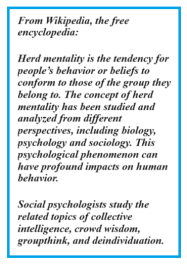
Lemmings are interesting little creatures who sometimes migrate collectively—herds of cute, furry rodents naïvely leaving home in search of better pastures. And just like the historical myths about wolves, the lore about them contains as much misinformation and downright cruelty as it does truth.

Herd_Mentality_1Wikipedia says:

Lemmings have become the subject of a widely popular misconception that they are driven to commit mass suicide when they migrate by jumping off cliffs. It is not a deliberate mass suicide, in which animals voluntarily choose to die, but rather a result of their migratory behavior. Driven by strong biological urges, some species of lemmings may migrate in large groups when population density becomes too great. They can swim and may choose to cross a body of water in search of a new habitat. In such cases, many drown if the body of water is an ocean or is so wide as to exceed their physical capabilities. Thus, the unexplained fluctuations in the population of Norwegian lemmings, and perhaps a small amount of semantic confusion (suicide not being limited to voluntary deliberation, but also the result of foolishness), helped give rise to the popular stereotype of the suicidal lemmings, particularly after this behaviour was staged in the Walt Disney documentary White Wilderness in 1958.

The misconception itself is much older, dating back to at least the late 19th century. In the August 1877 issue of Popular Science Monthly, apparently suicidal lemmings are presumed to be swimming the Atlantic Ocean in search of the submerged continent of Lemuria. [1]

Thus, some 19th-century scientists were quite imaginative as storytellers and got their fantasy stories published that way. If only it was so easy today!

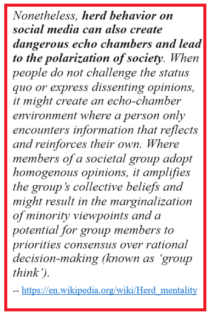
herd_mentalityBut back to the lemmings. We know how mob mentality works in humans, and it seems to happen in other creatures.

Events in life sometimes occur the way that an unsafe crowd surge at a concert does. Events and incidents pile up and press you, requiring more time and attention than one person has available. I suspect that sometimes, the unfortunate lemmings in the front of the pack are inadvertently shoved into danger by the unstoppable crush of the crowd behind them, and the rest follow, unaware of their peril.

For the caregiver, living with Parkinson’s is like that. It’s difficult to watch someone you love experience a series of declines that you are helpless to avert. Incidents happen that must be handled, and everything takes twice as long as we think it should.

When it’s all-hands-on-deck, everything else gets kicked to one side.

Here at Casa del Jasperson, giving my husband the assistance he needs has become a lot more involved than it was a year ago. Rising above the landslide of suggestions and well-meaning advice from friends and acquaintances that has become a buzz of white noise, I frequently hear the mantra, “Take care of yourself too.”

Sure. Thank you for that observation. Self-care is easier said than done, but lightening my commitment load will help.

medical symbolTwo weeks ago, my husband fell, sustaining a minor injury. Two days later, he was fighting off an infection, and we spent last Saturday in Urgent Care from 8:00 am to 7:00 pm. Rather than put him in the hospital, we were given the chance to participate in the “Hospital at Home” program.

Hospital-at-home enables some patients who need acute-level care to receive care in their homes rather than in a hospital. This program reduces costs, improves outcomes, and is much easier on the patient. So, we were at home, but he was on intravenous antibiotics, and nurses came and went with comforting regularity.

Thus, I didn’t have time to write my posts in advance the way I usually do. Wednesday and Friday’s posts were great examples of what happens when I rush to get a post up on schedule. I corrected the problems as soon as they were pointed out, but I’d prefer to not have to do that.

virtually golden medallion of mayhem copyNo one is perfect, but I like to do my best work. I’ll admit that publishing a post discussing a picture but with no image of that art piece is a humorous blooper. We did get a laugh out of it.

But it’s not “best” work.

Greg is now on the mend and slowly regaining the ground that he lost. His strength is gradually returning, and he is suffering fewer moments of confusion.

In the meantime, Life in the Realm of Fantasy is trimming back to two posts a week instead of three.

On Mondays, we will discuss the craft of writing and how it fits into my life. Sometimes, we’ll talk about the books I’m reading, and sometimes we’ll interview friends about their books.

On Fridays, I will share the images I find on Wikimedia Commons and talk about what I like about that painting or photograph.

8ce052b8e7c8182a51dc4999859c1061I try to write my posts on Saturdays and proof them on Sundays, so having only two to deal with will allow me time to proofread them and work on my other creative writing projects.

And so, my friends, I’ll see you next on Friday, when I feature an example of the mad, fantastic art of Hieronymus Bosch.


Credits and Attributions

[1] Wikipedia contributors, “Lemming,” Wikipedia, The Free Encyclopedia, https://en.wikipedia.org/w/index.php?title=Lemming&oldid=1221843458 (accessed May 3, 2024).

6 Comments

Filed under writing

#FineArtFriday: Bavarian Landscape by Albert Bierstadt

Bierstadt_Albert_Bavarian_LandscapeArtist: Albert Bierstadt  (1830–1902)

Title: Bavarian Landscape

Genre: landscape art

Date: possibly between 1853 and 1857

What I love about this painting:

Albert Bierstadt is one of my favorite artists. He loved the power of nature. His colors are strong, and he employs contrast to good effect. In this painting of cattle in a field, he manages to make even the simplest scene feel epic.

This is one of his earlier works, but the sky is pure Bierstadt—immense, powerful, the vaults of heaven reigning over the world below.

We see a lush, fertile farm with healthy cattle in the foreground. The dark clouds in the distance tell us a summer storm looms, but for us, the sun still shines overhead.

About the artist, via Wikipedia:

Albert Bierstadt (January 7, 1830 – February 18, 1902) was a German American painter best known for his lavish, sweeping landscapes of the American West. He joined several journeys of the Westward Expansion to paint the scenes. He was not the first artist to record the sites, but he was the foremost painter of them for the remainder of the 19th century.

Bierstadt was born in Prussia, but his family moved to the United States when he was one year old. He returned to study painting for several years in Düsseldorf. He became part of the second generation of the Hudson River School in New York, an informal group of like-minded painters who started painting along the Hudson River. Their style was based on carefully detailed paintings with romantic, almost glowing lighting, sometimes called luminism. Bierstadt was an important interpreter of the western landscape, and he is also grouped with the Rocky Mountain School.

In 1851, Bierstadt began to paint in oils. He returned to Germany in 1853 and studied painting for several years in Düsseldorf with members of its informal school of painting. After returning to New Bedford in 1857, he taught drawing and painting briefly before devoting himself full-time to painting.

Bierstadt’s popularity in the U.S. remained strong during his European tour. The publicity generated by his Yosemite Valley paintings in 1868 led a number of explorers to request his presence as part of their westward expeditions. The Atchison, Topeka, and Santa Fe Railroad also commissioned him to visit and paint the Grand Canyon and surrounding region.

Despite his popular success, Bierstadt was criticized by some contemporaries for the romanticism evident in his choice of subjects and for his use of light, which they found excessive.

Some critics objected to Bierstadt’s paintings of Native Americans based on their belief that including Indigenous Americans “marred” the “impression of solitary grandeur.”


Credits and Attributions:

IMAGE: Wikimedia Commons contributors, “File:Bierstadt Albert Bavarian Landscape.jpg,” Wikimedia Commons, https://commons.wikimedia.org/w/index.php?title=File:Bierstadt_Albert_Bavarian_Landscape.jpg&oldid=823443562 (accessed May 2, 2024).

Comments Off on #FineArtFriday: Bavarian Landscape by Albert Bierstadt

Filed under #FineArtFriday

Active prose #writing

Verbs are the engines that power our prose. They can push the action outward from their nouns or pull it back inward. Verbs show the action but have shades of mood and tone.

Verbs there is no tryWhen I am writing poetry, I look for words that contrast vividly against each other. I choose action words that begin with hard consonants and emotion words that begin with softer sounds.

If I can do this for poetry, I should be able to do this for narrative prose. Unfortunately, my poetic brain goes on vacation when I am trying to write a first draft.

Writing the first draft is difficult enough, but when that draft is finished, the real work begins. At that point, I must turn a choppy mess of a manuscript into something worth reading. There will be good passages, but they are interspersed with bald statements of action and response.

This stage of the process involves working on several layers:

  • prose
  • plot
  • character arc

So, besides ironing out plot holes, beefing up scene transitions, and fine-tuning character arcs, I must focus on the prose. I must use my words as creatively as possible to show the most with the least.

oxford_dictionaryVerb choices and the use of contrast in descriptors are crucial at this stage.
Power verbs push the action outward from a character. Other verbs pull the action inward. The two forces, push and pull, create a sense of opposition and friction. Dynamism in word choices injects a passage with vitality, vigor, and energy.

When we employ verbs that push the action outward from a character, we make them appear authoritative, competent, energetic, and decisive.

Conversely, verbs that pull the action in toward the character make them appear receptive, attentive, private, and flexible.

Concise writing can be difficult for those of us who love words in all their glory. So, I must use action words to set the mood. To do that, I must use contrasts.

  • dwell on / ignore
  • embrace / reject
  • consent / refuse
  • agony / ecstasy

A part of my life was burned away. I was destroyed, but now I was reborn in ways I’d never foreseen.

My action words are burn, destroy, and birth. The above character’s entire arc is encapsulated in those three words. In the opening pages, his verbs are darker, his actions more inward, and his demeanor sometimes brooding.

ozford american writers thesaurusAt the end of his story, events and interactions have changed him despite his wish for a calm life. His journey through the darkness brings about a renaissance, a flowering of the spirit.

Many power words begin with hard consonants. The following is a short list of nouns and adjectives that start with the letter B. The images they convey when used to describe action project a feeling of power:

  • Backlash
  • Beating
  • Beware
  • Blinded (adjective)
  • Blood
  • Bloodbath
  • Bloodcurdling (adjective)
  • Bloody (adjective)
  • Blunder

Some of the nouns are also verbs, such as beating or blunder.

When things get tricky, and the characters are working their way through a problem, verbs like stumble and blunder offer a sense of chaos and don’t require a lot of modifiers to show the atmosphere.

When you incorporate any of the above “B” words into your prose, you are posting a road sign for the reader, a notice that ahead lies danger.

Quill_pen smallIf I want to create an atmosphere of anxiety, I would use words that push the action outward:
  • Agony (noun)
  • Apocalypse (noun)
  • Armageddon (noun)
  • Assault (verb)
  • Backlash (noun)
  • Pale (modifier)
  • Panic (verb or noun)
  • Target (verb)
  • Teeter (verb)
  • Terrorize (verb)

If I want to show the interior workings of a character without resorting to a dump of italicized whining, I could write their internal observations using words that draw us in:

  • Delirious (modifier)
  • Depraved (modifier)
  • Desire (verb)
  • Dirty (modifier)
  • Divine (modifier)
  • Ecstatic (modifier)

So why are verbs so crucial in shaping the tone and atmosphere of a narrative?

Think about this sentence: Selwyn walked away.

We have three words indicating someone has departed, but they don’t show his mood.

Selwyn is a person (noun). He performs an action (verb).

steampunk had holding pen smallThat action affects both Selwyn and his objective: leaving. Away is an adverb (modifier) denoting distance from a particular person, place, or thing. It modifies the verb, giving Selwyn a direction in which to go.

We can write it several different ways still using only three words, and each indicates that Selwyn has left the scene. Each time we substitute a synonym for the word walked, we change the atmosphere of that scene.

  • Selwyn sauntered away. (He departed in a carefree, leisurely manner.)
  • Selwyn strode away. (He walked decisively in a particular direction.)
  • Selwyn stomped away. (Selwyn left the scene in a bad mood.)
  • Selwyn ambled away. (He walked slowly.)
  • Selwyn slogged away. (He departed but had to work at it.)
  • Selwyn slipped away. (Selwyn departed in a stealthy manner.)

Many verbs cannot impact a character or object directly. These are called intransitive verbs. They are as crucial as transitive verbs because they show a mood or condition, a state of being, or a reflex (automatic response).

Consider the word “mope.” Mope is an intransitive verb that means discouraged and apathetic. It’s an action word that goes nowhere.

  • Selwyn moped. (He was dejected and apathetic.) (Boring.)

We can have our character in a bad mood but with variations:

  • Selwyn pouted. (He was whiney, and we don’t want to read anything more about him.)
  • Selwyn languished. (He did nothing and stagnated, and we still don’t care.)
  • Selwyn sulked. (He was angry and self-pitying, and we will close the book on him.)
  • Selwyn fretted. (He was in a neurotic mood, and we tell our friends the book sucks.)

Some intransitive verbs in the family of “mope” are more robust and carry greater force:

  • Brood (a dark, obsessive mood.)
  • (Obsessively thinking about it, suffering.)

We can perk Selwyn up when we add a strong intransitive verb to a powerful transitive verb. Then, we have action and mood:

  • Selwyn strode away, brooding. (He left the scene, and someone will suffer.)

So, verbs and nouns must have modifiers and connectors to show a scene in the most visual and evocative way possible.

oxford_synonym_antonymThe trick is to choose the descriptors and the verb forms that have the most impact. The selection of modifiers and connecting verbs can enhance contrasts or weaken a sentence.

Making revisions is a lot of work. But taking the time to examine the layers of plot, prose, and character arc is required to take your manuscript from first draft to finished novel.

I suggest keeping a thesaurus on hand. I also have a dictionary of synonyms and antonyms because I want my words to say what I envision. Having a list of word forms and their synonyms enables me to express my ideas with fewer modifiers.

2 Comments

Filed under writing