
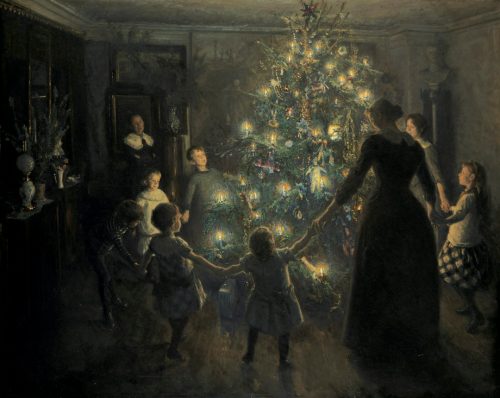
Artist: Viggo Johansen (1851–1935)
Title : Joyful Christmas (Danish: Glade jul)
Date: 1891
Medium: canvas and oil
Dimensions Height: 127.2 cm (50 in); Width: 158.5 cm (62.4 in)
December is here and the season of Christmas decorating has begun. I’ve made a trip to the storage unit for a few decorations but will have to go again. Our apartment is small, but the tiny tree and lights make the whole place feel festive during the darkest month of winter.
There is so much wonderful Christmas art out there. I wanted to take a second look at a painting that reflects a historical view of how the holiday was celebrated before it became a commercial windfall for the large department stores and big-box warehouse stores.
This painting first appeared here in December of 2020.
What I love about this painting:
This is an atmospheric depiction of the artist’s family, singing carols on Christmas Eve, 1891. The only light in the room is provided by the many candles on the tree. This is a homey, nostalgic piece showing not just a moment in time, but the warm feeling of tradition in an era when the giving and receiving of lavish presents was not the primary focus of the holiday. Instead, families celebrated with a small feast, and songs and games. Some families would have a tree such as the one in this painting, and many people would decorate doors and windows with holly and other evergreens.
Whether a family was deeply religious or not, the day was time to give thanks for their blessings and pray for a bountiful new year ahead.
Both of my grandmothers were born during the time this painting was made. Fire was a real hazard in those days, and neither of my grandparents’ families had candles on their trees. Instead, foil decorations, cut-paper snowflakes, and chains of popcorn and cranberries made their trees bright.
My maternal grandmother was one of fifteen children. They were a close-knit family, and not rich in any sense of the word. Christmas was always her favorite holiday, and she always went out of her way to make special treats for the big day. Grandma Ethel shaped my view of the world in many ways. I always make her special date nut bread and jam tarts, a Christmas tradition that connects our family through the generations and across time.
About this painting. Via Wikipedia:
From 1885, he (Viggo Johansen) exhibited in Paris; there he was inspired by Claude Monet, particularly in his use of colour as can be seen in his painting Christian Bindslev er syg (Christian Bindslev is ill, 1890), which also shows the influence of Christian Krohg, one of the other Skagen painters. After his return from Paris, his paintings took on lighter tones; he had noted the absence of black in the works of the French artists and considered his own earlier works too dark by comparison. Nevertheless, Johansen is remembered particularly for the subdued lighting effects of his interiors — many of which were painted after his visit to Paris — as in his Glade jul (Merry Christmas, 1891) According to Gauguin visited Skagen while Johansen was painting Merry Christmas and tried to encourage him to make the tree brighter, even going as far as to produce a pastel drawing to convey the idea, but Johansen “did not think there was much sense in what he sketched.”
About the Artist, via Wikipedia
Viggo Johansen (3 January 1851 – 18 December 1935) was a Danish painter and active member of the group of Skagen Painters who met every summer in the north of Jutland. He was one of Denmark’s most prominent painters in the 1890s. He also painted landscapes (at Skagen, at Tisvilde, and at his childhood home, the fishing port of Dragør outside Copenhagen), still lifes and portraits.
Credits and Attributions:
Wikipedia contributors, “Viggo Johansen,” Wikipedia, The Free Encyclopedia, https://en.wikipedia.org/w/index.php?title=Viggo_Johansen&oldid=938475993 (accessed December 20, 2020).


 Life in the Realm of Fantasy
The use of light and shadow really sets the mood of a cozy intimate celebration.
The lights on our early trees were fairly large bulbs that did get quite hot. I also remember the tinsel that we put on the tree were meant to be reused, so each year they would be removed and flattened out. I suspect they were made out of thin strips of lead and other metal. Gee, I wonder why those were discontinued. 😬
LikeLiked by 1 person
Leon, you are so right! I remember reusing tinsel every year until my father decided to be modern and bought an aluminum Christmas tree. Being an engineer, he then bought five boxes of pencils and cut the erasers off, placing those amputated erasers on the sharp ends of each branch so that we wouldn’t accidentally poke an eye out. Ah, memories!
LikeLiked by 1 person
What a sweet painting. ❤️💚
LikeLiked by 1 person
I’m glad you liked it, Alethea! to me, it’s a comforting painting.
LikeLiked by 1 person
Decorating the Christmas tree is a ritual to bring the family together. In my opinion, I prefer the Christmas tree with real branches. It’s so nice to smell the fresh scent of nature
LikeLiked by 2 people
Hello Giuseppa! I agree. I grew up in a heavily forested rural area, and some of my best memories involve the aroma of fresh-cut fir and the fun of decorating each branch.
LikeLiked by 1 person