
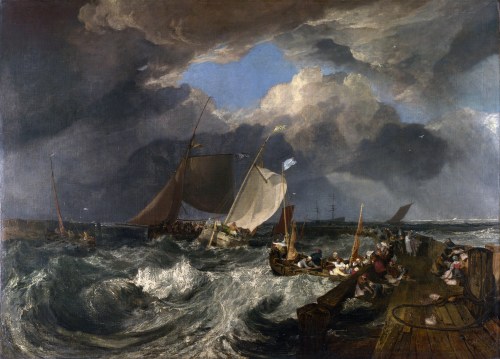
Artist: J. M. W. Turner (1775–1851)
Title: Calais Pier
Date: 1803
Medium: oil on canvas
Dimensions: height: 172 cm (67.7 in); width: 240 cm (94.4 in)
Collection: National Gallery
What I love about this painting:
The art of Joseph Mallord William Turner holds a large place in my heart. His originality, his later lack of deference to artistic conventions of the day often made his life hard. But what wonderful works emerged from his view of the world. Much like Van Gogh would do thirty years later, Turner’s work eventually evolved into a style that was original and sheer genius. His ability to paint what he saw and felt rather than the accepted classic literal depiction of a scene inspired the next generation of artists, the Impressionists.
Caiais Pier is one of his earlier works, painted when he was still influenced by his classical training. And yet, it is an emotion-packed image, the scene of a near-tragedy. The packet boat has arrived at Calais with a full load of passengers. The storm dominates the scene with lowering clouds and a heavy swell, but the sun breaks through and lights on the sail. A shaft of light shines down to the sea illuminating the center of the composition. The young artist put his experience and terror into the image, depicting the ferocity of the sea and the violence of the landing.
The National Gallery website says of this picture, “Although it had a mixed response when first exhibited at the Royal Academy in 1803, the critic John Ruskin declared it to be the first painting to show signs of ‘Turner’s colossal power’. Calais Pier is based upon an actual event. On 15 July 1802, Turner, aged 27, began his first trip abroad, travelling from Dover to Calais in a cross-channel ferry (a packet) of the type shown here. The weather was stormy, and Turner noted in his sketchbook: ‘Our landing at Calais. Nearly swampt.’” [1] Joseph Mallord William Turner | Calais Pier | NG472 | National Gallery, London
About the Artist, Via Wikipedia:
Joseph Mallord William Turner RA (23 April 1775 – 19 December 1851), known in his time as William Turner, was an English Romantic painter, printmaker and watercolorist. He is known for his expressive coloring, imaginative landscapes and turbulent, often violent marine paintings. He left behind more than 550 oil paintings, 2,000 watercolors, and 30,000 works on paper. He was championed by the leading English art critic John Ruskin from 1840 and is today regarded as having elevated landscape painting to an eminence rivalling history painting.
Turner was born in Maiden Lane, Covent Garden, London, to a modest lower-middle-class family and retained his lower class accent, while assiduously avoiding the trappings of success and fame. A child prodigy, Turner studied at the Royal Academy of Arts from 1789, enrolling when he was 14, and exhibited his first work there at 15. During this period, he also served as an architectural draftsman. He earned a steady income from commissions and sales, which due to his troubled, contrary nature, were often begrudgingly accepted. He opened his own gallery in 1804 and became professor of perspective at the academy in 1807, where he lectured until 1828. He travelled around Europe from 1802, typically returning with voluminous sketchbooks.
Intensely private, eccentric, and reclusive, Turner was a controversial figure throughout his career. He did not marry, but fathered two daughters, Evelina (1801–1874) and Georgiana (1811–1843), by his housekeeper Sarah Danby. He became more pessimistic and morose as he got older, especially after the death of his father in 1829; when his outlook deteriorated, his gallery fell into disrepair and neglect, and his art intensified. In 1841, Turner rowed a boat into the Thames so he could not be counted as present at any property in that year’s census. He lived in squalor and poor health from 1845, and died in London in 1851 aged 76. Turner is buried in St Paul’s Cathedral, London. [2]
Credits and Attributions:
“Calais Pier” by J.M.W. Turner, 1801. Wikipedia contributors, “Calais Pier,” Wikipedia, The Free Encyclopedia, https://en.wikipedia.org/w/index.php?title=Calais_Pier&oldid=1287504024 (accessed May 9, 2025).
[1] National Gallery contributors, Calais Pier, Joseph Mallord William Turner, https://www.nationalgallery.org.uk/paintings/joseph-mallord-william-turner-calais-pier (accessed May 9, 2025).
[2] Wikipedia contributors, “J. M. W. Turner,” Wikipedia, The Free Encyclopedia, https://en.wikipedia.org/w/index.php?title=J._M._W._Turner&oldid=1289276733 (accessed May 9, 2025).


 Life in the Realm of Fantasy
Turner was an amazing painter. Such emotion he put into his work.
I’m not familiar with this one, but it’s fabulous.
LikeLiked by 1 person
I so agree!!!
LikeLike