
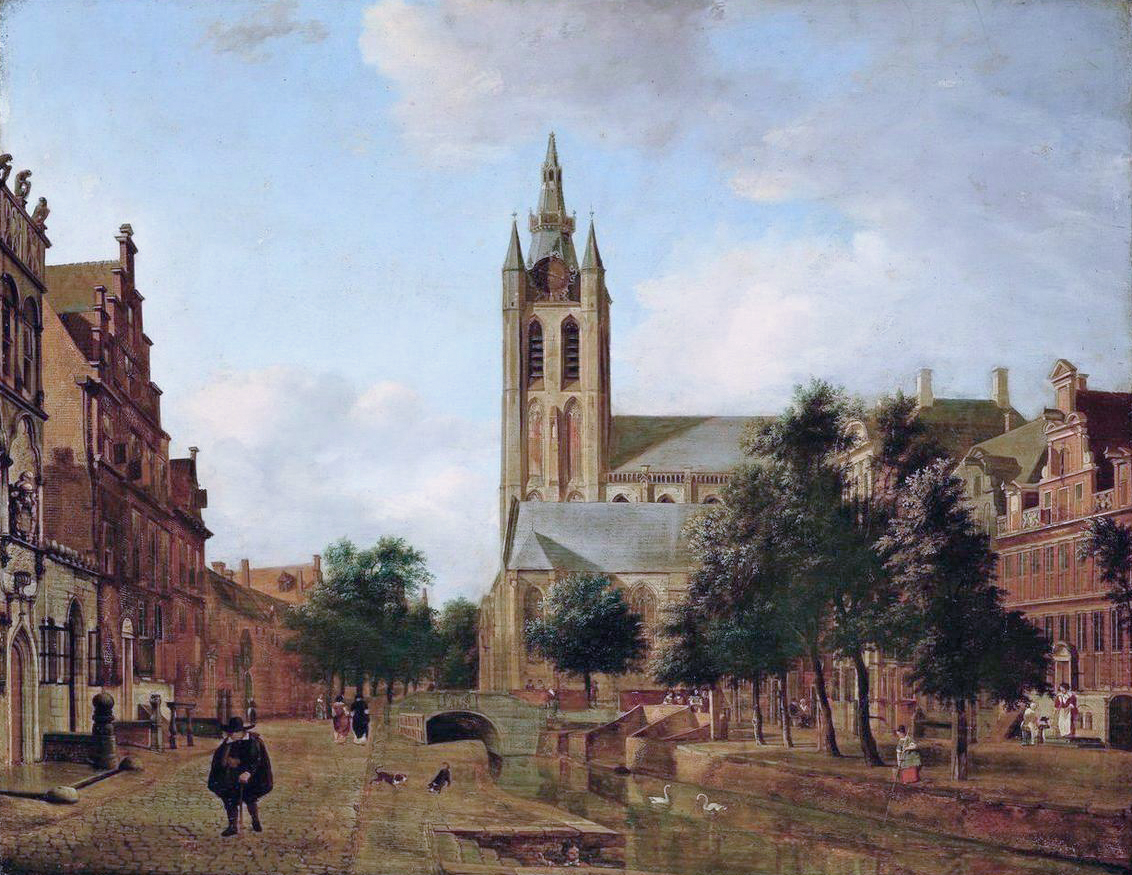
Artist: Jan van der Heyden (1637–1712)
Title: The Oude Kerk on the Oude Delft in Delft
Genre: landscape painting
Date: 1675
Medium: oil on panel
Dimensions: height: 45 cm (17.7 in); width: 57 cm (22.4 in)
Collection: National Museum of Art, Architecture and Design
What I love about this painting:
This scene shows us a fine day in the city of Delft, on the Trekvliet, a shipping canal that has existed since the 13th century. This canal flows past the foundations of the Oude Kerk. Van der Heyden has painted the tower as leaning, which is an accurate depiction. It currently leans two meters from the vertical.
We see the clean and prosperous street, with special attention paid to the architecture. The staffage (people) in this painting were most likely painted by Adriaen van de Velde. He collaborated with Adriaen van de Velde more frequently than Johannes Lingelbach or Eglon van der Neer, although they did sometimes work with him.
Fluffy white clouds sail across the scene. The air is not too warm or too cool. Instead, it is just right. The sky is that lovely shade of blue, the color that says “summer is near and all will be well.”
As a writer of fantasy, I often go to Wikimedia Commons for worldbuilding ideas, depending on the kind of era in which a story is set. If your work is set in a post-renaissance era, this is the kind of street and architecture that will be featured in the richest town. The buildings will be good to look at, made of stone and wood. The street will be paved, and if there is a canal, there will be places for barges and small watercraft to tie up.
About the artist, via Wikipedia:
Jan van der Heyden (5 March 1637, Gorinchem – 28 March 1712, Amsterdam) was a Dutch Baroque-era painter, glass painter, draughtsman and printmaker. Van der Heyden was one of the first Dutch painters to specialize in townscapes and became one of the leading architectural painters of the Dutch Golden Age. He painted a number of still lifes in the beginning and at the end of his career.
Jan van der Heyden was also an engineer and inventor who made significant contributions to contemporary firefighting technology. Together with his brother Nicolaes, who was a hydraulic engineer, he invented an improvement of the fire hose in 1672. He modified the manual fire engine, reorganized the volunteer fire brigade (1685) and wrote and illustrated the first firefighting manual (Brandspuiten-boek). A comprehensive street lighting scheme for Amsterdam, designed and implemented by van der Heyden, remained in operation from 1669 until 1840 and was adopted as a model by many other towns and abroad.
Painting was not the sole occupation and interest of van der Heyden. In fact he never joined Amsterdam’s painters’ guild. Even while his work was in great demand, he did not rely on his art to make a living. His principal source of income was, in fact, not painting. Rather he was employed as engineer, inventor and municipal official. He was clearly greatly preoccupied with the problem of how to fight fires effectively, and, with his brother Nicolaes, devoted much time between 1668 and 1671 to inventing a new, highly successful water pumping mechanism.
He devised streetlamps and the first street-lighting system for Amsterdam and was in 1669 appointed director of street lighting.
In 1673 the two brothers received official appointments to manage the city’s fire-fighting equipment and organisation. The two official appointments were sufficient to ensure the prosperity of the artist
Jan van der Heyden moved in 1680 to the Koestraat near the St. Anthonismarkt. Here he built a new family home and a factory for producing fire equipment. In collaboration with his eldest son Jan, he published in 1690 an illustrated book on firefighting, entitled ‘Beschrijving der nieuwlijks uitgevonden en geoctrojeerde Slangbrandspuiten’ (‘Description of the recently invented and patented hose fire engines’).
Jan van der Heyden died a wealthy man in 1712. His wife survived her husband by only a month. The inventory of the estate made soon after her death include more than 70 of his own paintings. [1]
Credits and Attributions:
IMAGE: Wikimedia Commons contributors, “File:Jan van der Heyden – The Oude Kerk on the Oude Delft in Delft.jpg,” Wikimedia Commons, https://commons.wikimedia.org/w/index.php?title=File:Jan_van_der_Heyden_-_The_Oude_Kerk_on_the_Oude_Delft_in_Delft.jpg&oldid=1035884888 (accessed June 12, 2025).
[1] Wikipedia contributors, “Jan van der Heyden,” Wikipedia, The Free Encyclopedia, https://en.wikipedia.org/w/index.php?title=Jan_van_der_Heyden&oldid=1293390184 (accessed June 12, 2025).


 Life in the Realm of Fantasy
A peaceful scene in what was probably a bustling town. I love the little touches, like the swans on the canal. I think this is early morning with people just beginning to go about their daily business.
LikeLiked by 1 person
Hello Vivienne – you might be right. I wonder if the bakeries are open. Maybe our prosperous-looking gentleman has just had a warm, flaky roll and a cup of coffee for breakfast.
LikeLike