
Short stories are a real training ground for authors because words must be rationed. Writing short stories and microfiction forces me to consider how the limited number of words I’m allowed can be used to their best advantage. It requires me to tell a large story using a small number of words carefully chosen for their impact.
 Word choice and sentence structure must convey a massive amount of information: mood, atmosphere, setting, and hints of backstory. All this must be packed into a space already occupied by intriguing characters, a gripping plot, and a clever resolution.
When writing a short story, it helps me if I know how it will end. I put together a broad outline of my intended story arc. I divide my story arc into quarters, which ensures the important events are in place at the right time.
Assume you have a 4000-word limit for your short story. This is a common limit for submissions to contests and anthologies. Some will be less, and very few will be more.
Editors will be swamped with submissions. You might only have three paragraphs before a prospective editor sets your work aside. If those paragraphs don’t grab her, she won’t buy your story.
If I want to interest an editor in my work, I absolutely must have a good opening paragraph.
- The first 250 words are the setup and hook. The next 750 words take your character out of their comfortable existence and launch them into “the situation.” Will they succeed or not?
- The next 2,500 words detail how the protagonist arrives at a resolution.
- The final 500 words are the wind-up.
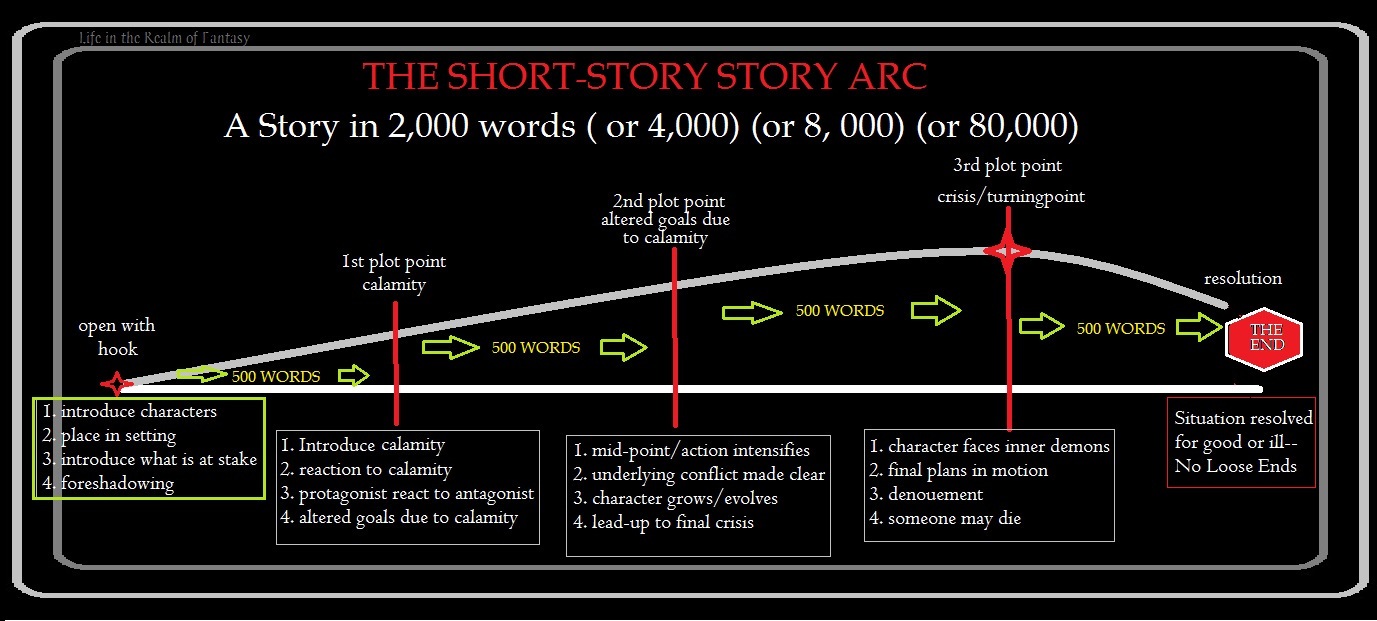
You might end on a happy note or not. It’s your story, but in a short story, no matter what else you do, nothing should be left unresolved. Unlike in a novella, you don’t have the word count to include subplots.
Part of being a professional writer is working within and adhering to word count limits. We must use every word we’re allowed to make that story the one an editor can’t put down.
I usually work from an outline. However, I’ve been known to deviate from my outline when a random idea turns out to be better than the original. I need structure when I begin writing, or my story might never be completed. The plot wanders all over the place, and it’s not worth submitting.
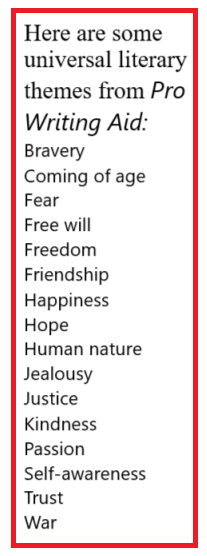
I have found that a strong theme is an essential tool for writing a coherent short story. Also, many anthologies we might want to submit to are themed. This ensures that even though the entire volume was written by many authors, readers won’t be jarred out of enjoyment.
Before I begin writing a themed story, I ask myself:
 What will be the inciting incident? How does it relate to the theme?
- What is the goal/objective? How does it relate to the theme?
- At the beginning of the story, what could the hero possibly want to cause her to risk everything to acquire it?
- How badly does she want it and why?
- Who is the antagonist?
- What moral (or immoral) choice is the protagonist going to have to make in her attempt to gain that objective?
- What happens at the first pinch point?
- Where is the group at the midpoint? What is happening?
- Why does the antagonist have the upper hand? What happens at the turning point to change everything for the worse?
- At the ¾ point, our protagonist should have gathered her resources and companions and should be ready to face the antagonist. How will you choreograph that meeting?
How does the underlying theme affect every aspect of the protagonists’ evolution in this story?
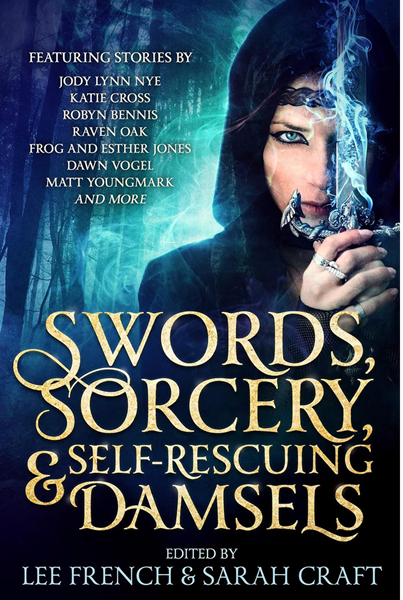
Then, I have to consider the narrative mode. Who is the best person to tell the story? One of my favorite short stories to write was Thorn Girl. It was published in the anthology Swords, Sorcery, and Self-rescuing Damsels.
I could easily have told her story in third omniscient POV, but I had a compelling main character with a real, gut-wrenching story.
It was a great theme, with so many possibilities. I love damsels who rescue themselves. And what fantasy author doesn’t love sorcery and a good sword?
The premise for a great short story had been rolling around in my head. I loved the idea of my character and had wanted to give her an adventure. So, I began writing her tale in my usual third-person narrative mode.
However, that mode didn’t feel as close, as intimate as I wanted. My main character had to tell her own story.
The theme really intrigued me, but I knew I had to avoid the obvious. It was a challenge to write something original and not overdone. It was an excellent opportunity to think widely.
 In the first draft, there were several places that I thought were the beginning. As always, I had difficulty deciding where the story actually began. After reading that first draft, my writing group pointed out where the story faltered. The narrative had to begin at the point of no return, as there is no room for backstory.
I tossed out the first half of the original story and began at what I had originally thought was the middle. That was when things began to fall together.
If my character were going to tell her own story, exactly what would she know? After thinking about it, I realized she could only know what she witnessed.
I spent some time figuring out what she really could have witnessed or overheard and then worked only with that information.
What did my protagonist want? At first glance, it seemed obvious, but the purported quest was only an impetus, a prod to move her down the path she needed to travel. Her true quest was to find herself as a human being, as much as it was to honor a promise made and quickly regretted.
What was she willing to do to achieve it? I didn’t know. She didn’t know either, and until I wrote the last line, I didn’t know what she was capable of or if she had the backbone to accomplish it.
So, now we know that need drives the short story, theme stitches it together, and word-count limits force us to be concise.
Go forth and write that story. You might be amazed at what you can produce when you are limited by word count.


Thank you, once again, for this valuable advice.
LikeLiked by 1 person
Hello Yvonne! Right now, short stories are about all I can concentrate on, so I have to remind myself not to ramble!
LikeLike
When still teaching,I always taught young aspiring ballet teachers that limitation is is source of creativity; in ballet, in writing and perhaps in life. I wish you lots of pleasure in controlling the ramble.
LikeLiked by 1 person
Thank you. I never thought of it that way, but you are right!
LikeLike