
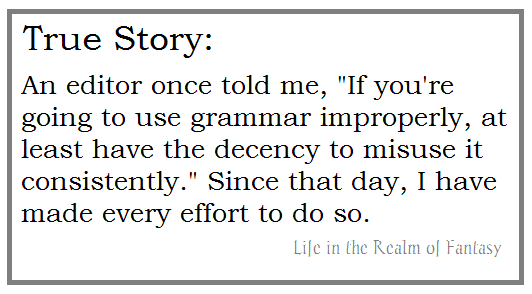
My native language is English (although I am fluent in gibberish). But since I wanted to be taken seriously as an author, my job is to understand how grammar works and use it to my advantage.
 The great authors bend the rules to energize their prose, but they know the rules they are ignoring and are consistent with how they bend them. They are deliberate.
Now, I do understand reality. If you are in the process of burning up the keyboard, tapping out a quick novel meant only to pay the bills, you won’t be thinking about getting fancy.
However, when it comes to word choices, some things are universal.
And so, here are seven rules that professional writing programs teach about sentence and paragraph construction.
One: Verbs. It is important to choose words that sound powerful when read aloud, as they convey the most meaning and reduce the tendency toward using too many “ly” words. In English, words that begin with hard consonants sound tougher and carry more power.
Verbs are power words. Fluff words and obscure words used too freely are kryptonite, sapping the strength from our prose.
Two: Placement of verbs in the sentence. Sentence construction can strengthen or weaken our work.
- Nouns followed by verbs make active prose:
- Moving the verbs to the beginning of the sentence makes it stronger.
From the building, Shari ran.
versus
Shari ran from the building.
It might fall out of our heads in the first draft, but we wouldn’t leave it. That kind of writing isn’t technically bad, but it’s awkward and not changing it in revisions is a newbie mistake. It’s the kind of writing that happens when we are just trying to spew the words as fast as we can.
Awkward phrasing is a subconscious code showing us what we need to revise.
 Three: Parallel construction smooths awkward phrasing. This is the act of combining two or more clauses of equal importance into one sentence. To make them parallel, each clause should use the same grammatical structure. They are parallel, and the reader absorbs what is said naturally.
What parallelism means can be shown by a quote attributed to Julius Caesar, who used the phrase “I came; I saw; I conquered” in a letter to the Roman Senate after he had achieved a quick victory in the Battle of Zela. Caesar uses the same number of words in each clause. This choice gives equal importance to the different ideas of arriving, seeing, and conquering.
Four: Contrast: In literature, we use contrast to describe the difference(s) between two or more things in one sentence. The sun burned like fire, but the ever-present wind chilled me.
Five: Similes show the resemblances between two concepts, using words such as “like” and “as.” The sun burned like fire.
Similes are different from metaphors, which suggest something “is” something else.
The pale moon shone, a guiding lamp in the sky that comforted me. In this sentence, the moon becomes a lamp to guide the narrator. “Lamp” is the metaphor.
Six: Repetition. If we occasionally employ deliberate repetition, it can emphasize emotion and atmosphere without increasing wordiness.
-
Repetition of the last word in a line or clause.
-
Repetition of words at the start of clauses or verses.
-
Repetition of words or phrases in the opposite sense.
-
Repetition of words broken by some other words.
-
Repetition of the same words at the end and start of a sentence.
-
Repetition of a phrase or question to stress a point.
-
Repetition of the same word at the end of each clause.
-
Repetition of an idea, first in negative terms and then in positive terms.
-
Repetition of words of the same root with different endings.
-
Repetition at both the beginning and the end of a sentence, paragraph, or scene.
-
Repetition is a construction in poetry where the last word of one clause becomes the first word of the next.

courtesy Office360 graphics
There are good repetitions and bad repetitions. Bad repetitions consist of the overuse of crutch words, such as grin, shrug, and wryly, along with many other easy words that come quickly to mind and litter the narrative during the first-draft rush.
Crutch words are easy because they say what you mean with little effort. They will become lazy writing if not found and trimmed back to a reasonable level during the revision process.
Seven: Alliteration is the occurrence of the same letter (or sound) at the beginning of successive words. Alliteration can lend a poetic feeling to a passage and help create the atmosphere of a given scene without adding wordiness.
When I see birches bend to left and right
Across the lines of straighter darker trees,
I like to think some boy’s been swinging them.
But swinging doesn’t bend them down to stay
As ice-storms do. (Birches, by Robert Frost, 1916) [2]
I love the way Robert Frost uses alliteration to set the scene and create the atmosphere in those opening lines.
Poetry makes good use of good repetition and alliteration. Consider this quote from Ralph Waldo Emerson:
“Every book is a quotation, and every house is a quotation out of all forests, and mines, and stone quarries; and every man is a quotation from all his ancestors.”
Ralph Waldo Emerson, Prose and Poetry. [1]
I know I say this all the time, but the way we habitually construct our prose is our voice. Our voice determines the impact of our work.
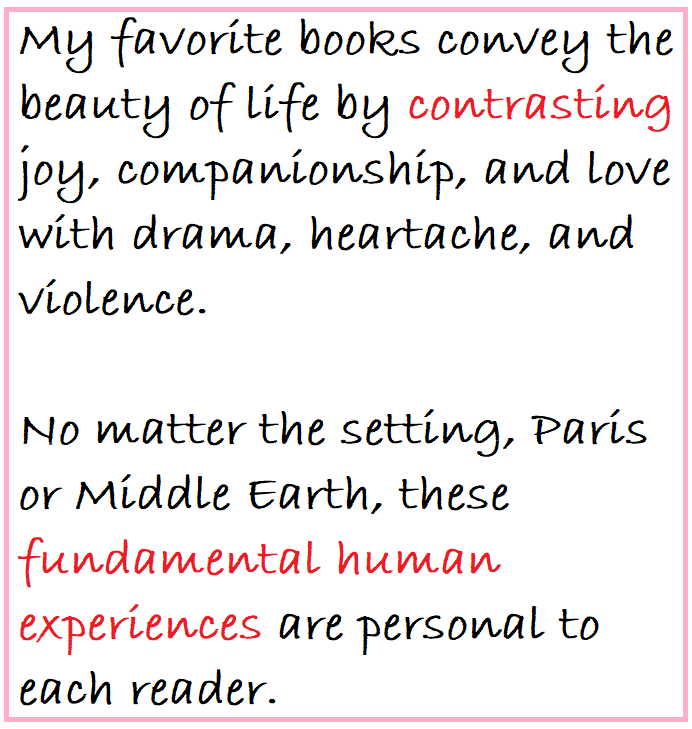 We all know different readers have widely different tastes. But everyone knows what they consider good writing, and they don’t recommend what they see as bad writing. If the work is well written, the author’s voice will determine whether a reader enjoys it.
And this brings me to that old bugaboo, GENRE.
We must know who our readers are, what they want, and construct our work to fit that market. All readers want to find what they perceive as good writing.
Active phrasing generates emotion.
Sometimes, using similes, repetition, and alliteration in subtle applications enhances the worldbuilding without beating your reader over the head.
We all know worldbuilding must be organic and natural, but there are times when we struggle to achieve it. Subtle application of these seven rules will empower your worldbuilding. The casual reader will be immersed but unaware of the mechanics. They won’t realize why the work is powerful.
Credits and Attributions
[1] Ralph Waldo Emerson, The Complete Works. Published in 1904. Vol. VIII. Letters and Social Aims, VI. Quotation and Originality, The Works of Ralph Waldo Emerson, vol. 8 (Letters and Social Aims) | Online Library of Liberty, Public Domain (accessed June 19, 2026).
[3] Wikipedia contributors, “Birches (poem),” Wikipedia, The Free Encyclopedia, https://en.wikipedia.org/w/index.php?title=Birches_(poem)&oldid=1351913530 (accessed June 19, 2026).


