
 Autumn is here in the Northern Hemisphere, the time of year I think of as the writing season. Many books begin in the cold, dark months and are published within a year. Others take years to finish. Some are good, and some contain many fatal flaws that should have been resolved before it went to press.
But how? Whether you are an indie or traditionally published author, good project management skills are an essential tool.
There are several project management methods, but I use a phased (or staged) approach. This method breaks down and manages the work through a series of steps.
- Concept: The Brilliant Idea. Make notes (a storyboard) so you don’t forget good ideas.
- The Planning Phase: create a raw outline. Some people don’t need this step, but I do.
- The Construction Phase: write the first draft from beginning to end, then continue through multiple drafts. This is time-consuming, but it is necessary.
Good project management gives authors a way to cope with the writer’s first-draft curse: “scope creep.” Scope creep refers to changes and uncontrolled growth in a project and can occur at many points after the project begins. Many novels die young and unappreciated because scope creep took over. The plot meanders through the swamps of blah, blah, blah.
 This happens when the project’s original idea is brilliant but nebulous. In business, as the project progresses, an inventor or production team may face unavoidable situations that affect production. The whole darned thing takes longer than we thought it would.
Novels begin life as a glorious idea not fully formed. Thus, stories grow exponentially as we write.
Books are one area where this sort of growth is fundamental to the project. However, this is why some rudimentary organizational skills are critical for the author. Successful authors are project managers, even if they don’t realize it.
ONE: Identify your Project Goals
This story is your invention, and some inventions take years to develop before they hit the market. Be prepared to take the time to do it right. Nothing reflects worse on an author than claiming AI slop is an original creation or rushing to publish a book before it is reader-ready. (The AI thing always comes out, so don’t fall into that trap. Be honest and admit to it if you are pushing books out via AI.)
TWO: Write the basic story.
- Monitoring and Controlling during the construction phase: This is where you build quality into your product.
- Find beta readers and heed their concerns in the rewrites. Take the manuscript through as many drafts as you must to have the novel you envisioned.
- Hire a good line editor to ensure consistent quality.
- Find reliable proofreaders. (Your writing group is an invaluable resource.)
THREE: Completion or Closing.
- Find an agent if you are taking the traditional route.
- Employ a professional formatter for the print version if you are going indie.
- Court an agent and publisher if you are taking the traditional route.
- Employ a cover designer if you are going indie.
Let’s go back to the second stage, writing the basic story.
Build your storyboard/stylesheet and note the changes you make as you go. See my post on stylesheets/storyboard’s here: Self-editing: Ensuring Consistency. Nothing upsets a reader more than a book where, in chapter forty-four, the author inadvertently contradicts what was written in chapter two. The storyboard is a visible, easy-to-understand way to stay on top of this.
I know, you’re going to tell me that you have it all straight in your head.
But as every child who has ever told a lie knows: stories grow and evolve in the telling. Eventually, the lie looks nothing like how it was in the first telling. I find that a storyboard is an essential tool for keeping the story straight.
 I use a spreadsheet program for this, but a standard Word or Google document, a pen-and-paper notebook, or a whiteboard with sticky notes works just as well.
My storyboards contain the following elements:
- GLOSSARY: A list of names and invented words as they arise, all spelled the way I want them.
- MAPS: nothing fancy, just something rudimentary to show me the layout of the world.
- CALENDAR of events: especially important if the characters must travel.
- ALSO: the rough outline of my projected story arc, along with descriptions of invented worlds, religions, and magic systems.
For maps, you don’t need to get fancy. All you need are lines and scribbles that show the essentials, like what lies to the north, south, east, and west. Also, we need to know the spelling of any named towns and where they are in relation to the protagonist’s opening location. Use a pencil so you can easily update your map if something changes during revisions.
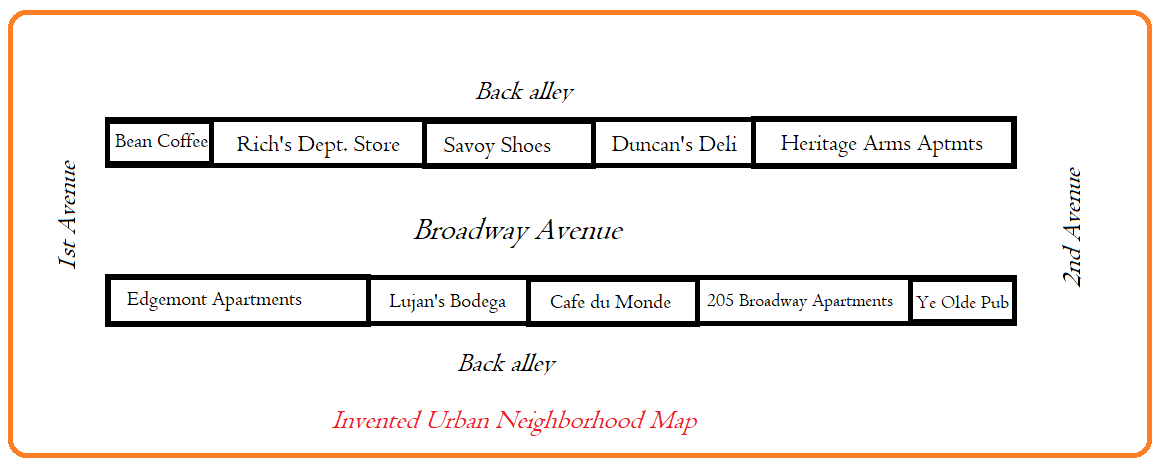
If you aren’t artistic and want a nice map later, your scribbled map will help a map artist create a beautiful, accurate product.
- If your story takes place in the real world, use Google Maps and print out a copy for your reference, or scan a map into your storyboard.
Distances: How long does it take to travel one mile or kilometer using the common mode of transportation?
Time: Sometimes time gets mushy when we are writing as fast as we can. A calendar gives us a realistic view of how long it takes to travel from point A to point B, or how much time it will take to complete a task.
Worldbuilding: What season do your events occur in? Foliage changes with the seasons, and weather is a part of worldbuilding. You should have some notion of where rivers and forests are relative to towns because those landmarks will be mentioned at some point.
More worldbuilding: The map shows the terrain your story takes place on, and weather can affect the terrain. Your characters will interact with their environment in different ways depending on the season and the weather, and this will affect how long it takes them to travel from place to place, depending on the mode of transportation.
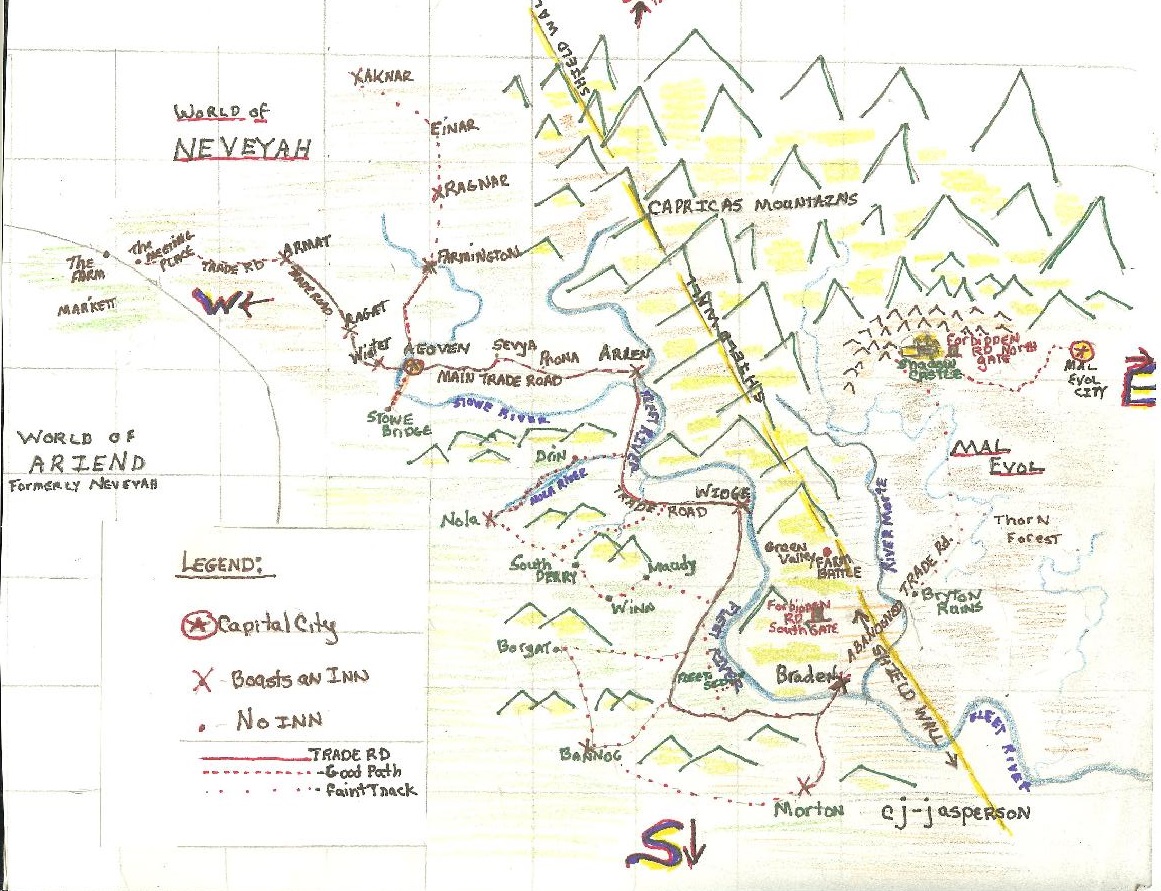
Original map of Neveyah from the author’s files. ©cjjasp 2008
I hope this long-winded rant helps you create the perfect novel. Project management is a vital tool for the author. Good storyboards are the author’s project management tools.


