Category Archives: Books

On Editing part 1, guest post by Carlie M.A. Cullen

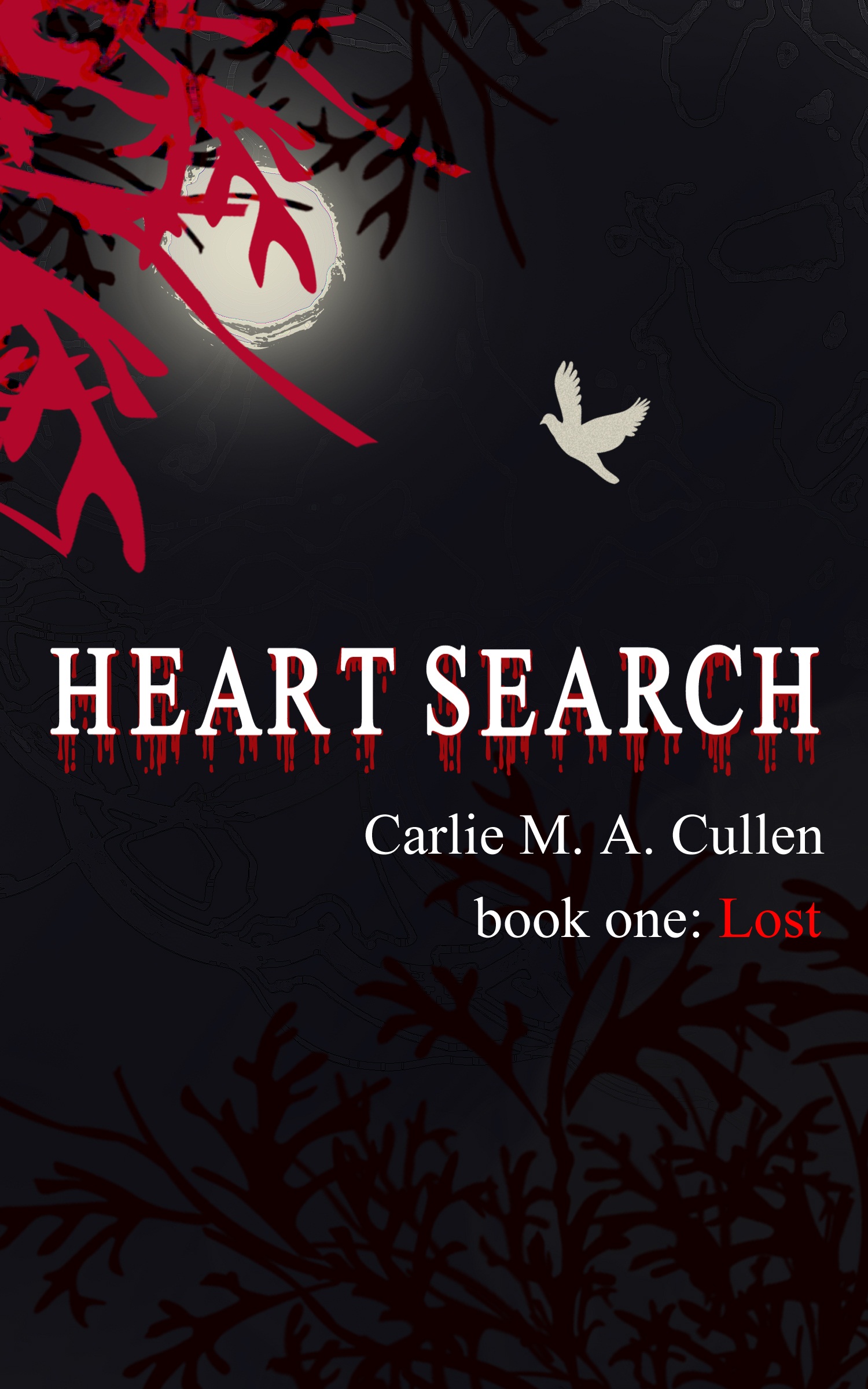
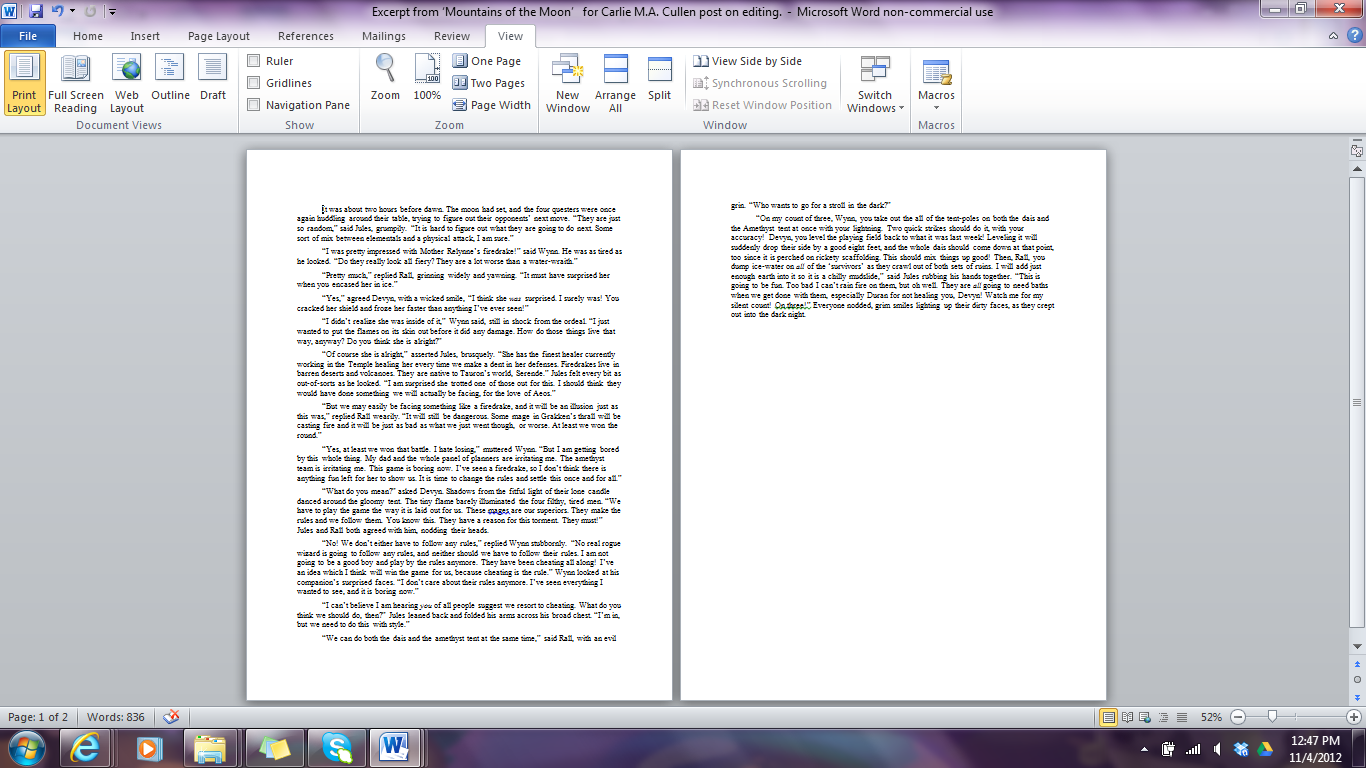
I’ve asked Carlie Cullen, author of Heart Search, and one of my editors on the Tower of Bones series to write a guest post detailing what an editor looks for when they receive a manuscript for the first editing. I also asked her to take a hitherto unedited bit of a current work in progress and to edit it for this post in the way she will when it actually goes to her sometime next year. The following is her post and the commentary.   To the left here, I’ve inserted  a screen shot of the unedited ms. At the bottom of this post is the screenshot of what the ms looks like now she’s sent it back to me.

What I hope you will all gain from this is (a) the importance of an impartial eye on your work, and (b) the understanding that criticism is a necessary part of growth.

I take each of her comments, and I analyze it with as fair an eye as I can.  Then I make the changes, but I do them my own way. I don’t do heavy descriptors, and Carlie’s own work is very descriptive. This is why we work well together. She brings out the places where I’ve skimped on the descriptors too much, and forces me to be more forthcoming with showing the emotions of the scene.

Today I bring you part one of Carlie M.A. Cullen on editing!

>>><<< 

Editing a raw manuscript is like dealing with an overgrown garden full of weeds; you need to cut back the long stuff before you can see the weeds choking the plants. This analogy is why editors generally do more than one round of editing, as they need to get some semblance of order to the manuscript before they can look at structure and the development of a story.

An editor has to look for a large number of things as they go through each line. As well as spelling, grammar (including correct use of tenses) and punctuation, which is the first thing I look at, there are the following:

  • ·         Sentence structure. If a sentence doesn’t flow there’s something wrong with it and an editor needs to identify what it is and give suggestions as to how to put it right.
  • ·         Consecutive sentences beginning with the same word. A couple of sentences beginning with ‘I’ for example, you can get away with, but more than that and it becomes repetitive.
  • ·         Repetition of words. This is a classic mistake every author makes and there are certain words which stick out like a sore thumb. The most common one I come across is ‘that’. In addition, I look for repetitive phrases. In the example, there is one paragraph which has ‘it will’ repeated three times.
  • ·         Dialogue. The dialogue has to be realistic otherwise the characters don’t come to life. This is more than just the actual words they say it’s also how they say it. Everybody uses contractions when they speak in everyday life (don’t / can’t / it’ll / I’m / I’ve / you’re / it’s – you get the drift) so these need to be reflected in your work. Also too many tags (he said / she said) can interrupt the flow.
  • ·         Inconsistencies. Again if we look at the example (comment C6), you will see some dialogue where Wynn is talking about seeing a firedrake and he then asks if they ‘look all fiery’. He’s already seen one so he shouldn’t be asking a question he already knows the answer to. This is just one example of how an inconsistency can occur.
  • ·         Timelines. In my first book I had an issue with a woman’s pregnancy and got the number of weeks muddled up, which thankfully, my editor picked up. An editor has to ensure the timelines are true to the story so it flows.
  • ·         Incorrect descriptive words. You will see towards the end of the example piece where the author used ‘grim smiles’. This doesn’t accurately reflect what’s happening in the story so the use of the word ‘grim’ is incorrect.
  • ·         Distinguishing ‘thoughts’ from text. Thoughts should be shown in italics to separate them from the general text and should be written in present tense, regardless of what voice is being used.

All the above is what I would normally do on a first round of editing – the cutting back of the long stuff to get to the plant-choking weeds. Then on the second round, I double check all the items above once more to ensure nothing has been missed, plus I begin the structural and developmental part of the edit. These are the sorts of things I look at:

  • ·         Imagery. A powerful analogy can help a reader picture a scene more clearly. This is where a writer can be particularly creative as using lots of clichés makes the writing boring and predictable. Also clever use of descriptive phrases can make something come alive.
  • ·         Showing not telling. This is mainly for character connection. Readers want to see expressions, gestures and mannerisms which give the character a three-dimensional quality. They want to be able to see and feel what the characters are feeling and seeing. They don’t want to be told someone is crying, they want to see the tears rolling down the cheeks and the anguish in someone’s eyes.
  • ·         Cutting extraneous text. When writing, it’s very easy to get carried away and add in all manner of superfluous detail. An editor needs to be able to isolate this extraneous text and suggest removal whilst ensuring the story isn’t compromised in any way.
  • ·         Actions reflecting character’s state of mind. Sometimes, writers give mixed messages about their characters. Their protagonist could be suffering a high state of anxiety yet their actions are portrayed as those of someone who is calm. This isn’t realistic. Therefore an editor needs to be able to identify these types of issues and suggest how to rectify the problem.
  • ·         Inflections. Think for just a moment about how people around you talk. Do they constantly talk in a monotone? When you’re out shopping and you overhear conversations, are the voices flat and devoid of any emotion whatsoever? No, and characters shouldn’t be either. By writing inflections in their voices, you are making them more rounded and real. It’s not called for in every bit of dialogue you write, but at a particularly emotive scene, whether it is anger, frustration, fear or sorrow, showing an inflection in the voice again helps the reader to connect with the characters.
  • ·         Story structure. This is where an editor looks at the story as a whole. Sometimes the starting place for the story isn’t strong enough (on the basis that you want to grip your readers early on to encourage them to continue reading). Sometimes the starting point would be better moved to another part of the book. Occasionally different P.O.V.’s (point of view) found in the same chapter can be confusing if not separated correctly. This point needs to be identified fairly early on in the editing process.
  • ·         Character development. A close look at how each character is written can reveal a great deal. Is it realistic for a character to be meek one minute and a raving psychopath the next if there is no trigger point or mention/hint of mental illness? There needs to be consistency, a journey for the character to take through the story and wild variations don’t work.
  • ·         Consistency. If a writer states in chapter two that Fred is the uncle of Lisa’s husband, he can’t be portrayed in chapter six as Lisa’s uncle. If a home is shown as being in Baltimore in chapter three, it can’t suddenly up sticks and walk to Florida in chapter twelve.

At the end of these processes and when the author has made any relevant changes, the editor has to final check the manuscript, to ensure it’s a polished gem, before it goes out for beta reading and subsequent publishing.

Thank you Carlie!  On Wednesday we will see what the lovely, colorful commentary on the finished ms above means!

3 Comments

Filed under Battles, Books, Humor, Literature, Uncategorized, writer, writing

NaNoWriMo – the first 6 hours

YES!!!  We survived the invasion of the 3 ½ foot tall Zombies. There was enough chocolate to go around, with plenty for my hubby and I to—er—examine.  But now another Apocalypse looms on the horizon.  Today is the first day of NaNoWriMo.  Now I must write 1666 words per day to have my 50,000 words by Nov. 30, 2012.  I will have no trouble. I managed to wake up at 2 a.m. and got the first 1538 words down.  Now it’s full steam ahead and no stopping for tourist distractions.

This blog will be the temporary home of eminent guest bloggers such as J.D. Hughes, Carlie Cullen, and Maria Johnson along with others as yet to be lassoed!  I can’t wait to see what they pull out of their incredibly creative minds for this!

Also, Alison DeLuca is having a blog tour for her fabulous Steampunk series, the  Crown Phoenix Series this month, and she will be visiting more than once, I hope!

So, to get you all started, these are the first paragraphs of what I did at 2:00 A.M.!

Excerpt from Valley of Shadows

The day John Farmer left home began as any typical winter day, rainy and cold. Only the day previously he’d turned fifteen making him legally an adult. His father had given him a new bow with a quiver full of arrows he’d forged especially for him, warning him to use them wisely. Other than that, nothing in John Farmer’s life had changed to mark his passage into adulthood. He still planned to try to get into town, and see Marjean Baker, if he could.  She was a friendly-girl down at the Boar’s Head tavern, and was five years his senior, but she really liked him, and he’d most definitely enjoyed her favors, the two times he’d managed to sneak off with her.

Unfortunately, he’d dallied with her too long the last time, returning home a bit too late the previous Restday, and his father discovered his secret arrangement with Marjean. John was now unlikely to get into town, unless he could figure out a way to sneak away without Wynn finding out—also unlikely as Wynn had taken to popping in and ‘checking’ on him at odd hours, making sure he was still there. His dad had even taken the precaution of hiding the saddle and bridle, so John would have to ride bareback if he did manage to sneak off.

He’d no idea why his father was so upset about such a minor thing. Unbonded men often had relationships with friendly-girls. No one thought twice about it. From what his dad’s old army friend, Jules Brendsson, said when he’d passed through Markett during Harvest, his dad had been the next best thing to a pleasure-boy as a young man, so Wynn’s attitude was hypocritical, in John’s opinion.  It’s not like I want to bond with her or anything, we’re just having fun. People expect you to have fun with friendly-girls, but Dad acts like it’s the end of the world.  

>>><<< 

It has a long way to go!  But it’s 30 days of straight on keying and no looking back until December 1st.  If I can just get the whole tale down from start to finish in that time, I will be able to spend the next half-year expanding on it.  Fortunately, I know these people and their world better than I know anything else right now, so I should be able to do it.

I will pop in and keep everyone posted on my progress. In the meantime I can’t wait to see what posts my friends will be making here during the month of November!


Comments Off on NaNoWriMo – the first 6 hours

Filed under Adventure, Battles, Books, Dragons, Humor, Uncategorized, writer, writing

You, Me and Mr W B

Today’s guest is the well-known author, blogger and editor, Carlie M.A. Cullen, author of Heart Search, a paranormal fantasy and who hails from the UK. She has consented to give us her humorous take on that bane of all writers – Writer’s Block.  Her approach is quite zen as compared to mine!  Take it away, Carlie…

You, Me and Mr W B

The vast majority of us authors have day jobs and families, so we try and squeeze in some time when we can to write. But it’s just not that easy.

Picture the scene; you’ve had a rotten day at work so you’re feeling kind of up-tight and frustrated – angry even. When you get home you find some bills in your post box so now you have to work out which ones you can pay now and which will have to wait a week or two. Your spouse/partner is worried about money, the kid(s) and is fed up because he/she broke a favourite ornament. One of the kids is ill; they’ve got a bit of a fever and keeps throwing up, and the dog has decided to expand its’ culinary repertoire by chewing on your slippers.

After all this and having had dinner, you manage to find half an hour to sit down and write. You fire up your PC or laptop, open the relevant page and nothing. Mr Writer’s Block has taken up residence in your head and you can’t think of a single thing to write. You re-read some of what you’ve written before in the hope it’ll spark something, anything, so you can continue with your story. But what happens? Zilch, zip, nada, nothing. Before you know it, your half an hour has gone, it’s time for bed and now you’re even more frustrated.

Is it any wonder?

Our busy lives get in the way of our writing and just trying to find the time is hard enough, but when you’re worried about money, job, kids et al, it’s really no wonder so many of us suffer visits from Mr Writer’s Block, is it?

For us to be productive with our writing, we need to be able to put aside all the stresses, strains and problems thrown across our paths. We need to allow our imaginations to soar in a creative way rather than imagining what will happen if a particular bill is not paid by the due date. We need to find our zone and shut everything else out. Sounds easy, right? Like heck it is!

So how do we do it?

Preparation is key here and there are a few techniques you can use to get past it. I’m going to share three with you here.

If you’re the sort of person who listens to music when you write, put on a CD or your iPod for a good 10-15 minutes before you start and really concentrate on it. If it’s instrumental, listen to how the notes rise and fall, the harmonies created by the different instruments and think what scene the music conjures; if there are vocals, listen to the words very carefully, and try to picture the artist’s mood when they were writing it or how they would look performing it on stage. By concentrating on the music, you’re beginning to free your mind.

Another way is deep breathing relaxation exercises with a twist. Sit or lay – it doesn’t matter as long as you are comfortable – and close your eyes. Start breathing deeply then begin by thinking about your feet and mentally picture the muscles relaxing and the stress as a puff of black smoke or a black cloud which appears outside your feet as the muscles relax. Then you start working your way up your body; ankles to knees, knees to top of thighs, hip / groin / stomach area, chest, shoulders, arms and hands, neck and last of all your head. Then you picture a shape, any shape you like. It starts off small then gets increasingly larger until it fills your vision. Then you allow the shape to morph or distort itself, bending in on itself, twirling around, basically anything your mind can invoke. Now you’ve spent that time relaxing and playing with the shape, it’s pushed out the worries and let your imagination go to work.

The final one is ten minutes of free-writing, using pen and paper. Most, if not all of you are likely to know what this is, but in case you don’t I’ll explain. Pick a word, any word you like, at random. Now you just write anything which pops into your head about that word. Spelling, grammar and punctuation go out the window. You don’t even need to worry about sentence structure. You can write a list of words you associate with your chosen topic, you can write sentences. It doesn’t matter what you write, how it sounds, how arbitrary it is, the important thing is concentrating on your chosen word and just keep writing. The mere fact of you concentrating on something else has opened your mind and allowed the creative side to emerge.

After doing one of these exercises you go straight to your computer or writing pad, whichever you use and begin to write. Allow your mind free rein on your work in progress; it’s primed and ready to accept the sparks of inspiration your preparations have encouraged. It might be a little hokey at first, a little off compared to how you normally write, but that’s okay. The important thing is you’re now writing and as you progress your style, sentence structure and all the things you’re used to will materialise and ‘hey presto’ you’re back in your groove. The worst thing you can do is concern yourself with your first few lines which may not be up to your normal standard – it can always be edited later – you’re putting words on the page or screen and that’s what matters.

So the next time you’re tense and Mr Writer’s Block come knocking on your door, slam it in his face, do your chosen exercise(s) then write to your heart’s content.

>>><<<

Carlie’s approach is so much more civilized than mine!  Although, I must say, my hair-dresser, Heavenly Kevin has become quite adept at disguising the flat spot I’ve gained from banging my head on my desk!  Thank you Carlie – we’ll hear more from you in November when NaNoWriMo is in full swing and I am begging for guest posts! 

Carlie’s book, Heart Search is available at amazon.com for the amazingly affordable price of only $2.99 for the Kindle download.  I love a good tale of vampires and love gone awry!

3 Comments

Filed under Adventure, Battles, Books, Humor, Literature, Romance, Uncategorized, writer, writing

Heart Search Blog Tour

I am a part of something I have never done before!  I am a stop on a blog tour!  A dear friend of mine, Carlie M.A. Cullen is publishing her first book, Heart Search.  I have a ‘badge’ for my blog and everything!

Carlie, along with Alison DeLuca, is my editor.  She gently guides me through the terrible swamps and dead-end roads of writing, and was the lead editor on Forbidden Road, the soon-to-be published sequel to Tower of Bones.

Carlie’s personal style of writing is very different from mine. Her tale is thick with description and her characters are drawn from today’s urban society and set in the real world (if vampires existed).  My tales are made with people who could exist, set in a world that may exist if Roger Zelazney was right (he said that if you can imagine a world, it probably exists).

Yet I believe it is the radical difference in our personal writing style which lends dimension to my work when she has her red pen in hand.

The way we work together is this: I send her the full ms in a form that is as perfect as I can make it.  This is called making a manuscript ‘submission ready’.  When I send it to her, I have been over and over it, looking for errors and inadvertent inconsistencies, and trying to make sure there are no contradictions in the spelling of made-up names, and capitalizations.  Also, I have already done my best to make sure I have used ‘closed quotes’  for each instance of dialogue, and checked and double-checked my punctuation.  When I send this in, it is as neat and ready to go as I can make it.  I have corrected everything I can find, and can’t see where it needs improvement.

She cuts my completed ms into chapters, making sure I have not mis-numbered them (which has happened!) and sharpens her red pencil and her teeth! As she finishes each chapter she sends it back to me with her suggestions and comments in the right hand side. I return it to her with the corrections and we repeat the process.

Despite my best efforts in making it submission-ready, there will be instances of all sorts of manuscript-mayhem. It is my line-editor’s job to find these nuggets of no-no and guide me in eliminating them.  Not only will she find the contradictions and punctuation errors, she will find the instances where a word has been used either in the wrong context or is simply awkward when used in that way.  She will help me rephrase ungainly ideas in a better way, or even suggest I eliminate them as they may be redundant or not necessary.

She finds and points out the overuse of certain words, such as ‘that’ or ‘had’.  These are words we habitually use in conversation and don’t realize how frequently we say them.  When they are written and appear 6 or 7 times in one paragraph they leap out at the reader and are annoying. They are insidious to the author, because they fade into the background when the author is reading his own work.  Thus it takes the eye of the editor to guide the writer through eliminating these ‘speed-bump words’ as I like to think of them.

She does this for me in as kind and gentle a way as is possible, while still getting the job done.  She builds my self-confidence while tearing apart my cherished manuscript and reassembling it in a way which actually reads the way I always thought it did.

To go through the process of having your manuscript edited is a humbling thing.  I don’t know how a person can produce a decent book with no outside input to shine a little light in the cluttered closets full of prose that will pop up in every manuscript. A completed, submission-ready manuscript is Chaos Theory realized. It is only through the objective eye of the editor that our book is made readable.

Now, I am sure you know Carlie, too, has an editor. Her editor is the wonderful Maria V. A. Johnson, and Maria does for Carlie what Carlie does for me.  Maria is an awesome editor and Carlie is fortunate to have her to guide her through the process.

It all comes full circle.

I also work as an editor. I’ve been privileged to work with such wonderful and diverse authors as Ross M. Kitson and Shaun Allan. My role as an editor is to do for them what Carlie does for me; in essence I smooth out the rough spots and let their wonderful work shine with their voices telling their tales in their own way.

I love editing as much as I love writing.  To be an intimate part of another author’s dream is an experience I treasure. To have had the experience of being edited was exhilarating.  To see my editor’s own book finally released is nothing short of awesome – I can’t wait to read it!

Heart Search, by Carlie M.A. Cullen

One bite starts it all . . .

When Joshua Grant vanishes days before his
wedding his fiancée Remy is left with only bruises, scratch marks and a hastily
written note. Heartbroken, she sets off alone to find him and begins a long
journey where strange things begin to happen.

As Joshua descends into his
new immortal life he indulges his thirst for blood and explores his superhuman
strength and amazing new talents while becoming embroiled in coven politics
which threaten to destroy him. But Remy discovers a strength of her own on her
quest to bring Joshua home.

Fate toys with mortals and immortals alike,
as two hearts torn apart by darkness face ordeals which test them to their
limits

Comments Off on Heart Search Blog Tour

Filed under Books, Romance, Uncategorized, writer, writing