Category Archives: #FineArtFriday

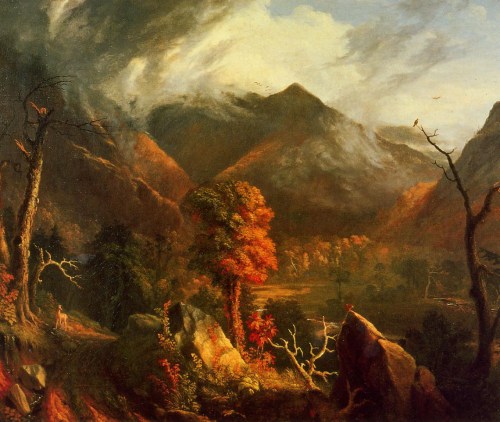
#FineArtFriday: Peace at Sunset (Evening in the White Mountains) by Thomas Cole, ca 1827

Peace_at_Sunset_(Evening_in_the_White_Mountains)_Thomas_ColeArtist: Thomas Cole (1801–1848)

Title: Peace at Sunset (Evening in the White Mountains)

Date: circa 1827

Medium: oil on canvas

Dimensions: height: 68.9 cm (27.1 in); width: 81.9 cm (32.2 in)

Collection: Fine Arts Museums of San Francisco

What I love about this painting:

This is one of Cole’s early works. He was able to show us the kind of autumn day we love, with rain trying to sweep in, but held back by the sunshine. It’s good day, despite the chill breeze attempting to scour the leaves from the trees. Clouds brush the hilltops, but the reds and golds seem to glow in the sunlight.

About the Artist, via Wikipedia:

Thomas Cole (February 1, 1801 – February 11, 1848) was an English-American painter known for his landscape and history paintings. He is regarded as the founder of the Hudson River School, an American art movement that flourished in the mid-19th century. Cole’s work is known for its romantic portrayal of the American wilderness.

After 1827 Cole maintained a studio at the farm called Cedar Grove, in the town of Catskill, New York. He painted a significant portion of his work in this studio. In 1836, he married Maria Bartow of Catskill, a niece of the owners, and became a year-round resident. Thomas and Maria had five children. Cole’s daughter Emily was a botanical artist who worked in watercolor and painted porcelain. Cole’s sister, Sarah Cole, was also a landscape painter.

Additionally, Cole held many friendships with important figures in the art world including Daniel Wadsworth, with whom he shared a close friendship. Proof of this friendship can be seen in the letters that were unearthed in the 1980s by the Trinity College Watkinson Library. Cole emotionally wrote Wadsworth in July 1832: “Years have passed away since I saw you & time & the world have undoubtedly wrought many changes in both of us; but the recollection of your friendship… [has] never faded in my mind & I look at those pleasures as ‘flowers that never will in other garden grow-‘”

Thomas Cole died at Catskill on February 11, 1848, of pleurisy. The fourth highest peak in the Catskills is named Thomas Cole Mountain in his honor. Cedar Grove, also known as the Thomas Cole House, was declared a National Historic Site in 1999 and is now open to the public.


Credits and Attributions:

Peace at Sunset (Evening in the White Mountains) by Thomas Cole PD|100 via Wikimedia Commons.

Wikipedia contributors, “Thomas Cole,” Wikipedia, The Free Encyclopedia, https://en.wikipedia.org/w/index.php?title=Thomas_Cole&oldid=1120453843 (accessed November 10, 2022).

Comments Off on #FineArtFriday: Peace at Sunset (Evening in the White Mountains) by Thomas Cole, ca 1827

Filed under #FineArtFriday

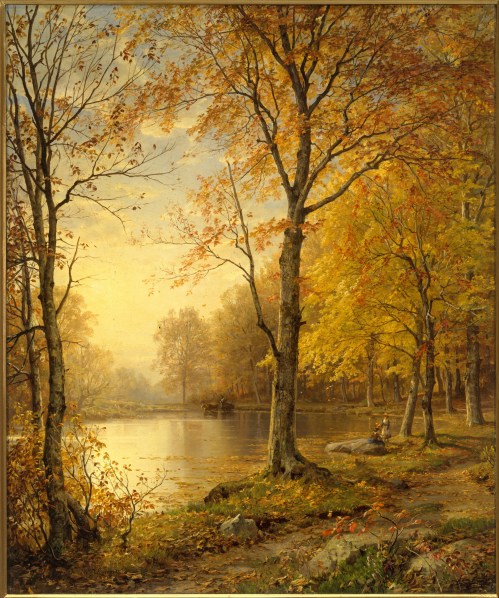
#FineArtFriday: Indian Summer by William Trost Richards 1875

Indian_Summer_MET_DT276257Title: Indian Summer by William Trost Richards

Genre: landscape art

Date: 1875

Medium: oil on canvas

Dimensions: 24 1/8 x 20 in. (61.3 x 50.8 cm)

Collection: Metropolitan Museum of Art

What I love about this painting:

Richards has captured a singular moment of tranquility for us all to enjoy in these troubled times. A light breeze barely ruffles the surface of our pond. At the bottom right, two girls play beside a large boulder at the waters’ edge.

Across the pond, in the center and nearly hidden in the shadows, a teamster and his oxen wade across the shallows.

Autumn’s haze lends a feeling of mystery to the scene, muting the reds, yellows, and oranges of leaves about to fall. This last burst of grandeur can’t hold back winter, though it tries. Soon the forest will sleep, soon snow and ice will decorate barren limbs and ice will stop the waters’ gentle motions.

But beneath the grasp of winter, new life will bide its time, and winter will fade into spring. The seasons will follow their course, but today is autumn’s day to shine, to go down in a blaze of golden glory.

Richards paints a day of peace and serenity, a small pocket of time where one can just sit back and admire the beauty of our world.

 >>><<<

About William Trost Richards:

William Trost Richards (November 14, 1833 – November 8, 1905) was an American landscape artist. He was associated with both the Hudson River School and the American Pre-Raphaelite movement. [1]

1856 he married Anna Matlack Richards (1834–1900), a 19th-century American children’s author, poet and translator best known for her fantasy novel, A New Alice in the Old Wonderland. The couple had eight children, only five of whom lived past infancy. Anna educated the children at home to a pre-college level in the arts and sciences. [2]

One of the couple’s sons, Theodore William Richards, would later win the 1914 Nobel Prize in Chemistry. Anna Richards Brewster, their sixth child, went on to become an important painter in her own right, having received an early arts education from her father as well. [2]

Richards rejected the romanticized and stylized approach of other Hudson River painters and instead insisted on meticulous factual renderings. His views of the White Mountains are almost photographic in their realism. In later years, Richards painted almost exclusively marine watercolors. [1]


Credits and Attributions:

Indian Summer by William Trost Richards, Wikimedia Commons contributors, “File:Indian Summer MET DT276257.jpg,” Wikimedia Commons, the free media repository, https://commons.wikimedia.org/w/index.php?title=File:Indian_Summer_MET_DT276257.jpg&oldid=678817431 (accessed November 3, 2022). Public Domain.

[1] Wikipedia contributors, “William Trost Richards,” Wikipedia, The Free Encyclopedia, https://en.wikipedia.org/w/index.php?title=William_Trost_Richards&oldid=1089835304 (accessed November 3, 2022).

[2] Wikipedia contributors, “Anna Matlack Richards,” Wikipedia, The Free Encyclopedia, https://en.wikipedia.org/w/index.php?title=Anna_Matlack_Richards&oldid=1055684363 (accessed November 3, 2022).

1 Comment

Filed under #FineArtFriday, writing

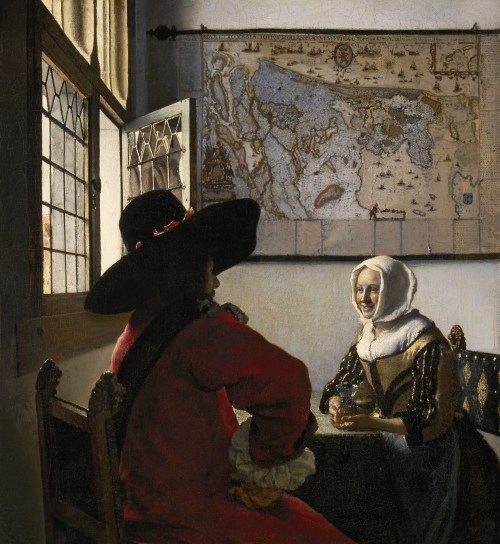
#FineArtFriday: Officer and Laughing Girl by Johannes Vermeer circa 1657 #prompt

Johannes_Vermeer_-_Officer_and_Laughing_Girl_-_Google_Art_Project

Artist: Johannes Vermeer (1632–1675)

Title: Officer and Laughing Girl

Genre: genre art

Date: circa 1657

Medium: oil on canvas

Dimensions: height: 50.5 cm (19.8 in); width: 46 cm (18.1 in)

Collection: The Frick Collection

This is the last prompt of October, as National Novel Writing Month kicks into gear in November. Vermeer paints us a story of courtship within the bounds of society, of two people with middleclass values who are clearly attracted to each other. Will they be married? I like to think so.

What I love about this painting:

As I said above, Vermeer paints a story for us. He shows us a courting couple, a modestly dressed young woman seated opposite a young officer. Is this the home of her parents?

It is clearly not a tavern, as she has a crystal wine glass, which taverns wouldn’t have. Another clue to her social status is the map on the wall behind her, indicating her family may be merchants. Taverns rarely displayed maps as they were expensive.

Our girl is dwarfed by the map and also by the large man, whose face we don’t see, as he is captivated by her. Yet though she is physically smaller than her companion, she is not made small in this painting. Indeed, she has a large presence; her personality and smile have power, speaking to us across the centuries.

The light falls gently though the open window, illuminating the woman, bathing the scene with that quality Vermeer recreated so brilliantly.

Some male art critics suggest that the position of her hand indicates a less savory transaction is occurring here, but I feel they are wrong. Her hair is completely covered. She is not dressed provocatively, nor are they shown in a tavern or brothel. Her hand is shown as if gesturing in conversation, a natural gesture.

I think that nasty kind of interpretation is the result of a Victorian-era male art critic prejudice against women in art, dismissing them as morally corrupt. That sort of attitude poisons art interpretation at all levels. Maybe traditional critics need to look at paintings such as this with a fresh eye and see what is actually there: a young woman talking to a young man, seated in a corner at a table, most likely in full view of her middleclass parents.

The model for the woman in this painting was most likely Vermeer’s wife, and the dress she wears appears in other domestic scenes painted by Vermeer, as does the window and the table.

About Johannes Vermeer, the Master of Light (from Wikipedia)

Johannes Vermeer (October 1632 – December 1675) was a Dutch painter who specialized in domestic interior scenes of middle-class life. He was a moderately successful provincial genre painter in his lifetime but evidently was not wealthy, leaving his wife and children in debt at his death, perhaps because he produced relatively few paintings.

Vermeer worked slowly and with great care, and frequently used very expensive pigments. He is particularly renowned for his masterly treatment and use of light in his work.

Vermeer painted mostly domestic interior scenes. “Almost all his paintings are apparently set in two smallish rooms in his house in Delft; they show the same furniture and decorations in various arrangements and they often portray the same people, mostly women.”

He was recognized during his lifetime in Delft and The Hague, but his modest celebrity gave way to obscurity after his death. He was barely mentioned in Arnold Houbraken‘s major source book on 17th-century Dutch painting (Grand Theatre of Dutch Painters and Women Artists), and was thus omitted from subsequent surveys of Dutch art for nearly two centuries. In the 19th century, Vermeer was rediscovered by Gustav Friedrich Waagen and Théophile Thoré-Bürger, who published an essay attributing 66 pictures to him, although only 34 paintings are universally attributed to him today. Since that time, Vermeer’s reputation has grown, and he is now acknowledged as one of the greatest painters of the Dutch Golden Age. [1]


Credits and Attributions:

Wikimedia Commons contributors, “File:Johannes Vermeer – De Soldaat en het Lachende Meisje – Google Art Project.jpg,” Wikimedia Commons, the free media repository, https://commons.wikimedia.org/w/index.php?title=File:Johannes_Vermeer_-_De_Soldaat_en_het_Lachende_Meisje_-_Google_Art_Project.jpg&oldid=617576363 (accessed April 29, 2022).

[1] Wikipedia contributors, “Johannes Vermeer,” Wikipedia, The Free Encyclopedia, https://en.wikipedia.org/w/index.php?title=Johannes_Vermeer&oldid=1082091616 (accessed April 29, 2022).

4 Comments

Filed under #FineArtFriday

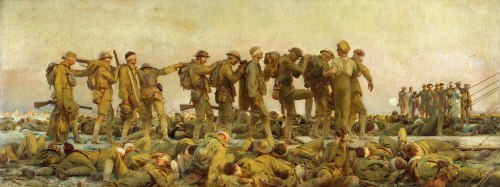
#FineArtFriday: Gassed by John Singer Sargent 1919 #prompt

2560px-Sargent,_John_Singer_(RA)_-_Gassed_-_Google_Art_ProjectArtist: John Singer Sargent (1856–1925)

Title: Gassed

Date: 1919

Medium: oil on canvas

Dimensions: Height: 231 cm (90.9 in); Width: 611.1 cm (20 ft)

Writing Prompt: John Singer Sargent tells many stories in this one powerful statement about war and the inhumanity of humankind. He also lays bare our resilience, our drive to survive. What thoughts, what ideas are prompted by what you see here?

What I love about this painting:

This painting is a deeply moving antiwar statement. John Singer Sargent was a complicated man, as most artists are. Famous as a portrait artist, he painted landscapes that conveyed a sense of mood and emotion that few of his contemporaries could match.

He was commissioned as a war artist by the British Ministry of Information. He illustrated numerous scenes from the Great War. Sargent had been affected by what he had seen while touring the front in France and by the death of his niece Rose-Marie in the shelling of the St Gervais church, Paris, on Good Friday 1918.

The colors are muted, and even the pastels are dark and dirty. The suffering of the maimed and injured men is laid bare. Through the legs of the walking wounded, the rising moon illuminates the desire of the uninjured to try to find some normalcy. Dwarfing the players and their game, the vast sea of dead and injured stretches as far as the eye can see.

Above, two tiny figures represent the clash of biplanes in the distance, the ever-moving machine of death and inhumanity that is war.

About this painting, via Wikipedia:

[1] Gassed is a very large oil painting completed in March 1919 by John Singer Sargent. It depicts the aftermath of a mustard gas attack during the First World War, with a line of wounded soldiers walking towards a dressing station. Sargent was commissioned by the British War Memorials Committee to document the war and visited the Western Front in July 1918 spending time with the Guards Division near Arras, and then with the American Expeditionary Forces near Ypres. The painting was finished in March 1919 and voted picture of the year by the Royal Academy of Arts in 1919. It is now held by the Imperial War Museum. It visited the US in 1999 for a series of retrospective exhibitions, and then from 2016 to 2018 for exhibitions commemorating the centenary of the First World War.

The painting measures 231.0 by 611.1 centimeters (7 ft 6.9 in × 20 ft 0.6 in). The composition includes a central group of eleven soldiers depicted nearly life-size. Nine wounded soldiers walk in a line, in three groups of three, along a duckboard towards a dressing station, suggested by the guy ropes to the right side of the picture. Their eyes are bandaged, blinded by the effect of the gas, so they are assisted by two medical orderlies. The line of tall, blind soldiers forms a naturalist allegorical frieze, with connotations of a religious procession. Many other dead or wounded soldiers lie around the central group, and a similar train of eight wounded, with two orderlies, advances in the background. Biplanes dogfight in the evening sky above, as a watery setting sun creates a pinkish yellow haze and burnishes the subjects with a golden light. In the background, the moon also rises, and uninjured men play association football in blue and red shirts, seemingly unconcerned at the suffering all around them.

The painting provides a powerful testimony of the effects of chemical weapons, vividly described in Wilfred Owen‘s poem Dulce et Decorum Est. Mustard gas is a persistent vesicant gas, with effects that only become apparent several hours after exposure. It attacks the skin, the eyes and the mucous membranes, causing large skin blisters, blindness, choking and vomiting. Death, although rare, can occur within two days, but suffering may be prolonged over several weeks.

Sargent’s painting refers to Bruegel’s 1568 work The Parable of the Blind, with the blind leading the blind, and it also alludes to Rodin’s Burghers of Calais.

About the Artist, via Wikipedia:

[2] John Singer Sargent (January 12, 1856 – April 14, 1925) was an American expatriate artist, considered the “leading portrait painter of his generation” for his evocations of Edwardian-era luxury. He created roughly 900 oil paintings and more than 2,000 watercolors, as well as countless sketches and charcoal drawings. His oeuvre documents worldwide travel, from Venice to the Tyrol, Corfu, the Middle East, Montana, Maine, and Florida.

Born in Florence to American parents, he was trained in Paris before moving to London, living most of his life in Europe. He enjoyed international acclaim as a portrait painter. An early submission to the Paris Salon in the 1880s, his Portrait of Madame X, was intended to consolidate his position as a society painter in Paris, but instead resulted in scandal. During the next year following the scandal, Sargent departed for England where he continued a successful career as a portrait artist.

From the beginning, Sargent’s work is characterized by remarkable technical facility, particularly in his ability to draw with a brush, which in later years inspired admiration as well as criticism for a supposed superficiality. His commissioned works were consistent with the grand manner of portraiture, while his informal studies and landscape paintings displayed a familiarity with Impressionism. In later life Sargent expressed ambivalence about the restrictions of formal portrait work, and devoted much of his energy to mural painting and working en plein air. Art historians generally ignored artists who painted royalty and “society” – such as Sargent – until the late 20th century. [2]


Credits and Attributions:

[1] Wikipedia contributors, “Gassed (painting),” Wikipedia, The Free Encyclopedia, https://en.wikipedia.org/w/index.php?title=Gassed_(painting)&oldid=1029966714 (accessed July 15, 2021).

[2] Wikipedia contributors, “John Singer Sargent,” Wikipedia, The Free Encyclopedia, https://en.wikipedia.org/w/index.php?title=John_Singer_Sargent&oldid=1032671314 (accessed July 15, 2021).

Image source: File:Sargent, John Singer (RA) – Gassed – Google Art Project.jpg – Wikipedia (accessed July 15, 2021).

Comments Off on #FineArtFriday: Gassed by John Singer Sargent 1919 #prompt

Filed under #FineArtFriday

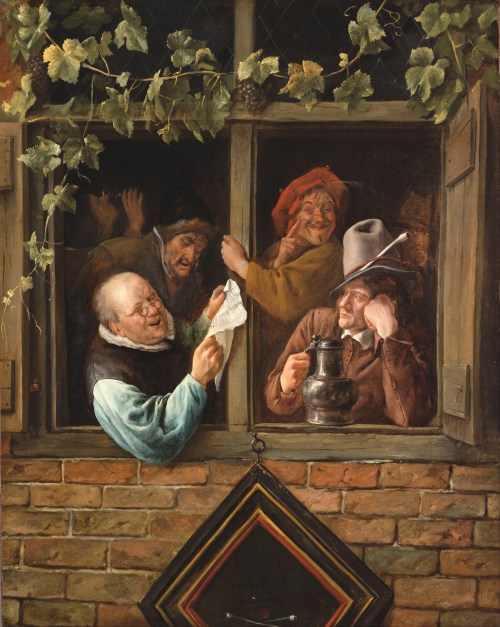
#FineArtFriday: Rhetoricians at a Window by Jan Steen ca. 1666 #prompt

Artist: Jan Steen  (1625/1626–1679)

Title: Rhetoricians at a Window

Genre: genre art

Date: c. 1661-66

Medium: oil on canvas

Dimensions: Height: 759.46 mm (29.90 in); Width: 586.23 mm (23.07 in)

Collection: Philadelphia Museum of Art

Today we’re looking to art for ideas, and our prompt is Rhetoricians at a Window by the Dutch master, Jan Steen.

What I love about this painting:

This is one of my all-time favorite Dutch genre paintings. It has inspired some the characters who pass through my stories, people my protagonists meet along the way. These jolly rogues have such vivid personalities that the viewer immediately feels a kinship to them. Who were they? Did they keep their day jobs?

The reading of a poem or play was clearly the opportunity for the performers to have a good time. From the drinker in the shadows of the background, to the grapevines growing around the window, Steen tells us that wine and rhetoric are clearly entwined.

I love the inclusion of both “the critic” who leans his head on his hand and listens analytically, and the man behind him, who is clearly “a little over the limit,” and supports himself by grasping the window frame and heartily agreeing with some point.

The actor who reads is clearly enjoying himself, as are the others.

About the Artist (Via Wikipedia):

Jan Havickszoon Steen (c. 1626 – buried 3 February 1679) was a Dutch Golden Age painter, one of the leading genre painters of the 17th century. His works are known for their psychological insight, sense of humour and abundance of colour.

Daily life was Jan Steen’s main pictorial theme. Many of the genre scenes he portrayed, as in The Feast of Saint Nicholas, are lively to the point of chaos and lustfulness, even so much that “a Jan Steen household”, meaning a messy scene, became a Dutch proverb (een huishouden van Jan Steen). Subtle hints in his paintings seem to suggest that Steen meant to warn the viewer rather than invite him to copy this behaviour. Many of Steen’s paintings bear references to old Dutch proverbs or literature. He often used members of his family as models, and painted quite a few self-portraits in which he showed no tendency of vanity.

Steen did not shy from other themes: he painted historical, mythological and religious scenes, portraits, still lifes and natural scenes. His portraits of children are famous. He is also well known for his mastery of light and attention to detail, most notably in Persian rugs and other textiles.

Steen was prolific, producing about 800 paintings, of which roughly 350 survive. His work was valued much by contemporaries and as a result he was reasonably well paid for his work. He did not have many students—only Richard Brakenburgh is recorded—but his work proved a source of inspiration for many painters. [2]

About this painting, Via Wikipedia:

Chambers of rhetoric (Dutch: rederijkerskamers) were dramatic societies in the Low Countries. Their members were called Rederijkers (singular Rederijker), from the French word ‘rhétoricien’, and during the 15th and 16th centuries were mainly interested in dramas and lyrics. These societies were closely connected with local civic leaders and their public plays were a form of early public relations for the city. [1]

In 1945, Sturla Gudlaugsson, a specialist in Dutch seventeenth-century painting and iconography and Director of the Netherlands Institute for Art History and the Mauritshuis in The Hague, wrote The Comedians in the work of Jan Steen and his Contemporaries, which revealed that a major influence on Jan Steen’s work was the guild of the Rhetoricians or Rederijkers and their theatrical endeavors.

It is often suggested that Jan Steen’s paintings are a realistic portrayal of Dutch 17th-century life. However, not everything he did was a purely realistic representation of his day-to-day environment. Many of his scenes contain idyllic and bucolic fantasies and a declamatory emphasis redolent of theater.

Jan Steen’s connection to theater is easily verifiable through his connection to the Rederijkers. There are two kinds of evidence for this connection. First, Jan Steen Steen’s uncle belonged to the Rhetoricians in Leiden, where Steen was born and lived a substantial part of his life. Second, Jan Steen portrayed many scenes from the lives of the Rederijkers, an example being the painting Rhetoricians at a Window of 1658–65. The piece is currently held in the Philadelphia Museum of Art which was established in February 1876. The humanity, humor and optimism of the figures suggest that Jan Steen knew these men well and wanted to portray them positively.

With his lavish and moralising style, it is logical that Steen would employ the stratagems from theater for his purposes. There is conclusive evidence that the characters in Steen’s paintings are predominantly theatrical characters and not ones from reality. [2]


Credits and Attributions:

This post first appeared here on Life in the Realm of Fantasy  in September of 2020.

[1] Wikipedia contributors, “Jan Steen,” Wikipedia, The Free Encyclopedia, https://en.wikipedia.org/w/index.php?title=Jan_Steen&oldid=950709901 (accessed September 10, 2020).

[2] Wikipedia contributors, “Chamber of rhetoric,” Wikipedia, The Free Encyclopedia, https://en.wikipedia.org/w/index.php?title=Chamber_of_rhetoric&oldid=975283829 (accessed September 10, 2020).

Wikimedia Commons contributors, “File:Jan Steen, Dutch (active Leiden, Haarlem, and The Hague) – Rhetoricians at a Window – Google Art Project.jpg,” Wikimedia Commons, the free media repository, https://commons.wikimedia.org/w/index.php?title=File:Jan_Steen,_Dutch_(active_Leiden,_Haarlem,_and_The_Hague)_-_Rhetoricians_at_a_Window_-_Google_Art_Project.jpg&oldid=355150081 (accessed September 10, 2020).

4 Comments

Filed under #FineArtFriday, writing

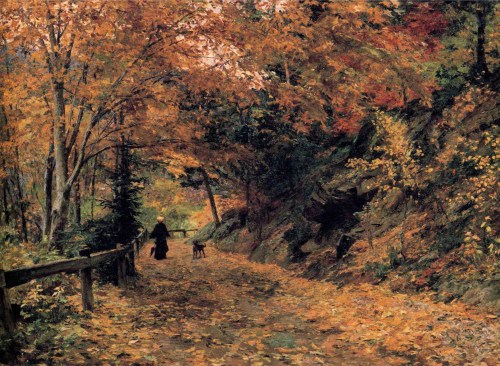
#FineArtFriday: Falling Leaves, by Olga Wisinger-Florian (revisited)

Falling Leaves, by Olga Wisinger-Florian, circa 1899, first appeared here in October of 2018.  It is one of my favorite depictions of autumn. The scene could be happening here in my lovely Pacific Northwestern forests. The colors of the leaves, the dirt road–this is very like where I grew up.

The painting depicts a woman and her dog enjoying a quiet walk in the serenity of an autumn day. Using light and shadow, the artist employs an impressionistic style to convey the forest. Nothing is drawn with precision, yet everything is shown in its entirety. The feeling of this piece is a little dreamlike–she carries an umbrella, so she’s prepared for rain. She is dressed all in black except for her yellow hat. Leaves in all the many shades of green, gold, and red cling to their trees; the damp, aging rails of the wooden fence offers a flimsy barrier to the carriages and motor vehicles that may travel the roadside. Leaves cover the dirt road, and more are falling down, and the dog trots happily along beside her mistress—the story is there for us to see.

About the Artist:

According to Wikipedia, Olga Wisinger-Florian’s early paintings can be assigned to what is known as Austrian Mood Impressionism. In her landscape paintings she adopted Schindler’s sublime approach to nature. The motifs she employed, such as views of tree-lined avenues, gardens and fields, were strongly reminiscent of her teacher’s work. After breaking with Schindler in 1884, however, the artist went her own way. Her conception of landscapes became more realistic. Her late work is notable for a lurid palette, with discernible overtones of Expressionism. With landscape and flower pictures that were already Expressionist in palette by the 1890s, she was years ahead of her time.


Credits and Attributions:

Falling Leaves, by Olga Wisinger-Florian, ca 1899 [Public domain], via Wikimedia Commons

Wikipedia contributors, “Olga Wisinger-Florian,” Wikipedia, The Free Encyclopedia, https://en.wikipedia.org/w/index.php?title=Olga_Wisinger-Florian&oldid=852607929 (accessed October 11, 2018).

Wikimedia Commons contributors, “File:Olga Wisinger-Florian – Falling Leaves.JPG,” Wikimedia Commons, the free media repository, https://commons.wikimedia.org/w/index.php?title=File:Olga_Wisinger-Florian_-_Falling_Leaves.JPG&oldid=273565541 (accessed October 11, 2018).

Comments Off on #FineArtFriday: Falling Leaves, by Olga Wisinger-Florian (revisited)

Filed under #FineArtFriday

#FineArtFriday: Moon Gate – Chinese Garden in the Hortus Haren by Dominicus Johannes Bergsma

Doorgang_in_muur._Locatie,_Chinese_tuin_Het_Verborgen_Rijk_van_Ming._Locatie._Hortus_Haren_01

Moon Gate, Chinese Garden in the Hortus Haren, The Netherlands

Date: 30 May 2015, 14:31:15

Author: Dominicus Johannes Bergsma

Camera location: 53° 10′ 48.67″ N, 6° 36′ 13.15″ E

About this image, via Wikimedia Commons:

A photograph of the passage in wall known as Moon Gate. Location, Chinese garden, the Hidden Realm of Ming. Location: Hortus Haren, one of the oldest botanical gardens in the Netherlands.

This photograph is a featured picture, which means that members of the community have identified it as one of the finest images on the English Wikipedia, adding significantly to its accompanying article. It was also a finalist in Picture of the Year 2015. [1]

What I love about this photograph:

This is a fairytale image. What magic lies beyond the gate? The composition is perfect. The round gate centered in the ordinary wall, a surprise opening onto a world of color and mystery. I would love to walk in this place.

About Hortus Haren, via Wikipedia:

Hortus Haren is a botanical garden in Haren, Groningen, Netherlands. First created in 1626 by the pharmacist Henricus Munting, it was then situated between Grote Rozenstraat and Grote Kruisstraat in Groningen.  Because of space considerations it relocated to Haren in 1967 and became the largest botanical garden in the country. [2]


Credits and Attributions:

Moon Gate, Chinese Garden in the Hortus Haren, The Netherlands, by Dominicus Johannes Bergsma. Dominicus Johannes Bergsma, CC BY-SA 4.0 https://creativecommons.org/licenses/by-sa/4.0, via Wikimedia Commons.

[1] Wikimedia Commons contributors, “File:Doorgang in muur. Locatie, Chinese tuin Het Verborgen Rijk van Ming. Locatie. Hortus Haren 01.jpg,” Wikimedia Commons, the free media repository, https://commons.wikimedia.org/w/index.php?title=File:Doorgang_in_muur._Locatie,_Chinese_tuin_Het_Verborgen_Rijk_van_Ming._Locatie._Hortus_Haren_01.jpg&oldid=684921659 (accessed September 29, 2022).

[2] Wikipedia contributors, “Hortus Haren,” Wikipedia, The Free Encyclopedia, https://en.wikipedia.org/w/index.php?title=Hortus_Haren&oldid=1111475348 (accessed September 29, 2022).

2 Comments

Filed under #FineArtFriday

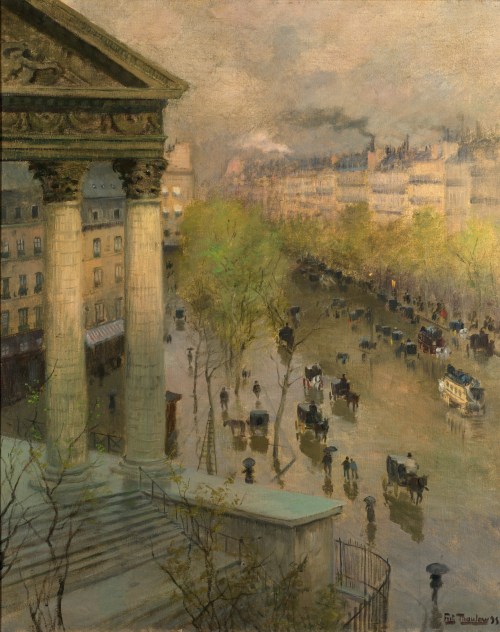
#FineArtFriday: Boulevard de la Madeleine in Paris by Frits Thaulow ca 1897 (revisited)

Frits_Thaulow_-_Boulevard_de_la_Madeleine_à_Paris_(1890s)Title: Boulevard de la Madeleine in Paris by Frits Thaulow

Date: circa 1896-1897

Medium: oil on canvas

Dimensions: Height: 88.2 cm (34.7 in); Width: 66.3 cm (26.1 in)

Collection: Pushkin Museum of Fine Arts

Inscriptions: Signature and date bottom right: Frits Thaulow (date is unclear)

What I like about this painting:

This is a street scene viewed from an angle we rarely see in paintings. The people and vehicles are small, insignificant in comparison with the size and grandeur of the buildings.

While Thaulow didn’t enjoy painting cityscapes, I think Boulevard de la Madeleine in Paris is one of the best of that era.

The soot from the chimneys in the distance, the wet street, the muted, watery colors of a rainy spring day, and the God’s-eye view of the busy street—it all comes together to present a powerful statement.

About the Artist, Via Wikipedia:

Thaulow was one of the earliest artists to paint in Skagen in the north of Jutland, soon to become famous for its Skagen Painters. He arrived there in 1879 with his friend Christian Krohg, who persuaded him to spend the summer and autumn there. They arrived from Norway in Thaulow’s little boat. Thaulow, who had specialized in marine painting, turned to Skagen’s favourite subjects, the fishermen and the boats on the shore.

Thaulow moved to France in 1892, living there until his death in 1906. He soon discovered that the cityscapes of Paris did not suit him. His best paintings were made in small towns such as Montreuil-sur-Mer (1892–94), Dieppe and surrounding villages (1894–98), Quimperle in Brittany (1901) and Beaulieu-sur-Dordogne in the Corrèze département (1903). One of his most famous works once he moved to france was A village street in France. In Dieppe Thaulow and his wife Alexandra made themselves popular: they were friends with artist Charles Conder, and they met Aubrey Beardsley. [1]


Credits and Attributions:

[1] Wikipedia contributors, “Frits Thaulow,” Wikipedia, The Free Encyclopedia, https://en.wikipedia.org/w/index.php?title=Frits_Thaulow&oldid=1026282924 (accessed June 10, 2021).

Boulevard de la Madeleine in Paris, ca 1896-97 by  Frits Thaulow, Public domain, via Wikimedia Commons. Wikimedia Commons contributors, “File:Frits Thaulow – Boulevard de la Madeleine à Paris (1890s).jpg,” Wikimedia Commons, the free media repository, https://commons.wikimedia.org/w/index.php?title=File:Frits_Thaulow_-_Boulevard_de_la_Madeleine_%C3%A0_Paris_(1890s).jpg&oldid=566337323 (accessed June 10, 2021).

7 Comments

Filed under #FineArtFriday

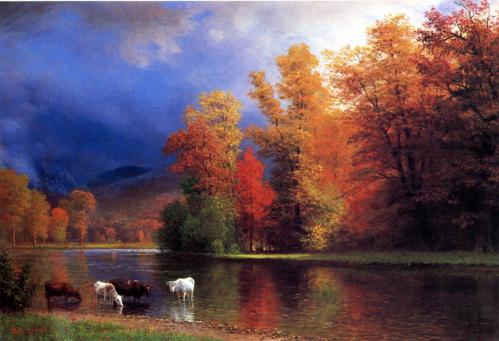
#FineArtFriday: On the Saco by Albert Bierstadt

Bierstadt_Albert_On_the_SacoArtist: Albert Bierstadt (1830–1902)

Title: “On the Saco”

Genre: landscape art

Description: Of the Saco River, Maine.

Date: Unknown date (19th century)

Medium: oil painting.

What I love about this image:

Bierstadt understood and respected the power of nature. The way he rendered the sky is wonderful. He captured that brilliant darkness of a distant storm against the bright sunshine of an autumn afternoon. I love contrasts in this painting, the bright foliage in every shade of red and yellow, the serenity of the cattle drinking in the shallows.

The heavy darkness of the storm in the hills seems to be pushed back by the serene glow of fall’s sunlight on the river. Will it rain itself out before it passes over the herd? Possibly.

About the Artist, via Wikipedia:

Albert Bierstadt (January 7, 1830 – February 18, 1902) was a German-American painter best known for his lavish, sweeping landscapes of the American West. He joined several journeys of the Westward Expansion to paint the scenes. He was not the first artist to record the sites, but he was the foremost painter of them for the remainder of the 19th century.

Bierstadt was born in Prussia, but his family moved to the United States when he was one year old. He returned to study painting for several years in Düsseldorf. He became part of the second generation of the Hudson River School in New York, an informal group of like-minded painters who started painting along the Hudson River. Their style was based on carefully detailed paintings with romantic, almost glowing lighting, sometimes called luminism. Bierstadt was an important interpreter of the western landscape, and he is also grouped with the Rocky Mountain School. [1]


Credits and Attributions:

Image: On the Saco by Albert Bierstadt, Wikimedia Commons contributors, “File:Bierstadt Albert On the Saco.jpg,” Wikimedia Commons, the free media repository, https://commons.wikimedia.org/w/index.php?title=File:Bierstadt_Albert_On_the_Saco.jpg&oldid=618723154 (accessed September 16, 2022).

[1] Wikipedia contributors, “Albert Bierstadt,” Wikipedia, The Free Encyclopedia, https://en.wikipedia.org/w/index.php?title=Albert_Bierstadt&oldid=1107140650 (accessed September 16, 2022).

5 Comments

Filed under #FineArtFriday

#FineArtFriday: The Munitions Girls by Stanhope Forbes,1918 #LaborDay

L0059548 'The Munitions Girls' oil painting, England, 1918

Artist: Stanhope Forbes (1857–1947)

Title: The Munitions Girls

Date: 1918

Medium: oil on canvas

Dimensions: height: 103 cm (40.5 in); width: 127 cm (50 in)

Collection: Science Museum

About this Image, via Wikimedia Commons:       

Commissioned by John Baker & Co, this famous oil painting, The Munitions Girls, shows women working at Kilnhurst Steelworks during the First World War. The artist was Alexander Stanhope Forbes (1857-1947). Like many other steelworks during the war, John Baker & Co’s Kilnhurst site was converted to make shells and ammunition. As men volunteered or were conscripted to fight in the British Army, women became the main work force in industry and farming. Munitions workers could often be picked out in a crowd because of the distinctive yellow coloring of their hair and skin caused by the sulfur used in production. They were nicknamed canaries. [1]

My Usual Fine Art Rant Goes in a Different Direction:

The women in this picture are shown doing dangerous, dirty work. They stepped up and did what they had to do to make sure their husbands and lovers had the weapons they needed to defend their country.

And they are doing it for very little money, less than men would have earned. While that is slowly changing, some things remain the same. It’s difficult to find people who want to do the “ordinary work,” jobs considered blue-collar, or manual labor.

Here in the US, it is Labor Day weekend, the last hurrah of summer, but more importantly, a day dedicated to appreciation of those who make up our labor force, the people who do the unglamorous work that keeps our world turning smoothly.

I’ve always been a writer, but I like to eat. I always held two and three part-time jobs just to keep the roof over my children’s heads and food on their table. I could make the food budget stretch like a politician’s idea of truth.

  • 1970s-80s – a field hand for a multi-national Christmas tree company, bookkeeper, photo lab tech, waitress in a bakery and also worked in a deli.
  • 1980s-90s – a hotel maid, a dark-room technician, a bookkeeper, and an office manager
  • 2000-13 – a bookkeeper, tax-preparer, data entry.

None of my work was glamorous but I always found something to enjoy in each job. By going to work every day I was able to pay my bills, which I did enjoy. Sometimes, especially during the Reagan years and into the 90s, wages were low, and jobs were scarce.

I worked every weekend and every holiday and yes it was not easy, but it was what it was. My kids knew I was doing my best for them, and they appreciated it.

During the late 70s and early 80s I was a field hand for the J. Hofert Company (Christmas trees) and absolutely loved the work. It was outdoors, paid $3.25 an hour and it was seasonal, but I was able to work a lot of overtime, as field hands were as hard to get then as they are now.

My favorite job was as a hotel maid at a large hotel in Olympia–the work was hard, but I enjoyed it for 12 years. For most of the 1990s it was my weekend job that I kept along with my bookkeeping job, because the hotel was a union shop.

As a bookkeeper/office manager for a charter bus company, I made $7.50 an hour (two dollars over minimum at the time). I worked four seven-hour shifts a week, Monday through Thursday, arriving at 06:00 AM to open the shop, ate lunch at my desk, and went home at 1:00 PM (13:00 military time). That job had no benefits whatsoever. However, I was home when my kids got off the school bus and could make sure they got to their after-school activities.

At my second job, 3 eight-hour shifts Friday through Sunday, I worked as a hotel housekeeper in a union shop. I made $8.50 an hour (three dollars over minimum).

I kept those two jobs all through the 1990s because I was home every night and earned enough to live decently and provide for my children.

No matter what other job I had, I kept my weekend job at the hotel, because it paid well and left my mind free to think about what I was writing. When other jobs went away, I always had that one to fall back on.

Because of the union, we who did the dirty work earned a little more than other women in that line of work, and had a few benefits, such as health insurance and a 401k. Without the union, we hotel maids would have had nothing more than minimum wage.

Not every union is good, and not every union is reasonable. But while I don’t agree with everything every union does and stands for, I do feel gratitude that I and my family was protected by a good, reasonable organization during those years of struggle.

I’m retired now and have the time to write all I want. The world is a different place in many ways, and workers are in short supply. Every place is short-staffed because there are more job openings than workers to fill them.

Someone must do the dirty jobs, the work that no one else wants. I have nothing but respect for those who work long hard hours in all areas of the service industry, struggling to support their families. Look around you, and see the people who make your life easier, by being there every day doing their job.

Every one of them is a person just like you, a living, caring human being with hopes, ambitions, triumphs, and tragedies. Every one of them has a story and a reason to be where they are, doing the task they have been given.

Say a little thank you to all those who take your unintentional abuse when you are stressed out and “don’t have time to wait,” or are upset by things you have no control over and need to vent at someone who can’t or won’t fight back.

The women in Stanhope Forbes’ painting are all gone now, memories of a moment in history. But what they did was important. Give a little thanks to those who do the dirty work and enable you to live a little easier.

About the Artist, via Wikipedia:

Forbes was born in Dublin, the son of Juliette de Guise Forbes, a French woman, and William Forbes, an English railway manager, who was later transferred to London. He had an older brother, Sir William Forbes, who was a railway manager for the London, Brighton, and South Coast Railway.

He was married in the summer of 1889 to fellow painter Elizabeth Armstrong at Newlyn’s St Peter’s Church. Their first home was at the “Cliffs Castle” cottage, which overlooked the sea. They had a son named Alexander (Alec). The couple had a home built for the family in Higher Faughan, Penzance. Elizabeth died in 1912.

Forbes generally painted genre scenes and landscapes en plein air.

Beyond his plein air painting, he also made interior scenes and was adept at capturing the “warm and charming” effects of lighting on a room and the people in it, such as The Lantern, made in 1897. More poignantly, Mrs. Lionel Birch writes of his style and particularly the painting The Health of the Bride: “[The painting depicts the] dominant note of his life’s message, his sense of sympathetic humanity. These people in their humble little parlour, are real and living. Intolerant of all shams and false sentiment, the painter has made himself one with the people he depicts; he has understood the humour which lies so close to tears.”

Of Forbes’s works, Norman Garstin said: “he is a good unsentimental painter, his work has a sense of sincerity that appeals to everyone”. [2]


Credits and Attributions:

[1] Wikimedia Commons contributors, “File:’The Munitions Girls’ oil painting, England, 1918 Wellcome L0059548.jpg,” Wikimedia Commons, the free media repository, https://commons.wikimedia.org/w/index.php?title=File:%27The_Munitions_Girls%27_oil_painting,_England,_1918_Wellcome_L0059548.jpg&oldid=667352991 (accessed September 1, 2022).

[2] Wikipedia contributors, “Stanhope Forbes,” Wikipedia, The Free Encyclopedia, https://en.wikipedia.org/w/index.php?title=Stanhope_Forbes&oldid=1089060843 (accessed September 1, 2022).

2 Comments

Filed under #FineArtFriday