Category Archives: #FineArtFriday

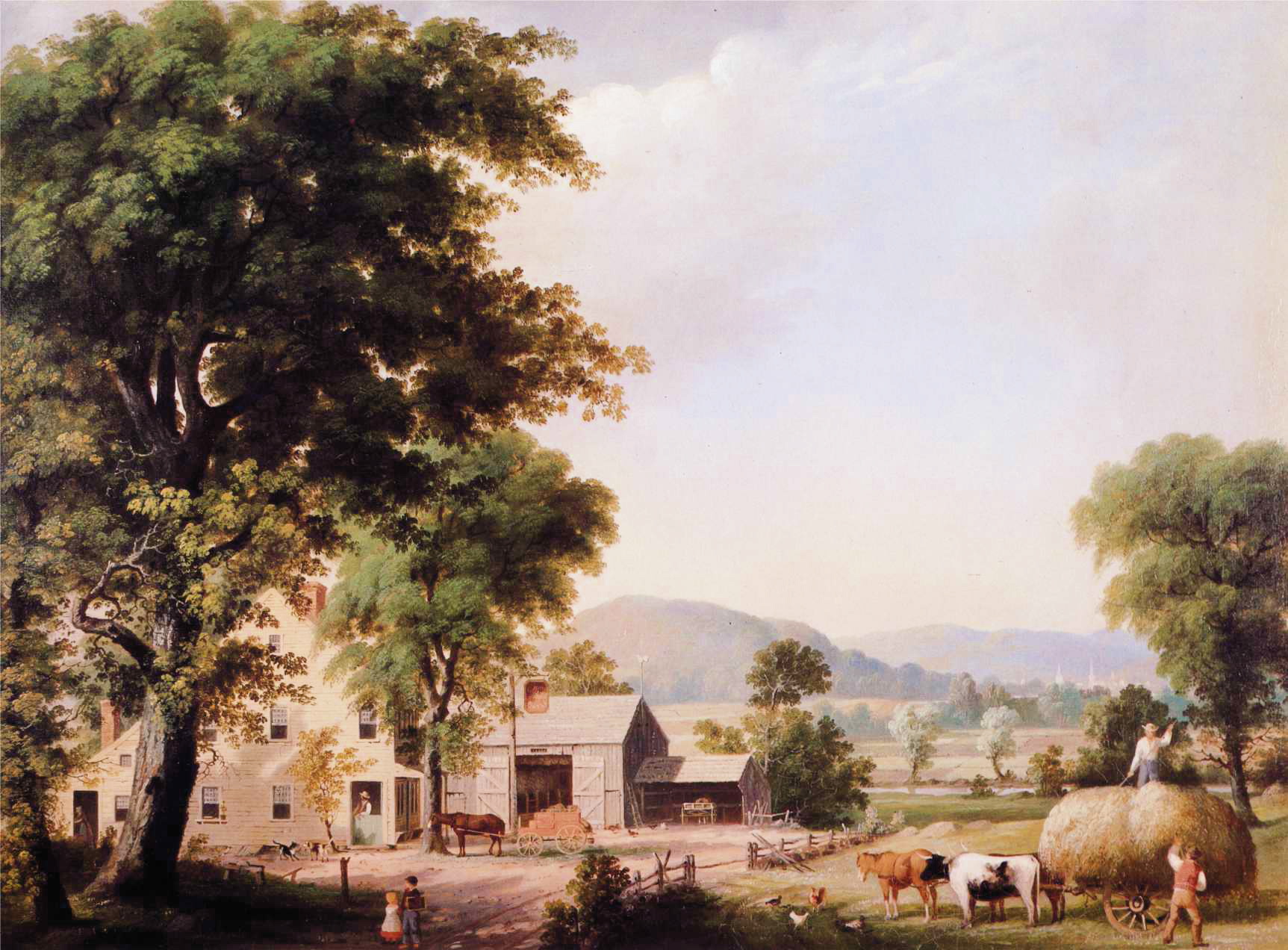
#FineArtFriday: Haying at Jones Inn by George Henry Durrie 1854

Artist: George Henry Durrie (1820–1863)

Title: English: Haying at Jones Inn

Date: 1854

Medium: oil on canvas

Dimensions: 22″×30″

Location: Private collection

What I love about this painting:

George Henry Durrie found beauty in the depictions of ordinary life. He always found a way to fit people into his scenes.

I absolutely love the nostalgia of this scene, and the wealth of information about how a reputable roadside inn worked. It is clear that Durrie was frequent guest at Jones Inn. He traveled widely in the years he worked as a portrait painter, and this particular public house is featured in his work several times from different angles. I like to imagine he painted the inn to provide a little respite from the demands of portraiture.

This scene shows us a day at the end of summer. Laborers are bringing a wagon piled high with hay. Two oxen are hitched behind a horse, the three working together to pull the laden wagon.

Country inns were often working farms. They had to be, as they were feeding staff and laborers as well as guests all year long, and there were no Costco, Sam’s Club, or Wholesale Foods to purchase supplies from.

The stables and the people who cared for the horses were just as important. Providing well for travelers’ horses was as crucial as that of providing the best rooms and food possible for their guests.

The hay piled on this wagon will feed not only the innkeepers’ beasts but will feed the horses ridden by guests as the year progresses. Many more wagons will be required to fill the barn and hayloft.

About the Artist, Via Wikipedia:

George Henry Durrie (June 6, 1820 – October 15, 1863) was an American landscape artist noted especially for his rural winter snow scenes, which became very popular after they were reproduced as lithographic prints by Currier and Ives.

For many years, Durrie made a living primarily as a portrait painter, executing hundreds of commissions. After marriage, he made frequent trips, traveling to New York, Massachusetts, New Jersey, and Virginia, fulfilling commissions and looking for new ones. His diary reveals that he was an enthusiastic railroad traveler, in the early days of the railroads. Durrie also painted what he called “fancy pieces”, whimsical studies of still lives or stage actors, as well as painting scenes on window-shades and fireplace covers. But portrait painting commissions became scarcer when photography came on the scene, offering a cheaper alternative to painted portraits, and, as his account-book shows, Durrie rarely painted a portrait after 1851.

Durrie’s interest shifted to landscape painting, and while on the road, or at home, made frequent sketches of landscape elements that caught his eye. Around 1844 Durrie began painting water and snow scenes, and took a second place medal at the 1845 New Haven State Fair for two winter landscapes. [1]

To learn more about this artist, go to  George Henry Durrie – Wikipedia


Credits and Attributions:

IMAGE: Wikimedia Commons contributors, “File:George Henry Durrie – Haying at Jones Inn.JPG,” Wikimedia Commons, https://commons.wikimedia.org/w/index.php?title=File:George_Henry_Durrie_-_Haying_at_Jones_Inn.JPG&oldid=853995435 (accessed October 22, 2025).

[1] Wikipedia contributors, “George Henry Durrie,” Wikipedia, The Free Encyclopedia, https://en.wikipedia.org/w/index.php?title=George_Henry_Durrie&oldid=1282714933 (accessed October 22, 2025).

Comments Off on #FineArtFriday: Haying at Jones Inn by George Henry Durrie 1854

Filed under #FineArtFriday

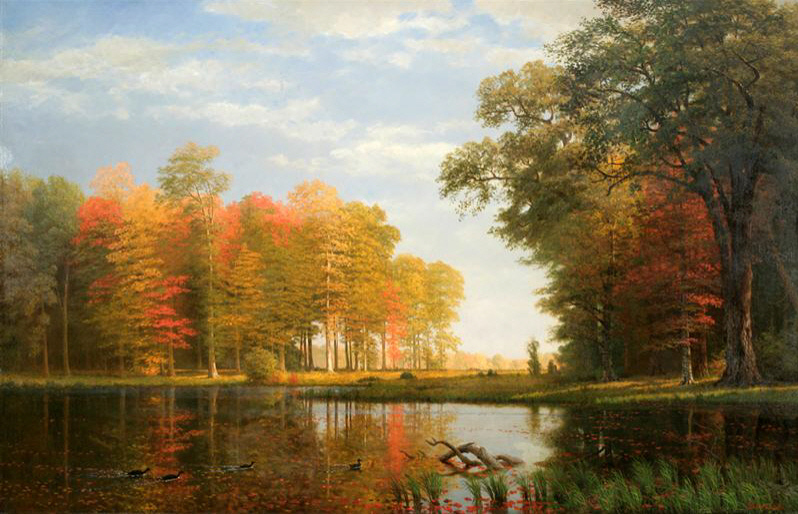
#FineArtFriday: Autumn Woods by Albert Bierstadt 1886

Artist: Albert Bierstadt (1830–1902)

Title: Autumn Woods, Oneida County, State of New York

Date: 1886

Medium: Oil on linen

Dimensions: Overall (linen): 54 x 84 in. (137.2 x 213.4 cm) Framed: 64 3/4 in. × 7 ft. 10 3/4 in. × 3 1/4 in. (164.5 × 240.7 × 8.3 cm)

Collection: New York Historical  (Gift of Mrs. Albert Bierstadt)

What I love about this painting:

Albert Bierstadt gives us a beautiful day in Glorious Autumn (with capitol letters), the kind of day rare here in my part of the Pacific Northwest. In October, rainy weather usually rolls in, accompanied by a blustery wind that strips the trees of leaves and takes the joy out of sightseeing.

Bierstadt’s trees are luminous, red and gold the way they are far away in the mystical lands on the other side of the continent from me. His sky is lovely, but he has kept our focus on the theme, so it doesn’t dominate the scene. The reflections of the trees on the quiet, still waters of the pond ensure they are the stars of this painting.

I especially like the realism of the branches of a downed tree rising out of the water in the foreground. This is a romantic depiction of what Autumn should be, as opposed to the sodden mess that it often is here in my town.

I would love to go walking along the shore of this pond.

About the Artist, via Wikipedia:

Albert Bierstadt (January 7, 1830 – February 18, 1902) was a German American painter best known for his lavish, sweeping landscapes of the American West. He joined several journeys of the westward expansion to paint the scenes. He was not the first artist to record the sites, but he was the foremost painter of them for the remainder of the 19th century.

Bierstadt was born in Prussia, but his family moved to the United States when he was one year old. He returned to study painting for several years in Düsseldorf. He became part of the second generation of the Hudson River School in New York, an informal group of like-minded painters who started painting along the Hudson River. Their style was based on carefully detailed paintings with romantic, almost glowing lighting, sometimes called luminism. Bierstadt was an important interpreter of the western landscape, and he is also grouped with the Rocky Mountain School. [1]

To read more about this artist, go to  Albert Bierstadt – Wikipedia.


Credits and Attributions:

IMAGE: Wikimedia Commons contributors, “File:Autumn Woods, Oneida County, State of New York 1910 11.jpeg,” Wikimedia Commons, https://commons.wikimedia.org/w/index.php?title=File:Autumn_Woods,_Oneida_County,_State_of_New_York_1910_11.jpeg&oldid=1069889157 (accessed October 16, 2025).

[1] Wikipedia contributors, “Albert Bierstadt,” Wikipedia, The Free Encyclopedia, https://en.wikipedia.org/w/index.php?title=Albert_Bierstadt&oldid=1308977510 (accessed October 16, 2025).

5 Comments

Filed under #FineArtFriday

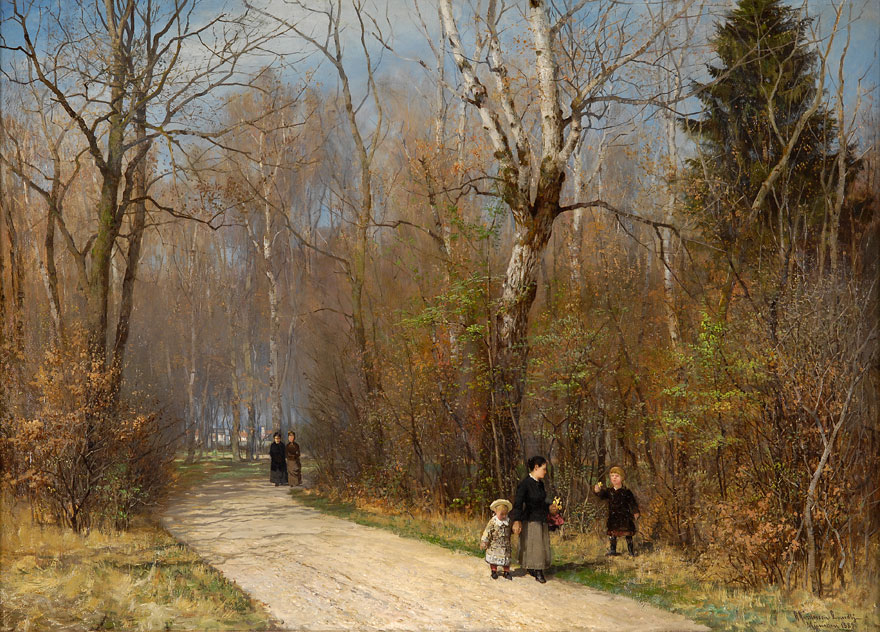
#FineArtFriday: An autumn walk in the English Garden of Munich by Anders Andersen-Lundby 1887

Artist: Anders Andersen-Lundby (1841–1923)

Title: English: An autumn walk in the English Garden of Munich. German: Herbstspaziergang im englischen Garten in München.

Date: 1887

Medium: oil on canvas

Dimensions: height: 77 cm (30.3 in); width: 106 cm (41.7 in)

Inscriptions: Signature and date: 1887

What I love about this painting:

Anders Anderson-Lundby shows us the perfect autumn day for a stroll. Truthfully, the day looks so pleasant that I’d like to be walking there. The leaves are nearly off the trees, and those that remain are golden and brown. Those who walk in these woods seem happy, content to be outdoors while the weather remains decent.

Autumn has arrived here in the Pacific Northwest. In a few weeks, this is how the deciduous trees in my part of the world will look. Right now the big-leaf maples are still holding fast to green but it’s shading toward brown and their leaves have begun falling. The Japanese maples and other non-native trees brightening gardens and public through-ways have turned a bright red. Soon our native vine maples and that (now undomesticated) decorative-plant-gone-native, staghorn sumac, will too.

About the Artist, via Wikipedia:

Anders Andersen-Lundby (December 16, 1841 – January 4, 1923) was a Danish landscape painter. He was most associated with winter landscapes.

(He) was born in Lundby, Denmark. He grew up in Lundby near Aalborg. In 1861, when he was twenty, Andersen-Lundby traveled to Copenhagen, and there he exhibited his works for the first time in 1864. By 1870, he gained popularity especially with his winter landscapes from both Denmark and southern Germany, most often with fallen snow or thaw.

In 1876, he moved to Munich with his family where he exhibited his paintings. He frequently visited Denmark and participated in exhibitions there. He exhibited at the Charlottenborg Spring Exhibition 1864–1913. [1]

To view more of Anders Anderson-Lundby’s work, go to Anders Andersen-Lundby – Wikipedia.


Credits and Attributions:

IMAGE: Wikimedia Commons contributors, “File:Anders Andersen-Lundby – Herbstspaziergang im Englischen Garten (1887).jpg,” Wikimedia Commons, https://commons.wikimedia.org/w/index.php?title=File:Anders_Andersen-Lundby_-_Herbstspaziergang_im_Englischen_Garten_(1887).jpg&oldid=1068508759 (accessed October 9, 2025).

[1] Wikipedia contributors, “Anders Andersen-Lundby,” Wikipedia, The Free Encyclopedia, https://en.wikipedia.org/w/index.php?title=Anders_Andersen-Lundby&oldid=1191864454 (accessed October 9, 2025).

5 Comments

Filed under #FineArtFriday

#FineArtFriday: Autumn in Towadako by Li Mei-shu

Title: Autumn in Towadako

Artist: Li Mei-shu

Date: 1978

Medium: oil on canvas.

What I love about this painting:

I love how this painting shows a pool of water at the base of the trees. I suspect the pond is dry during summer but in fall, the low area fills. The light shines through the trees and reflects on the water. It’s a scene of quiet beauty, a moment of serenity in the forest. I really like this painting.

Autum has arrived in the area where I live. The trees are beginning to turn colors, and unfortunately, the rains have come. But dryer weather is on the horizon, and we will be treated to red and gold leaves decorating the maples and other deciduous trees.

Soon, the streets and lanes in my town will be dressed in a final burst of color. It must be enjoyed while we can, as the beautiful leaves will soon turn brown and soggy, and the eternal gray of the Northwest winter will set in.

The coffee shops are all pushing their pumpkin spice blends, although I have so far resisted. However, I have pulled out a few cozy sweaters for when the weather really turns cool.

About the Artist, via Wikipedia:

Li Mei-shu (13 March 1902 – 6 February 1983) was a Taiwanese painter, sculptor, and politician. He was best known for his paintings as well as his restoration attempt of the Changfu Temple.

Li was born to an upper-class family in Sankakuyū (Pe̍h-ōe-jīSaⁿ-kak-éng), Japanese Taiwan (modern-day Sanxia DistrictNew Taipei City) on 13 March 1902. He began to demonstrate a propensity for painting in his early years. In 1918, he was accepted into the Painting Division of the Taiwan Governor-General’s National Language School. He taught himself painting after school through a copy of A Collection of Lectures, which he ordered from Japan through post. Upon graduating, he taught at Zuihō Public School (in modern-day Ruifang District). During this time, he participated in the Summer Art Seminar organized by Kinichiro Ishikawa. His works ‘Still Life and Backstreets of Sanxia’ were selected for the first and second Taiwan Art Exhibitions (Taiten), respectively. [1]

To learn more about Li Mei-shu, go to Li Mei-shu – Wikipedia.

Also, go to https://www.limeishu.org/


Credits and Attributions:

IMAGE: Wikimedia Commons contributors, “File:Autumn in Towadako, by Li Mei-shu.jpg,” Wikimedia Commons, https://commons.wikimedia.org/w/index.php?title=File:Autumn_in_Towadako,_by_Li_Mei-shu.jpg&oldid=1031830163 (accessed October 2, 2025).

[1] Wikipedia contributors, “Li Mei-shu,” Wikipedia, The Free Encyclopedia, https://en.wikipedia.org/w/index.php?title=Li_Mei-shu&oldid=1310846803 (accessed October 2, 2025).

6 Comments

Filed under #FineArtFriday

#FineArtFriday: A closer look at “The Alyscamps,” or “The Three Graces at the Temple of Venus” by Paul Gauguin 1888

Paul_Gauguin_les_alyscamps085

Artist: Paul Gauguin (1848–1903)

Title:  (English)The Alyscamps, or The Three Graces at the Temple of Venus

French: French: Les Alyscamps, ou Les Trois grâces au temple de Venus

Date: 1888

Medium: oil on canvas

Dimensions: height: 91.6 cm (36 in); width: 72.5 cm (28.5 in)

Collection: Musée d’Orsay

What I love about this painting:

Color! I love the vivid colors contrasted against the pale sky. The Three Graces in classical mythology are the goddesses of charm, beauty, nature, human creativity, goodwill, and fertility. They have come to symbolize faith, hope, and charity.

According to the internet, the traditional mythology Paul Gauguin explores in this composition demonstrates his early education and his appreciation of classical art. And truthfully, although he never trained formally, he did know his stuff. Before he became an artist, he was both a stockbroker and an art dealer/collector.

Gauguin is known for his use of bold colors, simplified forms, and strong lines. Again, according to the internet, this painting is a prime example of his study of form and color.

And he tells us a story. First, the eye is drawn to the vertical lines of the temple standing tall on the hill behind the figures. They are also depicted with a sense of height, and the hills beyond are tall and narrow.

A calm stream flows from beneath the temple, the river of time. The three women stand almost in the background, yet they are commanding, observing us and our lives as time passes them. They are as strong and unmovable as the rocky hills and the temple.

Gauguin tells us that time may pass, and things may change, but the Temple of Venus rises above it all. Does this Temple of Venus represent “agape,” a love that is selfless and unconditional? A kind of love that is spiritual in nature?

Maybe, and maybe not.

Paul Gauguin was a famously complicated man, conflicted and tormented by the contrasts of 19th century morality and the realities of his life.

Who knows what that temple meant to him on the day he created it? Either way, Gauguin’s Three Graces, Faith, Hope, and Charity, stand almost in the shadows, offering him comfort. They are as solid and eternal as time.

And who or what, I wonder, is the immense dark, nearly indistinct fourth shadow who peers over their left shoulder? It seems like a person’s form. Is it another of the Fates? Is it Death? There is so much to consider in this painting.

Paul Gauguin lived an eventful life. For a wonderful documentary on the man and his life, go to:

Why Is Gauguin So Controversial? (Waldemar Januszczak Documentary) | Perspective – YouTube

Also, check out Paul Gauguin – Wikipedia.


Credits and Attributions:

Image: Wikimedia Commons contributors, “File:Paul Gauguin 085.jpg,” Wikimedia Commons, https://commons.wikimedia.org/w/index.php?title=File:Paul_Gauguin_085.jpg&oldid=710795058 (accessed September 24, 2025).

Comments Off on #FineArtFriday: A closer look at “The Alyscamps,” or “The Three Graces at the Temple of Venus” by Paul Gauguin 1888

Filed under #FineArtFriday

#FineArtFriday: Indian Sunset – Deer by a Lake by Albert Bierstadt ca. 1880 – 90

Artist: Albert Bierstadt (1830–1902)

Title: Indian Sunset – Deer by a Lake

Date: circa 1880-1890

Medium: oil on canvas

Dimensions: height: 77.2 cm (30.3 in); width: 113.1 cm (44.5 in)

Collection: Yale University Art Gallery

What I love about this painting:

I love the way the setting sun glows through the rising mist, shining across the still waters of the lake. I love the shadowy woods, the deepening sense that twilight is near and night will soon enshroud the scene.

Deer graze in the lush meadow at the shore. Perhaps they will bed down in the shelter of the trees at the edge of the wood.

Albert Bierstadt’s landscapes made even the most ordinary scene feel majestic. One of his greatest skills was his ability to show the haze of twilight and the stillness of a pond or lake at that singular time of the late September evening, that moment when the warm breeze cools, slows, and fades to calm.

By placing wild deer in his scene, Bierstadt gives us a little story and a reason to care. It is autumn, and hunting season. Will this brief moment of peace be the buck’s last? We’ll never know, but I like to think Bambi and his family will live to see the advent of spring.

About the Author, via Wikipedia:

Albert Bierstadt (January 7, 1830 – February 18, 1902) was a German American painter best known for his lavish, sweeping landscapes of the American West. He joined several journeys of the westward expansion to paint the scenes. He was not the first artist to record the sites, but he was the foremost painter of them for the remainder of the 19th century.

Bierstadt was born in Prussia, but his family moved to the United States when he was one year old. He returned to study painting for several years in Düsseldorf. He became part of the second generation of the Hudson River School in New York, an informal group of like-minded painters who started painting along the Hudson River. Their style was based on carefully detailed paintings with romantic, almost glowing lighting, sometimes called luminism. Bierstadt was an important interpreter of the western landscape, and he is also grouped with the Rocky Mountain School. [1]

To read more about this artist, go to  Albert Bierstadt – Wikipedia.


Credits and Attributions:

IMAGE: Wikimedia Commons contributors, “File:Indian Sunset Deer by a Lake by Albert Bierstadt.jpeg,” Wikimedia Commons, https://commons.wikimedia.org/w/index.php?title=File:Indian_Sunset_Deer_by_a_Lake_by_Albert_Bierstadt.jpeg&oldid=828692957 (accessed September 18, 2025).

[1] Wikipedia contributors, “Albert Bierstadt,” Wikipedia, The Free Encyclopedia, https://en.wikipedia.org/w/index.php?title=Albert_Bierstadt&oldid=1308977510 (accessed September 18, 2025).


4 Comments

Filed under #FineArtFriday

#FineArtFriday: Autumn on the Hudson River by John Williamson 1871

Artist: John Williamson (1826–1885)

Title: Autumn, Hudson River

Date: 1871

Medium: oil on canvas

Dimensions: 45.7 × 58.4 cm (17.9 × 22.9 in).

Inscriptions: Signed and inscribed verso (now covered by relining): Autumn. / Hudson River. / By J. W. Williamson / N.Y. 1871


What I love about this painting:

Williamson shows us a peaceful autumn day on New York’s Hudson River, focusing on the quiet beauty of wild grass and calm waters.

This is a beautiful depiction of what autumn often looks like where I live, despite it’s being on the other side of the continent.

The morning mist is gradually lifting, revealing a field of harvest-gold grass. Inland, I imagine the farmers are hoping for the mist to burn off to sunny Indian summer day so they can get the hay in before the weather turns wet.

Further out, the sails of fishing boats and cargo vessels gleam white in the mist as they go about their business, likely also hoping for a sunny day. I suspect they won’t get it, as the cloud cover looks high and there to stay.

As I mentioned above, this view of a less-than-sunny day on the East Coast is not too different from autumn here in the Pacific Northwest.

To my knowledge, this is the first time I have come across works by John Williamson.

I could find nothing about him or his art on Wikipedia, but I did find a few biographies about him on several art auction sites. This was the most informative:

About John Williamson, via Questroyal Fine Art:

John Williamson was a versatile artist who created still lifes, genre scenes, and landscapes during the heyday of the Hudson River School. Born in Scotland, Williamson came to the United States with his family in 1831. He spent most of his life in Brooklyn, New York, studying art at the Brooklyn Institute and helping to found the Brooklyn Art Association. [1]

To continue reading about this artist, go to John Williamson – Questroyal Fine Art.


Credits and Attributions:

IMAGE: Wikimedia Commons contributors, “File:Autumn Hudson River-John Williamson-1871.jpg,” Wikimedia Commons, https://commons.wikimedia.org/w/index.php?title=File:Autumn_Hudson_River-John_Williamson-1871.jpg&oldid=1069869485 (accessed September 10, 2025).

[1] Quote from artist biography via John Williamson – Questroyal Fine Art, © 2025 Questroyal Fine Art, LLC.

Comments Off on #FineArtFriday: Autumn on the Hudson River by John Williamson 1871

Filed under #FineArtFriday

#FineArtFriday: Greenwood Lake by Jasper Francis Cropsey, 1879

Artist: Jasper Francis Cropsey (1823–1900)

Title: Greenwood Lake

Description: English: Greenwood Lake by Jasper Francis Cropsey

Date: 1879

Medium: oil on canvas

Dimensions: height: 60.3 cm (23.7 in); width: 110.5 cm (43.5 in)

Collection: Private collection

What I love about this painting:

Jasper Francis Cropsey loved the wild beauty of Greenwood Lake as it was in his day. I suspect he wouldn’t feel quite the same about it nowadays, since it is definitely a summer destination for modern vacationers. He found his muse in the rural beauty there.

Autumn seems to have been a favorite time of year for him. Each autumn, he made numerous paintings from his favorite spots along the shore and in the area. This painting was made just as warm September drifted toward the cold months of October and November. The deciduous trees are dressed in shades of red and gold.

Two men walk along the dirt lane that runs beside a meadow. Perhaps they are just going from one place to another, or maybe they are hunters. If so, they are returning empty-handed.

Cattle graze and gossip in the distance, as cows often do. A dog (perhaps the farm dog?) has stopped in the middle of the road to bark his greeting to the men.

I understand why Cropsey painted this scene many times from different angles. In my opinion, the end of September is the best part of autumn in the north. Soon, the beautiful colors will fade, falling to the ground and turning soggy and brown, marking the end of the annual cycle. But now, this day, Cropsey’s world is at peace, the air is crisp, and the leaves are at that wonderful stage that pleases the eye and makes one glad to be alive.

About the Artist, via Wikipedia:

Jasper Francis Cropsey (February 18, 1823 – June 22, 1900) was an American architect and artist. He is best known for his Hudson River School landscape paintings.

Cropsey trained as an architect under the tuition of Joseph Trench in the early 1840s, a period in which he was also trained in watercolor painting, instructed by Edward Maury, and took some life drawing courses at the National Academy of Design. He set up his own architecture office in 1843, but began exhibiting his watercolors at the National Academy of Design in 1844. A year later he was elected an associate member and turned exclusively to landscape painting; shortly after he was featured in an exhibition entitled “Italian Compositions”.[1]

To learn more about Jasper Francis Cropsey, go to Jasper Francis Cropsey – Wikipedia.

About the scenery in this painting via Wikipedia:

Greenwood Lake is an interstate lake approximately seven miles (11 km) long, straddling the border of New York and New Jersey. It is located in the Town of Warwick and the Village of Greenwood LakeNew York (in Orange County) and West MilfordNew Jersey (in Passaic County). It is the source of the Wanaque River.

Jasper Francis Cropsey created several paintings of Greenwood Lake beginning in 1843. Cropsey painted many paintings of the area such as American Harvesting (1864), Greenwood Lake (1870), Fisherman’s House, Greenwood Lake (1877), and Cooley Homestead–Greenwood Lake (1886). Cropsey met and married Maria Cooley, daughter of Issac P. Cooley, in 1847 and continued to visit the area for many years.

Some of Cropsey’s painting command high prices at auctions. Greenwood Lake (1879) sold at Christie’s auction in 2012 for $422,500. Sunset, Camel’s Hump, Lake Champlain (1877) sold for $314,500 in 2011. [2]


Credits and Attributions:

IMAGE: Wikimedia Commons contributors, “File:Greenwood Lake by Jasper Francis Cropsey, 1879.jpg,” Wikimedia Commons, https://commons.wikimedia.org/w/index.php?title=File:Greenwood_Lake_by_Jasper_Francis_Cropsey,_1879.jpg&oldid=617153620 (accessed September 4, 2025).

[1] Wikipedia contributors, “Jasper Francis Cropsey,” Wikipedia, The Free Encyclopedia, https://en.wikipedia.org/w/index.php?title=Jasper_Francis_Cropsey&oldid=1309347669 (accessed September 4, 2025).

[2]  Wikipedia contributors, “Greenwood Lake,” Wikipedia, The Free Encyclopedia, https://en.wikipedia.org/w/index.php?title=Greenwood_Lake&oldid=1300748871 (accessed September 4, 2025).

4 Comments

Filed under #FineArtFriday

#FineArtFriday: a second look at “Street Scene on a Rainy Day” by Francesco Miralles Galup (ca. 1891)

Title: Escena de carrer en un dia de pluja (Eng: Street Scene on a rainy Day)

Artist: Francisco Miralles Galup

Date: circa 1891

What I love about this painting:

Francesco Miralles Galup understood how to show the reality of weather, especially weather that was only mildly uncomfortable. We see a perfect rainy spring afternoon in a busy cosmopolitan city. It could have been any large city at the end of the 19th century. The sky is gray, the street is busy, full of carriages, and pedestrians must be careful where they step.

A cart full of flowers passes in the background, headed for the market. Two well-dressed ladies dodge puddles in their effort to cross the street. Around them, people stop to gossip, and umbrellas abound.

Like every chihuahua I’ve ever known, the little dog is miserable, unhappy with the damp.

I think this may be one of my favorite paintings of that era, one showing real people and their social lives. It was an era before refrigeration, so people went to the market each day to purchase whatever food they planned to serve. The market is where they met up with their friends and heard news of both the wider world and the local gossip.

He shows us ordinary people, happy and living their best lives.

About the Artist, via Wikipedia:

Francesco Miralles Galup was born Francesc Miralles i Galaup (6 April 1848, Valencia – 30 October 1901, Barcelona). He was a Catalan painter, best known for his realistic scenes of bourgeois life and high society.

When he turned eighteen, he received parental permission (and financial support) to study in Paris, where he would remain until 1893, with occasional visits home. During his first years there, he copied masterworks at the Louvre and may have worked briefly with Alexandre Cabanel. He eventually had several small studios in Montmartre and on the Rue Laffitte.

He exhibited regularly at the Salon and the Sala Parés, back home in Barcelona. He also became a client of the well-known art dealership Goupil & Cie, attracting wealthy buyers throughout Europe and America. This was a relief to his family, who had initially been concerned that they might have to support him indefinitely. Their ability to do so had been compromised as they had lost much of their fortune in the Panic of 1866 and were losing more of it as they paid off their debts. In fact, they eventually moved to Paris so he could help support them. [1]


Credits and Attributions:

IMAGE: Escena de carrer c1891, Francisco Miralles Galup / Public domain. Wikimedia Commons contributors, “File:Francesco Miralles Galup – Escena de carrer c1891.jpg,” Wikimedia Commons, https://commons.wikimedia.org/w/index.php?title=File:Francesco_Miralles_Galup_-_Escena_de_carrer_c1891.jpg&oldid=1039428081 (accessed August 28, 2025).

[1]Wikipedia contributors, “Francesc Miralles i Galaup,” Wikipedia, The Free Encyclopedia, https://en.wikipedia.org/w/index.php?title=Francesc_Miralles_i_Galaup&oldid=1291581678 (accessed August 28, 2025).

Comments Off on #FineArtFriday: a second look at “Street Scene on a Rainy Day” by Francesco Miralles Galup (ca. 1891)

Filed under #FineArtFriday

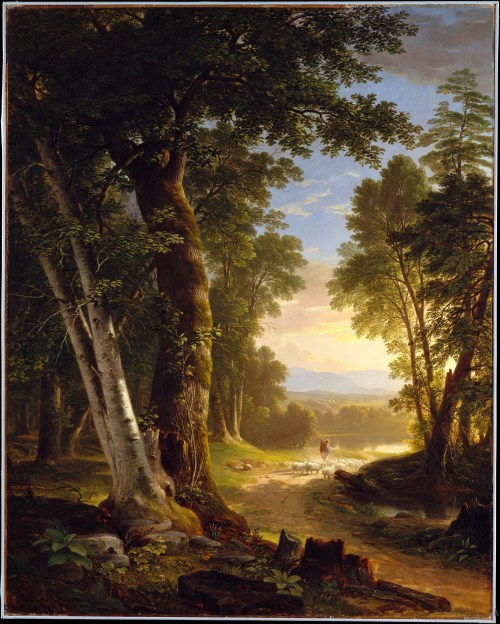
#FineArtFriday: a closer look at “The Catskills,” by Asher Brown Durand 1858

Artist: Asher Brown Durand (1796–1886)

Title: The Catskills

Date: 1859

Medium: oil on canvas

Dimensions: height: 158.8 cm (62.5 in); width: 128.3 cm (50.5 in)

What I love about this painting: 

I grew up in a forested place, not unlike that depicted here. That sentiment has endeared this style of art to me. I have become attached to the modern fantasy painters, those modern artists like Michael Whelan and the late Darrell K. Sweet, who paint images in this style for fantasy novels and RPG games. Their style is called Imaginative Realism.

What strikes me the most about this particular painting is not only the attention to detail, but the fairy-tale quality of Durand’s vision of realism. Viewed as a whole, this composition has an otherworldly quality to it, almost as if Elrond or Galadriel lurk just out of view, beyond the edges.

Quote from Wikimedia Commons on The Catskills: This painting was commissioned by William T. Walters in 1858, when the 62-year-old Durand was at the height of his fame and technical skill. The vertical format of the composition was a trademark of the artist, allowing him to exploit the grandeur of the sycamore trees as a means of framing the expansive landscape beyond. Durand’s approach to the “sublime landscape” was modeled on that of Thomas Cole (1801-48), founder of the Hudson River school of painting. The painters of this school explored the countryside of the eastern United States, particularly the Adirondack Mountains and the Catskills. Their paintings often reflect the Transcendental philosophy of Ralph Waldo Emerson (1803-82), who believed that all of nature bore testimony to a spiritual truth that could be understood through personal intuition.

>>><<<

Quote from Wikipedia (the fount of all knowledge): Asher Brown Durand is remembered particularly for his detailed portrayals of trees, rocks, and foliage. He was an advocate for drawing directly from nature with as much realism as possible. Durand wrote, “Let [the artist] scrupulously accept whatever [nature] presents him until he shall, in a degree, have become intimate with her infinity…never let him profane her sacredness by a willful departure from truth.”

Like other Hudson River School artists, Durand also believed that nature was an ineffable manifestation of God. He expressed this sentiment and his general opinions on art in his essay “Letters on Landscape Painting” in The Crayon, a mid-19th century New York art periodical. Wrote Durand, “[T]he true province of Landscape Art is the representation of the work of God in the visible creation…”


Credits and Attributions

[1] Wikimedia Commons contributors, “File:Asher Brown Durand – The Catskills – Walters 37122.jpg,” Wikimedia Commons, https://commons.wikimedia.org/w/index.php?title=File:Asher_Brown_Durand_-_The_Catskills_-_Walters_37122.jpg&oldid=354202161 (accessed August 21, 2025).

[2] Wikipedia contributors, “Asher Brown Durand,” Wikipedia, The Free Encyclopedia, https://en.wikipedia.org/w/index.php?title=Asher_Brown_Durand&oldid=1291945600 (accessed August 21, 2025)..

5 Comments

Filed under #FineArtFriday