Category Archives: #FlashFictionFriday

#FlashFictionFriday: Edna’s Garden, Part 2

I’m packing up to move. Selling the house was more work than I thought it would be. My agent assured me the large sum of money I spent replacing the old carpets with laminate, and getting new, natural-stone counter-tops would more than pay for itself when I found the right family to sell the place to. Frank Lanier, my real estate agent, has known me for years. He accepts that I believe more is at stake than mere money and was willing to write some unusual clauses into the contract.

My daughter doesn’t know this, but I told Frank that if the right people wanted the house, I would accept any offer they made, even if it was a little low.

The problem is, I’ve buried two husbands, and now I’ve outlived my handyman, Jasper. He seemed so healthy too. But he dropped dead of a heart attack at the young age of only eighty-two. Jasper did everything I couldn’t for the last thirty years, mowing the grass, cleaning the gutters, fixing the wonky electric system, or repairing the roof. I don’t want to have to train some young know-it-all in how things should be done, such as not running the lawnmower over the sprinkler heads. I’ve accepted that I can’t care for the place anymore.

But I do have a responsibility to see to it the right family moves in here. They must be able to see past the expected, must have an imagination, and absolutely must be committed to preserving…nature.

Marjorie, my daughter, is only in her seventies and, unfortunately for her husband, she’s as healthy as a racehorse. The way she carries on about every minor ailment, you’d think she was at death’s door. Arthur, Marjorie’s husband, is the least spirited man I’ve ever met. I suppose forty-eight years of being tied to her has long since beaten anything resembling a backbone out of him. Marjorie has the notion her life will be much easier if they sell everything and move to Florida.

I know what my extraordinarily lazy daughter is up to.  By purchasing a condominium in a resort for well-heeled seniors, Marjorie will have housekeepers to order around and will never have to cook again. They could eat every meal in the community dining room. I’m sure Arthur sees that as a point in her favor since Marjorie can’t even boil water without burning it.

It sounds like a cruise ship but without the Norovirus. However, she needs me to foot the bill, because she always spent her and her husband’s salaries faster than they could earn it, and then she insisted on retiring early. So, they’re out of money now, but she has a new retirement plan–me. She’s been pretending I’m senile and petitioned the court to be given custodial power over me and my assets “for my best interests.”

That will never happen. She now hates my lawyer, because he made it clear that I am in complete possession of my wits, and the judge rather bluntly asked her what she was hoping to gain. She became quite offended, saying it was her duty to care for me in my declining years.

Of course, she came apologizing afterward, trying to convince me to move in with them, but I told her I had plans that involved having a life. Marjorie got that pouty look, the one she wears anytime she’s balked. After we had left the court, I did tell Violet that booking myself into the lowest-rated nursing home in a Bombay slum would be preferable to putting myself and my money in Marjorie’s power. Violet knows Marjorie, and had to agree.

With Jasper’s untimely death, I had to do something about the house, but I have a responsibility to the “guests” in my garden. I didn’t tell Frank why I wanted only a certain kind of family, but the truth is, whoever purchased this place had to be people with an open mind. They had to be able to see my fairies and understand they are an endangered species and that they have a sacred duty to protect them. That’s why I had Frank put the clause in the contract that the new owners must never cut the hedge.

Frank finally found the right people. Kaitlyn and Martha fell in love with it. When they looked at the garden, Kaitlyn spotted the fairies and got all excited, pointing and whispering to Martha that this was the place for them to build their life together, and she had to have it, no matter what.

Martha agreed.

So now, that perfectly sweet couple will live here, and my fairies will be safe.

As the judge advised me to, I’m spending Marjorie’s inheritance. Frank found me the perfect little condo downtown near the senior center, and I can bring my cat, Rufus. It’s only a few blocks from the farmer’s market, and it’s on the bus line so I can sell my car, which will make my insurance agent happy.

Once I get settled there, Violet and I will take a two-week trip to Italy. We have a lot of plans, and making a pilgrimage to Fabio’s birthplace is just the beginning.

512px-August_Malmström_-_Dancing_Fairies_-_Google_Art_Project


Edna’s Garden, Part 2 © 2016 Connie J. Jasperson, All Rights Reserved

Click here to read part one of Edna’s Garden 

Comments Off on #FlashFictionFriday: Edna’s Garden, Part 2

Filed under #FlashFictionFriday, Fairies, Fantasy, writing

#flashfictionfriday: The Sea Doves

sanddollar

For more information on the life cycle of the common sand dollar, go to http://www.gma.org/tidings/sand-dollar

An older lady walking with a cane, and a young boy of about four strolled along the beach, following the line of shells and debris left by the retreating tide.

“Grandma, what’s this?” The boy picked up a round, flat shell, with a design that looked like a flower etched on the rounded top.

“It’s a sand dollar,” replied the grandmother. “When the little creature inside dies, it leaves its teeth behind. Their teeth are shaped like doves. If you shake it you can hear the doves inside, rattling around.”

“Real doves? Like the ones by our house?” He peered intently at it, turning it over in his chubby hands and then, holding it up to his ear, he shook it.  He  danced with excitement, his eyes bright. “I can hear them!”

They walked a while further and the boy bent down again, picking up another sand dollar. “This one is is broken. What happened to the doves? Did they fly to my yard back home?”

The grandmother chuckled. “Perhaps they did. Shall we open one and see if they’re the kind of doves that fly?”

“Okay. I’ll find one.”  After a few moments of searching, the boy shouted, “I found it.” Quickly bending down, he picked up his find and held it out to his grandmother. “Can you open it now?”

“We’ll need a rock,” said Grandma. “Get me a good rock for pounding on things, about the size of your fist.”

Soon the two were bent over a driftwood log, with the sand dollar lying ready to be opened. “What should I do?”

“Give it a good whack. Not too hard, but just enough to crack it open.”

The boy shook his head. “I’m too strong. What if I smash it? I’m much stronger than you, so maybe you should whack it.”

Laughing again, Grandma complied. Soon the shell was opened and the little dove-shaped teeth were exposed.

The boy waited for a moment, then asked, “How come they aren’t flying away?”

Grandma thought for a moment. “Perhaps they only fly when we aren’t looking at them. Maybe we have to close our eyes and wish as hard as we can.”

The boy did so and after a moment Grandma said, “Look!”

His eyes flew open and he saw in the distance five white birds, flying away. “They did it! We let them loose! But they turned into seagulls.”

Grandma fingered the tiny bones in her pocket. “You’re right. Those were seagulls. Maybe they only turn into sea doves if we let them break out naturally.”

“Okay. We won’t hatch any more. I think there are enough seagulls on this beach right now. What we need are sea doves.”

Grandma agreed. The two walked on, stopping occasionally and examining the amazing finds left behind by the tide.


The Sea Doves, © Connie J. Jasperson 2016, All Rights Reserved

7 Comments

Filed under #FlashFictionFriday, Fantasy, writing

#flashfictionFriday: Sonnet 116, by William Shakespeare

Wm Shakespeare Amazon Author Central portraitWe haven’t waxed poetic over Shakespeare recently, and I think it’s time to consider the prose of the master, both its meaning and its construction. To that end, I give you

Sonnet 116

Let me not to the marriage of true minds

Admit impediments, love is not love

Which alters when it alteration finds,

Or bends with the remover to remove.


O no, it is an ever fixèd mark

That looks on tempests and is never shaken;

It is the star to every wand’ring bark,

Whose worth’s unknown although his height be taken.


Love’s not time’s fool, though rosy lips and cheeks

Within his bending sickle’s compass come,

Love alters not with his brief hours and weeks,

But bears it out even to the edge of doom:


If this be error and upon me proved,

I never writ, nor no man ever loved.

Sonnet 116 is typical of what we think of as a classic English sonnet. The English sonnet has three quatrains (verses), followed by a final rhyming couplet. It follows the typical rhyme scheme of iambic pentameter, which is a type of poetic meter: one short (or unstressed) syllable followed by one long (or stressed) syllable.

The interpretation of this poem is open to many speculations, the most compelling of which I found in Cliffs Notes, and which I quote here:

Despite the confessional tone in this sonnet, there is no direct reference to the youth. The general context, however, makes it clear that the poet’s temporary alienation refers to the youth’s inconstancy and betrayal, not the poet’s, although coming as it does on the heels of the previous sonnet, the poet may be trying to convince himself again that “Now” he loves the youth “best.” Sonnet 116, then, seems a meditative attempt to define love, independent of reciprocity, fidelity, and eternal beauty: “Love’s not Time’s fool, though rosy lips and cheeks / Within his bending sickle’s compass come.” After all his uncertainties and apologies, Sonnet 116 leaves little doubt that the poet is in love with love.

The experts at Shakespeare Online say:

Sonnet 116 is about love in its most ideal form. The poet praises the glories of lovers who have come to each other freely, and enter into a relationship based on trust and understanding. The first four lines reveal the poet’s pleasure in love that is constant and strong, and will not “alter when it alteration finds.” The following lines proclaim that true love is indeed an “ever-fix’d mark” which will survive any crisis. In lines 7-8, the poet claims that we may be able to measure love to some degree, but this does not mean we fully understand it. Love’s actual worth cannot be known – it remains a mystery. The remaining lines of the third quatrain (9-12), reaffirm the perfect nature of love that is unshakeable throughout time and remains so “ev’n to the edge of doom”, or death.

In the final couplet, the poet declares that, if he is mistaken about the constant, unmovable nature of perfect love, then he must take back all his writings on love, truth, and faith. Moreover, he adds that, if he has in fact judged love inappropriately, no man has ever really loved, in the ideal sense that the poet professes.

Five hundred years after his time on this earth, the Bard of Avon’s crafting of ideals and emotions into words evokes powerful feelings in the reader. He is immortal, because we hear his words and feel their impact.

The secret poet within me hopes to one day develop more poetic skill, whether it is writing free-verse, or crafting a more traditional rhyming style of prose. To that end, I practice writing poetry when I am in the mood, and read the masters, and attend local poetry-slams. It’s amazing, the talent in your local poetry groups.


References:

Cliffs Notes, Sonnet 116 © 2016 Houghton Mifflin Harcourt. All rights reserved.

Shakespeare, William. Sonnet 116. Ed. Amanda Mabillard. Shakespeare Online. 8 Dec. 2012. http://www.shakespeare-online.com/sonnets/116detail.html

Comments Off on #flashfictionFriday: Sonnet 116, by William Shakespeare

Filed under #FlashFictionFriday, Literature, Poetry, writing

#FridayFiction: The Bolthole, part 2

The next morning, Eddie, Gertie, and Billy packed what few possessions they had and made ready to leave The Powder Keg, meeting Walter and his son Willie on the way downstairs. Severely hungover, the Bastard sputtered and cursed, but finally agreed that he could make a bit more gold if more merchants were able to travel. By mid-morning, they had made their goodbyes and were on the road north to Eddie’s lodge.

A storm was blowing fiercely atop Windy Ridge, which made the narrow, muddy road treacherous, slowing them. It was late afternoon when they arrived home, although the thick forest of tall firs made it seem later.

>>><<<

Just after noon on the fifth day of Eddie’s new venture, five mercenaries he’d ridden with during his tenure with the Wolves rode in, bringing all their possessions, hoping to sign on with Eddie’s new crew. They asked him what he was naming his mercenary band, and he confessed he hadn’t picked a name yet.

To his son’s rather visible joy, one of the new recruits was Dame Bess, a noblewoman who claimed no last name. Another was Alan Le Clerk, a younger merc of Billy’s age. Lady Barbara (Babs) Gentry, Lily Rhys, and George Finch rounded out the crew.

Dame Bess was the coldest woman Eddie had ever met, hard as steel. He wasn’t sure what his son saw in her, but the lad was completely smitten, despite the fact she ignored him the way she did every man, or woman for that matter. Still, she was one of the best sword-swingers in the business, level headed when anything bad went down, and a quick thinker in an ambush. He counted himself lucky to have her on his crew.

After they picked their bunks and settled their things upstairs, they sat down to supper, pleasantly surprised at the meal Eddie’s son, Billy, set before them. Alan said, “I never knew you could cook.”

“This is good. Better than Marien’s.” Bess took a few more bites of fish-stew, then said,”There’ll be one or two more Wolves coming along in the next day or so. They’re taking their time, wanting to see how the Bastard changes things up, so they’re working without a contract until they make up their minds. They have until the day after tomorrow before they have to make a commitment.”

George Finch, the younger son of a baron, spoke up, his clipped, northern nobleman’s accent sharp with indignation. “You got your son out there just in time, Walter. Guess who turned up, right after you left? Good old Bloody Bryan. He showed up as soon as he knew Marien was safely in the ground.”

Lily nodded. Her thick Eynierish accent was hard to follow, and an angry look marred her darkly attractive features. “Sure enough, the Bastard took him back, claiming he was shorthanded because you had taken half the crew and started your own ‘band of thieves and rowdies.’”

George’s scorn could have peeled the bark from a woodwraith. “After what that degenerate did, ruining our good name—”

Eddie snorted. “The Bastard always did have the worst taste in friends, but taking Bloody Bryan back…I don’t understand it.” He shrugged. “Anyway, I hope you’re aware that I have no jobs yet. We might be doing a lot of fishing here if we can’t find work.”

Lily’s grin lit up the room. “I love to fish—I’d rather do that than anything else. Besides, I wouldn’t spend another night in the Powder Keg, now Bryan is there no matter how hard things get here.”

Bess smiled, and when she forgot to be hard, she was pretty. “Just so you know, the Bastard is already referring to us as a bunch of highwaymen and rowdies whenever anyone asks and telling folks our shack is naught but a bolthole in the woods.”

The whole group laughed, Eddie most of all. “A bolthole–I like that. Coming from him it’s a compliment. You have to admit, it’s a pretty solid shack.”

“This place is a lot sturdier than the Powder Keg,” Walter said. “I hated living upstairs there during a high-wind storm. The top floors shake so bad, it’s like the whole place will blow down.”

“You have that right, Walter.” George leaned back against the wall, taking in his surroundings. “This is a damned log palace, compared the Powder Keg. Plus, the Keg get’s flooded every year when the river rises. This place is dry, with no moldy smell. I don’t care if I do have to share quarters—I can live without the mold.”

The next morning, just after midday, a knock sounded at the door. Eddie answered it. A merchant he recognized, John Caskman, stood there. “Hello, Eddie. I was just in Somber Flats and heard the news about Marien. The Bastard tells me you’re leading a new band of mercs called the Rowdies? If so, I have a job, for you, leaving Monday next. It’s a small wagon train for you to escort to Galwye, from Dervy. Three wagons, so I’ll need six guards for six days.”

Eddie shook his hand, and a smile split his face. “Yes, I think we can fit you into our schedule.” That evening he hung a shingle over the front steps:

the bolthole sign

With that, the names were established, and the Rowdies settled into a routine.

>>><<<

Five weeks had passed since Mad Marien’s funeral. The court papers had arrived at the end of the second week, and Eddie MacNess was officially granted a patent to form a mercenary outfit, the Rowdies. Things had gone far better than Eddie had dreamed they would, and even the Bastard had been forced to admit business was better than ever with the Rowdies funneling paying customers his way. Eddie now had sixteen Rowdies, including a trained provisioner,  a runaway sailor from Lanqueshire named Romy. Business was good and the Rowdies were working all the time.

It was a clear day, with blue skies and birds singing. Eddie, George, Allan, and Billy had just arrived back at the Bolthole. Eddie dismounted, handing his horse’s reins to young Willie. He’d just realized the birds had stopped singing, when the sounds of horses galloping caught his attention, and he looked up, seeing five knights in royal colors riding as hard as they could, heading for the safety of the barn.

The knight leading the group shouted, “Dragon! Get your livestock under shelter.”

Eddie caught the bridle as the man leaped from his horse. “Where was it last?”

The knight in charge was Lord Mat St. Coeur. “Just north of Psalter Pass. We were fighting it, but the damned thing flew away. Do you have any livestock?”

“Just a few chickens, which we keep in the barn. We keep the horses in the paddock by the stable because I haven’t had a chance to repair the main stockade yet. Where was it headed? I have a crew of Rowdies who should be coming home this afternoon, and they may already be on the Galwye road.” Gertie, Lily, Bess, and Babs had guarded a small merchant caravan from Dervy to Galwye and back. Eddie looked at the sun, thinking they should have just left the quarry town. They would be about two or three hours away, depending on the weather up in the hills. A ball of lead formed in his stomach as he realized he had no way to warn them, but he stuffed down his panic. “Was it wounded?”

“Yes, but he was still able to fly. He was headed this way, then disappeared. I think he may have landed, but he could still be flying around out there.”

Both men jumped deeper into the shadows of the stable as an immense shadow crossed the stableyard, flying low. Eddie’s bowels turned to water. The roar of flames lit the clearing, and the shadow passed.

The flickering light of a fire, however, did not. Willie grabbed Eddie’s arm. “Look to the house, Captain Eddie! The thatch is alight!”

St. Coeur leaped to action. To Eddie, he said, “Fetch a ladder and rakes.” He turned to Willie. “Boy—get everyone out of the house. Tell them to bring out every bucket and container they can find.” He turned back to Eddie. “I’ll go up on the roof and rake the burning thatch down to the ground. Once I have it on the ground you lads put out the flames.”

Young Willie’s eyes were terrified, but he had himself under control and ran to the house as instructed.

Racing to the tool shed for the ladder and rakes, Eddie called over his shoulder, “St. Coeur, you’re a fool! You’ll be right up there where the dragon can get you.”

Following Eddie, St. Coeur shuddered. “If so, I’ll be his dinner. We need to save your house. It’s the only dry shelter for miles!”

Willie emptied the house of people. Billy joined St. Coeur on the roof, working as fast as they could, raking and dragging every last bit of burning thatch off the roof. Down on the ground Eddie and the others had formed a bucket brigade, passing water up to the men on the roof while Willie and Romy drizzled water  and stamped on what St. Coeur and Billy threw to the ground.

Finally, the fire was out. One whole side of the house had no thatch, bare to the split-rails laid over the rafters, but the smoke had cleared, and the house was saved.

The two men carefully examined the rest of roof, to make sure no embers were hiding, pouring buckets of water over it, just in case.

Eddie stood in the clearing, staring up at the thatchless side of his house. His heart sank at the thought of the work ahead of him in repairing the damage over the next few days, but at least he still had his home.

However, that disaster paled in comparison to his real worry. What if the dragon had passed over Gertie’s crew? There was nothing he could do about her and the other ladies, so he forced himself to keep on working.  “I guess we’d best see if we can find enough canvas to keep the rain out of the attic while we get this fixed.” His jaw was clenched to keep his teeth from chattering. Visions of his lady being snatched up or trying to fight an enraged dragon kept stopping him in his tracks.

At last, he found several good-sized tarpaulins, canvases for covering freight-laden wagons. He sent Billy up on the roof with St. Coeur to help the knight secure the sheets of canvas. The two men bound them tightly to the rafters with stout hemp cords so the wind wouldn’t blow them off during the night. Finally, they were back down on the ground.

Billy grabbed his father’s arm. “Dad—we’ve done what we can here. I want to go look for the ladies.” He was demanding, it, and wouldn’t hear “no” if Eddie said it.

Eddie wanted nothing more, but he was captain. It was his duty to make sure everything was in order before he went looking for his lover.

Billy tried again. “Please? It’s Gertie, Dad…and Bess.”

Caving in to his own fear, Eddie nodded and turned to the knights. “St. Coeur, Romy will feed you and your lads, and get you settled for the night. I have a crew on the Galwye Road I need to go meet.” He turned to the Rowdies. “Alan, Lonnie, and Walter—you’re with Billy and me. Willy, let’s get these horses saddled.”

However, the thunder of hooves announced Gertie’s crew returning. The ladies rode hard into the stableyard but pulled up when they saw all was well. Once in the barn, Gertie jumped down, and Eddie grabbed and swung her, relief making him giddy.

Laughing as he set her down, Gertie said, “We saw a dragon flying off to the north. Then we saw a column of smoke rising from here and feared the worst.”

St. Coeur said, “Which way was he headed?”

Gertie shivered. “North along the foothills, below the Western Range. He wasn’t flying too well, and he was far away, but we stayed hidden under the forest.”

“Too right, we hid,” said Babs, winking at St. Coeur. “We had no intention of dancing swords with a dragon. Hello, Mat. Remember me from court? Lady Barbara Gentry.”

“I do remember you, Babs—and how well you got along with the queen regent.” Mat covered his laugh with a cough. “The snake in her dressing table was a lovely parting gift when you left to marry the elderly Earl of Grandon. I never knew you’d taken up the sword, though.”

Babs laughed. “To my noble father’s eternal embarrassment, I’m not really cut out to be a countess, so the night before the wedding I eloped with my sword.”

St. Coeur eyed Babs appreciatively, but said to Eddie. “The dragon’s lair is likely up in those mountains, then. They’re pretty smart. Maybe he won’t come this close to civilization again—we did manage to wound him.”

“What are you lads going to do about him?” Eddie couldn’t get the size of the shadow out of his mind. “We can’t fight something like that. You have those bespelled shields and majik amulets.”

St. Coeur nodded. “And even with those to assist us, we lost two men. We were about six men short to have a proper chance at killing him. But I suppose we’ll be sent on a dragon hunt up in the wilds. We don’t just let those sorts of creatures roam freely.”

Babs linked her arm with St. Coeur’s, smiling up at him through dark lashes. “Mat darling, have you ever considered becoming a mercenary? We have so much more fun than you noble younger sons who must do all the dirty work with so little appreciation from her royal bitchiness.”

Mat replied, “Well, I did receive an offer from the Ravens last week, and I may take them up on it. Outside of the occasional dragon hunt, court life bores the hell out of me.”

“You’ll be an asset to them, and if things don’t work out there, I’m sure Eddie could keep you busy here. We’re never bored.” She drew the knight toward the lodge, their voices dwindling as they left the stable.

>>><<<

Later that night, alone in the privacy of his room Eddie held Gertie, overcome by the thought that he’d nearly lost his home. But more importantly, during the ruckus, once everyone was safely out of the burning house all Eddie had been able to think about think about was that Gertie was on the Galwye Road, and the dragon was heading her way.

“I love you, Gertie Smith,” he said, kissing her forehead.

“I love you too. But I’m not giving up the sword.”

“I know, and I don’t care.” And he didn’t. He had as much of his lover as he ever would. He had his mercenary crew, he still had the Bolthole, partially roofless though it was, and he still had his son. No one had died. He didn’t need anything more than that to make him happy.

Gertie slept in his arms, and he laid there listening to the unfamiliar sound of rain hissing on the canvas that now protected his attic. Eddie had no idea what the next day would bring but at that moment he was filled with contentment. Still smiling, Eddie fell asleep.


To read part one of The Bolthole, click here

“The Bolthole, in two parts” © 2016 Connie J. Jasperson, All Rights Reserved

Comments Off on #FridayFiction: The Bolthole, part 2

Filed under #FlashFictionFriday, Fantasy

#fridayfiction: The Bolthole, part 1

The Coffee HouseEddie MacNess watched as the casket containing the body of his captain was lowered into the ground. Gertie Smith and Dame Bess had fixed Marien’s corpse up so well, you’d never know she’d taken a sword to the gut.

He fought the sense of foreboding that had been growing since the ambush two days before. Mad Marien McAllister had been the consummate mercenary and a good leader. With her as captain, he’d believed he’d stay a Wolf forever, but as Eddie looked around the large group gathered around the grave, he saw the same uncertainty reflected in the faces of fully half of his brothers- and sisters-in-arms.

He could feel his son, seventeen-year-old Billy, standing just behind him and knew the lad was wondering the same things he was. Eddie and Billy stood at the rear of the crowd as they were well over six and a half feet tall, the two tallest men in the Wolves, or perhaps anywhere. Eddie was known among the mercenaries as Easy Eddie, because of his genial nature, while Billy hadn’t earned a merc’s nickname other than “the beanpole” yet. He was the image of Eddie at his age, and there was no man larger than Easy Eddie MacNess.

Despite being rail thin and having the cherubic face of a boy, Billy had been a merc since the day he turned fifteen and was legally old enough to sign a contract. Eddie was fiercely proud of him. His son had good instincts and thought like a mercenary. He was captain material, showing initiative even at his young age. But, thinking as a father, Eddie didn’t want his son working under a weak captain.

Marien had been crazier any woman he’d ever known, but she’d never let her spirited nature affect business. Unfortunately, even though her blade had slowed, Marien had insisted on going out on the occasional short, safe job, and that had been the death of her. The utter stupidity of it made Eddie feel ill, even though he knew it would likely be the end of him too.  It was a rare merc who stayed working long enough to collect a pension. Most left the road as soon as they made enough to start a business or a family, and the stubborn ones died in the saddle.

She’d made a will years before, as all mercs were encouraged to do, and Eddie had witnessed it. Her son, Bastard John McAllister, would inherit all her possessions and the right to lead the Wolves. Eddie couldn’t help regarding the heir to Marien’s empire from the corners of his eyes.

The Wolves had maintained a good reputation under her leadership. How things would change after the Bastard took over, Eddie didn’t know, and that was the source of his foreboding.

John reeked of ale, as usual. His mother had just died; that was true. But he always smelled of too much ale. Drunk or sober, Bastard John had a volatile temper, and it clouded his judgment. Weak captains lost good mercs to bad decisions.

During Eddie’s ruminations, the traveling friar had finished his sermon. Marien was neatly buried, and the tamped soil was sprinkled liberally with holy water to keep her soul safe from Old Grim. With the solemnity and prayers out of the way, the townspeople drifted over to the Powder Keg, followed by the Wolves.

As Eddie and Billy walked back to the inn, they saw that a crowd had gathered to pay their respects. The townsfolk now wandered about inside the public common room gossiping, or outside where a white-haired traveling bard in his colorful robes had set up in the muddy square playing his harp and telling a tale praising Marien’s bravery.

“Listen to his accent—he’s a long way from the Eynier Valley.” Billy kept his voice low. “He’s not just an entertainer. He’s one of the old, important ones. It seems a little coincidental that one so advanced in age would chance along just in time for the funeral. He’s here to see what’s going to happen with the will.”

Eddie agreed. “Likely so. Those Southern bards know more about what goes on here in the north than they admit. Nothing they do is accidental. Any change in who runs things draws their attention, even here in the North.”

Billy laughed. “Songs about the youthful indiscretions of Mad Marien and old, dead, King Hargis will be popping up all up and down the trade road.”

As they made their way through the crowd, townsfolk stopped them, praising Marien’s virtues and making free with the ale and food that the Wolves had pulled together for the wake in the large common room. Occasional snatches of muted conversations drifted to them, indicating how even the townspeople were worried about how things would change with her passing.

The townsfolk seemed pleased that Elma McClain had finally agreed to hang up her sword and marry the Bastard although, for the life of him, Eddie couldn’t understand why she would do such a thing. Still, she brewed good ale and would handle running the Powder Keg, which she had regularly done when Marien was on the road. It was a sure thing the Bastard didn’t know how to be an innkeeper, and the only thing he knew about ale was how to drink it.

But Elma should know better than to tie herself to the Bastard. She knew what he was like, better than anyone, seeing as how she had a seven-year-old daughter by him.

The Wolves had gathered in their private parlor, where they had nearly finished the last of the formalities required by the Mercenary Code. All that was left was the reading of Marien’s will and getting John’s signature on a few documents.

Because of Marien’s relationship with the late King Hargis and her position as the leader of the Wolves, the man who was to take care of the legalities was old Eustace De Portiers, the Lord Dogwalker. He was known familiarly as Old Squash and was the man who served as the king’s secretary. He and his knights had arrived from Castleton just as the Wolves were closing up Marien’s grave, bringing Lady Marien McAllister’s will, along with several other documents transferring Marien’s authority to act as a magistrate for Somber Flats to her son and legal heir.

Eddie watched as the Bastard signed all the paperwork with his customary flair:

Bastard John's signature, transparency, kunstler script copy

That was only right—after all, he was the king’s illegitimate half-uncle, and proud of it. Old Squash had brought a letter of condolence from young King Henri to his uncle, of which the boy king’s mother, and currently regent, was likely unaware.

Eddie was in a quandary. The Bastard was now officially the captain of the Wolves, and that meant dealing with his erratic behavior and bastardly disposition.

“At least Elma can cook.” Chicken Mickey spoke from near Eddie’s elbow. Mick had taken her death hard and was already well into the ale barrel, something Eddie had rarely seen. “God knows that will be a positive change.” Smaller than most women, the bandy-legged old man had been the provisioner for the Wolves since the day Marien had received the patent to form her mercenary company as a gift from old King Hargis.

The Bastard would never be the kind of leader his mother had been, but he was a sharp negotiator and understood how the mercenary business worked. With Dave Watts, his cousin, acting as his lieutenant and smoothing things over, the Wolves should do well enough under his leadership.

The trouble was, John had an uncanny knack for making friends with highwaymen and ne’er-do-wells. There was no telling who he would hire—and Eddie didn’t want to deal with that as well as his drunken misbehavior. At last, he came to the conclusion he should have come to long ago.

He could leave and start a company of his own. He’d inherited an old house when his mother passed on, so he could operate out of there. It was nothing much, just a rambling lodge built forty years before by his grandfather who had held a high office under a long-dead king, a place for an avid fisherman to escape the stress of Castleton and royal commitments.

Eddie had grown up there. The family fortunes had faltered, and his distinctly un-noble, hardworking father had managed to turn it into a self-supporting farm despite the wood-wraiths and firesprites that infested the deep woods.

The house was a good two hours ride from the nearest village, a quarry town called Dervy. In its favor, the lodge was situated on the big bend of the River Limpwater halfway between Somber Flats and the capital city, Castleton. It was only a five-hour ride north from the Powder Keg, so Eddie had made the journey every two or three weeks, whenever he had a few days free, to see his parents, and after their deaths, to check on his home.

Another thing the house had going for it–if he wanted to start a business there, the muddy track listed on maps as the King’s Highway went right past it. The main trade road south from the capital city of Castleton, the rutted trail ran the length of the country all the way down to the southern port of Ludwellyn. Long caravans of merchants and their heavily laden wagons would be passing his gate regularly, two or three times a month.

He could tap into that business if he gave it a bit of thought. Times were hard all over. Highwaymen and beasts borne of majik waited at every blind corner and narrow place along the trade road, hoping for easy pickings. That meant there was more than enough guard-work for everyone. And lately, the stonemasons of Dervy had been complaining that no one was ever available to guard them when they needed to travel, putting them in considerable danger.

He was hesitant, only because he wasn’t sure if anyone other than his son would want to go with him. He didn’t even know if Gertie Smith, the lady merc he was in love with would leave with him. He hoped she might, but Gertie had a mind of her own.

He’d found her working at her father’s smithy in Bekenberg. When he collected his armor and paid the master smith for it, Gertie had walked away from her father’s forge, taking up her sword and leaving Bekenberg with him. Then she convinced Eddie to take his son off his aging mother’s hands.

Gertie had been better than good to Billy, raising him until he came of age as if he was her son, despite the closeness of their ages. But she had refused to marry Eddie, and wouldn’t give up the sword for him. In Eddie’s mind, this meant if he struck out on his own, she might not leave the Wolves .

“Eddie MacNess?” The Lord Dogwalker’s quavering voice got his attention. “If you’re witnessing, I need your signature here and here on these and then you can all get on with enjoying the wake.” Feeling guilty for even thinking about leaving, Eddie did as requested, putting his signature as witness to all the paperwork, as did Dirty Dave Watts and Cob John McNally. Once the Bastard and Old Squash had finished all the required signings and witnessings, the elderly knight began rolling his copies into his case, preparing to leave.

Eddie looked up, seeing Walter Besom, known as Iron-fist, gesturing with slight jerks of his head toward the door. Once outside, Walter drew him off even further. His slightly more pronounced Lanque accent indicated he also had been drinking more heavily than usual. “I ain’t signing on with the Bastard. I have my boy, Willie, to think about. Who knows what sort of degenerates the Bastard will sign on here? But I don’t want to drag my son all the way down to Bekenberg to the Ravens or up in the mountains to Wister and the Badgers. We need to do something on our own, maybe out of Galwye. You should be leading us.”

A wave of relief swept through him, and the stress seemed to leave Eddie’s shoulders. “I’ve been thinking that way too. But how about we do this out of my dad’s old place? It’s plenty big enough to hold a small company if we set it up the way the Badgers did their lodge up in Wister.”

Walter’s face broke into a smile, and he clasped Eddie’s shoulder. “I like that. We’ll get our customers from Dervy, and a fair amount from Castleton, so we won’t cut into the Bastard’s business at all. But you’d better grab the Lord Dogwalker while he’s here, and have him get the paperwork started.”

Gertie Smith stepped out of the shadows, stopping in front of them. “I’m going with you. Cob John can handle all the smithing that needs to be done here in Somber Flats. I’m not giving up the sword for you, but I go wherever you do. As long you don’t tie me down.”

“You know I’d never do that.” Eddie’s arms went around her, and he felt dizzy with relief. Gertie was the best part of his life, outside of his son, but he couldn’t have forced her to come with him. “I’ve enough saved to buy you a small anvil. I can set you up with a little forge behind the house so you can pound hot metal all you want.”

“I’d like that. Someday I’ll leave the road and take up my hammer for real, but not yet.” She kissed him soundly.

The three walked back toward the front door. Walter said, “The Bastard’s offering contracts all next week, now that the funeral is over and the paperwork is done. It might get a bit difficult when we don’t sign on with him.”

“He’ll get over it,” Gertie said. “He’ll whine, but he’ll be fine once he sees how he can benefit from it.”

Eddie cornered Old Squash just as he and his knights were mounting up to head back to Castleton. When Eddie explained that he wanted to break away and form his own mercenary company, the old man nodded. “That’s a good idea. The area around Dervy needs a band of mercenaries, and it would give my lads and me a dry spot to sleep when we’re on missions like this one. We’ll have to camp out tonight, which, at my age, I don’t enjoy.”

He sighed heavily, the weight of his myriad duties clearly written on his somber features. “The road through there is so dangerous that even highwaymen avoid it. If you clean out the nuisance-beasts, I’ll make sure you get your patent from the queen regent. She’s not that fond of the Wolves, what with the Bastard being a royal bastard and all, so she’ll agree with no argument.”

Eddie agreed, on one condition. “We don’t have bespelled shields, so we can’t fight firedrakes or dragons. Those sorts of beasts are for your lads to take care of. But we’ll eliminate anything else.”

“I haven’t heard of anything like that along there. It’s too rural, with no livestock to attract the big beasts, so it’s mostly the usual. You know, wood-wraiths, bears, wildcats, or the occasional nest of firesprites suddenly popping up in the middle of the trail, delaying the caravans.” Old Squash shrugged. “The merchants don’t like that, so the queen regent’s guards get sent out looking for things of that nature. But the road is long, and they can’t be everywhere.”

They shook hands, and the Lord Dogwalker and his men departed.

To be continued

Part 2 will post on Friday, July 29, 2016


“The Bolthole, in two parts” © 2016 Connie J. Jasperson, All Rights Reserved

6 Comments

Filed under #FlashFictionFriday

#FlashFictionFriday: Astorica

800px-Ladies_safety_bicycles1889Chance Jensen approached The Duck Walk Inn, aiming for the front door. It was classier than most of Astorica’s cocktail lounges, and was the third place she’d looked that afternoon. She entered, peering around to see if Jack was there.

He was, and ignoring the worried glances from the few men who were present in the otherwise empty bar, she walked toward him.

Stella, the bartender, chatted with Chuck Moore, Astorica’s lone hooker. Chuck’s clientele was comprised mostly of lonely, blue-collar laborers, women who worked in the shipyard. Stella nodded at Chance, as she lit Chuck’s cigarette.

Chuck exhaled a cloud of smoke, and glared at Chance. “You’ve been neglecting him, Chance Jensen. Don’t take your husband for granted. You’re a lucky woman to have a man like Jack. He shouldn’t be sitting in a place like this.”

“I know. I’ll do better, I promise.” She did have to smile, getting advice on her marriage from the local whore. But, she supposed, Chuck had seen plenty of marriages fail.

“Good. I don’t want to have this conversation again.” With a flounce, Chuck turned back to Stella.

The nervous-looking men at the corner table had moved their handbags to hide their cocktails, obviously regretting their decision to be so daring as to go into a cocktail lounge unaccompanied.

Jack looked out of place at the bar, dressed in his usual proper, suburban, house-husband style. He glanced up from his iced-tea. “What do you want? I’m not going back unless you’ve changed your mind.”

“Jack, we had a quarrel. I’m sorry I shouted. But, you can’t file for a divorce, as you don’t have grounds. I don’t beat you or cheat on you. You’re just angry because I can’t afford to buy you a bicycle like Loris did her husband.”

Jack straightened his sweater and crossed his trouser-clad legs. “You’re right, I am unhappy about that. I might not be able to get a divorce, but I don’t need one. I’m not interested in dating, so I have no desire to be single. But no law says I have to share your roof. If I got a job as a waiter or a housekeeper, I could support myself and buy my own bicycle. One with a good-sized basket for carrying things.”

Chance attempted to reason with him. “Jack, if you took a job outside our home what would people think? They’d think I can’t manage on my salary. I’m just starting out with this company. I don’t need that kind of image dogging me, holding me back, or I’ll never be promoted. They’re assigning me better routes now, so things will improve. I promise.”

He burst out, “I have needs too, you know. I want to go places, and do things. I’m tired of being cooped up, with nothing to do but slave away, making sure that when you come home, you find a clean house and a hot meal. Where’s the joy in that?” Jack wiped a tear, a sure sign he was really worked up. His voice, however, was calm. “It’s just, if we had a child, I would feel needed. I don’t have a purpose, Chance.” He met her eyes. “Give me a purpose, and I’ll stay.”

Chance sighed. It always came back to that. “I’d like a child too. I don’t know why we haven’t been blessed. We’re both healthy. There’s no reason we haven’t conceived.”

Jack looked around the room. “See? They’re the same as me. We’re bored stiff. Playing bridge on Tuesdays and going to Tupperware parties just doesn’t fill the void. It’s not just us. Fewer and fewer babies—something’s wrong with this world, and no one will admit it.” He stared down at his handbag. “It’s more than that. It’s everything. I get up at five to cook  breakfast and fix your lunch. The darkest corners in our house are so clean they glow in the dark! I do laundry. I wash windows. Every day, the same things.”

Chance started to agree, but Jack cut her off.

“At ten I get all dressed up and take the bus to the market, then I haul the groceries home and put them away. Once that’s done, I change and go out to work in the flower beds, because God forbid the neighbors should see an untidy yard! Once every bloody just-sprouting weed has been yanked, I prepare your dinner, and fifteen minutes before you get home I get all dolled up, just to look good while I serve you dinner. Then I have to clean the kitchen. The next day it starts all over again. My life revolves around cooking, cleaning, and what the damned neighbors might think of us.”

Hoping to calm him, Chance said,“I know it’s difficult for you, depending on public transportation. But I’m a truck driver. You knew that when you married me. Maybe I’m not as romantic or rich as the wives in your soap operas, but I do try. Don’t I give you a large enough allowance? I never ask how you spend it. I don’t care if you have lunch out with the boys, or have your hair done twice a week. I love you! I married you for keeps, and I respect the vows we took.”

“You could tell me you love me more often.” Jack sat  hunched in on himself.

“I know. I’m not good at saying how I feel.” Chance put her hand on his shoulder. “I’ll try to do better.”

Jack burst out, “I could learn to drive, but men aren’t allowed to. I could vote and help pass laws that would improve society, but no, men aren’t allowed to. We’re too emotional, too high strung to be allowed the same privileges as women.”

Desperate to head off the men’s emancipation argument, Chance said, “I know you’d be great at all those things, better than some women if I’m truthful. But it’s the way things are, and we have to live with it. And guess what—I got a raise, today.”

Jack’s eyes it up. “Really? That’s wonderful.”

Pressing her advantage, Chance said, “You know what that means? We can save up for your bicycle. If we’re careful, next month you can buy it.”

Picking up his handbag, Jack stood up. “Let’s go home. I’ll make a pie to celebrate your raise.”

Relief flooded Chance. Taking his elbow, she opened the door for Jack and guided him across the parking lot, reminding herself that men were the fairer sex, and required gentle handling. Chuck was right–she had been neglecting Jack’s emotional needs. She resolved to be more attentive.

She loved Jack , but he confused her. He had an overabundance of paternal instincts. It occurred to her that a puppy might take Jack’s mind off things. And, it just so happened Chance’s new boss, Carol, was trying to find homes for six dachshund puppies.

That was a brilliant idea. She’d gain favor with the boss and surprise Jack with a puppy, solving both problems in one swoop. Smiling, Chase opened the car door for her husband, helping him into the sedan.


“Astorica” © 2016 Connie J. Jasperson, All Rights Reserved

4 Comments

Filed under #FlashFictionFriday, Fantasy, writing

#flashfictionfriday: Beyond Ecola’s Door

Heaven lies beyond the hills, beside the Tillamook Head.

At Ecola’s door, where the river finds the sea,

Where east meets west and seabirds nest, my feet are often led.


Gray waves pound the stony cliffs, stout and standing tall

Rock is strong and water soft,  yet crumbling ‘neath the waves.

Winter’s wrath of wind and surge slowly grinds them small.


And out to sea a lighthouse stands beyond the Tillamook Head

No keepers shelter ‘neath her lamp, Tilly stands alone,

Guarded by the white-winged birds, and ashes of the dead.


Black rock rises from the waves, beyond Ecola’s door

I long to be at river’s edge, where Ecola meets the sea

And soon and soon, I’ll walk the sand, along the wild shore.

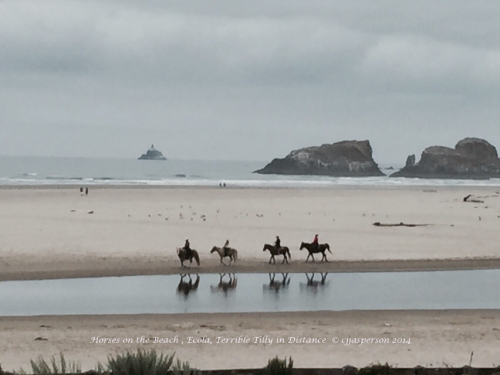
horses on the beach, Cannon Beach, Oregon by C.J. Jasperson 8-13-2014


Beyond Ecola’s Door, © Connie J. Jasperson 2016

4 Comments

Filed under #FlashFictionFriday, Politics, Uncategorized

#flashfictionfriday: Hope in the Desert of Plenty

Sunset_in_Dubai_desert_12I dreamed of a green oasis, and woke this evening, feeling disoriented at the normality of our desert home. A little voice in my head kept saying this is wrong, this is not how it’s supposed to be. The voice was mistaken because this is how it is, and what it is.

Grandfather frequently moans that it wasn’t always this way, blaming this and that technology we can no longer use, but it doesn’t matter. Yes, I remember those days, and maybe it’s not supposed to be, but it’s life, and we live with it.

At sunset, I went out to work in the garden and found the wind had blown the muslin sun shield off the dandelions. I replaced it, but don’t know if they were harmed by the direct sunlight. The wind usually rises later in the day, so perhaps they weren’t exposed to too much. I don’t know what will happen if they don’t make it.  I do have plenty of the leaves dried and have saved every seed, but fresh greens are essential, and dandelions are the faithful greens that produce all year round and keep us alive no matter what happens to the other vegetables.

Other plants frequently fail when the temperature reaches the high 120s. With luck, we’ll get one more crop of beans harvested before the rains.

The Himalaya blackberries are covered with small berries and with constant care they might survive the drought. The berries are a staple, lending sweetness to our food and blackberry wine makes life pleasant. They’re also attractive to the wasps that pollinate our crops, so we desperately need them.

But it’s been a hard, hot year, and even the Scotch broom, which we’ve come to depend on for everything from fuel, to building materials and fibers for cloth, is struggling. Hopefully, I’ll have enough water to keep the plantation alive. My fog traps have grown steadily less productive, as they do every year at the peak of the heat, but we’re not going thirsty yet.

Water is an issue, but when is it not? It’s always darkest before the dawn, someone once said. I like to think of it as “driest before the monsoon.” November is coming, and the downpour will begin, those brief weeks of dangerous weather and devastation, fearfully clinging to hope we won’t be washed away in the floods.

But this year, if we make it through the winds, it will be a blessing and not a catastrophe. Yes, it’s too much water all at once, but we’ve adapted. Where we once lived on the ground, we have raised our shacks on tall stilts. Our dandelion, blackberry, and broom plantations are situated on high, raised platforms, with muslin sun filters, as are our goat pens. I know, it seems odd when for eight months out of the year there is no water for many miles, but we’re safe from the wildcats and feral dogs, and they can’t get to our goats. The wild rabbits can’t destroy our farms.

Our village of twenty families has survived when the others failed because we learned how to shield our crops from the both the broiling sun and the punishing downpour with sturdy awnings. This year, the moment the rain stops, we’ll be more than an island of shacks on stilts in a shallow sea. This year we will become an oasis.

Every year until now, we’ve struggled to save that water, as within a month the sea becomes large puddles and within another month we’re left with scant barrels of water and our fog traps to get us by for the rest of the year.

This year we’re prepared for the monsoon, and will be able to save the runoff in a cistern. It’s impossible to labor outside during the day, but we spent our chilly nights building it, covering it with soil to insulate it from the heat, so it resembles a small, perfect hill. We lined the interior with fired ceramic tiles, and made sure every roof is pitched and has gutters to channel the water into it. This last year there was no rest for the wicked, as they say, but it will be worth it. Next year we won’t have to choose between thirst and watering the livestock and plants.

Grandfather is filled with doom and gloom, but not me. Next year will be a year of lush gardens, of cool, sweet blackberry wine at sunrise when the work-night has ended. Next year all our babies may survive.

Next year.

Comments Off on #flashfictionfriday: Hope in the Desert of Plenty

Filed under #FlashFictionFriday

#flashfictionfriday: October Sky

Louis_Français-CrépusculeIt had been the coldest October I could remember. Rafts of ice floated up and down the lake, blown by the winds, breaking up and re-forming as if dancing a ballet. The leaves had been off the trees since the end of September, almost as if they couldn’t fall fast enough.

It was in the last, quiet hour before sunset when the real beauty of my rustic lake home was revealed to me. The sun drifted its way behind the hills as the wind died off to nothing. The lake became a mirror reflecting the pink-blue-purple-gold of the sky and the deep green of the evergreen forested hills. It was a green so deep that it appeared to be black.

I would sit at my frozen picnic table with a steaming mug of coffee warming my hands, watching the snow geese and the western grebes. Only the voices of the loons and the geese pierced the blanket of peace I had wrapped about myself.

When the colors had faded, and I could no longer feel my fingers, I would go back into the house and stoke up the fire, still in the thrall of the lake’s spell. Then, only when I had absorbed the tranquility of my lake, would I pick up a brush and enter my world of canvas and color.

On the first morning I saw the naked trees stark against the incredible sky, I knew I had to somehow capture the power. Attempt followed attempt and soon my house was littered with the “almosts.” The bones of the trees were right, but the essence of the sky was missing. Each night I worked longer and more feverishly until one day I realized that I had to back off and gain some perspective.

And so it was that in the small hours before dawn one morning I put away the brushes and paints, and covered the canvasses, frustrated by my inability to capture the essence of the lake and the sky that was mirrored in it. Exhausted, I fell into my bed drained and unable to concentrate, yet sleep escaped me. My mind was filled with the loons and the trees and their sky.

At last, knowing it was futile to try to sleep I rose and made myself tea. Wrapping a blanket about myself I walked out to my small sitting room to watch the trees greeting the pale dawn. The warmth and fragrance of the steaming cup of tea made me feel rested as my bed never had, and the familiarity of the ritual soothed away my frustrations.

The serenity of the moment deepened, a sense of sacredness pervaded the garden. Willingly, I gave myself to the experience, allowing the essence of the moment to seep into my soul.

The air felt strange, alive and crystalline, and the trees beckoned to me. I could feel them calling me to come out and greet the sun with them, and bemused, I answered their call. Stepping outside, still wrapped in my blanket, I walked through the frozen grass, until I was in the orchard among the trees on the shore of the lake.

Looking west to the black-forested hills, I held my breath, overcome by the feeling of anticipation that infused me. Something told me I stood on the verge of an event, vast and unfathomable, though what it could be I couldn’t imagine.

Gradually I realized that the ground was vibrating, and had been for a while, shaking as if a giant walked nearby. As I became aware of the vibrations beneath my feet, a deep rumbling began to penetrate my reverie, shattering the peace. The unfamiliar thunders grew louder with every moment, and the birds fell silent as if waiting to see what approached.

Huddling nervously in my blanket, my eyes were drawn to the north and there, emerging from the mist I saw machines—great, huge, monstrous machines I had no words to describe. They came slowly and relentlessly down the middle of my lake. The waters rolled and boiled around them as they passed me by, paying me less attention than they did the trees. The ice floes broke and tipped crazily, riding the waves that danced about the giant treads.

The line of machines continued south, grinding through the swamp, going I knew not where and coming from where I could not imagine. As they came, the waters grew, and waves began splashing at my feet and then my knees. At last, realizing that I was in trouble, I turned and raced for the higher ground and the safety of my house.

Still the waters rose, following me, and still the machines came rolling down from the north.

I closed the door and stood to gaze out the window at the rising waters and the monstrous machines that continued their unrelenting journey south. The waters rose, and my house began swaying, creaking and groaning under the water’s assault.

I fell to my knees praying to the God I didn’t believe in, but he wasn’t listening.  My house shook and rocked, and lifted with the rising water, turning slowly as if to say goodbye to the lake and the hills to the west. Dishes and furniture careened off paintings and walls—my life in small objects passing before my eyes. I looked, disbelieving, through the shattered windows and saw the inconceivable sky spinning around like a child’s top spins.

I covered my head, and screamed my prayer, but the only answer I received was the sure and profound sound of breaking glass and furniture shattering.  At last, when I believed it would never stop, the floor I clung to gave a great lurch and the noise of destruction stuttered into silence, a silence every bit as loud as the din had been.

Throwing back my blanket, determined to get out of the wreckage while I could, I saw the last of the machines going south into the broken swamp. The trail they blazed through the marshland was a great scar that would never heal, and I wept at the sight of it.

I surveyed the damage to my home with stunned eyes. My house was now perched all askew upon a slight rise that had been perhaps fifty feet behind it before. Everything I had ever owned was now in full view of anyone who might choose to make a leisurely visit to my remote home. Every item of clothing, every bit of dish, smashed or whole, everything dangled from the branches of the broken trees, displayed everywhere.

Despite the carnage, the sky hung pink-blue-purple-golden and unchanged while the naked trees made lewd gestures with my most personal of possessions. The ridiculousness of the situation penetrated my shock, and I began laughing, and falling to my knees I laughed until I couldn’t breathe. Eventually, my laughter became sobs, and I howled until I was spent.

The silence was too much, making me intensely aware of my frail mortality. Stepping through the rubble, I gathered my canvasses, paints, and brushes. Miraculously my easel was untouched, and so I did the only thing I could think of.

I painted the pathetic wreck of my house reflected in the perfection of the lake and the hills.

I painted the obscene trees against the incredible sky as they proudly displayed the debris of my life.

And then I painted those awesome machines as they paraded past me, not realizing that I was there and not caring.

When I was done, three paintings leaned against my ruined fireplace. Exhausted, I found my bed and righted it. Crawling into it I finally fell asleep, resting dreamlessly.

When my eyes opened, I was disoriented. I awoke in my bedroom and looking around, I could see no signs of the previous day’s events. In disbelief, I went to the kitchen and found all my kitsch and accumulated knick-knacks still to be there, whole and in their tasteless entirety. There were no broken dishes, no broken furniture.

Awed and amazed at the power of the dream I had just experienced I set about preparing my breakfast. “Idiot,” I muttered, still feeling rather giddy. I wondered what my sister would say when I called to tell her about it.

Making a cup of coffee, I went to sit by the window in the sitting room.

As I passed the fireplace I froze. Three pictures leaned against the uninjured hearth.

One was of obscene trees decorated with my personal possessions, silhouetted against an incredible sky. In the second picture, my sad house perched askew on the hill, broken and sad, framed by the astounding sunset.

And the third picture was a terrifying image of gigantic, grotesque machines tearing up my lake, plowing through the swamp with the waters roiling wildly about the monstrous treads, beneath the sky that had eluded my skills until that night.

Even I had to admit that the power of the paintings was overwhelming.


October Sky © Connie J. Jasperson 2016 All Rights Reserved

Written circa 1992 and originally published On Wattpad, December 2012

Republished on Edgewise Words Inn, April 2015

8 Comments

Filed under #FlashFictionFriday, writing

#FlashFictionFriday:Happy Hour at the Drunken Sasquatch

796px-Louis_Ducros_(circle)_Pifferari_in_einer_römischen_TaverneI’m always at the Drunken Sasquatch for Happy Hour, as I have nowhere else to be. But Harry Wolfe was a family man with a problem, and he looked distinctly out of place there among the regulars. I had told him I thought the perfect person to resolve it would be in at about four, and sure enough, there she was.

He set his root-beer on the table. “Everyone knows Grandma is no one to mess with! Sure, my stepdad was a big, bad wolf. I won’t argue that he received a kind of back-handed justice. And who is sitting there proudly wearing his hide?” Harry gazed at the elderly woman seated at the bar. “Not my stepdad, that’s for sure.”

The elderly woman in the ratty fur coat turned to see what all the noise was about. We smiled and waved at Grandma.

“See how innocent she looks?  She could be any old barfly. But that’s no ordinary old drunk.” I tried to impress on him how perfect she was for his problem. “That’s Grandma, and she’s the one for the job.”

Harry capitulated. “Um… okay, but no violence. They’re terrible tenants, but they’re college kids, right?”

“So are you going to ask her?”

Harry’s eyes showed the whites, as he mastered his panic. “No! She’s…could you ask her?” The werewolf was actually shaking in his boots.

“Okay,” I said. “I’ll do it.” Very few things intimidate a dragon. I took my orange juice to the bar and found a stool next to the lady in question.

“Mrs. Johnson?” I asked.

“Who wants to know?”

“Dan Dragonsworthy. My friend has a rental property, occupied by some tenants who’re trashing it…he was wondering if you were still in the vigilante business.”

“You mean that nice young man doesn’t want to dirty his paws with such matters.” She met my gaze. “Sure, but it will cost him. I don’t work for free.”

I brought Harry over and introduced him. They got down to the nitty-gritty, and a price was arranged. Grandma fixed Harry with her steely gaze. “Tell me everything you know about these tenants.”

“Well, they’re pigs.”

“We know that. What do they look like?”

“They’re pigs, Yorkshire pigs, to be exact, and seemed so charming and British. They’re foreign exchange students and had good references, but now I’m assuming they were forged.”

“What exactly have they done to your property?” Grandma tried to look comforting. It scared the willies out of me. As I said, very few things scare a dragon, but that look on this old lady was one of them.

Harry said, “Every Saturday night they have these huge parties with hundreds of people and live bands. Loud punk music all night long. My phone is always ringing off the hook, with the other tenants’ complaining.”

“Over on Walnut Street?” Grandma asked, and Harry nodded. “Yeah,” she said. “Those are some great parties.” Grandma thought for moment. “I hate to evict my friends, but business is business, and a girl’s gotta make a living.”

She fished around in her handbag, setting things on the bar: old Kleenexes, mints, a pearl-handled Colt forty-five, her cell phone, a hacksaw, her checkbook, a crescent wrench, a dog-eared address book… and so on… and so on. Finally, she came to a small stack of business cards, with a rubber band wrapping them. Pulling one card from the bundle, she handed it to Harry. “Send the legal paperwork to me at this address here, along with half the fee. I’ll collect the other half when the job is done, Tuesday at the latest. Just make sure a large dumpster is delivered to the curb in front of the place Monday morning.” She turned, tossing everything back into her bag and addressed herself to her gin and tonic. It was a dismissal Harry and I both could recognize.

As we sat down at our table, Harry said, “I don’t like doing things this way, but I can’t have my property destroyed. She’s definitely the one for the job. I hate to have to play the Grandma card, but those pigs have got to go. I just hope she doesn’t harm them.”

Looking at the little old lady seated at the bar, I had to agree. “When you have a tough job, you can always count on Grandma. It may not be pretty, but she gets results.”

Harry shivered.


Happy Hour at the Drunken Sasquatch © 2016 Connie J. Jasperson, All Rights Reserved

6 Comments

Filed under #FlashFictionFriday