Category Archives: NaNoWriMo

#amwriting: #nanowrimo momentum

2016-placeholder-book-cover-smallWe’re on Day 2 of NaNo 2016. I’ve written two short stories totaling 11,605 words, 80% of them misspelled, but I won’t worry about that until January. I admit I was hoping to have written four, but I’m still on track to make 50 short stories and flash fictions by the end of November.

Some people are already behind, but all is not lost.  Get caught up now and go forward by adding a few extra words every day.

Habitual behavior, or ‘daily routine’ goes unnoticed because we don’t engage in self-analysis when undertaking routine tasks. Thus, writing daily is easier once it becomes a behavioral habit.

Consider smoking.

Smoking is a behavioral habit as much as it is a physical addiction. Smokers trying to quit always tell me they don’t know what to do with their hands. When they first started smoking they trained themselves to do “the cigarette ritual,” shaking the cigarette out of the pack, lighting it, holding it, and exhaling the smoke with their own style each time they went outside.  They did this ritual every time they lit up their cigarette, and now their hands have “nothing to do.”

If breaking certain habits is difficult, creating new, more positive habits is also tough. Behavioral patterns we repeat become imprinted in our neuro-pathways, so repetition of positive behaviors is necessary to make the behavior automatic. Wikipedia, the Fount of all Knowledge, says this:

“As the habit is forming, it can be analysed in three parts: the cue, the behavior, and the reward. The cue is the thing that causes the habit to come about, the trigger of the habitual behavior. This could be anything that one’s mind associates with that habit and one will automatically let a habit come to the surface. The behavior is the actual habit that one exhibits, and the reward, a positive feeling, therefore continues the “habit loop”.[13] A habit may initially be triggered by a goal, but over time that goal becomes less necessary and the habit becomes more automatic.”

In his November 3rd, 2013 blog post for Creative Writing Guild, Rob Blair says:

“Studies on habit formation have found that extra willpower is almost never sufficient for getting a new habit to stick. What does seem to work is an intervention that looks like this:

  • Write out the details of what you want the new habit to be. (In your case, it’s going to be writing 1,667 words per day.)

  • Plan the details of how and where you will be engaging in the new habit. Be as concrete as you can be.

  • Plan a “trigger” for when you will start doing the new habit. How will you know it’s time to start writing? This can be a specific time, but I’ve found it’s better to choose a point in your normal daily routine where you can insert the new habit. (e.g., “After pouring coffee but before changing out of my PJs.)

  • Write a list of the pitfalls, detailing what’s most likely to go wrong. What’s prevented you from writing in the past? Did you get busy? Did you sleep in? Did you “feel uncreative”? Be honest with yourself, and get your normal traps and tribulations on the page.

  • Write a response plan for each pitfall. This can be something complex, but research has found that even simple response plans (e.g., “I’ll remind myself this is writing time and I can sleep in come December”) are astoundingly effective. (end quoted material.)

I like what Rob has to say about doing a small intervention to short-circuit self-defeating habits, but remember such effort only works if you are honestly committed to the project. He also offers a great deal of other useful advice in that article, so I highly recommend you read his post in its entirety.

But what I really believe is that you will succeed in developing the habit when you write something you are really fired up about. When you are passionate about a story, the words will flow. Find that moment in your daily routine when you can insert a new habit, put pen to paper and begin writing!

The best thing about stream-of-consciousness writing is you don’t take the time to over-think things. You write it as you think it, and the word count grows as if by magic.

I’m using this time to write short stories, but just as if I were writing a nano-novel, I will be done writing at the end of November. I will take a break from this project until January and then, over the course of the next year I will be pulling these rough drafts out of the 2016 NaNoWriMo file and polishing them up.  That is when I will worry about what is wrong with these little stories, and implement plot adjustments. Right now, I am just writing it as I think it, warts and all.


Reference Sources:

6 Steps for Nailing the First Week of NaNoWriMo, published November 3, 2013, on http://www.creativewritingguild.com · by Rob Blair

Wikipedia contributors, “Habit,” Wikipedia, The Free Encyclopedia, https://en.wikipedia.org/w/index.php?title=Habit&oldid=747213739 (accessed November 1, 2016).

2 Comments

Filed under NaNoWriMo, writing

#amwriting: #NaNoWriMo Jump Start

NANO CrestIf you are doing NaNoWriMo this year, you’re quite busy right now and don’t have time to read a long post. So, here are a few quick tips and resources to help get your novel off the ground:

Tips:

  • Never delete, do not self-edit as you go. Don’t waste time re-reading your work. You can do all that in December when you go back to look at what you have written.
  • Make a list of all the names and words you invent as you go and update it each time you create anew one, so the spellings don’t evolve as the story does.
  • Write 1670 words every day – 3 more than is required (to account for differences in how your word processing program and NaNoWriMo’s official word counter validates wordcount – you don’t want to come up short at the end! This has happened and is quite frustrating.

If you are writing a story set in our real world and your characters will be traveling, walking a particular city, or visiting landmarks, bookmark google maps for that area and refer back to it regularly to make sure you are writing it correctly.

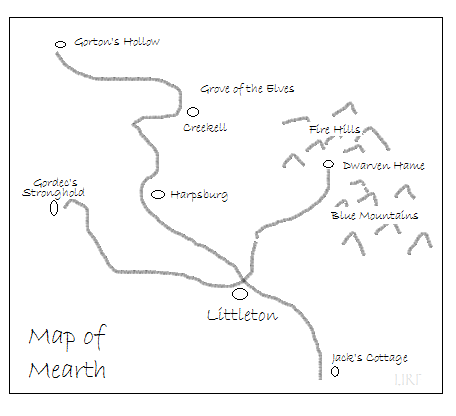
If you are writing about a fantasy world and your characters will be traveling, quickly sketch a rough map and refer back to it to make sure the Town names and places remain the same. Update it as new places are added. This is all you need:

sample-of-rough-sketched-map

If you are writing fantasy involving magic or supernatural skills, briefly draw up a list of rules for who can do what with each skill. Remember:

  • Magic with no rules is both impossible and creates a story with no tension. No one wants to read a story where the characters have nothing to struggle against.
  • Each character should have limits to their abilities. Because they are not individually all-powerful, they will need to interact and work with each other and with the protagonist. They will have to do this whether they like each other or not if they want to win the final battle or achieve their goal. That will provide openings for some great interactions.
  • This gives you ample opportunity to introduce tension into the story. Remember, each time you make parameters and frameworks for your magic you make opportunities for conflict within your fantasy world, and conflict is what drives the plot.

Resources to Bookmark:

Three websites a beginner should go to if they want instant answers in plain English:

Most importantly – enjoy writing that novel. This is time spent creating an amazing story only you can tell, so above all, enjoy this experience.

4 Comments

Filed under NaNoWriMo, writing

#NaNoWriMo2016: The Ghosts of NaNoWriMos Past

NaNoWriMo-General-FlyerYou’ve had this idea rolling around your head for a while now for a book you’d like to read, and you keep wishing your favorite author would write it. In my experience, you’re going to have to write it yourself, or it will never happen. This is because your favorite author can only write so fast, or, as in the case of several of my most respected authors, they might be dead. Dead authors rarely publish new books, unless they are ghost writers. (heh heh.) From what I can see, most authors don’t live beyond 100 years of age, so there you go–if you want that book, you’re going to have to write it yourself.

My first NaNoWriMo novel, written in 2010, began with the idea of writing a book Fritz Lieber might write if he were still alive (and if he had consumed several hallucinogenic mushrooms). You see, I had just finished re-reading my collection of Fritz Lieber tales, and I had Fafhrd and the Gray Mouser on the brain. These two characters are scoundrels, living in a decadent world where a lack of scruples a requirement for survival.

What I actually produced had no resemblance to Fafhrd and the Gray Mouser, and was nothing like anything Fritz would have written, but within the uneven plot and frequently overblown dialogue it had the bones of a good story.

My addiction to NaNoWriMo began innocently, as all good addictions do: A young writer in the Philippines whom I had met through a gaming website mentioned he was going to do this writing challenge. It was a worldwide thing where hundreds of thousands of people actually began writing a novel on November 1 with the intention of having it finished by November 30.  The catch was, you couldn’t start until 12:01 am on November 1st,  it had to be at least 50,000 words long, but it could longer than that if you needed it to be. And, you had to have it validated by 11:59 PM on November 30th to win the coveted winners goodies.

My friend challenged me to enter, and not sure I would really be able to do this crazy thing, I did. He said all I had to do was write 1,667 words a day, which I felt I could do. I figured the worst that could happen was that I would fail to get the word count. In the past, fear of failure had never stopped me from making my life more complicated, so of course I went out to the national website and signed up. I chose the handle dragon_fangirl.

At 6:30 a.m. on November 1, 2010, I looked at my laptop and had no idea what to do. Then it came to me: Just write the first line:

There was a cabin in the woods.

Well, that wasn’t exactly literary brilliance, but it wasn’t too terrible, and it gave my idea little more form. I just began telling the story as it fell out of my mind. To my surprise, I discovered my word count averaged 2,500 to 3,000 words a day. By day fifteen I knew I would have no trouble getting the 50,000, and by November 21 I had attained the winning number of words.

At the 68,000 word point, I had completed my rollicking tale of snark and medieval derring-do. Of course, it was completely unpublishable, but I didn’t know that until later.

What I did know, was that I had written a complete novel, and told a story that I would have wanted to read. Three years later I realized all it needed was rewriting, editing, revising, rewriting, and putting in a drawer, never to be seen again.

However, out of the wreckage of that book came the story of Huw the Bard. You never know what characters you will need later, so killing them when you get stuck for a plot point is not really wise.

One rule they tell you at NaNoWriMo is never delete, and don’t self-edit as you go along. This is all strictly stream-of-consciousness, write it the way you think it. That was hard for me, but I did get into the swing of things eventually.

When I was out lurking on the various threads on the national website, I discovered a contingent of writers who were not trying to write a book that could be published. For them, this was a game they wanted to win at any cost, and their goal was to see how high their word count could get.

One suggestion from them for increasing your word count was to use no contractions.

Let’s be clear: I do NOT recommend this. If you ever want to publish your manuscript, you will have a lot of work ahead of you to make it readable if you do that.

My rules for NaNoWriMo:

  1. Write at least 1,670 words every day (three more than is required) This takes me about 2 hours – I’m not fast at this.
  2. Write every day, no matter if you have an idea worth writing about or not. Do it even if you have to get up at 4:00 am to find the time and don’t let anything derail you. If you are stuck, write about how your day went and how you are feeling about things that are happening in your life, or write that grocery list. Just write, and think about where you want to take your real story. Write about what you would like to see happen in that story.
  3. Check in on the national threads and your regional thread to keep in contact with other writers.
  4. Attend a write-in if your region is having any, or join a virtual write-in at NaNoWriMo on Facebook. This will keep you enthused about your project.
  5. Delete nothing. Passages you want to delete later can be highlighted, and the font turned to red or blue, so you can easily separate them out later.
  6. Remember, not every story is a novel. If your story comes to an end, draw a line at the bottom of the page and start a new story, in the same manuscript. You can always separate the stories later, and that way you won’t lose your word count.
  7. Validate your word count every day.

These are the novels I have written during the month of November since 2010:

  • 2010 Billy’s Revenge (published 2011 as the Last Good Knight, has since been unpublished and will remain that way)
  • 2011 The Bard’s Tale, which was published in 2013 as Huw The Bard.
  • 2012 Neveyah 3, which was published in July 2016 as The Wayward Son.
  • 2013 Valley of Shadows, which was published May of 2016 as Valley of Sorrows.
  • 2014 The Seventh Space, still under construction, may not be a novel after all.
  • 2015 November Tales – 42 short stories, totaling 107,000 words. Included in this mess were ten truly awful poems, along with chapters 7 thru 11 of Bleakbourne on Heath, an ongoing serial, published 2015-2016. That serial is now past the mid-point and will end in the spring of 2017.
  • 2016 November Tales 2016 – 30 Days of Madness and Pot Pies – nothing written yet, but I will hit the keyboard at 12:01 a.m. on November 1st, and begin churning out as many short stories, flash-fictions, drabbles, poems, and chapters of Bleakbourne as my feeble fingers are able to do.

crest-bda7b7a6e1b57bb9fb8ce9772b8faafbIf you should choose to enter this highly addictive, adrenaline rush of a contest, go to www.nanowrimo.org and sign up! Pick your name, get your author profile started, and look up dragon_fangirl (that’s me). Add me as your writing buddy and I will be part of your writing posse, cheering you on when you need a morale boost.

9 Comments

Filed under NaNoWriMo, writing

#amwriting: November is National Novel Writing Month #NaNoWriMo2016

nanowrimo-2016-kick-it-in-gear-desktop

Dragon_Fangirl’s home-made nanowrimo-2016 “kick-it-in-gear “desktop

Every year starting on November 1st several million people sit down and attempt to write a 50,000-word novel in 30 days, most while holding down jobs and raising kids.

Four years running, 2010 – 2014, I used the month of November to lay down the rough draft of an intended novel. I made an outline in October and drew maps and such so that on November 1st I could hit the ground running. Most of the time, once I have that foundation down, I can write off the cuff, and that is how three of my books came into existence.

However, last year I already had two novels in the final stages and one simmering on the back burner.  What I lacked was short stories. I had the brilliant idea to write a short story collection, because I knew I had to build my backlog of submittable work. As a result, and despite having a viral plague during the entire month of November, I wrote 42 short stories for a total of 105,000 words.

That’s not counting the blog posts I also wrote. NaNoWroMo 2015 was a prolific year despite the plague!

For many participants, the challenge of sitting down and using the “seat of your pants” style of creative writing is what draws them to sign up.

On November 1, participants begin working towards the goal of writing a 50,000-word novel by 11:59 PM on November 30.

In 2011, the year I wrote Huw the Bard, I spewed the basic rough draft in the most unlinear way possible.  I had the plot outline and followed it, sort of.  With that as my guide, no matter how off track I found poor Huw (pronounced Hew), I still managed to get him to the end I had originally envisioned.

The next year, my novel didn’t go quite as smoothly, and I had a few hiccups.

But that novel was really only a writing exercise for me, just to see if I could write in that particular genre and I fell out of love with it. Since it didn’t have a grip on my heart, and by November 15th I had written 50,000 words of a story I hated, I began a different story.

I kept the work I had already done, as that book was as done as it was ever going to get. But I’m not silly – I had no intention of wasting that word count, so at the bottom of the last page, I began a new novel, which eventually became The Wayward Son, and was just published last month. At the end of that November, I had written 115,000 words total and had 2 completely different novels to show for my efforts.

2016-placeholder-book-cover

2016-placeholder-book-cover

This year my book has the working title of November Tales 2016: 30 days of Madness and Pot Pies by Dragon_Fangirl: The literary ranting of an author on the edge.

Once again I am embarking on a binge of writing short stories and essays.

Many authors are unwilling to commit to NaNoWriMo because it takes discipline to write 1667 words a day.

Also, they fear having to recoup any perceived losses should they find themselves in the middle of NaNoWriMo when they suddenly realize they’ve gone terribly astray. Or they fear writers’ block.

It happens. Not to me usually, because I know the secret: If you can’t write on the subject you intended, write about what you are experiencing and what interests you at that moment. Yes, it’s not that fabulous fantasy novel you began but are stuck on, and no epic dragons will be in it. (Unless you are Stephen Swartz. His real life has epic dragons. And bunnies.)

The key here is you will be writing, and that is what is important.

Rule 1 of NaNoWriMo: write.

Rule 2: Write 1667 words every day.

Rule 3: Every time you rewrite the scene with a slightly different outcome, it counts toward your word count. Don’t delete – just change the font color to red in that section, and begin rewriting the scene the way it SHOULD have been written in the first place, using the usual black font.

In December, cut the offending scene out of the ms, paste it into a separate document and save it in a ‘Background File’ in the same folder as the main manuscript. By doing that, you don’t lose prose you may need later.

During National Novel Writing Month, every word in my manuscript over and above 50,000 counts toward my region’s total word count. So if that means I have a lo-o-o-o-ong, multicolored manuscript for a few weeks, so be it.

For me, if I don’t begin to make those changes when I first realize they need to be done, I might forget until Dave Cantrell, my first reader and structural genius, points it out. (I daily thank God for Dave, and am grateful the internet connects to California.) (♥)

As one of the Municipal Liaisons for the Olympia Washington Region, I am required to attend most of the write-ins, which happen at different coffee shops or libraries. I handle the daylight hours, as I don’t drive after dark. It does eat into my day, which is why my husband thinks of it as National Pot-Pie Month. But I do get a lot of stream-of-consciousness writing done at these events and I have made life-long friends among the writing community of Olympia and the surrounding area.

If you want to sign up for this year’s month of madness and mayhem, get on the internet and go to:

www.nanowrimo.org

Sign up, pick a NaNo name – mine is Dragon_Fangirl, and you are in business. Look me up and make me one of your writing buddies. Spend the rest of October organizing what you think you will need to begin you story on November first. Then, on the first day of November you begin writing. If you apply yourself, and write (AT the minimum) 1667 words every day, on the 30th of November you should have a novel…or something.

nanowrimo-yodaIn reality, if you set aside one or two hours a day, and pound out the words as fast as you can during that time, you will get your word count. Never delete, and do not self-edit as you go along. Just spew words, misspelled and awkward as they may be. They all count, misspelled or not, and it is the discipline of writing that we are working on here, not the nuts and bolts of good manuscript.

Revising and correcting gross mistakes will come in the second draft, when you have time to look at it with a critical eye. What you are doing now is getting the ideas down.

Never discard your work no matter how much your first reader says it stinks. Even if what you wrote is the worst drivel she ever read, some of it will be worth saving and reusing later.

Spending a month immersed in stream-of-consciousness writing is not a waste of time. You will definitely have something to show for your efforts, and you will have developed the most import skill a writer must have: self-discipline.

4 Comments

Filed under NaNoWriMo, writing