Category Archives: writing

Mapping the Story

Billy's Revenge Floor plan ground floor

Billy’s Revenge © Connie Jasperson 2015

I was worried I wouldn’t have a blog post for today. The power was out most of Saturday due to a large storm here, and there have been times when that  lasts three days here.  When that happens I have no way to post my blog, although I hear you can post them from cell phones if you know the magic words.

I’ll just say that if I have to key my blog on a cell phone, it will take 5 years to get it ready for posting.  I am the world’s slowest text-message-er. Of course, if you have predictive texting set up, and make good use of auto-fill, you could have some real fun, and do it quickly! But that was another blog post.

After the power outage, my printer/scanner was not speaking to my computer, so I couldn’t print or scan. I did behave, no temper tantrums here. My IT man, (a.k.a. my beloved, long-suffering husband with the patience of a saint) took the time to rectify that situation. I was at the limits of my endurance with that thing.

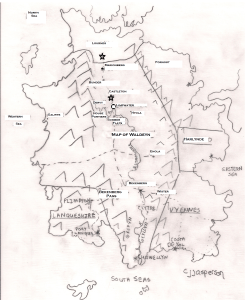
So, because our power was out, I worked on a pencil sketch of a new map for an upcoming novel, Billy’s Revenge. On Sunday, I digitalized it. It isn’t complete, and is out of proportion in some places but when it is finished, it will tell me everything I need to know about Limpwater.

Map of Limpwater copy

Map of Limpwater, © Connie Jasperson 2015

I always have some sort of map to work with, even if it’s just scribbled, when I am writing in a world of my invention, and they all start out as pencil sketches. Eventually, they become the digital versions you see in my books.

That book will consist of 1 novel and 4 short stories that all revolve around the inn known as Billy’s Revenge. Huw the Bard returns, as does Julian Lackland. Billy Ninefingers has a few misadventures that threaten his career, mess with his chances  to convince Dame Bess to marry him, and set him on a path he never thought he would find himself traveling.

In the opening short story, we meet Eddie, Billy’s father, and see the origins of the Rowdies. Eddie’s story sets the stage for Billy’s trouble with Bastard John. Several short stories that were cut from The Last Good Knight will be included at the end of Billy’s novel, as they don’t pertain to Julian Lackland as much as they do the entire group of Rowdies, Billy Ninefingers included, and they are fun stories.

BNF sign

BR Pub Sign © Connie Jasperson

I’ve had the sign that will hang over the porch in front of Billy’s inn ready for quite a while–hanging it is going to be the trick.

When the power went out, I had Photoshop open and was working on the cover for Valley of Sorrows. But while I know how the graphics will be and I am happy with their layout, I’m not really happy with the art I have located so far, but it’s still early days. I will keep searching, which I enjoy doing.

Anyway Saturday  was not as productive as it could have been.

And Sunday was a busy, catch-up day. Fortunately, it rained off and on all day, so I was able to finish a lot of what I needed to get done.  Today will be as crazy as any Monday ever is, and I will simply have to make time for revisions.  All I need is an hour here and there. I am close to having it ready for editing. I will have Valley of Sorrows published in the spring of 2016, if all continues to go well.

4 Comments

Filed under Books, Publishing, Uncategorized, writer, writing

5 Books: Society’s Mirror

The Green Mirror, by Guy Rose PD|80 via Wikimedia Commons

The Green Mirror, by Guy Rose PD|80 via Wikimedia Commons

Most authors do not sit down and say “I am going to write a novel and this will be the message.” However, as we progress in writing a given work, certain social themes that are important to us at that moment will emerge.

Most of the time social themes will emerge as a natural outgrowth of the creative process. That particular story may have begun as a a “what if” moment, which, during the process of writing, becomes a powerful story.

We don’t sit down to write with a particular moral or political agenda in mind, but our own values will come out in who the characters we create are, how they perceive their world, and in the society we create as the backdrop for them.

Some of the most gripping works of modern literature occurred when an author was particularly moved by a situation presented by the society in which he lived:

Fahrenheit_451_1st_ed_coverFahrenheit 451 is a dystopian novel by Ray Bradbury published in 1953, the year I was born. It is regarded as one of his best works. The novel presents a future American society where books are outlawed and any that are found are confiscated and burned. The title refers to the temperature that Bradbury believed was the ignition point of paper.

Besides having an incredible cast of characters set in compelling situations, the novel discusses and exposes the role of book burning in suppressing dissenting ideas. In a 1956 radio interview, Bradbury stated that he wrote Fahrenheit 451 because of his concerns at the time (during the McCarthy era) about the threat of book burning in the United States.

Fahrenheit 451 remains a classic, because the societal pressures and fringe threats that inspired Bradbury to write this novel still exist, perhaps even more so than during the McCarthy era.

Germinal_first_edition_coverGerminal  (1885) is the thirteenth novel in Émile Zola‘s twenty-volume series Les Rougon-Macquart. (From Wikipedia:) Often considered Zola’s masterpiece and one of the most significant novels in the French tradition, this novel is an uncompromisingly harsh and realistic story of a coal miners’ strike in northern France in the 1860s. It has been published and translated in over one hundred countries and has additionally inspired five film adaptations and two television productions.

Germinal is a brutal depiction of the poverty and wretchedness of a mining community in northern France under the second empire. At the center of the novel is Etienne Lantier, a handsome 21 year-old mechanic, intelligent but with little education and a dangerous predisposition to murderous, alcoholic rage. Germinal tells the parallel story of Etienne’s refusal to accept what he appears destined to become, and of the miners’ difficult decision to strike in order to fight for a better standard of life.

milagro beanfield warThe Milagro Beanfield War, 1974, is the first book in John Nichols New Mexico Trilogy. The book opens when Joe Mondragon, a feisty hustler with a talent for trouble, slammed his battered pickup to a stop, tugged on his gumboots, and marched into the arid patch of ground. Carefully (and also illegally), he tapped into the main irrigation channel. And so began-though few knew it at the time-the Milagro beanfield war.

But like everything else in the dirt-poor town of Milagro, it would be a patchwork war, fought more by tactical retreats than by battlefield victories. Gradually, the small farmers and sheep-men begin to rally to Joe’s beanfield as the symbol of their lost rights and their lost lands. And downstate in the capital, the Anglo water barons and power brokers huddle in urgent conference, intent on destroying that symbol before it destroys their multi-million-dollar land-development schemes. The tale of Milagro’s rising is wildly comic and lovingly tender, a vivid portrayal of a town that, half-stumbling and partly prodded, gropes its way toward its own stubborn salvation.

ProdigalSummerProdigal Summer (2000) is the fifth novel by American author, Barbara Kingsolver. It is a hymn to wildness that celebrates the prodigal spirit of human nature, and of nature itself. It weaves together three stories of human love within a larger tapestry of lives amid the mountains and farms of southern Appalachia. Over the course of one humid summer, this novel’s intriguing protagonists face disparate predicaments but find connections to one another and to the flora and fauna with which they necessarily share a place.

The narrative follows Deanna, a solitary woman working as a park ranger, Lusa, a widowed farmwife at odds with her late husband’s tight-knit family, and Garnett, an old man who dreams of restoring the lineage of the extinct American Chestnut tree.

Kingsolver’s extensive education in biology is on display in this book, laden with ecological concepts and biological facts. Her writing also exhibits her knowledge of rural Virginia, where she grew up.

The_Idiot_(book_cover)The Idiotfirst published serially in The Russian Messenger between 1868 and 1869. is a novel written by Fyodor Dostoyevsky. (From Wikipedia:) The 26-year-old Prince Lev Nikolayevich Myshkin returns to Russia after spending several years at a Swiss sanatorium. Scorned by the society of Saint Petersburg for his trusting nature and naiveté, he finds himself at the center of a struggle between a beautiful kept woman and a virtuous and pretty young girl, both of whom win his affection. Unfortunately, Myshkin’s very goodness precipitates disaster, leaving the impression that, in a world obsessed with money, power, and sexual conquest, a sanatorium may be the only place for a saint.

Elizabeth Dalton wrote that in The Idiot, more than in any other of Dostoevsky’s works, we are shown the actual experience itself of one mind wrestling with the various tensions of life – rather than simply dwelling on intellectual speculation, as we see in Crime and Punishment and Notes from Underground.

HouseofthesprirtsThe House of the Spirits (Spanish: La casa de los espíritus, 1982) is the debut novel of Isabel Allende. In one of the most important and beloved Latin American works of the twentieth century, Isabel Allende weaves a luminous tapestry of three generations of the Trueba family, revealing both triumphs and tragedies. Here is patriarch Esteban, whose wild desires and political machinations are tempered only by his love for his ethereal wife, Clara, a woman touched by an otherworldly hand. Their daughter, Blanca, whose forbidden love for a man Esteban has deemed unworthy infuriates her father, yet will produce his greatest joy: his granddaughter Alba, a beautiful, ambitious girl who will lead the family and their country into a revolutionary future.

The House of the Spirits is an enthralling saga that spans decades and lives, twining the personal and the political into an epic novel of love, magic, and fate.

>>><<<

These stories are powerful because of the characters that were created when that “what if” moment occurred, and because of the societal pressure under which their stories unfold. They are considered among  the greatest works in modern literature, and all of them are gripping, moving works of fiction, heavily laced with the social reality of the authors’ times.

All of these books are considered masterpieces, and each one struck a chord one way or another with me, although I confess, although each made a large impression on me, I have not reread most of them in recent years.

All of these books are available at your local library, or very reasonably priced at Amazon.com.

2 Comments

Filed under Books, Literature, Publishing, writer, writing

The clock, groceries, and a new thesaurus

Jetsonslogo640x480At times the world seems to be conspiring against me.  I have to drop what I’m doing, load up the van, and head up to town for something as mundane as groceries. Food should order itself, deliver itself, and put itself away.

But no. Where is my android butler and why is he not doing the shopping? Just like the flying car I was promised when I was child, my android butler is in the Jetsons‘ style garage of my imagination.

But sometimes I get two or three pages of writing done in the 20 or 30 minutes before I have to leave the house for an appointment. There is something about the pressure of knowing I will have to quit at a certain time that forces me to be more productive than I would ordinarily be.

Why is this? When I am pressed for time I use every second to get those ideas out of my head. I don’t stop and research on the good, old, time-wasting internet, and I don’t worry about whether or not I am overusing a word in the narrative. This is a rough draft–all of that can be ironed out when I have more leisure–the next day usually.

clockSome of my best ideas have come about under a time crunch.  Normally when I am writing on a stream-of-consciousness level, I can key about fifty words a minute–paltry compared to today’s young-uns who grew up keying their homework rather than writing it in cursive.

I do admit that just because I can key those words does not mean they will all make sense, or be worth reading. But that again is why we are driven to look at what we just wrote the day after we wrote it–did it say what I meant? How many times did I use the word “noose” in that particular chapter and where am I going to find six different alternatives for such a unique word?

Apricot poodle puppy portrait. Isolated on a white background (studio shoot), via Google Images

A little rephrasing here, cutting there, and voila! It looks like a poodle!

It’s a jungle in my head sometimes, and my ancient  student edition of Roget’s Thesaurus is my friend. But neither the old student version of the thesaurus from 40 years ago, nor the modern, online version is cutting it for me right now.

I need more synonyms. Lots, and lots more!

I have just now invested in a bigger, better, hardcover thesaurus. Thus I now have the Oxford American Writers’ Thesaurus winging it’s way to my doorstep. I expect the drone to drop it on Saturday.

ozford american writers thesaurusSome references have to be in hard-copy–such as The Chicago Manual of Style, which is the most comprehensive style guide geared for writers of essays, fiction, and nonfiction. Strunk and White’s Elements of Style is a good beginner style guide, but I found it hard to navigate and couldn’t always find what I wanted. The Chicago Manual of Style is written specifically for writers, editors and publishers and is the industry standard.

Just as a side note–if you are using AP style you are writing for the newspaper, not for literature–two widely different styles with radically different requirements. AP style was developed for expediency in the newspaper industry and is not suitable for novels or for business correspondence. For business, you want to use the Gregg Reference Manual.

Eternal_clock

Eternal Clock, Robbert van der Steeg CC|2.0 via Wikimedia Commons

All in all, I like the way being forced to produce words in a short time helps me lay down a rough draft. But being short on time is big pain when I am trying to revise and iron out stubborn, repetitive wrinkles in a narrative.

Summer is nearly over, and with that comes the long, dark days of the northern winter. I won’t be going as many places (I hope). But with the advent of September I will be spending longer hours editing for clients. My personal productivity will drop in regard to my own work, but I will still find time to write.

And I will also find time to revise. I am nearly at the end of two books written for the World of Neveyah series. Valley of Sorrows will wind up the Tower of Bones series–it is completed and is in revisions. The Wayward Son is nearly complete. While The Wayward Son is not actually a part of the Tower of Bones series, much of it does run concurrently with Forbidden Road, as it is the story of John Farmer’s redemption.

Today will be busy–groceries can wait until tomorrow. Today I am working as hard as I can, trying to get Valley of Sorrows ready to be edited, so that the ToB series will be complete, and also to get John’s story out there too.

2 Comments

Filed under Books, Humor, Literature, Publishing, writer, writing

But what if they don’t like what I #amwriting

leaves of grass memeI’m just going to come out and say it–sometimes people don’t like what I write.

I know!  Who knew?

But it’s true, and I’ve the reviews to prove it. However, for every person who dislikes my work for one reason or another, someone else loves it, and they are the reader I am writing for.

If you focus your attention on reviews, good or bad, you risk losing your enjoyment of the craft. Writing is an extremely personal thing, and when a novel is completed we offer it to the public, who then airs their opinion on the quality (or lack thereof) of the fruit of our  labors. We are proud of our work when it is well received, and we are proud of it when it is ignored or disparaged.

Wuthering_Heights,_1847I rarely look at my reviews because I have to concentrate on what I am currently writing, not on what I’ve already done. Every now and then a friend will post a good review by another reviewer on my personal Facebook page and I appreciate that sort of thoughtfulness.

But honestly, I don’t talk a lot about reviews on my personal page, good or bad. This is because I think my friends and family know what my job is and how selling my product works. I already bore them enough as it is with all my going here and there to hawk my books BS.

The minute we publish, whether through the traditional route or by going indie, we are putting ourselves and the thing we cherished most in the hands of the reading public.

At that point you must walk away from it emotionally.

Catch22But while I do like having reviews, I want a variety of them. This shows the potential buyer that more people than just my friends are reading my books.  A mix of good and bad reviews is good because even the bad ones go a long way toward establishing credibility in the reading community. The reviews and numbers of stars will level out and in the end, the more reviews you have, the better for your book.

Most readers are smart. I don’t know about other people, but want to judge a book or product for myself, rather than be told what to think by a reviewer.  This is because most reviews on Amazon are not very enlightening, and alternatively, reviews bought in advance by publishers don’t impress me, good or bad.

The_Casual_VacancyI make my own mind up when I read the book for myself. I enjoyed The Casual Vacancy by J.K. Rowling, even though a kajillion people couldn’t wait to take her down a notch. Read my review of that book here.

You won’t write anything worth reading if you only do it with the intention of getting glorious reviews. Write because you have something to say, and write what YOU want to read. Never publish anything less than your best work and ignore the reviews, good and bad.

Some of the best books ever written have received the worst reviews. Your book could be one of them, so don’t look at bad reviews as a measure of your worth as a writer. Ignore them and just keep on writing. You are writing because you love it and that is what you do.

Everything else is just fluff.

5 Comments

Filed under Literature, Publishing, Uncategorized, writer, writing

Elements of the story: identifying and crafting a strong theme

The Plaza After Rain, Paul Cornoyer PD|100 via Wikimedia Commons

The Plaza After Rain, Paul Cornoyer PD|100 via Wikimedia Commons

“Theme” is an idea or message that flows through a story from beginning to end. Theme is what readers think the work is about but it is also what the work itself says about the subject.

It is ephemeral in that theme is only an idea, but it is like the moon–it is there and the world is greatly affected by it through the pull of gravity: witness the tides.

In a given work the theme might never be mentioned outright, but the characters’ actions are motivated by it and the plot revolves around it. Here is a link to a list of 101 common themes in books.

How do you make something as hard to get a grip on as a theme central to your story? The theme was an idea about the plot, a notion you had about your story when you first began to write it, no matter what the setting you placed it in was, or whether the genre was fantasy, sci-fi, paranormal, or contemporary fiction.

Brothers in Arms, Bujold, coverPerhaps you are writing a tale where a group of people face heroic challenges in a war. On the surface this looks like it it is all about the action, but in reality it is is not. It is about relationships, the bonds of friendship, and the way the events of this war bind a group of soldiers together and also the way events test those bonds, perhaps breaking them. The theme of this tale is the way fighting a common enemy binds strangers from all walks of life together: creating brothers- and sisters-in-arms.

The way I look at it, the theme is as important as the main character. You spend as certain amount of time creating strong characters. Perhaps you are like me and make personnel files for each new character so you know who they are, how they think, and how they will react in a given situation. Or not, but you know your characters the minute the enter the story.

I try to identify my theme early on, and write a short paragraph to myself to remind me of what that central idea was so I stay on track. During the initial writing process I regularly refer back to that little note, to ensure I have not lost my way. I want to write in such a way that I emphasize and exploit that idea throughout the book or short-story.

Initially, when I first started writing full time, I was not always good at sticking to my original idea. At times the core themes became mushy, which, when you read these stories, takes away from the cohesiveness of what otherwise could have been good work. Theme is glue that binds your plot and characters.

The best way to get a grip on both identifying and solidifying the theme is to practice writing with a specific core theme in mind. Write a short story, just a piece of flash fiction. Make every paragraph represent some aspect of that central concept.

I tend to think of themes and then write stories set in fantasy worlds, but not always. Take this piece of Flash Fiction I wrote in 2013:

the watcher flash fiction

It is set in a contemporary environment with no fantasy elements. The idea came from the painting at the top of this post by Paul Cornoyer, and the action is minimal–an elderly woman staring out a window. But the theme is grief, and everything in these short paragraphs points to and represents her sense of loss.

How do you identify your theme? Sometimes it’s difficult, unless you start out with one in mind. Most of my books are based around the hero’s journey, and how the events my protagonists experience shape them. Alongside the theme of good vs evil are the sub-themes of brotherhood, and love of family.

These concepts are important to me on a personal level, and so they find their way into my writing. Ask yourself what is important to you? When you look for a book, what catches your interest?I am not talking genre here, I am speaking of the deeper story. When you look at it from a distance, what do all the stories you love best have in common?

  • Political thrillers: Set against the backdrop of a political power struggle. Political corruption, terrorism, and warfare are common themes.
  • Romance Novel: Two people as they develop romantic love for each other and work to build a relationship. Both the conflict and the climax of the novel are directly related to that core theme of developing a romantic relationship, although the novel can also contain subplots that do not specifically relate to the main characters’ romantic love.
  • Literary fiction focuses on the protagonist of the narrative, creating introspective, in-depth character studies of interesting, complex and developed characters. Action and setting are not the point here, although they must also be carefully developed in such a way they frame the character, and provide a visual perspective.
  • Science Fiction: realistic speculation about possible future events, based solidly on adequate knowledge of the real world, past and present, and on a thorough understanding of the nature and significance of the scientific method. Science and technology are a dominant theme, but based on current reality. Characters are still subject to sub-themes such as morality and love, but setting and science are the main themes.
  • Fantasy: Often set in alternate, medieval, or ancient worlds, common themes are good vs evil, hero’s journey, coming of age, morality, romantic love. Can also be set in urban settings with paranormal tropes.

the hobbit movie poster 2On the surface these types of books look widely different but all have one thing in common–they have protagonists and side-characters. These people will all have to deal with and react to the underlying theme of the book. Morality, love, coming of age–these ideas can be found in nearly every book on my shelves or in my Kindle.

In my mind, the genre and the setting in which these characters react to the wider concepts are just a backdrop. The world they are set in is the picture-frame, a backdrop against which the themes of the story play out, and characters are shaped by a force beyond their control–the author.

4 Comments

Filed under Literature, Publishing, writer, writing

The Writers’ Toolbox: Seminars, workshops, and conferences

via buzzfeed

via buzzfeed

One basic tool every author needs in his/her toolbox is the Writers’ Seminar. These are workshops offered by people who have mastered certain aspects of the craft, and are your way to gain more knowledge of the craft.

They are classes, focusing on every aspect of writing, from the story arc to character development. You can also get classes in how to court agents and editors, if the traditional route is your choice, or conversely, advice on negotiating the rough seas of indie publishing. In this craft, there is never an end to the learning process.

But what if you are housebound and can’t get to a conference? Three excellent resources for an intensive online 3 part seminar are Scott Driscoll’s courses through The Writer’s Workshop ($500.00 each, plus textbook, see the website for more information. Length- and quality-wise these classes are the equivalent of a college course–where else will you get this kind of education for the cost of an average 4 day seminar?)

What about actually finding and physically attending seminars and events? That is where you will meet authors, both famous and infamous, known and not yet known.  You will meet people in the industry who will enlighten you and also help you up the ladder to success.

I love writers’ seminars, and attend every one I can afford to get to–and cost is an issue. But there are many budget-friendly seminars out there, many offered by your local library system.

via buzzfeed

via buzzfeed

For me, it’s about being in a community of authors who are all seeking the same thing–a little more knowledge about the craft. Everyone who attends a writers’ conference, seminar or workshop is serious about the craft, and just in conversation with other attendees you can find great inspiration to help fuel your own creative muse.

How does one find these things? Google (or Bing) is your friend here:

A short list of Seminars, Workshops, and Conferences in Western Washington—check websites for the next seminars offered:

  • Hugo House ($60.00 to join-cost per event may vary)
  • PNWA Writers Conference ($65.00 to join PNWA + cost of 4-day conference–can be pricey. With early registration 2015 conference was $425.00 + the cost of room. Continental breakfasts and two dinners were included, and being vegan I brought my own food. Altogether I spent nearly $1000.00, but was able to do so in 2 chunks.)
  • Southwest Washington Writers Conference ($60.00 early registration, 1 day conference) VERY GOOD INVESTMENT!
  • Port Townsend Writers Conference (10 day conference, Tuition ranges from $150.00 for one or two classes to $900 for the full 10-days, includes room with meals==$90.00 per day–a steal!)
  • Northwest Institute of Literary Arts (costs of individual events vary, average seminar under $200.00) (Terry Persun is giving a seminar most indies could benefit from on taming the beast that is Amazon there August 22, 2015 from 9:30 am to 4:30 pm–get to it if you can!)
  • Clarion West Writers Workshop (Specializing in speculative fiction,  offering everything from seminars to a highly respected 6-week workshop for $3,800.00.  Costs vary, average one-day event $130.00)
via buzzfeed

via buzzfeed

But what if you have little or no $$ to spare for food much less a conferences? For the love of Tolstoy, check out your local library! They are an unbelievably great, free or exceedingly low-cost resource.

For example, the Tumwater, Washington branch of the Timberland Regional Library system has several upcoming seminars offered by author and writing coach Lindsay Schopfer, at no cost to the attendee– the library has hired him as a bonus for the aspiring authors among their patrons. These seminars are not fluff–Lindsay gives good, solid, technical classes for serious authors, so if you are in this area check out the schedule and try to attend.

via buzzfeed

via buzzfeed

Check out your local library, and see what is available for the starving author!

Now that you know what is available in my area, check your own area and see what you can find. You will be amazed at the wide variety of good one-day conferences, multi-day events, and continuing education courses that are available. While most have some cost attached to them, the author who is determined to improve within the craft and who has little or no money can find something that will fit his budget just by doing a little research at the local library.

6 Comments

Filed under Publishing, writer, writing

My #beachreads: Tenth of December & The Husband’s Secret

For my vacation reading this year I had a bit of a split personality book-wise. I had packed George Saunders’ book of short-stories, Tenth of December, and while we were in Cannon Beach, my oldest daughter, Leah, and I went to the local book stores. She found a book by an Australian writer, Liane Moriarty, called The Husband’s Secret.

She liked it so much I had to make a Kindle purchase.

The two books are radically different. Tenth of December is literary science fiction. The Husband’s Secret is contemporary fiction. Both books are about the human condition, and both books are character driven.

Although they are widely different, they are windows into the human soul, and both authors had me thinking about their work long after I finished them. These reviews are now up on Goodreads ,  so my work there is done.

the husbands secretFirst up is The Husband’s Secret, by Liane Moriarty. Released in 2013 by Berkley, and Penguin in the US, this book is currently a #1 bestseller at Amazon, and Moriarty is listed in the top 100 authors there.

First the Blurb:

At the heart of The Husband’s Secret is a letter that’s not meant to be read

My darling Cecilia, if you’re reading this, then I’ve died. . .

Imagine that your husband wrote you a letter, to be opened after his death. Imagine, too, that the letter contains his deepest, darkest secret—something with the potential to destroy not just the life you built together, but the lives of others as well. Imagine, then, that you stumble across that letter while your husband is still very much alive. . . .

Cecilia Fitzpatrick has achieved it all—she’s an incredibly successful businesswoman, a pillar of her small community, and a devoted wife and mother. Her life is as orderly and spotless as her home. But that letter is about to change everything, and not just for her: Rachel and Tess barely know Cecilia—or each other—but they too are about to feel the earth-shattering repercussions of her husband’s secret.

My review: This book is about loss and grief in Sydney, Australia–but it could easily have been set in Seattle or London and it would still feel true. These women are people you feel you know, and while they are not always likable, they are always true to who they are.

Several characters in the book have secrets they hold on to that they eventually reveal. The concepts of guilt and betrayal loom large in this tale, driving it to the shocking conclusion. Ethics and morality shift and bend under the stress, and three good women do things they consider heinous, and each finds herself justifying her actions.

The Berlin Wall is referred to throughout the novel as Cecelia’s daughter, Esther, works on her school project. And in fact, we learn that Cecilia met John-Paul on the day the Wall finally came down. The Wall is symbolic of many things in this tale, as Tess also has a connection to it.

Rachel is pinched and afraid to love anyone but her grandson. Her son is devastated by the loss of his sister and hurt by his mother’s distance. No matter how he tries, he can’t get close to her.

These are complicated women, faced with an unbearable situation. Their actions and the final resolution is completely true to their characters. This is a slow-moving tale action-wise, but it literally tears through the emotional gamut. I give The Husband’s Secret four and half stars.

>>><<<

Tenth_of_DecemberNow we come to Tenth of December, by George Saunders, a book of short-stories, also first published as a book in 2013. I reviewed this book as an Audible book before, so you may have a feeling of déjà vu here!

First, the blurb:

In the taut opener, “Victory Lap,” a boy witnesses the attempted abduction of the girl next door and is faced with a harrowing choice: Does he ignore what he sees, or override years of smothering advice from his parents and act? In “Home,” a combat-damaged soldier moves back in with his mother and struggles to reconcile the world he left with the one to which he has returned. And in the title story, a stunning meditation on imagination, memory, and loss, a middle-aged cancer patient walks into the woods to commit suicide, only to encounter a troubled young boy who, over the course of a fateful morning, gives the dying man a final chance to recall who he really is. A hapless, deluded owner of an antiques store; two mothers struggling to do the right thing; a teenage girl whose idealism is challenged by a brutal brush with reality; a man tormented by a series of pharmaceutical experiments that force him to lust, to love, to kill—the unforgettable characters that populate the pages of Tenth of December are vividly and lovingly infused with Saunders’s signature blend of exuberant prose, deep humanity, and stylistic innovation.

Writing brilliantly and profoundly about class, sex, love, loss, work, despair, and war, Saunders cuts to the core of the contemporary experience. These stories take on the big questions and explore the fault lines of our own morality, delving into the questions of what makes us good and what makes us human.

Unsettling, insightful, and hilarious, the stories in Tenth of December—through their manic energy, their focus on what is redeemable in human beings, and their generosity of spirit—not only entertain and delight; they fulfill Chekhov’s dictum that art should “prepare us for tenderness.”

My Review:

Wow! For once, a book that has a blurb that really tells the truth. Saunders has the ability to get inside each of his characters’ heads, showing them sharply as unique individuals. They aren’t always nice, and certainly not always moral as I see morality, but Saunders portrays them with such vivid strokes that you feel as if you understand their reasoning.

For me, the most powerful tale in this collection of stunning tales was “Escape from Spiderhead.” This sci-fi tale has an almost Vonnegut-like flavor. It is a stark journey into the depths to which we humans are capable of sinking in the pursuit of knowledge for the sake of knowledge. Where does punishment end and inhumanity begin? This story lays bare concepts regarding our view of crime and punishment that are difficult, but which are important to consider. The scenario is exaggerated, as it is set in a future world, but it exposes the callous view society has in regard to criminals and what punishment they might deserve.

This was not my first trip through this book–the first time was as an Audible book, narrated by Saunders himself. He reads his work with passion and life–I loved hearing him read these tales. But reading them for myself was also a treat–I savored the written word the way he laid it down. I love authors who bend and twist words and phrases into works of art and that is what Saunders does.

>>><<<

While I was on vacation, I enjoyed two wonderful books written by authors who couldn’t be more different in their approaches to writing. They both write in ways far different from my own approach. Both authors have given me ideas for my own work, in the way they approached certain technical aspects of the craft.

Yes, I was on vacation, but I can’t just leave writing behind–you know me better than that. In between grandkids and the family, I managed short bursts of work on two short-stories and continued revisions on the third book in the Tower of Bones series. Bless my hubby–he tolerates and encourages my obsession with this writing life.

3 Comments

Filed under Books, Literature, Uncategorized, writer, writing

Under the Oregon Stars, a State of Being

Moonless Meteors and the Milky Way Image Credit & Copyright: Petr Horálek courtesy NASA

Moonless Meteors and the Milky Way
Image Credit & Copyright: Petr Horálek courtesy NASA

In fragile folding chairs we sit watching the fire, listening to the music of the surf. We form a circle of people bound by blood somewhat, but in reality bound by that strongest of cements—love. Some are children of my body, given to me as gifts from the universe. Others are the children of my heart, given to me when I married their father.

All are my children—mine, do you hear me? Each one is my precious, my dearest earthly treasure, and I can’t remember a time when I didn’t love them with all the meddling, coddling love a Cancerian brings to motherhood.

I think about how it hurt to see these people grow to adulthood and leave the nest, but over and above the sense of loss at their fledging I was proud that I was a part of their lives.  They are who they are, separate from me, better, and unique.

As it should be.

We are blessed to have a family where love is thicker than blood, and if you cut one of us, we all bleed red. It is the friendship, the camaraderie, the need to be with each other that forges this blended family.

Our genetics may differ but we are the unit of us—a family united widely by marriage, closely by adoption, yes, some by birth. We are a melange of “inlaws and outlaws,” and that is okay. New spouses enter the group under duress and with trepidation, but soon  find themselves at ease, and we all make new memories.

There are many passports into this family, and blood is only a small part of it. Sometimes we go a while apart but memories of lazy summer vacations and stressed-out Christmases, and the challenge of making Thanksgiving menus work for everyone (even the vegan) draw us back together. Dietary dramas fade when unconditional love is applied to the injury.

That connection, these traditions, this path that leads us to each other is the core of a state of being that is hard to define, a concept we call family.

We are not all around this fire tonight. In low voices we talk about how we miss those who couldn’t make the journey this year. We laugh about their youthful antics and how we miss them. We understand well how being an adult means you can’t get time off when you want it, even for a traditional week of family rest and renewal.

Beneath the Oregon stars, my grandchildren run wild and the dunes echo with their laughter. Tonight I am contented, blessed in a way everyone should be.

4 Comments

Filed under Humor, Publishing, writer, writing

R & R for the soul

the goonies posterAs of this week I am on vacation. Yay for the burning heat or foggy chill of the Oregon Coast! As always we are in Cannon Beach, where the weather is random and as many of our large family as can make it come to kick off our shoes and play in the surf. This year several great-grandchildren I have never met are visiting from the east coast.

We are engineers and designers as well as artists and musicians–we will build a monument to sandcastles!

Or hang out at grandma’s condo and assemble a jigsaw-puzzle if it should suddenly turn cold and rainy.

Or we’ll watch TV on my son-in-law’s portable outdoor theater, which I find intriguing–I rarely watch TV at home. But we have to watch The Goonies, since we are in Cannon Beach–it’s a family tradition and a rule.

Tenth_of_DecemberFor reading material, I have my kindle loaded with Tenth of December by George Saunders. I listened to the Audible book, and I was so impressed with Saunders’ narration that I have to read it with my own eyes. Yep–this will be an awesome, relaxing reading-for-pleasure kind of vacation.

By virtue of past experience with Cannon Beach cuisine, I know I can eat in several cafes that offer vegan/vegetarian options–they are good, but limited.

But we always rent a condo, and I am doing most of my own cooking, as no one really gets that vegans eat vegetables–go figure! (oh god, a vegan–what will I cook?) I am the queen of barbecue tofu sliders, and all food homemade, not just vegan.

We always stay down by Ecola, and love that end of the beach. Watching the grand-kids and great-grand-kids play in the sun and surf is awesome. Making vegan smores is a total treat. The others are not vegan but I use vegan chocolate and if I can’t find any Dandies, I just won’t eat the marshmallows. The simplicity of sitting around the fire at night listening to my kids talk about their work, their ambitions, and their parenting lives inspires a sense of pride in me that is hard to explain.

The little ones are building memories that will bind them closer together, cousins with a common history of one particular place they went, a week-long family party, and a summer that seemed endless.

Amaranthus and Savvy at the needles by haystack rock cannon beach 2012Kite-flying is my big down-time hobby. I keep it simple, and have found through experience that flying a kite in the fog is not always as easy as it sounds. In many ways writing is a lot like flying a kite–it takes a little effort, but wow, once you’re aloft it’s mesmerizing.

I always return completely revitalized, and ready to get back into publishing and writing. Who knows what amazing revelations regarding my work will have occurred to me while I am enjoying the views and salt-sea air that Ursula K. Le Guin frequently enjoys?

Le Guin’s work was one of the many that inspired me to think I might be able to write–her way of telling a story was so compelling I couldn’t get enough of it. The first book of hers that I read,  A Wizard of Earthsea is set in the fictional archipelago of Earthsea. I loved how she painted that world with words, and brought it to life in my mind. And it was just my cup of tea–the story follows the education of a young mage named Ged who joins a school of wizardry—and is my favorite fantasy book of all time. She knows how to write great prose, and how to keep it moving so that even picky-wannabe-critics forget they are reading great prose.

Now, if only some of that  gift for word-bending will rub off on me while I am building sandcastles and flying kites in her old stomping grounds!

2 Comments

Filed under Humor, Uncategorized, writer, writing

Essays–the vegan discusses Bacon and other meaty reads

consider the lobsterWe have talked a lot about fiction and writing novels as well as short stories. You might think that outside of journalism and blogging there isn’t much left for an author. But there is another area of writing that we’ve all heard of but don’t often think about. They are Essays.

Essays are not just that bane of every school child’s existence–essays are where some of the best works of western literature can be found.

We shall go to the fount of all knowledge, Wikipedia, and ask the holy guru “what is an essay”: “Essays have been defined as “prose composition with a focused subject of discussion” or a “long, systematic discourse”.

Well–that was distinctly un-enlightening.

In her introduction to The Best American Essays 1988, Annie Dillard claims that “The essay can do everything a poem can do, and everything a short story can do—everything but fake it.”

The word essay also means to attempt–and why this meaning is important will emerge later.

But let’s take a look at essays, starting with Sir Francis Bacon, renaissance author, courtier, and father of deductive reasoning. The life and works of this English essayist and statesman had a major impact in his day and still resonate in modern literature. Essayes: Religious Meditations. Places of Perswasion and Disswasion. Seene and Allowed (1597) was his first published book.

The 1999 edition of The Oxford Dictionary of Quotations includes  91 quotations from the Essays. No one gets that many quotes unless his work has struck a chord with centuries of readers.

  • “Knowledge itself is power.”
  • “Riches are a good handmaid, but the worst mistress”

MusicAtNightAldous Huxley‘s book Jesting Pilate, an Intellectual Holiday had as its epigraph, “What is Truth? said jesting Pilate; and would not stay for an answer” quoted from Bacon’s essay “Of Truth”.  Huxley himself was a brilliant essayist and, according to Wikipedia, he defined essays in this way: “essays belong to a literary species whose extreme variability can be studied most effectively within a three-poled frame of reference”. These three poles (or worlds in which the essay may exist) are:

  • The personal and the autobiographical: The essayists that feel most comfortable in this pole “write fragments of reflective autobiography and look at the world through the keyhole of anecdote and description”.
  • The objective, the factual, and the concrete-particular: The essayists that write from this pole “do not speak directly of themselves, but turn their attention outward to some literary or scientific or political theme. Their art consists on setting forth, passing judgement upon, and drawing general conclusions from the relevant data”.
  • The abstract-universal: In this pole “we find those essayists who do their work in the world of high abstractions”, who are never personal and who seldom mention the particular facts of experience. (end quote)

Essays offer an author the opportunity to use prose to expound ideas and values. Michel de Montaigne (1533–1592) was the first author to describe his work as essays–by which he meant attempts. He used the term to characterize these short pieces as “attempts” to put his thoughts into writing. Montaigne’s essays grew out of his work that was then known as “commonplacing”:  published books that were essentially scrapbooks filled with items of every kind: medical recipes, quotes, letters, poems, tables of weights and measures, proverbs, prayers, legal formulas. Think of them as mini-encyclopedias.

Sir Francis Bacon and Aldous Huxley are two men whose works shaped modern literature and they did it though essays.

I highly recommend reading essays as a way to expand your imagination. Essays offer us ideas, philosophical, sociological, and ask us to examine our values.  This examination of the world through the eyes of essayists offers us many insights which will make their way into our own work in ways both seen and unseen, such as Huxley’s reference of Bacon’s work.

Some contemporary essayists I have read and who left an impression on me (some good, some bad) are:

Original_New_Yorker_coverJohn McPhee, The Search for Marvin Gardens published in the September 9, 1972 issue of The New Yorker

Norman Mailer, Advertisements for Myself (published by G.P. Putnam’s Sons in 1959)

David Foster Wallace, “Consider the Lobster” (originally appeared in Gourmet, 2004)

George Saunders, “The Braindead MegaPhone” (Essays by George Saunders) (published by Riverhead, 2007)

Norman Mailer was definitely not my cup of tea, but he might be yours. Great writing is not always comfortable, but it always challenges your view of the world. I still didn’t like it.

Essays most frequently appear in magazines, so that is where to look for awesome contemporary work by today’s best-known authors of mainstream fiction–and much of it is sitting around in waiting-rooms the world over. If you fly Alaska Airlines (as I usually always do) take a look at that magazine they provide you with. You will find essays by authors like Scott Driscoll.

Essays are also frequently referred to as “Creative Non-Fiction” which sounds like an oxymoron–after all, when we are growing up “creative truthing” was called “lying.”  Get creative with your ideas and philosophies–put them in an essay.

Comments Off on Essays–the vegan discusses Bacon and other meaty reads

Filed under Humor, Literature, Publishing, Uncategorized, writer, writing