Category Archives: writing

#FineArtFriday: a closer look at “The Bird Concert” by Jan Brueghel the Younger ca. 1640 – 45

OLYMPUS DIGITAL CAMERA

Artist: Jan Brueghel the Younger (1601–1678)

Title: the Bird Concert

Date: between circa 1640 and circa 1645

Medium: oil on copper

Dimensions: height: 13.2 cm (5.1 in); width: 17.9 cm (7 in)

Collection: Herzog Anton Ulrich Museum

Today we are taking a second look at one of my favorite paintings of the 17th century.

What I love about this painting:

This is one of my all-time favorite paintings. Jan Brueghel the Younger was a master who stood out in a dynasty of masters. The Brueghel family descended from Pieter Brueghel the Elder, and each generation left behind works that enchant us to this day.

I love this fantasy of birds, a renaissance view of what true harmony could be.

Brueghel gives us a joyous, surreal exploration of all the birds the artist had ever seen in his native Antwerp, and many rare birds that he could only imagine. He has gathered birds from all over the world into a mystical, fairytale glen, posing them around a songbook.

They are learning to sing a in a language they all can understand, a wonderful allegory of the aspirations of the artist for humanity in the turbulent times during which he lived.

This painting also celebrates the new discoveries made by European explorers, as Brueghel had only seen scientific drawings of many of these birds. Even though he hadn’t seen some of these birds personally, he paints them as if they are before him.

The amazing flock of birds gathered here gives us an insight into the mind and sense of humor of Jan Brueghel the Younger, a man not too different from us even though he lived over 300 years ago.

This composition must have been important to Brueghel and says something about him. He went to the expense of getting copper as the base upon which he painted this scene. He was comfortable but not rich, so that tells me he intended this painting to last, to be something he would be remembered for.

About the medium of Oil on Copper, via Wikipedia:

Oil on copper paintings were prevalent in the mid sixteenth century in Italy and Northern Europe. The use of copper as a substrate for an oil painting dates back to Medieval times. The Flemish masters and other artists including Jan Breughel the ElderClaudeEl GrecoGuido ReniGuercinoRembrandtCarlo SaraceniAmbrosius Bosschaert IICopley Fielding and Vernet painted on copper. They favored copper for its smooth surface which allowed fine detail, and its durability. Copper is more durable than canvas or wood panel as a support for oil painting, as it will not rot, mildew or be eaten by insects. Contemporary painters also use copper as a base for paintings, some of them allowing the metal or patina to show through.

The old masters prepared the copper for painting first by rubbing it with fine pumice abrasive. The copper surface was then treated with garlic juice which is believed to improve adhesion of the paint. Finally a white or grey ground layer of oil paint was applied as a primer. After drying the copper panel was ready for the artist to begin painting. Later artists used the patina process, in which the copper is oxidized with the use of various acidic solutions, as part of the art work itself. The resulting patina or verdigris includes darkening of the metal, green and blue tones, depending on the chemical solution used. Patina is characterized by beautiful, variated patterns and textures which occur on the metal’s surface. [1]

About the Artist, via Wikipedia:

Jan Brueghel the Younger was born in Antwerp on 13 September 1601 as the son of Jan Brueghel the Elder and Isabella de Jode. His mother was the daughter of the cartographer, engraver and publisher Gerard de Jode. He trained and collaborated with his father in his workshop. His father was a friend and close collaborator of Peter Paul Rubens. Brueghel likely assisted with his father’s large-scale commissions.

On the wishes of his father, he traveled around 1622 to Milan where he was welcomed by Cardinal Federico Borromeo. The cardinal was a patron and friend of his father who had met in Rome about 30 years earlier. In what was likely an act of rebellion against his father, he went to Genoa where he stayed with his cousins, the Antwerp painters and art dealers Lucas de Wael and Cornelis de Wael. Their mother was a sister of Brueghel’s mother. At the time his friend and fellow Antwerp artist Anthony van Dyck was also active in Genoa. He later worked in Valletta on Malta in 1623. From 1624 to 1625 he also resided in Palermo on Sicily at the time when van Dyck was also working there.

Brueghel learned that his father had died on 13 January 1625 from cholera only after his return to Northern Italy in Turin. Wanting to return to Antwerp immediately, he had to delay his departure for 16 days due to a severe fever. After recovering from his illness, he set off for his homeland by way of France. In Paris he met the Antwerp art dealer and painter Peter Goetkint the Younger, who was the son of Peter Goetkint the Elder, the master of Jan’s father. Goetkint was eager to return to Antwerp because his wife was expected to deliver a baby soon. The child was born on 25 August, the day on which Breughel arrived in Antwerp with his traveling companion who himself died a few days later.

Brueghel took over the management of his father’s workshop, sold the finished works of his father and finished some of his father’s unfinished paintings. In the Guild year 1624-1625, Brueghel became a master painter of the Guild of Saint Luke of Antwerp.

In 1626 he married Anna Maria Janssens, daughter of Abraham Janssens, a prominent history painter in Antwerp. He continued to operate the large workshop of his father. He became dean of the Guild of Saint Luke in 1630. That same year he was commissioned by the French court to paint a series of paintings on the life of Adam. It seems that his studio declined after this period and that he started to paint smaller scale paintings which commanded lower prices than those produced earlier.

In later years, he worked independently in Paris in the 1650s and produced paintings for the Austrian court in 1651. He is recorded again in Antwerp in 1657 where he remained until his death. [2]


Credits and Attributions:

[1] Wikipedia contributors, “Oil on copper,” Wikipedia, The Free Encyclopedia, https://en.wikipedia.org/w/index.php?title=Oil_on_copper&oldid=1060711380 (accessed JAug 7, 2025).

[2] Wikipedia contributors, “Jan Brueghel the Younger,” Wikipedia, The Free Encyclopedia, https://en.wikipedia.org/w/index.php?title=Jan_Brueghel_the_Younger&oldid=1086952033 (accessed Aug 7, 2025).

Image: The Bird Concert by Jan Brueghel the Younger ca. 1640 -1645, PD|100. Wikimedia Commons contributors, “File:Bruegel Vogelkonzert@Herzog Anton Ulrich Museum (1).JPG,” Wikimedia Commons, the free media

6 Comments

Filed under #FineArtFriday, writing

#Writing in the Blender of Life

Technically, I am a full-time writer. For about ten years after I retired from corporate America, I had regular office hours for writing, and very little interfered with it. Nothing lasts forever, and once again, I am drawing on the habits I developed during my years as a hobbyist.

While I’m rarely in the right headspace to do a long stint of writing new words, I manage to fit short bursts of writing into my day, no matter what is on the calendar.

When I was still working, I sometimes wrote during breaks or at lunch. Other days, I was able to dedicate a block of time for writing by rising two hours before I had to depart for work. But waking up that early was tough, so I frequently wrote after the dishes were done and the house was clean. If I skipped watching TV, I could get a whole scene on paper.

Nowadays,  I arrange my writing time around whatever the calendar says is scheduled. I usually have all afternoon to devote to it, but some days are less productive than I wish. However, I always manage to get something done. Even though the advancement is slow, I’m creeping toward the finish line.

A happy life is all about balance, which is sometimes hard to find.

blended margarita drinkI’ve mentioned before that sometimes life is like a blended margarita. It’s a slurry of everything all at once, and here at Casa del Jasperson, things are usually in a whirl or at a dead halt. Sometimes finding my creative muse among the chaos is difficult, and other times it won’t be silent.

If you are a regular here at Life in the Realm of Fantasy, you know my husband is in the late stages of Parkinson’s. He is now in an Adult Family Home, and every morning I go to visit him. That is the one thing that happens every day without fail. All my appointments are scheduled around that morning visit.

Setting him up in a care facility was a difficult decision, as I felt caring for him was my job, my responsibility. But his decline has been exceedingly rapid. He is unable to stand without two people assisting him as he can’t transfer himself from wheelchair to bed, and is unable to reliably communicate his needs. He can no longer write, use his cellphone, or use the computer.

In May, I had to face the reality I had put off for as long as I could: my husband was no longer safe in our home. He had fallen twice and developed a blood clot in his left leg.

I had help from a Senior Living professional in finding the right place for him. We found a lovely home fifteen minutes away from my apartment, just down the road from the house I grew up in.

The home is owned and operated by two registered nurses, with two licensed CNAs (certified nursing assistants) on duty around the clock. He has his own room, the kind of food he likes, and company. Currently, there are only three residents, but the maximum capacity is six, with each resident having a private room.

They have daily activities, games, and physical therapy. Best of all is the lovely, peaceful deck where residents can take their wheelchairs to sit. He and I often sit out there absorbing the serenity of the back garden. The ongoing squabbles and dramas among the squirrels and many birds keep us both entertained.

So, things have settled into a routine here. I have more free time, which allows me to participate in my writing group and engage in write-ins with the larger writing community. I have time to mentor new authors and can enjoy the occasional lunch with friends.

walla walla onionsWriting posts for this blog and the community of friends I have found here has been the one constant during a stretch of time when everything felt out of control. The plot in our community garden has been a surprisingly relaxing hobby. I have harvested strawberries, tomatoes, and onions. In the next few days, celery will be on the menu.

The lone pumpkin plant is taking over the world, and I will get six or seven pumpkins when all is said and done. They should be small, as they are the sugar pie variety, but when I planted it, I had no idea how big a single pumpkin plant would get.

I am so grateful for the blessings, the good things that stand out sharply against the not-so-good in life. I can still be with my husband for part of the day, and I have the freedom to do a few things that I was unable to do before.

Life is different, but it’s still good.

6 Comments

Filed under writing

Constructing the short story – the Narrative Essay #writing

I talk a lot about the craft of writing, from novels to short stories, poems, and microfiction. Some might think that outside of journalism and blogging, there isn’t much left for an author to focus on. However, there is another area of writing that we’ve all heard of but don’t often think about. They are essays.

Narrative essays most frequently appear in magazines, so that is where to look for the best contemporary work by today’s authors of mainstream fiction.

  • And much of it is sitting around in waiting rooms the world over, so take a more critical look at the magazines the next time you go to the dentist.

Essays offer an author the opportunity to express ideas and values. Michel de Montaigne (1533–1592) was the first author to describe his work as essays, by which he meant attempts. He used the term to characterize these short pieces as “attempts” to put his thoughts into writing.

Narrative essays are drawn directly from real life, but they are fictionalized accounts. They detail an incident or event and talk about how the experience affected the author on a personal level.

One of my favorite narrative essays is 1994’s Ticket to the Fair (now titled “Getting Away from Already Being Pretty Much Away from It All“) by David Foster Wallace, published in Harper’s. I’ve talked about this particular piece before. It’s a humorous, eye-opening story of a naïve, slightly arrogant young journalist’s assignment to cover the 1993 Iowa State Fair, told in the first person.

Wallace assumed it would be a boring event featuring farm animals, which might be beneath him. But it was his first official assignment for Harpers, and he didn’t want to screw it up. What he found there, the people he met, their various crafts, and how they loved their lives profoundly altered his view of himself and his values.

As we find in Wallace’s piece, the primary purpose of an essay is thought-provoking content. The narrative essay conveys our ideas in a palatable form, so writing this kind of piece requires authors to think.

Some magazines are still available in print and can be found at many grocery stores and bookstores. However, don’t hesitate to submit to online publications, as many magazines have transitioned to publishing online rather than on paper nowadays. Legitimate online publishers pay the same royalties to their authors as those still publishing via paper do.

A narrative essay is just like any other form of short fiction. It has content and structure:

  • Introductory paragraphs that hook the reader.
  • An intriguing plot that keeps the reader interested.
  • Engaging characters.
  • An immersive setting.
  • An ending that satisfies the reader, but leaves them thinking about the story and what might have happened next..

Choose your words for impact because writing with intentional prose is critical. A good narrative essay expresses far more than mere opinion, more than simply relating an experience. Essays sometimes convey deep, uncomfortable views. The trick is to offer them in a way that the reader feels connected to the story. Once readers have that connection, they will see the merit of the opinions and viewpoints.

So, now we know that narrative essays are a way of sharing our personal views of the world, the places we visit, and the people we meet along the way.

  • Names should be changed, of course.

Literary magazines want well-written essays on a wide range of topics and life experiences presented with a fresh point of view. Authors can make their names by being published in a reputable magazine. You must pay strict attention to grammar and editing to have any chance of acceptance.

After you have finished the piece, set it aside for a week or two. Then, return to it with a yellow highlighter and a fresh eye. Print it out and read it out loud, checking for dropped and missing words. Read it aloud yourself, because in this case, I do NOT recommend the narrator function of your word processing program.

In the process of reading aloud, you will highlight the following bloopers:

  • Misspelled words, autocorrect errors, and homophones (words that sound the same but are spelled differently). These words are insidious because they are actual words and don’t immediately appear out of place.
  • Repeated words and cut-and-paste errors. These are sneaky and dreadfully difficult to spot. Spell-checker won’t always find them. When you read them silently, they make sense to you because you see what you think you wrote. For the reader, they appear as unusually garbled sentences, and you will stumble over them as you read aloud.
  • Missing punctuation and closed quotes. These things happen to the best of us.
  • Digits/Numbers: Miskeyed numbers are difficult to spot when they are wrong, unless they are spelled out.

Don’t be afraid to write with a wide vocabulary and use power words. Readers of these publications have a broad command of language. While they won’t want excessively flowery prose, they also don’t want to read a dumbed-down narrative.

  • However, we never use jargon or technical terms that are only known to people in certain professions, unless it is a piece for a publication catering to that segment of readers.

Above all, be a little bold. I enjoy works by authors who are adventurous in their work.

And finally, we must be realistic. Not everything you write will resonate with everyone you submit it to. Put two people in a room, hand them the most exciting thing you’ve ever read, and you’ll get two different opinions. They probably won’t agree with you.

Don’t be discouraged by rejection. I follow several well-known authors via social media because what they have to say about the industry is intriguing. They’re journalists who submit at least one piece weekly, hoping they will sell one or two a year. One says she aims for one hundred rejections a year because two or three stories or essays are bound to strike a chord with the right editor during that time.

Rejection happens far more frequently than acceptance, so don’t let fear of rejection keep you from writing pieces you’re emotionally invested in.

This is where you have the opportunity to cross the invisible line between amateur and professional. Always take the high ground—if an editor has sent you a detailed rejection, respond with a simple “thank you for your time.” If it’s a form letter rejection, don’t reply.

What should you do if your work is accepted but the editor wants a few revisions?

If the editor wants changes, they will make their requests clear. Editors know what their intended audience wants. Trust that the editor knows their business.

Make whatever changes they request.

Never be less than gracious to any of the people at a publication when you communicate with them, whether they are the senior editor or the newest intern. Be a team player and work with them.

And when you receive that email of acceptance, crack open the Bubbly (in my case, Sparkling Cider). Give yourself permission to celebrate having sold your work.

Comments Off on Constructing the short story – the Narrative Essay #writing

Filed under writing

Constructing the short story – the double circular story arc #writing

I love writing short stories because they offer me opportunities to experiment with both style and genre. It’s a challenge for a wordy writer like me to build a world in only a few words and still tell a story with a beginning, a middle, and an end.

In any story, the words we choose must do some heavy lifting. They must be strong and visual to show the setting, and when we combine them with a powerful theme, a few well-chosen words will convey atmosphere and mood.

Usually, I write my ideas in an outline form that becomes the first draft, but not always. Sometimes I write the story as it unfolds in my mind. Then, I take that very rough draft and turn it into an outline and rewrite it.

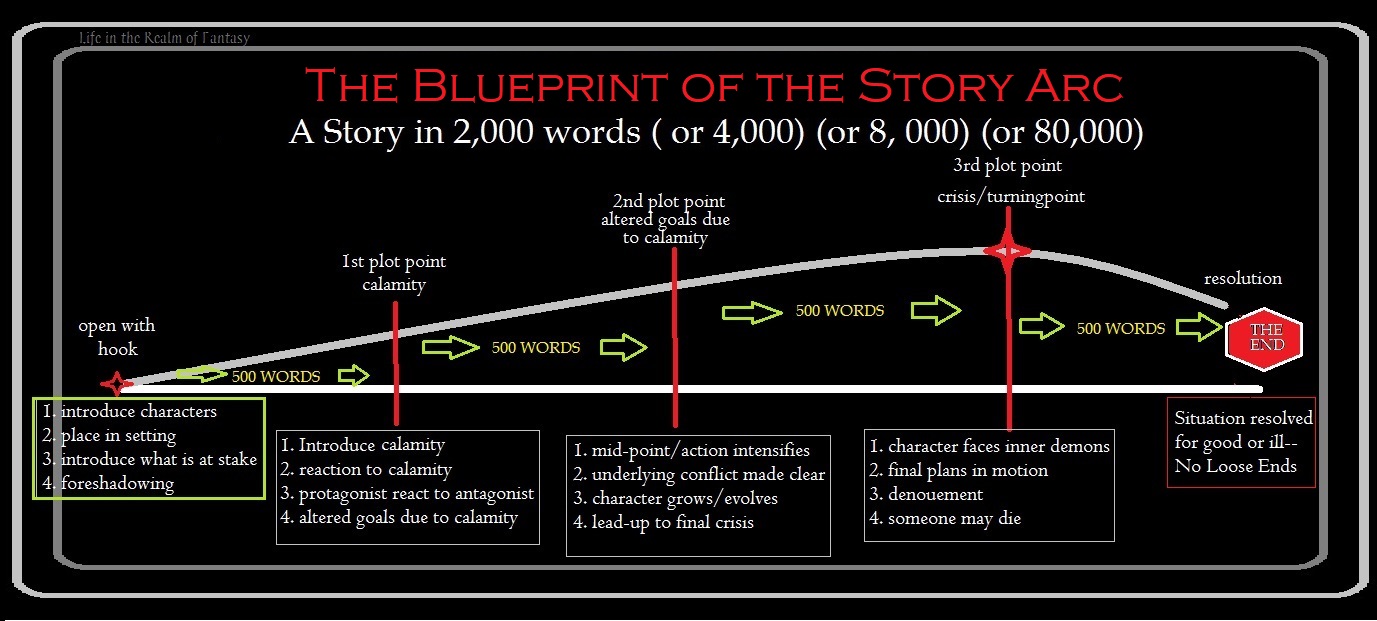
Let’s say I need to write a story for a contest or publication with a 2,000-word limit. Once I have the outline in shape, I will mentally divide the story into 3 acts. Act 1 must be told in 500 words. I will have 1,000 words to spend on Act 2, and finally, Act 3 will have to wrap things up in 500 words.

  • For any story, if you know the intended word count, you can divide the plot outline that way.

Knowing my intended word count helps me write a story, from drabbles to novels. This method works for stories with a traditional arc as well as those with a circular arc.

In a circular narrative, the story begins at point A, takes the protagonist through life-changing events, and brings them home, ending where it started. The starting and ending points are the same, and the characters return home, but they are fundamentally changed by the story’s events. The Hobbit is a tale with a circular story arc, as are many tales that follow the Hero’s Journey.

The infinity arc is similar but presents one story from two different viewpoints. The story begins with Character One, takes them through the events, and brings them back. At that point, the story shifts to Character Two and retells the events from their point of view, bringing them back to where they began. (Two circular story arcs joined by one event.) If we graphed it out, it would look something like an infinity sign, a figure-eight lying on its side: 

The story I’m using for today’s example is the Iron Dragon, which I wrote during NaNoWriMo 2015. That was the year I focused on experimental writing, putting out at least one short story every day and sometimes two. It’s the story of the web of time glitching and the perceptions of the characters who experienced it.

That year, a writing prompt I found on a writers’ website encouraged us to expand on the theme of dragons and use it to illustrate two aspects of a place. I chose to set my story in Wales, a country whose national symbol is the Red Dragon (Welsh: Y Ddraig Goch).

I am not Welsh, nor did we study Wales in school, so I had to go out and do some research. In the process, I learned a great deal and gained immense respect for a country I had known little about.

Once I had an idea of the two worlds I was building, I couldn’t resist setting two more goals to achieve.

  • I decided to experiment with the double circular story arc, seeing it as a way to tell one story as lived by two protagonists separated by twelve centuries and a multitude of legends.
  • I chose to use 1,000 words to tell both stories. I was not entirely successful, but I did keep it down to 1,025 words.

As I mentioned above, in the double circular arc, two characters are protagonists. Their stories begin at the same place, the center of the infinity symbol. They experience the event simultaneously but separately and arrive back at the same place. Both characters are tested and changed by what they have lived through. In some stories with this kind of story arc, the two characters never meet.

In the Iron Dragon, my characters physically don’t meet in person. However, they briefly occupy the same patch of ground during a glitch in the space-time continuum.

This story ends where it began, but with the two sets of characters having seemingly experienced two different events. Their perception of the meeting is colored by the knowledge and superstitions of their respective eras.

  • The first paragraph of the Iron Dragon begins in the middle of a story: the center of the infinity sign.

Those opening sentences establish the world, set the scene, and introduce the first protagonist.

  • The following three paragraphs show the situation and establish the mood. They also introduce the antagonist, which appears to be an immense iron dragon.

At this point, our first protagonist knows that he must resolve the problem and protect his people, which he does

But this is a story with two sides. Aeddan’s point of view is not the entire story.

  • Again, I had to set the scene and establish the mood and characters. Here, we meet the second protagonist, an engine driver named Owen. He has the same needs as Aeddan and also resolves the problem.

Neither character would have understood the strange physics of what just occurred had Brian Cox been around to explain it to them.

  • Each character’s understanding of what they saw and experienced is firmly based on the beliefs and lore of their era, and both do what they must to protect their people.
  • The final paragraphs wind it up. They also contribute to the overall atmosphere and setting of the second part of the story.

As a practice piece, the story had good bones. However, it’s not the right kind of story for submission to a magazine or contest, as it’s not a commercially viable piece.

The act of writing something different, a little outside my comfort zone, forces me to be more imaginative in how I tell my stories. We should all have a little fun with writing. Give that double circular arc a shot and see what you come up with.


Credits and Attributions:

IMAGE: The  Hero’s Journey, Public Domain. Wikimedia Commons contributors, “File:Heroesjourney.svg,” Wikimedia Commons, https://commons.wikimedia.org/w/index.php?title=File:Heroesjourney.svg&oldid=1013027507 (accessed July 20, 2025).

2 Comments

Filed under writing

Constructing the Short Story: theme #writing

I often find myself writing short pieces. These are scenes and mini stories that don’t really fit into a novel but are on my creative mind. Writing a short story gives me the chance to explore an idea that might be inspired by my longer work, but would muddy the waters if I included it there.

Many of my works are series, each set in a world of my creation. Writing short stories helps me develop that world. As a side benefit, it develops characters and plots I will definitely use later.

But what about stand-alone short stories? I usually submit them to contests, online magazines, and themed anthologies. The editor of the anthology ensures that each story she accepts explores an aspect of a single unifying theme.

And truthfully, having a theme to write to kickstarts my imagination.

According to Wikipedia:

A theme is not the same as the subject of a work. For example, the subject of Star Wars is ‘the battle for control of the galaxy between the Galactic Empire and the Rebel Alliance.’

The themes explored in the films might be “moral ambiguity” or “the conflict between technology and nature.” [1]

When we submit our manuscript to an editor with an open call for themed work, we must demonstrate our understanding of how the central theme can be manipulated to tell a story. Of course, engaging prose and a unique voice make a story stand out.

When you plan a story, analyze the theme. Look beyond the obvious tropes and find an original angle, and then go for it. As an author, most of my novels have been epic or medieval fantasy, based around the hero’s journey, detailing how their experiences shape the characters’ reactions and personal growth.

The hero’s journey is a theme that allows me to employ the sub-themes of brother/sisterhood and love of family.

Other layers of the story are strengthened when supported by a strong theme. Subtle use of allegory and imagery in set dressing can help strengthen the theme without beating the reader over the head.

In a story, the theme is introduced, either subtly or overtly, at the first plot point. If we’re writing a short story, this must happen on the first page. Most open calls for short stories require us to meet a specific word count. If so, lengthy lead-ins are not possible, as manuscripts that exceed the word count will be rejected.

I find it is easier to meet that wordcount when I know in advance how a story will end. I am a linear thinker, so I make an outline of my intended story arc.

  • I am an outliner, a planner, because when I “pants” it, I end up with a mushy plot that wanders all over the place and a story that isn’t commercially viable.

To create my outline, I divide my story arc into quarters. This ensures the critical events are in place at the right time. Then, I ask myself several questions about the story as I first imagine it. This will evolve, but it offers my creative mind a jumping off point.

  • What is the inciting incident? How does it relate to the theme?
  • What is the goal/objective? How does it relate to the theme?
  • At the beginning of the story, what does the hero want so badly that she will risk everything to acquire it? Why?
  • Who is the antagonist? What do they want and why?
  • What moral (or immoral) choice will our hero have to make? This is the real story, and how does it relate to the theme?
  • What is happening at the midpoint? Why does the antagonist have the upper hand?
  • At the ¾ point, my protagonist should have gathered her resources and be ready to face the antagonist. How can I choreograph that meeting?
  • How does the underlying theme affect every aspect of the protagonists’ evolution in this story?

I have mentioned before that in my own writing life, dumping too much background is my greatest first-draft challenge. Writing short stories has helped me find ways to write more concisely.

An outline keeps me on track. What is essential for the reader to know, and when should they learn it? What is just info for me to cut and save in the outtakes file?

Short stories follow a single event in a character’s life. Each word must advance that one story thread. Having your work beta read by your critique group will help you identify those places that need to be trimmed down.

I have close friends who see my work first and who help me see what the real story is before I bother my editor with it. My beta readers are published authors in my writing group.

Because I am a wordy writer, I have to keep in mind that (especially in a short story) every word is precious and must be used to the greatest effect. By shaving away the unneeded info in the short story, I can expand on the theme of the story and how it drives the plot.


Credits and Attributions:

Wikipedia contributors, ‘Theme (arts),’ Wikipedia, The Free Encyclopedia, https://en.wikipedia.org/w/index.php?title=Theme_(arts)&oldid=848540721(accessed July 12, 2025).

2 Comments

Filed under writing

Deciding the right chapter length #writing

I was recently asked what I think the right chapter length should be in a novel. We haven’t talked about this in a while, so today is as good a day as any.

I like it when an author considers the comfort of their readers. Many readers, including me, want to finish a chapter in one sitting. We rarely have the time to sit and read all day, no matter that we wish we could.

With that said, you must decide what your style is, and it will evolve as your writing career progresses.

Over the years, I’ve read and enjoyed many books where the authors made each scene a chapter, even if it was only two or three hundred words long. They ended up with over 100 chapters in their books, but because their story was so engaging, I barely noticed it.

In several seminars I’ve attended, the presenters suggested that we should have a specific word count limit for chapter length. One suggested 1500, while another said not more than 2500.

One of my favorite authors sometimes has chapters of only five or six hundred words, which keeps each character’s storyline separate and flows well. For my style of storytelling, 1,500 to 2,500 words is a good length.

As a reader, I have noticed that successful authors are careful to ensure that each chapter details the events of one scene or several closely related incidents. Chapters are like paragraphs in that cramming too many disparate ideas into one place makes the narrative feel erratic and disconnected.

My novel, Julian Lackland, has longer chapters. This is because the story arc details important events occurring over forty years of Julian’s life.

The novel follows the chronological order of his life, and the chapters detail the incidents that profoundly changed him. I inserted hard breaks within each chapter whenever a scene ended and a softer transition would have lent confusion to the narrative.

What is a soft transition? Conversations make good transitions to propel the story forward to the next scene. They also offer ways to end a chapter with a tidbit of information that will compel the reader to turn the page. Information is crucial, so we want to provide it when the protagonist and the reader require it.

Fade-to-black and hard scene breaks: I only use fade-to-black transitions as a finish to a chapter, as they leave the reader with something to think about.

Time must be considered too. When a real chunk of time has passed between the end of one scene and the beginning of the next, I suggest giving the scene a firm finish with a hook. That leads the reader to continue on to the next chapter.

With each scene, we push all the main characters forward and raise the stakes for each of them a little more. The action and dissemination of information entertain the reader. Good transitions allow the reader to reflect and absorb the information gained before moving on to the next scene.

This brings me to how the narrative point of view can influence the length of a scene or chapter. Some editors suggest you change chapters, no matter how short, when you switch to a different character’s point of view.

I (somewhat) agree with this stance, as a hard transition when you switch narrator-characters is the best way to avoid head-hopping and subsequent confusion.

But what is head-hopping? When you change the narrative point-of-view in the same scene, one paragraph to the next with no definite separation, you create a “viewpoint tennis match.”

First, you’re in Character A’s head hearing her thoughts, then you’re in Character B’s head hearing his. Then you’re back in A’s head. It becomes challenging to know who is speaking or thinking.

Also, the characters tend to lose their individuality. They begin to sound the same, further muddying the scene.

That is not to say that you should never switch viewpoints within a chapter. Sometimes, more than one character has a perspective that needs to be shown. However, readers will find it easier to follow the narrative if you are careful with how you handle the change of narrator.

One of the problems some readers have with Robert Jordan’s Wheel of Time Series is the way he wanders between storylines as if he couldn’t decide who the main character is. Rand al’Thor begins as the protagonist, but the narrative soon wanders far away from him as Matrim, Perrin, Nynaeve, Elayne, Aviendha, and Egwene are given prime storylines. Each thread comes together in the end, but this is the main criticism of the series.

I’m a dedicated WoT fan, but even I found that exceedingly annoying by the time we reached book eight, Path of Daggers. I was halfway through reading that book when I realized there was a good chance that we would never see Rand do what he was reborn to do.

I try to concentrate on developing a single compelling, well-rounded main character, with the side characters well-developed but not upstaging the star. I kept reading the entire WoT series because Jordan’s (and later Sanderson’s) writing was brilliant, and the world and the events were intriguing.

It’s easier for the reader to follow the story when they are confined to one character’s perspective for the majority of the narrative. If you choose to switch POV characters, I suggest using a hard, visual break, such as two blank spaces between paragraphs or ending the chapter.

Now we come to a commonly asked question: Should I use numbers, or give each chapter a name?

What is your gut feeling for how you want to construct this book or series? If snappy titles pop up in your mind for each chapter, by all means, go for it. Otherwise, numbered chapters are perfectly fine and don’t throw the reader out of the book. Whichever style of chapter heading you choose, be consistent and stay with that choice for the entire book.

To wind this up: Limit your point of view characters to one per scene. Each chapter should detail events that are related, rather than a jumble of unrelated happenings.

When it comes to chapter length, you must make the decision as to the right length and end chapters at a logical place. But do end each chapter with a hook that entices the reader to continue reading.


2 Comments

Filed under writing

#FineArtFriday: Seaport at sunset by Claude Lorrain 1682

Artist: Claude Lorrain (1604/1605–1682)

Title:   Seaport at sunset

Genre: landscape painting

Date: 1639

Medium: oil on canvas

Dimensions: height: 1 m (40.5 in); width: 1.3 m (53.9 in)

What I love about this painting:

Wow! Where to start? This is what true genius looks like. The overall scene is masterfully done, one of the best seascapes I have seen. The waters are calm, allowing for goods and passengers to be transferred safely to shore. The sky is that incredible quality that nature sometimes offers us on a summer evening. A haze is rising, and ships are still entering the harbor, waiting for their turn to offload their cargoes and passengers. Waves lap softly at the shore, a gentle rhythm.

Claude shows us a thriving, prosperous seaport under a glorious sunset. In fact, the scenery is so beautiful, it’s easy to overlook the dramas playing out in the foreground. However, we shouldn’t, as that is where the real story he wanted to show us lies.

In the bottom left, a family is seated on an upturned boat. Are they waiting to board a ship? They seem to be musicians, as the man plays a cittern, and a lute rests beside the woman and child, along with a pile of baggage.

To their right, a pair of merchants discuss business with a foreign trader, whose clothing suggests he is from Persia. Are they negotiating the purchase of rare spices? Or are they attempting to sell him something?

In the bottom center, violence has erupted as a pair of ruffians have decided to settle their dispute the old-fashioned way. Sailors on shore leave? Too much to drink? Fighting over a woman? The onlookers are disgusted but do not step in to break it up. Apparently, someone “had it coming.”

To the right of the combatants and knot of friends, a pair of well-dressed men, one seated on an upturned boat and one standing, are clearly waiting for something. Perhaps these people are all waiting to board the same ship.

And finally, on the far right, we have several ships, accompanied by small boats called tenders, which are going to and from them. In the foreground, sailors row tenders to the strand. Will our passengers be rowed out to board their ship? This is a bustling harbor, and it’s clear that berths along the quayside are at a premium. Perhaps, rather than paying for a berth when his cargo consists of passengers rather than goods, this ship’s owner keeps his costs down by bringing supplies on board by tender and ferrying passengers to and from the shore.

Claude’s glorious sunset hints that hope lies beyond the horizon. Are the passengers embarking on a journey to the New World? Perhaps they are going to India, or even to the French colonies in the South Pacific. Wherever they are going, I hope their journey is peaceful and ends well.

About the artist, via Wikipedia:

Claude Lorrain (born Claude Gellée), called le Lorrain in French; traditionally just Claude in English; c. 1600 – 23 November 1682) was a painter, draughtsman and etcher of the Baroque era originally from the Duchy of Lorraine. He spent most of his life in Italy, and is one of the earliest significant artists, aside from his contemporaries in Dutch Golden Age painting, to concentrate on landscape painting. His landscapes often transitioned into the more prestigious genre of history paintings by addition of a few small figures, typically representing a scene from the Bible or classical mythology. [1]

To learn more about this artist go to Claude Lorrain – Wikipedia


Credits and Attributions:

IMAGE: Seaport at sunset by Claude Lorrain 1682. Wikimedia Commons contributors, “File:F0087 Louvre Gellee port au soleil couchant- INV4715 rwk.jpg,” Wikimedia Commons, https://commons.wikimedia.org/w/index.php?title=File:F0087_Louvre_Gellee_port_au_soleil_couchant-_INV4715_rwk.jpg&oldid=967103912 (accessed June 27, 2025).

[1] Wikipedia contributors, “Claude Lorrain,” Wikipedia, The Free Encyclopedia, https://en.wikipedia.org/w/index.php?title=Claude_Lorrain&oldid=1298367934 (accessed July 2, 2025).

2 Comments

Filed under #FineArtFriday, writing

A few of the many things I wish I had known about #writing

I have always thought of myself as a writer. During the 1970s and into the early 1990s, my pen and ink ramblings were poems and random scenes that contained ideas that later evolved into full-fledged short stories.

My typewriter sat beside the hamster cage in the corner of the kitchen (a poor placement choice). While my kids did homework, I pecked away at short stories.

Eventually, I acquired a secondhand computer and began writing a novel. Five years and 225,000 words later, I had a rambling mess on my hands that would never be finished.

I didn’t know what to do with it. I couldn’t figure out how to end it, and it was filled with grammar and punctuation errors. I had no idea how to make it look professional, as I had never heard of “industry standards.” My enthusiasm exceeded my knowledge and ability, and I didn’t know how to rectify the problem.

In 1990, a book that would change my life was featured in the Science Fiction Book Club catalog: “How to Write Science Fiction and Fantasy” by Orson Scott Card. The day that book arrived in my mailbox was the day I embarked on my quest to learn everything I could about the craft of writing.

I’m still learning. Since acquiring that book, I have amassed a library on the craft. Some are brilliant, while others are not, but I always learn something.

Diving into the deep end of writing contests and seeking a publisher can be both scary and wonderful. Every experience, good and bad, educates you just a little more. What follows are a few things I wish I had known in 2010 when I was directed to the (now defunct) organization that was NaNoWriMo. and began this journey in earnest.

One: Make a style sheet (also known as a storyboard or bible) as you go.

Build a glossary of words and spellings unique to your story and be sure to list names. I use an Excel spreadsheet, but you can use any tool you like to help you stay consistent with your spelling.

And even though I work at developing a thorough glossary, my editor will find many words to add to it.

Two: Nothing hurts worse than completely losing an entire manuscript. Develop a logical, consistent system for naming your files. Save your document regularly and back up your files to an external thumb drive or to the cloud.

Save each version of your manuscript in its own master file, and give each subfile a different name so you can go back and retrieve bits you may need later. I use a system like this:

  • The master file might be titled: Lauras_Story
  • The subfile might be L_S_V5.docx

That stands for Laura’s Story version five. I work out of Word, so the extension is automatically a docx. Each master file will contain many subfiles before a story or book is published.

Three: Find a local group of writers to meet with and talk about the craft.

Authors need to network with other authors because we need to discuss the craft with someone whose eyes don’t glaze over.

I found a fantastic local group by attending write-ins for NaNoWriMo. The Tuesday Morning Rebel Writers have my back, and I have theirs. Since the pandemic, and with several of our members now on the opposite side of Washington State, we meet weekly via Zoom. We are a group of authors who write in a wide variety of genres.

Yes, we help each other bring new books into the world through beta reading and critiquing. But more than that, we are good, close friends who support each other through life’s twists and turns.

Four: Never stop educating yourself. It requires dedication and a small investment of money, but you can do it.

Learn how to say what you mean with your unique voice and style. A college education may be out of reach, but you can buy books on grammar, style, substance, and writing craft.

Learn about structure and pacing from successful authors. Spend the money to attend conventions and seminars. You will learn so much about the craft of writing, the genre you write in, and the publishing industry as a whole. These are things you can only learn from other authors.

Five: Don’t even consider signing with the slick-talking publisher that contacts you out of the blue.

In 2010, I made my word count and became a firm believer in the principle that was behind the founding concept of NaNoWriMo. If you sit down and write at least 1,667 words every day, you will complete the first draft of your novel in 30 days. If you have a community of like-minded authors to encourage you, you are more likely to succeed. That is what NaNoWriMo was originally intended to be, as Chris Baty envisioned.

I didn’t know that while a novel might have the complete story arc, it isn’t finished.

Here is where experience can be a painful teacher. The year that followed was filled with serious mistakes and naïve bungling.

Legitimate publishers NEVER contact you. You must submit your work to them, and they prefer to work with agented authors. I didn’t know this. I placed my book in the hands of someone who was not qualified to publish. 2011 was filled with low points, ending with a devastating falling out with my publisher. Fortunately, I retained the rights to my work.

Authors are perfect targets for predators. Be smart. Ask yourself how a publisher could possibly want work they haven’t seen? And why should you pay them for “editing” or any other aspect of publishing? And how did they get your email address?

Make use of SFWA’s Writer Beware site. Predator publishers profit from our deep desire to be published. They will charge you for services they don’t provide and publish your work in its raw, unedited form, and you will never see a dime.

Six: even though you’re writing that novel, keep writing short stories, too.

Short stories and micro-fiction are a training ground, a way to hone your skills. Submitting your work to magazines, anthologies, and contests is the best way to get it published. Each story that gets published increases your visibility, and you develop a reputation as a reliable author. I suggest building a backlog of work ranging from 100 to 5,000 words in length. Keep them ready to submit whenever magazines, anthologies, or contests announce a call for submissions.

Remember, every scene and vignette that rolls through your head can be made into something you can use.

Get the Submittable App and start submitting your work, and don’t let rejections stop you. Keep sending that work to new places because someone will want it.

Seven: Never Stop Reading. I say this all the time. Read widely and in all genres. Read critically and apply what you learn about writing, both good and bad, to your work.

These are a few of the many things that I wish I had known when I first started writing professionally but didn’t.

4 Comments

Filed under writing

Employing contrast in the architecture of a story #writing

There is a quote from the Buddha that I have found especially true for creating a great story. “There has to be evil so that good can prove its purity above it.”

J.R.R. Tolkien understood this quite clearly. His work was written in a highly literate style that everyone understood a century ago. Reading the Lord of the Rings trilogy requires commitment, and today, fewer readers are willing to undertake it.

Tolkien employs contrasts throughout the length of his stories. He shows the peace and prosperity that Frodo enjoys and then asks him to choose his destiny. Frodo chooses the difficult path. Tolkien takes the hobbit and all the central characters through many personal changes. He forces them to face their fears, gives them reasons to continue, to not give up.

Frodo’s story is about good and evil, war and peace, and the hardships endured in the effort to destroy the One Ring and negate the power of Sauron. So why would ordinary middle-class hobbits living comfortable lives go to so much trouble if Sauron’s evil posed no threat to their peace and prosperity?

They do it because they can see that in the long run, Sauron’s orcs would overrun the Shire and destroy everything good and beautiful.

Lengthwise, the three books aren’t as long as people make them out to be, especially when compared to Robert Jordan and Brandon Sanderson’s long and winding 15-book Wheel of Time series (comprised of 4,410,036 words) or Tad Williams’ epic and highly literate Memory, Sorrow, and Thorn series (comprised of 1,121,720 words).

Tolkien’s trilogy totals only 455,175 words, which is considered an optimal length for a debut series in the epic fantasy genre. Fans of epic fantasy like and expect long books with large stories.

Whenever I talk about what we can learn from Tolkien, someone will respond that Tolkien wrote in a style that 21st-century readers find frustrating. Certainly, he used more words than a modern writer would dare to. A 21st century writer would face the slings and arrows of the modern critique group.

But while his style is more wordy than modern taste, his work is still compelling. He still has plenty to say that can resonate with us. In the process, he takes us on a journey with side quests and an epic, wonderful ending that was somehow left out of the movies – the Scouring of the Shire.

Hint: Yes, reading the books requires persistence, but if you want the real story and don’t have the time or patience, the audiobooks, as narrated by Andy Serkis (who played the role of Gollum in the movies), are a must-listen.

With the Ballantine Books paperback edition in 1965, J.R.R. Tolkien brought epic fantasy to my generation of college students. In the 1970’s, in my college town, the graffiti in downtown Olympia read “Frodo Lives.”  Frodo Lives! – Wikipedia

But how did Tolkien’s style of storytelling influence the genre as we know it today? For that, we take a look at Tad Williams’s masterpiece, The Dragonbone Chair. It’s the first book in the fantasy series Memory, Sorrow, and Thorn. It was published in 1988 and hooked me.

Williams takes the fourteen-year-old Simon, a kitchen boy, and Miriamele, a princess, and gives them an epic quest. He brings them together and then forces them down separate paths that eventually rejoin. Along the way, they grow into adulthood, and what they learn about themselves is both bitter and wonderful.

I read The Dragonbone Chair when it first came out in paperback. I loved it so much, I had to re-read it immediately upon finishing.

In both the Lord of the Rings trilogy and Tad Williams’ Memory, Sorrow, and Thorn, we have two of the most enduring works of modern fantasy fiction. Both feature an epic central quest and side quests, all of which must be completed for the protagonists to arrive at the final resolution.

In both series, we have moments of joy and contentment sharply contrasted with events causing terrible deprivation and loss. Each event urges us to keep reading, inspiring the deepest emotions and the desire to find out what happens next.

This use of contrast is fundamental to the fables and sagas that humans have been telling since before the discovery of fire. Contrast is why Tolkien’s work is the foundation upon which modern epic fantasy is built. The way Tad Williams wrote his characters, and his trimmed down prose further modernized the genre, but he kept the tropes of an engaging narrative, epic quests, and diverse fantasy cultures and races.

When the author employs the highs and lows of our human experience to tell their story, the reader empathizes with the characters. They live the story as if they were the protagonist.

And what about contrasts in world-building? It can be shown in subtle ways.

Juxtaposing plenty and poverty in your worldbuilding shows the backstory without requiring an info dump. Contrast and good pacing turns a wall of words into something worth reading.

In our real world, war, famine, and floods are followed by times of relative peace and plenty. The emotions and experiences of people living through all those times are the real stories.

This is not just a concept found in fantasy novels; it’s a part of our human history and our future.

We shouldn’t limit our reading to the old favorites that started us on this writing path. You may not love the novels on the NY Times literary fiction bestseller list, but it’s a good idea to read one or two of them every now and then as a means of educating yourself. We learn the architecture of stories by reading and dissecting novels and short stories written by the masters, both famous and infamous.

What you don’t like is as important as what you enjoy. Why would a book that you dislike be so successful? No matter how much money a publisher throws at them, some books are stinkers.

You don’t need to pay for books you won’t like. Go to the library or to the secondhand bookstore and see what they have from the NYT bestseller list that you would be willing to examine.

Give that book a postmortem.

  • Did the book have a distinct plot arc?
  • Did it have a strong opening that hooked you?
  • Was there originality in the way the characters and situations were presented?
  • Did you like the protagonist and other main characters? Why or why not?
  • Were you able to suspend your disbelief?
  • Did the narrative contain enough contrasts to keep things interesting?
  • By the end of the book, did the characters grow and change within their personal arc? How were they changed?
  • What sort of transitions did the author employ that made you want to turn the page? How can you use that kind of transition in your own work?
  • Did you get a satisfying ending? If not, how could it have been made better?

Reading and dissecting the works of successful authors is a necessary component of any education in the craft of writing.

When you read a book that you like or dislike, think about how you can apply what you learn to your own work.

I say this regularly, but I must repeat it – getting an education about the craft of writing is important. If you have a good library in your town, this sort of education is free, a price that fits my budget perfectly. What I learn from the masters helps me to plan the pacing, helps me balance the emotions and events in my own stories.


4 Comments

Filed under writing

#Writing the Disaster 

Severe weather, fires, famines, and floods are terrible to live through, and many harrowing stories emerge from these experiences. Stories of apocalyptic catastrophes resonate because disaster drives humanity to strive for greater things. Those who survive and rise above it become heroes.

One disaster we may all face at some point is famine driven by climate change. Hunger exists in this world, and famine is an enemy that takes no prisoners.

Food deprivation can have a lasting impact on a person. People can survive on very little, and unfortunately, many do. To go without adequate food for any length of time changes you, makes you determined to never go hungry again. You stockpile preserved foods in times of plenty as a shield against the next famine.

Unfortunately, for some, hunger will lead them to make choices that challenge the accepted morality of those who have no concept of what hunger truly is.

If you are looking for the seeds of a good story, consider the small tragedies people face each day, deeply personal catastrophes. These disasters happen on what seems an unimportant level to people who have resources.

I have used this example before, but it’s a real-life situation, one that may be familiar to you and your community. A young widow is working two part-time jobs and raising her two small children. How would you write her story? Perhaps she lives in an area with no public transportation. She struggles to pay for fuel, but what if her car breaks down? How will she get to work?

All her money goes to fuel, childcare, rent, and utilities. What little she has left after those bills are paid goes to food. She has no resources and no means to pay for car repairs. Without her car, she will lose both jobs. That is a profoundly personal disaster, one from which she and her children might not recover.

But maybe that plot isn’t big enough to inspire you to write a book about it. Perhaps you want to write about a disaster that inspires heroics in the face of widespread devastation. The world itself can provide us with plenty of drama. Wildfires, floods, tornadoes, hurricanes, earthquakes, tsunamis – these catastrophes regularly destroy thousands of communities.

courtesy Office360 graphics

Once we have introduced our characters and set the scene, it’s time to bring on the natural disaster. When you begin writing the story, it will be chaotic. Just get the bones of the events down as well as you can and move on. You must get the entire story down while it is fresh.

In the first draft, write each scene as fast as you can, and don’t worry about fine-tuning it because you will come back to it later. The second draft is where you will iron out the rough spots and make things logical.

In the second draft, we take apart the scenes where we have told the story and reword them. We show the events as if we were painting with words. We use power words to inject real, believable emotion into the experience.

The window shatters, and a two-by-four impales itself in the wall beside David amid a shower of glass shards. I stare, dumbstruck, as the wind tears the door from my hand and slams it against the wall.

Verbs in that scene are: stare, impales, shatter, tears, and slams. Show the bones of the event by using verbs with powerful visuals, and the reader’s mind will fill in the rest.

I suggest you open a new document and describe the disaster in great detail. Then save it as background material for that story and walk away from it. Let it rest, and move on to something else. When you return to it, read it aloud and see what you can cut and condense and still have the bones of the action. As always, verbs and power words are action’s best friend.

Droughts often cause famines and worse. To go without water is to die. Thirst is a more immediate pain than hunger. The human animal can survive for up to three weeks without food but only three to four days without water. Rarely, one might survive up to a week.

Even brackish water must taste sweet when one suffers from a lack of potable water. And when one is starving, foods they would consider repugnant under other circumstances will fill their belly.

Look at the continual strife in some third-world countries. You will see how long-term droughts have precipitated widespread famine, leading to civil unrest. Gang wars are fought over the right to own a water source, and these conflicts can erupt into revolution.

We often forget this when we have plenty to eat and never have to worry about whether we will have water in our faucet as long as we can pay the bills. However, if we learned anything from the empty grocery store shelves in 2020 and the subsequent supply chain crisis, it is that our well-fed lives are standing on a one-legged stool.

Once the events of the disaster are on paper the way we want them, we have the opportunity to ratchet up the reader’s emotions by the way we portray the aftermath. Who finds strength through the calamity, and who is broken by it? What roadblocks do they face, and how do they recover?

We must complete the story and provide the reader with some closure by ending with our characters in a place of comparative happiness and security.

Drama, heartache, disaster, and violence are the backdrop against which humanity’s story plays out. The most powerful books in the Western Canon of Great Literature explore both the good and evil of the human experience.

We connect with these stories across the centuries because the fundamental concerns of human life aren’t unique to one society, one technological era, or one point in time. We all want enough food, enough water, and reliable shelter.

When we contrast ease with hardship, we add emotional texture to our narrative. I love a good story featuring courage in the face of personal disasters. Readers like me will think about the story and those characters long after it has ended.

5 Comments

Filed under writing