Category Archives: writing

Microsoft, you are p**sing me off, and other random rants #writing

Look, Microsoft. I have been using your products since 1994. I’ve stuck with you through screens of death, through Windows ME and Vista, and through Windows 8.

I adored Windows 10. I use your product every day, often for six to ten hours at a stretch. I write books and sometimes edit other people’s work. I listen to a terrific playlist while I do that, mostly epic JRPG fantasy game soundtracks. I also use it for gaming.

I’m just gonna lay this out there like it is. With every update, your current version of Windows 11 has become more of a shit show.

On the good side: While I utterly despise the mandatory inclusion of AI (CoPilot) to “assist” my writing, I am glad you allow me to turn it off. YAY for that blessing!  It is the most gawd-awful example of “fixing what ain’t broke” that I have recently encountered. In the default application, it insists on giving unasked-for advice, attempting to rewrite my prose to comply with modern business practices. Thank you for allowing me to shut it off, even though I had to Google the instructions.

Don’t screw that up, please. (Instructions for turning off CoPilot at the bottom of the post.)

Frustrated cartoon monkey at a computer, via Microsoft Word.

courtesy Office360 graphics

And now the negative: since the most recent updates, my audio has been acting up. Even better, I couldn’t connect either of my two (2) computers to my printer! That was a pain, as I like to print out my revised chapters and read them out loud to make sure they say what I intended. I had to pay a tech to come in and fix my printer problem. I don’t want to have to do that for the audio.

I live in fear of updates.

And yes, I have updated all the drivers and also ensured I have the most recent Realtek updates.

It’s still randomly droning and hanging up on certain sounds and words with M’s or N’s, even with the new drivers installed. Sometimes it goes all day with no problems. Other times it’s so bad I have to restart the computer two or three times in one day.

And this occurs on both my desktop AND my laptop.

Why should I have to go through this? The desktop PC is old, purchased in 2020, but this laptop is less than two years old, and if this keeps up, it’s gonna be a boat anchor because the random buzzing and stuttering is making me nuts.

I have no desire to purchase a Mac. My first computer was a Mac, and the office in my last job was equipped with Macs. So, while I have used them before, I prefer a PC.

Besides, my son-in-law works for you. I want to keep him employed!

Fix your product and let me get back to work! Otherwise, I will have to consider jumping ship. Don’t make me go to the dark side. Don’t do it.

And now for the sad news of the week: On the first day of February, I made the mistake of purchasing living plants, a miniature rose, and a potted tulip to brighten the eternal gray of winter in the Pacific Northwest.

I know better than this. Greg was the plant person, not me. Nevertheless, from the moment I brought them home, both Rose and Tulip were important members of the household. Rose, in her lovely pink petals and Tulip in her red were champions, fighting back the Northwest gloom.

Jan Brueghel the Elder - Flowers in a Vase with a Clump of Cyclamen and Precious StonesUnfortunately, both Rose and Tulip have passed away. Their two weeks of life in my neglectful care were meaningful and made a difference during the darkest days of winter.

Whatever it was that finally took them, at least they went into that dark unknown together.

One day, they were sitting in my window, waving to traffic as it passed by, and the next, they lay draped over the edges of their respective pots. They were good plants, beloved by all who met them, and I’m sure they are now in plant heaven.

Truthfully, I prefer houseplants that are dishwasher safe. I usually stop at the Dollar Tree and get the kind that you can put in the top rack every month or so for a good cleaning. I just run the rinse cycle (with the dry cycle turned off). It gives them a good wash and they look like new. I’ve never had a plastic plant die, no matter how I neglected it.

Now on to my next rant. I was recently forced to change health insurance so that my husband could be cared for by the doctor who makes monthly house calls to the Adult Family Care home where he is living. Suddenly, I was faced with the fact that while my husband was able to be cared for well, I could NOT find a doctor in my town that accepted new patients with my insurance.

But HUZZAH! After two months of struggle, searching, and worry that I would have to drive 70 miles north to the Seattle area to find a doctor that accepts new patients with my insurance, I have connected with a doctor who more than suits my needs. I am now on proper blood pressure meds, and hopefully everything will stay smooth sailing.

If Microsoft patches its current problems anytime soon, my blood pressure should return to somewhere near normal.

One can dream.

And finally, as promised above, here is an image showing how to turn off CoPilot in MS Word, as shown by my Google search. Feel free to right-click and save it to your desktop.

You can disable Copilot in Word to remove AI assistance and maintain a distraction-free editing environment. The process differs slightly between Windows and Mac. Windows Open Microsoft Word and click the File tab. Select Options from the sidebar to open the Word Options window. Click Add-ins in the left-hand menu. In the Manage dropdown at the bottom, choose COM Add-ins and click Go. Locate the Copilot add-in (e.g., Microsoft Word Copilot) and uncheck its box. Click OK to confirm. Restart Word to apply the changes.


Credits and Attributions:

“IMAGE: Wikimedia Commons contributors, “File:Jan Brueghel the Elder – Flowers in a Vase with a Clump of Cyclamen and Precious Stones.jpg,” Wikimedia Commons, https://commons.wikimedia.org/w/index.php?title=File:Jan_Brueghel_the_Elder_-_Flowers_in_a_Vase_with_a_Clump_of_Cyclamen_and_Precious_Stones.jpg&oldid=1168023989 (accessed March 1, 2026).

14 Comments

Filed under writing

Exploring Depth #writing

We often talk about the story arc and its component parts and features. But to explain depth, we must put all the parts and pieces back together and examine the story as a whole.

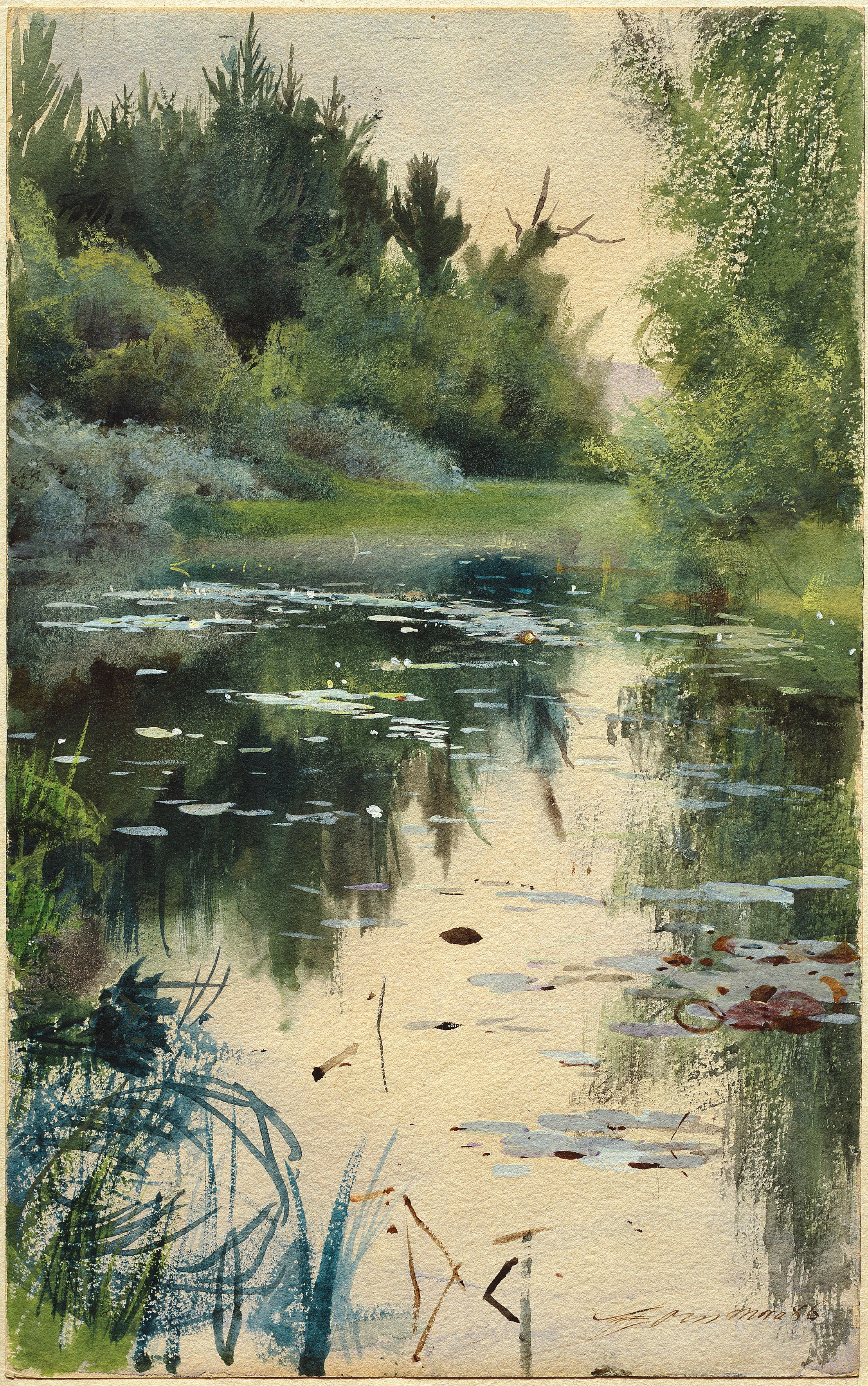
A story is like a pond filled with layers and meanings.So, what is depth, exactly? It is the component of the narrative that supports and informs the story’s arc. It is also comprised of layers.

When you look at a pond, you see the surface. It could be calm, or if a storm is brewing, it will be ruffled and moving. But it is deep and conceals many things beneath that calm surface. A narrative also comprises several layers.

Layer One is the surface layer. It is the Literal Layer; the what-you-see-is-what-you-get layer. The components of the story’s surface are:

  • the setting
  • the action
  • the visual/physical experience of the characters as they go about their lives.

When the reader sees something, they recognize it. Trees are trees, a bus is a bus, and we all recognize those aspects of worldbuilding. The surface layer also shows the characters’ actions in real time, so readers immediately feel they know what is going on.

The reader sees it when a figure steps from behind a tree. A gun was drawn and fired. What happened was clear and easy to understand.

Some authors play with the surface layer, choosing realism, surrealism, or a blend of the two.

  • Realism is serious, a depiction of what undisputedly is.
  • Surrealism takes what is real and warps it to convey a subtler meaning.

Layer Two: The layer below the surface is an area of unknown quantity. It is the Inferential Layer. This is the layer where inference and implication come into play, hints and allegations.

We show why the gun is drawn. Clues and hints imply reasons for the characters’ actions. The author offers ideas to explain how the shooter arrives at the point in the story where they squeeze the trigger, and the reader makes assumptions.

Authors drop clues and hints but allow the reader to draw their own conclusions.

In a murder mystery, the path to the moment the trigger was pulled is complicated. Perhaps no one knows exactly what led to it, but the author’s task is to include enough clues, hints, and allegations without an info dump.

A red herring is something that misleads or distracts from a relevant or important question. Authors insert clues that imply something to the reader, hints that may be red herrings. One meaning is displayed on the surface, but by using hints and clues, we enclose the secrets within the narrative. The message (inference) in the story is conveyed to the reader, but only if they pick up on the clues.

The author has to do their job well because we want the reader to feel as if they have earned the information they are gaining. They must be able to deduce what you imply. A reader can only extrapolate knowledge from the information the author offers them.

Serious readers want this layer to mean something on a level that isn’t obvious. They want to experience that feeling of triumph for having caught the meaning. That surge of endorphins keeps them involved and makes them want more of your work.

This middle layer is, in my opinion, the toughest layer for an author to get a grip on.

Below and sort of intertwined with the middle layer is Layer Three, the Interpretive Layer. This layer will be shallower in Romance novels because the point of the book isn’t a deeper meaning. It’s interpersonal relationships on a surface level. However, there will still be some areas of mystery that aren’t spelled out completely because the interpersonal intrigues are the story.

Books for younger readers might also be less deep on this level because they don’t yet have the real-world experience to understand what is implied.

Layer three is comprised of:

  • Themes
  • Commentary
  • Message
  • Symbolism
  • Archetypes

Symbolism in the matrix is shown by meaningful names and objects in the environment.This layer is sometimes the easiest for me to discuss because we are dealing with finite concepts. Theme is one of my favorite subjects to write about, as is symbolism. It is an aspect of the narrative I haven’t talked about lately, nor have I really discussed conveying messages. Archetype is another facet I haven’t discussed recently, and yet it is a fundamental underpinning of character building.

For the purposes of this post, commentary is the word that describes the expression of opinions or explanations about an event or situation. Perhaps you are writing a narrative that explores current real-world morals and hypocrisies. If so, this is an important aspect of your work.

I am looking forward to gaining a deeper understanding of the subtler, more abstract aspects of writing as I explore narrative depth. As always, when I come across a book or website with good information, I will share it with you.

In the meantime, a good core textbook is “Story” by Robert McKee. If you haven’t already gotten it, you might want to. It can be found second-hand at Amazon.

Another excellent and more affordable textbook for this is “Damn Fine Story” by Chuck Wendig. Chuck delivers his wisdom in pithy, witty, concise packets. If you fear potty-mouth, don’t buy it. However, if you have the courage to be challenged, this is the book for you.

2 Comments

Filed under writing

#FineArtFriday: A second look at “Gathering Wood for Winter” by George Henry Durrie 1855

Title: Gathering Wood for Winter

Artist: George Henry Durrie (1820–1863)

Date: 1855

Medium: oil on canvas

Dimensions: height: 26 in (66 cm); width: 36 in (91.4 cm)

Collection: Private collection

Why I love this painting:

I love the comforting hominess of George Heny Durrie’s works. in fact, I love everything the snobbier critics hate most about his work – it is meant for ordinary people (like me) to enjoy.

I thought about this painting because winter has lingered this year. Long ago when I was holding down two jobs and living through Reaganomics, I lived in a house that was heated with a woodstove. Every year it was a struggle to buy or cut enough wood to last through the winter.

In this painting, Durrie shows us a day in late autumn. His characteristic use of reds and browns juxtaposed against lighter shades of white portrays the stark beauty of late autumn in New England.

The first snow has fallen, and the season is turning to winter. It’s more important than ever to gather as much wood as possible. Fortunately for our wood gatherers, a giant has fallen victim to a storm, snapping off halfway up.

This is not necessarily the end of the tree. Leaves still cling to the branches below the wound and will continue to provide shade and habitat for as long as it can. Someday, it may be cut down, as the fact it broke in half shows that it is nearing the end of its life and may present a hazard to those who walk beneath it.

Regardless of the tree’s future, the farmer and his son are taking advantage of the bounty so close to their home. They will stack it in the woodshed in “cords” and allow it to dry out or “season” before they must burn it, hopefully not before the end of spring.

The more wood they gather now, the warmer they will be when winter’s grip tightens.

And one cord of wood won’t do it. When I was heating my house, it took five to seven cords to make it through a mild winter. And we were not cooking with it, only heating a small house.

A “cord” of wood is a standard measurement of split and stacked logs that measures 4 feet high × 4 feet wide × 8 feet long. How Big is a Cord of Wood? Exact Measurements & Visual Guide 

About the author, via Wikipedia:

George Henry Durrie (June 6, 1820 – October 15, 1863) was an American landscape artist noted especially for his rural winter snow scenes, which became very popular after they were reproduced as lithographic prints by Currier and Ives.

For many years, Durrie made a living primarily as a portrait painter, executing hundreds of commissions. After marriage, he made frequent trips, traveling to New York, Massachusetts, New Jersey,  and Virginia, fulfilling commissions and looking for new ones. His diary reveals that he was an enthusiastic railroad traveler, in the early days of the railroads. Durrie also painted what he called “fancy pieces”, whimsical studies of still lives or stage actors, as well as painting scenes on window-shades and fireplace covers. But portrait painting commissions became scarcer when photography came on the scene, offering a cheaper alternative to painted portraits, and, as his account-book shows, Durrie rarely painted a portrait after 1851.

Durrie’s interest shifted to landscape painting, and while on the road, or at home, made frequent sketches of landscape elements that caught his eye. Around 1844 Durrie began painting water and snow scenes, and took a second place medal at the 1845 New Haven State Fair for two winter landscapes. Although he had some training in portrait work, Durrie was self-taught as a landscape artist. He was undoubtedly influenced both by the American Hudson River School, and also by European artists, by studying exhibitions of their work at the New Haven Statehouse, the Trumbull Gallery, and at the Wadsworth Atheneum in Hartford, as well as in New York City. Durrie himself exhibited regularly, both locally, and in New York City at the National Academy of Design and the American Artists’ Union, and his reputation grew. Durrie was especially known for his snow pieces, and would often make copies or near-copies of his most popular pieces, with modifications to order.  The landscapes painted by Durrie offered a more intimate view than the panoramic landscapes painted by the Hudson River School, which was the leading school of American landscape painting. Colin Simkin notes that Durrie’s paintings took in a wide angle, but still “close enough to be within hailing distance” of the people who are always included in his scenes.

Currier and Ives

Durrie’s early landscapes were often of local landmarks, such as East Rock and West Rock, and other local scenes, which were popular with his New Haven clients, and he painted numerous variations of popular subjects. As his portrait commissions declined, Durie concentrated on landscapes. He wanted a wider audience, and he seemed to have a good sense of what would sell. Durrie realized that his paintings would have a wider appeal if he made them as generic New England scenes rather than as identifiable local scenes, retaining, as Sackett said, “a sense of place without specifying where that place was.” The New York City lithographic firm of Currier & Ives knew their audience; the American public wanted nostalgic scenes of rural life, images of the good old days, and Durrie’s New England scenes fit the bill perfectly. Lithographic prints were a very democratic form of art, cheap enough that the humblest home could afford some art to hang on the wall. Durrie had been marketing his paintings in New York City, and Currier and Ives, who had popularized such prints, purchased some of Durrie’s paintings in the late 1850s or early 1860s, and eventually published ten of Durrie’s pictures beginning in 1861. Four prints were published between 1861 and the artist’s death in New Haven in 1863; six additional prints were issued posthumously.

The popularity of Durrie’s snow scenes received an additional boost in the 1930s, when the Traveler’s Insurance Company began issuing calendars featuring Currier and Ives prints. Starting in 1946, the January calendar always featured a Durrie snow scene. Historian Bernard Mergen notes that “84 of the 125 paintings attributed to him are snowscapes, more than enough to make him the most prolific snow scene painter of his time.”

In Durrie’s time, winter landscapes were not popular with most curators and critics, but nevertheless, by the time of his death, Durrie had acquired a national reputation as a snowscape painter. Durrie died in 1863, at age 43, probably from typhoid fever, not long after Currier and Ives began reproducing his paintings as prints.

Durrie was dismissed by critics as a popular artist, an illustrator rather than a fine artist. Although Durrie’s Currier and Ives prints were popular, his name was still relatively unknown. But a revival of interest in Durrie began in the 1920s with the publication in 1929 of Currier and Ives, Printmakers to the American People, by collector Harry T. Peters, Sr., who called Durrie’s prints “among the most valued In the entire gallery [of Currier and Ives prints]”, and says that Durrie was known as the “snowman” of the group. [1]


Credits and Attributions:

IMAGE: Gathering Wood for Winter by George Henry Durrie 1855. Wikimedia Commons contributors, “File:George Henry Durrie – Gathering Wood for Winter.JPG,” Wikimedia Commons, https://commons.wikimedia.org/w/index.php?title=File:George_Henry_Durrie_-_Gathering_Wood_for_Winter.JPG&oldid=853995324 (accessed May 1, 2025).

[1]Wikipedia contributors, “George Henry Durrie,” Wikipedia, The Free Encyclopedia, https://en.wikipedia.org/w/index.php?title=George_Henry_Durrie&oldid=1282714933 (accessed May 1, 2025).

2 Comments

Filed under #FineArtFriday, writing

Building strength as a writer #writing

This last week, I edited a paper that my grandson had to submit to his literature class at his college. That experience sparked the realization that many people make it all the way through school without learning even a few of the more common rules for punctuating written English.

"All good writing is swimming under water and holding your breath." Quote from F. Scott Fitzgerald.Yet many of these people have stories they are bursting to write. But they are embarrassed to share them. Or perhaps they shared their first attempt with someone who either brushed them off or was harshly critical.

Many authors just out of school know they lack knowledge of punctuation mechanics but feel unworthy and a little traumatized. They don’t know where to get the information they need. If that is your situation, I have compiled a list of 7 easy-to-remember rules of punctuation, which was posted on May 26, 2025.

Feel free to bookmark that post and refer back to it as needed.

I have learned a great deal by reading the Chicago Manual of Style. It’s a behemoth of a book. Just the thought of reading, much less understanding this doorstop, is daunting to a new writer, and the price for the latest hardcover version is steep.

However, if you learn the seven basic rules discussed in my May 26th post, your work will be acceptable to most people. I will add links to several other good, affordable books on craft at the end of this post.

First of all, good writing conveys the most information with no unnecessary words. Bad writing is not a sin, if we understand that many problems can be resolved in the second draft, the stage known as revisions.

Passive phrasing, skipped punctuation, and garbled cut-and-paste issues are all codes for the author. The overuse of modifiers and descriptors are first-draft signals that tell us what we need to rephrase or show more clearly.

For example:

  1. The tree was actually covered in red leaves.

This is a simple, passively phrased sentence, but it is properly punctuated. The sentence begins with a capital letter, as it should, and ends with a period (full stop). However, it is an example of bad writing, the kind of thing we lay down in the first draft when we are just trying to get the whole story down.

It is passive rather than active, and the word “actually” isn’t necessary.

  1. Red leaves covered the tree.

The revision expresses the same idea, using many of the same words. It is active, and by rephrasing it, we conveyed the same idea with fewer words. The author moved the noun and its descriptor (red leaves) to the front of the sentence, followed by the verb (covered) and the subject of the sentence (the tree). The author also removed the words “was” and “in” because they aren’t needed and would have fluffed up the word count.

  • Using too many words to convey an idea leads to run-on sentences. It confuses the reader and makes what could be good scenes uninteresting.

The order in which you place your words changes the tone of the narrative. When I begin revisions, I do a global search for “ly” words. I look at each instance and see how they fit into that context.

I also look for passive phrasing and the various forms of “to be,” such as was, were, and had been. They are needed in some places, but overuse of them weakens the prose.

If a word or phrase weakens the narrative, I change it to a simpler form or remove it and rewrite the sentence.

Many power words begin with hard consonants, such as backlash, beating, beware, etc.I DON’T recommend going through and getting rid of every adjective or adverb, although some gurus will say just that. They forget that words like bare are adjectives, and so is barely. Many descriptors and modifiers are power words.

  • If you take out the power words, you gut your prose.
  • Also, words like every and very are part of larger words, such as everything. Cutting those words via a global search will ruin your manuscript.

Context is everything. Take the time to look at each example of the offending words and change them individually. You have already spent months writing that novel. Why not take a few days to do the job well?

Sentence structure matters. Where you place an adjective relative to the noun they are describing affects a reader’s perception. Adjectives work best when showing us what the point-of-view characters see, hear, smell, touch, and taste. The following sentence is an example I have used before:

Sunlight glared over the ice, a cold fire in the sky that cast no warmth but burned the eyes.

In the above sentence, the essential parts are structured this way: noun – verb (sunlight glared), adjective – noun (cold fire), verb – adjective – noun (cast no warmth), and finally, verb-article-noun (burned the eyes). Lead with the action or noun, follow with a strong modifier, and the sentence conveys what is intended but isn’t weakened by the modifiers.

The above scene could be shown in many ways, but a paragraph’s worth of world-building is pared down to 19 words, three of which are action words.

William Shakespeare understood the beauty and strength that powerful words written with minimal fluff can add to ordinary prose. Consider this line from his play, As You Like It, written in 1599:

It strikes a man more dead than a great reckoning in a little room. As You Like It, Wm. Shakespeare, 1599.

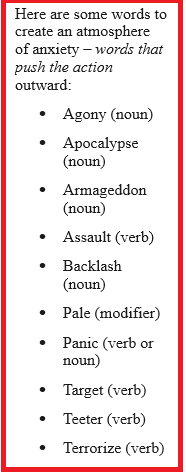
Some words that create an atmosphere of anxiety. Agony, apocalypse, Armageddon, assault, backlash, pale, target, terrorize.What brilliant imagery Shakespeare employed in that sentence. He used strong words with powerful meaning: strikes, dead, great, reckoning, and little. Those words have visual impact. They convey emotion, which is what we all hope to do with our work.

As your reward for reading this post, here is the list of my current favorite books on the craft of writing. I suggest getting these in hardback, as it is much easier to find what you need. They can also be found used on Amazon, an option for cash-strapped authors.

To learn the basics:

The Chicago Guide to Grammar, Usage, and Punctuation ($11.99 US for Kindle, $22.11 hardcover). Great reference material at much lower cost than the Chicago Manual of Style, which runs around $55.00 or more.

The Merriam-Webster Dictionary of Synonyms and Antonyms: ($5.99 Kindle, $19.99 hardcover). Find the alternatives to crutch words and learn to use them to the best effect.

To learn ways to fine-tune your manuscript:

Activate: a thesaurus of actions & tactics for dynamic genre fiction ($7.99 Kindle, $23.99 paperback). Written by Damon Suede, this is a great primer to help you write lean, descriptive prose.

Damn Fine Story ($15.99 Kindle, $18.99 paperback). Written by Chuck Wendig, this book is filled with information about how stories are constructed to help you write a cohesive narrative.

Examine the 8 forms of the words "to be." Decide if they work in the context you are using them.

8 Comments

Filed under writing

Revisions part 2 – Allegory, Symbolism, and Foreshadowing #writing

Allegory and symbolism are important tools in a writer’s toolbox. They are similar to each other but different and often misunderstood. The difference between them is in how they are presented.

  • An allegory is a narrative, a moral lesson in the form of a story, heavy with symbolism.
  • Symbolism is a literary device that uses one thing (an item, a theme, a visual reference, etc.) throughout the narrative to represent something else or to create an atmosphere and mood.

Using these tools in worldbuilding offers us a way to avoid clumsy info dumps to imply a particular atmosphere, underscoring a theme. We can increase the reader’s awareness of possible danger if that is our desire. It involves placing symbolism into the story’s visual environment.

Symbolism helps create mood and atmosphere with fewer words. When certain objects are part of the world, what the characters see, hear, and smell is subliminal to the reader. But these clues evoke an emotional response in the reader, encouraging them to stay with the story.

Take the classic Gothic novel Wuthering Heights. Interest in Emily Brontë’s work has never been greater, with a new movie based on the novel’s characters and setting.

The movie strays widely from the novel. The novel is a tragedy delving into deeply disturbed personalities more than it is a romance.

It’s not an allegory because it doesn’t explore a moral or symbolic meaning beyond its obvious story. Brontë’s symbolism in her world-building supports and underscores the themes of love, revenge, and social class.

The way Emily Brontë employed atmosphere in Wuthering Heights is stellar. I would love to achieve that level of world-building.

We can find allegories in nearly any written narrative because humans love making connections and often imagine them where none exist. While Wuthering Heights is not considered an allegory in the literary sense, it is heavily symbolic.

Spark Notes says:

The constant emphasis on landscape within the text of Wuthering Heights endows the setting with symbolic importance. This landscape is comprised primarily of moors: wide, wild expanses, high but somewhat soggy, and thus infertile. Moorland cannot be cultivated, and its uniformity makes navigation difficult. It features particularly waterlogged patches in which people could potentially drown. (This possibility is mentioned several times in Wuthering Heights.) Thus, the moors serve very well as symbols of the wild threat posed by nature. As the setting for the beginnings of Catherine and Heathcliff’s bond (the two play on the moors during childhood), the moorland transfers its symbolic associations onto the love affair.

The two large estates within the book create a pocket world of sorts, where little, if anything, lies beyond their existence. Thus, windows both literal and figurative serve to showcase what exists on the other side while still keeping the characters trapped. [1] Wuthering Heights: Symbols | SparkNotes

Symbolism on its own is a powerful tool. We can show more with fewer words. But while a tale may be heavily layered with symbolism, it might not be an allegory.

So, what is an allegory?

The storytelling in The Matrix series of movies is a brilliant example of an allegory. The Matrix was written by The Wachowskis. The narrative is an allegory for Plato’s Allegory of the Cave, a depiction of reality and illusion. The movies in the series employ heavy symbolism in both the setting and conversations to drive home the multilayered themes of humankind, machine, fate, and free will.

In The Matrix, reality and illusion are portrayed with layers of symbolism:

  • The names of the characters
  • The words used in conversations
  • The androgynous clothes they wear

Everything on the set or mentioned in conversations underscores those themes, including the lighting. Inside The Matrix, the world is bathed in a green light, as if through a green-tinted lens. In the real world, the lighting is harsher, unfiltered.

Everything that appears or is said onscreen in the movie is symbolic and supports one of the underlying concepts. When Morpheus later asks Neo to choose between a red pill and a blue pill, he essentially offers the choice between fate and free will.

We incorporate symbolism and allegory into the environment during worldbuilding to create mood and atmosphere.

These subliminal impressions affect our (the reader’s) mood and emotions, drawing us deeper into that world. These are separate but entwined forces, and they can create an emotion in the reader, such as a sense of foreboding, which is a subtler form of foreshadowing.

In real life, emotion is the experience of contrast, of transitioning from negative to positive emotional energy, and back again.

In a powerful story, symbolism, allegory, or both exist on the surface and in the subtext. Without the feelings and emotions the writer injects into the story, our characters do a zombie-like shuffle to the end, leaving the reader feeling robbed.

Setting is only a place. It is not atmosphere. Mood, atmosphere, and emotion are part of the inferential layer of a story.

How a setting is shown contributes to the atmosphere. Atmosphere is created as much by odors, scents, ambient sounds, and visuals as by the characters’ moods and emotions. Emily Brontë‘s moors and windows are subliminal background elements, but they are also foreshadowing. They convey information to the reader on a subconscious level, supporting the actions and conversations of her characters.

In my own work, I want to convey mood and atmosphere without resorting to an info dump. But what symbols can I place in the environment of my current work-in-progress to help build suspense? I need to create a list and add it to my outline as I go.

  • Side note: Just because I use a plan doesn’t mean you have to. It’s just how I work.

For me, themes are important, and a powerful theme inspires me to tell a story. A strong theme can offer suggestions and symbols when we imagine the world we are creating. I note these ideas in the outline, so I don’t lose track of them.

  • Another side note: Don’t be surprised if a casual reader doesn’t notice the symbolism you worked so hard on. They won’t see symbolism on a conscious level. However, it will reinforce the mood and atmosphere, keeping them reading.

Dedicated readers love work that holds up on closer examination, enjoying work with layers of depth, work they can read again and again and always find something new in it.

On the surface, the story and the characters who live it out are what make a book great. Deeper down, the allegories and symbolisms embedded in the narrative sink into the reader’s subconscious, stirring thoughts and raising ideas they might not otherwise have considered.

Previous in this series: Revisions, part 1: Shakespeare and the Art of Foreshadowing #writing | Life in the Realm of Fantasy


Credits and Attributions:

[1] Wuthering Heights: Symbols | SparkNotes Copyright ©2026SparkNotes LLC (accessed 08 February 2026). Fair Use.

3 Comments

Filed under writing

Revisions, part 1: Shakespeare and the Art of Foreshadowing #writing

Good foreshadowing is crucial. If, like me, you work from an outline (a planner), you might plan to embed clues in the first quarter of the story, hints that are little warning signs of future events.Revisions: the moment you discover that writing "the end" was only the beginning.For those who wing it (pantsers), this happens on a subconscious level, but it does happen.

Whether we are planners or pantsers, clumsy foreshadowing or neglecting to foreshadow are things we do when laying down our story’s first draft.

They are clues we leave in our first drafts, hints that tell us what we need to expand on or cut. For new writers, recognizing and correcting those signals can be a challenge. Experience helps us understand what we are looking at when it comes to seeing our own work with an unbiased eye.

We gain experience by

  • Writing as often as we can, daily if possible.
  • Attending writing seminars.
  • Reading books on the craft.
  • Participating in local writing groups.
  • Looking back at our earlier work with a critical eye.

Foreshadowing can be an opportunity for an info dump. This is why we seek out writing groups or hire freelance editors. We want our work to be the best we can make it. And trust me, first drafts are rife with what doesn’t work as it is currently written.

Even editors have editors because when it comes to our own work, we see what we intended to write, not what is there.

Absolute perfection is flat and mechanical, devoid of life. The eye of an experienced editor is needed to ensure the human element, the voice of the author, is protected and developed in a manuscript.

The second draft is when we finetune our foreshadowing. When a possibility is briefly, almost offhandedly mentioned, but almost immediately overlooked or ignored by the protagonists, that is foreshadowing.

It is perfectly acceptable to use the occasional “I told you so” moment in fiction. These happen in real life, but fiction isn’t quite real. ALL fiction is a way of dealing with reality but dressed up in a bit of fantasy.

We subtly insert small hints, little offhand references to future events. If the narrative is well-written, readers will stick with it as they will want to see how it plays out.

Readers aren’t perfect. Some will miss the suggested possibility just as the unsuspecting characters do. Other readers will catch the clues and begin to worry.

The most crucial aspect of foreshadowing is the surprise when all the pieces fall into place. This is the moment when the reader says, “I should have seen that coming.”

Imply: definition. In Latin it means to enfold within. One meaning is displayed on the surface but a deeper meaning is folded within.We have many reasons to pursue good foreshadowing skills. In my opinion, the most important is that it helps avoid using the clumsy Deus Ex Machina (pronounced: Day-us ex Mah-kee-nah) (God from the Machine) as a way to miraculously resolve an issue.

A Deus Ex Machina occurs when, toward the end of the narrative, an author inserts a new event, character, ability, or otherwise resolves a seemingly insoluble problem in a sudden, unexpected way.

Foreshadowing also helps us avoid the opposite and equally awkward device, the Diabolus Ex Machina (Demon from the machine). This is the bad guy’s counterpart to the Deus Ex Machina.

It’s a problem that occurs when the author suddenly realizes the evil his character faces doesn’t warrant a novel. Yet, they don’t want to waste what they have already written. At that point, they introduce an unexplained new event, character, ability, or object designed to ensure things suddenly get much worse for the protagonists.

As a reader, I hate it when a character suddenly develops a new skill or knowledge without explanation. This is when the narrative becomes unbelievable and is known as a Chekhov’s Skill. Some authors explain it away after the fact, but this kind of fault makes it impossible for me to suspend my disbelief. To avoid this, we need to mention previous examples of the characters using or training that skill. Without briefly foreshadowing that ability, the reader will assume the character doesn’t have it.

Literature and the expectations of the reader are like everything else. They evolve and change over the centuries.

In genre fiction today, a prologue may or may not be a place for foreshadowing. This is because modern readers don’t have the patience to wade through large chunks of exposition dumped in the first pages of a novel.

William Shakespeare used both exposition and foreshadowing. Larger events may be foreshadowed through the smaller events that precede them.

Let’s look at a scene from The Tragedy of Romeo and Juliet, one I have talked about before. Modern readers know it as simply Romeo and Juliet, but Shakespeare originally called it what it is: a tragedy. This is the scene where Benvolio is trying to talk Romeo out of his infatuation for Rosaline.

“Take thou some new infection to thy eye,

And the rank poison of the old will die.” 

In other words, “Dude, the minute you see a new girl, you’ll forget this one.”

Benvolio knows his friend well. Just as he predicts, as soon as Romeo lays eyes on Juliet, he forgets his obsession with Rosaline, and a new obsession begins.

Shakespeare employs foreshadowing again in a later scene. When Benvolio brings the news that Mercutio is dead, Romeo says,

“This day’s black fate on more days doth depend; 

This but begins the woe, others must end.”

Romeo is predicting that Mercutio’s death is a disaster for everyone and feels as if he is racing toward an unknown future.

In that moment, we see that Romeo is deeply aware that he has reached a point of no return.

He must fight Tybalt to avenge Mercutio because his society requires it. Therefore, he must duel to the death despite knowing that killing Tybalt won’t resolve anything. Instead, the murder will only perpetuate the problem.

Romeo has seen the foreshadowing and knows he is no longer in control of his fate.

This is one of the many reasons why (four-hundred years later) we still read and love the works of William Shakespeare. This is why movies about him are still being made, such as 2025’s masterpiece, Hamnet.

It takes both restraint and skill to insert tiny hints of what is to come into your narrative, but foreshadowing gives the protagonists (and the writer) an indication of where to go next.

These clues tantalize a reader. The desire to see if what we think has been foreshadowed keeps us turning the page.

Part 2 of this little series on revisions will explore worldbuilding and how the clues we leave in the environment can be a form of foreshadowing. And later, we will talk about easy fixes for those of us whose schooldays didn’t include a dive into practical grammar.

3 Comments

Filed under writing

Bringing emotions to life #writing

To create characters with emotional depth, you must swim with the sharks of show-and-tell. Most authors who have been in writing groups for any length of time become adept at writing emotions on a surface level.

We work to show our characters’ facial expressions, whether happiness, anger, or spite, etc. We show their eyebrows raise or draw together. Their foreheads crease and eyes twinkle; shoulders slump and hands tremble; lips turn up and dimples pop; lips curve down and eyes spark … and so on and so on.

When done sparingly and combined with conversation, this can work. But no more than one facial change per interaction, please. Nothing is more off-putting than reading a story where each character’s facial expressions take center stage.

Writing emotions with depth is a balancing act. Expressions and body language can only hint at the internal thoughts and feelings of a character, as showing the outward physical indicators of a particular emotion is only half the story.

This is where we write from real life. When someone is happy, what do you see? Bright eyes, laughter, and smiles. When you are happy, how do you feel? Energized, confident.

Conversation is about something we didn't know and offers us clues.How do we show it? Through the observations, both spoken and unspoken, of the main characters and those close to them.

In revisions, I look at each scene and try to combine the physical evidence of personal mood with the deeper aspect of the emotion. I combine spoken dialogue and internal dialogue with physical cues to offer hints as to why a character is feeling a certain way.

The hard part is to write it so I don’t tell the reader what to experience. I love it when an author makes the emotion feel as if it is the reader’s idea.

Here is a short list of simple, commonly used, easy to describe, surface emotions. These are easy to show through conversations and physical cues.

  • Anger
  • Anticipation
  • Awe
  • Confidence
  • Contempt
  • Defensiveness
  • Denial
  • Desire
  • Desperation
  • Determination
  • Disappointment
  • Disbelief
  • Disgust
  • Elation
  • Embarrassment
  • Fear
  • Friendship
  • Grief
  • Happiness
  • Hate
  • Interest
  • Love
  • Pride
  • Revulsion
  • Sadness
  • Shock
  • Surprise

Other emotions are tricky because they are more difficult to show physically unless some background information is included. They are complicated and deeply personal, but these are the gut-wrenching emotions that make our work speak to the reader.

So, here is an even shorter list of complex emotions:

  • Anguish
  • Anxiety
  • Defeat
  • Depression
  • Indecision
  • Jealousy
  • Ethical Quandary
  • Inadequacy
  • Lust
  • Powerlessness
  • Regret
  • Resistance
  • Temptation
  • Trust
  • Unease
  • Weakness

When I began writing seriously in the 1990s, I had no idea how to convey the basic emotions of my characters other than through dialogue, a form of telling. Other writers have the opposite problem, and their characters smile, and smile, and grin, and smile. It is showing … but not showing very much other than a lack of inspiration on the writer’s part.

I had good mentors and editors in those days, and through their kind suggestions, I have learned ways to combine the showing and telling. The key is to think of them as salt and garlic powder: a little of each makes the soup delicious but too much ruins it.

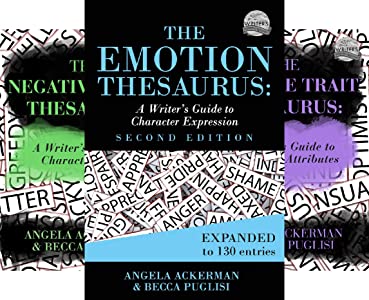
Book Cover, Emotion thesaurus.If you are just starting out, and don’t know how to include physical cues in a scene, a good handbook that offers a jumping off point is The Emotion Thesaurus by Angela Ackerman and Becca Puglisi. This book is affordable and full of hints that you can use to give depth to your characters, which makes the story deeper as a whole.

Just don’t go overboard. They will offer nine or ten hints that are physical indications for each of a wide range of surface emotions. Do your readers a favor and only choose one physical indicator per emotion, per scene.

I say this because it is easy to make a mockery of your characters, turning them into melodramatic cartoons.

  • Subtle physical hints, along with some internal dialogue laced into the narrative show a rounded character, one who is not mentally unhinged.

Each of us experiences emotional highs and lows in our daily lives. We have deep-rooted, personal reasons for our emotions.  Our characters must have credible reasons too, inspired by a flash of memory or a sensory prompt that a reader can empathize with.

Why does a blind alley or a vacant lot make a character nervous?

  • Perhaps they were attacked and robbed in such a place.

Why does a grandmother hoard food?

  • Perhaps her baby sister died of starvation.

Why does the sight of daisies make an old man smile?

  • He might be remembering the best day of his life, sixty years before.

motivation definition: the reason one has for behaving a certain way.Writing genuine emotions requires practice and thought. I’ve mentioned this before, but motivation is key. WHY does the character react with that emotion? Emotions that are undermotivated have no base for existence, no foundation.

The story feels shallow, a lot of noise about nothing. Hints of backstory offered through dialogue, either internal or spoken, can resolve this.

Another thing to consider is timing. The moment to mention the character’s memory is when the physical response to the emotion hits and the character is processing it. That way, there is a reason for their sudden nausea. With small hints, you avoid the dreaded info dump, and the reader begins to see the needed backstory. They want to keep reading to discover the whole truth.

Phrasing and word choices can convey emotional impact in your narrative. If you use powerful words, you won’t have to resort to a great deal of description.

  • I don’t worry about this in the first draft. The second draft is where I check for weak word choices.

weak words - all forms of the word be. Look for their context and decide to keep or toss them.Passive phrasings are first draft clues, places where I was just trying to get the story on paper. If they are left in the final draft, they separate the reader from the experience, negating the emotional impact of what could be a powerful scene.

The trick is to avoid writing maudlin caricatures of emotions, and over-the-top melodrama.

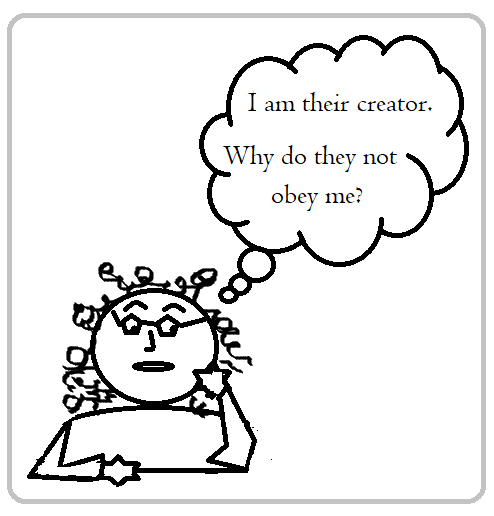
Cartoon: I am their creator. Why do they not obey me?The books I love are written with bold, strong words and phrasing. The emotional lives of their characters are real and immediate to me. Those are the kind of characters that have depth and are memorable.

A good exercise for writing deep emotions is to create character sketches for characters you currently have no use for. I say this because just as in all the many other skills necessary to the craft of writing a balanced narrative, practice is required.

Practice really does make the imperfections in our writing less noticeable, and you may find a later use for these practice characters. They may be the seeds of a marketable short story.

1 Comment

Filed under writing

A few ideas for a Zen #writing life

We may all write novels or short stories or poetry, but every writer is different. We each have our own approach to getting our work on paper.

I’m like everyone else. I have difficulty thinking creatively when life is too stressful. However, blog posts are more like technical writing, which is how I keep my writing mind working.

Over the years, I have developed a few tools for my writer’s toolbox. These are exercises that jar things loose, help me feel like writing when my well of creative energy is running low.

When the blender of life kicks into gear here at Casa del Jasperson, my ability to write goes out the window.

Nowadays, I stop forcing it.

I’m an indie and my deadlines are self-imposed. My timelines aren’t as finite as a writer who is under contract. I write every day no matter what, but rather than beating myself up over something I can’t deal with, I work on a different project. It might be a blog post or a short story. Sometimes, I take on an editing job.

I can always come back to the novel when inspiration returns.

Sometimes a project begins well but despite that great beginning, it goes unfinished.

Maybe I have run out of ideas for that story, which led to me loosing enthusiasm. No matter what the intended length is, an unfinished project is something I can work on later.

As an indie, my goals are for me, not for anyone else. I choose to embrace a Zen writing life

One manuscript has sat unfinished for several years for a variety of reasons. The story was stalled at the halfway point, and I had only a vague idea of how it must end. This year I managed to write a synopsis of the final half of the story arc and that has become invaluable as an outline. Writing is now moving ahead as I had hoped.

Despite how much I love the stories that fall out of my head, my work doesn’t appeal to readers of action adventure. My stories are internal. The characters and the arc of their personal journeys are the central elements of their stories. While I love the action and the setting, those elements are only the frame within which the characters live and grow.

In the old days, I didn’t understand that. I marketed it to the wrong audience. Readers of action and adventure aren’t interested in slower-paced work. Even worse, I rushed to publish my work when it wasn’t ready.

So, the first hard-earned snippet of wisdom I have to share today is this: Write your stories for yourself and don’t stop trying. We have to know our target market. One important thing I have come to accept is this: my work is written for a niche market of those few readers who seek out the kind of work that I do. I write what I want to read, and I am an odd duck when it comes to literature. So, I am writing for a smaller subset of readers and that will have to guide how I market my books.

The second piece of wisdom is a little more challenging but is a continuation of the first point: Write something new every day, even if it is only one line. Do it whether you are inspired or not because it is exercise. Just like yoga or martial arts, your aptitude for writing grows in strength and skill when you exercise it daily. Writing a blog post is my daily exercise. If you only have ten minutes free, use them to write whatever enters your head, stream-of-consciousness.

The third thought is a fun thing: learn the meaning of a new word every day. You don’t have to use every word you know, but it never hurts to learn new things. Authors should have broad vocabularies. Today’s word was bumptious which means offensively self-assertive.

The fourth thing: is don’t worry about self-editing when you are laying down the first draft. I know it’s a cliché, but it is also a truism. Let the words fall out of your head, passive phrasing and all, because the important thing is to finish the story.

The fifth thing to remember is thisevery author begins as someone who wants to write but feels like an imposterThe authors who succeed in finishing a poem, a short story, or a novel are those who are brave enough to just do it. They find the time to sit down and put their ideas on paper. And ninety times out of a hundred, they still feel like an imposter.

Finally, authors must overcome roadblocks in their personal life. My husband has late-stage Parkinson’s which makes life a little too interesting at times. Writing enables me to make sense of the twists and turns of our human experience.

It helps me process life’s complications in a non-threatening way.

In real life, nothing is certain. Adversity happens. Dealing with troubles forges strength and if you are a person blessed with empathy, it creates an understanding of other people’s challenges.

I am blessed. I can write whatever I am in the mood for. Having the time and opportunity to write is a luxury, one I didn’t have as a younger person raising children and holding down two jobs. I have a group of fellow writers that I can depend on for good advice, and for support when life is hard.

I don’t write to win awards, and I don’t earn a lot from my work. but I love what I do and don’t feel guilty about any arbitrary goals I don’t achieve.

I can relax and enjoy the act of creating something from idea to completion, but in my own time and at my own pace.

In this new year, I hope you find the time and inspiration to write whatever your dreams lead you to. I hope you have success at whatever your creative mind dreams up.

And I hope you have a Zen creative experience.

7 Comments

Filed under writing

#FineArtFriday: An Old Red Cedar on the Rocks near West Manchester, Massachusetts by Marianne North 1871

Artist: Marianne North (–1890)

Title: An Old Red Cedar on the Rocks near West Manchester, Massachusetts

Date: 1871

Dimensions: height: 35 cm (13.7 in)

Collection: Marianne North Gallery

What I love about this painting:

Marianne North gives us a sunny day and the portrait of a tree whose life was written in its twisted trunk and tangled branches. This tree has seen some stuff!

I can relate to that tree. This staunch old lady is perched on a promontory overlooking the sea, a perfect view of all the world. However, this tree has carved its living from a harsh environment.

Trees must grow where their seeds fall, and seed that sprouted this cedar fell into a tiny crack on the cliffs, finding just enough soil to nourish the seedling. No gentle forest loam for this hardy monarch; salty air and violent storms are her companions.

I love the sunny day and the strength of this tree. Marianne North is a new artist to me, and I will post some of her other paintings as I come across them.

About the artist, via Wikipedia:

Marianne North (24 October 1830 – 30 August 1890) was an English biologist and botanical artist, known for her plant and landscape paintings, her extensive foreign travels, her writings, her plant discoveries and the creation of her gallery at the Royal Botanic Gardens, Kew.

North trained as a vocalist under Charlotte Helen Sainton-Dolby, but her voice failed, and she then devoted herself to painting flowers. After the death of her mother in 1855, she constantly travelled with her father, who was then member of parliament for Hastings; and on his death in 1869 she decided to pursue her early ambition of painting the flora of distant countries.

The scientific accuracy with which she documented plant life in all parts of the world, before photography became a practical option, gives her work a permanent value. Plant species named in her honour include Areca northianaChassalia northiana, Crinum northianumKniphofia northiaeNepenthes northiana, and the genus name Northia.

Kew Gardens claims that the North Gallery (situated in the east section of the gardens) is “the only permanent solo exhibition by a female artist in Britain”. In 2008 Kew obtained a substantial grant from the National Lottery, which enabled it to mount a major restoration of both the gallery and the paintings inside.

On 26 September 2016, the television channel BBC Four broadcast Kew’s Forgotten Queen. The documentary told the story of North’s life. [1]

For a great video biography of the artist, go to YouTube:  The Remarkable Miss North


Credits and Attributions:

IMAGE: Wikimedia Commons contributors, “File:Marianne North (1830-1890) – An Old Red Cedar on the Rocks near West Manchester, Massachusetts – MN207 – Marianne North Gallery.jpg,” Wikimedia Commons, https://commons.wikimedia.org/w/index.php?title=File:Marianne_North_(1830-1890)_-_An_Old_Red_Cedar_on_the_Rocks_near_West_Manchester,_Massachusetts_-_MN207_-_Marianne_North_Gallery.jpg&oldid=1030484784 (accessed January 15, 2026).

[1] Wikipedia contributors, “Marianne North,” Wikipedia, The Free Encyclopedia, https://en.wikipedia.org/w/index.php?title=Marianne_North&oldid=1330628765 (accessed January 15, 2026).

5 Comments

Filed under writing

Plot Armor, Objective, and Risk #writing

My weekend got derailed due to life cluttering it up with huge chunks of reality. I hate it when reality ruins my carefully plotted existence. So, instead of a new post, I am revisiting a post from 2023, a short story about a writer wrestling with her characters, objectives, and inventing risks with a dash of plot armor thrown in. I hope you enjoy it!


Sometimes I lose the plot. I know that character plus objective plus risk equals a story, but sometimes I can’t figure out the risk part.

Or the objective.

Characters can be tricky too. I have the plot armor part down well, but that’s just for the protagonist. Everyone else’s safety is fair game.

StoryMemeLIRF10052021Sometimes I can’t find the plot even when I have an outline. I get to a place where I don’t know what to write, and the characters stand around doing nothing. I repeat the same old crisis with slight variations, which is tedious.

I thought I was writing a medieval fantasy, but according to a reddit thread I saw last week, dragons are overdone. Apparently, every fantasy features dragons.

Version 1.0.0

So now what? Griffons and manticores are prominent in medieval heraldry. There must be a reason for that. Mecedes Lackey did griffons, and I don’t want to copy her, so what is left? Unicorns?

My imagination is stuck on manticores, but even in fantasy they’re a rare beast. My hero just killed the last one so I’m unsure what to do now. Readers don’t like it when you milk a plot twist over and over, no matter how you change the scenery around it.

Sometimes I hate this job.

So, let’s look at the plot outline again. I’m all about giving my characters agency, but they have to work with me, give me a bit of help. Sometimes it takes divine intervention to get the plot moving again.

Today I have barely gotten started when I feel someone staring at me. Of course, it’s Sir Percival, looking over my shoulder. “Ahem.” He glares at me.

My characters no longer surprise me when they intrude, but being polite when I am disturbed is impossible. “What do you want? I’m a little busy.”

Bodleian_Library-MS_Bodl_764-fol_025r-manticoreSir Percival the Pointless says, “I rescued Lady Adeline, and the manticore is dead. Did you notice?”

“Yes. I wrote that scene, and if I do say so myself, you were magnificent.” One problem with heroes is their desire for obscene amounts of praise.

“Thank you,” he replies, attempting to appear modest and failing. “Well, the thing is, Lady Adeline has thrown herself into wedding preparations.”

“I know.” I force myself to reply politely. “I’m designing the dress.”

“Well, you’ve been doing that for the last twenty pages, but who’s counting. Anyway, I’ve been booted outside because no one needs the groom until the big day. I need something to do.”

I never noticed it before, but Percy isn’t handsome when he scowls. Is there some way I can make him look like an adult? I don’t like beards, but he needs something to disguise his serious lack of a chin.

Percy the Pointless presses his attack. “You know, you’re really good at telling folks how to plot a book, but you suck at it yourself. We’re 25,000 words into your novel, and you’ve already wasted the big scene.”

What? He’s cruisin’ fer a bruisin’, as they say in my part of the world. “Watch it buddy. I wrote you, and I can easily delete you.” See? I can give a dirty look too.

He just shrugs. “I doubt you’re going to do that. You’ve spent two months on this epic. However, if you intend this to be a novel, you have at least 50,000 or so more words to write. I have nothing to do.”

I just realized that he has a slightly nasal whine. Oh, lord. I’ve written a whiney hero. However, the idiot has a point. I mistimed the big finale, so now I need a new objective for him, something entailing risk.

This could take a while. I gaze at Sir Percival the Prim, wondering what I was thinking when I made an idiot nobleman like him the star of this charade. “I can’t work with you staring over my shoulder. Look, why don’t you watch TV for a while?” I park him in front of the TV and give him the clicker.

He looks first at me and then at the clicker. “What is this?”

Sighing, I show him how to turn the TV on and help him find something he’ll enjoy.

That takes an hour. Nine hundred channels and nothing interests him. Eventually we settle on old Star Trek reruns.

Finally, I am back at the keyboard and scraping the bottom of the barrel for a few more terrifying plot twists, hoping to keep this bad boy busy. All I can think of is manticores, but he’s already killed the only one that was left in the world.

Readers hate it when authors milk the same old plot twists.

“Ahem.”

I look up, only to see Duchess Letitia, Percy’s future stepmother-in-law standing at my elbow. “Yes?”

Book- onstruction-sign copy“I’m sorry to bother you, but we desperately need a certain magical ingredient for my special anti-aging cream.” She looks at me expectantly. “My stepdaughter’s wedding is a big deal. But the outline says Percival and Adeline will assume the throne upon their marriage. It’s canon now, so I’m done, kicked to the curb in the prime of my life.” She dabs the corner of her squinty eyes with a silken handkerchief. “You set this story in an era where women have few career options. I simply must have my beauty cream, or I won’t be able to snare a new hubby.”

She has a point. “And that ingredient is…?” I hope it’s not a complicated thing because now I have two bored characters nagging the hell out of me.

A sharklike smile crosses her features. “Manticore’s milk.”

How odd. I never realized until this moment is how evil Adeline’s stepmother looks when she smiles like that. I love this woman.

She says, “I’m sure Sir Percival can get some since he’s just sitting around watching a magic box filled with other people having adventures.”

Duchess Letitia’s malicious smirk offers me no end of possibilities. I consider this for a moment. I could rewrite the original battle scene and subtract the dead manticore part.

He could get killed milking the manticore.

Or perhaps only maimed. After all, he does wear highly polished (but heavy-duty) plot armor.

Lady Adeline would have to rescue herself and then him. But what the hell?

He’s a hero, right? Bad days at the office come with the territory. A few dents in his plot armor should deflate his ego a bit.

I hoist myself out of my chair and walk to the living room.

There he is, sitting with his dirty boots propped on my coffee table.

Oh, yes. there will be mutilation in his future. I am going to stretch his plot armor to the limit. Rather than deleting his character from the story and starting anew, this jackass will live.

Percy the Prim and Proper will beg me to kill him off.

I can still change things up. The manticore that the idiot fought in chapter ten was only feigning death. Yes …. the nice, persecuted manticore lives, and now manticores are an endangered species.

Lady Adeline won’t approve of Percy attempting to murder the last one so there will be trouble in paradise. The noble idiot will have misadventure after misadventure until my new coffee table is paid for.

I feel invigorated. My plot is back on track, and I am inspired to write like the wind! “Percy, I have a task for you. Take this bucket and get some manticore’s milk. It’s a matter of life and death.”

He looks up. “I will in a minute, but I must see how this story ends. Captain Kirk might die if Spock can’t get the medicine!”

That’s another good plot twist. Note to self: have Duchess Letitia supervise stocking the medical supplies in Percy’s kit.

You know, now that I think about it, the duchess was wrong about one crucial thing. Nothing is canon until the book is published. I think the duchess deserves a much larger role in this story.

Excalibur London_Film_Museum_ via Wikipedia

Excalibur London Film Museum via Wikipedia

So does my new protagonist, Lady Adeline.

A lady hero who needs armor and a sword.

And a horse.

A horse that’s a unicorn.

I love this job.

And the reddit trolls are wrong. Dragons are NOT overdone. In fact, I need a big, angry one now.

4 Comments

Filed under writing