Category Archives: writing

Verbalize by @DamonSuede and Damn Fine Story by @ChuckWendig #bookreview #amreading

Today we’re going to discuss two books on writing craft that, in my opinion, genre writers should read.

First up is VERBALIZE by Damon Suede.

But first, the Blurb:

Fascinating fiction starts with characters who make readers care. This Live Wire Writer Guide presents a simple, effective technique to sharpen your hook, charge your scenes, and amplify your voice whether you’re a beginner or an expert.

Most writing manuals skirt craft questions with gimmicks and quick fixes rather than plugging directly into your story’s power source. Energize your fiction and boost your career with

  • a new characterization method that jumpstarts drafting, crafting, revision, and pitching.
  • skill-builders to intensify language, stakes, and emotion for your readers.
  • battle-tested solutions for common traps, crutches, and habits.
  • a dynamic story-planning strategy effective for plotters and pantsers.
  • ample examples and exercises to help you upgrade fiction in any genre.

Blast past overused tics and types with storycraft that busts your ruts and awes your audience. Whether you like to wing it or bring it, Verbalize offers a fresh set of user-friendly, language-based tools to populate your pages and lay the foundations of unforgettable genre fiction.

My Review:

Damon Suede is a writing craft educator and a best-selling Romance author. One thing he understands is how to write active prose. VERBALIZE is jammed with hard-hitting, rapid-fire information, just like his seminars.

This is a book with a lot going on visually as well as informationally. I find it easiest to absorb this information in small doses, which allows me to think about what he is saying. I read a bit, think a bit, and write a lot.

If you learn nothing else, what Suede has to say about verbs, their importance in character development, and how best to place them in the sentence is worth the cost of the book. Which, by the way, is quite affordable.

>>><<<           >>><<<           >>><<<

Next up is Damn Fine Story by Chuck Wendig. Wendig understands the art of “Story.” If you are writing genre fiction, this is a book you should consider buying.

But first, The Blurb:

Hook Your Audience with Unforgettable Storytelling!

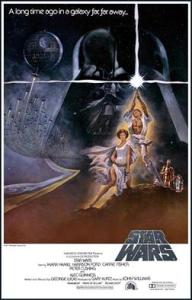
What do Luke Skywalker, John McClane, and a lonely dog on Ho’okipa Beach have in common?

Simply put, we care about them.

Great storytelling is making readers care about your characters, the choices they make, and what happens to them. It’s making your audience feel the tension and emotion of a situation right alongside your protagonist. And to tell a damn fine story, you need to understand why and how that caring happens.

Using a mix of personal stories, pop fiction examples, and traditional storytelling terms, New York Times best-selling author Chuck Wendig will help you internalize the feel of powerful storytelling. In Damn Fine Story, you’ll explore:

• Freytag’s Pyramid for visualizing story structure–and when to break away from traditional storytelling forms
• Character relationships and interactions as the basis of every strong plot—no matter the form or genre
• Rising and falling tension that pulls the audience through to the climax and conclusion of the story
• Developing themes as a way to craft characters with depth
Whether you’re writing a novel, screenplay, video game, comic, or even if you just like to tell stories to your friends and family over dinner, this funny and informative guide is chock-full of examples about the art and craft of storytelling–and how to write a damn fine story of your own.

My Review:

As a writing craft book junkie, I can’t walk past any book that purposes to discuss the dirty little habit of writing.

Chuck Wendig is well-known for his pithy way of expressing things, but despite the in-your-face rawness of his delivery, he does know how to tell a great story, and he does it with outrageous hilarity.

This book takes the writer beyond the essentials of writing craft (grammar, sentence structure, etc.) and into the deeper elements of storytelling, rhythm, cadence, and breaking the rules adored by the more fascist writing-group gurus. He does this to encourage you to develop your own storytelling style.

I highly recommend it. You’ll get your money back in the wildly sarcastic humor of the footnotes alone.

>>><<<           >>><<<           >>><<<

These two books are just the tip of the informational iceberg.

Many fine, informative books are out there for writers, and while I don’t have them all, I have a large library of them, all in physical book form.

My shelves contain books on craft by authors like Ursula K. LeGuin, Orson Scott Card, and Stephen King. I have thesaurus(s) on emotions and character traits by Angela Ackerman and Becca Puglisi.

Knowledge of grammar is the silver frame that shows a story in its best light.

I have numerous Chicago Style Manuals and Bryan Garner’s Usage Guides, and books on rhetorical grammar. Dictionaries, sure, and a thesaurus—but I rely on the Oxford Book of Synonyms and Antonyms to help me find my words. Believe me, that book is well used.

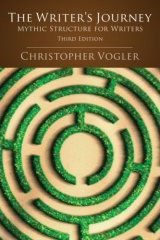
Christopher Vogler’s The Writer’s Journey, Mythic Structure for Writers is a foundation book in my library—I’ve worn out two copies and am on my third.

Books on writing craft feed my ongoing quest for self-education.

Serious writers have questions that won’t always be answered in writing groups or on blogs like mine, but books exist which do have the answers.

Some will be expensive, but many, such as the two featured books today, are affordable. Google your writing craft questions, and see what books come up that might answer them. You might strike gold, as I have often done.

Comments Off on Verbalize by @DamonSuede and Damn Fine Story by @ChuckWendig #bookreview #amreading

Filed under Book Reviews, writing

Prepping for November #amwriting #NaNoWriMo2019

November is National Novel Writing Month. Every year starting on November 1st, several hundred thousand people sit down and attempt to write a 50,000-word novel in 30 days.

Most will do this while holding down jobs and raising kids.

I began participating in NaNoWriMo in 2010. For the first four years, 2010 – 2014, I used the month of November to lay down the rough draft of an intended novel. However, in 2015, I already had two novels in the final stages and one simmering on the back burner.

What I lacked that year were short stories. I decided to write a short story collection because I knew I had to build my backlog of submittable work. As a result, and despite suffering a respiratory virus during the entire month of November, I wrote 42 short stories for a total of 105,000 words.

That’s not counting the blog posts I also wrote. NaNoWriMo 2015 was a prolific year despite the plague!

That was such a boost to my short story collection that I did the same in 2016 and 2017. I worked on a novel in 2018 and also wrote short stories, so that was a “blender” year.

My first year, 2010, was difficult in many ways. My story arc wandered all over the place, my main character sometimes disappeared for several chapters, and my hokey prose got away from me.

But that year was a great experience. I learned how to prep for the month of madness so that it can be a productive 30 days. I learned that October is an important month, even though you aren’t writing for official word count.

October, cold and dark, is your NaNo Prep Month.

I have a number of tricks I will share with you each Monday during the month of October, all aimed toward helping you succeed at your writing goal during National Novel Writing Month.

My goal is that on November 1st, you will be able to hit the ground running.

Once I have the foundations laid, I can write off the cuff. That is how three of my books came into existence.

For many participants, the challenge of sitting down and using the “seat of your pants” style of creative writing is what draws them to sign up.

Many authors are unwilling to commit to NaNoWriMo because it takes discipline to write 1667 words a day.

Also, they fear having to recoup any perceived losses should they find themselves in the middle of NaNoWriMo when they suddenly realize they’ve gone terribly astray. Or they fear writers’ block.

It happens.

Not to me usually, because I know the secret: If you can’t write on the subject you intended, write about what you are experiencing and what interests you at that moment.

I know; ranting on paper about your life is not writing that fabulous fantasy novel you began but don’t know how to finish.

But you are writing!

The answers will come, sometimes in the middle of a rant about your evil mother-in-law.

The key here is you will be writing, and that is what is important.

Rule 1 of NaNoWriMo: SIT DOWN AND WRITE.

Rule 2: WRITE AT LEAST 1667 WORDS EVERY DAY.

Rule 3: NEVER DELETE WHAT YOU HAVE WRITTEN, NO MATTER HOW GARBLED OR AWFUL OR OFF TOPIC.

There are 2 ways to create the official manuscript that you use to upload to the national site every day.

  1. Type it all in one document. When you don’t like something, just change the font color to red in that section and begin rewriting the scene the way it SHOULD have been written in the first place, using the usual black font. Every time you rewrite the scene with a slightly different outcome, it counts toward your word count. Your official wordcount manuscript will be a lo-o-o-ong, multicolored thing of beauty for a few weeks.
  2. OR, you can write each new section in a new file but paste all of them into the official manuscript at the end of your writing session. I make notes as I go for my later rewrite because if I don’t leave a message for myself, I will forget until my beta reader (who is a structural genius) points it out.

December is “Read-‘em-and-Weep” month. That is when we go over the ramblings of November and doubt our sanity.

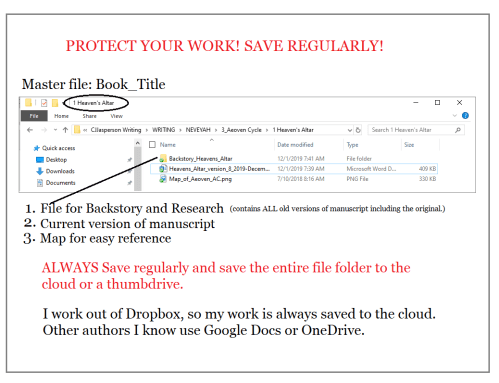
In December, save what you want to discard in a ‘Background File’ in the same folder as the main manuscript. By doing that, you don’t lose prose you may need later.

During National Novel Writing Month, every word we write over and above 50,000 counts toward the region’s total word count. Once I hit that mark, I keep plowing ahead right to the bitter end.

Other people stop when they make the official winning word count. It’s a stressful month, so how you handle it is your choice.

If you want to sign up for this year’s month of madness and mayhem, get on the internet and go to:

www.nanowrimo.org

Sign up, pick a NaNo name – mine is Dragon_Fangirl, and you are in business. Look me up and make me one of your writing buddies. Spend the rest of October organizing what you think you will need to begin your story on November first. Then, on the first day of November you begin writing. If you apply yourself, and write (AT the minimum) 1667 words every day, on the 30th of November you should have a novel…or something.

In reality, if you set aside one or two hours a day, and pound out the words as fast as you can during that time, you will get your word count. Never delete, and do not self-edit as you go along. Just spew words, misspelled and awkward as they may be. They all count, readable or not, and it is the discipline of writing that we are working on here, not the nuts and bolts of the good manuscript.

Revising and correcting gross mistakes will come after November 30th. The second draft is when you have time to look at it with a critical eye. What you are doing now is getting the raw ideas down before you forget them.

Never discard your work no matter how much your first reader says it stinks. Even if what you wrote is the worst crap she ever read, some of it will be worth saving and reusing later. (And don’t ask “Sharp Tongue Sally” to read your work again because if she can’t find at least one good thing, she’s not a good beta reader.)

Spending a month immersed in stream-of-consciousness writing is not a waste of time. You will definitely have something to show for your efforts, and you will have developed the most important skill a writer must have: self-discipline.

8 Comments

Filed under NaNoWriMo, writing

What I’ve learned from Miguel Cervantes #amreading

In the book we know familiarly as Don Quixote, Miguel de Cervantes wrote a brilliant, enduring story, one that has survived intact since it was first published in 1605.

Cervantes himself had a fantastic history, a story which could have been written as a novel.

Born in 1547 to an impoverished Spanish doctor, Miguel was better educated than many of his time, although exactly where he was educated is not known. He joined the army at twenty-one.

In 1575, pirates kidnapped Cervantes and his brother and sold them as slaves to the Moors. Originally from Morocco, the Moors were Muslims and were the longtime adversaries of Catholic Spain, which they had once conquered.

History says Cervantes was taken to Algiers. His three or four attempts to escape his slavery were unsuccessful, but finally, he was ransomed in 1580 and returned to Spain.

Upon gaining his freedom, he worked in many clerical capacities, notably as a purchasing agent for the Spanish navy (i.e., the Spanish King). His unfortunate trust in an Andalucían banker with whom he had deposited Crown funds led to his imprisonment for a few months in Seville, after said banker went bankrupt.

It was during his stay in prison that the story of Don Quixote was born. All his life, Cervantes had to work a day job to support himself, writing at night and whenever he had the chance. Prison offered him the chance to spend his entire day writing.

In Don Quixote, Cervantes took many risks with vocabulary. He had as immense an effect on the Spanish language as William Shakespeare did English.

Sayings you might hear every day that were coined by Cervantes:

  • By a small sample we may judge of the whole piece.
  • Can we ever have too much of a good thing?
  • No limits but the sky.
  • Why do you lead me a wild-goose chase?
  • Thank you for nothing.
  • Let every man mind his own business.
  • The pot calls the kettle black.

Only in the final ten years of his life did Cervantes achieve literary success, and even then, he struggled to support himself.

Cervantes divided Don Quixote into three sections, each with a different perspective:

In the first section of the First Part, which covered Don Quixote’s first expedition, he wrote a parody of contemporary romance tales. Cervantes tells this section in a straightforward style.

The second section (comprising the rest of the First Part) is written as if it were a historical account. Here, Cervantes tells us he’s merely translating the manuscript of Cide Hamete Benengeli. He often breaks the fourth wall, interrupting the narrative to mention Benengeli. He remarks on the “internal inconsistencies” in Benengeli’s manuscript. It is broken into chapters at intervals, and Cervantes records the events of each of Don Quixote’s days.

The third section (which covers the Second Part of the novel) is different. It was written as a traditional novel might be. Emotions, large themes, and strong character development are features of this section. Here, Cervantes has gotten a grip on the story arc and the characters.

It is in this third section that Cervantes himself enters the novel as a character. He casts himself as a synthesis of the fictional Benengeli and Cervantes the author.

This is a morality tale. The character Don Quixote strives to be an example, becoming a knight-errant as a way to force his contemporaries to face their failures. In his eyes, they have abandoned the traditions of morality and the chivalric code.

This conflict between tradition and modern values becomes a stalemate. No one understands Don Quixote, and he understands no one.

Only Sancho, his good-hearted, loyal friend can intercede between Don Quixote and the rest of the world. Yet, Sancho, a modern man of the peasant class (and with his own agenda) has a basic understanding of morality. He alone is able to interpret for Don Quixote, acting as a mediator. Sancho quite often agrees with the morals of his day but then surprises us by supporting Don Quixote’s outdated ethics and chivalry.

Toward the end is where it gets a bit out of hand. The characters are aware of the books that have been written about them. They try to alter the content of subsequent editions. This complicates things mightily. At times, we readers feel as disoriented as the mad knight, unable to tell which plotlines are internal to the story and which are factual.

I believe that disorientation was intentional on the author’s part.

I’ve learned several things from Cervantes’s wonderful story of the mad knight, Don Quixote, but I will explore only two.

First, its clear that minor flaws will be ignored by the reader if the story is compelling enough. It was so wildly popular in its day that it inspired publication of an unauthorized continuation, a true fan fiction written by an unknown writer who masqueraded under the name of Alonso Fernández de Avellaneda.

It’s unclear if Cervantes knew the true identity of the superfan. But he wasn’t amused; indeed, he went to great lengths to write “the true continuation of the story,” mocking and poking fun at the fanfiction in many places in his work.

Second, my belief that charismatic characters and epic conflicts of morality make a great story was reinforced.

Cervantes challenged the notion that social class and worth were entwined. He shows that Nobility of Birth does not necessarily confer wisdom or kindness. In the Duke and Duchess, he gives us thoughtless cruelty, casually delivered purely for its entertainment value. In the peasant, Sancho, he shows us a wise, kind, and thoughtful man. In the shepherds, he gives us philosophers.

I’m not suggesting you have to read modern translations of classic Spanish literature. I do suggest you read something new every day, though. Reading a variety of genres opens our eyes to new ideas and widens our minds.

Reading makes us better writers.

It was this laying bare of the disparity between social class and human worth that made Don Quixote such a revolutionary work in its time. This is also why it endures today as one of the foundations of the Western Literary Canon.

I highly recommend Edith Grossman’s modern translation, which was published in 2003. For those of you who feel you’re too impatient to read literary fiction, this wonderful version is available as an audio book.

7 Comments

Filed under writing

The well-rounded villain #amwriting

One character archetype that is critical to any story is the villain. Christopher Vogler, in his brilliant book, The Writer’s Journey, Mythic Structure for Writers, shows us how the villain of a piece represents the shadow. They are the character who shows us the energy of the dark side, and whose influence on the protagonist must be fully explored.

The shadow character serves several purposes.

  • He/she is usually the main antagonist and represents the darkness, which opposes the light.
  • The shadow provides the roadblocks, the reason the protagonist must struggle.

The shadow represents our own darker side. Great villains bring ethical and moral dilemmas to the story, offering us food for thought. The hero may recognize the darkness within herself and struggle to take the higher road.

The best stories are when the protagonist must face and overcome the shadow on a deeply personal level as well as succeeding at the quest. This places her in true danger.

The best shadow-characters are multidimensional. Great villains have many layers, and not all of them bad.

Characters portrayed as evil for the sake of drama can be cartoonish. Layers must support their actions, or the villain is not believable.

I think of these two-dimensional villains as little “Skeletors.” Skeletor is a cartoon villain with one of the least believable storylines.

Skeletor has great passion and drive, but it’s all noise and show. His ostensible quest is to conquer Castle Grayskull so he can obtain its ancient secrets. Possession of these would make him unstoppable, allowing him to conquer the world of Eternia.

But his character is hollow, and his storyline is simply one long declaration of his villainy. In reality, Skeletor’s sole purpose is to give He-Man a reason to draw his mighty sword and proclaim, “I have the power!”

It was a fun cartoon, but these characters were originally conceived as a means of selling toys.

From Wikipedia:

In the illustrated books released with the first series of toys, He-Man was a barbarian from an Eternian tribe. The planet’s inhabitants were dealing with the aftermath of the Great Wars, which devastated the civilizations which once ruled supreme. The wars left behind advanced machinery and weaponry, known only to select people. An early incarnation of the Sorceress of Castle Grayskull gave He-Man some of these weapons, and he set out to defend the secrets of Castle Grayskull from the evil Skeletor.

He-Man possessed one-half of the Power Sword; Skeletor had the second half, and used it as his main weapon. When joined, the two halves of the Power Sword will provide the key to Castle Grayskull (this is why the two figures’ swords could combine into one, when the action figures were initially released). In one early illustrated story, He-Man and Skeletor united their two Power Sword halves to form the true Power Sword, defeating a common enemy.

(…) By the time the animated series was developed, He-Man’s origins had been revised: his true identity was Prince Adam of Eternia, son of King Randor and Queen Marlena (an earthling), who ruled the Kingdom of Eternia on the planet of the same name. The Sorceress of Castle Grayskull endowed Prince Adam with the power to transform into He-Man, which Adam did by raising his Power Sword and proclaiming, “By the power of Grayskull…” Once the transformation was complete, he continued “…I have the power!”.

What is your goal? Are you selling toys? If so, a token villain serves the purpose. However, if  writing a memorable story, you need a character with history.

Great villains have deep stories. They may have begun life as unpleasant people and even may be sociopaths, but they become “evil” through a series of formative steps. No one wakes up some morning and says, I am evil. I will now go out, gather some minions, and do evil things.”

Look at one of the greatest villains of all time, a character who represents the worst humanity can offer: Hannibal Lector: (via Wikipedia)

In The Silence of the Lambs, Lecter’s keeper, Dr. Frederick Chilton, claims that Lecter is a “pure sociopath” (“pure psychopath” in the film adaptation). In the film adaptation of The Silence of the Lambs, protagonist Clarice Starling says of Lecter, “They don’t have a name for what he is.”

Lecter’s pathology is explored in greater detail in Hannibal and Hannibal Rising, which explains that he was traumatized as a child in Lithuania in 1944 when he witnessed the murder and cannibalism of his beloved sister, Mischa, by a group of deserting Lithuanian Hilfswillige, one of whom claimed that Lecter unwittingly ate his sister as well.

Villains must have a back story to explain their villainy or a quest that is as important to the story as the Hero’s quest.

In the Tower of Bones series, light and dark (good and evil) are represented through two different theologies. Both societies believe in the righteousness of their gods. Both have rituals they perform to appease their deities. The people of both worlds believe firmly that their way and their deity is the only true way.

When we write a story, we want the protagonist’s struggle to mean something to the reader. We put them through hell and make their lives a misery. The characters in our stories aren’t going through the horrible trials alone. The moment we begin the story, we are dragging the reader along for the ride.

We owe it to our readers to give them rounded, believable characters, hero or villain.

What turned the villain to the darkness? What events gave them the strength and courage to rise above the past, twisted though they are? What drives their agenda? What do they hope to achieve?

We who write novels can’t offer the reader hollow, cartoonish characters. If we don’t give the shadow hints of depth, we have failed.

We must make their ultimate victory evoke great relief in the reader, joy that all is made right.

The reader has survived, and the victory is as much theirs as it is the hero’s.


Credits and Attributions:

Wikipedia contributors, “He-Man,” Wikipedia, The Free Encyclopedia, https://en.wikipedia.org/w/index.php?title=He-Man&oldid=916702029 (accessed September 22, 2019).

Wikipedia contributors, “Hannibal Lecter,” Wikipedia, The Free Encyclopedia, https://en.wikipedia.org/w/index.php?title=Hannibal_Lecter&oldid=916951188 (accessed September 22, 2019).

Skeletor-spoo: Fair Use, for identification of and critical commentary on the television program and its contents. DVD screen capture from the She-Ra: Princess of Power episode “Gateway to Trouble,” where Skeletor is offered a bowl of Spoo. Wikipedia contributors, “He-Man,” Wikipedia, The Free Encyclopedia, https://en.wikipedia.org/w/index.php?title=He-Man&oldid=916702029 (accessed September 22, 2019).

Imogen by Herbert Gustav Schmalz PD|100 via Wikimedia Commons

4 Comments

Filed under writing

#PNWA2019 Conference Ramblings #amwriting

Those of you who regularly follow my ramblings may have noticed you received a “bonus” post yesterday. I was in the process of scheduling the post for today but hit the publish button before I set the calendar.

Oops.

Anyway, for those of you who are just happening by, the post is called Employing Polarity, and it deals with Shackleton’s expedition to Antarctica.

Or not. What I was riffing on yesterday is the use of opposites and contrast in your narrative. Check it out if you’re in the mood for writing craft.

So why was I so punch-drunk I misposted my post? The blurry photo at the top left shows my little piece of turf, and I wish I had thought to show my neighbor’s booths. They were amazing compared to my offering.

I just spent four jam-packed days in Seattle at the PNWA Writers’ Conference. My goodness, what a fun, educational experience it was.

I also had the honor of being the moderator for award-winning narrator, Brian Callanan’s seminar, Audiobooks: A New Chapter for Writers. Wow! Did I learn some stuff about the process or what!

Cat Rambo had some excellent words on world-building, of course, in her seminar The Realistic Fantastic. That woman has a real way with words, and trust me – if you get a chance to attend one of her seminars, you are in for a treat.

An author I was unfamiliar with prior to the conference, but who is now on my “Never Miss This Show” list is Romance author Damon Suede. What he had to say about Verbs was not only extremely hilarious, it was a look at action words from an angle I hadn’t considered—that of a person who writes screenplays.

Anyone who has ever heard Chris (C.C.) Humphreys speak knows what a hilarious and informative speaker he is. I’ve never enjoyed gagging down terrible food so much in my life as I did that final buffet breakfast on Sunday morning.

And last of all, thanks to the kind intervention of Indie author Ellen King Rice, who had a spare Square device that would fit my new phone, Grandma sold a few books.

I met a lot of old friends, made a great many more new friends, and on Sunday afternoon, after four days of partying like a rock star, Grandma was too tired to be scheduling blogposts.

Live and Learn!

Comments Off on #PNWA2019 Conference Ramblings #amwriting

Filed under writing

Employing polarity  #amwriting

When we have finished the first draft of our story and come back to revise it later, we find that in places, our characters seem two dimensional.

Certain passages stand out; the characters have life, intensity. Their emotions grab us, and we feel them come alive. We see them as sharply as the author intends.

In other passages, they are flat, lacking any sort of spark.

When we add contrast to the scenery – polarity – the setting comes alive. The imaginary world of the narrative becomes as real to the reader as the world of their living room.

The same is true for how we show our characters.

Word choice matters. How we phrase a passage makes an immersive experience or throws the reader out of the book.

Our goal is to make vivid sensory images for our readers.

John Keats used both polarities and similes in his work. The last stanza of To Autumn begins with this line:

“Or sinking as the light wind lives or dies;”

We see one obvious polarity in that line, and one sneaky one:

  • Lives or dies is an obvious polarity.
  • Sinking implies heaviness, and he contrasted it with light wind; a less weighty, gentler sensory experience opposite the weight of sinking.

Characters grow more distinct when portrayed with subtle contrasts. We all know opposites attract; it’s a fundamental law of physics. Contrast – polarity – supplies a needed missing component of the narrative, giving the important elements strength.

Polarity gives your theme dimension. Remember, the theme is the backbone of your story, the thread that binds the disparate parts together. Great themes are often polarized: good vs. evil or love vs. hate.

Think about the theme we call the circle of life. This epic concept explores birth, growth, degeneration, and death. Within that larger motif, we find subthemes. For example, young vs. old is a common polarity with many opportunities for conflict. Both sides of this age-old conflict tend to be arrogant and sure of their position in each skirmish.

Wealth vs. poverty offers an author the opportunity to delve into social issues and inequities. This polarity has great potential for conflict, which creates a deeper narrative.

What we must see beyond the obvious are the smaller, more subtle polarities we can instill into our work. Small, nearly subliminal conflicts support the main theme and add texture to the narrative.

  • Without injustice, there is no need for justice. Justice only exists because of injustice.
  • The absence of pain, emotional or physical, is only understood when someone has suffered pain. Until we have felt severe pain, we don’t even think about the lack of it. In literature, emotional pain can be a thread adding dimension to an otherwise stale relationship.
  • Truth and falsehood. The fundamental issue of trust adds drama to a plot and provides a logical way to underscore a larger theme.

Throughout the narrative, ease should be contrasted with difficulty. This is called pacing.

Many commonly used words have opposites, such as the word attractive, the opposite of which is repulsive. When you want to add texture to your narrative, look at how you could show the mood and the emotions of a scene by using antonyms, words with contrasting meanings.

  • create – destroy
  • crooked – straight/honorable
  • cruel – kind

Each polarity has many nuances. In daily life, cowardice is most often exhibited as a subtle, habitual evasion of the truth or as an avoidance mechanism. It can be shown in an act as mild as a fib. Or, it can be an event as large as an act of treason committed for personal gain.

Bravery can be as small as a person facing a silly fear, as large as a person not backing down when a strong personality attempts to assert authority over them, or as epic as a responder entering a burning building to rescue a victim.

When we have characters who contrast subtle acts of bravery with small acts of cowardice we add power to a scene.

In all its many forms, contrast is a catalyst for change when we wish to electrify an otherwise bland scene.

It’s the fertile soil from which conflict grows. Each small polarity pushes your characters a bit further and underscores your larger theme.

Here is a sample of words found in the “D” section of  the  Oxford Dictionary of Synonyms and Antonyms. This small selection is filled with opposites that create powerful mental images:

  • dangerous – safe
  • dark – light
  • decline – accept
  • deep – shallow
  • definite – indefinite
  • demand – supply
  • despair – hope
  • discourage – encourage
  • dreary – cheerful
  • dull – bright, shiny
  • dusk – dawn

Every time you employ polarities in your word selections, you show something about the world or a character without having to tell it.

You add a dimension of depth.

I love and regularly use the Oxford Dictionary of Synonyms and Antonyms to spur my creativity. It can be purchased in paperback, so it’s not too expensive. Often you can find these sorts of reference books second hand. The internet is also your friend. A large, comprehensive list of common antonyms can be found at Enchanted Learning. This website is a free resource.

Opposites add dimension and rhythm to our work. Polarity is an essential tool of world building.

Polarities, words that show contrast add dimension to an otherwise flat depiction, showing a written world that is as clear to the reader as the room they inhabit.

3 Comments

Filed under writing

Lichenwald, by Ellen King Rice #amreading

I always enjoy reading novels set in the Pacific Northwest, the part of the world where I live. I especially enjoy it when the author understands how the forests here really work. I read in all genres, and the most recent book was Lichenwald, the third book in Ellen King Rice’s Mushroom Thriller series.

A former wildlife biologist, Ellen King Rice knows her stuff. Her books are terrific novels to while away a rainy day with.

BUT FIRST, the blurb:

Lichenwald is the newest “mushroom thriller” by Ellen King Rice. This science-based adventure delves into the vibrant diversity of the Pacific Northwest with a story of the power in lichens and their relationships.

At the edge of exhaustion, lichenologist Zinnie Fazail struggles to maintain a professional life as her mother descends into dementia. Ursula Fazail insists on wandering the neighborhood, looking for a vaguely remembered blue mushroom while lapsing into the language of her childhood.

Zinnie is desperate for a health aide who can keep up with her mother’s excursions. When May Belle Pope moves in with promises to “Take care of things,” Zinnie learns that Evil can be a roommate with small barking dogs.

As Ursula bonds with a blind Cocker Spaniel, Zinnie realizes May Belle will exploit any situation to her advantage. Zinnie has to act before hearts and bodies are broken, especially once May Belle has access to the home computer and family accounts.

How can Zinnie protect her mother and her home when what she knows are lichens?

Lichenwald includes illustrations of local lichens by Olympia artist Duncan Sheffels.

Part adventure, part science class, and totally fungi and lichen friendly, Lichenwald takes the reader into a place of friendships and intertwining ecosystems.

My review:

I found Zinnie Fazail an immediately relatable character. The story opens in the fictional Summit College where she works. While much of the focus is on mushrooms, lichens, and fungi, the cast of characters, their problems, and their relationships are the heart of the story.

Ellen King Rice’s understanding of human nature is spot on. Laurel’s youthful insecurity, Marvin and Allie’s wary father-daughter relationship, and Zinnie’s frustrations are real.

German-born Ursula’s slipping into dementia is poignant and is shown with truth and sensitivity. New to the neighborhood, Allie was raised in Germany. Her immediate attachment to the German grandmother is genuine and well portrayed.

Things get complicated when a woman with suspect credentials accepted into Zinnie’s home and agrees to care for Ursula. May Belle Pope is a frightening woman even at her most ingratiating.

May Belle’s criminal sense of entitlement is boundless, and her casually callous behavior evokes real anger in the reader. The twists and turns of her nefarious plans are  both real and frightening. I kept thinking “This could happen to any family, even mine.”

The illustrations are really well done and informative. I enjoyed Lichenwald and found myself thinking about the events and the characters long after I finished it.

Each book in Ellen King Rice’s Mushroom Thriller series is a standalone novel featuring a different cast of characters, so you can start with any book and not be confused.

Comments Off on Lichenwald, by Ellen King Rice #amreading

Filed under writing

Schadenfreude and Humor #amwriting

September is conference month for me. I just finished attending the Southwest Washington Writers’ Conference in Centralia, Washington. On Thursday the 12th of September, I will be in Seattle for four days at the Pacific Northwest Writers’ Association Conference.

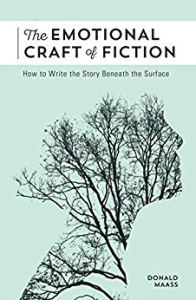
I will be attending a masters’ class offered by Donald Maass, on exploring depth with The Emotional Craft of Fiction.

Writers’ conferences are great ways to connect with agents and publishers, but they are also excellent ways to connect with other writers. A good conference offers the best education a new and beginning author can get.

This last Saturday, while in a seminar on injecting humor into the narrative, I reconnected with an old word that is making a resurgence in the English language: Schadenfreude (shah-den-froid-deh) This word from our Germanic roots describes the experience of happiness or self-satisfaction that comes from witnessing or hearing about another person’s troubles, failures, or humiliation.

I discovered this lovely (Deutsch) German word years ago while in college and had forgotten it. However, we are all familiar with it, as we experience it on a personal level quite often.

About schadenfreude, Via Wikipedia:

Schadenfreude is a complex emotion, where rather than feeling sympathy towards someone’s misfortune, schadenfreude evokes joyful feelings that take pleasure from watching someone fail. This emotion is displayed more in children than adults; however, adults also experience schadenfreude, though generally concealed.

In other words, we know it’s an uncharitable emotion, and we don’t like it in others. But for many centuries, popular humor had an aspect of schadenfreude to it. Charlie Chaplin, The Three Stooges, and Jerry Lewis were all popular comedy acts of the 20th century who employed physical comedy that evoked a feeling of schadenfreude in the audience.

Since the ancient Greeks, Chinese, and Egyptians began writing plays, people have always enjoyed seeing other people’s missteps and pratfalls as long as the comedian recovers with a smile and “keeps on keepin’” on. Aristotle said that we are amused when we feel superior to others.

Dr. Adam Potthast, in his 2016 thesis on the Ethics of Slapstick Humor discussed how the recurring themes of clowns and idiots in popular slapstick comedy evoke a subtle feeling of superiority and also desensitizes us to violence. It makes bullying acceptable.

And, until recent years, dealing with bullying has been a common theme of childhood that teachers and parents, all former victims of bullying, weren’t equipped to deal with. According to Andy Luttrell in his post for Social Psych Online, psychologists believe we find something funny when it’s a “benign violation.” In other words, we are amused by things and incidents that violate the way we think things should work and which do so in a non-threatening manner.

In our current society, we don’t want to promote bullying or harassment as a positive thing in any form. But in the narrative, we do want to inspire that feeling of “payback” in the reader whenever roadblocks—instant karma—temporarily halt the Antagonist. If we can inject a little humor into a narrative, the reader feels an extra burst of endorphins and keeps turning the pages.

Exchanges of snarky dialogue (mocking irreverence and sarcasm) liven up regrouping scenes, transitions from one event to the next.

Humor and what is hilarious can vary widely from person to person. E. B. White wrote, “Humor can be dissected, as a frog can, but the thing dies in the process, and the innards are discouraging to any but the purely scientific mind.”

He was right. I can’t know what you find humorous, but I do know what makes me smile. I like snark and witty comments. I like things that surprise me, and which take a sudden detour from the expectations of normal.

Some of us have an earthy sense of humor, while others are more cerebral. For me, humor occurs when conventional rules are undercut or warped by incongruity. I have never liked slapstick as a visual comedy, but Horror authors often have it right: in the narrative, putting your characters through a little comedic disaster now and then can’t hurt.

When I was growing up, my family ran on “gallows humor” and still does, to a certain extent. We put the “fun” in dysfunctional.

That grim and ironic tendency to find humor in a desperate or hopeless situation is a fundamental human emotion.

This is why I often find myself writing gallows humor into my own work. We all need something to lighten up with now and then.

Adding a little humor can add both depth and pathos to the characters, humanizing them without your having to resort to an info dump. Each individual character’s sense of humor (or lack thereof) shows more of who they are and why the reader should care about them.

For many reasons, humor is an aspect of depth in the narrative that is impossible to fully define, but which adds a little fresh air at places where the story arc could otherwise stall.

Humor in literature occurs on an organic level, arising during the first draft before the critical mind has a chance to iron it out. Have you found yourself writing the occasional hilarity into your work? If not, why not? What holds you back from expressing this aspect of your personality in your work?

Comments Off on Schadenfreude and Humor #amwriting

Filed under writing

Structure of the Word-Pond #amwriting

Today we’re winding down my summer blogpost series, The Word-Pond. We’ve explored the myriad aspects of ‘depth,’ the wide inferential layer of Story. Depth isn’t easy to categorize, nor can we point to one aspect and say, “Get this right, and you’ve got a story with depth.”

I’ve described Story as a pond filled with words and discussed the three layers:

Surface: The Literal Layer; the what-you-see-is-what-you-get layer. Characters live, and events happen. These are reflected in the surface of the story. The ways in which we play with the surface layer are by choosing either Realism or Surrealism, or a blend of the two.

Middle: The Inferential Layer, where Inference and Implication come into play. This is an area of unknown quantity filled with cause and effect: the reasons why these lives are portrayed, and why events happened. This is where emotions muddy the waters.

Bottom: The Interpretive Layer. This level is not only foundational; it contains and shapes the story:

  • Themes
  • Commentary
  • Messages
  • Symbolism
  • Archetypes

The words in this pond behave like the waters of a pond in nature. While close scrutiny reveals that the waters of a pond are separated into layers by temperature, salinity, microbial life, or by the sheer weight and pressure of the volume of water, the overall structure is one large, important thing: a hole filled with water.

Without water, a pond is a depression in the ground filled with possibilities only.

In our word pond, the one large thing containing our words is “story.” So now we want to form these layers into a coherent, meaningful story. We need a container for our words, the hole in the ground for the story to flow into.

This container is the story arc.

Many people say they have a book in them, one they’d love to write. They begin, get a chapter or so into it, and lose the thread. They can’t see how to get the story from the beginning, to the crisis, to the resolution.

This is where the skills I’ve developed through my years of participating in National Novel Writing Month (NaNoWriMo) has paid off.  If you want to write a novel, it’s best to sit down and get that first draft out of you while the story is fresh in your mind. You’ll spend a year or more rewriting it, but if you don’t get the original ideas down while they’re fresh, you’ll lose them.

A story begins with an idea for a character. That character usually comes to me along with a problem. This is the seed from which the story grows.

I sit down and draft a story plan in four acts. First, I tell myself how I believe the story will go. This only takes half an hour and gives me finite plot points to write to. Once I have the four acts, I know where the turning points are, and what should happen at each. This ensures there is an arc to both the overall story and to the characters’ growth.

I’m going to use the original plot idea for a work in progress as my example. My WIP is a short story, 5000 words in length, but you can plot any length of story.

The story: Our Protagonist is a courier, transporting a valuable artifact. This artifact brings her to the attention of the Antagonist who intends to seize it, no matter the cost.

You must know what the surface of the Story looks like before you can explore the depths. A good way to discover what you are writing is to “think out loud.” Divide the story into four acts:

Act 1: the beginning: We show the setting, the protagonist, and the opening situation.

  1. Setting: a village near a crossroads.
  2. The weather is unseasonably cold.
  3. The protagonist is carrying a jewel reputed to enable a mage to control the weather.
  4. The protagonist must travel alone, as her partner was killed.
  5. Unbeknownst to her, a traitor in her employer’s court has designs on the artifact. By possessing it, the Antagonist will have the power to usurp the throne.
  6. She is wary, knowing the danger of traveling alone. She conceals the artifact by sewing it inside her shirt.

Act 2: First plot point: The inciting incident.

  1. The Antagonist’s hired thugs capture her.
  2. She is thrown into prison.
  3. A fellow prisoner has overheard that her partner was murdered to ensure she would be traveling alone.
  4. This fellow prisoner believes he has a plan to enable their escape.
  5. The protagonist isn’t sure she should trust him but refuses to let the artifact fall into the Antagonist’s hands.

Act 3.: Mid-point: We show their dire condition and how they deal with it.

  1. Seeing no other way, our Protagonist agrees to the Sidekick’s plan.
  2. He is on the verge of managing an escape but needs help with one last thing.
  3. By working together for several days, they manage to complete the escape route.
  4. Timing the rotation of their guards is critical to the success of their plan.
  5. Just as they are about to make their escape, the Antagonist makes a surprise visit to the dungeon and roughs up our Protagonist. He batters her physically and mentally, attempting to force her to tell him the whereabouts of the jewel, but she manages to keep her secret. When he leaves, her shirt is torn, but the jewel is still safe.

Act 4: Resolution:

  1. They must wait for another rotation of the guards, giving the Protagonist a chance to rest. She is injured but can still do what she must.
  2. The two make their escape but find themselves emerging near the kennels.
  3. The Sidekick gives the watchdogs the food he had saved for their journey, distracting the dogs and allowing them to escape over the walls.
  4. The Protagonist and the Sidekick manage to keep ahead of their pursuers and arrive back at court, where she delivers the artifact and reveals the identity of the traitor.
  5. The Employer is grateful, and the Protagonist and her Sidekick are all set for another adventure—perhaps a novel.

You have an idea for a story. Take a moment to analyze and plan what needs to be said by what point in the story arc. This method works for me because I’m a linear thinker.

If you know the length of a book or story you intend to write, you know how many words each act should be. Once you have the map, you can get to the nitty-gritty of turning that far-fetched tale of woe into a good story.

As you write each event and connect the dots, the plot will evolve and change. You begin to explore the deeper aspects of the story. Emotions, both expressed and unexpressed, secrets withheld, truths discovered—all these details that emerge as you write will shape how the characters react to each other. In turn, these interactions will alter the shape of the larger story.

This is why we never really know how a story will go, even if we begin with a plan. The plan serves to keep us on track with length and to ensure the action doesn’t stall.

Draft a short plan for a 50,000 word manuscript. 50,000 words is the industry standard for a novel. Write 1,667 words a day that connect those events together, and in thirty days you will have written a 50,000 word first draft of your novel.

To see more of what National Novel Writing Month is all about, go to: www.nanowrimo.org

I am dragon_fangirl there. Look me up and become a writing buddy!

3 Comments

Filed under writing

Transitions #amwriting

We love reading dramatic stories. However, in order for the events of the drama to be meaningful, we need to see it in context to understand what is going on. We need just enough artfully inserted exposition to show us what is really going on.

Within the narrative, moments of transition are critical, yet they are often done clumsily. These linking scenes can be too long, conveying far too much unneeded information. Conversely, they can be nearly omitted.

Neither of  those well-meaning faux pas serves the story.

Good transitions establish many things. The opening paragraphs are a critical transition. They show us

  • the general location (Alternate world, London, Seattle, a space station, etc.)
  • the setting (the immediate environment),
  • the era (past, present, future) in which the narrative takes place.

These first paragraphs are the doors through which the reader takes the first tentative steps from their real world and enters our invented world.

When a reader opens the book, they are a visitor, but they’re searching for something, questing for a good story. They hope you have supplied whatever it is they are looking for in the pages of that book.

Good opening paragraphs sink the hook and suck your reader into your world.

As the narrative moves beyond the opening scene, more transitions come along. These are the places where we must end one dramatic scene and open another—and do it gracefully. Sometimes it’s a moment where we must show the passage of time between events. Whatever the case, with each transition, we want the reader to remain engaged.

Transitions are more doors for the reader, portals that open at the end of the dramatic scene. By moving through them, we arrive at the next event.

Transitions are critical. Without good transitions, dramatic scenes have no context. Instead of progressing in an arc, the narrative leaps and falls along to a conclusion that may make no sense.

But transitions can be fraught with danger for me as a writer because this is where the necessary information, the exposition, is offered to the reader. This is the “how much is too much” moment.

In my first draft, the narrative is sometimes almost entirely exposition. This is because I am telling myself the story, trying to get the events down before I forget them.

In the second draft, I look at words like “went.” In my personal writing habits, “went” is a code word for the transition. In fact, all passive phrasing is code for the author. It is the code laid down in the first draft that indicates to the author that the characters are in the process of transition. They, or their circumstances, are undergoing a change. Is this change something the reader must know?

For example, when I see the word “went,” I immediately know someone goes somewhere.

I ask myself, “How did they go?” Went can be changed to

  • they walked (to the next room, or down the street, or to Mordor.)
  • they drove (a car, a wagon, a space ship.)
  • they rode (a horse, donkey, motorcycle, or dragon.)
  • they took a plane (bus, ferry, space shuttle, or sleeping pill.)
  • they teleported (vanished into the ether)

You get the idea. I have to find the “telling” paragraphs that connect my dramatic scenes together and decide what will stay and what should be cut. If the necessary information requires a paragraph, I have to consider how to rewrite it so that it is interesting and not a mind-numbing wall of words.

Many times, a transition can be cut to only a sentence or two because the necessary information it imparts can be consolidated.

This is where being a part of a writing group is most beneficial. Within the writing group, you will find a person you can bounce ideas off, someone you can trust and who will say, “This is not needed as it doesn’t advance the story” or “this scene seems to come out of nowhere. It needs more foreshadowing.”

Consolidating the transition into a sentence or two is optimal but isn’t always possible.

If it takes more than a paragraph to make the transition, I must be vigilant in my revision, and if I must give information, I must find and change all the passive code words to active prose. To that end, I look for these codes:

  • All forms of To be (see my post on subjunctives)
  • basically
  • Too many emdashes
  • Exclamation points (usually not needed)
  • Finally
  • I think
  • -ing
  • Its / it’s
  • –ize –ization (global search)
  • just
  • Like
  • -ly (global search)
  • now
  • Okay
  • Only
  • Really
  • Said (decide if speech tags can be eliminated and shown by actions)
  • Seem
  • Still
  • Suddenly
  • That (often not needed)
  • The
  • Then (often not needed)
  • There was (a subjunctive)
  • –tion (global search)
  • Very (usually not needed)
  • Which (not a substitute for ‘that’)

We know that each scene can be a chapter, or a chapter can consist of several scenes. In this regard, each author constructs the layout of the story the way they feel works best. The reader gets into the swing of it and rarely notices the overall structure. Whether a chapter or a series of scenes, dramatic passages have universal commonalities:

  • All scenes have an arc to them: rising action, climax, reaction.
  • These arcs of action and reaction begin at transition point A and end at transition point B.
  • Each scene will end at a slightly higher point of the overall story arc.
  • Each scene must blend so smoothly to the one that follows that the reader doesn’t notice the transition.
  • Pacing is the rise and fall of the action, drama and transition, the ebb and flow of conversations.

Conversations make great transitions. Inserting the necessary information into conversations and then fading to black and beginning a new chapter/scene can be the key to making the transition unobtrusively.

When we rewrite something, we are making revisions. Think about that word, revision.

re vision = to envision again.

Transitions are small connections that are woven into the larger narrative. When we begin revising them, we are looking at small passages of our work with new eyes and seeing how they might be changed to better fit the story—usually condensed, but sometimes expanded.

On the surface, it’s a daunting task, but it’s one of the most important parts of the writing process.


Credits and Attributions

Tavern of the Crescent Moon by Jan Miense Molenaer [Public domain or Public domain], via Wikimedia Commons

Wikimedia Commons contributors, “File:Jan Miense Molenaer 003.jpg,” Wikimedia Commons, the free media repository, https://commons.wikimedia.org/w/index.php?title=File:Jan_Miense_Molenaer_003.jpg&oldid=302686494 (accessed November 9, 2018

Wikimedia Commons contributors, “File:David Teniers de Jonge – Peasant Wedding (1650).jpg,” Wikimedia Commons, the free media repository, https://commons.wikimedia.org/w/index.php?title=File:David_Teniers_de_Jonge_-_Peasant_Wedding_(1650).jpg&oldid=225700063 (accessed November 2, 2018).

Autumn on Greenwood Lake, ca. 1861, by Jasper Francis Cropsey [Public domain], via Wikimedia Commons


Comments Off on Transitions #amwriting

Filed under writing