Category Archives: writing

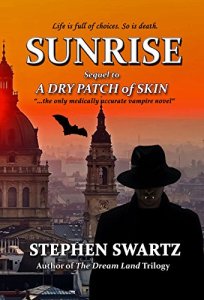
When your Sequel Makes a 90 Degree Turn, by @StephenSwartz1

My good friend, author Stephen Swartz, had a brilliant post this weekend on plot and the three-act structure. I couldn’t explain it better, so here is his post. Please, do click on the link at the bottom of the excerpt and go out to his post and read it to the end!


A week ago, SUNRISE, the sequel to my 2014 vampire novel A DRY PATCH OF SKIN launched and let me tell you it has been anything but a roller-coaster ride. In fact, when my personal copies arrives I was so excited I did not open the box for a day. Then I picked one up and routinely flipped through it to be sure there were no ink splotches on any page. You see, I’ve read it already – about 15 times!

But I cannot let it be. There is a third book to write if this is going to be a trilogy. I kinda expected to give it the trilogy treatment when I started Book II. Of course, it’s been three years since Book I came out. I thought that would be it, the end, one and done in the genre of literary horror. I am not even a horror author. I just needed to prove something to my teenage daughter: the truth about vampires! But I digress…

It was easy to set up Stefan Szekely’s departure from his family castle, leaving his vampire parents behind. I simply replicated my own history with my parents. I extrapolated a vampire version and recited similar scripts. How does the adult child relate to the elderly parents?


Stephen goes on to show us how he employs the three-act structure for plotting the story arc, with excellent graphics to illustrate it. You can find the rest of Stephen’s article here at his website, Deconstruction of the Sekuatean Empire.  Please click on the link to find the best parts of this informative post.

When your Sequel Makes a 90 Degree Turn


Stephen Swartz is the author of literary fiction, science fiction, fantasy, romance, and contemporary horror novels. While growing up in Kansas City, he dreamed of traveling the world. His novels feature exotic locations, foreign characters, and smatterings of other languages–strangers in strange lands. You get the idea: life imitating art.

After studying music and even composing a symphony, Stephen planned to be a music teacher before turning to fiction writing. Today Stephen teaches writing at a university in Oklahoma. Stephen Swartz has published poetry, stories, essays, and articles for scholarly journals in the U.S. and Japan.

2 Comments

Filed under writing

Chaos and Order #amwriting

Theme is the core of the plot, an idea-thread that runs through your story from the opening pages to the end. It binds the elements of character, conversation, action, and reaction, making the story cohesive. Theme is independent of the setting or genre.

A common theme in literature is the juxtaposition of chaos and stability. Good versus evil is a common trope of genre fantasy. Evil is usually portrayed by taking one or the other of these concepts to an extreme.

Author L.E. Modesitt Jr. has taken the theme of chaos and order and built his Magic of Recluce series around the contrasts and conflicts of the two fundamental forms of magic arising in the world of Recluce. Each side is explored from the protagonists’ POV in different books as the series progresses.

Modesitt digs deep and discovers the way each side’s magic works and the fundamental changes the mage goes through from the use of magic. He lays bare the moral and ethical values that each side holds dear. Politics and the slim justifications we hold dearly to for the sometimes-inhumane way in which we treat others is central to his work, showing that neither side is without sin.

When it comes to good and evil, each considers themselves morally superior, and believe they are the side of good. Both sides are wary of those who walk that gray path in the middle. This allows Modesitt real opportunities to put his protagonists through the wringer.

The late Roger Zelazney’s brilliant Chronicles of Amber series also details the distinctions between Chaos and Order, and moral and ethical challenges of those who travel from reality to reality through the shadows by walking the pattern, with each shadow growing more radical depending on the distance from Castle Amber (which represents Order). In several of his works, elements of each are combined freely and interchangeably.

Zelazney’s Jack of Shadows and Changeling, for example, revolve around the tensions between the two worlds of magic and technology, which manifest as order and chaos.

But what is chaos, and what is order?

Google defines Chaos as

Google also defines Order as:

Either side of the coin, when taken to an extreme, can be truly evil.

Consider chaos, or Anarchy. When a culture descends into anarchy, you have an absence of government and absolute freedom of the individual. While this frequently begins as an attempt to allow for individual freedoms without state interference, history shows that what follows is the emergence of a violent culture that is beyond the reach of the law.

There is no law as we see it, and no one capable of enforcing it. The strongest, most violent thugs rise to the top and frequently war with each other, while the common person is caught in the middle. Followers of each warlord are rewarded with the spoils of conquest, which are often goods taken from the common citizen who must somehow survive under that tyranny.

Now let’s look at order: totalitarianism, or total order can also be a form of tyranny. Everything is static, and nothing changes. There is centralized control by an autocratic authority, combined with the political concept that the citizen should be totally subject to absolute state authority. No divergence from the norm can be tolerated, and good, obedient citizens are rewarded, while deviants who are seen to be free-thinkers: intellectuals and artists are persecuted and imprisoned, or killed.

Anarchy=instability and a breakdown of society. Totalitarianism=lack of growth and stagnation of society.

For most people’s comfort, a good society allows for both law and creativity.

In extreme types of societies, power is everything, and drawing negative attention to yourself is dangerous. Thus chaos-based societies are usually represented in literature as having an underlying order that holds them together, and order-based societies are often represented as requiring the ability to grow and change, but within certain parameters.

The theme of order and chaos can really power a story-line, and the way you perceive them will not be the way another author sees them. L.E. Modesitt, Jr. and Roger Zelazney couldn’t be more different in the way they portrayed these concepts.

If you haven’t read either of these two authors’ works, I highly recommend them.


Credits and Attributions:

This post first appeared here on Life in the Realm of Fantasy in the post Theme: chaos or stability by Connie J. Jasperson © Oct. 12, 2015.

2 Comments

Filed under writing

Creating Romance #amwriting

Normally people don’t look too romantic. On weekends they hang around the house in comfy clothes and only get cleaned up to go somewhere. Come Monday, they dress a certain way to go to work–dressing in whatever is suitable for their business.

However, no matter how they dress for work, people always dress in their fanciest clothes if they’re going out nightclubbing, or to dinner in a fancy restaurant, or going to a party. People want to look their best, especially if they are single and hoping to find love.

The point is, no one looks good all the time in real life. In many novels, the events and action leaves them dirty and disheveled for a large portion of the story, which in real life isn’t that pretty. But what if you want to give these unkempt, stinking heroes a romance? When it comes to injecting romance into an action adventure story, the author’s task is to make the protagonists ignore the dirt and seem attractive no matter what the circumstances. There is a bit of escapism in all readers. A grand adventure with a good romance is the sort of story I will gravitate to in a heartbeat.

I love an author who manages to take her heroes and heroines through rough adventures and still make the romance between them special. Sure, let them get dirty and sweaty, and make their lives hard. That makes them feel like real people.

Just please, make any romance between them a part of the story that advances the plot.

Writing romance into a scene and not going off the rails requires skill.  Do we keep it restrained or get graphic? Would my characters really get graphic? And how much graphic is too much graphic? When do we cross the line of writing fantasy and venture into erotica?

I don’t really see myself going into that area of writing, although I understand there is a large market for it.

As for what is too much, it depends on what story I am trying to tell. In my current work in progress, innuendo and allusion are the means to convey the deeper story. In my novel, Huw the Bard, a certain amount of graphic detail was required to advance the plot, although not as much as in many other authors’ books. Because these scenes were such a small part of the story but were defining moments in his life, the romance scenes of Huw’s book required many revisions to get right. They had to be important, but couldn’t overshadow the larger story.

For me as a reader, there is a fine line between enjoying an erotic scene and feeling like a voyeur. It’s easy to write graphic details, but are they romantic? Quite often they read like the assembly instructions for a set of bookshelves from IKEA—insert tab A into slot B.

Certain words repel me, especially if they are applied with no finesse, emerging from the prose with force of a jackhammer.

The lead up to romance is critical. Are you going to have them together forever? If so, make the road to happiness difficult. We must show longing, wondering, hoping, and there must be roadblocks to instant happiness. A trail of hints and innuendo creates a sense of growing connection between two characters. Each tiny connection between two characters raises the emotional stakes, and emotions are the key to a real romance. The chase is the story—‘happily ever after’ is the epilogue.

If the romance is a brief moment of respite in a sea of chaos, a long chase is not needed. With that said, the romance between two characters who are not destined for each other must be central to advancing the plot. Whether you choose the ‘fade to black’ method (which I usually do) or get graphic (which I have done on occasion) is up to you. You must consider your intended reader and what they will expect.

When I contemplate how to portray a love scene, I want the reader to feel like it was worth the time they took to read it. I want them to care about what happens next in that couple’s relationship—if anything does. Just as in real life, sometimes true love is not meant to be.

I want to be able to stretch myself as a writer and learn more skills at telling a good tale. I try to do that by finding the works of other writers that moved me and discovering what it was about a scene (regardless of whether it involved romance or not) that made me glad I had read it.

When I write, I’m like every other author—words fall out of my head, some good and some not so elegant. And if I have written something awkward, my beta readers will graciously (or bluntly) tell me so.

Being an author isn’t always roses and wine. Sometimes it’s weeds and pickle-juice.

Writing something worth reading is hard work. It’s striving to meet the expectations of people you’ve never met, which is not easy. By working closely with a circle of trusted author friends, I have gained a better ability to step back and see my work with a less prejudiced eye.

If they don’t see the charm that I do in a certain passage, I ask myself why. Sometimes, the answer lies in the fact they don’t enjoy the sort of work I do, but very often the answer is that what I wrote was not ready for someone else to read it.

That ‘proud child’ urge to display your work in its raw stage is one we all combat. Nevertheless, for me, having the opportunity to do this full time is living the dream.


Credits and Attributions:

Galadriel and Celeborn, by Araniart [CC BY 3.0 (http://creativecommons.org/licenses/by/3.0)%5D, via Wikimedia Commons|Wikimedia Commons contributors, “File:Araniart – Galadriel and Celeborn.jpg,” Wikimedia Commons, the free media repository, https://commons.wikimedia.org/w/index.php?title=File:Araniart_-_Galadriel_and_Celeborn.jpg&oldid=262862472 (accessed April 1, 2018).

5 Comments

Filed under writing

Random Thoughts on Lazy Writing #amwriting

For me as an author, the easiest part of writing is inadvertently slipping some clumsy bit of phrasing into my narrative and having an action scene go hilariously (and impossibly) wrong. I don’t usually notice the awkwardness until my editor points it out.

As a reader, there are a few things that will pull me out of the narrative, and most of them are lazy writing habits. First up is the poorly researched “historical” novel. Lazy writers get some info from Wikipedia and fabricate the rest.

Research: Using real science requires research which is hard work and can be expensive—I have a friend who is writing a historical novel and has been working on it for nine years. She has made two trips to New Zealand to the town where her novel is set. While in New Zealand she visited the local libraries and interviewed people who knew witnesses to the shipwreck she is writing about.

I realize we can’t all visit New Zealand to research a book, but wow—that is what I call doing “due diligence.”

Writing true history, writing medical dramas, and using police and military procedures requires ACTUAL research from more sources than Wikipedia and watching old CSI episodes. Robert Dugoni is a lawyer, and interviews law enforcement professionals for his novels. He knows what he is writing about, and his thrillers sell quite well.

If you’re writing historical/medical/legal fiction, you must read many books on your subject. Make notes as you read each one, noting the book title, the author, and the page number where you found the info—you may need to know those things later. It’s work, but this is a job you can’t skimp on.

Even if you are writing speculative fiction, you will accumulate background info in your world building process. Keep your notes in a clearly labeled file, and back them up on a thumb-drive or file them in the cloud via Dropbox, OneDrive, or Google Docs. I use and work out of a file-saving service, so no matter what happens to my computer, my files won’t be lost. Turning those notes into your story is called research and is an important part of the writing process.

Lazy writers sometimes “write” work written by other people. When we first start out as bloggers, we don’t always realize what our legal obligations are when it comes to using images and information found on the internet. We may want to quote another blogger or use the information we have learned from them.

 Savvy bloggers cite their sources and only use images they have the legal right to use. 

If you are blogging, put it in quotes and include a link back to the site you found it. Then credit your source in footnotes at the bottom of your post. See my post on citing sources and images here: Citing Sources and Image Attribution

This is most important: do not ever copy lines from another person’s work and put them in your book or essay without their permission. That is plagiarism, and you never want to be accused of that. If you must quote someone verbatim in your work, contact their publisher and get their legal permission to do so and credit them by using proper footnotes. An excellent article on how to do this can be found here on Beard with a Blog: Cite Unseen: 3 Bits for a Better Bibliography

Random thoughts about strangely worded things I’ve read:

The awkward description: Sometimes we struggle to get too artful and it just doesn’t work. Please, don’t use a phrase like: “He felt his eyes roll over his host’s attire” and then follow it with a paragraph describing the host. Let me just say it now: If ever you feel your eyes roll over anything, pick them up and have a professional put them back in your head.

That unfortunately phrased sentence is one of the less obnoxious lines from a book I was unable to finish reading. I could see what the author was trying to say, but other than Professor Alastor (Mad Eye) Moody, most people’s eyes do not operate autonomously. Try to slip descriptions into the narrative in less obvious ways, with no clumsy lead in that announces a lengthy exposition is forthcoming.

Use of clichés. Speaking as a reader, please do a global search for the word alabaster. If you have used it to describe a woman’s skin, get rid of it, and find a different way to describe her. It’s an overused word that has become cliché. Find different ways to say what you want, unless you have a character who uses clichés—if so, she’d better have a good reason. Even then, don’t go overboard.

Use of obscure words. Sometimes we try too hard to bring variety to our prose. We need to change things up, but we should avoid technical words and jargon that only a professional in that field would know.

Events that occur for no reason: I loved “The Hitchhiker’s Guide to the Galaxy” series of books written by the late Douglas Adams. The books detail the adventures of Arthur Dent, a hapless Englishman traveling the galaxy in his pajamas. He and his friend are transported off the Earth just in time to miss the destruction of the planet by the Vogons, a race of unpleasant and bureaucratic aliens, to make way for an intergalactic bypass.

Don’t be afraid to be a little bit “out there” but there must be a point to having the protagonist leave his house wearing his pajamas. Otherwise, get rid of it. Adams used that opportunity to show the environment Arthur was about to be thrust out of. Adams understood he had to show Arthur in his happy home, and then he had to be quickly yanked out of there and placed on that Vogon Constructor Ship.

Books are my life—I read constantly, and often re-read my favorites. I learn just as much from the ones I don’t love as I do from the ones I like.

I haven’t had the time lately to write reviews, but I will have several reviews soon. I always try to review the books I loved, especially if the author is an indie. In fact, I’m several behind, so I need to stop chatting and get reviewing!

17 Comments

Filed under writing

Voice, passive or active? #amwriting

What is the passive voice? What is the active voice? In this case, we are talking about how a story is told.

Passive voice offers separation from the action. The reader becomes a witness to the events, rather than a participant. This voice can produce unclear, wordy sentences if an author isn’t careful. Using the active voice produces clearer, more concise sentences.

Consider the simple act of and elderly woman mailing a letter. Perhaps the letter tells her niece the truth about a family secret.

In the passive voice, the subject (the letter) is not active but is acted upon by the verb, or passive (dropped, was mailed). It is a telling mode: Georgia stopped at the mailbox on the corner. She opened the slot and dropped the letter in. Turning, she walked home. The letter was mailed—there was no changing it now. Georgia sat on the porch, contemplating the wisdom of having done so.

The letter was mailed–Georgia performs the only action, and her thoughts are the important part. In literary fiction, the author might want the reader’s attention on the Georgia’s internal journey. Passive delivery is less straightforward, leaning toward allegory and symbolism rather than action.

Georgia stopped at the mailbox on the corner. She opened the slot, watching as the letter fell in. Turning, she walked home and sat on the porch, unsure if she had done the right thing. Most readers of genre fiction, such as mysteries, romance, and sci-fi, want active prose as they want to be involved in the action. In the active voice, the attention is still on Georgia, but the letter is active–it falls in. It does something.

Sometimes we combine the two and don’t realize we’re doing so: Georgia stopped at the mailbox on the corner and opened the slot, watching as the letter fell in. Turning, she walked home, unsure if she had done the right thing. The letter was mailed—there was no changing it now.

How we combine active and passive phrasing is part of our signature, our voice. By mixing the two, we choose where to direct the reader’s attention.

We want to avoid wordiness. Overuse of forms of to be (is, are, was, were) leads to wordiness. Long, convoluted passages turn away most readers.

In a writer’s forum I frequent, a frustrated author said, “My editor keeps hijacking my manuscript. She won’t let me use ‘there was,’ but I don’t know how to tell my story without using it.”

She wasn’t trying to rewrite his story for him. What his editor was trying to do was encourage him to use an action verb in place of a form of to be.  Acted, as opposed to acted upon.

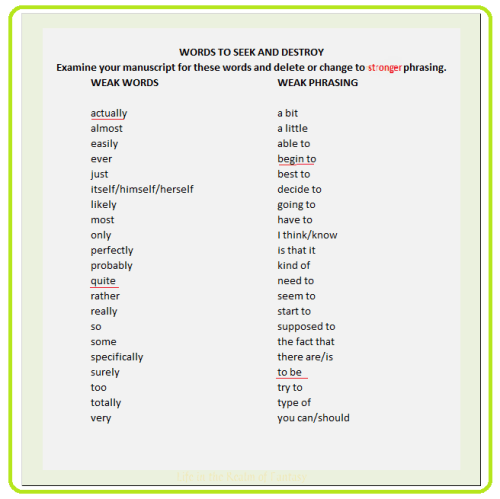
In my own work, I go on a search and destroy mission, looking for weak words and timid phrasing. Adverbs frequently contribute to excessive wordiness and passive phrasing, so I do a global search for the letters “ly.” Sometimes my manuscript will become a mass of words with yellow highlighted “ly’s.”

When it comes to adverbs, most often simply removing and replacing them with nothing strengthens the prose. But having said that, don’t be an idiot and remove every adverb—use common sense. It’s a daunting task, but I look at each adverb and see how they fit into that context.

These are the words to watch for and reconsider how you have used them:

Weak prose tells the story, holds the reader away from the immediacy of the experience. Passive voice also tells a story, but when done well, it isn’t weak–done well it can be beautiful and immersive.

Take Erin Morgenstern’s beautiful fantasy, The Night Circus. It’s a perfect example of passive voice blending with active. The novel is also a lightning rod of sorts, polarizing readers. Genre fantasy purists decry her lush, beautiful prose, and lack of direct conflict between the two magicians, while readers of literary fiction enjoy her lush, beautiful prose, and the deeper story that underlies the politely wage war between two magicians.

Poetry is often written in the Passive Voice. This gives the author the opportunity to apply rhythm and cadence to her words.

A good writing exercise is to take a short paragraph and write it in both the passive and active voices. You can learn a lot about how you think as a writer when you try to write in an unfamiliar style.

6 Comments

Filed under writing

First-Person POV #amwriting

Third-person omniscient is my usual mode to write in, but I am currently writing a short story in first-person present tense, and it’s not going well. When we write in third-person omniscient mode, the story is told from an outside, overarching point of view. The narrator sees and knows everything that happens within the world of the story, including what each of the characters is thinking and feeling.

As authors, we want to create a sense of intimacy, of being in the character’s head.

First-person point of view is fairly common and is told from one protagonist’s personal point of view. It employs “I-me-my-mine” in the protagonist’s speech, allowing the reader or audience to see the primary character’s opinions, thoughts, and feelings.

One way to create intimacy is to use stream of consciousness, a narrative mode that offers a first-person perspective by attempting to replicate the thought processes as well as the actions and spoken words of the narrative character.

This device incorporates interior monologues and inner desires or motivations, as well as pieces of incomplete thoughts that are expressed to the audience but not necessarily to other characters. Consider this passage from James Joyce’s Ulysses:

“A dwarf’s face, mauve and wrinkled like little Rudy’s was. Dwarf’s body, weak as putty, in a whitelined deal box. Burial friendly society pays. Penny a week for a sod of turf. Our. Little. Beggar. Baby. Meant nothing. Mistake of nature. If it’s healthy it’s from the mother. If not from the man. Better luck next time.

—Poor little thing, Mr Dedalus said. It’s well out of it.

The carriage climbed more slowly the hill of Rutland square. Rattle his bones. Over the stones. Only a pauper. Nobody owns.”

In this narrative mode, we see the POV character’s rambling thoughts, as well as witness their conversations and actions. Stream-of-consciousness is a tricky device to do well, and the only time I have employed it was in a writing class.

When they want to tell a story though the protagonist’s eyes, many authors employ a simple first-person point of view to convey intimacy. “I walked to the corner, thinking about what she had said.” The narrative is more structured than stream-of-consciousness yet flows quickly from the pen. As a reader, I prefer structured prose to unstructured, which is why I’m writing my new short story using a first-person POV.

I like the fact that stories in this mode are told from the view and knowledge of the narrator-character, and not of other characters. The author must keep in mind that no one ever has complete knowledge of anything.

In real life we can’t be all-seeing and all-knowing—witnesses are notoriously unreliable. By allowing the reader to discover information as the protagonist does, a story can be engrossing. Best of all, the narrator may not be honest with the reader. As in Gone Girl, by Gillian Flynn, she might withhold secrets, offering small bits of information in subtle ways.

So I know I am right not to settle, but it doesn’t make me feel better as my friends pair off and I stay home on Friday night with a bottle of wine and make myself an extravagant meal and tell myself, This is perfect, as if I’m the one dating me. ~~ Gone Girl, by Gillian Flynn

As I mentioned before, my intention with my current short story is to put the reader into my main character’s head. The problem I have as I read the first draft is this: written in the present tense narrative mode, it feels like a walk-through for a “choose your own adventure” book.

First-person point of view employs the unreliable narrator, which I do like. While this story has to be told from the main character’s first-person point of view, it might not be best  to tell  it in the present tense. I will keep the point of view but will change the narrative to a more reflective tense, rather than present tense.

For me, writing is as much about rewriting as it is writing new words. When something feels awkward, I rewrite it. If it still feels awkward, I set it aside for several weeks or even months. When I come back to it, I’m able to see what needs to be done more clearly. Sometimes that means it must be completely rewritten again. That struggle on my part is just part of the process.


Sources and Attributions:

Wikipedia contributors, “Narration,” Wikipedia, The Free Encyclopedia, https://en.wikipedia.org/w/index.php?title=Narration&oldid=777375141 (accessed May 7, 2017).

Quote from Ulysses, by James Joyce, published 1922 by Sylvia Beach

Quote from Gone Girl, by Gillian Flynn, published 2012 by Random House.

25 Comments

Filed under writing

Style and Voice #amwriting

The literary voice is the way a story is told. Literary voice has been compared to  music. We’ve all noticed how a well-known song can sound so different, depending on who is performing it. The words are the same, the basic melody is there, but some performances shine while others miss the mark.

The distinctive style of each writer forms when we engage personally with a topic and impart our personality to that piece of literature. We are each islands in a vast sea of writers, and the view from our place in the universe is slightly different from that of our fellows.

Therefore, how we convey what we see and imagine has an identifiable sound that is ours alone. Phrasing, word choices, these are the recognizable sounds of our literary style. Our habitual writing style is our unique fingerprint, the author’s voice.

However, voice is often what we love or hate about a certain author’s work. Editors for publications are readers who are looking for the best work to publish in their magazine or anthology. If a story has great characters and a good story arc, voice is what will attract or repel them.

These are the holy trinity that combines to make a classic tale:

  • great characters
  • unique voice
  • gripping plot

You may have noticed plot is listed last—and it is last for a reason. If the characters are not engaging and the writer’s style isn’t to my taste, the plot alone won’t sell me that book.

What is the writer’s voice? Wikipedia, the fount of all knowledge, says:  The writer’s voice is the individual writing style of an author, a combination of their common usage of syntax, diction, punctuation, character development, dialogue, etc., within a given body of text (or across several works).

Don’t confuse lazy writing with style. Lazy writers

  • Use too many quantifiers “It was really big.” “It was incredibly awesome.”
  • “Tell” the story instead of showing it: “Bert was mad.”
  • Swamp the reader with minute details: “Mary’s eyebrows drew together, her lips turned down, and her cheeks popped a dimple.”
  • Ruin the taste of their work with an avalanche of prettily written descriptors: “-ly” words
  • Have their characters natter on about nothing just to kill time. It doesn’t show them as human, it shows them as boring.

Lazy writers don’t realize how smart their readers are. We don’t have to offer up every minute detail of breakfast. Broad strokes will paint the picture.

In contrast, some enthusiastic writers go overboard in trying to create beautiful, literary prose. They’re confusing contrived writing with literary style.

Literary agent, Noah Lukeman, in his book The First Five Pages: A Writer’s Guide To Staying Out of the Rejection Pile, says, “All of these writers think they add a distinctive flavor, a ‘richness’ to the text, but more often than not they are just indulging themselves—thus the term ‘self-indulgent’—a common symptom of the over-styled manuscript.”

As we grow in the craft, our style becomes more cohesive, less self-indulgent, and more able to reflect our ideas. Certain habits will remain, the core of who we are and how we express ourselves. This is our voice.

It gets a little confusing when voice can also mean the tense in which the narrative is presented. English is a language where one word can have a multitude of meanings and context is critical. Some writers incorrectly use the terms voice and point of view interchangeably, so when they are talking about third voice, they mean Third Person Point of View. In this case, they are speaking of the main character’s voice, how she tells her story.

In this aspect, there are two voices to every narrative: the author’s voice, and the character’s voice.

Narration is the use of a written or spoken commentary to convey a story to an audience. Perspective and voice are components of the narrative.

Wikipedia says “Narrative point of view or narrative perspective describes the position of the narrator, that is, the character of the storyteller, in relation to the story being told. It can be thought of as a camera mounted on the narrator’s shoulder that can also look back inside the narrator’s mind.” It also explains that a narrative consists of three components:

  • Narrative point of view: the perspective (or type of personal or non-personal “lens”) through which a story is communicated.
  • Narrative voice: the format (or type presentational form) through which a story is communicated.
  • Narrative time: the grammatical placement  of the story’s time-frame in the past, the present, or the future.

Anyone who is a member of a critique group is regularly beaten over the head with certain basically good, but occasionally clichéd, rules. Improperly applied, this mindless interpretation of proper grammatical style can inhibit an author’s growth.

These rules are fundamentally sound but cannot be rigidly applied across the board to every sentence. For editing and also for writing, when I have questions about grammar I rely on The Chicago Manual of Style, but I also understand common sense.

Again it’s all about context. Sometimes a sentence that is grammatically incorrect sounds better, especially in dialogue. The bold writer sometimes breaks grammatical laws to write great books. How they habitually break those laws is their fingerprint, their style.

English is a living language. As such it is in a continual state of evolution and phrasing that made sense one-hundred years ago may not work well in today’s English. We may be writing a period piece, but we are writing it for modern readers. Nevertheless,

  • You can split an infinitive: it is acceptable to boldly go where you will.
  • You can begin a sentence with a conjunction if you so choose. And no one will die if you do.

How you apply grammar, the words you gravitate to, the point of view you work best in—these are the identifiable aspects of your voice as an author. Your writing style is a combination of how you speak through your pen or keyboard, how you craft your prose—your voice.
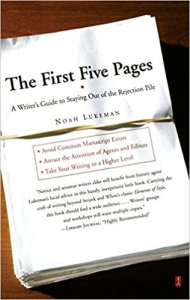
As Noah Lukeman’s book tells us, your author’s voice should not be so distinct and loud that it makes your prose obnoxious. Sharing your work in the early stages with an interested reader who will be honest with you can help you avoid some of the pitfalls in developing your style and voice. Find a good editor you can work with, one who will understand your stylistic choices, but who will guide you away from bad writing. This is money that is well spent.

Write something new every day, even if it is only a paragraph. Of all the advice I have to offer, this is the most important because if you don’t write, you have no voice, no style, no story.


Credits and Attributions:

Quote from The First Five Pages: A Writer’s Guide To Staying Out of the Rejection Pile, by Noah Lukeman, published by Simon and Shuster, © 2000.

Wikipedia contributors, “Narration,” Wikipedia, The Free Encyclopedia, https://en.wikipedia.org/w/index.php?title=Narration&oldid=777375141 (accessed Mar 18, 2018).


12 Comments

Filed under writing

#FlashFictionFriday: Elegy for Hawking

Stephen Hawking, Star Child,

Entered the world in the Year of the Horse

While bombs fell over London.

Rebel,

Always went his own way

Even when his way was difficult.

Revolutionary,

Freed his mind to travel the cosmos.

Sat taller in his chair than giants stand.

Quantum thinker,

Body shrunken to a singularity,

Mind as expansive as the universe.

Dreamer,

Stephen Hawking

Left us in the Year of the Dog

While we baked Pi for Einstein

And marveled at what we had lost.


Stephen Hawking,

Born 8 Jan 1942; died 14 Mar 2018 at age 76.

Author, Motivational Speaker, English Theoretical Physicist.

Hawking was the Lucasian Professor of Mathematics at Cambridge University, a position once held by such notables as Charles Babbage and  Sir Isaac Newton. Afflicted with amyotrophic lateral sclerosis (Lou Gehrig’s disease, or ALS), Hawking was confined to a wheelchair and was unable to speak without the aid of a computer voice synthesizer. However, despite his challenges, he made remarkable contributions to the field of cosmology, which is the study of the universe. His principal areas of research were theoretical cosmology and quantum gravity.

Hawking also co-authored five children’s books with his daughter, Lucy.

Hawking’s book list can be found at Amazon: Stephen Hawking’s Author Page 

Popular books

  • A Brief History of Time (1988)
  • Black Holes and Baby Universes and Other Essays (1993)
  • The Universe in a Nutshell (2001)
  • On the Shoulders of Giants (2002)
  • God Created the Integers: The Mathematical Breakthroughs That Changed History (2005)
  • The Dreams That Stuff Is Made of: The Most Astounding Papers of Quantum Physics and How They Shook the Scientific World (2011)
  • My Brief History (2013)

Co-authored

  • The Nature of Space and Time (with Roger Penrose) (1996)
  • The Large, the Small and the Human Mind (with Roger Penrose, Abner Shimony and Nancy Cartwright) (1997)
  • The Future of Spacetime (with Kip Thorne, Igor Novikov, Timothy Ferris and introduction by Alan Lightman, Richard H. Price) (2002)
  • A Briefer History of Time (with Leonard Mlodinow) (2005)
  • The Grand Design (with Leonard Mlodinow) (2010)

Forewords

  • Black Holes & Time Warps: Einstein’s Outrageous Legacy (Kip Thorne, and introduction by Frederick Seitz) (1994)

Children’s fiction

Co-written with his daughter Lucy

  • George’s Secret Key to the Universe (2007)
  • George’s Cosmic Treasure Hunt (2009)
  • George and the Big Bang (2011)
  • George and the Unbreakable Code (2014)
  • George and the Blue Moon (2016)

Stephen Hawking, StarChild, Image By NASA [Public domain], via Wikimedia Commons

Wikipedia contributors, “Stephen Hawking,” Wikipedia, The Free Encyclopedia, https://en.wikipedia.org/w/index.php?title=Stephen_Hawking&oldid=830584312 (accessed March 15, 2018).

Elegy for Hawking, by Connie J. Jasperson © 2018 All Rights Reserved

5 Comments

Filed under #FlashFictionFriday, Poetry, writing

Semicolon; Comma Splice, Comma #amwriting

My previous post on the em dash brought up some interesting comments, so I thought we should review the rules for the punctuation that we use and abuse so regularly. I have covered all of these before, so if you’re already up on these rules, thank you for stopping by and happy writing!

First up, the semicolon. This joining punctuation is not complicated, once you know the one rule about when to use semicolons:

  1. If you join two clauses with a semicolon, each clause must be a complete sentence, and they must relate to each other. In other words, they must be two short sentences expanding on ONE idea.

If your two short sentences don’t relate to each other, use a period at the end of each clause and make them separate sentences. You’re an author, for the love of Tolstoy. Use your creativity and reword those little sentences, so they aren’t choppy.

Two separate ideas done wrong: We should go to the Dairy Queen; it’s nearly half past five.

The first sentence is one whole idea: they want to go somewhere. The second sentence is a completely different idea: it’s telling you the time.

Two separate ideas done right, assuming the mention of time is important: We should go to the Dairy Queen soon. They close at eight, and it’s nearly half past five.

If time is the issue in both clauses and you want it to be once sentence, use a semicolon, reword it to say, “The Dairy Queen is about to close; it’s nearly half past five.”

Alternatively you can join them with the em dash. My personal inclination is to find alternatives to both semicolons and em dashes, as they can easily create run-on sentences. I don’t dislike them, as some editors do, but I think they are too easily abused and misused. My rule for you is this: Semicolons should not be used if you are in doubt.

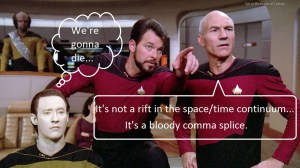
Some authors will do anything to avoid using a semicolon, which is ridiculous. However, they see their work is a little choppy, so they join the independent clauses with commas. That is a grammar no-no. You do not join independent clauses (clauses that can stand alone as separate sentences) with commas as that creates a rift in the space/time continuum: the Dreaded Comma Splice. If you join independent clauses with commas and we all die, you’ll only have yourself to blame because I did warn you.

Comma Splice: My car is a blue Chevy Malibu and I like it, the dog likes to ride shotgun.

Same two thoughts, written correctly: My car is a blue Chevy Malibu, and I like it. The dog likes to ride shotgun.

But what do we join with commas? Commas are the universally acknowledged pausing and joining symbol. Readers expect to find commas separating certain clauses. Some simple rules to remember:

  1. Never insert commas “where you take a breath” because everyone breathes differently.
  2. Do not insert commas where you think it should pause because every reader sees the narrative differently.

We do use commas to set off introductory clauses:

  1. In the first sentence, “because he was afraid” isn’t necessary.

I italicized the introductory clause in the above sentence to show that it is not a stand-alone sentence. This clause introduces the clause that follows it, and its meaning is dependent on that following clause.

A comma should be used before these conjunctions: and, but, for, nor, yet, or, and so to separate two independent clauses. They are called coordinating conjunctions.

However, we don’t always automatically use a comma before the word “and.” This is where it gets confusing.

Compound sentences combine two separate ideas (clauses) into one compact package. A comma should be placed before a conjunction only if it is at the beginning of an independent clause. So, use the comma before the conjunction (and, but, or) if the clauses are standalone sentences. If one of them is not a standalone sentence, it is a dependent clause, and you do not add the comma.

Take these two sentences: She is a great basketball player. She prefers swimming.

  1. If we combine them this way we add a comma: She is a great basketball player, but she prefers swimming.
  2. If we combine them this way, we don’t: She is a great basketball player but prefers swimming.

I hear you saying, “Now wait a minute! My English teacher very clearly taught us to use commas to join clauses.”

I’m sorry, but she probably did explain that exception. It just didn’t stick in your memory.

Two complete ideas can be joined with ‘and’ and you don’t need a comma.

Think of it as a list: if there are only two things (or ideas) in a list, they do not need to be separated by a comma.  I am buying apples and then going to the car wash.

If there are more than two ideas, the comma should be used to separate them, with a comma preceding the word ‘and’ before the final item/idea. This is called the Oxford comma, or the serial comma.

I must buy apples, go to the car wash, and then go to the library.

Oh yes, Grasshopper. We do use serial commas to prevent confusion. In March of 2017, the New York Times reported that the omission of a comma between words in a list in a lawsuit cost a Maine company millions of dollars.

One habit I had to unlearn the first time I sent my work to a professional line editor:

  1. Do not place a comma before the word ‘because’ unless the information that follows is necessary to the sentence.

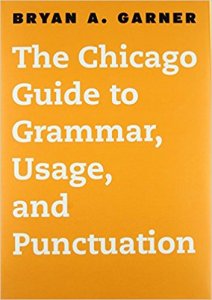
Grammar doesn’t have to be a mystery. If we want to write narratives that all speakers of English from Houston to Brisbane can read, we must learn the simple common rules of the road. To this end, I recommend investing in The Chicago Guide to Grammar and Punctuation. It is based on The Chicago Manual of Style but it’s smaller and the contents are easier to navigate.

If your prose feels wonky to you, and you know the punctuation is weird but think a reader won’t notice, you are wrong. Take the plunge and open the grammar book, and look up the rules. You will become more confident in your writing, and your work will go faster. Editing will certainly go faster!

11 Comments

Filed under writing

em dash, en dash #amwriting

Over the years, as I’ve become a professional writer, I have learned what I know about my craft by not only experiencing the editing process but by availing myself of the Chicago Manual of Style. I regularly attend seminars on writing craft and have invested in many books written by editors and famous authors.

I do write reviews for books I enjoyed, and in the course of reading for two review blogs, I have seen many books written by wonderful authors who overuse em or en dashes instead of proper punctuation when they are trying to emphasize a particular thought.

I also tend to do that in blogging and in Facebook posts, and that habit bleeds over into my first drafts.  It’s incredibly easy to rely on them too heavily. However, I find it distracting to see an em dash in every paragraph or even on every page. If we think about it, the em dash is like any other repetitive word in a manuscript. It is useful to emphasize certain ideas but should be used sparingly to be most effective.

So how DO we use them?

Hyphens join certain compound words. Never use a hyphen in the place of an em dash or en dash. See my blogpost of February 12, 2018, on the subject of how to use Hyphens.

Dashes are not hyphens and are used in several ways.

One is the ‘en dash,’ which is the width of an ‘n.’ Another is the ‘em dash,’ which is the width of an ‘m.’

En dashes join two numbers that are written numerically, not spelled. To insert an en dash in a Word document: type a single hyphen between two words, with a space on either side of it:

1994 – 1996 (1994SpaceHyphenSpace1996) Once you hit the space key after the second word, the hyphen will form an en dash.

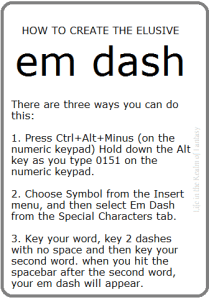
An em dash (—)   is a versatile punctuation mark. It is the width of an ‘m,’ hence the name. An em dash serves as a comma, does the same task as parentheses, and also does the work of the colon. Used in these situations, the em dash creates a slightly less formal effect and is a useful tool in the author’s arsenal.

To insert an em dash in a Word document: type two hyphens next to each other without any space between the words or hyphens:

A—B (LetterHyphenHyphenLetter) Once you hit the space key after the second word, the two hyphens will form an em dash.

They can be more emphatic than a comma and will really set apart any clause bracketed by them. In dialogue, we don’t use semicolons to join short related independent clauses. Instead, we use em dashes. Used sparingly, and not in every paragraph, they can smooth a choppy conversation and make it more normal sounding.

Unfortunately, in the rush of getting a first draft committed to paper, I tend to use them far too frequently, and in my hands, they lose their effectiveness.

I regularly find them sprinkled through my work, maniacally creating run-on sentences where brevity would be a better choice.

Properly, an author should use a comma, a semi colon, or a period to create that dramatic break, because too many em dashes are like too many curse words: they lose their power when used too freely.  Lynn Truss, author of Eats, Shoots and Leaves: the Zero Tolerance Approach to Punctuation, has been quoted as saying “People use the em dash because they know you can’t use it wrongly—which for a punctuation mark, is an uncommon virtue.”  

So what are these alternative forms of punctuation to create that dramatic pause?

  • PERIOD = a full stop. End of Sentence. That’s all folks.
  • SEMICOLON = Use a semicolon in place of a period to separate two complete sentences where the conjunction has been left out. Call me tomorrow; we’ll go dancing then. (The AND has been left out.) The sentences must be directly related to each other. If they are not related, use a period and make them stand alone.
  • COLON = Use the colon after a complete sentence to introduce a list of items when introductory words(such as namely, for example, or that is) do not appear. Here is the list of fruits: apples, oranges, and bananas.

Hyphens, en dashes, and em dashes are like any other drug. Authors and editors become addicted to using them. Perhaps this plague of dashes has occurred because they don’t understand the basic rules of the road regarding periods, colons, and semicolons. Get a copy of The Chicago Guide to Grammar, Usage, and Punctuation and crack it open; you will be amazed at what you find. The wise author will make use of this excellent tool.

I have mentioned this wonderful quote before, which is from a blog post called “The Case—Please Hear Me Out—Against the Em Dash.”  The post was written by the witty Noreen Malone, staff writer for The New Republic:

“What’s the matter with an em dash or two, you ask?—or so I like to imagine. What’s not to like about a sentence that explores in full all the punctuational options—sometimes a dash, sometimes an ellipsis, sometimes a nice semicolon at just the right moment—in order to seem more complex and syntactically interesting, to reach its full potential? Doesn’t a dash—if done right—let the writer maintain an elegant, sinewy flow to her sentences?”

That wonderful paragraph says it all. Em dashes have their place, but any easy crutch is to be avoided when it comes to writing a good narrative. As in all things, common sense is the rule of the day.

My personal writing goal is to find ways to set important phrases off within the framework of a sentence without relying so heavily on the em dash. This means I must write as creatively as possible, with intention and deliberate phrasing and I must make proper use of punctuation.

Wow. What a concept!


Credits and Attributions:

“The Case—Please Hear Me Out—Against the Em Dash”  by Noreen Malone, staff writer for The New Republic 24 May 2011 (accessed 11 March 2018).

Eats, Shoots and Leaves: the Zero Tolerance Approach to Punctuation, by Lynn Truss, Publisher: Avery April 2004.

22 Comments

Filed under writing