Category Archives: writing

#amwriting: creating a strong novella

A little over three years ago, I discovered that one of my works in progress was not really a novel after all.

The first draft was at 85,000 words, but it occurred to me that it was a novella. In the first half of the book, 4 chapters didn’t advance the protagonist’s story. When I finished weeding it out, the manuscript length was slightly over 50,000 words.  In YA and some romance 50,000 words is a novel-length book, but in fantasy, it is only half a book.

So, I  shelved that manuscript, as I had other, more pressing, work to get finished and had nothing of value to add to the tale. I said at the time that I would much rather be known for having written a strong novella than a weak novel.

Those four cut chapters totaled about 16,000 words. Added to that were the words I weeded out in the second draft. They totaled 8,000 to 10,000 more words.

But why did I do this?

  1. Besides the four chapters that didn’t belong there anymore, 3 more chapters were mostly background that didn’t need to be in the finished product. When I removed large chunks of exposition, I was able to condense those 3 chapters into 1 that actually moved the story forward.
  2. Also, in the rough draft we always find words we can cut or find alternatives for, words and phrases that weaken our narrative such as:
  • There was
  • To be

Also, we look for places where we can make contractions: ‘was not’ becomes ‘wasn’t,’ ‘has not’ becomes ‘hasn’t,’ etc.

Many times we can simply cut some words out, and find the prose is better without them. Most times, those words need no replacement.

I have mentioned the overuse of what I think of as “crutch” words. You can lower your word count when you look at each instance of these words. These words  fall out of our heads along with the good stuff as we are sailing along:

  • so,
  • very,
  • that,
  • just,
  • so,
  • literally
  • very

But back to the novella: why did I cut an 85,000 word MS down to 50,000 or so words?

A lot of what I had written was good work, but as I said, several long passages didn’t advance my protagonist’s tale. They pertained to a different character’s story set in that world–so they were a rabbit-trail to nowhere in the context of that story.

I didn’t discard those chapters, though. Those passages will come in handy later if I choose to write that character’s story, so I saved them in a separate file, under the character’s name.

The fact is, you must be willing to be ruthless. Yes, you may well have spent three days or even weeks writing that chapter. But sometimes, when you see it in the context of the overall story arc, you realize it bogs things down, and there is no fixing it.

Just because we wrote it does not mean we must keep it in that story.

At some point I will finish that novella, but the lesson I learned was this: no matter how much you like your prose, there are times when it must go.

12 Comments

Filed under writing

#FlashFictionFriday: Ballad of Jennet Adair (reprise)

Jennet, she lies

‘Neath the white rose tree

And never again will she

Play false to me


T’was not my hands

Round her lily-white throat

But would that I could

Drown her deep in the moat


Her hair was as dark

As summer is fair

Her lips were for kissing

Sweet Rose of Adair


Jennet, she lies

‘Neath the rose tree white

My brother will hang

For her murder tonight


Jennet, she lies

‘Neath the white rose tree

Never again will

Those lips lie to me


T’was not my hands

Round her lily-white throat

She ruined my brother

She ruined us both


Played us like pawns

In the age-old game

Until she did misstep

To her sorrow and shame


My brother will hang

‘Neath the town hall light

And who will tell mother

What happened tonight?


Jennet, she lies

‘Neath the white rose tree

And never again will she

Play false to me.


Ballad of Jennet Adair © Connie J. Jasperson 2016-2017, All Rights Reserved

The Ballad of Jennet Adair by Connie J. Jasperson was first published July 31, 2015 on Edgewise Words Inn, as a song her character, Huw the Bard, might have written. It is a story poem, written in a traditional, bardic style, and was inspired by the Child Ballads collected in the 19th century by Francis James Child.

Bouquet of Roses at the Window, Ferdinand Georg Waldmüller 1892 [Public domain], via Wikimedia Commons

Comments Off on #FlashFictionFriday: Ballad of Jennet Adair (reprise)

Filed under #FlashFictionFriday, Poetry, writing

#amreading: The Wheel of Time, series by Robert Jordan and Brandon Sanderson

Once again, epilepsy has reared its ugly head in my family, and travel to and from hospital the hospital 70 miles north of my home has interfered with my ability to write. So, for today’s post I’ve chosen to reprise my review of a hearty 14-book trilogy. I’ve warned you that many of the books I love and turn to when I need a good book are NOT comforting in any way, and for many people the incredibly long, epic series, The Wheel of Time, definitely falls into the UNcomfortable category. This is for a variety of reasons.

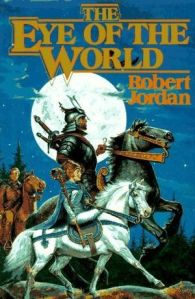
The Eye of the World was the opening volley in what would ultimately become one of the most controversial series in epic fantasy. Written by Robert Jordan and first published in 1990, this series of books has polarized the most dedicated fans of true fantasy into two groups: the lovers and the haters.  No reader walks away from this series unscathed.

The story begins in the exceedingly rural village of  Emond’s Field. They are so rural that they have no concept that they are still considered to be a part of a larger country. The village is suddenly attacked by Trollocs (the antagonist’s soldiers) and a Myrddraal (the undead-like officer commanding the Trollocs).  These creatures are intent on capturing the three protagonists, Rand al’Thor, Matrim (Mat) Cauthon, Perrin Aybara, although why they are being hunted is not revealed at first. To save their village from further attacks, Rand, Mat, Perrin, and Egwene (Rand’s first love interest) flee the village, accompanied by the Aes Sedai Moiraine Damodred, her Warder, Al’Lan Mandragoran, and gleeman, Thom Merrilin.They are later joined by Nynaeve al’Meara, who is their village’s medicine woman.

This huge range of characters and the many, many threads that weave an incredibly tangled plot are what polarizes the reading community over this series of books. Originally intended to be a trilogy, it eventually expanded to encompass fourteen LARGE, long books.

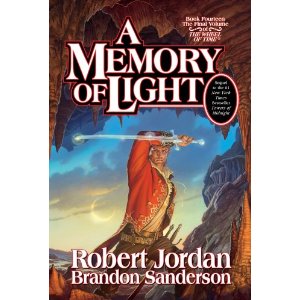
Robert Jordan passed away in 2007 while working on the final book, leaving the series uncompleted, but he left the rough draft and enough notes behind that Brandon Sanderson was able to finish the series, eventually breaking that final volume into three very large  books, and bringing the story to a satisfying conclusion.

So what is the basis for the plot’s tension, what conflict could possibly draw the reader in and keep them reading for such a long, drawn out process? It’s Robert Jordan, folks–the eternal quest for power, and dominance through violence, religion and politics is the core of this tale.

According to Wikipedia, the Fount of All Knowledge: The series draws on numerous elements of both European and Asian mythology, most notably the cyclical nature of time found in Buddhism and Hinduism, the metaphysical concepts of balance and duality, and a respect for nature found in Daoism. Additionally, its creation story has similarities to Christianity’s “Creator” (Light) and Shai’tan, “The Dark One” (Shaytan is an Arabic word which in religious contexts is used as a name for the Devil). It was also partly inspired by Leo Tolstoy’s War and Peace (1869).”

I loved the first three books in this series. I both enjoyed and endured the next three, hoping Robert Jordan would get to the point and finish the damned series. I had become a little irritated with book eight, Path of Daggers, but by the time Winter’s Heart came out, I was resigned to never seeing an end to it, and was back to simply enjoying each strange plot twist and new random thread for what it was–just a great tale.

When Robert Jordan died, I was thrilled that Brandon Sanderson was the author tapped to finally bring that unwieldy mess together. There were so many different stories within the greater story that the task of winding up each thread must have been incredibly daunting, and he did it magnificently.

The reason so many devoted fans abandoned the series somewhere around book six , Lord of Chaos, was that Rand al’Thor’s story ( and Mat’s and Perrin’s) stalled, and Jordan was sent way off track by the stories of Egwene, Nynaeve, and Elaine Trakand. In fantasy, there is a large contingent of readers who want instant gratification are not going to wait around for eight more books. They proved it by jumping ship and trash-talking his work.

Throughout the series, the quality of the writing never faltered. The depth of story and the intensely alive characters whose stories graced those pages never failed to intrigue me. The fact that it felt like the conflict would never be resolved was, at times, upsetting to me as a reader, and is a lesson authors should take to heart with their own work.

To write a story that is so compelling that readers become so violently polarized over it is quite an accomplishment.  I see this happening with George R.R. Martin‘s fans right now. Although I adore him as a person, I’ve never cared much for his style of writing, as he jumps around too much even for me. Have patience, people! It looks like George has a large story there too, so it may take him a while.

For Brandon Sanderson to step into the wasps’ nest of controversy that was The Wheel of Time and complete the series with such grace and finesse is nothing short of amazing, and I am glad I stuck with it to the end. Brandon Sanderson has become one of my favorite authors because of what he did to wind up this epic series.

In the end, the final resolution was satisfying, and was well worth the journey.  I have gotten rid of most of my hard copies, and am down to only one room’s worth of hardbound books at our house. I don’t buy too many hard copies of books, being a fan of the Kindle, and  but I did make an exception for this book.   For me, some books need to be in hard copy form and the Wheel of Time Series is one of them, as are the Harry Potter books. There was a large contingent of people who were upset that the epub edition wasn’t released until 4 months after the paper book, but this was a choice made by Robert Jordan’s widow and her publisher, TOR. It was a strange one in my opinion, but it was their choice.

Amazon’s early reviews of the later books in this series were rife with trolls and naysayers who couldn’t wait to emerge from the woodwork and have their say. Apparently very few of these people purchased the book, much less read it. That is the price of success and these days it’s almost an honor to have so many haters just spoiling to knock you down. But their strident caws and self-important rants should have no effect on the true fans of WoT. In my humble opinion these works are masterpieces and Brandon Sanderson’s three books are a triumphant finish to the series.

I love Brandon Sanderson’s handling of this series finale, and feel I more than got my money’s worth from this series of book, as I will definitely read it again and again–in my opinion it’s that good. If you love this series, you will love the way it ends!

The original cover artist for these amazing books was none other than the late Darrell K. Sweet, who was just as amazing a fantasy artist as is Michael Whelan. The newer covers are nice, but for me they lack the power of Sweet’s brilliant paintings.

And as we all know, I buy most books for their covers, even epubs, and then fall in love with the tale.


This post has been recycled and was previously posted as Comfort Books, the main course: The Wheel of Time, by Robert Jordan and Brandon Sanderson  in February of 2015 here on Life in the Realm of Fantasy, Copyright 2015-2017  Connie J. Jasperson, All Rights Reserved.

1 Comment

Filed under Book Reviews, writing

#amwriting: Identifying Genre

When you write a lot of different short stories, you really get to explore all aspects of your creative mind. You never know what will fall out of your head, so you find yourself writing in a wide variety of genres, things you never thought you would find interesting.

But they consume you, and you can’t stop writing.

So now you have this wonderful backlog of short and novella-length stories to enter in contests and submit to various publications–but now you find that this contest wants general fiction, and this one is fantasy. And this one is sci-fi only!

Dude–how do I know what tale to send to who?

If your work is nonfiction, it’s no problem because your work is targeted to a magazine with a specific readership, so the sub-genre will be clear and where you should submit it was likely evident the day you decided to write it.

Where this gets dicey is when you write short fiction with no specific contest or magazine in mind. When you sit down to write a short story with an open mind, random ideas flow, and because you are working within the limits of 3000 to 7000 words, your stories are creative and stretch you. But they will be widely different from your normal work, and will not always be in a genre you can easily identify. You have all this work, but no idea where to submit it.

Mainstream (general) fiction–Mainstream fiction is a general term publishers and booksellers use to describe works that may appeal to the broadest range of readers and have some likelihood of commercial success. Mainstream authors often blend genre fiction practices with techniques considered unique to literary fiction. It will be both plot- and character-driven and may have a style of narrative that is not as lean as modern genre fiction but is not too stylistic either. The prose of the novel will at times delve into a more literary vein than genre fiction, but the story will be driven by the events and action that force the characters to grow.

Science fiction–Wikipedia says:  “Science Fiction is fiction dealing with imaginative content such as futuristic settings, futuristic science and technology, space travel, time travel, faster than light travel, parallel universes and extraterrestrial life.” BE WARNED: the internet is rife with purists and impurists in the sci-fi field, snobs and folks with their heads up their anachronisms. Anyway, if you use magic for any reason you are NOT writing any form of sci-fi.

Hard Sci-fi is characterized by rigorous attention to accurate detail in the physics, chemistry, and astrophysics. Emphasis is placed on accurately depicting worlds that more advanced technology may make possible. Soft Sci-fi is characterized by works based on social sciences such as psychology, economics, political science, sociology, and anthropology.

Other main sub-genres of Sci-fi include Space-operasCyberpunk, Time Travel, Steampunk, Alternate history, Military, Superhuman, Apocalyptic and Post-Apocalyptic.

The main thing to remember is this–Science and Magic cannot coexist in the Genre of Science Fiction. The minute you add magic to the story, you have Fantasy.
Fantasy: Wikipedia says: “Fantasy is a genre of fiction that commonly uses magic and other supernatural phenomena as a primary plot element, theme, or setting. Many works within the genre take place in imaginary worlds where magic and magical creatures are common. Fantasy is generally distinguished from the genres of science fiction and horror by the expectation that it steers clear of scientific and macabre themes, respectively, though there is a great deal of overlap between the three, all of which are sub-genres of speculative fiction.” 

I’ll be truthful–fantasy has its share of snobs and damn fools when it comes to defining the sub-genres:

High fantasy–High fantasy is defined as fantasy fiction set in an alternative, fictional world, rather than the real, or “primary” world, with elves, fairies, dwarves, dragons, demons, magic or sorcery, wizards or magicians, constructed languages, quests, coming-of-age themes, and multi-volume narrative. Often the prose is more literary, and the primary plot is slowed by many side quests. Think William Morris and J.R.R. Tolkien.

Epic Fantasy–These stories are often serious in tone and epic in scope, dealing with themes of grand struggle against supernatural, evil forces. Epic fantasy shares some typical characteristics of high fantasy includes fantastical elements such as elves, fairies, dwarves, dragons, demons, magic or sorcery, wizards or magicians, constructed languages, quests, coming-of-age themes, and multi-volume narratives. Tad Williams’s Memory Sorrow and Thorn is classic Epic Fantasy.

Paranormal Fantasy–Paranormal fantasy often focuses on romantic love and includes elements beyond the range of scientific explanation, blending together themes from all the speculative fiction genres. Think ghosts, vampires, and supernatural.

Urban Fantasy– can take place in historical, modern, or futuristic periods, and the settings may include fictional elements. The prerequisite is that they must be primarily set in a city.

Horror–Wikipedia says “Horror fiction, horror literature and also horror fantasy are genres of literature, which are intended to, or have the capacity to frighten, scare, or startle their readers by inducing feelings of horror and terror. Literary historian J. A. Cuddon has defined the horror story as “a piece of fiction in prose of variable length… which shocks or even frightens the reader, or perhaps induces a feeling of repulsion or loathing.

Romance– Novels of this type of genre fiction place their primary focus on the relationship and romantic love between two people, and must have an “emotionally satisfying and optimistic ending.”

I’m discussing Literary Fiction last because it is the most complicated and least understood genre of all. Literary fiction tends to be more adventurous with the narrative, with the style of the prose taking a prominent place. Stylistic writing and the exploration of themes and ideas form the substance of the piece. Writer’s Relief Author’s Submission Service defines literary fiction as “…fiction of ideas. While the story must be good, emphasis on action is not often as important as emphasis on the ideas, themes, and concerns of the book. Literary fiction tackles “big” issues that are often controversial, difficult, and complex.”  (end quoted text)

One of the problems in the perception of what constitutes Literary Fiction is this: A book like Alexander Chee’s Queen of the Night is a historical fantasy–BUT it is the style and VOICE with which it is written that makes it a powerful literary work. The same goes for much of George Sanders work. The Tenth of December is technically scifi, but it is the style and voice that makes George Sanders literary. The same with Neil Gaiman’s lovely work on the book, Stardust, which is a lightning rod for the “that’s not literary–yes it is” debate.

But think about this: an editor at Harpercollins once told me (at a conference) that literary fiction is anything that is well written with intentional prose, is character driven, has a compelling story, and doesn’t quite fit into any other category. A friend of mine in an online writer’s community said in a thread, “Intention, approach, the way resolutions happen, and the ideas explored help create these distinctions.”

Now that you know what the genre of your story is, you can seek out magazines and contest looking for that sort of work. Choose carefully who you submit your work to, carefully follow their submission guidelines, and only submit the work you have that best fits what they publish.

Never submit anything that is not your best work, and do not assume they will edit it because they won’t. And let’s be real–no one will even consider publishing work that is poorly written, sloppily formatted, and generally unreadable.


Parts of Identifying Genre were first published here on Life in the Realm of Fantasy under the title, What did I just write? Labeling short fiction, by Connie J. Jasperson © 2015-2017 All Rights Reserved.

How Do You Know If Your Novel Is Literary Or Mainstream Fiction? How Long Is A General Fiction Book? Posted on July 22, 2009 by Writer’s Relief Staff, accessed 11 June, 2017.


4 Comments

Filed under Publishing, writing

#FlashFictionFriday: Rain Falling on a Young Girl’s Face

Here_comes_rain_again

Rain falling on a young girl’s face,

Falling down, down,

Rolling down, down.

Went where she shouldn’t.

Broke the rules,

Broke their trust,

Broke her dreams,

And all because he seemed so nice.

Too young to drink, but drank too much,

Said no, she wouldn’t,

Said, no, he couldn’t,

Said no, he shouldn’t,

When he pressed her,

When he forced her,

When he mocked her.

Rain falling on a young girl’s face,

Falling down, down,

Rolling down, down.

Punished her for breaking the rules.

Can’t bear the shame,

Can’t bear the guilt,

Can’t face her family.

Rain falling down, down her face.

Who will raise her up?

Who will sooth her pain?

Who will say “It’s not your fault?

“He had no right.

“He had no right.

“You broke the rules, but He had no right.”

Rain falling on a young girl’s face,

Falling down, down,

Rolling down, down.


Sources and Attributions

Rain Falling on a Young Girl’s Face © 2017 Connie J. Jasperson

National Sexual Assault Hotline (No matter who you are–woman, man, or child–you are not alone: click https://www.rainn.org/ or call 800-656-HOPE)

Image: Here Comes the Rain Again, By Juni from Kyoto, Japan (Flickr) [CC BY 2.0 (http://creativecommons.org/licenses/by/2.0)%5D, via Wikimedia Commons

Comments Off on #FlashFictionFriday: Rain Falling on a Young Girl’s Face

Filed under #FlashFictionFriday, Poetry, writing

#amblogging: How to use WordPress to Publicize your blog posts

Blogging is one thing writers need to do regularly, even if it is only once or twice a month. However, it’s hard to gain readers when you first begin to blog. After all, blogging requires writing, and many writers feel it takes them away from their ‘real’ work.

But what is our real work? We write, hoping people will read our work, and our blog is the way to connect with those readers. For the Indie Author, your blog is your store, and is where your books are sold.

However, if we have a limited audience, we feel defeated in our efforts to gain readers, and many authors let their blogs languish for that reason.

All blogs begin with a small readership. Because we all begin small and want to gain readers, it’s necessary to use every platform available to get the word out and WordPress offers us many opportunities to do just that.

I’m taking you through the WP Admin menu, because some WordPress.org users don’t have the universally dreaded “New and Better” way to post via the “improved editor” menu, but they still need to publicize their blogs. The options and steps are pretty much the same on the WordPress.com “improved editor” menus.

On the dropdown menu to the left of your Blog title, under the words “My Sites,” click the dropdown menu. Scroll all the way to the bottom and open the WP ADMIN menu.

Step One: In that menu, scroll down to “Settings” and open that menu.

Step Two: In the Settings menu, open “sharing” and click on it. that will take you to the “Sharing Settings” page. Click on the button that says, “Publicize Settings.”

That will open a list of what I think of as blog warehouses, places that collect blogs and offer them to their regular readers.

Step Three: You want to activate as many of them as you can.

Follow these Screenshots, in this order:

Step Four is an important step especially for those who use twitter to promote their posts to the world. Because I have my blog set to automatically post to twitter, I use a hashtag in the title of every blogpost. If you don’t make twitter your tool, you are missing out on an important and simple “publicizing” opportunity:

I highly recommend blogging regularly, at a minimum two posts a month. Writing blog posts develops your writing craft. Also, your blog is where you talk about your interests, your writing, and is where potential readers can find your books.

If you really want your work to be visible, use the options and tools WordPress offers you.

25 Comments

Filed under writing

#amwriting: Literature and Language: Gormenghast and Lyonesse

Two series of fantasy novels that had a profound effect on me as a reader are the Gormenghast series of novels, written by Mervyn Peake, and The Lyonesse Trilogy by Jack Vance. Both series are literary, yet still fantastic,

They are both considered a fantasy of manners, yet they are wildly different from each other. Both combine the comedy of manners with the hero’s journey of traditional high fantasy. Gormenghast is dark and gothic, while Lyonesse is set in an alternate Arthurian world.

The Washington Post Book World had this to say about the Gormenghast series:  “This extravagant epic about a labyrinthine castle populated with conniving Dickensian grotesques is the true fantasy classic of our time.”

The immense, labyrinthine Hayholt, featured in Tad Williams’ epic masterpiece, Memory, Sorrow, and Thorn, seemed reminiscent of castle Gormenghast to a certain extent when I first read that series. I don’t know if Williams is a Gormenghast fan–I’ve never asked him, although I should. I do know he is not afraid to write great literary fantasy.

Vance’s vision of Lyonesse has influenced fantasy literature in the most subtle of ways, creating a canon for those who write alternate Arthurian history that is nearly set in stone.

Wikipedia says, Vance builds the history of his world using layers of facts, names and religions taken from various European cultures — Greeks, Romans, Celts, pre-Carolingian French and Spanish “kingdoms” etc., and adding in places and peoples imagined by those same cultures — Atlantis, Ys, Avalon, Formor and so on. This fantastical/factual mix is used to ground his tale in “history.” It also seems to give some of the same depth that a longer series of books might develop where place, relationships, and plot are built up over time (as in Thomas Hardy’s “Wessex” or Trollope’s “Barsetshire”). It seems to provide the believability that develops where a story is set in a well-known, well-defined historical setting as if the reader holds merely a hitherto untold story.

These complicated, convoluted books are not for everyone. They are beautifully written, but the less perceptive, more impatient type of reader will find Gormenghast confusing and plot-less. Despite being a dark, Gothic fantasy, the prose is literary.

For some casual readers, both Gormenghast and Lyonesse will be considered too heavy on the descriptions.

But for those readers like me, readers who adore beautiful prose, deep, involving books, and darkly baroque settings peopled with unforgettable characters, these two watershed works strike a chord deep within the soul.

These books must be savored, experienced in the fullest sense of the word. The focus is on the breathtaking visual descriptions, and while I am thrilled by it, the verbal beauty of Mervyn Peake and Jack Vance’s prose is what will leave many impatient modern readers cold.

When you are reading these novels, the journey itself is more important than the destination. While Gormenghast is often compared to Tolkien’s work, there is little similarity between the two, other than they are both extremely well written fantasy, written by authors with a good command of the English language and all its nuances.

Literature drives changes in language and is in turn driven by changes in language. For me, Gormenghast is a surreal, visual painting, created of beautifully crafted words.  The prose of Jack Vance’s Lyonesse is equally beautiful, describing a time and place that never was but could have been.


Sources and Attributions:

Wikipedia contributors, “Lyonesse Trilogy,” Wikipedia, The Free Encyclopedia, https://en.wikipedia.org/w/index.php?title=Lyonesse_Trilogy&oldid=782651719 (accessed June 4, 2017).

Wikipedia contributors, “Titus Groan,” Wikipedia, The Free Encyclopedia, https://en.wikipedia.org/w/index.php?title=Titus_Groan&oldid=769262142 (accessedJune 4, 2017).

Cover illustration of the 1983 trade paperback edition of Lyonesse by Jack Vance. Low-res scan for fair use purpose. Illustration by James C. Christensen. via Wikimedia Commons https://en.wikipedia.org/wiki/File:Vance-Lyonesse.jpg

Titus Groan, by Mervyn Peake, cover art also by Mervyn Peake, published by Eyre & Spottiswoode 1946 https://en.wikipedia.org/w/index.php?title=Titus_Groan&oldid=769262142 (accessed June 4, 2017).

2 Comments

Filed under writing

#FlashFictionFriday: Old Man Walking

Rembrandt_Harmensz._van_Rijn_070

Old man walking to the tavern

No license, mumbling.

Saw too many things

Knows too many things

War is one of those things.

Old man riding to the tavern

A young boy’s bike.

Lost his license

Lost his mind

Lost his self-respect.

Old man walking to the tavern

No license, mumbling.


Old Man Walking, by Connie J. Jasperson, © 2017 All Rights Reserved.

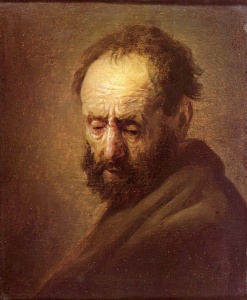
Head of a Bearded Man (Manner of Rembrandt) after circa 1630 [Public domain or Public domain], via Wikimedia Commons

If you or a loved one are a wounded veteran and are struggling with PTSD, call Vet to Vet Assistance 888-777-4443 or log onto the National Veterans Foundation https://nvf.org/about-national-veterans-foundation/

1 Comment

Filed under #FlashFictionFriday, Poetry, writing

#amwriting: Dinosaurs Among the Birds

This week has been a challenge–life has conspired against my ability to write. So, being an ecologically minded person, today’s blog post is an essay, recycled from my archives.


I graduated from high school in 1971. My friends and I were so close in those years and we have held onto those connections, despite the rough seas of young adult life. We drifted apart during the ‘blender years,’ but as our children left home and our lives became more our own, we drifted back together.

Forty-six years ago, we were young and wild, determined to carve our path in the world and desperate to get on with living. We were tired of the war, tired of politics, and tired of being told what to think by a media that was controlled by pin-headed men in suits. We were tired of Congress selling us out.

We were going to change the world.

We did change it, but not exactly the way we naively believed we would. Even though we were unable to solve all the problems we wanted to, we did manage to make some positive changes. Unfortunately, we were too few, voices shouting in the wind.

And now we are somewhat jaded. The country is still divided, big money still buys votes. Congress is still selling out, and the media is still owned by pin-headed men in suits. There is always a war somewhere, and it is never done with.

My generation clings to our belief that we will see positive changes, but we don’t believe we’ll live long enough to enjoy them. Nevertheless, change is inevitable and it will happen, even if, like Moses and the promised land, we stand on the opposite shore and see only what yet may be.

My old friends and I are not exactly who we were in those wild days. Now we’re an amalgamation of everything we once believed would happen and the reality we lived. We are people who survived Reaganomics, who survived raising children through the MTV years. We held down three part-time jobs because trickle-down economics didn’t really trickle down the social ladder to our rung, and we had kids to feed.

We survived the Bush years with some of our dignity intact and didn’t fold under the “you’re with us, or you’re against us” propaganda designed to shut us up. We will survive whatever comes our way with the current regime because old wood is tough wood and doesn’t break easily.

We are jaded, but we have hope, we old hippies, we old women and men who are dinosaurs among the birds of the modern, hyper-connected world. We still believe small businesses feed more families and provide more jobs than big corporations do, and are therefore more deserving of the tax breaks that Corporate America extorts from the public coffers. We believe in the American dream of entrepreneurship, that the world can be a better place for everyone. The difference is now we know we can change the world… just not in the way we thought we would.

Now we put our money where our mouth is, donating to charities and spending our retirement years volunteering in schools and hospitals. We do it in small ways, chipping away, and little by little we have a positive effect.

We lost the battle to make the world a simpler, kinder place. Our parents were The Greatest Generation, and they won the second World War with their firm, 20th century belief that only through technology would mankind benefit, and that somewhere a miracle drug was waiting, one able to cure every disease known to man.  It just hadn’t been discovered yet. Now the drug companies have the government’s balls in one hand and a claw-like grip on our pocketbooks with the other. That hoped-for miracle cure is still somewhere out there on the horizon, and likely always will be.

My generation was conquered, despite the struggle to keep it simple. We old hippies now embrace technology and make it ours. We do this because we must either adapt or die, and I am not ready to die. We are a wired society, and we old people have the luxury of a little free time and occasionally, extra money. So, we have become wired.

Writing is my opportunity to live in the world as I would like it to be, and it is my chance to get away from the war, from politics, from the problems of everyday life. Writing is my escape.

I support creativity and free-thinking on a local level. I volunteer as municipal liaison for NaNoWriMo. I encourage people from all walks of life, and from every point of view to write. It doesn’t matter to me if we agree politically or not. Everyone has a story to tell. Some stories are real and incredibly moving, and all the writer needs is the skill to tell that story the way it should be told.

crest-bda7b7a6e1b57bb9fb8ce9772b8faafbThey can gain that skill through participating in NaNoWriMo, National Novel Writing Month. Children and schools benefit year-round from writing programs sponsored by this organization. For me, November is the busiest month of the year. I will be meeting and getting to know many new people, and I will be writing the framework for a new novel.  For one month, thousands of people will be too busy writing to spend their evening in front of the electronic altar, being fed mindless pap in the form of ‘entertainment.’ Instead, they will entertain themselves and find they are so much more than they ever thought they could be.
With every new book that is written, each new magazine article or essay, the world opens its eyes a bit more, seeing more possibilities. Readers discover they are not islands disconnected from society, cocooned in dark living-rooms, unable to look away from the poorly crafted mind-porn we are force-fed by the big networks.

I am an old hippy, I admit it. But I am water, wearing away at ignorance, helping the world learn how to tell its story one person at a time.


Dinosaurs Among the Birds, by Connie J. Jasperson was first published 17 May 2017 on the  myrddinpublishing.com blog, http://www.myrddinpublishing.com/dinosaurs-among-birds/.

American Flag By Michael Dorausch (Flickr: American flag) [CC BY-SA 2.0 (http://creativecommons.org/licenses/by-sa/2.0)%5D, via Wikimedia Commons

2 Comments

Filed under writing

In Flanders Fields #MemorialDay

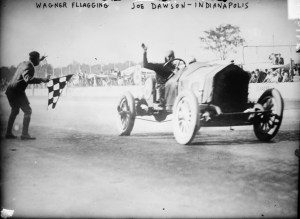
The Indianapolis 500 took place on Sunday, and while I wasn’t there this year, my son was.

But Memorial Day is more than just the official launch of Summer here, more than just a car race. It began after the American Civil War in 1868 as “Decoration Day,” established as a time for the nation to decorate the graves of the war dead with flowers. Officially, Memorial Day is the last Monday in May.

In the US, it is a 3-day holiday weekend. Banks are closed on Monday, and the US Postal Service is also closed. The American flag is traditionally set at half-staff until noon to honor all those whose lives have been given in the service of our country. At noon, it is raised to the top of the staff, signifying that we, as a nation, will rise again.

After each great and terrible war of the last two centuries, the hope was always that we had fought a “war to end all wars.” World War I, also known as The Great War, was spoken of in literature as just that: a war to end all wars.

With each conflict we still hope, but we are less able to believe it.

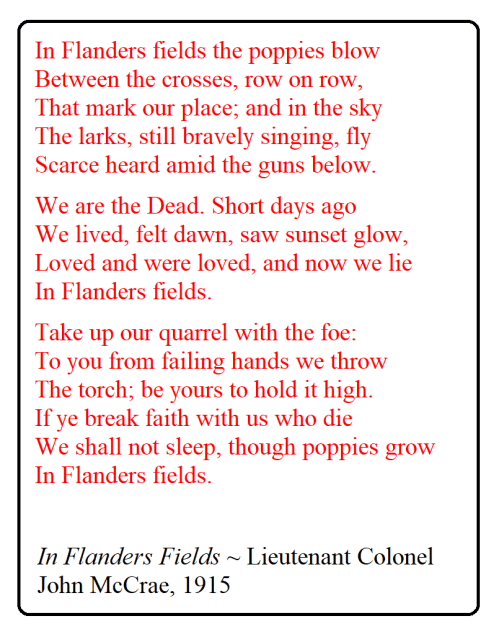
From Wikipedia:  “In Flanders Fields” is a war poem in the form of a rondeau, written during the First World War by Canadian physician, Lieutenant-Colonel John McCrae. He was inspired to write it on May 3, 1915, after presiding over the funeral of friend and fellow soldier Alexis Helmer, who died in the Second Battle of Ypres. According to legend, fellow soldiers retrieved the poem after McCrae, initially dissatisfied with his work, discarded it. In Flanders Fields was first published on December 8 of that year in the London-based magazine Punch.


Sources and Attributions

In Flanders Fields, by Lieutenant Colonel John McCrae, MD, PD|75 years

John McCrae died of pneumonia January 28, 1918, near the end of the Great War. In Flanders’ Fields is a staple poem for Memorial Day services.

Wikipedia contributors, “In Flanders Fields,” Wikipedia, The Free Encyclopedia, https://en.wikipedia.org/w/index.php?title=In_Flanders_Fields&oldid=781662754 (accessed May 28, 2017).

1912 Indianapolis 500, Joe Dawson winning, Image By Bain News Service, publisher [Public domain or Public domain], via Wikimedia Commons

Comments Off on In Flanders Fields #MemorialDay

Filed under Politics, writing