#amreading: Into the North, by Lindsay Schopfer

Today I’m talking about a book written by Indie author, Lindsay Schopfer. I enjoyed the first book in the series, The Beast Hunter, and Into the North is a fitting sequel to Keltin’s first adventure. Both are stand-alone novels, so you don’t have to have read The Beast Hunter to know what is going on.

But First, THE BLURB:

Professional beast hunter Keltin Moore is returning home a changed man. With a new apprentice and a lifetime of experience gained in faraway Krendaria, he prepares to settle into his old life of being a small town hero. But when gold is discovered in the far north, Keltin must again leave his home in order to protect the prospectors from the beasts ravaging the gold fields. Arriving in the boom town of Lost Trap, Keltin soon discovers that there are dangers beyond beasts in the frozen north. A local gang has established themselves as the resident Hunters Guild and will not tolerate any competition. Meanwhile, a specter haunts the gold fields. A legendary creature known as the Ghost of Lost Trap stalks the snowy countryside, testing Keltin and his friends to their very limits as they try to hunt their most dangerous beast yet.

MY REVIEW:

Like Schopfer’s other work, this novel is well-structured, with creative environments, good tension, and deep characters. It is a complex tale, layered with political and ethical themes. As in The Beast Hunter, the technology is all that which we would find available in any late 19th century steampunk tale, but there the similarity ends. Keltin is a beast hunter, and the Ghost of Lost Trap is not your average Edwardian creature. The creatures in this series are some of the most horrific things I have seen outside of an RPG, all of them fun and dangerous.

Keltin Moore is still slightly flawed, and still intriguing. He still has family troubles and will likely always have trouble getting along with certain members of his own species. He lives in a world of diverse sentient races of people, and the prejudice and political intrigue stemming from that diversity is central to their culture. One of my favorite characters is Bor’ve’tai, a member of a species called the Loopi, and he makes a return.

A bounty hunter, Keltin is used to working alone, but now he has an apprentice—Jaylocke, the Weycliff Wayfarer. Jaylocke is, at times, hilarious, and is a good foil for Keltin’s intensity. The people they meet along the way and the relationships they forge with other species are the core of this story. Lindsay Schopfer’s knack for showing a good story really shines, as the action driven plot, rather male-dominated but multicultural society, and solid, well-drawn characters of many different species make this novel a good read.

I received an advance copy of this book as a Beta reader. I enjoyed it very much in that incarnation, and liked the finished product even more. I highly recommend it as an action adventure.


I will be a guest author participating in the official online launch party on Facebook, Saturday April 15, beginning at 4:oo p.m. Pacific time. Four other wonderful authors will also be participating, helping to boost the signal so feel free to log into Facebook and  join in the conversation. Some awesome prizes could be yours!

Into the North Online Launch Party

Log on and engage with some fantastic fantasy and steampunk authors as we celebrate the release of Lindsay Schopfer’s latest novel, “Into the North.” Our lineup of authors is as follows:

4:00 to 4:30 pm PDT – Pembroke Sinclair (7:00 EDT) (US) Pembroke Sinclair is a literary jack of all trades, playing her hand at multiple genres. She has written an eclectic mix of fiction ranging from horror to sci-fi and even some westerns. Born in Rock Springs, Wyoming–the home of 56 nationalities–it is no wonder Pembroke ended up so creatively diverse. Her fascination with the notions of good and evil, demons and angels, and how the lines blur have inspired her writing. Pembroke lives in Laramie, Wyoming, with her husband, two spirited boys, a black lab named Ryder, and a rescue kitty named Alia, who happens to be the sweetest, most adorable kitty in the world! She cannot say no to dessert, orange soda, or cinnamon. She loves rats and tatts and rock and roll and wants to be an alien queen when she grows up.

4:30 to 5:00 pm PDT – Terry Persun (7:30 EDT) (US) Terry Persun’s books have taken readers to the uncharted worlds near the edge of the galaxy (“Hear No Evil”), to lands where shape shifters battle humans (the “Doublesight” series), to the near future in both technology (“The Killing Machine” and “Revision 7:DNA”) and shamanism (“The NSA Files” and “The Voodoo Case”), all while keeping the pace with thriller/suspense novels. He’s also ventured into history (“Sweet Song” and “Ten Months in Wonderland”), contemporary crime (“Man by the Door” and “Mistake In Identity”), and mainstream novels (“The Perceived Darkness”, “Wolf’s Rite”, and “Deception Creek”).

5:00 to 5:30 pm PDT – Katherine Perkins (8:00 EDT) (US) Katherine Perkins lives wherever the road of a Visiting Assistant Professor’s family takes her, her husband, and one extremely skittish cat. She was born in Lafayette, Louisiana, and will defend its cuisine on any field of honor. She is the editor of Jeffrey Cook’s Dawn of Steam series and serves as Jeff’s co-author for the YA Fantasy Fair Folk Chronicles (beginning with Foul is Fair) and various short stories, including those for the charity anthologies of Writerpunk Press. When not reading, researching, writing, editing, or occasionally helping in the transcription of Braille songbooks, she tries to remember what she was supposed to be doing.

5:30 to 6:00 pm PDT Connie J. Jasperson (8:30 EDT) (US) This is ME!!! I bill myself as an author, blogger, and medieval renaissance woman. Feel free to join the conversation on Facebook–I will be talking about the Tower of Bones series and giving away 2 eBook downloads of book one in the series, Tower of Bones.

6:00 to 6:30 pm PDT – Nicole J. Persun (9:00 EDT) (US) Nicole J. Persun started her professional writing career at age sixteen, when Booktrope Editions published her novel A Kingdom’s Possession. Her second novel, Dead of Knight, won Gold in Foreword Magazine’s 2013 Book of the Year Awards. Aside from novels, Nicole has had short stories, flash fiction, poetry, and essays published in a handful of literary journals. With a Master’s in Creative Writing, Nicole lives in Washington State.

6:30 to 7:00 pm PDT – Lindsay Schopfer (9:30 EDT) (US) Lindsay Schopfer is the author of The Adventures of Keltin Moore, a series of steampunk-flavored fantasy novels about a professional monster hunter. He also wrote the sci-fi survivalist novel Lost Under Two Moons and the fantasy short story collection Magic, Mystery and Mirth. His short fiction has appeared in Merely This and Nothing More: Poe Goes Punk from Writerpunk Press and Unnatural Dragons from Clockwork Dragon.

All the participating authors will share tidbits about their work, and some will have games. Several are offering prizes to participating visitors. As I mentioned above, I will be talking about the Tower of Bones series and giving away Kindle downloads of Tower of Bones to two lucky winners.

Comments Off on #amreading: Into the North, by Lindsay Schopfer

Filed under Book Reviews

#amwriting: Thoughts on Italics, revisited

Once again real life has interfered with my blogging life, so today, we’re revisiting a post that was originally published in May of 2016. This is a post that evolved out of a conversation with author Lee French. One of the virtues of being a part of a group of writers is that you can bounce questions and ideas off them. And, one thing the authors I hang out with all agree on is that italics are the devil.


Italics are hard on the eyes, daunting, and difficult to read in large chunks when the main character is waxing internally poetic. Also, many readers subconsciously skip them, and so they have missed important information you may have imparted there. Having not read the italicized information, they may think your book is confusing and disjointed.

Yet the standard practice in genre fantasy is to set internal dialogue off in italics. For this reason, I no longer give my characters a lot of time to think, as such. In my more recent work, only rarely do my characters think in italics. I believe thoughts occur as an organic part of the narrative as a whole and should be identified as if with a speech tag:

  • I wondered, why the red hat? Surely it meant something, as she was the second person I’d seen with a red hat. But perhaps I saw what I wanted, a conspiracy where none existed.
  • The flash of a purple stocking covering a shapely ankle, quickly hidden by her skirts, caught his attention. Was she a whore? He wondered. Some women working the streets wore red to advertise their profession, but she didn’t have the look of disillusionment the others wore beneath their masks of false desire. Why did she wear purple stockings?
  • His sword belt hung on the chair just as he’d left it the night before. But while the scabbard had been left behind, Caliburn was gone. His heart sank, and he cast his mind back, picturing his room before he’d gone down to breakfast. Nothing had seemed out of place, but had he seen the grip sticking out of sheath? He couldn’t recall.

Most thoughts don’t have to be italicized. My recommendation is to only voice the most important thoughts via an internal monologue, and in this way, you will retain the reader’s interest. The rest can be presented in images that build the world around the characters.

The exception to this is if the person who is thinking is also speaking with other people, and his thought could be mistaken as dialogue spoken aloud.

Other, equally insidious reasons exist as to why authors may choose to use italics, most of which I think should be formatted in a better, easier to read style that still sets them off:

  • Mental telepathy, which is technically spoken dialogue
  • Letters, which are the written thoughts of people from far away
  • Emails, which are electronic letters
  • Text messages

Let’s consider correspondence between characters: some work is written in an epistolatory style. The entire narrative is told in the form of letters exchanged between the characters, as in the case of the brilliant steampunk Dawn of Steam series by Jeffrey Cook with Sarah Symonds. In that case, with each exchange of letters, the speaking character/author is made clear.

However, correspondences inserted into the body of a narrative should be formatted to set them apart, but not to throw the reader out of the story. For that passage, add an extra space both before and after, and inset both left and right margins by one-half inch (.5).

He looked at the missive from Father Rall, wondering how his day could get any worse.

Cayne,

I understand you are too unwell to duel lately. Your students’ health is at risk if you have a contagious disease. You must go to the infirmary today. If your illness is treatable, you should be back to dueling soon. If you are suffering from the prolonged use of magic, many treatments are now available that will help you live a long and productive life. Either way, Darlen is expecting to see you today.

Rall

Cursing, he wadded the note and threw it in the wastebasket.

To inset the margin in Microsoft Word: Highlight the section you want to inset. On the ribbon, go to the home tab. On the paragraph menu, click the little grey square on the lower right-hand corner to open the menu. Then on the indentation menu set both right and left to 1”. Click okay

Emails should also be represented this way, set in 1/2″ (.5), as they are the most common form of modern correspondence, but you want to show they are emails:

To: Ima.Fool@maildelivery.com

From:M.Jones@buenavuecorps.com

We regret to inform you that your manuscript “Under the Grandstand” is not what we are looking for at this time.

Good luck in your future endeavors,

Maurice Jones

Editor, Buenavue Magazine

And what about text messages? They can be inset too.

Helen:

Hi. R U on ur way?

************************

Joe:

What? I only speak English. I’m on my way.

So that leaves us with mental telepathy. Mental telepathy is a commonly used trope in genre fantasy, and I have one series where it figures prominently. In writing groups, you will hear a variety of ways to deal with that.

Some authors will use italics.

  • I am always with you. Zan’s smile and supportive thought warmed her

Some authors use parentheses:

  • (I am always with you.) Zan’s smile and supportive thought warmed her.

Some authors will preface mental communication with a colon:

  • : I am always with you.: Zan’s smile and supportive thought warmed her.

When a story is mental-telepathy heavy, I personally will do anything to avoid throwing the reader out of the story.

  • Through their link, Zan said, “I am always with you.” His smile and supportive thought warmed her.

How you choose to portray thoughts and mental telepathy is purely your choice, and reflects what you see as your style. I was not always a purist—this lack of enthusiasm for italics has evolved along with other aspects of writing. But as an editor, when I am faced with large blocks of italics, I find them difficult to read. And frankly, some authors use internal monologues as a way to dump large amounts of background info.

When you have a thought-heavy narrative, I would suggest you find an alternative way to phrase your characters’ ruminations, making them an active part of the story. Avoiding italics will force you to write a stronger narrative, and your readers will thank you.


Thoughts on Italics by Connie J. Jasperson was originally published on Life in the Realm of Fantasy on May 11, 2016.

5 Comments

Filed under writing

#amtalking: Interview with @LindsaySchopfer, Into the North #BeastHunter

One of my good friends, Lindsay Schopfer, whose work I have featured on this blog before, has a new book launching on this coming Saturday (April 15th, 2017). Into the North is the second Keltin Moore adventure, and is a fitting sequel to the first book in the series, The Beast Hunter.

I will be participating in the official online launch party on Facebook. Four other wonderful authors will also be participating, helping to boost the signal:

Into the North Online Launch Party

Log on and engage with some fantastic fantasy and steampunk authors as we celebrate the release of Lindsay Schopfer’s latest novel, “Into the North.” Our lineup of authors is as follows:

4:00 to 4:30 pm PDT – Pembroke Sinclair (7:00 EDT) (US)

4:30 to 5:00 pm PDT – Terry Persun (7:30 EDT) (US)

5:00 to 5:30 pm PDT – Katherine Perkins (8:00 EDT) (US)

5:30 to 6:00 pm PDT – Connie J. Jasperson (8:30 EDT) (US)

6:00 to 6:30 pm PDT – Nicole J. Persun (9:00 EDT) (US)

6:30 to 7:00 pm PDT – Lindsay Schopfer (9:30 EDT) (US)

All the participating authors will share tidbits about their work, and some will have games. Several are offering prizes to participating visitors. I will be talking about the genesis of the Tower of Bones series and giving away Kindle downloads of Tower of Bones to two lucky winners.

I will post the lineup and times again on Friday, along with my review of Into the North!

I had a few questions for Lindsay about his newest book:

CJJ: When did Keltin Moore first become a character you were compelled to write?

LS: I’ve told the story before in other interviews about playing a video game and getting the initial idea for the character of Keltin Moore, but it took a while for me to really get interested in writing more about the professional monster hunter. What’s now the prologue of The Beast Hunter was originally just a standalone flash fiction story. It was almost a year later before I  wrote what is now chapter one, originally the first episode of an online serial. It was while I was working on that serial that I really came to love the character of Keltin Moore along with his unique world and adventures. By the time I’d written the first three episodes, I was hooked.

CJJ: How much of you and your personal values is in Keltin? Where do you and he differ?

LS: There’s definitely a lot of me in Keltin. He has a strong sense of responsibility for those that he cares about, and he tries to take the moral high ground regardless of how much harder it will make things for him. We also both struggle with social situations, and sometimes have a tendency to bottle things up to our detriment. I guess the biggest difference between us is that I recognize my need for people and do my best to draw them to me. Keltin is still learning about the limitations that come from trying to do things alone.

CJJ: Once a new work is in progress, what are the main hurdles you have to overcome in laying down the first draft?

LS: The biggest issue I run into is the temptation to start over. I do the same thing with video games. I could be half-way through a game and realize “Oh shoot! I’m not going to be able to do that side-quest now!” And I’ll start the game over to have a ‘perfect’ run. With stories, it’s very tempting to go back and get it right from start to finish. I’ll confess that I did start over with Into the North four times (once when I was more than a hundred pages in) before I finally made it to the end of the first draft.

CJJ: Into the North, Keltin’s second adventure, has many of the fans’ favorite characters returning. What was your favorite plot twist for your returning side-characters?”

LS: Hmm… that’s a tough one. I think I’d have to say the resolution of a few subplots at the very end of the book. I won’t give any spoilers, but there were definitely some moments when I couldn’t stop smiling as I wrote about how Keltin’s friends and close associates really feel about him.

CJJ: What are you working on now?

LS: I’ve got several projects in the works, but the one that I’m the most excited for right now is a new collection of short stories. This will include a Keltin Moore short story, as well as stories that have previously appeared in anthologies printed by Writerpunk Press and Clockwork Dragon. I know that I’ve got fans that have been wanting to read them, so I’m excited that they’ll finally be able to get all of them in one place.

CJJ: What books can you recommend for new writers who are just beginning to learn the craft?

LS: Bird by Bird is a classic by Anne Lamott. Most of the other books that I’ve read on the craft are pretty obscure or out of print, so it’s hard to recommend them.

CJJ: Where can writers find your classes and seminars?

LS: I’m actually planning on making some changes in the way I offer my classes and workshops, but people that are interested can sign up for my newsletter to keep updated on that along with other news about my books and appearances.

CJJ: Finally, where will you be making live appearances this spring and summer?

LS: I’ve got a book tour this month for the release of Into the North that will include stops in Washington, Utah, and Wyoming. You can find all of the dates and locations below:

Dates and Locations for my Book Tour

I’m also planning on teaching at the PNWA summer conference this year, and will also be making an appearance at the Brass Screw Confederacy in Port Townsend.


If you would like to know more about author Lindsay Schopfer and his work, he can be found online at these places::

Lindsay Schopfer’s Author Central page at Amazon

Lindsay’s Website

Lindsay Schopfer on Facebook

Lindsay’s Blog

Follow Lindsay on Twitter: @LindsaySchopfer

Comments Off on #amtalking: Interview with @LindsaySchopfer, Into the North #BeastHunter

Filed under Author Interviews, writing

#FlashFictionFriday: Talisman

Talisman


The evening sun lingers,

Red, golden,

Unwilling to set.


Time seems to stop.

This moment

Will be a talisman,


Hanging in my heart.

Warming me

When winter’s fist is closed.


Talisman, Copyright © 2017 Connie J Jasperson, All rights reserved

Puget Sound Sunset, By Vladimir Menkov (Own work) [GFDL (http://www.gnu.org/copyleft/fdl.html), CC-BY-SA-3.0 (http://creativecommons.org/licenses/by-sa/3.0/) or CC BY 2.5 (http://creativecommons.org/licenses/by/2.5)%5D, via Wikimedia Commons

1 Comment

Filed under #FlashFictionFriday, Poetry

#amwriting: getting lost in translation

The question about using foreign languages in dialogue recently arose again, so it seemed appropriate to revisit a situation from one of last year’s posts.

The quote that started it all was posted in a writers forum: “I have a main character in a fantasy novel who speaks no English. She speaks several other languages, though. Should I put the translations for her dialogue in italics or in parentheses?”

The answer to both options is a resounding no. We write in our native language for people who read in that language.

We can add a slightly foreign flair, but translations should not be necessary at all. We don’t put the reader through that kind of torture, wading through a language they don’t understand, and then giving them the translation in italics. (Or large chunks of whatever in parentheses.)

The writer whose question had begun this was writing a fantasy novel, and there are certain conventions readers expect authors to adhere to in this genre. When writing genre fantasy it’s a generally accepted practice that thoughts are set off with italics, not parentheses (aka Virginia Woolf), and so brackets have no place in the fantasy narrative.

Too many brackets clutter up the narrative just as much as large blocks of italics. In fantasy, the em dash or ellipsis has the function of setting portions of the narrative aside or giving it emphasis.

Italics, parentheses, and foreign dialogue are like cayenne—a little goes a long way. It’s all right to include an occasional foreign word or phrase, as long as it is done in such a way that the reader who most likely does not speak that language is not completely thrown out of the book.

My next thought when I was told about this particular conversation was, does the writer speak the languages she is writing, or is she getting her Russian (or Spanish or German) from Google Translate?

If that is the case, this author has a hot mess on her hands and her readers aren’t likely to finish her book.

Original sentence in English: “It appears as if my dog may have fleas.”

Google translation in French: “Il semble que si mon chien peut avoir des puces.”

Re-run that French phrase through Google translator: “It seems as if my dog can have fleas.”

Note the slight change in the translation—one word has been shifted, “may” becomes “can.” While these words are sometimes interchangeable in English, they don’t always mean the same thing:

  • May sometimes means might or perhaps; or sometimes may gives permission.
  • Can gives permission or enables.

That slight switching out of the word “can” for “may” changes the meaning of the sentence. The first sentence with “may” suggests it is possible the dog has fleas. The second translation to French assumes the word “may” is permission and gives the dog permission to have fleas.

These are two entirely different concepts.

English originally developed from a set of Anglo-Frisian or North Sea Germanic dialects originally spoken by Germanic tribes traditionally known as the Angles, Saxons, and Jutes.  So, modern English is an offshoot of Frisian, as is Dutch. Basically, we speakers of English speak a version of Dutch.

I hear you now: “But I don’t understand Dutch!”

This is because even though we share the same roots, we have widely different syntax.  English is heavily influenced by Latin, thanks to the Roman Conquest of Britain. In linguistics, syntax is the set of rules, principles, and processes that govern the structure of sentences in a given language, specifically word order.

How do you know that the Google translator understands syntax? The answer is: it doesn’t.

Imagine this situation: Your character from Amsterdam has bent a spoke on his bicycle wheel. He speaks Dutch. Filtered through the translator, it goes like this:

English: “Oh no. My bicycle has a bent spoke. How can I fix it?”

1st Dutch translation: “Oh nee. Mijn fiets heeft een gebogen sprak. Hoe kan ik dat op?”

2nd English translation: “Oh no. My bike needs an bent. How can I fix it?”

Note the misplaced words: When we retranslate it back to  English, the second translation makes no sense.

Google Translate is an extremely useful tool, but it is not intended to be used to translate an entire book into a foreign language. You need to hire a translator for that.

So, now we know that texts translated via Google Translate often emerge slightly twisted and make no sense, which is not what we want. If you do use the occasional foreign word or phrase, it’s no big deal as long as it is used appropriately and in a context that will be understandable to readers who don’t speak that language. It lends a certain realism when done with a deft and sparing hand.

Just don’t rely on Google Translate to help you write your Russian spy novel’s love scene.

13 Comments

Filed under writing

#amwriting: action and introspection

All works of fiction, no matter what their genre have several commonalities. Protagonists and side characters begin in a comfortable place. An incident/event occurs, throwing them out of what they know and into disarray. This is the inciting incident.

Once they recover from the first stumbling block, our protagonist realizes they want or need something: an object or person that will resolve the situation they are in. This is a moment of truth, a point where the protagonist realizes they could lose everything.

To resolve their situation and acquire what they need,  the protagonist and their companions must enter unfamiliar circumstances. They will flounder and make mistakes until they become accustomed to their new situation.

In my own work there have been times where I was so busy setting traps and roadblocks for the protagonist and their nemesis that the story line wandered off and got lost.

For a particular event to have a place in the narrative, it must fulfil several requirements:

  • It must entertain the reader.
  • It must enable new circumstances.
  • It must force growth on the character, for good or for ill.

We do not insert random incidents simply for the sake of action. The events the protagonist experiences must be there to facilitate change. The action must force personal growth or otherwise affect the characters involved in it.

When we are deep in the creative process, it’s easy to forget that characters must evolve. Morality, love, coming of age—these ideas can be found in nearly every book on my shelves or in my Kindle.

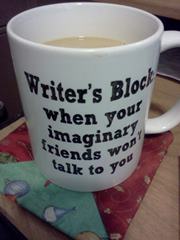
Perhaps you are experiencing writer’s block. Inspiration has abandoned you, and you become desperate to get your narrative moving again.

It may be that you have lost track of what you originally imagined your story was about, and your characters no longer know what they are fighting for. Was it love? Was it destiny? Was it hope?

When you first imagined you had a story to write, you had an idea of what the characters would be like. Did you picture them fully formed? At the beginning, we must leave room for growth and change, for us to show the character evolving, growing to that finished state. This is how we involve the reader in the hero’s journey.

When an author becomes desperate and inserts outlandish events or conversations “just to show they are human” it disrupts the story arc. At that point, the author frequently loses interest in the story and believes they are suffering writer’s block.

Think about novels you may have read where the author became too focused on the action and neglected to devote a few sentences detailing the character’s introspection. Their protagonist went from one death defying incident to another, without a pause or a moment to catch their breath. The protagonist may as well have been a crash test dummy, ricocheting from one event to the next with no thought or feeling.

The constant onslaught of random action became a loud noise that didn’t make any sense because there was no chance to link the events together and put them in perspective. Events inserted for shock value  and with no pause for reflection don’t show personal growth. This can make an otherwise good character two-dimensional.

This need for pauses between the action has been referred to (by better educated people than me) as: writing the way a skater skates: “push  – glide – push – glide.” Action – reflection – action – reflection. These small pauses give the reader a chance to breathe and process what just happened.

What will the protagonist gain from the experience? Action, deeds, and accomplishments are necessary to force change and growth on the characters. When you write a scene, ask yourself, “How will their fundamental ethics and ideals be challenged by this event?” If there is no personal cost, the scene is a side trip to nowhere and should be removed.

Writing these blind alleys is not a waste of time. You never know when you will need those ideas, so don’t throw them away—always keep the things you cut in a separate file. Remember, just because that idea doesn’t work for this book, doesn’t mean it won’t work in another book.

I label that file “outtakes,” and believe me, it has come in handy when I need an idea to jump-start a new story.

In the greatest, most memorable novels, the reader experiences the characters’ lives as they react to the events and setbacks.

This is what we want to achieve in our own work. The genre and the setting in which these characters react to the wider concepts are just a backdrop. The world they are set in is the picture-frame, a stage upon which the themes of the story play out, and characters are shaped by a force beyond their control—the author.

2 Comments

Filed under Publishing, writing

#FlashFictionFriday: Silence and Love

Silence and Love

There was a time when we talked,

A time when words connected us the way kisses join lovers.

You mind amazed me as much as your body did

And I knew them both better than I knew my own.

You still amaze me but years have wedged silence between us.

Not the stony silence of anger or hurt—thank god, not that.


It is the silence of comfortableness,

The soundless speech of two old people

who sometimes read each other’s minds.

The quiet sharing of a back porch in the summer.

Side-by-side on a second-hand settee with a blue cushion,

You reach for my hand, and I am swept away.


Now when we speak, it is a more cerebral sharing,

Mind to mind, heart to heart,

Two old people still in love, but with little to say.

Did we say it all in the young wild days?

Did we spend our words the way we spent our kisses?

If so, then many more remain, waiting to pass between us.


No. We were learning each other, discovering truths

and facing our self-deceptions.

Now it is a calm sharing.

I still know your mind and your body

and love them better than my own.

I still love it when you hold my hand.


And when we speak it means something.

And when we kiss it means something.

And when we hold hands in the silence

Of an evening on a back porch,

Side-by-side on a second-hand settee with a blue cushion,

It means everything.


Credits and Attributions:

Silence and Love © Connie J. Jasperson 2015–2017, All Rights Reserved (First Published Nov. 13, 2015 on Life in the Realm of Fantasy)

Sun in May, Józef Mehoffer 1911 [Public domain], via Wikimedia Commons

2 Comments

Filed under #FlashFictionFriday, Poetry, writing

#Amwriting: The Coordinating Conjunction

In grammar, a conjunction is a connection: a part of speech that connects words, phrases, or clauses.

What are coordinating conjunctions and why should you care? For one thing, conjunctions are like any other essential part of English grammar. They have a particular use, and when they are used correctly, they blend into the background.

The Fount of All Knowledge, Wikipedia, says:

Coordinating conjunctions, also called coordinators, are conjunctions that join, or coordinate, two or more items (such as words, main clauses, or sentences) of equal syntactic importance. In English, the mnemonic acronym FANBOYS can be used to remember the coordinators for, and, nor, but, or, yet, and so. These are not the only coordinating conjunctions; various others are used, including “and nor” (British), “but nor” (British), “or nor” (British), “neither” (“They don’t gamble; neither do they smoke”), “no more” (“They don’t gamble; no more do they smoke”), and “only” (“I would go, only I don’t have time”). Types of coordinating conjunctions include cumulative conjunctions, adversative conjunctions, alternative conjunctions, and illative conjunctions.

Here are some examples of coordinating conjunctions in English and what they do:

For – presents rationale (“They do not gamble or smoke, for they are ascetics.”)

And – presents non-contrasting item(s) or idea(s) (“They gamble, and they smoke.”)

Nor – presents a non-contrasting negative idea (“They do not gamble, nor do they smoke.”)

But – presents a contrast or exception (“They gamble, but they don’t smoke.”)

Or – presents an alternative item or idea (“Every day they gamble, or they smoke.”)

Yet – presents a contrast or exception (“They gamble, yet they don’t smoke.”)

So – presents a consequence (“He gambled well last night, so he smoked a cigar to celebrate.”)

We use and, or, and but as connectors of words, phrases, clauses, or sentences of equal rank.

  • apples and oranges
  • apples or oranges
  • apples, but not oranges

In a sentence, we can use “and” and “or” to join strings of nouns or strings of verbs:

  • Apples and oranges and bananas (are tasty).
  • Wash and dry (the dishes).
  • Apples or bananas or oranges
  • Apples and oranges, but not bananas
  • I love cooking and my pets and my family.

I would prefer to use serial commas to connect my string rather than conjunctions:

  • Apples, bananas, or oranges
  • Apples, bananas, and oranges
  • I love cooking, my pets, and my family.

Yes, I said I would use a serial comma. I’ve seen people launch into rants against serial commas, claiming it’s too many and looks awful.

That argument is hogwash.

For whom are you writing? Are you writing only yourself or are you writing for an unknown reader who may one day buy your book? If you are writing for your own eyes only, do whatever you like. But if you expect others to enjoy your work, you need to think about the reader. Using serial commas will make your work easy for the reader to understand what you are saying. Other aspects of commas may escape me at times, but the serial comma, also known as the Oxford comma, is one I adhere to in my own work, and heartily wish other authors would too.

But enough about the commas–let’s get back to conjunctions.

The word “but” is a little different from “and” or “or.”  It is a coordinating conjunction, and we use “but” to join two words:”

  • (I want you to) sing, but loudly.

“But” is also a connector that indicates contrast.

  • I like black but not white.

“But” can connect just about any kind of word or phrase that “and” and “or” can connect, with one difference: it can’t connect nouns in phrases.

  • Consider Betty and Judy (went shopping). We wouldn’t say Betty but Judy (went shopping).

However, “but” can connect noun phrases to other phrases:

  • Betty and Judy (went shopping) but I don’t know who drove.

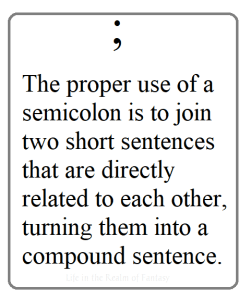
When I speak, I have a habit of beginning my sentences with the conjunctions “and,” “but,” “because,” and “so.” Because these words are conjunctions, connector words, some people will say this is wrong.  I disagree with them, for this reason: in this case, these conjunctions are connecting ideas.

On page 257, The Chicago Manual of Style says this rule has “no historical or grammatical foundation.” The CMOS further points out that William Shakespeare, Mark Twain, and the authors of America’s Declaration of Independence freely began sentences with those four conjunctions.

These people were well educated, and we can assume they understood grammar as well as anyone. Consider the following sentence, written by Abraham Lincoln:

“But, in a larger sense, we can not dedicate, we can not consecrate, we can not hallow this ground.” (Abraham Lincoln’s Gettysburg Address)

As he was a lawyer as well as a respected public speaker, we know Abe was a well-educated man.

Get It Write Online says:

“Most likely, many people believe they should not start a sentence with a coordinating conjunction because their grammar teachers in grade school discouraged them from doing so. Yet such a rule is completely unjustifiable. When grammar teachers teach youngsters the essentials of sentence structure, they most likely explain that coordinating conjunctions are used to hold together elements within a sentence. Therefore, they may discourage students from starting sentences with coordinating conjunctions because they are trying not only to explain conjunctions but also to help their students learn to avoid sentence fragments like this one:

She was a nice girl. And smart, too.

In this example, using “and” after the period is wrong because the second “sentence” is not really a sentence at all: it has neither a subject nor a verb.

So, just like the ubiquitous (but often unnecessary) “comma before the word because” and the silly debate over the incredibly important serial comma, we will likely have this disagreement for many generations to come.


Sources and Attributions:

Wikipedia contributors, “Conjunction (grammar),” Wikipedia, The Free Encyclopedia, https://en.wikipedia.org/w/index.php?title=Conjunction_(grammar)&oldid=771179901  (accessed March 28, 2017).

Weird Coordinating Conjunctions: Yet, For, and So, © Mignon Fogarty, Grammar Girl, July 10, 2014, http://www.quickanddirtytips.com/education/grammar/weird-coordinating-conjunctions-yet-for-and-so, (accessed Mar. 28, 2017).

University of Chicago (2010). The Chicago Manual of Style (16th ed.). Chicago: Univ. of Chicago Press. p. 257. ISBN 978-0-226-10420-1.

Starting Sentences with “And” or “But,” © 03/26/2001 Nancy Tuten,  Get It Write, http://www.getitwriteonline.com/archive/032601startsentandbut.htm  (accessed Mar. 28, 2017).

23 Comments

Filed under Self Publishing, writing

#amwriting: Update, and the Room of Shame

I work in a room officially designated as the Room of Shame. It is not a room of shame in a dark, Fifty Shades of Gray way.  No. That would be interesting, which this particular Room of Shame is not.

This room is a boring office that could be owned by hoarders. I’ve mentioned before that it’s haunted by the Ghost of my Feline (Past): Yum Yum (the demon-possessed cat). My little companion died died in 2009, and I’ve never had the heart to replace her. Despite my oft-repeated intention to clean this toxic waste dump out, her ghost still manifests in the fur that still lurks behind the sagging bookshelves and boxes of papers dating back to the Bronze Age. Plastic bins filled with my books, ready to take to a show or signing, are stacked atop dusty crates still bearing her furry imprint. The disgraceful carpet is proof that to clean the floor, one must be able to find it.

Somehow, despite the embarrassing chaos, I do manage to crank out the work.

Last month I finished the second draft of Billy Ninefingers. He has been through the beta reading process and is currently fermenting in a dark place while I wind up some other projects. I received excellent feedback and have a firm idea as to how I will structure the final draft.

I am making headway on the first draft of Eternity’s Gate, a new novel in the Tower of Bones series. This is the ‘how it began’ story, and it features Aelfrid Firesword, Edwin’s many time’s great-grandfather, and the unintentional founder of the College of Warcraft and Magic. Even though it is set in an established world (Neveyah), planning this novel presented an unusual problem in that the magic system had to be redesigned as much of what is canon in the later books doesn’t exist during the time this story is set. New maps have been drawn. Alf is a Barbarian, so I have learned a great deal about his culture in the process of creating this early, far wilder version of world of Neveyah.

Knight’s Redemption, a novella featuring Julian Lackland, Golden Beau Baker, and Huw the Bard, is in the final stage of the revision process.

As always, I am working on flash-fiction and poems as the mood strikes, some weeks more than others. Flash-fiction usually happens when I’m at a stopping point on my other projects and my mind just wants to roam free. This is always a good time to think about possible blog posts.

And finally, I’m in the process of rewriting a short story for an editor who likes the overall premise, the protagonist, and the way the story ends, but wants me to make some fundamental changes to the way I am telling the tale. In my opinion, any interest from an editor should be celebrated, and their requests and suggestions should be given my full, immediate attention, so that will be an ongoing project over the next few weeks.

Not being rejected out-of-hand is good, in my opinion. I see this type of interaction as an encouraging thing. The door is open to an opportunity I might not have again, so I try to make whatever changes they request. The trick is to make the changes with your own flair so that you don’t lose what they liked about the piece in the first place. Either way, whether they ultimately reject it or not, I will gain something out of this.

Also, I have been cooking. I’ve found some more wonderful food ideas to take along when I am on the road. Traveling as a vegan can be quite dicey, unless you carry your own food. Once I leave the Northwest, restaurants don’t offer vegan options. Rather than go hungry, I make my meals ahead. I’m always looking for tasty treats that travel well, and are satisfying.

Today is a good day to write. I intend to make the most of it, working on whichever project is inspiring me. Having more than one project going at a time allows me to stay productive because when I can’t think what to do next in one manuscript, I’ll know exactly what I need to do in another.

6 Comments

Filed under Publishing, writer, writing

#FlashFictionFriday: Dreams and Shadow Truths

Dreams and Shadow Truths

Tales, dreams,

Shadow-truths…

The fabric of the multiverse.

One universe touches upon another, and

The dreamer dreams.

The faerie queen leads her court though the forest and

One more mortal falls in love.

Books are evidence that once upon a time

A mortal slept, and dreamt.

Within the pages of dusty, leather-bound books

Lies proof the philosophers’ stone

Exists in the realm of imagination,

Spinning words of straw into gold,

Bequeathing immortality to those who possess it.

The multiverse is yours for the taking

If  you believe, and

Are unafraid to dream.

Open a book, and

Step into a realm

Unknown.


Credits and Attributions

Dreams and Shadow Truths, © Connie J. Jasperson 2015.

Fantasy Digital Painting, By Boxiness (Painting using tablet PC.) [GFDL (http://www.gnu.org/copyleft/fdl.html) or CC BY-SA 3.0 (http://creativecommons.org/licenses/by-sa/3.0)%5D, via Wikimedia Commons

8 Comments

Filed under #FineArtFriday, #FlashFictionFriday, Poetry