#FlashFictionFriday: The Dog’s Tale

I used to spend a lot of time in the backyard, howling. What can I say? I was young and impulsive in those days.

However, Dave bought me this new collar, which, while it’s really nice to look at, has an inherent flaw. It becomes terribly uncomfortable when I howl or announce the arrival of that vandal who shoves trash through the slot in our door. He seems to be targeting our house. Since I can no longer yell at him to go away, I nip at his fingers through the slot. But he’s crafty now and doesn’t get close enough for me to do any damage.

I’m not complaining, though. I’m no different than any other girl. I’m quite partial to jewelry, and since Dave is my human, I always show my appreciation for his thoughtfulness, even though he has no idea what sort of collar I’d really like. It’s the thought that counts.

However, I hope he understands that the new cover he puts on the sofa when he leaves is not very comfy at all. It buzzes and zaps me when I step on it, so I have to sleep on the floor. At least he doesn’t put me in the kennel when he’s gone, the way some humans do. Bonzo, the dachshund from next door, spends all day in his kennel. I’m only forced to sleep in mine when Dave and that woman have a sleep-over.

It took a while, but I have Dave trained pretty well now. He’s a considerate man, and never forgets to feed me, and he has never once left me alone in the car on a hot day. It’s a good life.

I’m feeling sleepy now, so I’ll just go nap by the front door, and wait for the vandal. He shows up nearly every day just before noon. Today, if he’s careless, maybe I’ll finally draw blood, and he’ll stop throwing trash into our house.

pomeranian-tb2


The Dog’s Tale, © Connie J. Jasperson, 2017

This little bit of flash fiction was inspired by the above photo, found on Wikimedia Commons.

Image: Pomeranian, By Chunbin (Own work) [CC BY-SA 4.0 (http://creativecommons.org/licenses/by-sa/4.0)%5D, via Wikimedia Commons

1 Comment

Filed under #FlashFictionFriday, writing

#amwriting: Too many characters?

my-books-cjjasp-own-workYou’re writing the first draft of your novel.  A beta reader has pointed out that you may have too many named characters to keep track of, and now you’re on a mission to whittle down your cast of thousands.

But who should go and who should stay? What is the optimal number of characters for a book? Some say only four, others fifteen, but I say introduce however many characters it takes to tell the story but use common sense. Put the reader first–they must be able to keep them straight without any effort.

When you introduce a named character, ask yourself if it is someone the reader should remember. Does he or she offer information the protagonist and reader must know? Some characters will give us clues to help our protagonist complete his/her quest.  Others show us something about the protagonist, give us a clue into their personality or past.

Does the person return later in the story or does he or she act as part of the setting, showing the scenery of, say, a coffee shop, or a store?

Only give names to characters who advance the plot.

In an excellent article on screenwriting, Christina Hamlett of the Writer’s Store writes:

In a screenplay, the rhythm you’re attempting to establish–along with the emotional investment you’re asking a reader to make–is disrupted whenever you devote more than two lines of introduction to a character who is simply there to take up space. In order to justify their existence, each player in your script should perform a unique function or deliver a specific line that:

  1. Advances the plot,
  2. Thwarts the hero’s objectives,
  3. Provides crucial background, and/or
  4. Contributes to the mood of the scene.

If you’ve included characters who don’t fulfill one or more of these jobs, they’re probably not critical to the storyline and can be deleted.

While she is speaking of screenplays, this is true of a novel or short story. A name implies a character is an important part of the story. Ask yourself if the character is an example of “Chekhov’s Gun.” Does this character serve a purpose the reader must know? If not, don’t give them a name.

One of my current works in progress has this passage, which takes place in an inn and involves a conversation overheard from a table adjacent to my protagonists:

The older merchant’s face darkened at the mention of the prince and his henchman. Quickly looking over his shoulder at the other guests in the common room, he hushed his son. “We’ll have no more mention of them at this table. If the wrong person overhears such talk, we’ll all end our days in our own beds with our throats slit!”

Culyn’s eyebrow rose, and he looked at Jack, who nodded.

Despite the fact the merchant and his sons give my protagonists information they needed, they are in this scene for only one purpose: to be overheard and don’t appear again. For this reason, only Jack and Culyn, and the three others of their party are named in the full transcript of this scene.

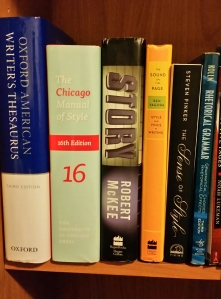
Novelists can learn a great deal about how to write a good, concise scene from screenwriters. An excellent book I have gained a lot of knowledge from is Story by Robert McKee. If you can get your hands on a copy, I highly recommend it.

We want the reader to stay focused on the protagonist(s) and their story. The second draft is where we make every effort to find the distractions we may have have inadvertently introduced in our rough draft, and extraneous named characters is an easy one to fix. Simply remove their name, and identify them in general terms. The reader will move on and forget about them.


Credit: Minor Characters Don’t Need Major Introductions, Christina Hamlett, Copyright © 1982 – 2017 The Writers Store ® Incorporated.

5 Comments

Filed under writing

Reblog: A Question of Quests, by Stephen Swartz #amwriting

My good friend, Stephen Swartz had an excellent blogpost on Sunday. (He usually does, but don’t tell him I said so.) Anyway, since I accidentally hit “publish” instead of “schedule,” thereby posting today’s post yesterday (DOH!) I offer for your reading pleasure:

A Question of Quests

by Stephen Swartz.

 >>>—<<<

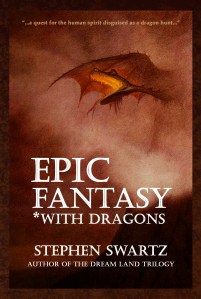
swartz_efwd1_frontcvr6x9_bw_670_cs-3_thbA little more than a year ago, I set out on a quest, pushed by fellow writers who encouraged me to try my hand at writing an epic fantasy. Well, good folks, I did that. I typed every day of the year with a story firmly in mind. On good days in the summer I wrote for a full eight hours. I actually wrote a novel following a hero’s quest. Then I wrote a novella about a little princess in another part of the realm. Then I merged the two stories. The result is a 235,000 word tale of daring-do chocked full of all the epic wisdom I could stuff into it–which, I am learning, may be relevant in our heated political season.*

stephen-swartzBy “quest” I mean a journey of some kinda hero’s journey, in Joseph Campbell parlance. However, in writing an epic fantasy, a quest could be a hero going in search of something of value, or a hero simply trying to travel home from far away, perhaps from a place of tribulation. A quest could mean a bubbly travelogue, much like Chaucer’s Canterbury Tales. Or, a quest could be a hero going to a particular place where he intends to do something important. This last option is the pattern I adopted for my epic fantasy. (e.g., A man with a plan, out getting a tan, and learning to pan the jokes of his sidekick Tam.) My model for a quest was Tolkien’s Lord of the Rings, although I bent over backwards to avoid borrowing anything from it. Likewise, I started reading George R. R. Martin’s Game of Thrones, but I deliberately avoided any dragon references which my readers might tease were similar to Martin’s use of dragons.

Then, much to my chagrin, I discovered a problem. A fatal flaw. An underlying faux pas. A fundamental error. So…what to do with a 235,000-word tale of rousing adventure that falls short of being an epic fantasy? Maybe call it epic sci-fi? That just might be crazy enough to work! You see, there are some rules….


For the rest of the story, continue on to A Question of Quests, Deconstruction of the Sekuatean Empire.

Comments Off on Reblog: A Question of Quests, by Stephen Swartz #amwriting

Filed under writing

#amwriting: Revisions

Book- onstruction-sign copyI am in the process of making revisions on my next novel, Billy Ninefingers. This book was partially written in 2013 during NaNoWriMo, but was only recently completed. Now I am deep into revisions.

Most authors understand that there is an arc to the overall novel–the Story Arc  which  consists of :

  1. Exposition, where we introduce our characters and their situation.
  2. Rising Action, where we introduce complications for the protagonist
  3. Climax, the high point of the action, the turning point of the narrative
  4. Falling Action, the regrouping and unfolding of events that will lead to the conclusion
  5. Resolution, in which the problems encountered by the protagonist are resolved, providing closure for the reader.

We can easily lose track of that arc when we are in the throes of writing our first draft.

Underpinning the larger story arc is another, more fundamental arc to consider. At the 2014 PNWA Conference, in his seminar on the arc of the scene, author Scott Driscoll explained how the main difference in the arc of the scene vs the overall arc of the novel is this: the end of the scene is the platform from which your next scene launches.

As you revise, keep in mind:

  1. Each chapter is a scene.
  2. These scenes have an arc to them: action and reaction.
  3. These arcs of action and reaction begin at point A and end at point B.
  4. Each launching point will land on a slightly higher point of the story arc.

If you discover that you have lost the plot of your novel, remind yourself what the original idea was. This happened to me in 2015 when I was trying to finish the book, Valley of Sorrows. The book was to wrap up Edwin’s story, but I became sidetracked with his father’s story. I ended up separating John’s story out of the book, and giving him his own novel, The Wayward Son.

In order to write Valley of Sorrows, I had to re-connect with what the story really was about, and place it in the context of the overall series:

  1. In the case of my derailed book, the series dealt with Edwin’s story.
  2. What was his problem? He was separated from his wife and child because of his task on behalf of the Goddess Aeos. He had endured losing a man who was a brother to him while he was in Mal Evol. However, things had happened in Aeoven during his absence (an attack on his family, his wife’s miscarriage and subsequent breakdown). Unfortunately, he had a task only he could do,which kept him away from his wife and son.
  3. Completion of his task took us to the 3rd plot point of the novel.
  4. Hunting  the acolyte of Tauron and the final battle in Aeoven resolved the story.
  5. What I had to remind myself was this: No conversation could happen unless it advanced the plot of Edwin’s story. Because the World of Neveyah is an ongoing series, anything that did not pertain to Valley of Sorrows could be cut, saved, and used in a later story.

While you are doing all of this, consider the length of your chapters.This is where pacing comes into play. Remember, pacing is the rise and fall of the action, the ebb and flow of conversations.

Courtney Carpenter, writing for Writers Digest, says “Pacing is a tool that controls the speed and rhythm at which a story is told and the readers are pulled through the events. It refers to how fast or slow events in a piece unfold and how much time elapses in a scene or story.”

How long are the chapters in your novel?

lessons-from-a-lifetime-david-morrellIn his book, Lessons from a Lifetime of Writing: A Novelist Looks at His Craft, action/adventure author, David Morrell (creator of the Rambo character, among others), says he tries to write short chapters, so that a reader can complete one chapter (or structural unit) at one sitting.

He bases his ideas on two essays by Edgar Allen Poe, “The Philosophy of Composition” and “The Poetic Principle.”

Part of this is about pacing, because it’s about keeping the reader’s attention. Morrell says he keeps his structural units small in order to accommodate the reader’s bladder, TV interruptions, phone calls, a neighbor who drops in, etc.

Each chapter should be as long as it needs to be for your novel. Write what works for you, but as a reader I suggest you consider shorter chapters which can be read at one sitting.


For an excellent article on pacing, go to:

7 Tools For Pacing A Novel & Keeping Your Story Moving At The Right Pace, Courtney Carpenter, WritersDigest. com Apr. 24, 2012 (accessed Jan 29, 2017)

6 Comments

Filed under writing

#bookreview: The Couple Next Door, by Shari Lapena

the-couple-next-doorJust before Christmas, I finished reading a wonderful mystery/thriller, The Couple Next Door, by Shari Lapena. This was a book that was impossible to put down, but with one thing and another, I’m only now getting around to reviewing it.

But first, THE BLURB:

It all started at a dinner party. . .
A domestic suspense debut about a young couple and their apparently friendly neighbors—a twisty, rollercoaster ride of lies, betrayal, and the secrets between husbands and wives. . .

.Anne and Marco Conti seem to have it all—a loving relationship, a wonderful home, and their beautiful baby, Cora. But one night when they are at a dinner party next door, a terrible crime is committed. Suspicion immediately focuses on the parents. But the truth is a much more complicated story.

.
Inside the curtained house, an unsettling account of what actually happened unfolds. Detective Rasbach knows that the panicked couple is hiding something. Both Anne and Marco  soon discover that the other is keeping secrets, secrets they’ve kept for years.

.
What follows is the nerve-racking unraveling of a family—a chilling tale of  deception, duplicity, and unfaithfulness that will keep you breathless until the final shocking twist.

MY REVIEW:

The Couple Next Door, by Shari Lapena is a tale of love, fear, greed, and secrets. Nothing is what it seems, except for the central plot point: A baby is missing from her crib.

Anne and her husband, Marco Conti have gone to a dinner party in the house next door. The sitter has cancelled at the last minute, and the hostess has insisted on an adults only party, as she doesn’t like children. Since they share a wall with these neighbors, they have brought the baby monitor with them, leaving their baby home in the row house next door.

The baby, Cora, disappears during the dinner party.

No one is free of secrets.

Rasbach is the detective, Jennings is his assistant. As the case unfolds they discover that Anne Conti’s family is more than merely rich. They are old money, and secure in their sense of privilege, and her parents are quick to offer a ransom. At every step of the way, Anne’s parents are interfering, shielding Anne and Marco.

Little by little, evidence emerges about each character, none of it flattering. Anne herself is not without secrets.

Anne is a well-drawn character, with a mysterious history she has never fully told to her husband. She is portrayed realistically, flaws and all. Marco is also a flawed protagonist, which makes him intriguing.

I liked how well the story flows. With many twists and turns, it never stalls or halts. This is a gripping mystery, with an ending that took me by surprise, despite the fact the clues were there all along.

Comments Off on #bookreview: The Couple Next Door, by Shari Lapena

Filed under Books

#amwriting: kinship names and terms of endearment

misuse_grammar_consistently_memeI am in the final stages of getting a manuscript ready to send to my editor. As such, I am trying to make it as clean as I can so she won’t tear her hair out in frustration. One thing I am checking for consistency is proper capitalization of terms of endearment, such as “Sir,” or “Dad,” and “Mom.”

I discussed this topic a while back, but having read several books written by authors who clearly had no idea there are rules about terms of endearment and capitalization, it bears repeating.

The rules are basic and simple to remember:

For people who are related, if you are saying it directly to them in place of their name, capitalize it.

  • “I love you, Son.”

If you are mentioning them in conversation, don’t capitalize it.

  • “My son is wonderful.”

Terms of endearment can also

  • Be relatively impersonal.
  • Denote a friendship.
  • Be slightly patronizing in situations where the speakers are not friends.

If the speaker is not related to the person in question, do not capitalize it.

  • “I wouldn’t do that, son.”

Again, as in so many other aspects of the writing craft, context is everything. Consider the word “sir.” It is an honorific. Quoted from the Chicago Manual of Style:

Honorific titles and respectful forms of address are capitalized in any context with several exceptions:

  • sir
  • ma’am
  • my lord
  • my lady

You must also capitalize the words “sir” and/or “madam” when beginning a letter or an email.

  • Dear Sir or Madam

Where king/queen, Lord, or Sir is used as part of someone’s name, it is always capitalized, as are these honorifics:

  • King Karl, and Wanda, the Queen of Meatballs
  • the Empress Sophia
  • Lord Albert Beaucleigh; Lady Mary Cheltenham
  • Sir Julian De Portiers

Where king/queen is employed in the context of a general reference it is lowercased:

  • “Good grief,” said the king.

But should one capitalize the word “sir” when it’s used in dialogue? Which of the following would be correct? “Yes sir.” OR “Yes Sir.”

If the reply is to a respected person in general, it is written with no capital, as it’s not a formal name. But you do need a comma just you would with a formal name:

“Yes, sir.”

“Yes, George.”

The_Chicago_Manual_of_Style_16th_editionAgain, consider the context. When writing dialogue: if your speaking character is in the military and the person he/she is addressing has a military rank above them, and is speaking in their military capacity you must capitalize it.

The exception to this rule is if a younger person of lesser rank is talking to an older person of higher rank in an informal setting. At that point, the younger person is simply speaking respectfully to an older person, and “sir” does not need to be capitalized.

For a more in-depth exploration of that subject see my post of March 14, 2016: son and sir: to capitalize or not?


For further information, see The Chicago Manual of Style, 16th Edition,  issued September 2010,  section 8.32

Chicago-Style Citation Quick Guidehttp://www.chicagomanualofstyle.org/tools_citationguide.html

Comments Off on #amwriting: kinship names and terms of endearment

Filed under writing

#amwriting: Tolkien, one-star reviews, and our shifting language

the hobbit movie poster 3Tolkien did NOT use too many words in The Hobbit, and the movie was NOT better.

The book is one thing, and the movies are something else completely. The movies, while they are awesome, exciting, and great fun, do bear some relation to the actual book. The basic plot, some of the high points, and various characters are all taken from the book. However, the movie most certainly does not chronicle the tale as Tolkien originally wrote it.

In the book (for starters) while elves are long lived and it is accepted that he must have been alive at the time, Legolas was not a character. Therefore, he did not have a love interest featured in the book. So, no– Tauriel did not exist in the book, The Hobbit. But she did in the movie, The Desolation of Smaug, and she was a great character there. In reality, no female elves are featured in the original book, The Hobbit, in more than passing, so that pretty much scotched any chance of romance for Kili in the novel.

If you read the credits at the end of the movies, you will see it clearly says “BASED ON” the book, The Hobbit by J.R.R. Tolkien.

Now, let me address the concept of “too many words,” a direct quote from one of the many one-star reviews of the book,  The Hobbit by J.R.R. Tolkien, and posted on Amazon several years ago:

J.R.R. Tolkien was a Professor of Anglo-Saxon Studies at Pembroke College, Oxford. That tells us he was educated, but he was writing stories for his children when he wrote The Hobbit and developed the world of Middle Earth. Because of that connection to his children, we know he was writing at a level they could understand. A master of languages, he invented the elfin language. We should assume he had a moderately good grasp of the English language as well.

What modern readers may not realize is this: Tolkien was writing in the early part of the twentieth century. He served in the British army during the First World War, the notorious War To End All Wars. That war was fought one hundred years ago.  Things were different then, he wrote in the literary style of his time.

The problem with the book is not in Tolkien’s writing. It is in the eye of the modern beholder who has no appreciation for the literary style of that era. That is a fair consideration, as reading the literature of this era takes time and persistence, and many readers don’t have the patience. No reader should feel guilty for not enjoying a book their friends loved. It happens to me all the time.

the hobbit movie posterThe Hobbit remains a classic of modern literature because it details that intrinsic thing all great novels consider, the search for self. That quest to discover who we are and what we are capable of is what drives Bilbo to keep going, even in the face of terrible events. Underneath the trappings of fantasy, the elves and goblins represent humanity in all its many imperfections, as does the hobbit himself.

Writers of modern fantasy might try to read what the early masters of the genre wrote, and discover what made their work classics. It will be difficult because the gap between the style and usages of today’s English versus the English of even one hundred years ago is widening with each passing year.

Readers must be patient and set aside their knowledge of what works in today’s literature. In other words, stop looking AT the words as disparate parts that you could write better, and read them in context. You might be surprised at what you will find.

Writers are always readers, and Tolkien often discussed his fondness for the work of William Morris (b.1834 – d.1896). Morris was an English textile designer, artist, writer, and socialist associated with the Pre-Raphaelite Brotherhood and English Arts and Crafts Movement. Tolkien and many of his contemporaries loved Morris’s prose- and poetry-romances.

Tolkien himself said his own work followed the general style and approach of Morris’s work. The Desolation of Smaug portrays dragons as detrimental to landscape, a motif borrowed directly from Morris. Tolkien had what he considered an accepted canon for how dragons should behave to work from.

But exactly what does “canon” mean in the context of a literary genre?

Wikipedia says, “In fictioncanon is the material accepted as officially part of the story in an individual universe of that story. It is often contrasted with, or used as the basis for, works of fan fiction. The alternative terms mythologytimeline, and continuity are often used, with the former being especially to refer to a richly detailed fictional canon requiring a large degree of suspension of disbelief (e.g. an entire imaginary world and history), while the latter two typically refer to a single arc where all events are directly connected chronologically. Other times, the word can mean “to be acknowledged by the creator(s).”

The modern image and mythology of the elf as he is written into most of today’s fantasy has been directly modeled on the elves of Tolkien’s Rivendell, whether the author knows it or not. Even the elves we find in the onslaught of modern urban-fantasy-romances are created in Tolkien’s image—close to the earth, immortal, and somehow nobler and more clever than we mere humans.

The love of a beautifully crafted tale will always endure. While future generations may have to learn to read and understand English as we speak it today, a true appreciation of Tolkien’s influence on modern epic fantasy literature will live on.

hobbit-battle-five-armies-bilbo-posterWhen I decided to read Chaucer’s Canterbury Tales in their original form, I had to take a college class. In that class we learned to read and understand Middle English, and then wrote our own modern translations. It was a lot of fun, but many great modern translations are out there if you don’t have the patience to read the original.

In the future, modern translations of Tolkien’s work will be published, and new fans of his work will emerge, just as in the case of Cervantes’ Don Quixote, a novel fully titled The history of the valorous and wittie Knight-Errant Don-Quixote of the Mancha. It was written in early modern Spanish (the equivalent of Shakespearean English) by Miguel de Cervantes Saavedra. Published in two volumes, in 1605 and 1615, Don Quixote is considered one of the greatest novels of all time. New translations are published every few decades.

So, Tolkien didn’t use too many words, and the movies were not better than his books. They were good, but they were different stories, one based on the other, but not following it.


Wikipedia contributors, “Canon (fiction),” Wikipedia, The Free Encyclopedia,  https://en.wikipedia.org/w/index.php?title=Canon_(fiction)&oldid=760595154  (accessed January 17, 2017).

1 Comment

Filed under Books, writing

#bookreview: The Heart of What Was Lost, by @TadWilliams #OstenArd

tadwilliams-the-heart-of-what-was-lostI just finished reading Tad William’s latest book. Wow! Told from three points of view, Duke Isgrimnur of Rimmersgard, a Norn leader, Viyeki, and Porto, a Perdruinese mercenary, The Heart of What Was Lost, by Tad Williams is a gripping, worthy return to the world of Osten Ard.

But first, THE BLURB:

At the end of Memory, Sorrow, and Thorn, Ineluki the Storm King, an undead spirit of horrifying, demonic power, came within moments of stopping Time itself and obliterating humankind. He was defeated by a coalition of mortal men and women joined by his own deathless descendants, the Sithi.

In the wake of the Storm King’s fall, Ineluki’s loyal minions, the Norns, dark cousins to the Sithi, choose to flee the lands of men and retreat north to Nakkiga, their ancient citadel within the hollow heart of the mountain called Stormspike. But as the defeated Norns make their way to this last haven, the mortal Rimmersman Duke Isgrimnur leads an army in pursuit, determined to end the Norns’ attacks and defeat their ageless Queen Utuk’ku for all time.

Two southern soldiers, Porto and Endri, joined the mortal army to help achieve this ambitious goal—though as they venture farther and farther into the frozen north, braving the fierce resistance and deadly magics of the retreating Norns, they cannot help but wonder what they are doing so very far from home. Meanwhile, the Norns must now confront the prospect of extinction at the hands of Isgrimnur and his mortal army.

Viyeki, a leader of the Norns’ military engineers, the Order of Builders, desperately seeks a way to help his people reach their mountain—and then stave off the destruction of their race. For the two armies will finally clash in a battle to be remembered as the Siege of Nakkiga; a battle so strange and deadly, so wracked with dark enchantment, that it threatens to destroy not just one side but quite possibly all.

Trapped inside the mountain as the mortals batter at Nakkiga’s gates, Viyeki the Builder will discover disturbing secrets about his own people, mysteries both present and past, represented by the priceless gem known as The Heart of What Was Lost.

MY REVIEW:

the-heart-of-what-was-lostI became a confirmed fan of epic fantasy in 1988 when I first entered this world of Osten Ard and the books of Tad Williams. It seemed like each character was deserving of a novel, and the diverse races whose cultures were so clearly shown fascinated me. The bigotry and arrogance some members of each race have with regard to their innate superiority struck me as illustrating a sad truth about the real world.

When this new series set in Osten Ard was announced, I was curious as to how Tad Williams would maintain that deep connection to the story after such a long absence. When The Heart of What Was Lost was launched, I bought the hard-copy, but also downloaded the Audible book, because I have a monthly subscription. Andrew Wincott is the narrator, and he’s an incredible reader. His narration makes this one of the best audiobooks I’ve ever listened to. Like some gutter-dwelling book junkie, I read along with his narration–an awesome experience.

This is not a long novel, only 224 pages. It is well-written, with the harsh, beautiful prose I have come to expect from Tad Williams. Most importantly, an inspiring story is encapsulated in those pages. I found the pacing excellent, and at times, heart stopping. There is no place where it slows or becomes pedestrian.

Osten Ard is created from both good and evil, with all the many grey places between those two absolutes clearly defined. For each misery, some small glimmer of hope is introduced, offering a reason for the characters to keep struggling. The unlikely friendship between Porto and Endri is deep despite their humorous rivalry. Through their eyes we see the truth of the conflict and what it means in terms of human suffering.

Duke Isgrimnur is strong and resolute, driven on every level. He is faced with hard decisions, an impossible task, and does what he has to. A many-layered character, Isgrimnur is one of my favorite people in the series, as is Sludig. I had wondered about them at the end of To Green Angel Tower. This ties up their threads well.

Opposite Isgrimnur is Viyeki,  a Norn who has risen high in the Order of Builders. He has also been given an impossible task. It is through him we feel some compassion for the Cloud Children, the immortal Norns, and what they have lost. His thoughts and the way he deals with the constraints he is under illustrate the alien society he loves, making their reasoning more clear to us. He sees many things that worry him, but as a Host Foreman, his position is somewhat perilous. His world is at stake, but faced with conquering the terrors of the deeps or being crushed by the enemy, he is beset on all sides, caught in the middle. He has questions, doubts, and the answers he is given offer him no comfort.

I give this book five full stars. In the watershed series, Memory, Sorrow, and Thorn, Tad Williams originally created the world of Osten Ard masterfully, exploring it through the diverse people’s thoughts and conversations. This novel is a brilliant continuation of that tale. He uses his characters’ impressions to show the setting, the history, and the core of the conflict. Through their eyes, we know this amazing world. At the end of the book, it’s hard to let them go.

You can find  The Heart of What Was Lost, by Tad Williams  in paper, as an audiobook, or a Kindle download at Amazon. It is also available at other eBook retailers, and in paper at all brick and mortar stores.

1 Comment

Filed under Books, writing

#amwriting: words to seek and destroy

It’s been about a year since I last discussed what have been termed “weed words.” Certain words and phrases don’t add to the narrative and only serve to increase the wordiness. Used too freely, they separate the reader from the experience.

In my first draft, these words are like tics–they fall out of my fingers and into my keyboard randomly, and out of my voluntary control. I never self-edit as I write the first draft because I am just trying to get the story down. The second and third drafts are where you deal with grammar and phrasing.

One of my three current manuscripts is an epic fantasy and is genre fiction. This means I must write active prose, so I don’t want to use words with no power behind them.

words_to_seek_and_destroy_lirf_cjjasp1-17-2017

And these are just the tip of the verbal iceberg. I seek out adverbs, descriptors, qualifiers, and other “weed words,” look at how they are placed in the context of the sentence, and decide if they will stay or go.

In the second draft  I address larger things like the story arc, and plotting problems. I have a reader who will gladly tell me where I have gone off the rails, and he is merciless. Call me a glutton for punishment, but putting Dave’s suggestions into play is the best part of my writing experience, even though it is hard to give up some of my favorite passages.

If they don’t add to the story, they have to go to the outtakes file, my tears notwithstanding.

The third draft is the most difficult, primarily because I just want to be done with it. This is where I go on a “search and destroy” mission, seeking out instances of weak words and timid phrasing words. Consider adverbs: I do a global search for the letters “ly.” I kid you not, a kajillion of them will pop up in my left margin, and my ms will become a mass of words with yellow highlighted “ly’s.” It’s a daunting task, but I look at each and see how they fit into that context. If they weaken the narrative, I change or remove them. When it comes to adverbs, most often simply removing them strengthens the prose.

At this stage, I am preparing this manuscript to be edited professionally. The character arcs are solid, major plot problems have been addressed, and the story is as good as I can make it. Before I bother an editor with it, I want to make the process as smooth as possible. In order to find the offending words, I do what is called  a “global search.”

With your mouse or stylus, highlight the word you want to find every occurrence of. On the far right of the home tab, click ‘find.’ This will open the navigation pane.

Or, on your keyboard press the ‘ctrl’ key and the ‘f’ key at the same time. This is the keyboard shortcut to the navigation pane. Follow the instructions in this image:

LIRF Global Search all steps

Caution: if you are hasty or impatient a global search can be dangerous and can mess up an otherwise good manuscript.

Be aware: This is a boring, time-consuming task.

stop don't click replace allYou can’t take shortcuts. If you get hasty and choose to “Replace All” you run the risk of creating inadvertent bizarreness in your work.

Suppose you decide to simply eliminate every instance of the word “very” because you have discovered you overuse it. You open the navigation pane and the advanced search dialog box. In the ‘Replace With’ box you don’t key anything, thinking this will eliminate the problem.

Before you click ‘replace all’ consider three common words that have the letters v-e-r-y in their makeup:

  • Every
  • Everyone
  • Everything

Deleting every instance of ‘very’ could mess things up on an incredibly large scale.

Examine the context. Have you used the word “actually” in a conversation? If so, you may want to keep it, as dialogue must sound natural, and people use that word in conversation. If you have used it to describe an object, consider ditching it.

Do take the time to look at each example of the offending words and change them individually. The way I see it, what’s a day or two spent doing the job right, as compared to the year or more you’ve already spent writing that novel?

As always, while I am going through this, I address the occasional awkward phrasings and other things that pop up when you look at your manuscript from a different view.

It’s unfortunate, but there is no quick way to do this. Every aspect of getting your book ready for the reading public must be done with the human eye, patience, and attention to detail.

As I have mentioned before, editing programs are out there, some free, and some for an annual fee. Grammarly is one, but the problem is, these programs are unable to see the context. They operate by finite rules and will often strongly suggest you insert an unneeded article, or change a word to one that is clearly not the right one for that situation:

  • “The tea was cool and sweet, quenching her thirst.
  • Grammarly suggested replacing quenching with quenched. I have no idea why.

Context is defined as the parts of a written or spoken statement that precede or follow a specific word or passage, usually influencing its meaning or effect. 

At this time in our technology, understanding context is still a human function. Because context is so important, I am wary of relying on these editing programs for anything other than alerting you to possible comma and spelling malfunctions.

I don’t mind taking the time to visit each problem and resolve them one at a time. Remember, readers don’t forget the authors whose work they despised.

11 Comments

Filed under writing

#amwriting: thoughts on the industry

IBM_SelectricThe ease with which anyone possessing the ability to access a computer and use the internet can publish their work independently has sparked a revolution in the publishing industry. Unfortunately, revolutions are NOT easy nor are they bloodless and pain-free.

For every book I feel good about recommending, I see on average 6 that are just plain awful. I’m not only talking Indies here–some are books that should never have made it past the gateway editor of a large publishing house, much less an agent.

It’s true that some indie books are so abysmally edited it is apparent the author is the only person who has ever seen the manuscript.

Others are moderately edited but not by a professional, or someone who knows how to write. This is a flaw that can drive away of all but the most determined readers, people who would ignore most typos and slight inconsistencies for a really good tale. For these books, the unbiased eye of the editor could have made a great novel out of a promising tale.

The core of this problem lies in the incredible number of people who are writing but have no concept of what it takes to write a good novel. Once they have rewritten the rough draft to their satisfaction, they believe they are done.

Then, they publish it.

Sadly, this sometimes happens with traditionally published books as well. I see this as evidence that editing and proofreading by the large houses for many successful traditionally published authors is sometimes overlooked in the rush to cash in on a commercial success. These publishers set impossible deadlines and race to launch what they hope will be a follow-up best seller, but because they were rushed, these books sometimes fail to live up to the hype.

The Novel Meme LIRFAnd while this means that they publish crap too, the stink washes off the traditional houses but clings to the Indie industry as a whole.

This brings me to my point: The big 5 traditional publishers pretend everything they publish is sheer magic, while loudly pointing out the faults inherent in self-publishing. And, while it makes me laugh that they decry us as worthless but leap to publish us the minute we show any sign of real success, there are hard truths here we indies who are committed to the craft of writing must face.

First off, I feel strongly that we shouldn’t rush to churn out more than one or two books a year. Romance novels can be a different kind of animal, but unless you are producing pulp fiction, the same applies. (Click here to read an article by romance novelist Merry Farmer on this subject.)

Traditional publishers fail us (as readers) by pushing successful authors to spew several books a year, beating dead horses and creating long-winded series that lose the way after the third book. We Indies have the luxury to take our time to craft a good book, as we don’t have externally imposed deadlines.

Some of the worst books I’ve read were written by traditionally published authors who also wrote books I loved. But their best (in my opinion) books were written in the early days when they weren’t book-producing machines.

Some general things for any author to do when they are first starting out:

  1. Learn the mechanics of how to write in your native language. Grammar and Punctuation are essential, even in modern literature.
  2. Join a writing group and meet other authors, either in your local area or on-line. This will help you with steps 3 and 4. Enter writing contests and participate in the boards and threads. Ignore the trolls; they pop-up everywhere (usually with badly written ego-stroking crap to their publishing credit.)
  3. Develop a thick hide, and find an unbiased eye among your trusted acquaintances to read your work as you are writing it, so you can make changes more effectively and not be overwhelmed at the prospect of rewriting an entire manuscript from scratch.
  4. Lose your ego. Your ego gets in the way of your writing.  Are you writing for yourself or for others to read and enjoy your work?
  5. Find a good, professional editor. There are hidden aspects to every great book, and they are all centered around knowledge of the craft. An external eye is essential to the production of a good book. Check their references, and when you do engage their services, do not take their observations personally. This editor must be someone you can work closely with, who makes suggestions and lets you make the changes on your masterpiece yourself. They must understand it is your work and you have the right to disagree with any suggested changes. If you have this symbiotic relationship, you will turn out a good final product.
  6. Don’t give up your day job. Even authors receiving hefty advances have to struggle to make ends meet. (Read Thu-Huong Ha’s article, A New Book Shows the Financial Cost of Leading a Creative Life.)

EDWAERT_COLLIER_VANITAS_STILL_LIFEIt’s far more affordable now for a dedicated reader to buy enough books to keep themselves happy, but making your way as a reader through the many offerings in our eBookstores is a perilous journey, and you can’t always trust the quality by reading the publisher’s label. You just have to realize that whether a novel is traditionally published or Indie, some books are frogs, and some are princes.

You may have to read a few books you wish you hadn’t on your way to finding the book that sweeps you away. For me, that’s just part of the journey.


Sources and Attributions:

How Many Books Should You Write Per Year, by Merry Farmer, Nov 13, 2013

A New Book Shows the Financial Cost of Leading a Creative Life,  by Thu-Huong Ha, Jan 11, 2017, Flipboard

IBM Selectric, By Oliver Kurmis (Self-photographed) [CC BY 2.5], via Wikimedia Commons

Still Life, By Evert Collier (1642-1708) [Public domain], via Wikimedia Commons

8 Comments

Filed under Publishing, writing