#flashfictionfriday: Frost at Midnight, Samuel Taylor Coleridge

740px-No_Known_Restrictions_Christmas_Eve_by_J__Hoover,_no_date_(LOC)_(2122063062)

The Frost performs its secret ministry,

Unhelped by any wind. The owlet’s cry
Came loud—and hark, again! loud as before.
The inmates of my cottage, all at rest,
Have left me to that solitude, which suits
Abstruser musings: save that at my side
My cradled infant slumbers peacefully.
‘Tis calm indeed! so calm, that it disturbs
And vexes meditation with its strange
And extreme silentness. Sea, hill, and wood,
This populous village! Sea, and hill, and wood,
With all the numberless goings-on of life,
Inaudible as dreams! the thin blue flame
Lies on my low-burnt fire, and quivers not;
Only that film, which fluttered on the grate,
Still flutters there, the sole unquiet thing.
Methinks, its motion in this hush of nature
Gives it dim sympathies with me who live,
Making it a companionable form,
Whose puny flaps and freaks the idling Spirit
By its own moods interprets, every where
Echo or mirror seeking of itself,
And makes a toy of Thought.


Continue reading  Frost at Midnight  at

Frost at Midnight by Samuel Taylor Coleridge

Comments Off on #flashfictionfriday: Frost at Midnight, Samuel Taylor Coleridge

Filed under #FlashFictionFriday, Poetry

#amwriting: trust your readers

Stardust, Neil GaimanSome hard-core fantasy qualifies as literary fiction because of the way in which the story is delivered. Because of the style in which they’re written, these books appeal to a broader fan base than work pigeonholed into either the “genre fantasy category” or the “literary fiction category.”

Neil Gaiman’s Stardust qualifies as a novel that is a “literary fantasy.” This is because it is a fairy tale told with beautiful prose in an unhurried fashion.

Among the burgeoning population of authors who are just learning the craft, opinions regarding style and voice run high and loud.

According to those critique groups armed with a little dangerous knowledge, in the very first sentence of chapter one, Gaiman commits the most heinous crime an author can: he tells the story with leisurely, poetic prose.

Quote: There once was a young man who wished to gain his heart’s desire. 

OMG!  He did he really write “There once was” in a genre fantasy novel?  Passive Voice! Passive Voice!

Well, guess what? Neil Gaiman knows what he is doing when he sits down to tell a story, and his rabid fans and best-selling novels are a testament to that.

Those megalomaniacal gurus armed with tattered copies of Strunk and White, limited talent of their own, and who believe themselves the fount of writerly knowledge really lose their minds over what he does after that first sentence:

  1. He sets the scene: In a style reminiscent of traditional fairy-tales, he explains how our hero, Tristam, lives in the village of Wall. It’s a tiny town about a night’s drive from London. A giant wall stands next to the town, giving the place its name.
  2. He goes on to explain that there’s only one spot to pass through this huge grey rock wall, and it’s always guarded by two villagers at a time, and they are vigilant at their task.
  3. Gaiman comments that this guarding of the gap is peculiar because all one can see through the break in the wall is meadows and trees. It looks as if nothing frightening or strange could be happening there, and yet no one is allowed to go through the break in the wall.
  4. Only then does he bring us to the point: Once every nine years, always on May Day, a unique, traveling fair comes to the meadow. That is the only day the guards ever take a break from their posts on the gap in the wall.

I can hear the group’s de facto emperor pontificating now. What was Gaiman thinking, starting a fantasy novel with a TELLING, PASSIVE sentence followed by an info dump? Why, everyone knows real authors only use active prose and never, ever, offer information up front.

To that breathless expert, I say “not true, my less-than-widely-read friend.” Lean prose can be leisurely and poetic, and still pack a punch. That is what true writing is all about, conveying a story in a style that is crafted and has a voice that is uniquely that of the author.

In Stardust, each character is given a certain amount of importance, and even minor players are clearly drawn. The circumstances and events gradually pick up speed, and in the end, the reader is left pondering what might have happened after the final words on the last page.

stardust_promo_posterIf you saw the movie that is loosely based on the book, you might be surprised at how different the book is from the movie. There are no cross-dressing sky pirates in the book, although Robert De Niro was awesome in that role in the movie. The movie is excellent but bears little resemblance to the book, and, like The Hobbit movie, should be looked at as a different entity entirely.

Neil Gaiman trusts his readers. That is something we all need to do. Sometimes a story needs to emerge slowly and be told with beautiful, immersive prose, and we need to trust that our readers will enjoy it if we craft it well.

There is room in the bookstore for books with a less urgent story to tell as well as those that ambush the reader and beat them bloody with non-stop action.

When we write, we are writing because we have a story to tell. (Yes, I said tell.) To that end, every word must count, every idea must be conveyed with meaningful words, and sometimes you can just have a little fun with it.

In the opening lines of Gaiman’s Stardust, nothing unimportant is mentioned although the prose meanders in a literary way. Yes, he takes the long way, but the attitudes, mores, and personalities of Tristam’s village are conveyed with humor, and the journey is the best part of this fairy tale. He never devolves into florid, overblown purple prose, yet it has a poetic feel.

True authors are driven to learn the craft of writing, and it is a quest that can take a lifetime. It is a journey that involves more than just reading “How to Write This or That Aspect of a Novel” manuals. Those are important, but they only offer up a part of the picture.

You must read widely, and outside your favorite genre. When you come across authors whose work shocks, rocks, and shakes you, study how they crafted the sentences that moved you.

Let their works show you how to use words to form the moods and emotions that drive the plot.

Learn from the masters how to show the true character of a protagonist, or the smell of an alley by the wharves, painting pictures with words.

Read widely, and then apply what you’ve learned to your own work.

6 Comments

Filed under Fantasy, Literature, writing

#amwriting: November is National Novel Writing Month #NaNoWriMo2016

nanowrimo-2016-kick-it-in-gear-desktop

Dragon_Fangirl’s home-made nanowrimo-2016 “kick-it-in-gear “desktop

Every year starting on November 1st several million people sit down and attempt to write a 50,000-word novel in 30 days, most while holding down jobs and raising kids.

Four years running, 2010 – 2014, I used the month of November to lay down the rough draft of an intended novel. I made an outline in October and drew maps and such so that on November 1st I could hit the ground running. Most of the time, once I have that foundation down, I can write off the cuff, and that is how three of my books came into existence.

However, last year I already had two novels in the final stages and one simmering on the back burner.  What I lacked was short stories. I had the brilliant idea to write a short story collection, because I knew I had to build my backlog of submittable work. As a result, and despite having a viral plague during the entire month of November, I wrote 42 short stories for a total of 105,000 words.

That’s not counting the blog posts I also wrote. NaNoWroMo 2015 was a prolific year despite the plague!

For many participants, the challenge of sitting down and using the “seat of your pants” style of creative writing is what draws them to sign up.

On November 1, participants begin working towards the goal of writing a 50,000-word novel by 11:59 PM on November 30.

In 2011, the year I wrote Huw the Bard, I spewed the basic rough draft in the most unlinear way possible.  I had the plot outline and followed it, sort of.  With that as my guide, no matter how off track I found poor Huw (pronounced Hew), I still managed to get him to the end I had originally envisioned.

The next year, my novel didn’t go quite as smoothly, and I had a few hiccups.

But that novel was really only a writing exercise for me, just to see if I could write in that particular genre and I fell out of love with it. Since it didn’t have a grip on my heart, and by November 15th I had written 50,000 words of a story I hated, I began a different story.

I kept the work I had already done, as that book was as done as it was ever going to get. But I’m not silly – I had no intention of wasting that word count, so at the bottom of the last page, I began a new novel, which eventually became The Wayward Son, and was just published last month. At the end of that November, I had written 115,000 words total and had 2 completely different novels to show for my efforts.

2016-placeholder-book-cover

2016-placeholder-book-cover

This year my book has the working title of November Tales 2016: 30 days of Madness and Pot Pies by Dragon_Fangirl: The literary ranting of an author on the edge.

Once again I am embarking on a binge of writing short stories and essays.

Many authors are unwilling to commit to NaNoWriMo because it takes discipline to write 1667 words a day.

Also, they fear having to recoup any perceived losses should they find themselves in the middle of NaNoWriMo when they suddenly realize they’ve gone terribly astray. Or they fear writers’ block.

It happens. Not to me usually, because I know the secret: If you can’t write on the subject you intended, write about what you are experiencing and what interests you at that moment. Yes, it’s not that fabulous fantasy novel you began but are stuck on, and no epic dragons will be in it. (Unless you are Stephen Swartz. His real life has epic dragons. And bunnies.)

The key here is you will be writing, and that is what is important.

Rule 1 of NaNoWriMo: write.

Rule 2: Write 1667 words every day.

Rule 3: Every time you rewrite the scene with a slightly different outcome, it counts toward your word count. Don’t delete – just change the font color to red in that section, and begin rewriting the scene the way it SHOULD have been written in the first place, using the usual black font.

In December, cut the offending scene out of the ms, paste it into a separate document and save it in a ‘Background File’ in the same folder as the main manuscript. By doing that, you don’t lose prose you may need later.

During National Novel Writing Month, every word in my manuscript over and above 50,000 counts toward my region’s total word count. So if that means I have a lo-o-o-o-ong, multicolored manuscript for a few weeks, so be it.

For me, if I don’t begin to make those changes when I first realize they need to be done, I might forget until Dave Cantrell, my first reader and structural genius, points it out. (I daily thank God for Dave, and am grateful the internet connects to California.) (♥)

As one of the Municipal Liaisons for the Olympia Washington Region, I am required to attend most of the write-ins, which happen at different coffee shops or libraries. I handle the daylight hours, as I don’t drive after dark. It does eat into my day, which is why my husband thinks of it as National Pot-Pie Month. But I do get a lot of stream-of-consciousness writing done at these events and I have made life-long friends among the writing community of Olympia and the surrounding area.

If you want to sign up for this year’s month of madness and mayhem, get on the internet and go to:

www.nanowrimo.org

Sign up, pick a NaNo name – mine is Dragon_Fangirl, and you are in business. Look me up and make me one of your writing buddies. Spend the rest of October organizing what you think you will need to begin you story on November first. Then, on the first day of November you begin writing. If you apply yourself, and write (AT the minimum) 1667 words every day, on the 30th of November you should have a novel…or something.

nanowrimo-yodaIn reality, if you set aside one or two hours a day, and pound out the words as fast as you can during that time, you will get your word count. Never delete, and do not self-edit as you go along. Just spew words, misspelled and awkward as they may be. They all count, misspelled or not, and it is the discipline of writing that we are working on here, not the nuts and bolts of good manuscript.

Revising and correcting gross mistakes will come in the second draft, when you have time to look at it with a critical eye. What you are doing now is getting the ideas down.

Never discard your work no matter how much your first reader says it stinks. Even if what you wrote is the worst drivel she ever read, some of it will be worth saving and reusing later.

Spending a month immersed in stream-of-consciousness writing is not a waste of time. You will definitely have something to show for your efforts, and you will have developed the most import skill a writer must have: self-discipline.

4 Comments

Filed under NaNoWriMo, writing

#flashfictionfriday: When You are Old, by W. B. Yeats

maude_gonne_by_sarah_purser_1898

Maude Gonne, by Sarah Purser, 1898

WHEN you are old and grey and full of sleep,

And nodding by the fire, take down this book,

And slowly read, and dream of the soft look

Your eyes had once, and of their shadows deep;


How many loved your moments of glad grace,

And loved your beauty with love false or true,

But one man loved the pilgrim soul in you,

And loved the sorrows of your changing face;


And bending down beside the glowing bars,

Murmur, a little sadly, how Love fled

And paced upon the mountains overhead

And hid his face amid a crowd of stars.


When You Are Old,  by W.B. Yeats, first appeared in The Rose, a collection of twenty-two poems published by William Butler Yeats in 1893. His works entered the public domain in 2010, 70 years after his death.

Many poems in the collection, The Rose, express Yeats’ unrequited love for Maude Gonne. Though she had resisted his courtship at the time  The Rose was published, it is understood that her rejection of him was not complete, and during those years he did have some small glimmer of hope.

1 Comment

Filed under Poetry, writing

#amwriting: consider the short story

via buzzfeed

For the author struggling to get their name out there, one of the best ways is writing and submitting short stories to magazines, contests, and anthologies. You might earn a little cash, and you have the added thrill that someone liked your work enough to publish it.

But how does one go about writing a short story? First, you need a theme, an idea or message that flows through a story from beginning to end. The theme is what readers think the work is about, but it is also what the work itself says about the central subject.

In a given work the theme might never be mentioned outright, but the characters’ actions are motivated by it, and the plot revolves around it. (In case you need it, here is a list of 101 common themes in books.)

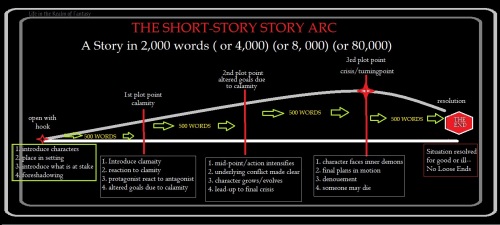
The structure of the short story is the same as for a novel: it consists of the Story Arc, which is the term that describes plot structure, or the sequence of events that occur within a story.

Plot Structure is the way the story is arranged:

*the setup

*the obstacle

*the turning point

*the resolution/outcome

THE SETUP: You must have a good hook. In some cases, the first line is the clincher, but especially in a short story, by the end of the first page you must have your reader hooked and ready to be enthralled.

One of the best first lines ever: George Eliott’s Middlemarch starts, “Miss Brooke had that kind of beauty which seems to be thrown into relief by poor dress.” That line makes you want to know Miss Brooke. And the reader wonders who the observer is who chronicles this. It is a novel, but if it had been a short story, it would still have hooked the reader.

Good first lines make the reader beg to know what will happen next.  We have to think about that first line, those first paragraphs, and how to land our reader.

After the hook, you must immediately get down to business, as you have no words to waste. Consider these things when writing the opening paragraphs:

  1. The opening lines set the tone for the story.
  2. The opening lines introduce the dramatic question that is the core of the story.
  3. The opening lines introduce the sense of place, the setting of the story.

Sometimes you have a short story you can’t seem to get off the ground. Something stalls it. It could be that you are trying to place too much background in at the beginning. Ask yourself where the story truly begins and start there.

Consider the length of the story you intend to write. Most literary magazines want stories of 1000 to 4000 words in length, but many will say no more than 2000 words. That places a real constraint on you as the storyteller because, to sell your work to that magazine, you must fit your story into a very small box. Every word in a 2000-word story is critical and has a specific task — that of advancing the plot. To that end, in a story of only 2,000 words:

  • No subplots are introduced
  • Minimal background is introduced
  • The number of characters must be limited to 2 or 3 at most

How do you fit a story into 2000 words? Make the Story Arc your friend.

Divide your story into four acts and assign a word limit to each of those acts: in a 2000 word story, each act would be 500 words long.

short story arc

Writing short fiction forces the author to become more economical and yet poetic in how they lay down their prose.

  • Each word must set the scene and convey the atmosphere, and every conversation must impart both information and give the reader a sense of who these characters are.
  • Every sentence must propel the story to the conclusion.
  • By the end of the first ¼ of the manuscript, the reader should have an idea of who the character is, what their moral compass is, what the character wants, and what they are willing to do to acquire it.

Be economical with your words: If you are writing a less formal story, make liberal use of contractions in the narrative as well as in the dialogue: hasn’t, he’d, wasn’t, didn’t, couldn’t, etc. A contraction is a “Two-fer” word – you get two words for the price of one.

Ditch the “crutch” words. You will lower your word-count when you look at each instance and see if you can get rid of these words. Removing them tightens your prose and makes room for important words that will convey the story more effectively.

“Crutch” words are overused words that fall out of our heads along with the good stuff as we are sailing along:

  • so
  • very
  • that
  • just
  • literally
  • there was
  • to be

We all use them too liberally in the rough draft. When we are doing revisions, we look at each instance of those words and decide if the sentence is stronger without it. Nine out of ten times, it is.

As I have said before, writing short stories gets you writing more:

  • more often,
  • more widely on a broad range of topics, and
  • more creatively using a variety of styles.

Using and building on the skills gained in writing short stories can only grow you as an author. Your prose will become stronger and tighter, and you will have a better grip on story construction.

9 Comments

Filed under Publishing, writing

#amwriting: bloated conversations are bad for business

SUPPORT YOUR LOCAL AUTHORSBeing an author is a business. It is a retail business, and you must look at it from that point of view, even if your work isn’t selling like hotcakes at the local diner. Big, fat books that are full of bloated exposition and conversations to nowhere are more expensive to publish and are unlikely to sell once the prospective reader has leafed through them.

Once you have a book published, you have a business, whether you are an Indie or traditionally published, and you must think about it from that angle. Wouldn’t you like to see some money from your work? Your best chance of this is at trade shows and book signing events. However,

  • In the real world, authors must pay for each book that is stocked on their table.

“This won’t apply to me,” you say.  “I’m going the traditional route. Once I sell my book to that Big Publisher in the Sky, he will provide me with all the copies of my books that I will ever need when I do signings, at no cost to me.”

Not so, my deluded friend.

A traditional publisher who is really excited about your book might arrange for you to have a table at a convention and will advance you copies of the books for you to sell and sign, but the cost of those books will come out of your earned royalties. You will see no money from your publisher until your book has out-earned all the advances they have paid you. So, just like an Indie, you pay for the books for your table at trade shows, conventions, and at most book-signings. The fact is, many traditionally published authors never out-earn their advances. Retail sales at shows are where they stand the most chance of bringing home money from book sales.

Consider how many copies of each book you can afford to take to the book signing event. You must weigh this cost against what you think the demand will be. Books that cost YOU more than $5.99 each are not a good thing for an Indie, because you must pony-up the cash at the time you order them. If you buy too many and they don’t sell, you have a lot of cash tied up in stock-on-hand that is earning you nothing.

For an indie who writes epic fantasy, it’s most cost-effective to keep your work to between 90,000 and 120,000 words if you intend to print through CreateSpace, which prints my paper books. If you have written a 300,000-word epic fantasy, consider dividing it into three volumes of 100,000 words each. Otherwise, you will be required to charge $17.99 to $20.00 per book just to make a minimal profit through Amazon.

How do we keep this cost down? We get a grip on the fluff that has worked its way into our work, and trust me, I didn’t understand this when I first began writing full time.

In the first draft, we have created a large amount of backstory. This is because we needed it to get a grip on the characters, their world, and the situation in order to write it. This is work the reader does not need to know the minuscule details of. To avoid info dumps and yet deploy the background as it is needed, we write conversations.

We need to exercise restraint. In the second draft, we decide what is crucial to the advancement of the plot and what could be done without. In recent years, I have begun cutting entire chapters that, when I looked at them realistically, were only background. In some cases, it was my favorite work, but when looked at with an independent eye, it didn’t do anything but stall the forward momentum of my book.

So how do we convey a sense of naturalness and avoid the pitfalls of the dreaded info dump and stilted dialogue? First, we must consider how the conversation fits into the arc of the scene.

The Arc of the Conversation

It begins, rises to a peak, and ebbs, an integral part of the scene, propelling the story forward to the launching point for the next scene. A good conversation is about something and builds toward something. J.R.R. Tolkien said, “Dialogue has a premise or premises and moves toward a conclusion of some sort. If nothing comes of it, the dialogue is a waste of the reader’s time.”

First, we must identify what must be conveyed in our conversation.

  1. Who needs to know what?
  2. Why must they know it?
  3. How many paragraphs do you intend to devote to it?

My rule of thumb is, keep the conversations short and intersperse them with scenes of actions that advance the plot. Think like a screenwriter–visualize the conversation as if you are viewing it on a stage. Does the thought of two heads yammering about the weather for half an hour really interest you? No. Show the weather and spend your conversations on the important things. Walls of conversation don’t keep the action moving and will lose readers.

Author James Scott Bell says dialogue has five functions:

  1. To reveal story information
  2. To reveal character
  3. To set the tone
  4. To set the scene
  5. To reveal theme

So now that we know what must be conveyed and why, we arrive in the minefield of the manuscript:

  • Delivering the backstory.

CAUTION INFO DUMP ZONE AHEADDon’t give your characters long paragraphs with lines and lines and lines of uninterrupted dialogue. Those can become info dumps laced with useless fluff and are sometimes seen as a wall of words by the reader.

When the dialogue is trying to tell the reader too much, characters end up saying a lot of unnatural and awkward things. Characters go back and forth explaining precisely what they are feeling or thinking, and it doesn’t seem remotely real.

  • Background information must be deployed on a “need to know” basis. If it is not important at that moment, the reader does not need to know it.
  • The only time exposition works is when both the reader and the character being spoken to do not know the information being artfully dumped.

When reading, even dedicated readers will skip over large, unbroken blocks of words. Elmore Leonard famously said, “Try to leave out the part that readers tend to skip.”

I feel this goes double for dialogue.

4 Comments

Filed under Publishing, writing

#FineArtFriday: Rallé: Madonna Without a Child

Madonna Without a Child; oil on board by Ralle CC-3.0-SSA

Madonna Without a Child; oil on board by Ralle CC-3.0-SSA

(Via Wikipedia) Rallé, also known as Master of the Town of Consuls (MTC), is an American artist whose work has most recently been shown in the Meisel Gallery[1][2] and the Bruce R. Lewin Fine Art[3] in New York City. His paintings have accompanied several articles in the magazine Omni, and appeared as covers of several books. Rallé’s work has also been featured in Time Life Books,[4]Esquire, Penthouse, Gulf-Commentator, Toronto Life, Graphics Annual and American Illustration 3.[5]He published an autobiography in 2003, which won the 2004 Sappi European Printer of the Year gold award.

Viewing art inspires my personal creativity as much as listening to music or reading does. The eye of the artist sees things from a different angle, is inspired by things we might at first see as mundane or inconsequential. This is also true about literature, and music.

For me as an author and would-be poet, the world is comprised of myriad different genres, styles, and interpretations of the diverse forms of art. I think this is because all art, whether created of words, paint, images, or sound is filtered through the mind of the artist, photographer, composer, or author and is interpreted by the mind of the beholder.

Inspired by what I behold, I become a creator.

The late Surrealist Artist, René Magritte, said, “The searching intelligence sharpens when it Sees the meaning in poetic images. This meaning goes with the moral certainty that we  belong to the World. And so, this actual belonging becomes a right to belong. The changing content of these poetic images tallies with the richness of our moral certainty. It does not happen at will, it does not obey any system, whether logical or illogical, rigid or fanciful.”


Quote from Literary Hub:  Poetry is a Pipe: Selected Writings of René Magritte ©  René Magritte September 29, 2016

Selected Writings of René Magritte,  Copyright © 2016 by Kathleen Rooney and Eric Plattner, University of Minnesota Press

Quote from Rallé (Artist) Author: Wikipedia contributors / Publisher: Wikipedia, The Free Encyclopedia.

2 Comments

Filed under #FineArtFriday

#amwriting: prying the character out of the idea

My Coffee Cup © cjjasp 2013I am searching for my character.

Technically, I know his name, and I know what he has to do. I also know why he has to do it. When and where this will all occur is also well-established.

But who is he as a person?

I have several backstories of him as a young boy, but they don’t shed any light on him as a man.

In the Tower of Bones series, he is legendary, a man with a flaming sword who was a superhero. Children’s books are full of the tales of Aelfrid Firesword, a man who lived over a thousand years before the time in which the Tower of Bones series is set.

Alf is a man whose parents survived the chaos of the War of the Gods, and from the ashes of that post-apocalyptic world, he carved the Temple of Aeos and the College of Warcraft and Magic. I know why he has to do that, and what he will sacrifice to accomplish it.

But this story is about him as a young man, and details the incidents that pushed him to the breaking point and forced him to leave his comfortable backwater existence and build a city in the wilderness.

I know who his antagonists are, and what makes them so dangerous.

I know what makes two of Alf’s sidekicks tick. The third sidekick, not so much, but she’s getting there.

I know who will die, why they will die, and why it is important that they die.

I also know who Alf will marry, although he doesn’t know that yet.

I know how this epic fantasy will end.

I know what everyone’s magic gifts are and how the use and abuse of magic threatens them.

So, the story arc is in place, and all I have to do is write to it.

Still, in the opening pages, I can’t quite get a grip on who this protagonist, this mythical man, Aelfrid Firesword. Before the inciting incident, before his comfortable life is forever changed, what does he feel passionate about? What does he want? What makes him get up every morning? Right now he’s just going to work at his forge, pounding on hot metal all day, and then getting drunk at the Dancing Goat. He’s got magic, and he forges weapons that are pretty extraordinary. When he has to, he can fight.

That’s not very heroic. There has to be more to this guy.

So, I need to write some backstory, some side quest that will pry him loose and shed some light on the man in the tin suit. This is back material that will most likely never make it into the novel per se, but it will help flesh him out, make him fully formed in my mind.

So, now that you know what I am doing, I will let you go, while I run off and try to find this guy.

He’s in this manuscript, somewhere.

6 Comments

Filed under writing

#FlashFictionFriday:1998 Boxing up Michael

paul cornoyer rainy day in madison square

1998 Boxing up Michael

Putting his things in boxes,

Placing them on the wet grass by the street,

Rain on my face, stinging.

Tears in my eyes, also stinging.

Anger, hot in my heart because, stupidly

I believed.

Changing sheets, changing locks,

Changing passwords, changing banks.

Doubt should have prevailed.

Sanity could have prevailed.

My trust was his tool and, stupidly

I believed.

His books and tools and clothes resided

In open boxes on rain-damp grass,

And later he found them on Sylvia’s grass

Because some things never change.

He was a lesson learned because, stupidly

I believed.


1998 Boxing Up Michael by Connie J. Jasperson © 2016 All Rights Reserved

2 Comments

Filed under #FlashFictionFriday, Poetry