#FineArtFriday: Autumn on the Hudson River by John Williamson 1871

Artist: John Williamson (1826–1885)

Title: Autumn, Hudson River

Date: 1871

Medium: oil on canvas

Dimensions: 45.7 × 58.4 cm (17.9 × 22.9 in).

Inscriptions: Signed and inscribed verso (now covered by relining): Autumn. / Hudson River. / By J. W. Williamson / N.Y. 1871


What I love about this painting:

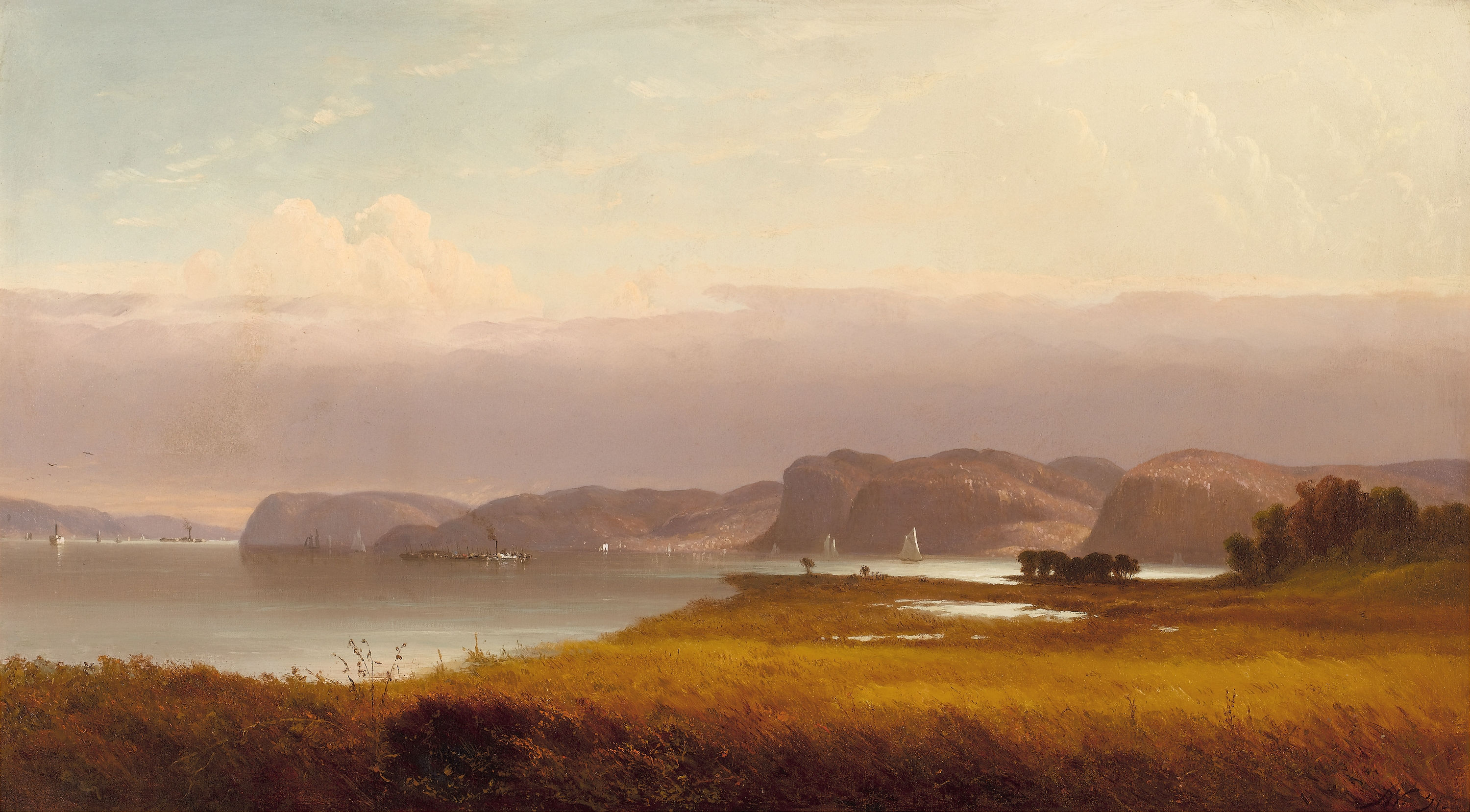
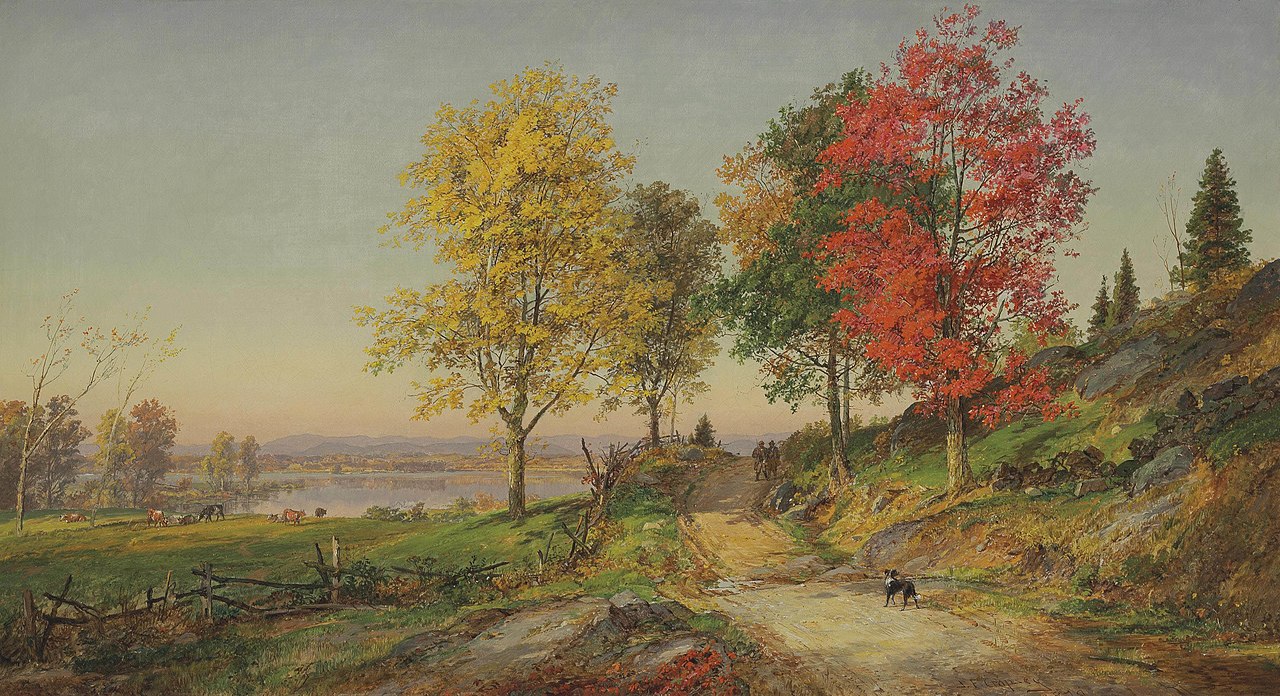
Williamson shows us a peaceful autumn day on New York’s Hudson River, focusing on the quiet beauty of wild grass and calm waters.

This is a beautiful depiction of what autumn often looks like where I live, despite it’s being on the other side of the continent.

The morning mist is gradually lifting, revealing a field of harvest-gold grass. Inland, I imagine the farmers are hoping for the mist to burn off to sunny Indian summer day so they can get the hay in before the weather turns wet.

Further out, the sails of fishing boats and cargo vessels gleam white in the mist as they go about their business, likely also hoping for a sunny day. I suspect they won’t get it, as the cloud cover looks high and there to stay.

As I mentioned above, this view of a less-than-sunny day on the East Coast is not too different from autumn here in the Pacific Northwest.

To my knowledge, this is the first time I have come across works by John Williamson.

I could find nothing about him or his art on Wikipedia, but I did find a few biographies about him on several art auction sites. This was the most informative:

About John Williamson, via Questroyal Fine Art:

John Williamson was a versatile artist who created still lifes, genre scenes, and landscapes during the heyday of the Hudson River School. Born in Scotland, Williamson came to the United States with his family in 1831. He spent most of his life in Brooklyn, New York, studying art at the Brooklyn Institute and helping to found the Brooklyn Art Association. [1]

To continue reading about this artist, go to John Williamson – Questroyal Fine Art.


Credits and Attributions:

IMAGE: Wikimedia Commons contributors, “File:Autumn Hudson River-John Williamson-1871.jpg,” Wikimedia Commons, https://commons.wikimedia.org/w/index.php?title=File:Autumn_Hudson_River-John_Williamson-1871.jpg&oldid=1069869485 (accessed September 10, 2025).

[1] Quote from artist biography via John Williamson – Questroyal Fine Art, © 2025 Questroyal Fine Art, LLC.

Comments Off on #FineArtFriday: Autumn on the Hudson River by John Williamson 1871

Filed under #FineArtFriday

Walking the path to becoming an author #writing

This last week I was asked what it takes for an ordinary person to be an author. My first thought was, no one is more ordinary than an author.

But I didn’t say that.

Authors are crafts folk, people who work at the craft of writing and take the time to turn out a finished product that is as good as we can make it. You wouldn’t enter a half-finished quilt at the county fair. You would go through all the steps to finish the job and take pride in your creation.

A serious writer takes the book through all the steps needed to make it readable, salable, and enjoyable because we love what we do, and we take pride in it.

It’s a lot of work.

Some writers are better than others, not unlike those crafters who work with wood. A good author is like a carpenter who makes a piece of furniture that will be handed down for generations.

Today seems a good day to revisit an article from February of 2020 on this very subject. Nothing has changed since I wrote this article, so here it is, a rerun that I hope you enjoy.


People often say they want to write a book. I used to say that too.

In 1985 I came across my first stumbling block on my path to becoming a writer. I didn’t know it, but to go from dreamer to storyteller is easy. Anyone can do it.

But if we choose to become an author, we’re taking a walk through an unknown landscape.

And the place where we go from dreamer to storyteller to author is the hardest part.

At first the path is gentle and easy to walk. As children, we invent stories and tell them to ourselves. As adults, we daydream about the stories we want to read, and we tell them to ourselves.

That part of the walk is easy. At some point, we become brave enough to sit down and put the story on paper.

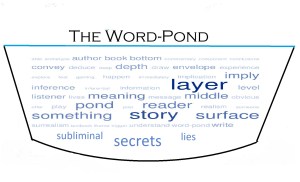
The blank screen or paper is like an empty pond. All we have to do is add words, and the story will tell itself.

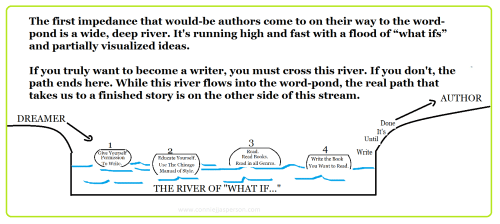
The first impedance that would-be authors come to on their way to filling the word-pond with words is a wide, deep river. It’s running high and fast with a flood of “what ifs” and partially visualized ideas.

If you truly want to become a writer, you must cross this river. If you don’t, the path ends here. While this river flows into the word-pond, the real path that takes us to a finished story is on the other side of this stream.

Fortunately, the river has several widely spaced steppingstones. Landing squarely on each one requires effort and a leap of faith, but the determined writer can do it.

The last thing you do before you step off the bank and begin crossing that river is this: visualize what your story is about.

The first stone you must leap to is the most difficult to reach. It is the one most writers who remain only dreamers falter at:

  • You must give yourself permission to write.

We have this perception that it is selfish to spend a portion of our free time writing. It is not self-indulgent. We all must earn a living because very few writers are able to live on their royalties. If writing is your true craft, you must carve the time around your day job to do it. All you need is one undisturbed hour a day.

The second stone is an easy leap:

  • Become literate. Educate yourself.

Buy books on the craft of writing. Buy and use the Chicago Manual of Style. You can usually find used copies on Amazon for around $10 – $15, passed on by those who couldn’t quite make the first leap.

I freely admit to using the internet for research, often on a daily basis, and I buy eBooks. However, my office bookshelves are filled with reference books on the craft of writing. I buy them as paper books because I am always looking things up. The Chicago Manual of Style is one of the most well-worn there.

Most professional editors rely on the CMOS because it’s the most comprehensive style guide—it has the answer for whatever your grammar question is. Best of all, it’s geared for writers of all streaks: essays, novels, all varieties of fiction, and nonfiction.

The third stone is the reason we decided to write in the first place:

  • Good writers never stop reading for pleasure.

We begin as avid readers. A book resonates with us, makes us buy the whole series, and we never want to leave that world.

We soon learn that books like that are few and far between.

The fourth stone is an easy leap from that:

  • We realize that we must write the book we want to read.

As we reach the far bank, we climb up and across the final hurdle:

  • We finish the work, whether it’s a novel or short story.

Over the years since I first began writing, I’ve labored under many misconceptions. It was a shock to me when I discovered that we who write aren’t really special.

Who knew?

We’re extremely common, as ordinary as programmers and software engineers. Everyone either wants to be a writer, is a writer, has a writer in the the family, or knows one.

Even my literary idols aren’t superhuman.

Because there are so many of us, it’s difficult to stand out. We must be highly professional, easy to work with, and literate.

Filling the pond with words and creating a story that hooks a reader is as easy as daydreaming and as difficult as giving birth.

Because writers are so numerous, every idea has been done. Popular tropes soon become stale and fall out of fashion.

A study by the University of Vermont says there are “six core trajectories which form the building blocks of complex narratives.” These are:

  1. Rags to riches (protagonist starts low and rises in happiness)
  2. Tragedy, or riches to rags (protagonist starts high and falls in happiness)
  3. Man in a hole (fall–rise)
  4. Icarus (rise–fall)
  5. Cinderella (rise–fall–rise)
  6. Oedipus” (fall–rise–fall)

No stale idea has ever been done your way.

We give that idea some thought. We apply a thick layer of our own brand of “what if.”

It’s our different approaches to these stories that make us each unique.

Sure, we’re writing an old story. But with a fresh angle, perseverance, and sheer hard work, we might be able to sell it.

And that is what makes the effort and agony of getting that book published and into the hands of prospective readers worthwhile.

2 Comments

Filed under writing

#FineArtFriday: Greenwood Lake by Jasper Francis Cropsey, 1879

Artist: Jasper Francis Cropsey (1823–1900)

Title: Greenwood Lake

Description: English: Greenwood Lake by Jasper Francis Cropsey

Date: 1879

Medium: oil on canvas

Dimensions: height: 60.3 cm (23.7 in); width: 110.5 cm (43.5 in)

Collection: Private collection

What I love about this painting:

Jasper Francis Cropsey loved the wild beauty of Greenwood Lake as it was in his day. I suspect he wouldn’t feel quite the same about it nowadays, since it is definitely a summer destination for modern vacationers. He found his muse in the rural beauty there.

Autumn seems to have been a favorite time of year for him. Each autumn, he made numerous paintings from his favorite spots along the shore and in the area. This painting was made just as warm September drifted toward the cold months of October and November. The deciduous trees are dressed in shades of red and gold.

Two men walk along the dirt lane that runs beside a meadow. Perhaps they are just going from one place to another, or maybe they are hunters. If so, they are returning empty-handed.

Cattle graze and gossip in the distance, as cows often do. A dog (perhaps the farm dog?) has stopped in the middle of the road to bark his greeting to the men.

I understand why Cropsey painted this scene many times from different angles. In my opinion, the end of September is the best part of autumn in the north. Soon, the beautiful colors will fade, falling to the ground and turning soggy and brown, marking the end of the annual cycle. But now, this day, Cropsey’s world is at peace, the air is crisp, and the leaves are at that wonderful stage that pleases the eye and makes one glad to be alive.

About the Artist, via Wikipedia:

Jasper Francis Cropsey (February 18, 1823 – June 22, 1900) was an American architect and artist. He is best known for his Hudson River School landscape paintings.

Cropsey trained as an architect under the tuition of Joseph Trench in the early 1840s, a period in which he was also trained in watercolor painting, instructed by Edward Maury, and took some life drawing courses at the National Academy of Design. He set up his own architecture office in 1843, but began exhibiting his watercolors at the National Academy of Design in 1844. A year later he was elected an associate member and turned exclusively to landscape painting; shortly after he was featured in an exhibition entitled “Italian Compositions”.[1]

To learn more about Jasper Francis Cropsey, go to Jasper Francis Cropsey – Wikipedia.

About the scenery in this painting via Wikipedia:

Greenwood Lake is an interstate lake approximately seven miles (11 km) long, straddling the border of New York and New Jersey. It is located in the Town of Warwick and the Village of Greenwood LakeNew York (in Orange County) and West MilfordNew Jersey (in Passaic County). It is the source of the Wanaque River.

Jasper Francis Cropsey created several paintings of Greenwood Lake beginning in 1843. Cropsey painted many paintings of the area such as American Harvesting (1864), Greenwood Lake (1870), Fisherman’s House, Greenwood Lake (1877), and Cooley Homestead–Greenwood Lake (1886). Cropsey met and married Maria Cooley, daughter of Issac P. Cooley, in 1847 and continued to visit the area for many years.

Some of Cropsey’s painting command high prices at auctions. Greenwood Lake (1879) sold at Christie’s auction in 2012 for $422,500. Sunset, Camel’s Hump, Lake Champlain (1877) sold for $314,500 in 2011. [2]


Credits and Attributions:

IMAGE: Wikimedia Commons contributors, “File:Greenwood Lake by Jasper Francis Cropsey, 1879.jpg,” Wikimedia Commons, https://commons.wikimedia.org/w/index.php?title=File:Greenwood_Lake_by_Jasper_Francis_Cropsey,_1879.jpg&oldid=617153620 (accessed September 4, 2025).

[1] Wikipedia contributors, “Jasper Francis Cropsey,” Wikipedia, The Free Encyclopedia, https://en.wikipedia.org/w/index.php?title=Jasper_Francis_Cropsey&oldid=1309347669 (accessed September 4, 2025).

[2]  Wikipedia contributors, “Greenwood Lake,” Wikipedia, The Free Encyclopedia, https://en.wikipedia.org/w/index.php?title=Greenwood_Lake&oldid=1300748871 (accessed September 4, 2025).

4 Comments

Filed under #FineArtFriday

The second draft – a deeper dive into the emotional side of subtext #writing

Last week, in Monday’s post, ‘The Second Draft – Subtext,‘ we barely skimmed the surface of that aspect of our story. We discussed how it can be conveyed as part of world-building. But subtext is so much more. Subtext is emotion. It’s the hidden story, the hints, allegations, and secret reasoning.

  • Subtext is the content that supports both the dialogue and the personal events experienced by the characters.

These are implicit ideas and emotions. These thoughts and feelings may or may not be verbalized, as subtext is often conveyed through the unspoken thoughts and motives of characters. It emerges gradually as what a character really thinks and believes.

It also shows the larger picture. It can imply controversial subjects, or it can be a simple, direct depiction of motives. Metaphors and allegories are excellent tools for conveying ideas.

Subtext can be a conscious thought or a gut reaction on the part of the characters. It is imagery as conveyed by the author. A good story is far more than a recounting of ‘he said’ and ‘she said. ‘It’s more than the action and events that form the arc of the story. A good story is all that, but without good subtext, the story never achieves its true potential.

Within our characters, underneath their dialogue, lurks conflict, anger, rivalry, desire, or pride. Joy, pleasure, fear … as the author, we know those emotions are there, but conveying them without beating the reader over the head is where artistry comes into play.

When it’s done right, the subtext conveys backstory with a deft hand. When layered with symbolism and atmosphere, the reader absorbs the subtext on a subliminal level because it is unobtrusive.

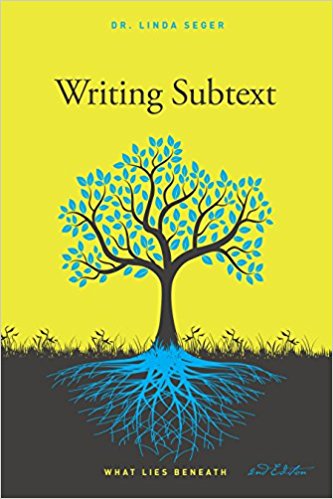
An excellent book on this subject is Writing Subtext: What Lies Beneath by Dr. Linda Seger. On the back of this book, subtext is described as “a silent force bubbling up from below the surface of any screenplay or novel.” This book is a valuable resource for discovering and conveying the deeper story that underlies the action.

Some writers assume that heavy-handed information dumping is subtext because it is often conveyed through internal dialogue,

It’s not. Descriptions, opinions, gestures, imagery, and yes – subtext – can be conveyed in dialogue, but dialogue itself is just people talking.

When characters constantly verbalize their every thought, you run into several problems. First, verbalizing thoughts can become an opportunity for an info dump. Second, in genre fiction, the accepted method of conveying internal dialogue (thought) is through the use of italics.

The main problem I have with italics is that when a writer expresses a character’s thoughts, a wall of leaning letters is difficult to decipher.

Nevertheless, thoughts (internal dialogue) have their place in the narrative and can be part of the subtext. However, I recommend going lightly with them. There are other ways to convey thoughts. In the years since I first began writing seriously, I’ve evolved in my writing habits. Nowadays, I am increasingly drawn to using the various forms of free indirect speech to show who my characters think they are and how they see their world. I rarely use italics.

most of our random thoughts involve obsessing on what we could have done better.A character’s backstory is the subtext of their memories and the events that led them to the situation in which they find themselves. We use interior monologues to represent a character’s thoughts in real time, as they actually think them in their head, using the precise words they use. For that reason, italicized thoughts are always written in first-person present tense I’m the queen! We don’t think about ourselves in the third person, even if we really are the queen.

We think in the first-person present tense because we are in the middle of events as they happen. Our lives unfold in the “now,” so they are written as the character experiences them.

Memories are subtext and reflect a moment in the past. They should be written in the past tense to reflect that. If it was a moment that changed their life, consider rewriting it as a scene and have the character relive it.

We can combine memories and emotions in the form of free indirect speech:

Jeanne paused. The sight of that dark entrance brought a wave of memories, all of them dark and painful.

Chris, on his knees sobbing … their mother’s bloody form ….

She was too young to understand then, but now she knew why Chris seemed so emotionless at times.

Resolutely, she followed him inside.

Subtext expressed as thoughts must fit as smoothly into the narrative as conversations. My recommendation is to express only the most important thoughts through an internal monologue, which will help you retain the reader’s interest. The rest can be presented in images that build the world around the characters.

image of a question mark, asking "what was I thinking?"Information is a component of subtext. We have provided the reader with a lot of information in only a few sentences. They might think they know who a character is, and they have a clue about his aspirations.

But a good story keeps us hanging. Knowledge must emerge via subtext and through descriptions of the environment, conversations, interior monologues, and a character’s general impressions of the world around them.

Odors and ambient sounds, objects placed in a scene, sensations of wind, or the feeling of heat when the sun shines through a window. These bits of background are subtext.

I like books where the scenery is shown in brief impressions, and the reader sees exactly what needs to be there. We don’t want to distract our readers by including unimportant things, such as the exact number of ferns in a forest clearing. The ferns are there, the lost hiker thinks eating their tips is better than starving, and that is all the reader wants to know.

Subtext, metaphor, and allegory are impressions and images that build the world around and within the characters. They are as fundamental to the story as the plot and the arc of the story. As a reader, I’m always thrilled to read a novel that is a voyage of discovery, and good subtext makes that happen.

2 Comments

Filed under writing

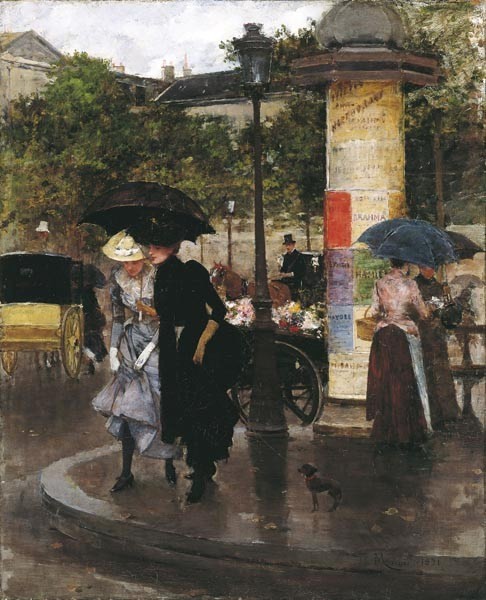
#FineArtFriday: a second look at “Street Scene on a Rainy Day” by Francesco Miralles Galup (ca. 1891)

Title: Escena de carrer en un dia de pluja (Eng: Street Scene on a rainy Day)

Artist: Francisco Miralles Galup

Date: circa 1891

What I love about this painting:

Francesco Miralles Galup understood how to show the reality of weather, especially weather that was only mildly uncomfortable. We see a perfect rainy spring afternoon in a busy cosmopolitan city. It could have been any large city at the end of the 19th century. The sky is gray, the street is busy, full of carriages, and pedestrians must be careful where they step.

A cart full of flowers passes in the background, headed for the market. Two well-dressed ladies dodge puddles in their effort to cross the street. Around them, people stop to gossip, and umbrellas abound.

Like every chihuahua I’ve ever known, the little dog is miserable, unhappy with the damp.

I think this may be one of my favorite paintings of that era, one showing real people and their social lives. It was an era before refrigeration, so people went to the market each day to purchase whatever food they planned to serve. The market is where they met up with their friends and heard news of both the wider world and the local gossip.

He shows us ordinary people, happy and living their best lives.

About the Artist, via Wikipedia:

Francesco Miralles Galup was born Francesc Miralles i Galaup (6 April 1848, Valencia – 30 October 1901, Barcelona). He was a Catalan painter, best known for his realistic scenes of bourgeois life and high society.

When he turned eighteen, he received parental permission (and financial support) to study in Paris, where he would remain until 1893, with occasional visits home. During his first years there, he copied masterworks at the Louvre and may have worked briefly with Alexandre Cabanel. He eventually had several small studios in Montmartre and on the Rue Laffitte.

He exhibited regularly at the Salon and the Sala Parés, back home in Barcelona. He also became a client of the well-known art dealership Goupil & Cie, attracting wealthy buyers throughout Europe and America. This was a relief to his family, who had initially been concerned that they might have to support him indefinitely. Their ability to do so had been compromised as they had lost much of their fortune in the Panic of 1866 and were losing more of it as they paid off their debts. In fact, they eventually moved to Paris so he could help support them. [1]


Credits and Attributions:

IMAGE: Escena de carrer c1891, Francisco Miralles Galup / Public domain. Wikimedia Commons contributors, “File:Francesco Miralles Galup – Escena de carrer c1891.jpg,” Wikimedia Commons, https://commons.wikimedia.org/w/index.php?title=File:Francesco_Miralles_Galup_-_Escena_de_carrer_c1891.jpg&oldid=1039428081 (accessed August 28, 2025).

[1]Wikipedia contributors, “Francesc Miralles i Galaup,” Wikipedia, The Free Encyclopedia, https://en.wikipedia.org/w/index.php?title=Francesc_Miralles_i_Galaup&oldid=1291581678 (accessed August 28, 2025).

Comments Off on #FineArtFriday: a second look at “Street Scene on a Rainy Day” by Francesco Miralles Galup (ca. 1891)

Filed under #FineArtFriday

The second draft – subtext #writing

Subtext is a complex but essential aspect of storytelling. As the word implies, subtext lies below the surface (sub) and supports the plot and the conversations (text).

It is the hidden story, an unstated knowledge embedded within the narrative.

Subtext can be inserted into the story through the layers of worldbuilding. It is conveyed by the images we place in the environment and how the setting influences our perception of the mood and atmosphere.

We all know good worldbuilding is more than simply detailing the setting. It starts there, but without the addition of mood and atmosphere, a coffee shop is just a room with a few tables and chairs. A reader’s perception of a gripping narrative’s reality is influenced by aspects of the setting that they may not consciously notice at the time.

How does good worldbuilding contribute to good subtext? The clues about mood and atmosphere combine on a subliminal level. This undercurrent shapes a reader’s emotional impressions of the story.

A brief mention of décor can convey atmosphere: Tess stood in line, looking around while Evan secured a table. Country-style furnishings lent a coziness to the room, a warm contrast to the rain pounding on the windows. Soon it was her turn to order. “Two large mochas, please.”

A view of the world from the characters’ point of view is essential, as it conveys mood.

“Why did they bother putting a sign on the dining hall? No matter what Temple you visit, every building is made of white sandstone and you always know where you are and what you are looking at.” Bryson’s scathing tones floated to the instructor, who glared at us all.

Afterward, while readers may not consciously remember details, they will remember what they felt as they read that novel. When asked who their favorite writer is, they will mention that author.

When we experience emotion, we are feeling the effect of contrasts, of transitioning from the positive (good) to the negative (bad) and back to the positive. Moodatmosphere, and emotion form the inferential layer of a story, part of the subtext. When an author has done their job well, those transitions feel personal to the reader.

Atmosphere has two aspects: overall and personal. The overall atmosphere of a story is long-term, an element of mood that is conveyed by the setting as well as by the actions and reactions of the characters.

The overall mood of a story is also long-term. It resides in the background, going almost unnoticed. Mood shapes (and is shaped by) the emotions evoked within the story.

The inferential layer of a story has another component, one we must look at in the second draft. This is where another aspect of worldbuilding, scene framing, comes into play. This component has two aspects: first, it involves the order in which we stage people and visual objects, as well as the sequence of events along the plot arc. It shapes the overall mood and atmosphere, contributing to the subtext.

The second aspect of scene framing involves the plot arc and how we place the scenes and their transitions. We want them in a logical, sequential order.

Good worldbuilding can help us give backstory without an info dump, and symbolism is a key tool for this. Environmental symbols are subliminal landmarks for the reader. Thinking about and planning symbolism in an environment is crucial to developing the general atmosphere and affecting the overall mood.

For example, the word gothic in a novel’s description tells me it will be a dark, moody piece set in a stark, desolate environment. A cold, barren landscape, constant dampness, and continually gray skies set a somber tone to the background of the scene.

A setting like that underscores each of the main characters’ personal problems and evokes a general atmosphere of gloom.

Our characters’ emotions affect their attitudes toward each other and influence how they view their quest. This, in turn, shapes the overall mood of the characters as they move through the arc of the plot. And the visual atmosphere of a particular environment may affect our protagonist’s personal mood.

What tools in our writer’s toolbox are effective in conveying an atmosphere and a specific mood? Allegory and symbolism are two devices that are similar but different. The difference between them is how they are presented.

  • Allegoryis a moral lesson in the form of a story, heavy with symbolism.
  • Symbolismis a literary device that uses one thing throughout the narrative (perhaps shadows) to represent something else (grief).

How can we use allegory and symbolism in modern genre fiction? Cyberpunk, as a subgenre of science fiction, is exceedingly atmosphere-driven. It is heavily symbolic in worldbuilding and often allegorical in the narrative. We see many features of the classic 18th and 19th-century Sturm und Drang literary themes but set in a dystopian society. The deities that humankind must battle are technology and industry. Corporate uber-giants are the gods whose knowledge mere mortals desire and whom they seek to replace.

The setting and worldbuilding in cyberpunk work together to convey a gothic atmosphere. This overall feeling is dark and disturbing. That aspect of subtext is reinforced by the dark nature of interpersonal relationships and the often criminal behaviors our characters engage in for survival.

No matter what genre we write in, the second draft is where we expand on our ideas and fill in the gaps of the rough first draft manuscript. We find words to show the setting more clearly and use visuals to hint at what is to come. We create an immersive atmosphere by including colors, scents, and ambient sounds.

We choose our words carefully as they determine how the visuals are shown. When we have no words and feel stuck, we go to the thesaurus and find them.

Authors are painters, creating worlds out of words. We strive to create an atmosphere and mood that underscores our themes and highlights plot points without resorting to info dumps. Each word is a brushstroke that can lighten the mood as easily as it can darken it.

  • When we create a setting, intense color brightens the visuals, and gray depresses them. Those tones affect the atmosphere and mood of the scene.

In the real world, sunshine, green foliage, blue skies, and birdsong go a long way toward lifting my spirits. When I read a scene set in that kind of environment, the mood of the narrative feels lighter to me.

Worldbuilding is complex. It can feel too difficult when we are trying to convey subtext, mood, and atmosphere, using slimmed down prose and power words rather than flowery. But keep at it because the reader won’t be aware of the complexities involved.

All they will know is how strongly the protagonist and her story affected them and how much they loved that novel.

3 Comments

Filed under writing

#FineArtFriday: a closer look at “The Catskills,” by Asher Brown Durand 1858

Artist: Asher Brown Durand (1796–1886)

Title: The Catskills

Date: 1859

Medium: oil on canvas

Dimensions: height: 158.8 cm (62.5 in); width: 128.3 cm (50.5 in)

What I love about this painting: 

I grew up in a forested place, not unlike that depicted here. That sentiment has endeared this style of art to me. I have become attached to the modern fantasy painters, those modern artists like Michael Whelan and the late Darrell K. Sweet, who paint images in this style for fantasy novels and RPG games. Their style is called Imaginative Realism.

What strikes me the most about this particular painting is not only the attention to detail, but the fairy-tale quality of Durand’s vision of realism. Viewed as a whole, this composition has an otherworldly quality to it, almost as if Elrond or Galadriel lurk just out of view, beyond the edges.

Quote from Wikimedia Commons on The Catskills: This painting was commissioned by William T. Walters in 1858, when the 62-year-old Durand was at the height of his fame and technical skill. The vertical format of the composition was a trademark of the artist, allowing him to exploit the grandeur of the sycamore trees as a means of framing the expansive landscape beyond. Durand’s approach to the “sublime landscape” was modeled on that of Thomas Cole (1801-48), founder of the Hudson River school of painting. The painters of this school explored the countryside of the eastern United States, particularly the Adirondack Mountains and the Catskills. Their paintings often reflect the Transcendental philosophy of Ralph Waldo Emerson (1803-82), who believed that all of nature bore testimony to a spiritual truth that could be understood through personal intuition.

>>><<<

Quote from Wikipedia (the fount of all knowledge): Asher Brown Durand is remembered particularly for his detailed portrayals of trees, rocks, and foliage. He was an advocate for drawing directly from nature with as much realism as possible. Durand wrote, “Let [the artist] scrupulously accept whatever [nature] presents him until he shall, in a degree, have become intimate with her infinity…never let him profane her sacredness by a willful departure from truth.”

Like other Hudson River School artists, Durand also believed that nature was an ineffable manifestation of God. He expressed this sentiment and his general opinions on art in his essay “Letters on Landscape Painting” in The Crayon, a mid-19th century New York art periodical. Wrote Durand, “[T]he true province of Landscape Art is the representation of the work of God in the visible creation…”


Credits and Attributions

[1] Wikimedia Commons contributors, “File:Asher Brown Durand – The Catskills – Walters 37122.jpg,” Wikimedia Commons, https://commons.wikimedia.org/w/index.php?title=File:Asher_Brown_Durand_-_The_Catskills_-_Walters_37122.jpg&oldid=354202161 (accessed August 21, 2025).

[2] Wikipedia contributors, “Asher Brown Durand,” Wikipedia, The Free Encyclopedia, https://en.wikipedia.org/w/index.php?title=Asher_Brown_Durand&oldid=1291945600 (accessed August 21, 2025)..

5 Comments

Filed under #FineArtFriday

Action, reaction, and consequences #writing

Some of my writing projects start with an idea for a good plot or character. Others are inspired by something I see or witness in my daily perambulations around town. But no matter how my ideas arrive, they all boil down to “what if….”

On rare occasions, usually at the midpoint of a story that I didn’t outline, it felt as if I was looking for water in the desert, as the ideas were few and far between. That’s when I used to find myself trying to make a novel out of a manuscript rife with unplanned stupidity.

I no longer force my brain to work when it’s on its last legs.

For me, the first stages of laying down a story are more like creating an extensive and detailed outline. This method helps me build an overall logic into the story as it evolves.

At every story’s outset, we meet our protagonist and see them in their familiar surroundings. The inciting incident occurs once we have met them, whether they are ready for it or not. At that point, we must take them to the next stumbling block. But what is that impediment, and how do we overcome it?

And, just as importantly, what repercussions will they face for having crossed that barrier?

Answering that question isn’t always easy. The place where writing becomes work is a hurdle that the majority of people who “always wanted to be an author” can’t leap. Their talents lie elsewhere, and that is okay.

front cover of Mountains of the MoonFortunately, I know what must happen next in my current work in progress because the story is already canon, a historical side note in Mountains of the Moon. At this point, I am brainstorming the characters’ motivations that lead to the desired ending.

I have found it helps to write the last chapter first – in other words, start with the ending. My first NaNoWriMo novel in 2010 began with the final chapter. I managed to write 68,000 words in 30 days thanks to my great characters, whom I wanted to learn more about. I was desperate to know how they arrived at that ending.

What happens when the first lull in creativity occurs? It often happens within the first ten pages. But no matter where it happens, we need to remember that an imbalance of power drives plots, and knowledge is power.

The dark corners of the story are illuminated by the characters who have critical knowledge. This is called asymmetric information, and the enemy should have more of that commodity than our protagonist.

The enemy puts their plan in motion, and we have action. The protagonists are moved to react. The characters must work with a limited understanding of the situation because asymmetric information creates tension. A lack of knowledge creates a crisis.

Plots are comprised of action, reaction, and consequences. I must place events in their path so the plot keeps moving forward. These events will be turning points, places where the characters must re-examine their motives and goals, and how much they are willing to endure to achieve them.

At several points in this process, I will stop and think about the characters. What do they want? How motivated are they to get it? If they aren’t motivated, why are they there?

Answering a few questions about your characters can kick the plot back into motion. Start with the antagonist because his actions force our characters to react:

  1. Why does the enemy have the upper hand?
    • How does the protagonist react to pressure from the antagonist?
    • What are the consequences of this reaction for both characters?
    • How does the struggle affect the relationships between the protagonist and their cohorts/romantic interests?
    • What complications arise from a lack of information?
    • How will the characters acquire that necessary information?

Our characters are unreliable witnesses. The way they tell us the story will gloss over their failings. We can accidentally make them into Penny Perfects if we aren’t careful. The story takes shape as the characters are compelled to overcome their weaknesses and confront their deepest fears.

My first drafts are just the skeleton of the tale, an expanded outline. I flesh out what I can as I write, and that first draft will still be somewhat thin with significant gaps.

Once the first draft is finished, I add visuals, action, and reactions. I may have gotten the large things down, but much will evade my imagination. To resolve that problem, I insert notes to myself, such as:

  • Fend off the attack here.
  • Shouldn’t they plan an assault here? Or are they just going to defend forever? Make them do something!
  • Contrast tranquil scenery with turbulent emotions here.

We all know that arcs of action drive plots. Every reader knows this, too. Unfortunately, when I’m tired, random, disconnected events that have no value will seem like good ideas. Action inserted for shock value can derail what might have been a good plot.

I never show my first drafts to anyone because the manuscript is more like a series of disjointed events and conversations than a novel. I save that file as a first draft once I have written the ending, because if (deities forbid) something should happen to a later draft, I will need that original file, despite it being not much more than a long and fluffy outline. The file name might be: my_novel_fst_draft

I then resave the manuscript as a second draft and begin stitching it all together, focusing on worldbuilding, expanding on scenes, and filling in the plot holes: my_novel_snd_draft

I must be honest. It usually takes five or six drafts and several years for me to make a coherent story with a complete plot arc and interesting characters with logical actions and reactions.

I am not able to churn out novels the way some prolific authors have done over the years. I write for fun and don’t worry about deadlines, which, in my opinion, is the sole reason for pursuing any art form.

2 Comments

Filed under writing

#FineArtFriday: a second look at “The Painter in his Studio” by Adriaen Van Ostade

Artist: Adriaen van Ostade (1610–1685) 

Title: German: Der Maler in seiner Werkstatt. English: The painter in his Studio.

Date: 1663

Medium: oil on oak wood

Dimensions: height: 38 cm (14.9 in); width: 35.5 cm (13.9 in)

Collection: Gemäldegalerie Alte Meister

In “The Painter in his Studio” by Adriaen Van Ostade (1663), we see a self-portrait of the artist, sitting with his back to us. He is at his easel, and his brush hand rests on a ‘maulstick,’ a stick with a padded head used by painters to support the hand holding the paintbrush.  In the shadowed background, a pupil is at work, possibly preparing a palette, or maybe preparing colors.

The window, the floor with all its debris, the walls, and the ceiling are depicted with great detail. The artist and his pupil are less detailed.

The studio is untidy, with brushes fallen on the littered floor. The room is cluttered with numerous odd objects and tools of the trade, including the head of a broken bust beneath a table. On the ceiling above the artist, a canvas canopy is tacked up, possibly to protect the artist’s work area from leaks, or perhaps falling dust.

A skull of some sort hangs near the window, and antlers also decorate the ceiling. The painter’s mannequin poses near the stairs, and an indistinct trunk stands open in the background.

The room is in desperate need of a good sweeping. The large leaded-glass window, however, is clean and lets in good light. It shows us how the artist saw himself and his work space.

A Netherlandish contemporary of the Flemish painters David Teniers the Younger and Adriaen Brouwer, Van Ostade was inspired by the work of Rembrandt.

As Rembrandt did, Van Ostade painted people who had seen hard times. They were often old, sometimes ill-favored, and not always beautiful. He painted dark interior scenes, where shadows are often the dominant features. He also painted the interiors of taverns and the homes of ordinary people, so through his work we who write can see how people really lived.

Van Ostade lived and painted in Haarlem. His subjects and the mood of his work is darker than that of his Flemish contemporaries, as hard times had fallen on the people of Holland, and  Haarlem in particular.

About the artist, via Wikipedia:

Adriaen van Ostade (baptized as Adriaen Jansz Hendricx 10 December 1610 – buried 2 May 1685) was a Dutch Golden Age painter of genre works, showing everyday life of ordinary men and women. [1]

To read his full biography, go to Adriaen van Ostade – Wikipedia


Credits and Attributions:

Wikimedia Commons contributors, “File:Adriaen van Ostade – The Painter in His Studio – WGA16748.jpg,” Wikimedia Commons, https://commons.wikimedia.org/w/index.php?title=File:Adriaen_van_Ostade_-_The_Painter_in_His_Studio_-_WGA16748.jpg&oldid=661600977 (accessed August 14, 2025).

[1] Wikipedia contributors, “Adriaen van Ostade,” Wikipedia, The Free Encyclopedia, https://en.wikipedia.org/w/index.php?title=Adriaen_van_Ostade&oldid=1212324357 (accessed August 14, 2025).

5 Comments

Filed under #FineArtFriday

Riding in the Rattlebones and wearing the Cone of Shame #writing

At the sweet young age of seventy-two, I make all sorts of calculations as I go through the day. I attempt to cut recipes down to serve only one person but usually fail.

Then I give up and buy single-serve microwave meals. There is less waste, and it’s cheaper. I look for small loaves of bread in the bakery, quarts of oat milk rather than gallons, that sort of thing. That is the usual sort of math people my age do, other than managing the bills. It’s the ordinary trimming down of a once larger food-prep empire.

However, on Friday, as I sat in the emergency room at the local trauma center, I found my bookkeeper brain doing a different sort of math. I had taken my car to be serviced at the Olympia Kia dealership. While walking from the ladies’ room, which was in a separate building, back to the service center, I tripped on a curb.

I suddenly found myself face down on the concrete, in incredible pain. For a few moments, I couldn’t move, but I finally managed to roll onto my back and then sit up.

Then I couldn’t see for the blood that flowed, obscuring my vision.

The fall smashed my glasses and opened a large gash, rearranging my right eyebrow and ringing my head like a bell. I also had several other not-so-good injuries. The people in the sales office rushed to my aid, staunching the gushing wound and calling 911.

I experienced a huge sense of mortality, feeling suddenly very old as I was placed on a gurney with the right half of my face bandaged. Wearing the cervical collar/neck brace felt like the human equivalent of wearing the canine cone of shame.

This experience will lend a bit more understanding as to how I approach writing my characters’ experiences of traumatic injuries.

I did, however, gain a deep understanding of why some folks call the Medic One wagon a “Rattlebones.” The streets here are a bit rough and travelling down the main drag while lying on your back rattles you, the gurney, and the wagon like maracas in a mariachi band.

The EMTs were both kind and supportive. When we arrived at the hospital, they stayed with me until I was booked into triage. After numerous tests, it was determined that I didn’t have a concussion, for which I am grateful.

Via Wikipedia: An emergency medical technician (often, more simply, EMT) is a medical professional who provides emergency medical services. EMTs are most commonly found serving on ambulances and in fire departments in the US and Canada, as full-time and some part-time departments require their firefighters to at least be EMT certified. [1]

I now have a lovely black eye, partly shielded by a white bandage protecting the stitches for a few more days, and a splint that supports my wrist but inhibits movement and makes typing a challenge.

Fortunately, I still had my old glasses. I can still see well enough to read if I use a magnifier, and the distance part of my bifocal lens is still good for driving. I will go to Costco and get another pair of glasses with my new prescription.

So, what sort of math was my confused brain doing in the ER?

  • 1 slight misstep for womankind = 1 ride on a gurney in the Thurston County Medic One van, aka the Rattlebones.
  • 1 cervical collar whether you need it or not.
  • 7 stitches in the right eyebrow, and
  • 1 sprained wrist in a splint (possibly fractured, won’t know for a week).

Add in the black eye, numerous bruises and contusions, eight hours in the ER, and the sum total is:

  • 1 completely deflated ego.

the author taking a picture of herself in a mirror, with bandage over eye and splint on right hand.Yes, technically, I am a senior citizen. But I’m only 72, which, given that most women in my family live well into their 90s, is middle-aged. Mama’s admonitions in my early childhood ring in my ears: “Pick up your feet when you walk and be careful to step up at curbs!”

I should know better.

I DO know better.

But all is not lost. The words are flowing, sort of, and I’m getting them down. I have plenty of microwavable meals and DoorDash to keep me fed.  Everything else that requires mobility/flexibility is doable with a bit of figuring it out.

I suspect I will be healed before I have it completely figured out. That’s the way it is when fate sends us on another spin the Blender of Life.


Credits and Attributions:

Image: Wikimedia Commons contributors, “File:EMTs loading a patient.jpg,” Wikimedia Commons, https://commons.wikimedia.org/w/index.php?title=File:EMTs_loading_a_patient.jpg&oldid=702262046 (accessed August 10, 2025).

[1]  Wikipedia contributors, “Emergency medical technician,” Wikipedia, The Free Encyclopedia, https://en.wikipedia.org/w/index.php?title=Emergency_medical_technician&oldid=1304690357 (accessed August 9, 2025).

8 Comments

Filed under writing