#FineArtFriday: Haying at Jones Inn by George Henry Durrie 1854

Artist: George Henry Durrie (1820–1863)

Title: English: Haying at Jones Inn

Date: 1854

Medium: oil on canvas

Dimensions: 22″×30″

Location: Private collection

What I love about this painting:

George Henry Durrie found beauty in the depictions of ordinary life. He always found a way to fit people into his scenes.

I absolutely love the nostalgia of this scene, and the wealth of information about how a reputable roadside inn worked. It is clear that Durrie was frequent guest at Jones Inn. He traveled widely in the years he worked as a portrait painter, and this particular public house is featured in his work several times from different angles. I like to imagine he painted the inn to provide a little respite from the demands of portraiture.

This scene shows us a day at the end of summer. Laborers are bringing a wagon piled high with hay. Two oxen are hitched behind a horse, the three working together to pull the laden wagon.

Country inns were often working farms. They had to be, as they were feeding staff and laborers as well as guests all year long, and there were no Costco, Sam’s Club, or Wholesale Foods to purchase supplies from.

The stables and the people who cared for the horses were just as important. Providing well for travelers’ horses was as crucial as that of providing the best rooms and food possible for their guests.

The hay piled on this wagon will feed not only the innkeepers’ beasts but will feed the horses ridden by guests as the year progresses. Many more wagons will be required to fill the barn and hayloft.

About the Artist, Via Wikipedia:

George Henry Durrie (June 6, 1820 – October 15, 1863) was an American landscape artist noted especially for his rural winter snow scenes, which became very popular after they were reproduced as lithographic prints by Currier and Ives.

For many years, Durrie made a living primarily as a portrait painter, executing hundreds of commissions. After marriage, he made frequent trips, traveling to New York, Massachusetts, New Jersey, and Virginia, fulfilling commissions and looking for new ones. His diary reveals that he was an enthusiastic railroad traveler, in the early days of the railroads. Durrie also painted what he called “fancy pieces”, whimsical studies of still lives or stage actors, as well as painting scenes on window-shades and fireplace covers. But portrait painting commissions became scarcer when photography came on the scene, offering a cheaper alternative to painted portraits, and, as his account-book shows, Durrie rarely painted a portrait after 1851.

Durrie’s interest shifted to landscape painting, and while on the road, or at home, made frequent sketches of landscape elements that caught his eye. Around 1844 Durrie began painting water and snow scenes, and took a second place medal at the 1845 New Haven State Fair for two winter landscapes. [1]

To learn more about this artist, go to  George Henry Durrie – Wikipedia


Credits and Attributions:

IMAGE: Wikimedia Commons contributors, “File:George Henry Durrie – Haying at Jones Inn.JPG,” Wikimedia Commons, https://commons.wikimedia.org/w/index.php?title=File:George_Henry_Durrie_-_Haying_at_Jones_Inn.JPG&oldid=853995435 (accessed October 22, 2025).

[1] Wikipedia contributors, “George Henry Durrie,” Wikipedia, The Free Encyclopedia, https://en.wikipedia.org/w/index.php?title=George_Henry_Durrie&oldid=1282714933 (accessed October 22, 2025).

Comments Off on #FineArtFriday: Haying at Jones Inn by George Henry Durrie 1854

Filed under #FineArtFriday

#Preptober: is it historical fiction or sci-fi? #writing

Today, we’re continuing our Preptober series by designing a conflict and a story arc. I write fantasy, but every story is the same, no matter the set dressing. Protagonist A needs something desperately, and Antagonist B stands in their way.

Logo, my writing life.What does the protagonist want? Everyone wants something. The story is in the way they fulfill that need, or what happens when they don’t. Doubt, uncertainty, people facing the unknown as they struggle to succeed in their quest … these nouns are what makes the story interesting.

This is where we have to sit and think a bit. Are we writing a murder mystery? A space-opera? A thriller? The story of a girl dealing with bulimia?

Let’s do something different and write a historical fiction.

My Uncle Don fought in WWII in the Ardennes and was wounded, coming home with a steel plate in his head. He was an unfailingly kind man who never discussed his wartime experiences. Here in the US, that battle is referred to as the Battle of the Bulge.

  • Our proposed novel’s genre is historical fiction because it explores a fictional Allied soldier’s experiences. It isn’t a biography.

However, any historical fiction novel is a form of fantasy. This is because we must imagine how our soldier acted and reacted to the events, and the friends he made and lost along the way. Those events now exist only in a few places, such as military archives, old newspaper accounts, and the memories of a generation that is now in their nineties.

We will make a list of things we want to include in our worldbuilding. Filthy living conditions will provide the backdrop to the impending confrontation. Life on the frontline was brutal, and we need to use the environment to emphasize our characters’ experience of combat as it was in 1944-45.

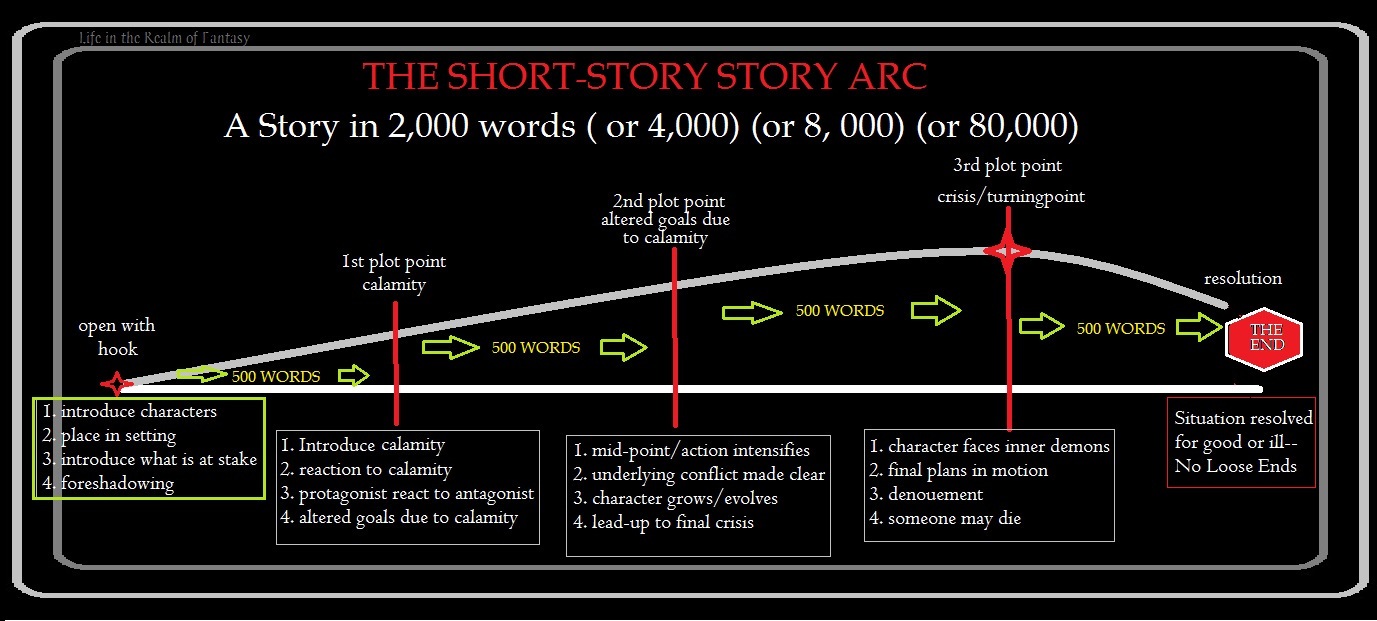
We want to have a complete story arc, so what length should our manuscript top out at? We will plan for a mid-length novel of 75,000 words. We get out the calculator and divide our word count by 4.

  • The first quarter will be 18,175 words, the two middle quarters will be 37,500 words, and the final run-up to the climactic ending will be 18,175 words.

Visual depiction of dividing a story's wordcount into quarters.The first quarter opens our story and introduces the moment of no return, even if our characters still believe they can salvage things.

The following two quarters are the middle of the narrative, exploring the obstacles that our soldier faces. The final quarter winds our soldier’s story up.

Remember, the historical events are NOT movable or changeable if you want to remain in the historical fiction genre. Once you change the timeline or alter events in any way, you have ventured into alternate history and are writing speculative fiction.

I confess, spec-fic is my kind of book. But accuracy counts for readers of historical fiction.

Readers are smart. Military buffs will know that a soldier can’t be at both St. Vith and the Meuse River, unless he was in the US Army Air Force.

So, our four quarters can be divided this way if our soldier is American:

  1. Attack in the south
  2. Allied counteroffensive
  3. German counterattack
  4. Allies prevail

We will write the scenes that connect those events, and that is where we take a deep dive into history. We can invent characters and use our imagination to flesh out their lives within as accurate a WWII context as possible.

To complete our story arc, we will

  1. Take each incident and write the scenes that our soldier experiences.
  2. We might also write scenes showing the commanders planning the offensives and switch to show the enemy’s plans.

Drawing of an author saying "30 days, 50,000 words. We got this."No matter what genre of book you plan to write, all you need is a skeleton of the plot, just a series of events for you to connect. You will write the scenes between these events, connecting them to form a story with an arc to it.

As we write, our soldier’s thoughts and interactions will illuminate and color the scenes. His encounters, how he saw the enemy. Were they people like him or were they faceless? All his emotions will emerge as you write his story.

But maybe you aren’t writing a historical fiction. Some things are universal.

No matter what genre we are writing in, we start with a worthy problem, a test that will propel the protagonist to the middle of the book.

This event is the inciting incident and could be the hook. We discover a problem and set our heroine on the trail of the answer. In finding that answer, she is thrown into the action.

Drop the protagonist into the action as soon as possible, even if the conflict is interpersonal. It could be a minor hiccup that spirals out of control with each attempt to resolve it.

  • This is the place where the characters are set on the path to their destiny.

Some plots are action and adventure. Other books explore a relationship that changes a character’s life in one direction or another. Others, like our war story, explore surviving extreme hardship.

The inciting incident is the moment when the protagonists first realize they’re utterly blocked from achieving their desired goal. Note this event on your outline early in the first quarter. Then the trouble escalates, so make a note of the moment our protagonist realizes their situation is much worse than they initially thought.

At this point, our people have little information regarding the magnitude of their problem. One thing that I do is make notes that help limit my tendency toward heavy-handed foreshadowing. Most of what I write in the first draft will be severely cut back by the time I’m done with the final revisions.

Subplots will emerge once I begin writing. I note them on the outline as soon as I can, but sometimes I do forget.

The last weeks of Preptober are upon us and this is a good time to visit the brick-and-mortar bookstore and look at the books currently being offered in the genre you are writing in. Then you’ll know what you need to achieve in your work if you want to sell that story.

Depiction of the story arc.

1 Comment

Filed under writing

#FineArtFriday: Autumn Woods by Albert Bierstadt 1886

Artist: Albert Bierstadt (1830–1902)

Title: Autumn Woods, Oneida County, State of New York

Date: 1886

Medium: Oil on linen

Dimensions: Overall (linen): 54 x 84 in. (137.2 x 213.4 cm) Framed: 64 3/4 in. × 7 ft. 10 3/4 in. × 3 1/4 in. (164.5 × 240.7 × 8.3 cm)

Collection: New York Historical  (Gift of Mrs. Albert Bierstadt)

What I love about this painting:

Albert Bierstadt gives us a beautiful day in Glorious Autumn (with capitol letters), the kind of day rare here in my part of the Pacific Northwest. In October, rainy weather usually rolls in, accompanied by a blustery wind that strips the trees of leaves and takes the joy out of sightseeing.

Bierstadt’s trees are luminous, red and gold the way they are far away in the mystical lands on the other side of the continent from me. His sky is lovely, but he has kept our focus on the theme, so it doesn’t dominate the scene. The reflections of the trees on the quiet, still waters of the pond ensure they are the stars of this painting.

I especially like the realism of the branches of a downed tree rising out of the water in the foreground. This is a romantic depiction of what Autumn should be, as opposed to the sodden mess that it often is here in my town.

I would love to go walking along the shore of this pond.

About the Artist, via Wikipedia:

Albert Bierstadt (January 7, 1830 – February 18, 1902) was a German American painter best known for his lavish, sweeping landscapes of the American West. He joined several journeys of the westward expansion to paint the scenes. He was not the first artist to record the sites, but he was the foremost painter of them for the remainder of the 19th century.

Bierstadt was born in Prussia, but his family moved to the United States when he was one year old. He returned to study painting for several years in Düsseldorf. He became part of the second generation of the Hudson River School in New York, an informal group of like-minded painters who started painting along the Hudson River. Their style was based on carefully detailed paintings with romantic, almost glowing lighting, sometimes called luminism. Bierstadt was an important interpreter of the western landscape, and he is also grouped with the Rocky Mountain School. [1]

To read more about this artist, go to  Albert Bierstadt – Wikipedia.


Credits and Attributions:

IMAGE: Wikimedia Commons contributors, “File:Autumn Woods, Oneida County, State of New York 1910 11.jpeg,” Wikimedia Commons, https://commons.wikimedia.org/w/index.php?title=File:Autumn_Woods,_Oneida_County,_State_of_New_York_1910_11.jpeg&oldid=1069889157 (accessed October 16, 2025).

[1] Wikipedia contributors, “Albert Bierstadt,” Wikipedia, The Free Encyclopedia, https://en.wikipedia.org/w/index.php?title=Albert_Bierstadt&oldid=1308977510 (accessed October 16, 2025).

5 Comments

Filed under #FineArtFriday

#Preptober: some things I learned from Lee French #writing

Every year since 2010, I have participated in the annual challenge of writing a 50,000-word (or more) novel in November. I was a Municipal Liaison for the now defunct organization known as NaNoWriMo for twelve years, but dropped that gig when the folks at NaNo HQ got too full of themselves and lost the concepts the organization was founded on.

I still participated, just not on their website. Before I deleted my account, I took a screenshot of my header, as it showed my accumulated wordcount. During those years I wrote 1,409,399 words. Some years were easier than others, but I always came away with something useful.

Spending the time every day to get a certain number of new words written forces me to become disciplined. It requires me to ignore the inner editor, the little voice that slows my productivity down and squashes my creativity.

For those two reasons alone, I will most likely always be a November Writer.

I love the rush, the thrill of having laid down the first draft of something that could become better with time and revisions. I am competing against my lazy self and really making the effort to get a complete story arc on paper.

Have I ever mentioned how my family loves Indy Car and the Memorial Day Weekend extravaganza known as the Indy 500? Well, if I haven’t, it’s true.

Jasperson clan at Indy 2012.

I have had many favorite drivers, one of whom is Takuma Sato . You may ask how an Indy Car driver is relevant to my completion of November’s writing rumble, and I will tell you.

He approaches competing like a samurai warrior, and that is how I see making a daily wordcount goal in November. No Attack, No Chance: The Takuma Sato Story – THOR Industries

As Takuma Sato says, “No attack, no chance.”

To really commit to this and get your word count, you must become a Word Warrior. Even if you intend to wing it, a little advance prep is helpful.

Author Lee French, who was my co-ML and dear friend for all those years had a pep-talk she would give our writers, beginning in October, or Preptober as we veterans call it. She has kindly allowed me to quote her notes from 2020:

Pick any of these things you want to write about or with. Be as specific as possible for each thing. These things can come from a number of different categories, such as but not limited to:

  1. Creatures – Dragons, demons, fae, vampires, elves, aliens, babies, wolves, mosquitoes, and so on. This includes anything nonhuman, and may refer to heroes, villains, or side characters of any importance.

  2. Natural disasters – Tornadoes, earthquakes, hurricanes, tsunamis, melting polar ice caps, climate change effects, etc. This can mean a story that takes place during or after a disaster, or it can mean there’s a disaster looming and the goal is to prevent or mitigate it.

  3. Themes – Love, death, survival, good vs. evil, prejudice, etc. Any theme will do. You can mix two, but should steer clear of more than that. If you’re not sure what constitutes a theme, google “story themes” for an array of options.

  4. Relationships – Siblings, romance, platonic love, friendship, breaking up/divorce, etc.

  5. Moods – Grim, utopian, dark, gritty, light, noble bright, comedic, etc.

  6. Geography/type of area – Forest, mountains, urban, rural, caves, isolated, etc.

  7. Phenomena – Magic, psychic powers, supernatural whatnot, miracles, and the like.

Once you have your list, take the time to think about it. Sit back, ruminate on each thing, and make some notes. This could take a few days, or as little as an afternoon. In 2020,

Lee’s five things looked like this:

Magic

  1. Secondary world fantasy.
  2. Other races exist.
  3. The MC uses magic in a lowkey way.
  4. Magic is not commonly used by ordinary people.
  5. There’s a squirrel.

Romance

  1. Cishet. Female MC, male Love Interest.
  2. The guy is different in some important way, like being nonhuman or following a religious path that’s frowned upon by most folk.
  3. The romance is a value-added bonus, not the plot.

Unexpected Ice Age

  1. Caused by magic.
  2. Affects the entire world.
  3. Makes survival challenging, especially for food and fuel.
  4. The cold is enough to kill fairly swiftly.

Good vs. Evil

  1. Bad guy is the leader of the city.
  2. No, wait. It’s two bad guys. They’re partners. Siblings?
  3. Good guy is in hiding.
  4. I think I need a secondary bad guy too, like a lieutenant.

Refuge City of Debris

  • Jagged edges, abrupt changes in material, faded colors.
  • The population is in the 2-5 thousand range.
  • Surrounded by a wall or cliffs. Or both!

I have always loved the way her mind works.

For me, once I begin writing my new manuscript on November 1st, the hardest part is NOT SELF-EDITING!!! But overcoming that habit is crucial, and not just for wordcount. We need to get the ideas down while they are fresh, and any step backwards can stall the project.

Tips from me for a good November:

Never delete and don’t self-edit as you go. Don’t waste time re-reading your work. You can do all that in December when you go back to look at what you have written.

Make a list of all the names and words you invent as you go and update it each time you create a new one, so the spellings don’t evolve as the story does.

If wordcount is your goal, write 1670 words every day and you will have 50,000 words on November 30th.

This year for me, wordcount is important but not the entire enchilada. Writing the second book in my unfinished duology is the project that I intend to complete.

Here are some Resources to Bookmark in advance:

Three websites a beginner should go to if they want instant answers in plain English:

Most importantly, enjoy this experience of writing. There is no other reason to put yourself through this.


Credits and Attributions:

Special thanks to best-selling author of YA Fantasy and Sci-fi, Lee French, for allowing me to quote her work notes. She is an inspiration to me!

Comments Off on #Preptober: some things I learned from Lee French #writing

Filed under writing

#FineArtFriday: An autumn walk in the English Garden of Munich by Anders Andersen-Lundby 1887

Artist: Anders Andersen-Lundby (1841–1923)

Title: English: An autumn walk in the English Garden of Munich. German: Herbstspaziergang im englischen Garten in München.

Date: 1887

Medium: oil on canvas

Dimensions: height: 77 cm (30.3 in); width: 106 cm (41.7 in)

Inscriptions: Signature and date: 1887

What I love about this painting:

Anders Anderson-Lundby shows us the perfect autumn day for a stroll. Truthfully, the day looks so pleasant that I’d like to be walking there. The leaves are nearly off the trees, and those that remain are golden and brown. Those who walk in these woods seem happy, content to be outdoors while the weather remains decent.

Autumn has arrived here in the Pacific Northwest. In a few weeks, this is how the deciduous trees in my part of the world will look. Right now the big-leaf maples are still holding fast to green but it’s shading toward brown and their leaves have begun falling. The Japanese maples and other non-native trees brightening gardens and public through-ways have turned a bright red. Soon our native vine maples and that (now undomesticated) decorative-plant-gone-native, staghorn sumac, will too.

About the Artist, via Wikipedia:

Anders Andersen-Lundby (December 16, 1841 – January 4, 1923) was a Danish landscape painter. He was most associated with winter landscapes.

(He) was born in Lundby, Denmark. He grew up in Lundby near Aalborg. In 1861, when he was twenty, Andersen-Lundby traveled to Copenhagen, and there he exhibited his works for the first time in 1864. By 1870, he gained popularity especially with his winter landscapes from both Denmark and southern Germany, most often with fallen snow or thaw.

In 1876, he moved to Munich with his family where he exhibited his paintings. He frequently visited Denmark and participated in exhibitions there. He exhibited at the Charlottenborg Spring Exhibition 1864–1913. [1]

To view more of Anders Anderson-Lundby’s work, go to Anders Andersen-Lundby – Wikipedia.


Credits and Attributions:

IMAGE: Wikimedia Commons contributors, “File:Anders Andersen-Lundby – Herbstspaziergang im Englischen Garten (1887).jpg,” Wikimedia Commons, https://commons.wikimedia.org/w/index.php?title=File:Anders_Andersen-Lundby_-_Herbstspaziergang_im_Englischen_Garten_(1887).jpg&oldid=1068508759 (accessed October 9, 2025).

[1] Wikipedia contributors, “Anders Andersen-Lundby,” Wikipedia, The Free Encyclopedia, https://en.wikipedia.org/w/index.php?title=Anders_Andersen-Lundby&oldid=1191864454 (accessed October 9, 2025).

5 Comments

Filed under #FineArtFriday

#Preptober: Names as a part of worldbuilding #writing

October has arrived, or as many writers will tell you, Preptober. This is the month when November Writers begin preparing for November’s annual writing rumble, the event formerly known as NaNoWriMo. They may create a list of characters and their respective roles.

Text only: NaNo Prep, character creation, names and the people who have them.Some, like me, will begin with worldbuilding, drawing a map of where the story will take place and thinking about the people who will bring that world to life.

Creating characters and maps means devising names for people and places. If you are setting your story in a real-world environment, half of the work is done for you. All you have to do is download a few Google Maps, and you have your world.

However, you still need to give your people names. You may also need to invent a town or county that doesn’t exist, but which will fit seamlessly into the real world.

Text only: Fantasy names are a minefield. Keep it simple and think about ease of pronunciation when it comes to how you spell them. Names are a part of the subtext, an aspect that adds to the reader’s mental view but usually goes unnoticed. The names you assign people and places are a part of worldbuilding. If you give your characters names that don’t fit the time, society, and geographical area, readers will find them jarring.

Although I usually start with an outline, my first drafts are often a mess. My stream of consciousness takes over, and I give every walk-on a name, right down to the dog.

This happens because when I am in the creative zone, I forget to look at the outline.

During the first stage of revisions, I whittle down my cast of thousands to a reasonable level.

Here are three rules for deciding who should be named and who should not. Don’t worry about these rules when you are laying down the first draft. Think about them when the story is finished and you are making revisions, as that is when you are making the story flow better.

  1. Is this character someone the reader should remember?
  2. Does the person return later in the story?
  3. Only give names to characters who advance the plot.

These suggestions are true of a novel, a screenplay, or a short story. Names alert us, telling us a character will play an important role in the story.

In my experience as a reader, the pacing an author is trying to establish comes to a halt when a character who is only included for the ambiance has too much time devoted to them.

Book Cover image “Story” by Robert McKee.

Novelists can learn a lot about writing a good, concise scene from screenwriters. An excellent book on craft is an older one, but it’s still relevant. Story by Robert McKee.

We want the reader to stay focused on the protagonist(s) and their story. Having too many named characters in a scene is easy to fix. Consider removing characters from the scene if they have nothing to contribute. An example of this is one I’ve used before. It is a transition scene between two characters involved in solving a mystery. One has learned something crucial and needs to meet with the other before he stumbles into trouble.

Julie entered the café at 3:30. All the seats were taken, except for one at the counter, between a man in paint-stained coveralls and a woman with a briefcase at her feet. She caught Nathan’s eye, and he brought her a coffee. “We need to talk,” she whispered. “I’ll wait until you’re free.”

Nathen raised an eyebrow. “I get off at four. See you then.” He refilled several coffees at the counter, then carried the pot to the tables.

This scene depicts Nathan in his job, serving as both worldbuilding and character development. Julie doesn’t need to talk to the people on either side of her onscreen, as idle chit-chat is not necessary and fluffs up the wordcount. The scene can skip forward, and the conversation with Nathan will pick up outside the café after he is off work.

Transition scenes between action scenes are dangerous because the tendency to make every random character memorable is one we can’t indulge. The reader will become confused and irritated if too many characters are named. If a character is set dressing, they should be like the furniture, included solely to lend atmosphere to the scene.

So what about the names we give our people? I’ve mentioned before that I learned a lesson the hard way about naming characters. I have a main character named Marya in one of my early novels, and she’s central to that series. Also, in the first book, a side character was important enough to have a name, but my mind must have been in a rut when I thought that one up.

For some reason, I named her Marta. Marya … Marta … the two names are nearly identical.

To make that faux pas worse, halfway through the first draft of the second book in the series, Marta suddenly became a protagonist with a significant storyline. She actually becomes Marya’s mother-in-law in the next book.

Fortunately, I was in the final stages of editing Book One for publication. I immediately realized I had to make a major correction, and Marta was renamed Halee.

An author should introduce as many characters as necessary to tell the story but should also use common sense.

Inset with text only: Names matter. Keep them simple, keep them separate, and make them count.One last thing to consider is how that name will be pronounced when read aloud. Something that looks good on paper might be impossible to pronounce. Audiobooks have become a big thing, so you may not want to get too fancy with the spelling. That way, a narrator can easily read that name aloud.

In conclusion, don’t confuse your readers by giving unimportant walk-on characters names, and never give two characters names that are nearly identical.

Consider making your spellings of names and places pronounceable, just in case you decide to have your novel made into an audiobook. Your narrator will thank you!

5 Comments

Filed under writing

#FineArtFriday: Autumn in Towadako by Li Mei-shu

Title: Autumn in Towadako

Artist: Li Mei-shu

Date: 1978

Medium: oil on canvas.

What I love about this painting:

I love how this painting shows a pool of water at the base of the trees. I suspect the pond is dry during summer but in fall, the low area fills. The light shines through the trees and reflects on the water. It’s a scene of quiet beauty, a moment of serenity in the forest. I really like this painting.

Autum has arrived in the area where I live. The trees are beginning to turn colors, and unfortunately, the rains have come. But dryer weather is on the horizon, and we will be treated to red and gold leaves decorating the maples and other deciduous trees.

Soon, the streets and lanes in my town will be dressed in a final burst of color. It must be enjoyed while we can, as the beautiful leaves will soon turn brown and soggy, and the eternal gray of the Northwest winter will set in.

The coffee shops are all pushing their pumpkin spice blends, although I have so far resisted. However, I have pulled out a few cozy sweaters for when the weather really turns cool.

About the Artist, via Wikipedia:

Li Mei-shu (13 March 1902 – 6 February 1983) was a Taiwanese painter, sculptor, and politician. He was best known for his paintings as well as his restoration attempt of the Changfu Temple.

Li was born to an upper-class family in Sankakuyū (Pe̍h-ōe-jīSaⁿ-kak-éng), Japanese Taiwan (modern-day Sanxia DistrictNew Taipei City) on 13 March 1902. He began to demonstrate a propensity for painting in his early years. In 1918, he was accepted into the Painting Division of the Taiwan Governor-General’s National Language School. He taught himself painting after school through a copy of A Collection of Lectures, which he ordered from Japan through post. Upon graduating, he taught at Zuihō Public School (in modern-day Ruifang District). During this time, he participated in the Summer Art Seminar organized by Kinichiro Ishikawa. His works ‘Still Life and Backstreets of Sanxia’ were selected for the first and second Taiwan Art Exhibitions (Taiten), respectively. [1]

To learn more about Li Mei-shu, go to Li Mei-shu – Wikipedia.

Also, go to https://www.limeishu.org/


Credits and Attributions:

IMAGE: Wikimedia Commons contributors, “File:Autumn in Towadako, by Li Mei-shu.jpg,” Wikimedia Commons, https://commons.wikimedia.org/w/index.php?title=File:Autumn_in_Towadako,_by_Li_Mei-shu.jpg&oldid=1031830163 (accessed October 2, 2025).

[1] Wikipedia contributors, “Li Mei-shu,” Wikipedia, The Free Encyclopedia, https://en.wikipedia.org/w/index.php?title=Li_Mei-shu&oldid=1310846803 (accessed October 2, 2025).

6 Comments

Filed under #FineArtFriday

Notes on Managing Submissions #writing

Do you have a backlog of short stories? One of the best ways to build a reputation as an author is to submit your work to magazines and anthologies.

At first, finding places to submit your work can be challenging, but it’s not impossible. Here are links to two Facebook groups where publishers post open calls for short stories. I have posted these before, and they are still relevant.

Open Submission Calls for Short Story Writers (All genres, including poetry)

Open Call: Science Fiction, Fantasy & Pulp Market (speculative fiction only)

  • You must answer some questions to prove you are legitimately seeking places to submit your work if you apply to be accepted into these groups.
  • Once you are in, you must follow the rules of good conduct for a happy coexistence. Troublemakers and trolls are unceremoniously ejected.

A word of warning: some open calls will be for charity anthologies and are not paid. Do your due diligence. Some “charity” anthology mills have fancy websites featuring “glowing” reviews designed to trick you into publishing with them. Be wary and carefully research the unpaid ones to ensure that the publisher is reputable and that there is a good reason why you are being asked to donate your work for no compensation.

When an author is new to the mean streets of publishing, a vanity anthology mill can seem like a miracle. After all, your work will definitely be published by these predators, no matter how poorly edited it is. Worse, they sometimes offer that service for a steep fee (a BIG red flag). The only volumes they sell are the ones that the individual authors can pressure their friends and families to purchase.

Legitimate publishers do not charge for editing or any other aspect of the publishing process.

Before you sign a contract, remember this: your author name will be listed on the cover and forever associated with that book.

However, legitimate publishers are out there, and they are worth your time and effort. These publishers will pay industry-standard royalties and will offer reasonable contracts.

And on that note, be sure any contracts you sign limit the use of your story to that volume only, and you retain all other rights.

  • You should retain the right to republish that story after a finite amount of time has passed, usually 90 days after the anthology publication date.

SFWA maintains a list of predatory publishers to avoid doing business with. They also provide useful information on potential red flags in predatory contracts. You don’t need to be a member to access these. https://www.sfwa.org/

There are legitimate calls for extremely short fiction by highly reputable publishers. Flash fiction, works of 1000 words or less, is easier to sell to online magazines. Royalties will be paid by the word and might be small as the work they are contracting for isn’t long, but it is payment.

Reputable publishers often have open calls for charity anthologies, which are worth submitting to. These anthologies typically feature one or two well-known authors donating a short story, with work by up-and-coming writers comprising the rest of the book.

You could be one of those up-and-coming authors. But in order to achieve that goal, you must write something worthy of submission.

If a publisher is looking for work that explores a particular theme, such as “escape,” you must think creatively. Consider an original angle that will play well to that theme and then write it.

When you submit your work to various places, you should keep a record of it. Most publishers won’t accept simultaneous submissions. To avoid that, you should list:

  • what was submitted,
  • links or email addresses of where it was sent to,
  • when submissions close.

To that end, consider creating a database for your work. I use an Excel spreadsheet that lists the title, word count, completion date, where and when I submitted the work, how much I earned for it, etc.

Below is a screenshot of what my list of submitted work looks like. I started this file in 2015 and continue to use it to track my submissions.

In extremely short fiction such as drabbles and other flash fiction, you must include only the most essential elements of a story. This kind of constraint teaches us to write concisely and still show an engaging story.

As a poet, I find it far easier to tell a story in 100 words than in 1,000. That 100-word story is called a drabble and is an art form in its own right.

You can find publications with open calls at Submittable. Unfortunately, that site is no longer as useful for speculative fiction as it was several years ago. However, I have seen anthology calls for spec fic there. Still, poetry collections, literary anthologies, and contests use Submittable, so that is an option. https://www.submittable.com/

Some social media platforms are useful, as you may hear about open calls that way. I know many people are avoiding social media these days, but you don’t have to go nuts. Use it just for business (and yes, writing is a business). Follow editors on LinkedIn, Facebook, Instagram, and their Twitter feeds, if you are still using that platform. (I no longer use Twitter, but I do use Bluesky.) Consider following the magazines you submit to (or would like to send work to) on each social media platform you use.

A fellow author keeps a networking notebook. It includes the names of people in the industry she has spoken to, their affiliations (if they work for an agent or editor), their emails and/or business cards, and other relevant details. This information comes in handy when she has to write cover letters to go with submissions to these editors, as she can reintroduce herself as having met them at a specific seminar or conference.

This list of suggestions is meant for authors who intend to write professionally. It’s a business, so these habits help keep me focused and on track.

1 Comment

Filed under writing

#FineArtFriday: A closer look at “The Alyscamps,” or “The Three Graces at the Temple of Venus” by Paul Gauguin 1888

Paul_Gauguin_les_alyscamps085

Artist: Paul Gauguin (1848–1903)

Title:  (English)The Alyscamps, or The Three Graces at the Temple of Venus

French: French: Les Alyscamps, ou Les Trois grâces au temple de Venus

Date: 1888

Medium: oil on canvas

Dimensions: height: 91.6 cm (36 in); width: 72.5 cm (28.5 in)

Collection: Musée d’Orsay

What I love about this painting:

Color! I love the vivid colors contrasted against the pale sky. The Three Graces in classical mythology are the goddesses of charm, beauty, nature, human creativity, goodwill, and fertility. They have come to symbolize faith, hope, and charity.

According to the internet, the traditional mythology Paul Gauguin explores in this composition demonstrates his early education and his appreciation of classical art. And truthfully, although he never trained formally, he did know his stuff. Before he became an artist, he was both a stockbroker and an art dealer/collector.

Gauguin is known for his use of bold colors, simplified forms, and strong lines. Again, according to the internet, this painting is a prime example of his study of form and color.

And he tells us a story. First, the eye is drawn to the vertical lines of the temple standing tall on the hill behind the figures. They are also depicted with a sense of height, and the hills beyond are tall and narrow.

A calm stream flows from beneath the temple, the river of time. The three women stand almost in the background, yet they are commanding, observing us and our lives as time passes them. They are as strong and unmovable as the rocky hills and the temple.

Gauguin tells us that time may pass, and things may change, but the Temple of Venus rises above it all. Does this Temple of Venus represent “agape,” a love that is selfless and unconditional? A kind of love that is spiritual in nature?

Maybe, and maybe not.

Paul Gauguin was a famously complicated man, conflicted and tormented by the contrasts of 19th century morality and the realities of his life.

Who knows what that temple meant to him on the day he created it? Either way, Gauguin’s Three Graces, Faith, Hope, and Charity, stand almost in the shadows, offering him comfort. They are as solid and eternal as time.

And who or what, I wonder, is the immense dark, nearly indistinct fourth shadow who peers over their left shoulder? It seems like a person’s form. Is it another of the Fates? Is it Death? There is so much to consider in this painting.

Paul Gauguin lived an eventful life. For a wonderful documentary on the man and his life, go to:

Why Is Gauguin So Controversial? (Waldemar Januszczak Documentary) | Perspective – YouTube

Also, check out Paul Gauguin – Wikipedia.


Credits and Attributions:

Image: Wikimedia Commons contributors, “File:Paul Gauguin 085.jpg,” Wikimedia Commons, https://commons.wikimedia.org/w/index.php?title=File:Paul_Gauguin_085.jpg&oldid=710795058 (accessed September 24, 2025).

Comments Off on #FineArtFriday: A closer look at “The Alyscamps,” or “The Three Graces at the Temple of Venus” by Paul Gauguin 1888

Filed under #FineArtFriday

The Zen of #writing

Every writer is different, with a unique approach to getting their work on paper. There is no one-size-fits-all method for taking a story from an idea, a “what if” moment, to a finished piece. Each of us has to find our own way.

As an indie, my deadlines are self-imposed, so my production timelines aren’t as finite as a writer who is under contract. If I find myself at a real stopping point, a place where the plot isn’t moving forward, I stop forcing it.

I choose to stop forcing myself to write when the ideas have dried up. I set aside what isn’t working and relax by writing flash fiction and short stories. I have no deadlines, so I can return to a piece that is stuck when I’ve figured out how to get it back on track.

 My goals are for me, not for anyone else. I choose to embrace a Zen writing life.

I’ll admit there is one drawback to this approach, but it’s not the end of the world. One book I began ten years ago feels as if it will never be finished, because I became stalled at the halfway point. Despite my best intentions in 2022, I never got back to it. I know how it has to end, because it is history and is canon in the Tower of Bones series. At this point, I haven’t decided the best way to arrive at that conclusion.

So, one goal for that novel during the rest of this year (2025) is:

First, I will go back to the outline and begin the next phase. Looking at the original plan will help me get the book back on track again. Once I have the plot firmly in mind, I’ll finish writing the pivotal scenes, then tie them together with good transitions. That will complete the manuscript which should top out at 170,000 words.

After that, I will send it to my beta readers. Once I receive their recommendation, I can embark on my favorite part: revising the manuscript. It could take months, but this really is the stage of the process I enjoy most.

Once all that is done to my satisfaction, I will send the manuscript to Irene and have it professionally edited.

The last stage is a two-step process:

  • I make the corrections Irene wants.
  • Then, I hang on to a manuscript and let it sit unread for a while. A month or so later, I print out each chapter and go back through it with a yellow highlighter. At this point, I am proofreading it, looking for typos and cut/paste errors, and making corrections.

Then, if I am happy with it, I will have it professionally formatted for publication. I will also hire the cover out, as I no longer have the patience to deal with cover design.

The first hard-earned piece of wisdom that I have to share with you today is this: you must develop perseverance. You can write the greatest novel ever, but it won’t satisfy every reader. So write your stories for yourself and don’t stop trying.

The second bit is a little more challenging but is a continuation of the first point: Write something new every day, even if it is only one line. You develop better skills when you practice writing a few new words every day. Even if you only have ten minutes free, use them to write whatever enters your head, stream-of-consciousness. Maybe you should write a journal entry.

The third suggestion is fun and easy: learn the meaning of a new word every day. You don’t have to use it, but it never hurts to know new things. Authors should have a wide vocabulary.

The fourth thing: don’t sweat the small stuff when you are just laying down a first draft. I know it’s a cliché, but it is true. Lay the words down, passive phrasing and all, because the important thing is to get the story finished. Don’t share that first draft with anyone you can’t unconditionally trust, as it is yours and still in its infant stage.

The fifth thing to remember is this: every author begins as someone who wants to write but feels like an imposter. The authors who succeed in finishing a poem, a short story, or a novel are those who are brave enough to just do it.

Every author I know has struggled in their personal life. During the years I was raising my children, I had three failed marriages, worked three part-time jobs, and struggled to find time to write. Just when life was getting better financially, two of my children developed adult-onset epilepsy. However, that bad year was when I reconnected with the love of my life. That was the year life became better than good despite the hiccups and the dreaded “E” word.

Now, twenty-two years later, my spouse is suffering from late-stage Parkinson’s, and I am no longer physically able to properly care for him. Still, I visit him every morning without fail, the high point of my day. And even though he is unable to reliably communicate his thoughts, he tells me he loves me. Things are different, but we are still who we always were.

The good things in life are still good, and I choose to focus on those. As time has gone on, I have learned not to panic when I get the dreaded phone call letting me know something bad has happened. Our five children are strong and have stepped into the roles Greg and I have had to step back from. We pull through the rough times as a family.

Everyone needs a creative outlet, whether it is painting, music, or gardening. Writing is how I make sense of the twists and turns of life. It helps me process the complications in a non-threatening way. My Zen approach to writing means I have the choice to write what I can and not feel guilty for the goals I don’t achieve.

  • The story is the goal. Everything else is a bonus.

In real life, nothing is certain. Adversity in life forges strength and understanding of other people’s challenges. It enables us to create characters who aren’t perfect, but with secret backstories that make them more human, more relatable.

Storytelling is my art form, my creative outlet, the one thing I do for myself. I write the stories I want to read, and that is what every writer should do.

So, take ten minutes, and write as many new words as possible. Write a scene, write a 100-word microfiction, or write a haiku. Write these words just for you, a piece you don’t have to share with anyone unless you choose to.

Let go of the guilt. Enjoy the freedom of writing for the joy of it.


7 Comments

Filed under writing