Revisions and Plotting the End #amwriting

Many authors who finished NaNoWriMo with a complete story are now beginning the revision process. This year, I wrote most of an unplanned novel, one I had no intention of writing, and therefore I had no outline.

In the rush of laying down those ideas, I wrote many scenes that will need to be moved to a more logical place in the story arc or cut altogether. Still other scenes don’t yet exist and will need to be written so that the ultimate outcome makes sense.

For me, working on the outline is a form of brainstorming. If you haven’t already done so, this is an excellent time to draw up a brief outline that shows you at a glance what you have written. If you are beginning from scratch, writing this outline will take the better part of a day.
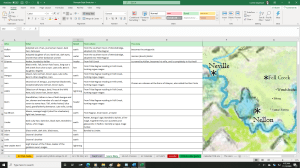
However, having an outline to work with will speed the revision process up by a month or so.

I did make an outline in an Excel Workbook as I went, so I have the basics done, but many things didn’t get noted. I have two major events to plan and write, and then the first draft will be complete.

I know what has to happen, but I’m not sure how to begin this push to the end. So, this week I’m planning what needs to be done next to carry this tale to its conclusion.

Using a spreadsheet program like Excel, or the free program, Google Sheets, allows you to cut and paste events, moving and rearranging scenes up and down the story arc, so they flow logically. There are programs like Scrivener out there that also help you do this, but I’ve never been able to figure out how to use them. I stick with the simple, cost-free options.

When I make the decisions first on a small, easily manageable scale rather than the larger manuscript, I don’t get confused. This makes cutting and moving scenes forward or back along the timeline a lot easier.

So, what do I need to look at first? In this case, it is the timeline: as I wrote, I noted most of the decisions my protagonist and the antagonist made on their way to this point, such as this scene in my antagonist’s thread:

  • Kellan shares relic w/Eriann.
  • Eriann possessed, goes mad.
  • Kellan terrified, casts sleep. Not sure what to do when she wakes.

In the rush to write during NaNo, some scenes didn’t get noted. I’m adding them now, and this is how I will brainstorm the chapters leading to the final scenes.

If you choose to do this, I recommend that you list every decision they made that triggers an event. You need to see the ripple effect of how their actions affect the other characters’ storylines.

Ivan, Marta, and Kellan all made decisions that affected their journey to this point. I need to ensure that I have written them in a way that follows a logical connective evolution. My mind sometimes thinks too far ahead while I am writing.

So, if these choices don’t seem to follow a logical path, I will use my spreadsheet program’s cut and paste function to rearrange the order of events. Then I will go to the manuscript and move or delete them.
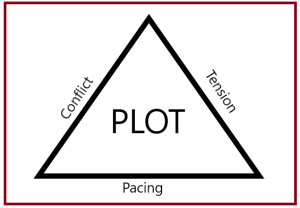
Are the choices they made all necessary to achieve the final goal? Does every scene move the plot forward? Does the action reveal aspects of the characters to the reader that were hidden before?

We all write fluff, but it can be hard to recognize it. Are the scenes you wrote background or word-wandering for word count? If so, they don’t advance the plot. I will cut them and save them in a file labeled as background.

Next, I will look at the outline of the story structure again. In every second draft, I ask these questions:

  • Who is the story about now? Are the main characters still the original protagonist and antagonist, or have side characters stolen the show? If so, I would need to rewrite it so that the characters who best serve the story are the center of focus.
  • How high are the stakes if the protagonist fails? Why should we care?
  • How high are the stakes for the antagonist, and why should we care?
  • What do these two characters want most now that they have had a chance to evolve? Did the quest remain the same, or has a new goal emerged?
  • Did the protagonist grow and evolve as a person? If not, why not? Or did they turn to the dark side, becoming an antihero or an antagonist? Is there a new hero?
  • Where are the pivotal places where something important to the logic is missing?

I am going to examine my outline to see what doesn’t need to be included. What should I remove to make the ultimate ending feel more logical? I will write new scenes into the outline, events that push the plot to its conclusion.

I have read many stories that weren’t told in chronological order. Some were successful, but others failed.

Suppose you are going out of chronological order. The plot should still be the same logical chain, but the story might contain flashbacks or memories. I suggest you make a note on your timeline of where these occur so that you don’t repeat information the reader already knows.

Some authors use “flash-forwards,” which can easily make the story arc feel clumsy and unbelievable. I don’t use them myself but have read plenty of books that employ them.

I will tell you now that inserting a flash-forward requires good planning to fit seamlessly into the story and not ruin the mystery.
Good foreshadowing doesn’t tell the story in advance. It offers small clues hidden in the overall picture, hints in the scenery that all is not what it seems. It tantalizes the reader and makes them curious.

Many authors reject the outline process in the first draft because they prefer to “wing it.” The novel I am working on right now was written that way and was fun to write. However, my story has wandered and skipped its way to this point, and now I need to drag it to the conclusion. I will find many places to cut and other areas that need expansion.

This will require more work than if I had planned it and written to an outline, but I am glad I wrote it the way I did. NaNoWriMo 2020 was a good experience. It’s been a long time since I had a novel that insisted on writing itself.
9 Comments

Filed under writing

Submitting to Literary Contests #amwriting

With the advent of December, it’s time to prepare for the 2021 literary contest season.

I recently attended a virtual meeting of one of the professional organizations I belong to, PNWA (Pacific Northwest Writers Association). The discussion revolved around the submission guidelines and rules for their 2021 literary contest.

One point that was brought up and underscored was the importance of following the submission requirements strictly, with no deviations.

A manuscript has the potential of getting 100 points – and I have seen several stellar submissions that did just that.

Be warned, an association like PNWA will take ten points off your submission for each deviation from these requirements, but not more than twenty. If you are starting at 80 points instead of 100, you have already blown your chance.

You might think this is harsh and wonder why they would assess such a penalty.

These are professional organizations, with many best-selling authors in their ranks. They expect their members to have a high standard of professionalism.

Hobbyists generally don’t see the point of these rules and weed themselves out by virtue of not complying. Quite honestly, if an author cannot adhere to a contest’s submission guidelines, their manuscript might also be a mess.

Most writers are hobbyists for many years before they go full time as authors. By the time they decide writing is their career, they will have made all the newbie mistakes. They will better understand how the industry works and what is expected of us, no matter who we are or how great we think our work is.

PNWA and most other literary contests accept submissions through a service like Submittable. All manuscripts will be read “blind.”

Before you click the “submit” button, check and double-check each requirement to ensure your submission complies in full with every step. Once that button has been pressed, there is no turning back.

2015 Nancy Pearl Award

When entering most literary contests, the first rule is: do not include your name anywhere in your manuscript file.

That means that there should be absolutely NO identifying marks on the manuscript to indicate who the author might be. This ensures a fair contest, where each entry is judged on its merits rather than its provenance.

Most contests require submissions to follow specific guidelines, so first up is the font and general layout.

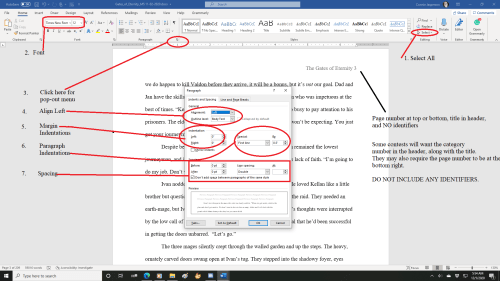
I use MS WORD, but Google Docs and Open Office have similar functions. On the Home tab, click on select all to highlight the entire manuscript.

Go to the font group on the left-hand end of the ribbon. Unless you write with a particular font, the default font, or pre-designed value or setting, will probably say ‘Calibri (Body),’ and the size will be .11.

  • Change font size on the home tab by clicking on the little grey square in the font menu’s right-hand corner and accessing the drop-down menu. Scroll down to Times New Roman and set it to .12. Clicking on that will change the font for the whole thing.
  • On the Home tab, look in the group labeled ‘Paragraph.’ On the lower right-hand side of that group is a small grey square. Click on it. A pop-out menu will appear, and this is where you format your paragraphs.
  • Align left. DO NOT justify the text. In justified text, the spaces between words and letters (known as “tracking”) are stretched or compressed. Justified text aligns with both the left and right margins. It gives you straight margins on both sides, but this type of alignment only comes into play when a manuscript is being made ready for publication.
  • Indentation: leave that alone or reset both numbers to ‘0’ if you have inadvertently altered it.
  • Where it says ‘Special’: on the drop-down menu, select ‘first line.’ On the ‘By’ menu, select ‘0.5.’
  • Line Spacing’: set to ‘double.
  • Click the little box that says, “Don’t add space between paragraphs of the same style.”

Once you have it formatted and submitted, the readers/judges will be examining the work closely. Points will be assessed for each aspect of the submitted piece.

Some of the things they will judge:

Synopsis: When submitting an unpublished novel, the synopsis is critical, as you won’t be submitting the entire manuscript.  Did the synopsis convey the essence of the novel, showing a full arc, including the ending? Did the author fit it into the page/word count as required by the contest rules? Do NOT exceed the word/page count for this. DO include the who, what, when, where, why, and how it ends.

Submission’s Overall Word/Page Count: Most short stories contests are limited to 14 pages, which is around 4000 words. Do not exceed this page/word count. AT ALL.

Novels are different. If the submission is limited to the first twenty pages of a novel, including the synopsis, did the author stick to that rule absolutely? Don’t cut a sentence or paragraph in half—end it a hair short of the upper limit rather than that. Do not exceed the limit, or you will lose 10 points off the top of your score.

In a “blind” contest, your name and reputation won’t come into it at all, so what will your work be judged on?

  1. Plot
  2. Structural arc
  3. Viewpoint
  4. Characterization
  5. Dialogue/Internal Narrative
  6. Conflict/Tension/Pacing
  7. Hooks/Transitions
  8. Setting/Description
  9. Voice
  10. Mechanics: Does the author demonstrate an understanding of grammar, industry practices, etc.?
  11. Appeal (This is purely subjective and genre-driven. Don’t submit a literary fantasy to a sci-fi contest.)

Electronic submissions will be accepted through a service such as Submittable. In fact, Submittable will have a list of open calls for submissions, so check it regularly.

Some contests will still accept mail-in submissions, although this is more labor-intensive and requires someone to process them by hand. Many organizations don’t have that sort of office help, so they will only accept digital submissions.

2020 Nancy Pearl Award

Don’t worry that you won’t be credited for your work if you don’t have your name on it. Your name and bio will be in the Submittable profile and cover letter. Also, your entry will automatically be electronically linked to your profile.

It’s a good idea to go out to Submittable in advance and create a professional profile, with a short, professional bio less than 100 words and in the third person. Keep it simple; keep it professional.

Entry Fees will be listed if there are any. Non-profits who use a service like Submittable will have to charge one, as they must pay for that service.

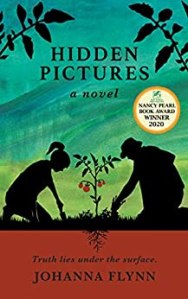
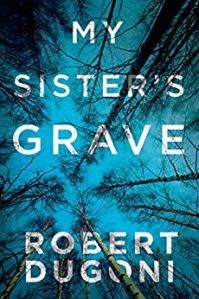
To see what quality of work you are up against if you choose to submit to a professional organization’s literary contest, I highly recommend Robert Dugoni’s My Sister’s Grave, and Johanna Flynn’s Hidden Pictures. Both are winners of PNWA’s Nancy Pearl Award.

“Blind” submissions and strict submission rules level the playing field. Every author, famous and award-winning, or completely unknown, is held to the same standard.

Your work will be judged on its merits, which is the real test of your skill. Some contests give the authors the judge/readers’ critiques. Because there are no preconceptions or bias, they tend to be honest and kindly worded. I think those are well worth any entry fees.

Happy writing, and good luck if you choose to submit to 2021’s upcoming literary contests.

8 Comments

Filed under writing

#FineArtFriday: Hastings: the Front by Theodore Casmir Roussel 1908


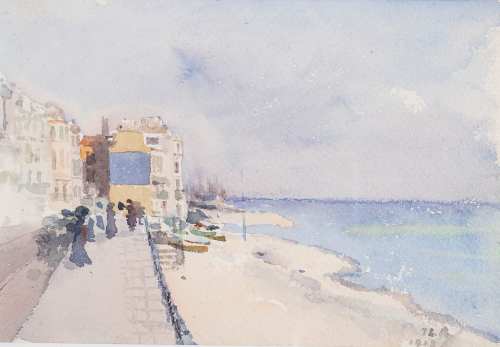
Title: Hastings: the Front.

Medium: Watercolor.

Signed and dated: Theodore Roussel 1908.

Dimensions: 6.75×10 inches. Framed: 13.75×16 inches.”

Hastings is a seaside town in East Sussex on the south coast of England, south east of London. In the 19th and early 20th century, when this painting made, the railway enabled ordinary tourists and visitors to reach the town, and it became a popular seaside resort.

What I love about this painting:

I love watercolors. The medium allows for a dreamy atmosphere, and in this case, the artist has presented us with the impression of a sundrenched afternoon at the seashore. Roussel’s work grew more atmospheric as he grew older, but he was known more for his classically depicted nudes than as an impressionist. However, it’s clear he had an eye for impressionism and the ability to show a story with watercolors.

Tourists stroll along the breakwater in front of the hotels, wearing broad hats and coats. Like many days at the beach on the Washington Coast, where I live, even in summer the wind often carries a chill.

About the Artist, via Wikipedia:

Theodore Casimir Roussel (1847–1926) was a French-born English painter and graphic artist, best known for his landscapes and genre scenes. He came to painting late, in 1872, after his military service had ended, and he was entirely self-taught. His earliest works were scenes of daily life, rendered in the style of the Old Masters. In 1878, he moved to London and, two years later, married the widow Frances Amelia Smithson Bull (1844–1909), a distant collateral relative of James Smithson. In 1885, he met James McNeill Whistler, who became a lifelong friend and mentor.


Credits and Attributions:

Hastings: the Front by Théodore Roussel, Public domain, via Wikimedia Commons

Wikipedia contributors, “Theodore Roussel,” Wikipedia, The Free Encyclopedia, https://en.wikipedia.org/w/index.php?title=Theodore_Roussel&oldid=896039278 (accessed December 3, 2020).

Comments Off on #FineArtFriday: Hastings: the Front by Theodore Casmir Roussel 1908

Filed under #FineArtFriday

The Pros and Cons of Using Editing Software #amwriting

When you complete NaNoWriMo and get that winner’s certificate, you unlock many special deals on various software created for writers. I have tried Scrivener and didn’t find it useful for my writing style, but many people swear by it. My head doesn’t work that way.

Three of the many offers NaNoWriMo winners can get and which I am familiar with are:

All of these are good, reputable programs. Many people ask if I use them in my own work. I use editing software, but I don’t follow their suggestions blindly.

No software can replace knowledge of grammar. An author must have confidence in what they intend to convey and how they wish to say it.

For this reason, editing software is not as useful as we want it to be.

A person with no knowledge of grammar will not benefit from relying on an editing program for advice. There is no way to bypass learning the craft of writing.

I use Grammarly, an editing program for checking my own work. I also use ProWriting Aid. I pay a monthly fee for the professional versions of these two programs. Each one has strengths and weaknesses.

These programs operate on algorithms defined by finite rules.

Not every recommendation is right. However, when the editing program highlights something, I look at the problem sentence carefully. Just knowing that the way I phrased a sentence tripped the program’s algorithms encourages me to look at that passage with a critical eye.

I may not use the program’s suggestion, but something triggered the algorithm. That means my phrasing might need work. I may need to find a better way to get my idea across.

Editing programs will only confuse and mislead you if you don’t understand grammar, sentence construction, paragraph construction, or how to punctuate dialogue.

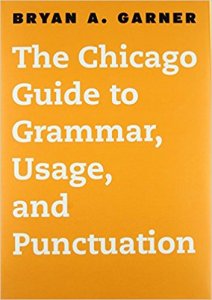
New writers should invest in the Chicago Guide to Grammar, Usage, and Punctuation and learn how grammar works.

You may have found that your word processing program has spellcheck and some minor editing assists. Spellcheck is notorious for both helping and hindering you.

Spellcheck doesn’t understand context, so if a word is misused but spelled correctly, it might not alert you to an obvious error.

  • There, their, they’re.
  • To, too, two.
  • Its, it’s

For me, especially in my first draft, some words are like tics. They fall out of my fingers and into my keyboard randomly and out of my voluntary control. I don’t self-edit as I go because I’m just trying to get the story down. The second and third drafts are where I shape my grammar and phrasing.

With each revision, I locate adverbs, descriptors, qualifiers, and “weed words.” I look at the context of the sentence and decide if they will stay or go. Many will go, but some must stay.

An excellent program to help point out when specific passages are passive and need to be “made active” is ProWriting Aid. I use the professional version for my own work. However, they have a free version that will alert you to a few of the most common problems.

These are expensive purchases and for that reason I would recommend trying the free versions first. The main reason for those who don’t understand the basics of grammar to NOT invest in them is this: these programs are unable to see the context of the work they are analyzing.

“The tea was cool and sweet, quenching her thirst.”

Grammarly suggested replacing quenching with quenched.

ProWriting Aid made the same suggestion.

I have no idea why they make that suggestion. You can see how a person blindly following mechanical advice could go wildly astray.

Context is defined as the parts of a written or spoken statement that precede or follow a specific word or passage, usually influencing its meaning or effect.

Currently, at this stage in our technology, understanding context is solely a human function.

Because context is so important, I am wary of relying on these editing programs for anything other than alerting you to possible comma and spelling malfunctions.

You might disagree with the program’s suggestions. You, the author, have control and can disregard suggested changes if, as illustrated above, they make no sense. I regularly reject weird recommendations.

Good editing software is not cheap, but for my specific needs it has been a worthwhile investment.

If you do choose to invest in some, use your common sense. Remember, you have the final say when it comes to your work.

17 Comments

Filed under writing

Goodbye NaNoWriMo2020 and Hello Revisions #amwriting

Today is the final day of 2020’s NaNoWriMo. Many writers have passed the hurdle and already collected their winners’ goodies. They have ordered their winner’s T-shirt and are embarking on revisions.

Others have decided they’re never going to finish, it’s a waste of time, and they’ll never do this again.

But some will.

The real storytellers, people who can’t completely stifle that dream of writing, will return in several years with a better idea and a realistic plan. They’ll conquer it, and writing will become their passion.

This year, I have so far written over 90,000 words. I wrote the final scenes of Bleakbourne on Heath, the alt-Arthurian serial I lost momentum on and couldn’t finish. Also, I made headway on my other unfinished novel, focusing on my antagonist’s story. In discovering the logic of a tainted relic, I accidentally wrote a backstory that became a novel. It is ¾ of the way done.

Participating in NaNoWriMo for the last ten years has taught me discipline.

It makes me do what is the most challenging thing for me—I have to ignore my inner editor to get my word count.

For that reason alone, I will most likely always “do” NaNoWriMo, even when I am no longer able to be a Municipal Liaison.

I love the rush, the thrill of having written something for myself, something I alone will see and enjoy. But more than that, I love knowing that some of what I have written is good and is worthy of sharing with readers.

When I finally write the last words of my accidental novel, the work will have only begun.

I will set it aside, as I need to gain some distance. I’ll go back to finalizing Bleakbourne on Heath, which will take a couple of weeks, or even a month or two. By the time that book is ready for the editor, I’ll be able to see my other work with fresh eyes.

Writers tell me all the time how new and intriguing characters pop up and take their tale in a different direction. Sometimes this works out well. Other times, not so much. I floundered for years on my first novel and can tell you now, it will never be published.

I didn’t know the first thing about how to write a novel, which is apparent when you look at that old manuscript. I didn’t realize that authors are sculptors. The first draft is not the finished product. It’s only a roughly shaped block of clay.

In that glorious moment where we write the final words of our novel, we see it as a precious object, as if it were complete.

Trust me, others won’t see the story the way you do just yet.

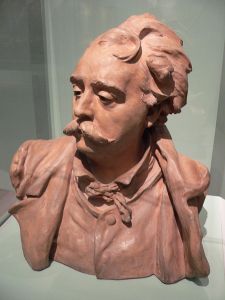
A block of clay is only a lump of sticky dirt, but a sculptor envisions what that mass of soil can become. They begin by scraping the layers away until the real shape emerges. That is what we must do.

We scrape away, scene by scene, removing the extraneous fluff in one place and adding more substance in others.

Each chapter is made up of scenes. It might be one scene or several strung together, but these scenes have an arc to them. They’re shaped by action and reaction.

These arcs of action and reaction begin at point A and end at point B. Each launching point will land on a slightly higher point of the story arc.

Strung together, these scenes give form to the narrative, with a beginning, middle, and end.

Often, the middle is where you discover that you have lost your novel’s overall plot. This happens to me for several reasons.

First, it can happen because I deviate from the outline, and while my new idea is better, it lacks something. I go back to the original idea and rewrite it so that it conforms to that outline.

We try to figure out why the plot has failed. I have to ask myself, did the original quest turn out to be a MacGuffin? The MacGuffin’s importance to the story is not the object or goal itself, but rather its effect on the characters and their motivations.

Many times, it is inserted into the narrative with little or no explanation, as the sole purpose of the MacGuffin is to move the plot forward.

Every story has a quest of some sort. It can be a personal quest for enlightenment or a search for the Holy Grail. No matter what, the characters want something, and that thing must be sharply defined.

If the quest has become a MacGuffin, the real quest is not for the object. It is a search for power, love, money, or personal growth and must be given more prominence. The effect that searching for it has on the characters must be clearly shown.

We peel back the layers of our first draft. What symbolism have we subconsciously inserted into the story, clues that we can work with?

Authors always leave hints and symbols in their work, signs of who they are and what they believe. Sometimes it is intentional, but often it is our subconscious writer-mind in action.

If we can identify the symbolic aspect of the plot, we have the opportunity to amplify it.

I have often used the film, The Matrix as an example of how symbolism, intentionally applied, is an underpinning of world-building. When it’s done right, it can show the story in a more focused light.

In one of my favorite scenes, when Neo answers the door and is invited to the party, he at first declines. But then he notices that Du Jour, the woman with Choi, bears a tattoo of a white rabbit. He remembers seeing the words: follow the white rabbit, on his computer.

Curious and slightly fearful of what it all means, he changes his mind and goes to the party, setting a sequence of events in motion. The white rabbit tattoo is a symbol, an allegorical reference to Alice in Wonderland, a subliminal clue that things are not what they seem.

What is the deeper story? With each pass through our manuscript, we sharpen the final product, scrape away from this part and add some over here, rewording and redefining as we go.

Ultimately, we will have exposed the core of our original vision, revealed the parts we couldn’t articulate at first. Some things only become more apparent to us as we dig deeper.

This is why, while many people can write, not everyone can write well. It takes patience and time to cut away the fat and bring out the core of the plot, the story that needs to be told. It also takes practice.

Digging the deeper story out doesn’t happen overnight.

A first draft is our block of clay, and after much effort, the final draft is our finished sculpture. November 30th has arrived, and NaNoWriMo 2020 is over.

Now the real work begins.


Credits and Attributions

David Monniaux, CC BY-SA 3.0 <http://creativecommons.org/licenses/by-sa/3.0/&gt;, via Wikimedia Commons

Auguste Rodin (French, 1840-1917): Bust of Albert-Ernest Carrier-Belleuse, 1882, terracotta, Iris & B. Gerald Cantor Center for Visual Arts, Stanford University Campus, Palo Alto, United States Wikimedia Commons contributors, “File:Rodin Carrie-Belleuse p1070141.jpg,” Wikimedia Commons, the free media repository, https://commons.wikimedia.org/w/index.php?title=File:Rodin_Carrie-Belleuse_p1070141.jpg&oldid=451362532 (accessed November 29, 2020).

5 Comments

Filed under writing

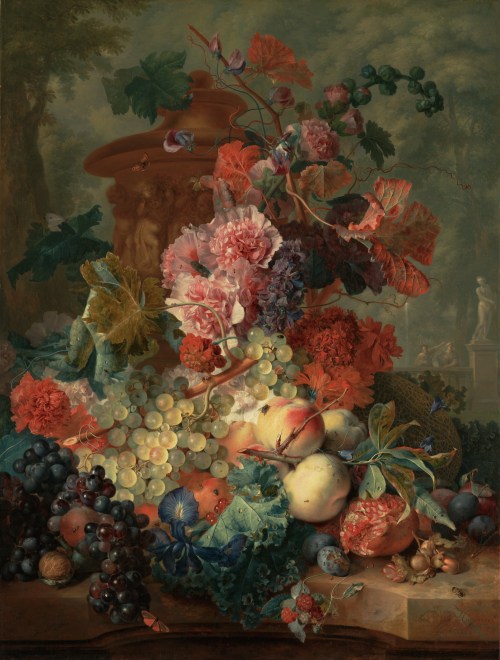
FineArtFriday: Fruit Piece by Jan van Huysum 1722

Fruit Piece by Jan van Huysum (Dutch, 1682 – 1749)– artist (Dutch)

Genre: still-life

Date: 1722

Medium: oil on panel

Dimensions: Height: 800 mm (31.49 in); Width: 610 mm (24.01 in)

What I love about this painting:

This scene depicts the very essence of abundance and comfort. Every piece of fruit in this image is perfect, begging to be eaten, every flower wishes to be admired. Carnations, grapes, plums, figs, apples, a melon, raspberries, and numerous other fruits occupy the center of the image. Butterflies have found the flowers.

In the background, slightly out of focus as if the centerpiece is seen through a camera lens, we have a lush garden, a fantasy of earthly paradise. Far to the rear of the scene, painted as if they just happened to stray into it, two figures on a low bridge carry on a quiet conversation beneath a graceful statue.

More than any other artist of his time, van Huysum understood how to show the “life” aspect of still-life by combining fantasy with the faithful reproduction of perfect, ripe fruit.

Yesterday, here in the US, we enjoyed our lockdown pandemic version of Thanksgiving. Despite not hosting the large extended family gathering we usually do, we offered our thanks for the abundance in our lives, the multitude of blessings for which we are truly grateful.

This painting celebrates food in plentiful, mouthwatering profusion, a true blessing for which we should all be thankful.

About the Artist: The website at the National Gallery says:

Jan van Huysum (1682 – 1749)  was the last of the distinguished still life painters active in the Northern Netherlands in the 17th and early 18th centuries, and an internationally celebrated artist in his lifetime. Although he specialised in flower still lifes, van Huysum also painted a few landscapes.

His early works are more concentrated in design than his elaborate later paintings, like the Gallery’s Flowers in a Terracotta Vase, with its lighter background and superabundance of detail.

Van Huysum was a native of Amsterdam and was trained, according to Arnold Houbraken, by his father, who was also a still life painter. His first dated work is of 1706.

Van Huysum often travelled to horticultural centres like Haarlem so he could make sketches of rare and unusual flowers. During his lifetime, his flower paintings were sold for as much as 2,000 guilders, and he had famous patrons including the Duc d’Orléans, William VIII, Landgrave of Hesse-Kassel, and Sir Robert Walpole.


Credits and Attributions:

Wikimedia Commons contributors, “File:Jan van Huysum (Dutch – Fruit Piece – Google Art Project.jpg,” Wikimedia Commons, the free media repository, https://commons.wikimedia.org/w/index.php?title=File:Jan_van_Huysum_(Dutch_-_Fruit_Piece_-_Google_Art_Project.jpg&oldid=507579017 (accessed November 25, 2020).

National Gallery Contributors, Biography of Jan van Huysum (1682 – 1749) | National Gallery, London ©2020 National Gallery, London  https://www.nationalgallery.org.uk/artists/jan-van-huysum (accessed November 25, 2020).

Comments Off on FineArtFriday: Fruit Piece by Jan van Huysum 1722

Filed under #FineArtFriday

Conferring Power: logic and limitations #amwriting

We are now in the final six days of NaNoWriMo. My region is small, only 174 active writers, but we’re moving along well. As a whole, we just crested the four million word mark. That’s not as much as some regions, but wow!

In our forums on Discord and Facebook, the conversation sometimes turns to the use of magic or science in a narrative. Many of these authors are new at this and need a place to safely discuss their work, so I make it my business to not impose my opinions in either forum.

Besides, I have this platform for ranting about writing. So, how do I feel about science and magic?

In the words of Egon in Ghostbusters, “Don’t cross the streams.”

I have said this before, but I feel the need to repeat it. Science is not magic, and it should not feel to a reader as if it were.

Science is logical, rooted in the realm of real and theoretical physics. The scientific method objectively explains nature and the world around us in a reproducible way. Skepticism and peer review are fundamental parts of the process.

Those who read and write hard science fiction are often employed in the field of science in some capacity. They know the difference between reality and fantasy. The same goes for those who read fantasy—they are often employed in fields that require critical thinking.

Often, readers of both genres are avid gamers. Gamers learn to develop skillsets within strict parameters to advance in the game. Thus, logic and limitations define how much enjoyment they get from a gaming or reading experience.

I read a great many books in all genres. If I have one complaint, it is that many authors indulge in mushy science or magic. They make it up as they go, which is what we all do.

But when they get to the editing stage, they don’t go back and look for the contradictions in their magic or science, the places where a reader can no longer suspend their disbelief.

Having magic conveys power in the same way that having superior technology does. It should be held to the same standards.

If magic is a tool that your characters rely on, it should be believable. The science of magic is an underlying, invisible layer that is part of my world-building process.

The following is my list of places where magic and technology converge in genre fiction:

  1. The number of people who can use either magic or technology should be limited.
  2. The ways that magic or technology can be used should be limited.
  3. The majority of people are limited to one or two kinds of magic/technology. Only specific mages/technicians have the ability to make use of all forms of magic/technology.
  4. There must be strict, inviolable rules regarding what each kind of magic/technology can do.
  5. The conditions under which this magic/technology will work must be clearly defined.
  6. There must be some conditions under which the magic/technology will not work.
  7. There must be limits to the damage magic/technology can do as a weapon or the healing it can perform.
  8. Does the wielder of this magic/technology pay a physical/emotional price for the use?
  9. Does the wielder of this magic/technology pay a physical/emotional price for abusing it?
  10. Is the learning curve steep and sometimes lethal?

Personal power and how we confer it is the layer of world-building where writers of science and writers of magic come together.

  • Magic and the ability to wield it confers power.
  • Science and superior technology do the same.

For the narrative to have any real conflict, the enemy must have access to equal or better Science/Magic.

Often in the case of magic, the protagonist and their enemy are not from the same “school.” This means that the author has two systems and sets of rules to design for that story.

The same goes for technology. One group may have found a way to exploit physics that places the other group at a disadvantage. This is where the tension comes into the story.

WE authors must create the rules of magic or the limits of science for both the protagonist and antagonist. We must do it in the first stages of the writing process.

It will only require a small bit of time and maybe fifteen minutes of writing to create a system that satisfies the above ten requirements. This way, you will be sure the logic of your magic/technology has no hidden flaws.

When you take the time to research science technologies or create magic systems, you create a hidden framework that will support and advance your plot. Limits force us to be creative, to find alternative ways to resolve problems.

Within either science or magic, there can be an occasional exception to a rule, but it must be clear to the reader why that exception is acceptable.

There must be an obvious, rational explanation for that exception.

This is an underpinning of the plot and is a foundational component of the backstory. The only time the reader needs to know these systems exist is at the moment it affects the characters and their actions.

The best background information comes out at the moment that knowledge affects the story. It emerges naturally in conversations or in other subtle ways.

By not baldly dropping it on the reader in paragraph form, the knowledge becomes a normal part of the environment rather than an info dump.

5 Comments

Filed under writing

Murder and the Dry Well of Inspiration #amwriting

We have arrived at week three of 2020’s NaNoWriMo (National Novel Writing Month). I’m still zooming along in my accidental novel. However, this is the place in the month where many writers will fall by the way, as they lose the plot and then lose momentum.

The well of inspiration has gone dry.

When we are writing a story that encompasses 50,000 to 100,000 words, these mental stopping places are how we end up with bunny trails to nowhere. We’re trying to force getting our word count, so we go a bit off the rails.

There are ways around that.

If your employment isn’t a work-from-home kind of job, using the note-taking app on your cellphone to take down notes during business hours will be frowned on. In that case, I suggest keeping a pocket-sized notebook and pen to write those ideas down as they come to you.

This is an old-school solution but will enable you to discreetly make notes whenever you have an idea that would work well in your story. The best part is, you don’t appear to be distracted or off-task.

For me, ideas occur when I stop “pressing my brain” to work when it’s on its last legs. Trust me, pounding out 1,667 or more new words a day severely tests both your creativity and endurance.

We know that arcs of action drive the plot. However, random, disconnected events inserted for shock value can derail the best story. Therefore, when I am brainstorming where to go next in my plot, I keep both the ending and overall logic of how to get there in mind.

At the outset of the story, we find our protagonist and see him/her in their familiar surroundings. Once we have met them and seen them in their comfort zone, the inciting incident occurs.

This is the first point of no return and is often where an author’s ideas run out.

They had only visualized the character and the problem but hadn’t thought beyond that point.

A point of no return comes into play in every novel to some degree. The protagonists are in danger of losing everything because they didn’t recognize the warning signs, and they are pushed to the final confrontation, whether they are ready for it or not.

I’m writing a fantasy, and I know what must happen next in the novel because it’s an origin story. I’m writing it from a historical view. I see how this tale ends and am merely writing the motivations for that ending.

Try to identify the protagonist’s goals early on. The words will come as you clarify why the protagonist must struggle to achieve them.

  • How does the protagonist react to being thwarted in their efforts?
  • How does the antagonist currently control the situation?
  • How does the protagonist react to pressure from the antagonist?
  • How does the struggle deepen the relationships between the protagonist and their cohorts/romantic interest?
  • What complications arise from a lack of information regarding the conflict?
  • How will the characters acquire that necessary information?

Suppose your main character doesn’t want something bad enough to do just about anything to achieve it over the next couple hundred pages. In that case, they don’t deserve to have a story told about them.

At the inciting incident, our hero just wants to go back to their comfort zone. They want that desperately, but things happen that prevent it.

  1. What are the events that keep the main characters slogging through the roadblocks to happiness?
  2. Why should the reader care? Every scene and conversation will push the characters closer to either achieving that goal or failing, so if you make it a deeply personal quest, the reader will become as invested in it as you are.

Everything you write from the inciting incident to the last page will detail the quest and answer that second question. Your protagonist and antagonist must both desire nothing more than to achieve that objective.

If they care about the outcome, the reader will too.

I find it helps to have some idea of what the ending will be. Now, as I write my current unplanned novel, a broad outline of my intended story arc is evolving. As I’ve mentioned before, I keep my notes in an Excel workbook. It contains maps, calendars, and everything pertaining to any novel set in that world, keeping it in one easy to find place.

When logic forces things to change as I am writing, as it always does, I make notes to the growing outline and update my maps.

If you are stuck, it sometimes helps to go back to the beginning and consider these questions:

  • What is the goal/objective?
  • Is the objective compelling enough to warrant risking everything to acquire it?
  • What choices will the protagonist have to make that challenge their moral values and sense of personal honor?
  • Who is the antagonist? What do they want, and what are they willing to do to achieve it? Are they facing ethical quandaries too?

Every obstacle we throw in the path to happiness for both the protagonists and their opposition forces change and shapes the direction of our narrative.

When your creative mind needs a rest, step away from the keyboard, and do something else for a while.  I find that when I take a break to cook or clean out a corner, random ideas for what to do next in my novel will occur to me.

Sometimes, these little flashes of inspiration are what I need to carry me a few chapters further into the novel.

Finally, let’s talk about murder as a way to kickstart your inspiration.

I suggest you don’t resort to suddenly killing off characters just to get your mind working. Readers become frustrated with authors who randomly kill off characters they have grown to like.

When a particular death was planned all along, it is one thing, but developing characters is a lot of work. If you kill off someone with an important role, who or what will you replace them with?

You may need to replace that character later, so plan your deaths accordingly.

in the meantime, happy writing! May the words flow freely for you and may you never run out of new ideas to write.

5 Comments

Filed under writing

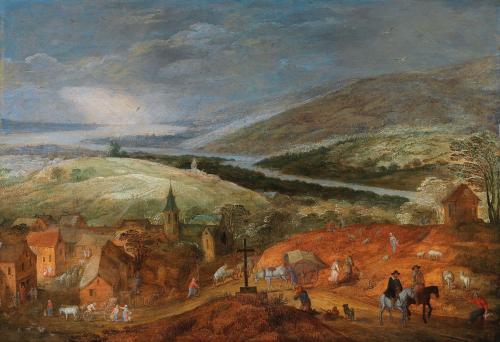
#FineArtFriday: Mountain River Landscape, Jan Brueghel the younger and Joos de Momper the Younger

A collaborative work by:

Jan Brueghel the Younger  (1601–1678)

Joos de Momper the Younger  (1564–1635)

Title:    An extensive mountainous river landscape with travellers near a village

Date:   by 1678

Medium: oil on panel

Dimensions: Height: 46.5 cm (18.3 in); Width: 66 cm (25.9 in)

Collection: Private collection

What I like about this painting:

There is an intensity, a richness of color in the foreground, and a subtle chastisement the subject matter of this picture.

In the center we have a beggar on his knees and praying before a cross, with his worldly possessions stacked beside him and his dog patiently waiting. All around him, the world is going about its business. Shepherds are moving their flocks from one field to another, a merchant urges his horse-drawn cart down the hill. Further down the hill, another merchant unloads a wagon. At the right of the beggar, two travelers on horseback ignore the outstretched hand of yet another beggar, this one an old woman.

This painting is relatively less known, a scene composed and executed by two prolific artists, both of whom were the sons of two of the more famous artists of the 17th century.

At first glance this seems like an ordinary bucolic view of a village and surrounding countryside. Yet, I think the lesson they offer us is clear—we go through life relatively comfortably, unaware of the opportunities for charity that are all around us.

Both artists made their livings from their work so there was a market for what they produced. For both Brueghel and de Momper, their fathers (and in Brueghel’s case, his grandfather ) were hard acts to follow.

About the Artists, via Wikipedia:

Joos de Momper the Younger  primarily painted landscapes, the genre for which he was highly regarded during his lifetime. Only a small number of the 500 paintings attributed to de Momper are signed and just one is dated. The large output points to substantial workshop participation. He often collaborated with figure painters such as Frans Francken II, Peter Snayers, Jan Brueghel the Elder and Jan Brueghel the Younger, usually on large, mountainous landscapes, whereby the other painters painted the staffage (people) and de Momper the landscape. His works were often featured in the prestigious gallery paintings of collections (real and imagined) from the early seventeenth century.

Jan Brueghel the Younger was born and died in the 17th century in Antwerp. He was trained by his father and spent his career producing works in a similar style. Along with his brother Ambrosius, he produced landscapes, allegorical scenes and other works of meticulous detail. Brueghel also copied works by his father and sold them with his father’s signature. His work is distinguishable from that of his parent by being less well executed and lighter.

In an episode of BBC’s Britain’s Lost Masterpieces broadcast in November 2019, a very badly damaged picture of a village scene, whose panel has spilt into two pieces, was located at Birmingham Art Gallery. Following a complete restoration by Simon Gillespie, the landscape was attributed to Joos de Momper and the figures were attributed to Jan the Younger.


Credits and Attributions:

Wikimedia Commons contributors, “File:Jan Brueghel II and Joos de Momper II – An extensive mountainous river landscape with travellers near a village.jpg,” Wikimedia Commons, the free media repository, https://commons.wikimedia.org/w/index.php?title=File:Jan_Brueghel_II_and_Joos_de_Momper_II_-_An_extensive_mountainous_river_landscape_with_travellers_near_a_village.jpg&oldid=345270137 (accessed November 19, 2020).

Wikipedia contributors, “Jan Brueghel the Younger,” Wikipedia, The Free Encyclopedia, https://en.wikipedia.org/w/index.php?title=Jan_Brueghel_the_Younger&oldid=988772158 (accessed November 19, 2020).

Wikipedia contributors, “Joos de Momper,” Wikipedia, The Free Encyclopedia, https://en.wikipedia.org/w/index.php?title=Joos_de_Momper&oldid=988664019 (accessed November 19, 2020).

Comments Off on #FineArtFriday: Mountain River Landscape, Jan Brueghel the younger and Joos de Momper the Younger

Filed under #FineArtFriday

Foreshadowing #nanowrimo2020 #amwriting

November is half over, and we are on the downward slide for NaNoWriMo 2020. This is a good time to think about where you are taking your story.

Good foreshadowing is crucial. Suppose you have been working from an outline. In that case, you should have a few clues embedded in the first quarter of the story to subliminally alert the reader that things are not what they seem. These are little warning signs of future events.

For those who wing it, this happens on a subconscious level, but it does happen. Clumsy foreshadowing or neglecting to foreshadow are things we do when laying down our story’s first draft.

Recognizing those signals can be a challenge unless you have a plan.

When a possibility is briefly, almost offhandedly mentioned, but almost immediately overlooked or ignored by the protagonists, that is foreshadowing.

Some readers will miss the suggested possibility just as the unsuspecting characters do. Other readers will guess what is going on.

We subtly insert small hints, little offhand references to future events. If the narrative is well-written, readers will stick with it as they will want to see how it plays out.

The most crucial aspect of foreshadowing is the surprise when all the pieces fall into place. This is the moment when the reader says, “I should have seen that coming.”

We have many reasons to pursue good foreshadowing skills. In my opinion, the most important is that it helps avoid using the clumsy Deus Ex Machina (pronounced: Day-us ex Mah-kee-nah) (God from the Machine) as a way to miraculously resolve an issue.

A Deus Ex Machina occurs when, toward the end of the narrative, an author inserts a new event, character, ability, or otherwise resolves a seemingly insoluble problem in a sudden, unexpected way.

Foreshadowing also helps us avoid the opposite ungainly device, the Diabolus Ex Machina (Demon from the machine). This is the bad guy’s counterpart to the Deus Ex Machina.

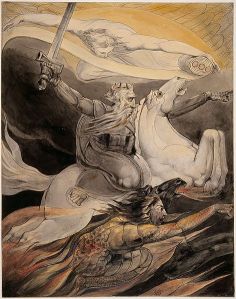
Death on a Pale Horse, William Blake c. 1800 (via Wikimedia Commons)

That occurs when the author suddenly realizes the evil his character faces isn’t evil enough. We see the sudden introduction of an unexplained new event, character, ability, or object designed to ensure things suddenly get much worse for the protagonists.

As a reader, I hate it when a character suddenly develops a new skill or knowledge without explanation. When this happens, it’s usually explained away as a Chekhov’s Skill.

You need to mention previous examples of the characters using or training that skill. Without briefly foreshadowing that ability, the reader will assume the character doesn’t have it.

This is when the narrative becomes unbelievable.

Literature and the expectations of the reader are like everything else. They evolve and change over the centuries.

In genre fiction today, a prologue may or may not be a place for foreshadowing. This is because modern readers don’t have the patience to wade through large chunks of exposition dumped in the first pages of a novel.

Shakespeare used both exposition and foreshadowing. Larger events may be foreshadowed through the smaller events that precede them.

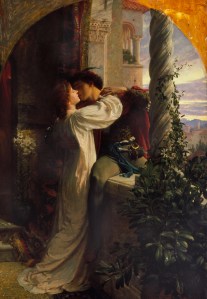
Let’s look at Romeo and Juliet and the scene where Benvolio is trying to talk Romeo out of his infatuation for Rosaline.

“Take thou some new infection to thy eye,

And the rank poison of the old will die.” 

In other words, “The minute you see a different girl, you’ll forget this one, Bro.”

Benvolio’s advice proves to be correct because as soon as Romeo lays eyes on Juliet, he forgets his obsession with Rosaline.

And again, later, when Benvolio brings the news that Mercutio is dead, Romeo says,

“This day’s black fate on more days doth depend; 

This but begins the woe, others must end.”

Romeo is predicting that Mercutio’s death is a disaster for everyone and feels as if he is racing toward an unknown future.

In that moment, we see that Romeo is deeply aware that he has reached a point of no return.

He will fight Tybalt to avenge Mercutio because his society requires it. Therefore, he must duel but is fully aware that killing Tybalt won’t resolve anything. Instead, the murder will only perpetuate the problem.

Romeo has seen the foreshadowing and knows he is no longer in control of his fate.

Inserting small hints of what is to come into your narrative gives the protagonists an indication of where to go next.

It tantalizes a reader and keeps them turning the page.


Credits and Attributions:

Wikimedia Commons contributors, “File:DickseeRomeoandJuliet.jpg,” Wikimedia Commons, the free media repository, https://commons.wikimedia.org/w/index.php?title=File:DickseeRomeoandJuliet.jpg&oldid=431079125 (accessed November 17, 2020).

Painting: Death on a Pale Horse, Commissioned from Blake and acquired by Thomas Butts c. 1800 (via Wikimedia Commons)

9 Comments

Filed under writing