Tag Archives: 15th century art

#FineArtFriday: Saint George and the Dragon by Paolo Uccello

paolo_uccello_stgeorge_and_dragonArtist:  Paolo Uccello (1397–1475)

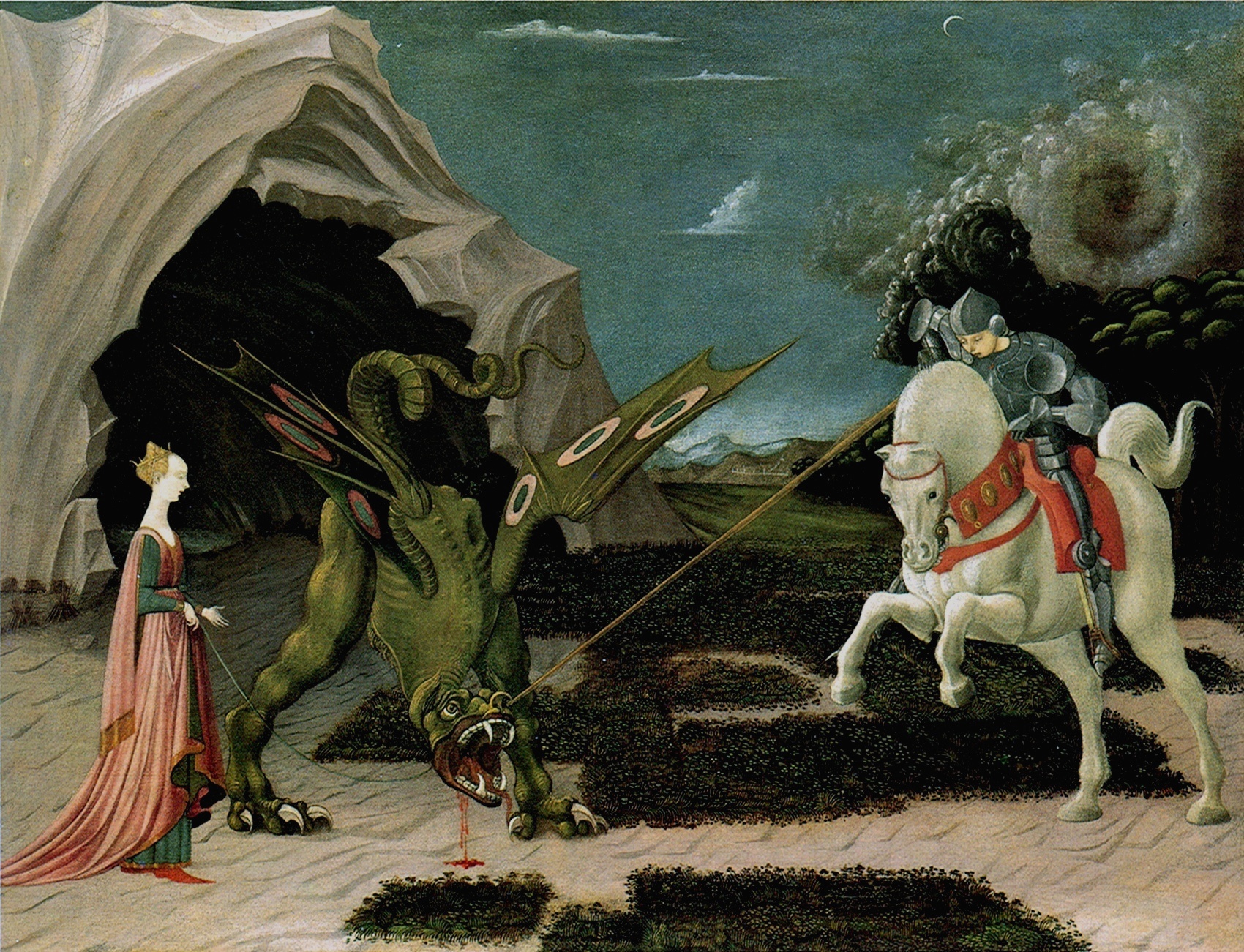
Title: Saint George and the Dragon

Medium: oil on canvas

Dimensions: Height: 57 cm (22.4 in); Width: 73 cm (28.7 in)

The above painting by Paolo Uccello, from around 1470, is a surreal, stylized retelling of the legend of Saint George and the Dragon. The legend tells of the knight slaying a dragon that demanded human sacrifices. With the slaying of the dragon, the hero has saved the princess who was chosen to be the next offering.

Nothing looks real except the dragon which is nightmare come to life. I love the hyper-heroic way Uccello portrayed horses. The people are pallid, with no personality to their features. The dragon and the horse are alive, as if the scene is about them only. All the passion of the moment converges in the dragon and the horse.

Done in oil on canvas, the painting was one of the last of Uccello’s creations.

According to Wikipedia, the Fount of All Knowledge: The narrative (of Saint George) has pre-Christian origins (Jason and MedeaPerseus and AndromedaTyphon, etc.), and is recorded in various saints’ lives prior to its attribution to St George specifically. It was particularly attributed to Saint Theodore Tiro in the 9th and 10th centuries, and was first transferred to Saint George in the 11th century. The earliest narrative record of Saint George slaying a dragon is found in a Georgian text of the 11th century. [1]

About the Artist (via Wikipedia)

Born Paolo di Dono, his nickname, Uccello (of the birds), came from his fondness for painting birds. He worked in the Late Gothic tradition, emphasizing colour and pageantry rather than the classical realism that other artists were pioneering. His style is best described as idiosyncratic (eccentric or unique), and he left no school of followers.

With his precise and analytical mind, Paolo Uccello tried to apply a scientific method to depict objects in three-dimensional space. In particular, some of his studies of the perspective foreshortening of the torus are preserved, and one standard display of drawing skill was his depiction of the mazzocchio.

In the words of G. C. Argan: “Paolo’s rigour is similar to the rigour of Cubists in the early 20th century, whose images were more true when they were less true to life. Paolo constructs space through perspective, and historic event through the structure of space; if the resulting image is unnatural and unrealistic, so much the worse for nature and history.”

The perspective in his paintings has influenced many famous painters, such as Piero della FrancescaAlbrecht Dürer and Leonardo da Vinci, to name a few. [2]


Credits and Attributions:

Wikimedia Commons contributors, “File:Paolo Uccello 047.jpg,” Wikimedia Commons, the free media repository, https://commons.wikimedia.org/w/index.php?title=File:Paolo_Uccello_047.jpg&oldid=308602797  (accessed January 18, 2019).

Wikipedia contributors, “Saint George,” Wikipedia, The Free Encyclopedia, https://en.wikipedia.org/w/index.php?title=Saint_George&oldid=1029544183 (accessed June 23, 2021). [1]

Wikipedia contributors, “Paolo Uccello,” Wikipedia, The Free Encyclopedia, https://en.wikipedia.org/w/index.php?title=Paolo_Uccello&oldid=873078862  (accessed January 18, 2019). [2]
Comments Off on #FineArtFriday: Saint George and the Dragon by Paolo Uccello

Filed under #FineArtFriday, writing

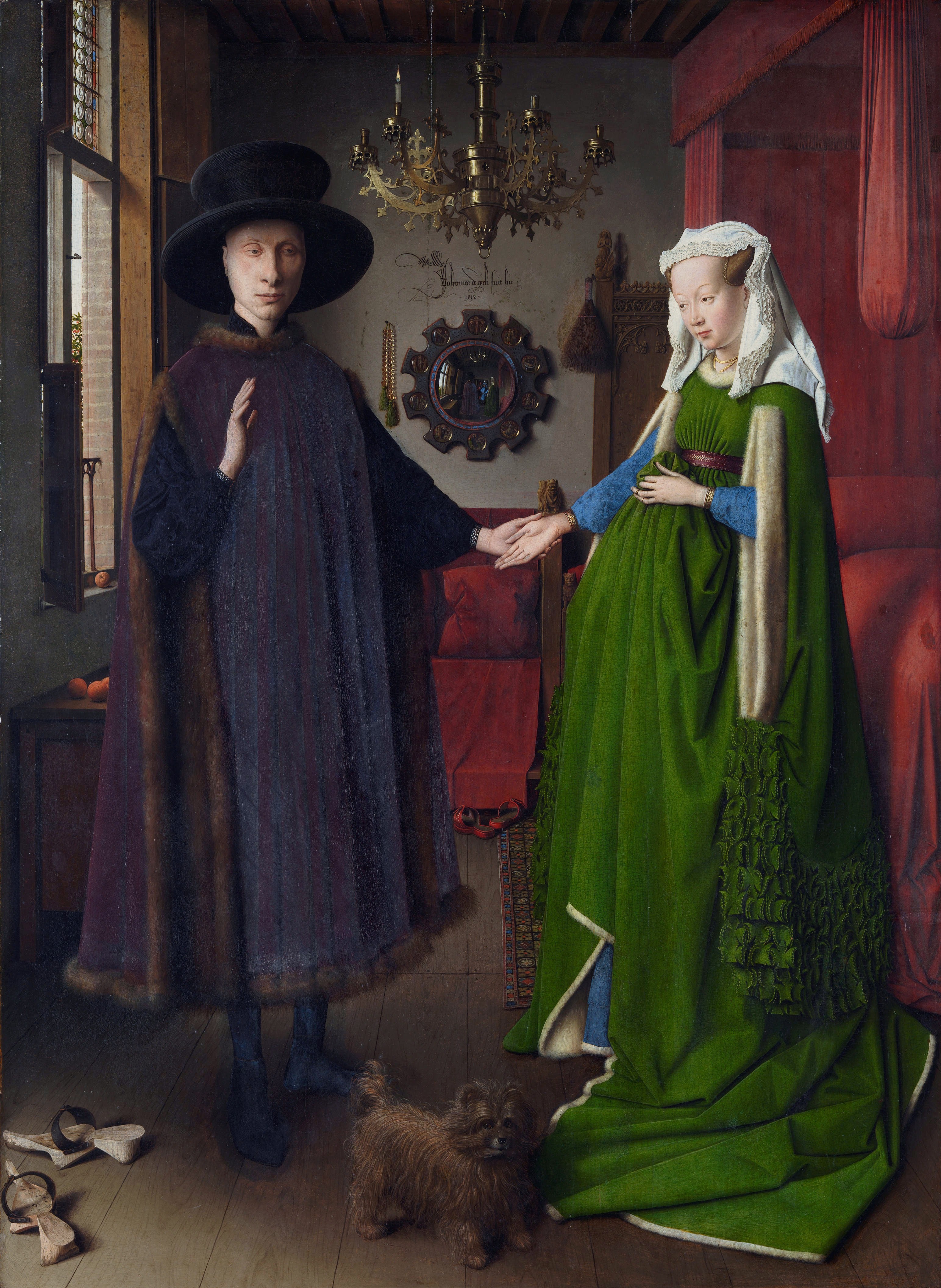
#FineArtFriday: The Arnolfini Portrait by Jan van Eyck 1434

Artist: Jan van Eyck  (circa 1390 –1441)

Title: The Arnolfini Portrait

Genre: portrait

Date: 1434

Medium: oil on panel

Dimensions: Height: 82 cm (32.2 in); Width: 59.5 cm (23.4 in)

Collection: National Gallery

About this painting, via Wikipedia:

The Arnolfini Portrait (or The Arnolfini WeddingThe Arnolfini Marriage, the Portrait of Giovanni Arnolfini and his Wife, or other titles) is a 1434 oil painting on oak panel by the Early Netherlandish painter Jan van Eyck. It forms a full-length double portrait, believed to depict the Italian merchant Giovanni di Nicolao Arnolfini and his wife, presumably in their residence at the Flemish city of Bruges.

What I love about this painting:

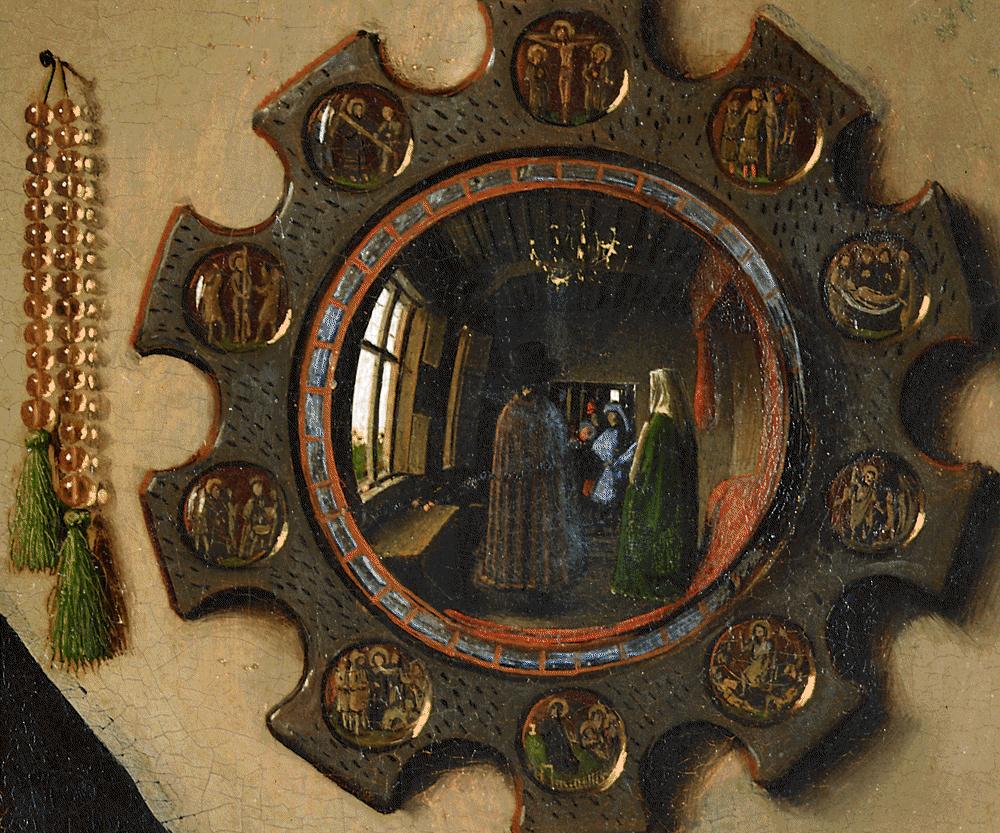
The painting is signed, inscribed, and dated on the wall above the mirror: “Johannes de eyck fuit hic 1434” (Jan van Eyck was here 1434).  This signature, made to look as if it were an inscription explaining the mirror over which it is centered, is a shining example of the sharp wit the later Netherlandish painters frequently inserted into their pictures.

I suspect his inclusion of subtle humor in his works gave permission to those painters who followed in his footsteps, such as the great Bruegel dynasty.

The colors of the garments are deep and rich. These were expensive clothes, completely befitting a wealthy merchant and his wife. In regard to the controversy which is explained below – yes, this painting is steeped in allegory and symbolism, down to the clogs in the left hand corner placed as if they are going out of the picture. In some cultures, a pair of shoes placed like that symbolizes an imminent departure, usually death.

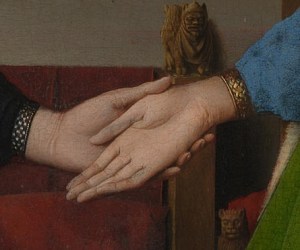
All van Eyck’s work was heavily symbolic. But she appears to be in the late stages of a pregnancy. To me, given the societal norms of the Netherlands in the year 1434, this means the picture shows a married couple. If they were not actually married, it seems unlikely they would have commissioned a portrait showing her in that condition. In fact, and this will probably expose my self-taught ignorance of art history, it makes me wonder why there is a controversy about their marital status at all.

And the mirror…oh my. That mirror is brilliant.

The Controversy, via Wikipedia:

In 1934 Erwin Panofsky published an article entitled Jan van Eyck’s ‘Arnolfini’ Portrait in the Burlington Magazine, arguing that the elaborate signature on the back wall, and other factors, showed that it was painted as a legal record of the occasion of the marriage of the couple, complete with witnesses and a witness signature. Panofsky also argues that the many details of domestic items in the painting each have a disguised symbolism attached to their appearance. While Panofsky’s claim that the painting formed a kind of certificate of marriage is not accepted by all art historians, his analysis of the symbolic function of the details is broadly agreed, and has been applied to many other Early Netherlandish paintings, especially a number of depictions of the Annunciation set in richly detailed interiors, a tradition for which the Arnolfini Portrait and the Mérode Altarpiece by Robert Campin represent the start (in terms of surviving works at least).

Since then, there has been considerable scholarly argument among art historians on the occasion represented. Edwin Hall considers that the painting depicts a betrothal, not a marriage. Margaret D. Carroll argues that the painting is a portrait of a married couple that alludes also to the husband’s grant of legal authority to his wife. Carroll also proposes that the portrait was meant to affirm Giovanni Arnolfini’s good character as a merchant and aspiring member of the Burgundian court. She argues that the painting depicts a couple, already married, now formalizing a subsequent legal arrangement, a mandate, by which the husband “hands over” to his wife the legal authority to conduct business on her own or his behalf (similar to a power of attorney). The claim is not that the painting had any legal force, but that van Eyck played upon the imagery of legal contract as a pictorial conceit. While the two figures in the mirror could be thought of as witnesses to the oath-taking, the artist himself provides (witty) authentication with his notarial signature on the wall.


Credits and Attributions:

Wikimedia Commons contributors, “File:Van Eyck – Arnolfini Portrait.jpg,” Wikimedia Commons, the free media repository, https://commons.wikimedia.org/w/index.php?title=File:Van_Eyck_-_Arnolfini_Portrait.jpg&oldid=446521642 (accessed September 4, 2020).

Wikimedia Commons contributors, “File:The Arnolfini Portrait, détail (2).jpg,” Wikimedia Commons, the free media repository, https://commons.wikimedia.org/w/index.php?title=File:The_Arnolfini_Portrait,_d%C3%A9tail_(2).jpg&oldid=428220496 (accessed September 4, 2020).

Wikimedia Commons contributors, “File:Arnolfini Portrait 3.jpg,” Wikimedia Commons, the free media repository, https://commons.wikimedia.org/w/index.php?title=File:Arnolfini_Portrait_3.jpg&oldid=428554231 (accessed September 4, 2020).

2 Comments

Filed under #FineArtFriday, writing

#FineArtFriday: Portrait of a Lady by the workshop of Sandro Botticelli ca. 1480

  • Artist: Workshop of Sandro Botticelli  (1445–1510)
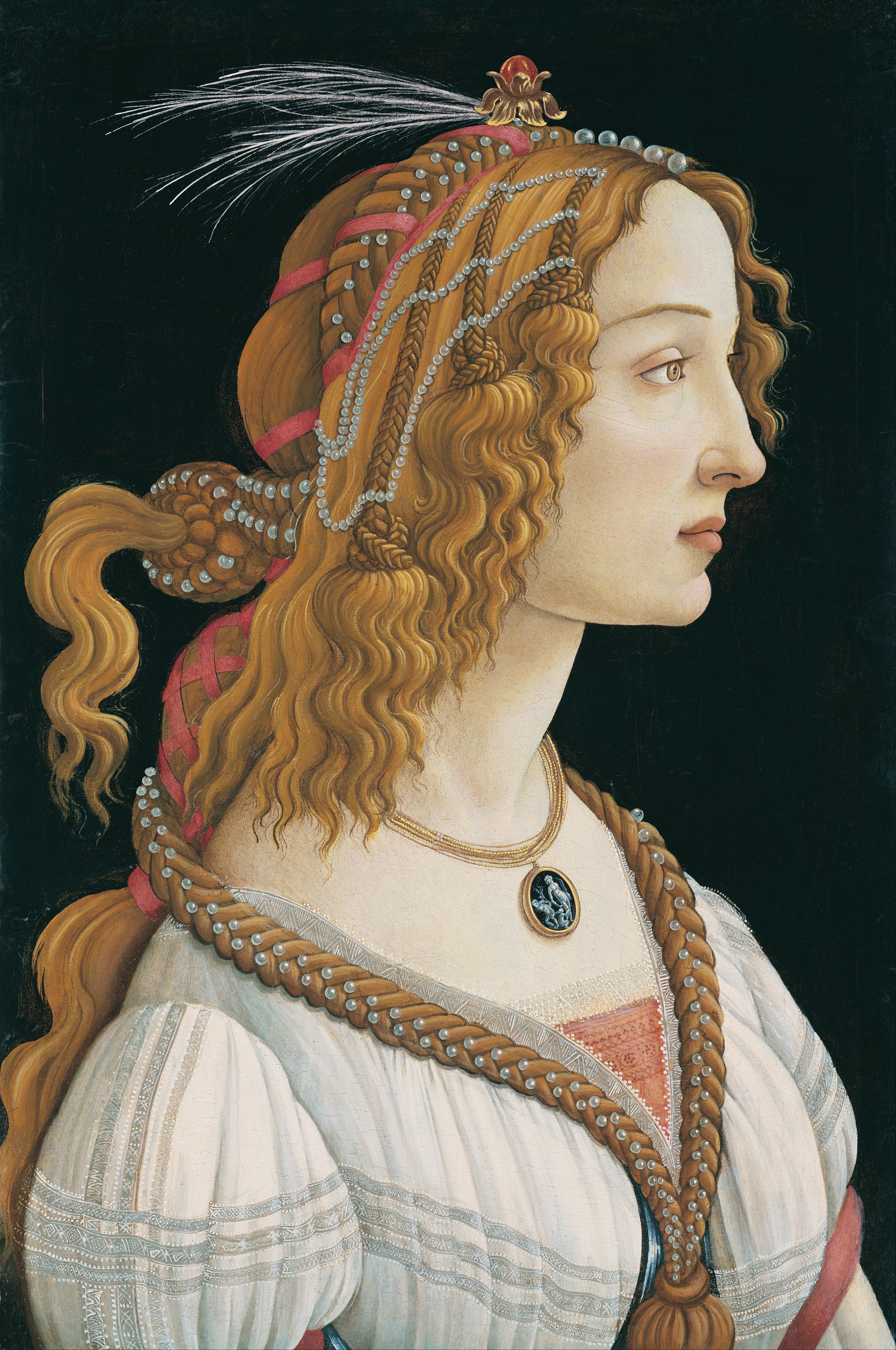
  • Title: Idealized Portrait of a Lady (Portrait of Simonetta Vespucci as Nymph)
  • Genre: portrait
  • Date: circa 1480
  • Medium: tempera on wood
  • Dimensions: Height: 82 cm (32.2 ″); Width: 54 cm (21.2 ″)

About Portrait of a young woman, possibly Simonetta Vespucci, 1484:

The Roman engraved gem on her necklace was owned by Lorenzo de’ Medici. It is suggested that in Quatrocento paintings, hair and water are related. Certainly, the waves of her hair seem to suggest water.

Ronald Lightbown, author of Botticelli: Life and Works claims it is  a creation of Botticelli’s workshop and was likely neither drawn nor painted exclusively by Botticelli himself. He also reminds us that the model’s identity can’t be confirmed; that Botticell’s workshop most likely executed fancy portraits of idealized beauties, rather than real ladies.

About the Artist, via Wikipedia:

Alessandro di Mariano di Vanni Filipepi (c. 1445[1] – May 17, 1510), known as Sandro Botticelli (/ˌbɒtɪˈtʃɛli/, Italian: [ˈsandro bottiˈtʃɛlli]), was an Italian painter of the Early Renaissance. He belonged to the Florentine School under the patronage of Lorenzo de’ Medici, a movement that Giorgio Vasari would characterize less than a hundred years later in his Vita of Botticelli as a “golden age“. Botticelli’s posthumous reputation suffered until the late 19th century; since then, his work has been seen to represent the linear grace of Early Renaissance painting


Credits and Attributions:

Wikipedia contributors, “Sandro Botticelli,” Wikipedia, The Free Encyclopedia, https://en.wikipedia.org/w/index.php?title=Sandro_Botticelli&oldid=916319613 (accessed October 4, 2019).

1 Comment

Filed under #FineArtFriday