Tag Archives: 15th-century Netherlandish paintings

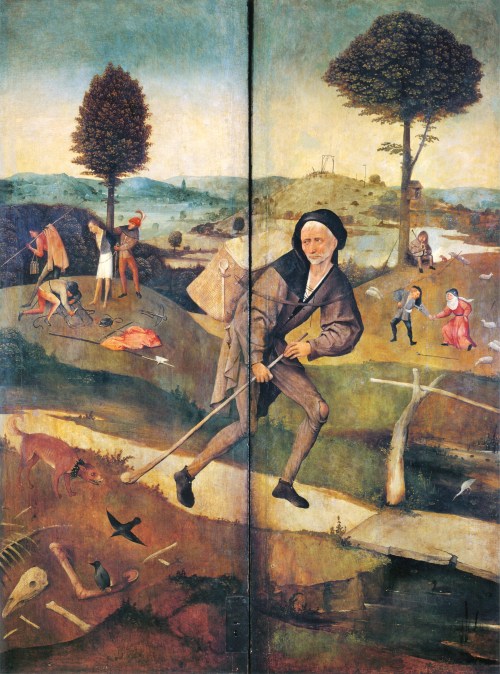
#FineArtFriday: The Pedlar, closed state of The Hay Wain by Hieronymus Bosch ca. 1500

The_Pedlar,_closed_state_of_The_Hay_Wain_by_Hieronymus_BoschArtist: Hieronymus Bosch  (circa 1450–1516)

Title: The Pedlar, Part of The Haywain Tryptich

Genre: religious art Edit this at Wikidata

Date: circa 1500

Medium: oil on panel

Dimensions: height: 147.1 cm (57.9 in)

Collection: Museo del Prado

What I like about this painting:

Hieronymus Bosch tells a story in this scene that is the cover of an altar piece. We see a wayfarer walking a path that winds through dangerous territory. Thieves and murderers and carnal temptations tempt him to stop a while, but he keeps walking.

The hound of hell snaps at his heels as he keeps to the path and he shoves it behind him as he passes the bones of the fallen.

Bosch’s most famous altar pieces were quite graphic, gory even, depicting the prevailing 15th century idea of Hell. He painted his vision of what a sinner would face if one didn’t keep to the straight and narrow path of morality and righteousness.

About this painting, via Wikipedia:

The Haywain Triptych is a panel painting by Hieronymus Bosch, now in the Museo del Prado, Madrid, Spain. A date of around 1516 has been established by means of dendrochronological research. The central panel, signed “Jheronimus Bosch”, measures 135 cm × 200 cm (53 in × 79 in) and the wings measure 147 cm × 66 cm (58 in × 26 in). The outside shutters feature a version of Bosch’s The Wayfarer.

The exterior of the shutters, like most contemporary Netherlandish triptychs, was also painted, although in this case Bosch used full colors instead of the usual grisaille. When closed, they form a single scene depicting a wayfarer. Around him is a series of miniatures including the robbery of another wayfarer and a hanged man. The man uses a stick to repel a dog.

According to the most recent interpretations, this figure may represent the man who follows his road in spite of the temptation of sins (such as lust, perhaps symbolized by the two dancing shepherds) and the evil acts occurring around him.[1]

About the Artist, via Wikipedia:

Little is known of Bosch’s life, though there are some records. He spent most of it in the town of ‘s-Hertogenbosch, where he was born in his grandfather’s house. The roots of his forefathers are in Nijmegen and Aachen (which is visible in his surname: Van Aken). His pessimistic fantastical style cast a wide influence on northern art of the 16th century, with Pieter Bruegel the Elder being his best-known follower.

Today, Bosch is seen as a highly individualistic painter with deep insight into humanity’s desires and deepest fears. Attribution has been especially difficult; today only about 25 paintings are confidently given to his hand along with eight drawings. About another half-dozen paintings are confidently attributed to his workshop. His most acclaimed works consist of a few triptych altarpieces, including The Garden of Earthly Delights. [2]


Credits and Attributions:

IMAGE: Wikimedia Commons contributors, “File:The Pedlar, closed state of The Hay Wain by Hieronymus Bosch.jpg,” Wikimedia Commons, https://commons.wikimedia.org/w/index.php?title=File:The_Pedlar,_closed_state_of_The_Hay_Wain_by_Hieronymus_Bosch.jpg&oldid=618864212 (accessed May 4, 2024).

[1] Wikipedia contributors, “The Haywain Triptych,” Wikipedia, The Free Encyclopedia, https://en.wikipedia.org/w/index.php?title=The_Haywain_Triptych&oldid=1221796985 (accessed May 4, 2024).

[2] Wikipedia contributors, “Hieronymus Bosch,” Wikipedia, The Free Encyclopedia, https://en.wikipedia.org/w/index.php?title=Hieronymus_Bosch&oldid=1215179336 (accessed May 4, 2024).
2 Comments

Filed under #FineArtFriday

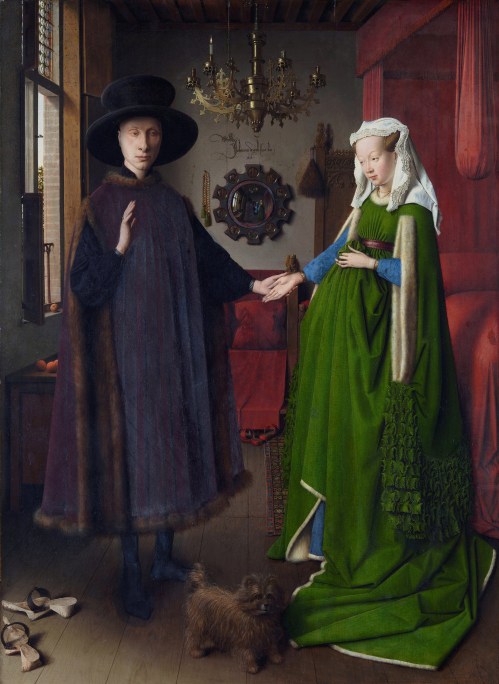
#FineArtFriday: The Arnolfini Portrait by Jan van Eyck 1434

Artist: Jan van Eyck  (circa 1390 –1441)

Title: The Arnolfini Portrait

Genre: portrait

Date: 1434

Medium: oil on panel

Dimensions: Height: 82 cm (32.2 in); Width: 59.5 cm (23.4 in)

Collection: National Gallery

About this painting, via Wikipedia:

The Arnolfini Portrait (or The Arnolfini WeddingThe Arnolfini Marriage, the Portrait of Giovanni Arnolfini and his Wife, or other titles) is a 1434 oil painting on oak panel by the Early Netherlandish painter Jan van Eyck. It forms a full-length double portrait, believed to depict the Italian merchant Giovanni di Nicolao Arnolfini and his wife, presumably in their residence at the Flemish city of Bruges.

What I love about this painting:

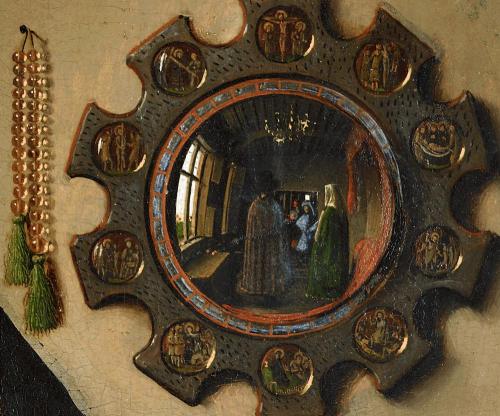
The painting is signed, inscribed, and dated on the wall above the mirror: “Johannes de eyck fuit hic 1434” (Jan van Eyck was here 1434).  This signature, made to look as if it were an inscription explaining the mirror over which it is centered, is a shining example of the sharp wit the later Netherlandish painters frequently inserted into their pictures.

I suspect his inclusion of subtle humor in his works gave permission to those painters who followed in his footsteps, such as the great Bruegel dynasty.

The colors of the garments are deep and rich. These were expensive clothes, completely befitting a wealthy merchant and his wife. In regard to the controversy which is explained below – yes, this painting is steeped in allegory and symbolism, down to the clogs in the left hand corner placed as if they are going out of the picture. In some cultures, a pair of shoes placed like that symbolizes an imminent departure, usually death.

All van Eyck’s work was heavily symbolic. But she appears to be in the late stages of a pregnancy. To me, given the societal norms of the Netherlands in the year 1434, this means the picture shows a married couple. If they were not actually married, it seems unlikely they would have commissioned a portrait showing her in that condition. In fact, and this will probably expose my self-taught ignorance of art history, it makes me wonder why there is a controversy about their marital status at all.

And the mirror…oh my. That mirror is brilliant.

The Controversy, via Wikipedia:

In 1934 Erwin Panofsky published an article entitled Jan van Eyck’s ‘Arnolfini’ Portrait in the Burlington Magazine, arguing that the elaborate signature on the back wall, and other factors, showed that it was painted as a legal record of the occasion of the marriage of the couple, complete with witnesses and a witness signature. Panofsky also argues that the many details of domestic items in the painting each have a disguised symbolism attached to their appearance. While Panofsky’s claim that the painting formed a kind of certificate of marriage is not accepted by all art historians, his analysis of the symbolic function of the details is broadly agreed, and has been applied to many other Early Netherlandish paintings, especially a number of depictions of the Annunciation set in richly detailed interiors, a tradition for which the Arnolfini Portrait and the Mérode Altarpiece by Robert Campin represent the start (in terms of surviving works at least).

Since then, there has been considerable scholarly argument among art historians on the occasion represented. Edwin Hall considers that the painting depicts a betrothal, not a marriage. Margaret D. Carroll argues that the painting is a portrait of a married couple that alludes also to the husband’s grant of legal authority to his wife. Carroll also proposes that the portrait was meant to affirm Giovanni Arnolfini’s good character as a merchant and aspiring member of the Burgundian court. She argues that the painting depicts a couple, already married, now formalizing a subsequent legal arrangement, a mandate, by which the husband “hands over” to his wife the legal authority to conduct business on her own or his behalf (similar to a power of attorney). The claim is not that the painting had any legal force, but that van Eyck played upon the imagery of legal contract as a pictorial conceit. While the two figures in the mirror could be thought of as witnesses to the oath-taking, the artist himself provides (witty) authentication with his notarial signature on the wall.


Credits and Attributions:

Wikimedia Commons contributors, “File:Van Eyck – Arnolfini Portrait.jpg,” Wikimedia Commons, the free media repository, https://commons.wikimedia.org/w/index.php?title=File:Van_Eyck_-_Arnolfini_Portrait.jpg&oldid=446521642 (accessed September 4, 2020).

Wikimedia Commons contributors, “File:The Arnolfini Portrait, détail (2).jpg,” Wikimedia Commons, the free media repository, https://commons.wikimedia.org/w/index.php?title=File:The_Arnolfini_Portrait,_d%C3%A9tail_(2).jpg&oldid=428220496 (accessed September 4, 2020).

Wikimedia Commons contributors, “File:Arnolfini Portrait 3.jpg,” Wikimedia Commons, the free media repository, https://commons.wikimedia.org/w/index.php?title=File:Arnolfini_Portrait_3.jpg&oldid=428554231 (accessed September 4, 2020).

2 Comments

Filed under #FineArtFriday, writing