Tag Archives: 19th century American landscape art

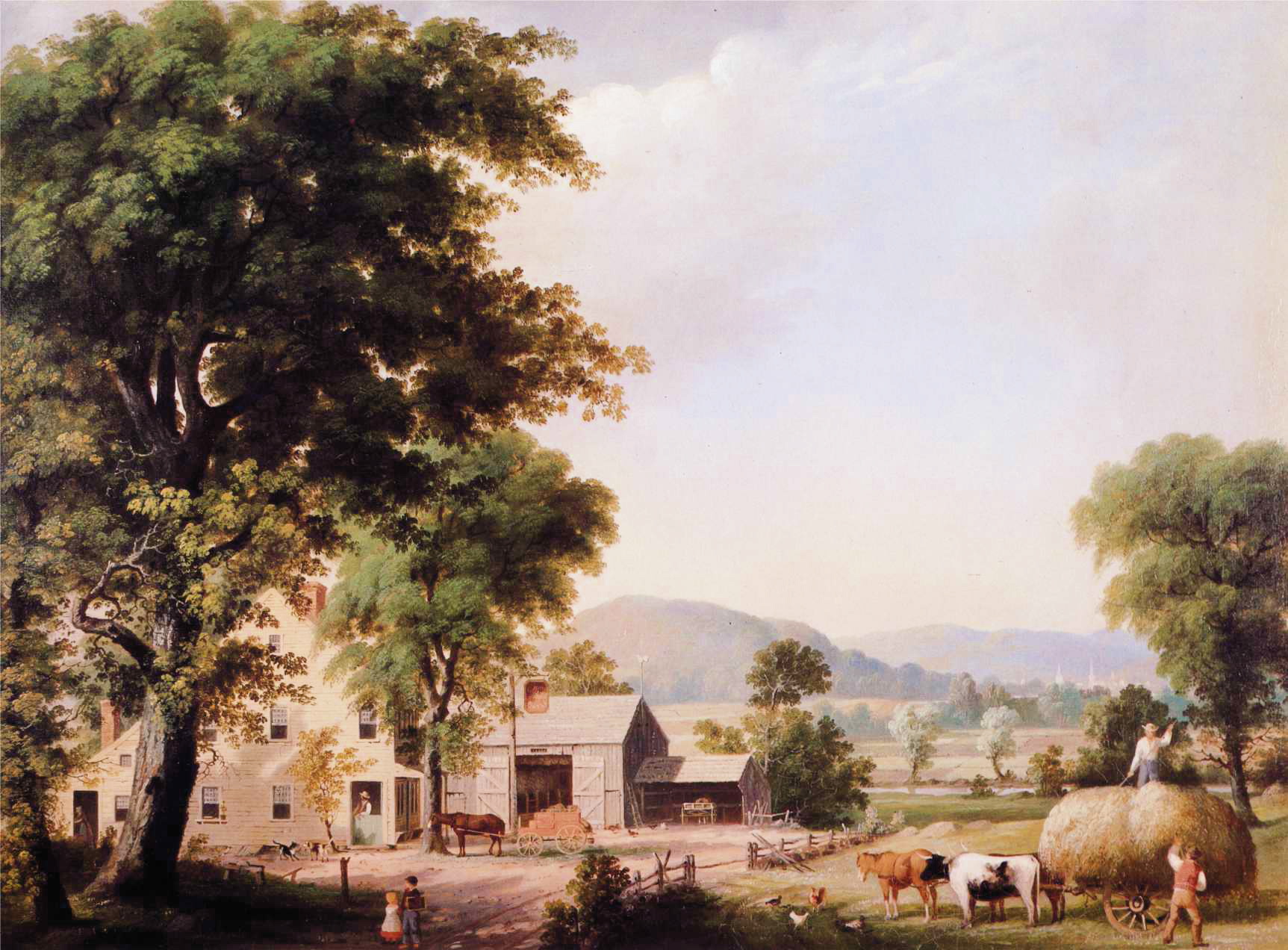
#FineArtFriday: Haying at Jones Inn by George Henry Durrie 1854

Artist: George Henry Durrie (1820–1863)

Title: English: Haying at Jones Inn

Date: 1854

Medium: oil on canvas

Dimensions: 22″×30″

Location: Private collection

What I love about this painting:

George Henry Durrie found beauty in the depictions of ordinary life. He always found a way to fit people into his scenes.

I absolutely love the nostalgia of this scene, and the wealth of information about how a reputable roadside inn worked. It is clear that Durrie was frequent guest at Jones Inn. He traveled widely in the years he worked as a portrait painter, and this particular public house is featured in his work several times from different angles. I like to imagine he painted the inn to provide a little respite from the demands of portraiture.

This scene shows us a day at the end of summer. Laborers are bringing a wagon piled high with hay. Two oxen are hitched behind a horse, the three working together to pull the laden wagon.

Country inns were often working farms. They had to be, as they were feeding staff and laborers as well as guests all year long, and there were no Costco, Sam’s Club, or Wholesale Foods to purchase supplies from.

The stables and the people who cared for the horses were just as important. Providing well for travelers’ horses was as crucial as that of providing the best rooms and food possible for their guests.

The hay piled on this wagon will feed not only the innkeepers’ beasts but will feed the horses ridden by guests as the year progresses. Many more wagons will be required to fill the barn and hayloft.

About the Artist, Via Wikipedia:

George Henry Durrie (June 6, 1820 – October 15, 1863) was an American landscape artist noted especially for his rural winter snow scenes, which became very popular after they were reproduced as lithographic prints by Currier and Ives.

For many years, Durrie made a living primarily as a portrait painter, executing hundreds of commissions. After marriage, he made frequent trips, traveling to New York, Massachusetts, New Jersey, and Virginia, fulfilling commissions and looking for new ones. His diary reveals that he was an enthusiastic railroad traveler, in the early days of the railroads. Durrie also painted what he called “fancy pieces”, whimsical studies of still lives or stage actors, as well as painting scenes on window-shades and fireplace covers. But portrait painting commissions became scarcer when photography came on the scene, offering a cheaper alternative to painted portraits, and, as his account-book shows, Durrie rarely painted a portrait after 1851.

Durrie’s interest shifted to landscape painting, and while on the road, or at home, made frequent sketches of landscape elements that caught his eye. Around 1844 Durrie began painting water and snow scenes, and took a second place medal at the 1845 New Haven State Fair for two winter landscapes. [1]

To learn more about this artist, go to  George Henry Durrie – Wikipedia


Credits and Attributions:

IMAGE: Wikimedia Commons contributors, “File:George Henry Durrie – Haying at Jones Inn.JPG,” Wikimedia Commons, https://commons.wikimedia.org/w/index.php?title=File:George_Henry_Durrie_-_Haying_at_Jones_Inn.JPG&oldid=853995435 (accessed October 22, 2025).

[1] Wikipedia contributors, “George Henry Durrie,” Wikipedia, The Free Encyclopedia, https://en.wikipedia.org/w/index.php?title=George_Henry_Durrie&oldid=1282714933 (accessed October 22, 2025).

Comments Off on #FineArtFriday: Haying at Jones Inn by George Henry Durrie 1854

Filed under #FineArtFriday

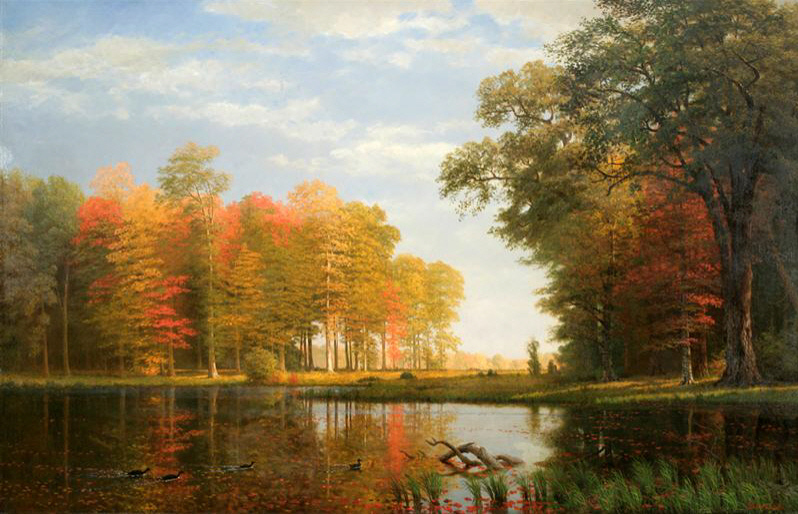
#FineArtFriday: Autumn Woods by Albert Bierstadt 1886

Artist: Albert Bierstadt (1830–1902)

Title: Autumn Woods, Oneida County, State of New York

Date: 1886

Medium: Oil on linen

Dimensions: Overall (linen): 54 x 84 in. (137.2 x 213.4 cm) Framed: 64 3/4 in. × 7 ft. 10 3/4 in. × 3 1/4 in. (164.5 × 240.7 × 8.3 cm)

Collection: New York Historical  (Gift of Mrs. Albert Bierstadt)

What I love about this painting:

Albert Bierstadt gives us a beautiful day in Glorious Autumn (with capitol letters), the kind of day rare here in my part of the Pacific Northwest. In October, rainy weather usually rolls in, accompanied by a blustery wind that strips the trees of leaves and takes the joy out of sightseeing.

Bierstadt’s trees are luminous, red and gold the way they are far away in the mystical lands on the other side of the continent from me. His sky is lovely, but he has kept our focus on the theme, so it doesn’t dominate the scene. The reflections of the trees on the quiet, still waters of the pond ensure they are the stars of this painting.

I especially like the realism of the branches of a downed tree rising out of the water in the foreground. This is a romantic depiction of what Autumn should be, as opposed to the sodden mess that it often is here in my town.

I would love to go walking along the shore of this pond.

About the Artist, via Wikipedia:

Albert Bierstadt (January 7, 1830 – February 18, 1902) was a German American painter best known for his lavish, sweeping landscapes of the American West. He joined several journeys of the westward expansion to paint the scenes. He was not the first artist to record the sites, but he was the foremost painter of them for the remainder of the 19th century.

Bierstadt was born in Prussia, but his family moved to the United States when he was one year old. He returned to study painting for several years in Düsseldorf. He became part of the second generation of the Hudson River School in New York, an informal group of like-minded painters who started painting along the Hudson River. Their style was based on carefully detailed paintings with romantic, almost glowing lighting, sometimes called luminism. Bierstadt was an important interpreter of the western landscape, and he is also grouped with the Rocky Mountain School. [1]

To read more about this artist, go to  Albert Bierstadt – Wikipedia.


Credits and Attributions:

IMAGE: Wikimedia Commons contributors, “File:Autumn Woods, Oneida County, State of New York 1910 11.jpeg,” Wikimedia Commons, https://commons.wikimedia.org/w/index.php?title=File:Autumn_Woods,_Oneida_County,_State_of_New_York_1910_11.jpeg&oldid=1069889157 (accessed October 16, 2025).

[1] Wikipedia contributors, “Albert Bierstadt,” Wikipedia, The Free Encyclopedia, https://en.wikipedia.org/w/index.php?title=Albert_Bierstadt&oldid=1308977510 (accessed October 16, 2025).

5 Comments

Filed under #FineArtFriday

#FineArtFriday: Indian Sunset – Deer by a Lake by Albert Bierstadt ca. 1880 – 90

Artist: Albert Bierstadt (1830–1902)

Title: Indian Sunset – Deer by a Lake

Date: circa 1880-1890

Medium: oil on canvas

Dimensions: height: 77.2 cm (30.3 in); width: 113.1 cm (44.5 in)

Collection: Yale University Art Gallery

What I love about this painting:

I love the way the setting sun glows through the rising mist, shining across the still waters of the lake. I love the shadowy woods, the deepening sense that twilight is near and night will soon enshroud the scene.

Deer graze in the lush meadow at the shore. Perhaps they will bed down in the shelter of the trees at the edge of the wood.

Albert Bierstadt’s landscapes made even the most ordinary scene feel majestic. One of his greatest skills was his ability to show the haze of twilight and the stillness of a pond or lake at that singular time of the late September evening, that moment when the warm breeze cools, slows, and fades to calm.

By placing wild deer in his scene, Bierstadt gives us a little story and a reason to care. It is autumn, and hunting season. Will this brief moment of peace be the buck’s last? We’ll never know, but I like to think Bambi and his family will live to see the advent of spring.

About the Author, via Wikipedia:

Albert Bierstadt (January 7, 1830 – February 18, 1902) was a German American painter best known for his lavish, sweeping landscapes of the American West. He joined several journeys of the westward expansion to paint the scenes. He was not the first artist to record the sites, but he was the foremost painter of them for the remainder of the 19th century.

Bierstadt was born in Prussia, but his family moved to the United States when he was one year old. He returned to study painting for several years in Düsseldorf. He became part of the second generation of the Hudson River School in New York, an informal group of like-minded painters who started painting along the Hudson River. Their style was based on carefully detailed paintings with romantic, almost glowing lighting, sometimes called luminism. Bierstadt was an important interpreter of the western landscape, and he is also grouped with the Rocky Mountain School. [1]

To read more about this artist, go to  Albert Bierstadt – Wikipedia.


Credits and Attributions:

IMAGE: Wikimedia Commons contributors, “File:Indian Sunset Deer by a Lake by Albert Bierstadt.jpeg,” Wikimedia Commons, https://commons.wikimedia.org/w/index.php?title=File:Indian_Sunset_Deer_by_a_Lake_by_Albert_Bierstadt.jpeg&oldid=828692957 (accessed September 18, 2025).

[1] Wikipedia contributors, “Albert Bierstadt,” Wikipedia, The Free Encyclopedia, https://en.wikipedia.org/w/index.php?title=Albert_Bierstadt&oldid=1308977510 (accessed September 18, 2025).


4 Comments

Filed under #FineArtFriday

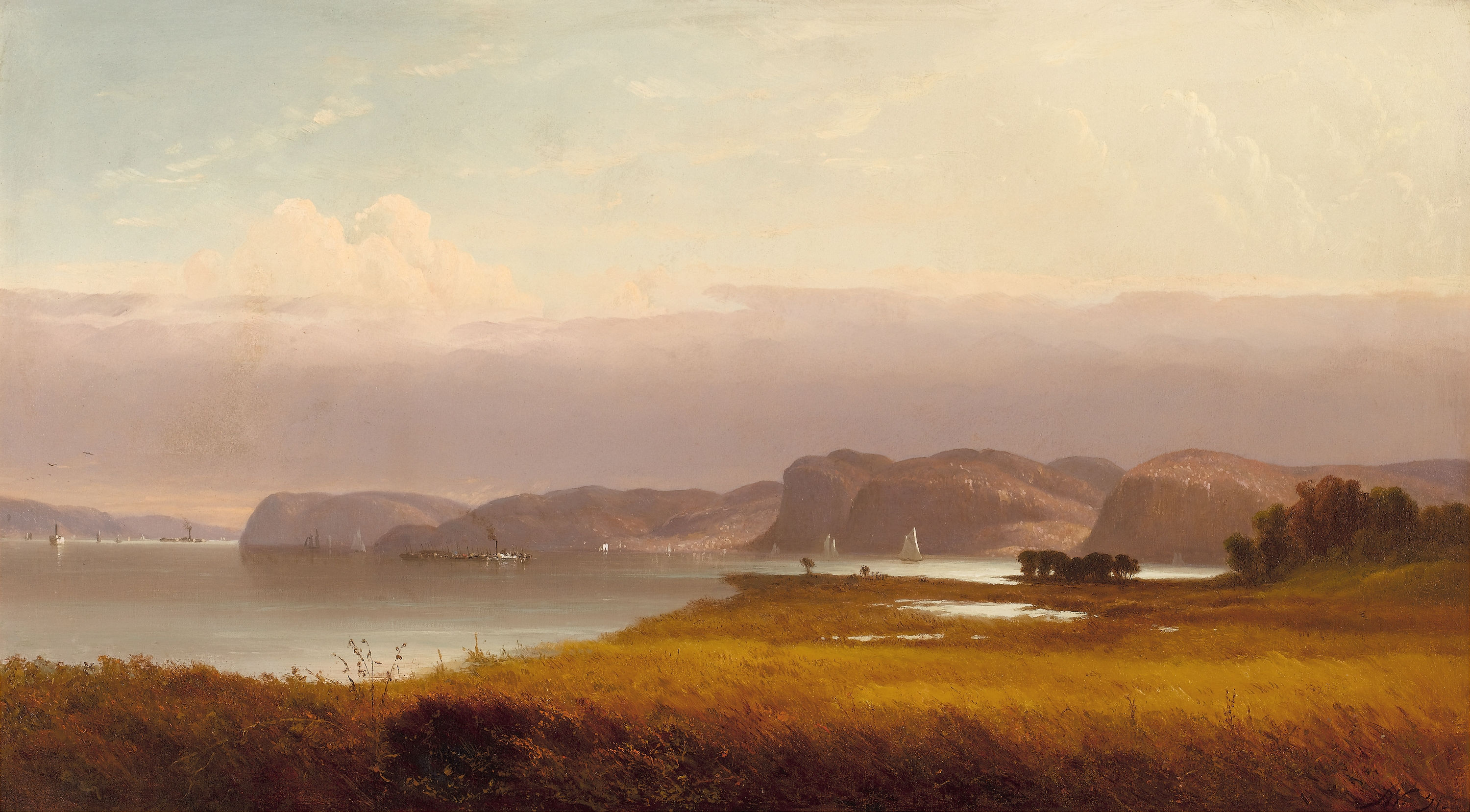
#FineArtFriday: Autumn on the Hudson River by John Williamson 1871

Artist: John Williamson (1826–1885)

Title: Autumn, Hudson River

Date: 1871

Medium: oil on canvas

Dimensions: 45.7 × 58.4 cm (17.9 × 22.9 in).

Inscriptions: Signed and inscribed verso (now covered by relining): Autumn. / Hudson River. / By J. W. Williamson / N.Y. 1871


What I love about this painting:

Williamson shows us a peaceful autumn day on New York’s Hudson River, focusing on the quiet beauty of wild grass and calm waters.

This is a beautiful depiction of what autumn often looks like where I live, despite it’s being on the other side of the continent.

The morning mist is gradually lifting, revealing a field of harvest-gold grass. Inland, I imagine the farmers are hoping for the mist to burn off to sunny Indian summer day so they can get the hay in before the weather turns wet.

Further out, the sails of fishing boats and cargo vessels gleam white in the mist as they go about their business, likely also hoping for a sunny day. I suspect they won’t get it, as the cloud cover looks high and there to stay.

As I mentioned above, this view of a less-than-sunny day on the East Coast is not too different from autumn here in the Pacific Northwest.

To my knowledge, this is the first time I have come across works by John Williamson.

I could find nothing about him or his art on Wikipedia, but I did find a few biographies about him on several art auction sites. This was the most informative:

About John Williamson, via Questroyal Fine Art:

John Williamson was a versatile artist who created still lifes, genre scenes, and landscapes during the heyday of the Hudson River School. Born in Scotland, Williamson came to the United States with his family in 1831. He spent most of his life in Brooklyn, New York, studying art at the Brooklyn Institute and helping to found the Brooklyn Art Association. [1]

To continue reading about this artist, go to John Williamson – Questroyal Fine Art.


Credits and Attributions:

IMAGE: Wikimedia Commons contributors, “File:Autumn Hudson River-John Williamson-1871.jpg,” Wikimedia Commons, https://commons.wikimedia.org/w/index.php?title=File:Autumn_Hudson_River-John_Williamson-1871.jpg&oldid=1069869485 (accessed September 10, 2025).

[1] Quote from artist biography via John Williamson – Questroyal Fine Art, © 2025 Questroyal Fine Art, LLC.

Comments Off on #FineArtFriday: Autumn on the Hudson River by John Williamson 1871

Filed under #FineArtFriday

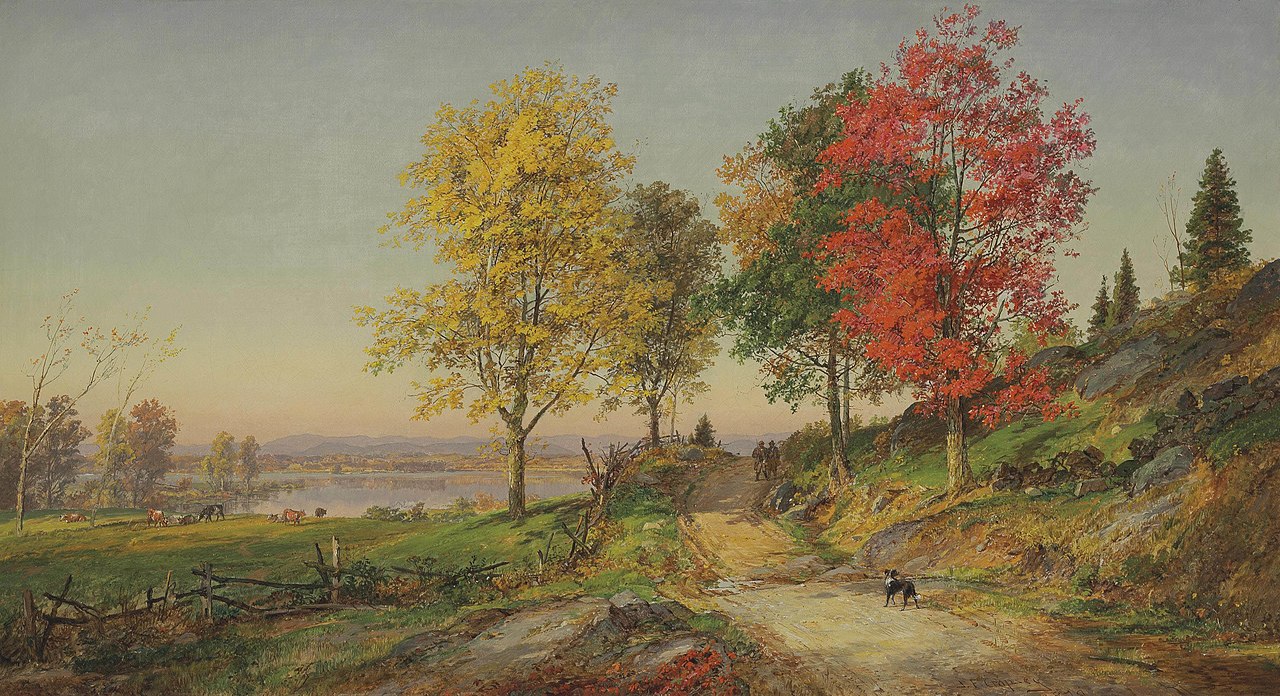
#FineArtFriday: Greenwood Lake by Jasper Francis Cropsey, 1879

Artist: Jasper Francis Cropsey (1823–1900)

Title: Greenwood Lake

Description: English: Greenwood Lake by Jasper Francis Cropsey

Date: 1879

Medium: oil on canvas

Dimensions: height: 60.3 cm (23.7 in); width: 110.5 cm (43.5 in)

Collection: Private collection

What I love about this painting:

Jasper Francis Cropsey loved the wild beauty of Greenwood Lake as it was in his day. I suspect he wouldn’t feel quite the same about it nowadays, since it is definitely a summer destination for modern vacationers. He found his muse in the rural beauty there.

Autumn seems to have been a favorite time of year for him. Each autumn, he made numerous paintings from his favorite spots along the shore and in the area. This painting was made just as warm September drifted toward the cold months of October and November. The deciduous trees are dressed in shades of red and gold.

Two men walk along the dirt lane that runs beside a meadow. Perhaps they are just going from one place to another, or maybe they are hunters. If so, they are returning empty-handed.

Cattle graze and gossip in the distance, as cows often do. A dog (perhaps the farm dog?) has stopped in the middle of the road to bark his greeting to the men.

I understand why Cropsey painted this scene many times from different angles. In my opinion, the end of September is the best part of autumn in the north. Soon, the beautiful colors will fade, falling to the ground and turning soggy and brown, marking the end of the annual cycle. But now, this day, Cropsey’s world is at peace, the air is crisp, and the leaves are at that wonderful stage that pleases the eye and makes one glad to be alive.

About the Artist, via Wikipedia:

Jasper Francis Cropsey (February 18, 1823 – June 22, 1900) was an American architect and artist. He is best known for his Hudson River School landscape paintings.

Cropsey trained as an architect under the tuition of Joseph Trench in the early 1840s, a period in which he was also trained in watercolor painting, instructed by Edward Maury, and took some life drawing courses at the National Academy of Design. He set up his own architecture office in 1843, but began exhibiting his watercolors at the National Academy of Design in 1844. A year later he was elected an associate member and turned exclusively to landscape painting; shortly after he was featured in an exhibition entitled “Italian Compositions”.[1]

To learn more about Jasper Francis Cropsey, go to Jasper Francis Cropsey – Wikipedia.

About the scenery in this painting via Wikipedia:

Greenwood Lake is an interstate lake approximately seven miles (11 km) long, straddling the border of New York and New Jersey. It is located in the Town of Warwick and the Village of Greenwood LakeNew York (in Orange County) and West MilfordNew Jersey (in Passaic County). It is the source of the Wanaque River.

Jasper Francis Cropsey created several paintings of Greenwood Lake beginning in 1843. Cropsey painted many paintings of the area such as American Harvesting (1864), Greenwood Lake (1870), Fisherman’s House, Greenwood Lake (1877), and Cooley Homestead–Greenwood Lake (1886). Cropsey met and married Maria Cooley, daughter of Issac P. Cooley, in 1847 and continued to visit the area for many years.

Some of Cropsey’s painting command high prices at auctions. Greenwood Lake (1879) sold at Christie’s auction in 2012 for $422,500. Sunset, Camel’s Hump, Lake Champlain (1877) sold for $314,500 in 2011. [2]


Credits and Attributions:

IMAGE: Wikimedia Commons contributors, “File:Greenwood Lake by Jasper Francis Cropsey, 1879.jpg,” Wikimedia Commons, https://commons.wikimedia.org/w/index.php?title=File:Greenwood_Lake_by_Jasper_Francis_Cropsey,_1879.jpg&oldid=617153620 (accessed September 4, 2025).

[1] Wikipedia contributors, “Jasper Francis Cropsey,” Wikipedia, The Free Encyclopedia, https://en.wikipedia.org/w/index.php?title=Jasper_Francis_Cropsey&oldid=1309347669 (accessed September 4, 2025).

[2]  Wikipedia contributors, “Greenwood Lake,” Wikipedia, The Free Encyclopedia, https://en.wikipedia.org/w/index.php?title=Greenwood_Lake&oldid=1300748871 (accessed September 4, 2025).

4 Comments

Filed under #FineArtFriday

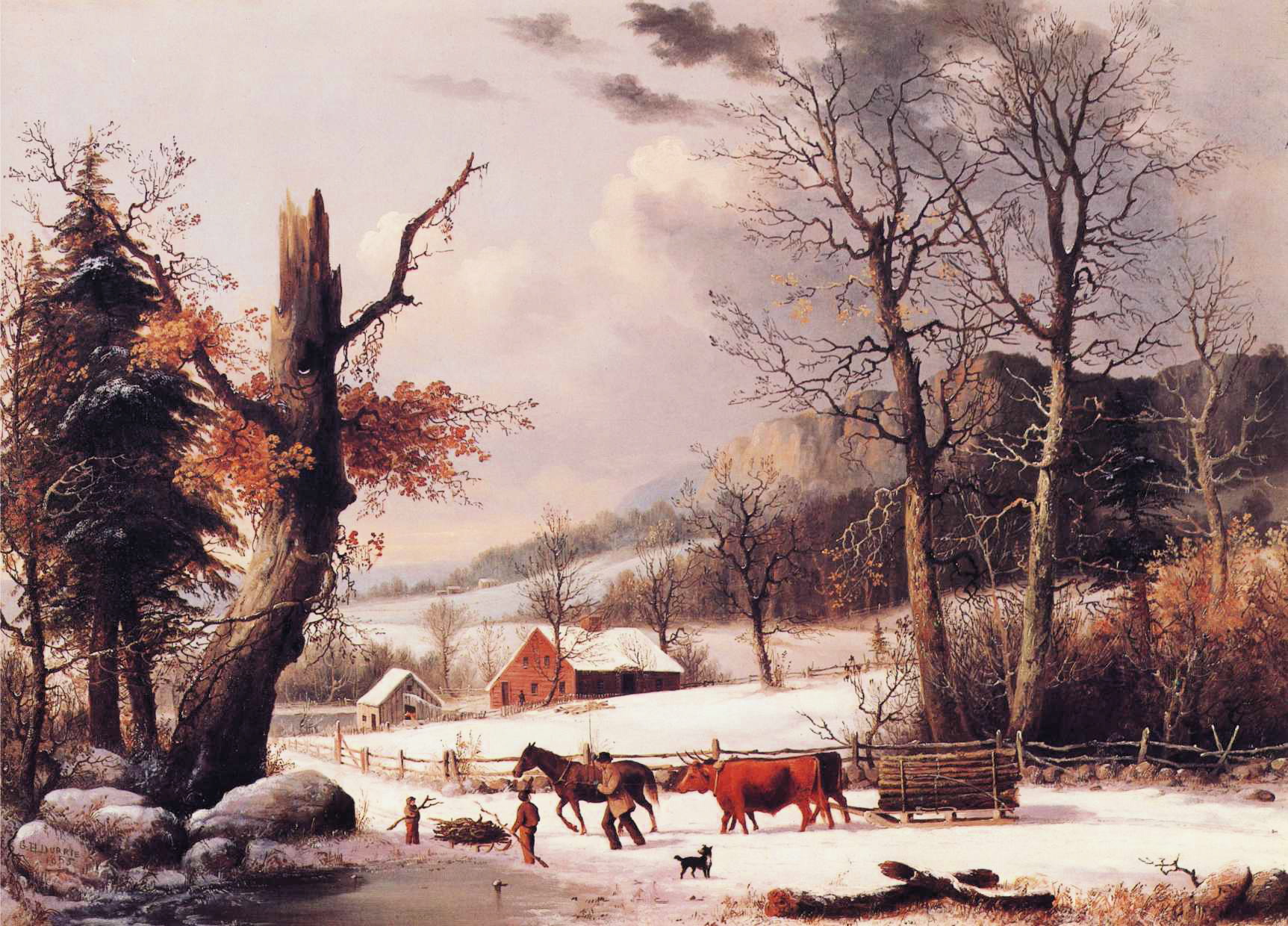
#FineArtFriday: Gathering Wood for Winter by George Henry Durrie 1855

Title: Gathering Wood for Winter

Artist: George Henry Durrie (1820–1863)

Date: 1855

Medium: oil on canvas

Dimensions: height: 26 in (66 cm); width: 36 in (91.4 cm)

Collection: Private collection

Why I love this painting:

Durrie shows us a day in late autumn. His characteristic use of reds and browns juxtaposed against lighter shades of white portrays the stark beauty of late autumn in New England.

The first snow has fallen, and the season is turning to winter. It’s more important than ever to gather as much wood as possible. Fortunately for our wood gatherers, a giant has fallen victim to a storm, snapping off halfway up.

This is not necessarily the end of the tree. Leaves still cling to the branches below the wound and will continue to provide shade and habitat for as long as it can. Someday, it may be cut down, as the fact it broke in half shows that it is nearing the end of its life and may present a hazard to those who walk beneath it.

Regardless of the tree’s future, the farmer and his son are taking advantage of the bounty so close to their home. They will stack it in the woodshed and allow it to dry out or “season” before they must burn it, hopefully not before the end of spring.

The more wood they gather now, the warmer they will be when winter’s grip tightens.

About the author, via Wikipedia:

George Henry Durrie (June 6, 1820 – October 15, 1863) was an American landscape artist noted especially for his rural winter snow scenes, which became very popular after they were reproduced as lithographic prints by Currier and Ives.

For many years, Durrie made a living primarily as a portrait painter, executing hundreds of commissions. After marriage, he made frequent trips, traveling to New York, Massachusetts, New Jersey,  and Virginia, fulfilling commissions and looking for new ones. His diary reveals that he was an enthusiastic railroad traveler, in the early days of the railroads. Durrie also painted what he called “fancy pieces”, whimsical studies of still lives or stage actors, as well as painting scenes on window-shades and fireplace covers. But portrait painting commissions became scarcer when photography came on the scene, offering a cheaper alternative to painted portraits, and, as his account-book shows, Durrie rarely painted a portrait after 1851.

Durrie’s interest shifted to landscape painting, and while on the road, or at home, made frequent sketches of landscape elements that caught his eye. Around 1844 Durrie began painting water and snow scenes, and took a second place medal at the 1845 New Haven State Fair for two winter landscapes. Although he had some training in portrait work, Durrie was self-taught as a landscape artist. He was undoubtedly influenced both by the American Hudson River School, and also by European artists, by studying exhibitions of their work at the New Haven Statehouse, the Trumbull Gallery, and at the Wadsworth Atheneum in Hartford, as well as in New York City. Durrie himself exhibited regularly, both locally, and in New York City at the National Academy of Design and the American Artists’ Union, and his reputation grew. Durrie was especially known for his snow pieces, and would often make copies or near-copies of his most popular pieces, with modifications to order.  The landscapes painted by Durrie offered a more intimate view than the panoramic landscapes painted by the Hudson River School, which was the leading school of American landscape painting. Colin Simkin notes that Durrie’s paintings took in a wide angle, but still “close enough to be within hailing distance” of the people who are always included in his scenes.

Currier and Ives

Durrie’s early landscapes were often of local landmarks, such as East Rock and West Rock, and other local scenes, which were popular with his New Haven clients, and he painted numerous variations of popular subjects. As his portrait commissions declined, Durie concentrated on landscapes. He wanted a wider audience, and he seemed to have a good sense of what would sell. Durrie realized that his paintings would have a wider appeal if he made them as generic New England scenes rather than as identifiable local scenes, retaining, as Sackett said, “a sense of place without specifying where that place was.” The New York City lithographic firm of Currier & Ives knew their audience; the American public wanted nostalgic scenes of rural life, images of the good old days, and Durrie’s New England scenes fit the bill perfectly. Lithographic prints were a very democratic form of art, cheap enough that the humblest home could afford some art to hang on the wall. Durrie had been marketing his paintings in New York City, and Currier and Ives, who had popularized such prints, purchased some of Durrie’s paintings in the late 1850s or early 1860s, and eventually published ten of Durrie’s pictures beginning in 1861. Four prints were published between 1861 and the artist’s death in New Haven in 1863; six additional prints were issued posthumously.

The popularity of Durrie’s snow scenes received an additional boost in the 1930s, when the Traveler’s Insurance Company began issuing calendars featuring Currier and Ives prints. Starting in 1946, the January calendar always featured a Durrie snow scene. Historian Bernard Mergen notes that “84 of the 125 paintings attributed to him are snowscapes, more than enough to make him the most prolific snow scene painter of his time.”

In Durrie’s time, winter landscapes were not popular with most curators and critics, but nevertheless, by the time of his death, Durrie had acquired a national reputation as a snowscape painter. Durrie died in 1863, at age 43, probably from typhoid fever, not long after Currier and Ives began reproducing his paintings as prints.

Durrie was dismissed by critics as a popular artist, an illustrator rather than a fine artist. Although Durrie’s Currier and Ives prints were popular, his name was still relatively unknown. But a revival of interest in Durrie began in the 1920s with the publication in 1929 of Currier and Ives, Printmakers to the American People, by collector Harry T. Peters, Sr., who called Durrie’s prints “among the most valued In the entire gallery [of Currier and Ives prints]”, and says that Durrie was known as the “snowman” of the group. [1]


Credits and Attributions:

IMAGE: Gathering Wood for Winter by George Henry Durrie 1855. Wikimedia Commons contributors, “File:George Henry Durrie – Gathering Wood for Winter.JPG,” Wikimedia Commons, https://commons.wikimedia.org/w/index.php?title=File:George_Henry_Durrie_-_Gathering_Wood_for_Winter.JPG&oldid=853995324 (accessed May 1, 2025).

[1]Wikipedia contributors, “George Henry Durrie,” Wikipedia, The Free Encyclopedia, https://en.wikipedia.org/w/index.php?title=George_Henry_Durrie&oldid=1282714933 (accessed May 1, 2025).
Comments Off on #FineArtFriday: Gathering Wood for Winter by George Henry Durrie 1855

Filed under #FineArtFriday, writing

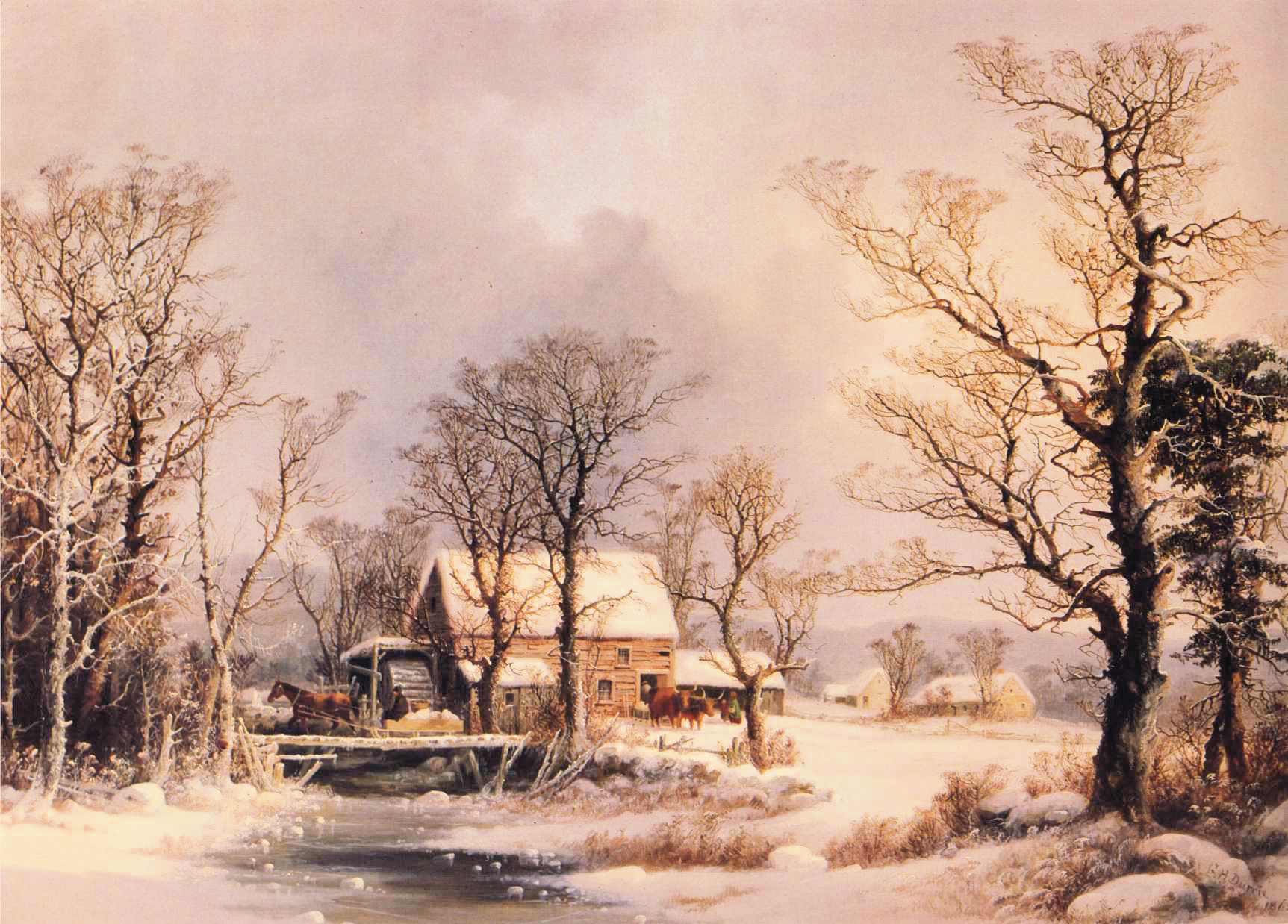
#FineArtFriday: Winter in the Country – The Old Grist Mill by George Henry Durrie

Artist: George Henry Durrie (1820–1863)

Painting: Oil on canvas, 26 x 36 in

Date: 1862

What I love about this painting:

George Henry Durrie is one of my favorite American artists. In this painting, he shows us a winter’s day in New England in 1862. Snow covers the ground, but the sun is shining, lending a rosy glow to the day.

The stream bears a light skim of ice, but though the millwheel is covered in snow, the mill is not idle. This late (or early) in the year there is no wheat to grind, but the grain from the previous autumn’s harvest has been turned to flour and shoveled into bags and barrels and stored for sale as needed.

A horse-drawn sled crosses the log bridge, loaded with white cotton bags of flour. Perhaps the driver intends to take advantage of the good weather and deliver them to the local General Store or Mercantile.

Durrie’s horses and cattle are as true to life as his landscapes are. One can almost see the muscles moving beneath the glossy coat as our horse pull the sleigh.

If you are writing a story set in an era of lower technology, I strongly suggest you go to the art of Durrie and his contemporaries to find inspiration for worldbuilding.

About the artist, via Wikipedia:

George Henry Durrie (June 6, 1820 – October 15, 1863) was an American landscape artist noted especially for his rural winter snow scenes, which became very popular after they were reproduced as lithographic prints by Currier and Ives.

In Durrie’s time, winter landscapes were not popular with most curators and critics, but nevertheless, by the time of his death, Durrie had acquired a national reputation as a snowscape painter. Durrie died in 1863, at age 43, probably from typhoid fever, not long after Currier and Ives began reproducing his paintings as prints.

Durrie’s paintings, depicting idyllic rural life, a world of stability and home comforts, held great appeal for the middle class and the working class, as an visual antidote for the growing industrialization of America, and the uncertainties of a boom-and-bust economy. The American ideal of a land of self-sufficient farmers, captured by Durrie’s paintings, was being replaced with factories belching smoke, along with a rise in urban populations, foreign immigration, and crime brought about by crowded conditions and poverty. The American descendants of the early English settlers felt that their values and way of life were threatened by these new developments and turned to nostalgic images such as Durrie’s for comfort. [1]


Credits and Attributions:

IMAGE: Wikimedia Commons contributors, “File:George Henry Durrie – Winter in the Country, The Old Grist Mill.JPG,” Wikimedia Commons, https://commons.wikimedia.org/w/index.php?title=File:George_Henry_Durrie_-_Winter_in_the_Country,_The_Old_Grist_Mill.JPG&oldid=995260526 (accessed February 10, 2025).

[1] Wikipedia contributors, “George Henry Durrie,” Wikipedia, The Free Encyclopedia, https://en.wikipedia.org/w/index.php?title=George_Henry_Durrie&oldid=1244671369 (accessed February 10, 2025).

5 Comments

Filed under #FineArtFriday, writing

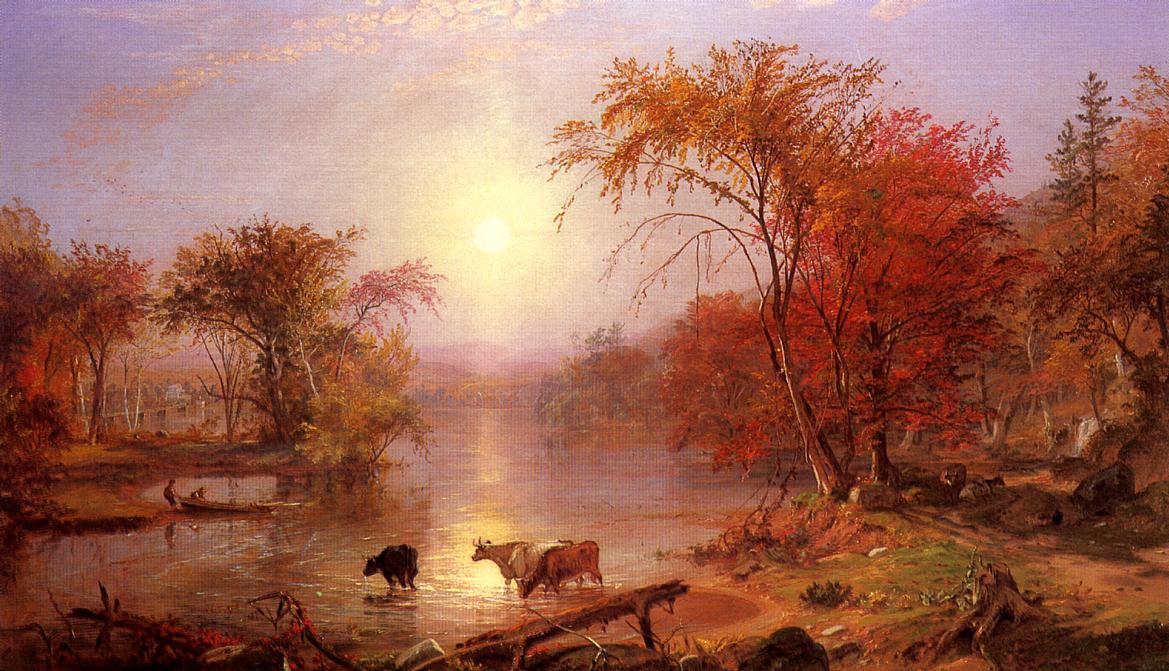
#FineArtFriday: Indian Summer on the Hudson River by Albert Bierstadt 1861

Bierstadt_Albert_Indian_Summer_Hudson_RiverArtist: Albert Bierstadt  (1830–1902)

Title: “Indian Summer on the Hudson River”

Genre: landscape painting

Date: 1861

Medium: oil on canvas

Dimensions: height: 60.9 cm (24 in); width: 104.1 cm (41 in)

What I love about this painting:

This is the quintessential autumn afternoon in New England on the Hudson River one-hundred and sixty-three years ago. The woods along the banks were old, ancient in some places. Deciduous trees like sugar maples, hornbeams, and sycamores grew along the riverbank.

In this scene, cattle are being watered while a pair of fishers pull their boat ashore, hopefully with a good catch in that basket.

One can almost hear soft splash of the occasional fish snatching waterbugs from the surface of the waters. The evening songs of the woodland birds as they settle down for the night drift across the waters. Tomorrow, the birds will take flight, heading south, while winter birds from further north will arrive and take their place.

About the artist, via Wikipedia:

Albert Bierstadt (January 7, 1830 – February 18, 1902) was a German American painter best known for his lavish, sweeping landscapes of the American West. He joined several journeys of the Westward Expansion to paint the scenes. He was not the first artist to record the sites, but he was the foremost painter of them for the remainder of the 19th century.

Bierstadt was born in Prussia, but his family moved to the United States when he was one year old. He returned to study painting for several years in Düsseldorf. He became part of the second generation of the Hudson River School in New York, an informal group of like-minded painters who started painting along the Hudson River. Their style was based on carefully detailed paintings with romantic, almost glowing lighting, sometimes called luminism. Bierstadt was an important interpreter of the western landscape, and he is also grouped with the Rocky Mountain School. [1]

Credits and Attributions:

Image: Wikimedia Commons contributors, “File:Bierstadt Albert Indian Summer Hudson River.jpg,” Wikimedia Commons, https://commons.wikimedia.org/w/index.php?title=File:Bierstadt_Albert_Indian_Summer_Hudson_River.jpg&oldid=837006005 (accessed October 11, 2024).

[1] Wikipedia contributors, “Albert Bierstadt,” Wikipedia, The Free Encyclopedia, https://en.wikipedia.org/w/index.php?title=Albert_Bierstadt&oldid=1137881139 (accessed October 10,  2024).

4 Comments

Filed under #FineArtFriday

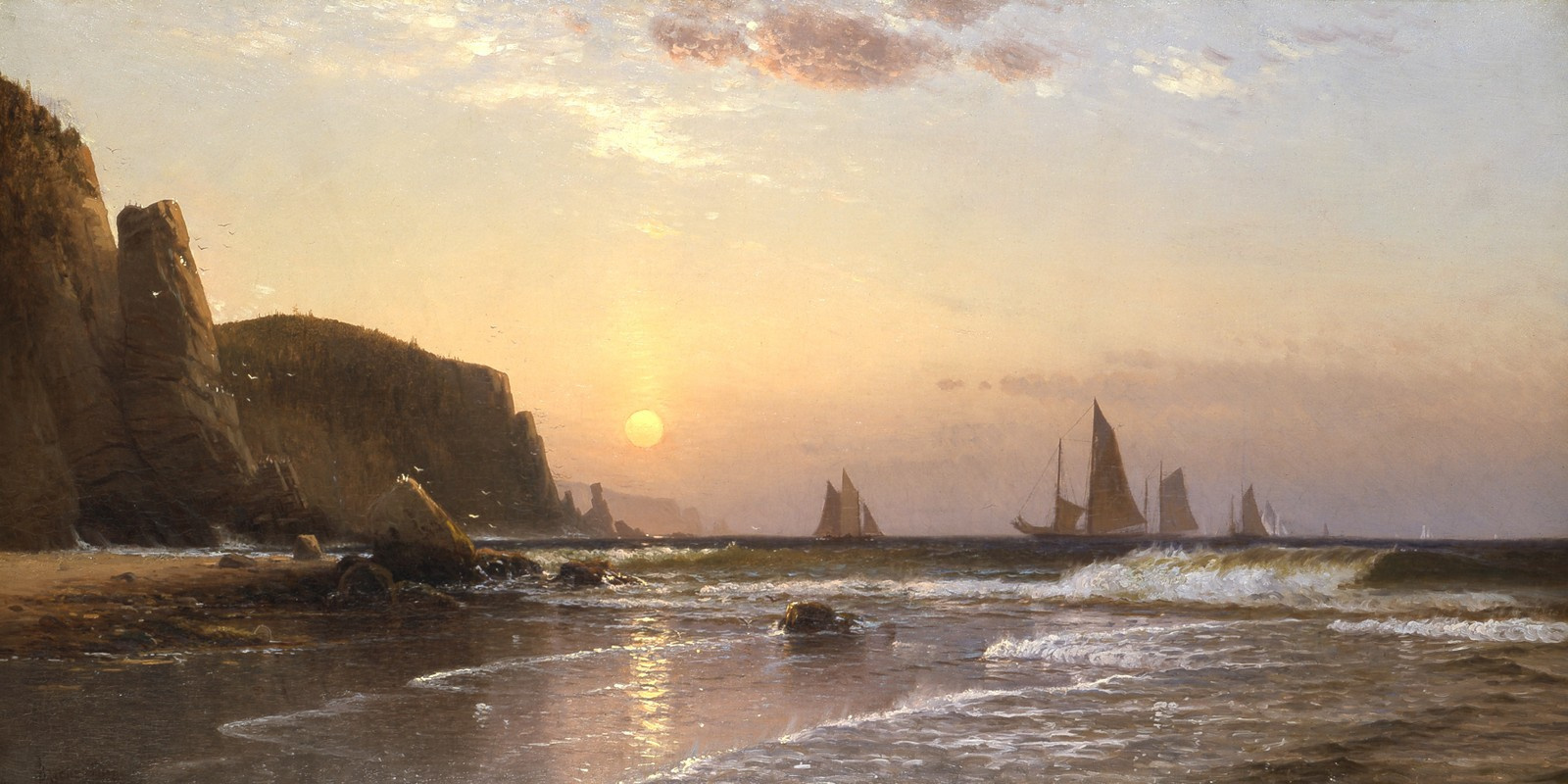
#FineArtFriday: Morning at Grand Manan by Alfred Thompson Bricher 1878

Morning_at_Grand_Manan_by_Alfred_Thompson_BricherArtist: Alfred Thompson Bricher (1837–1908)

Title: Morning at Grand Manan

Date: 1878

Medium: oil on canvas

Dimensions: height: 25 in (63.5 cm); width: 50 in (127 cm).

Collection: Indianapolis Museum of Art

Current location: Paine Early American Painting Gallery

What I Love about this painting:

This is a satisfying scene capturing the best moments of a morning at the shore. The light falls on the water with an almost photographic sheen. Fishing vessels leave the harbor, heading out to sea. The sea is calm, and the waves roll up to embrace the shore. One could wade in the shallows and search the tidal pools for starfish or crabs and other creatures in safety.

The sun is up and the few clouds in the sky are dissipating. This will be a good day, perhaps the best day of the summer.

About this painting via Wikipedia:

Morning at Grand Manan is an 1878 oil painting by Alfred Thompson Bricher. It is part of the permanent collection at the Indianapolis Museum of Art, and is currently on view in the Paine Early American Painting Gallery.

Painted along Grand Manan Island, a favorite vacation spot of the artist in New Brunswick, Canada, Bricher painted the sunrise coming above the Atlantic Ocean in a tiny inlet on the coast. Four sailing ships are clearly visible against the pink sky. On the left of the canvas, a sharp, rocky cliff face is seen, breaking up the composition. Bricher clearly depicts each wave rolling onto the beach in minute detail. The sun is positioned a little left of center of the canvas, but is the major focal point, drawing the eye in. Just like other Hudson River School painters, Bricher hides his brushstrokes as if to make the canvas disappear.

Alfred Thompson Bricher was part of the American Luminist movement, coming out of the Hudson River School. Much like the Impressionists, they were interested in the play of light in landscapes, with Bricher himself being particularly interested in how light played against the ocean. Bricher, in particular, became famous for his seascapes and depicting the North Atlantic seaboard. Bricher is considered the last important luminist painter. Morning at Grand Manan came at the height of his career, and displayed Bricher’s acquisition of European aesthetics into his own paintings.

About the Artist via Wikipedia:

Alfred Thompson Bricher (April 10, 1837 – September 30, 1908) was an American painter associated with White Mountain art and the Hudson River School.

Bricher was born in Portsmouth, New Hampshire. He was educated in an academy at Newburyport, Massachusetts. He began his career as a businessman in Boston, Massachusetts. When not working, he studied at the Lowell Institute. He also studied with Albert BierstadtWilliam Morris Hunt, and others. He attained noteworthy skill in making landscape studies from nature, and after 1858 devoted himself to the art as a profession. He opened a studio in Boston, and met with some success there. In 1868 he moved to New York City, and at the National Academy of Design that year he exhibited “Mill-Stream at Newburyport.” Soon afterward he began to use watercolors in preference to oils, and in 1873 was chosen a member of the American Watercolor Society. In the 1870s, he primarily did maritime themed paintings, with attention to watercolor paintings of landscape, marine, and coastwise scenery. He often spent summers in Grand Manan, where he produced such notable works as Morning at Grand Manan (1878). In 1879, Bricher was elected into the National Academy of Design as an Associate member.


Credits and Attributions

IMAGE: Wikimedia Commons contributors, “File:Morning at Grand Manan by Alfred Thompson Bricher.jpg,” Wikimedia Commons, https://commons.wikimedia.org/w/index.php?title=File:Morning_at_Grand_Manan_by_Alfred_Thompson_Bricher.jpg&oldid=872660352 (accessed September 5, 2024).

[1] ABOUT THE  IMAGE: Wikipedia contributors, “Morning at Grand Manan,” Wikipedia, The Free Encyclopedia, https://en.wikipedia.org/w/index.php?title=Morning_at_Grand_Manan&oldid=1192844232 (accessed September 5, 2024).

[2] BIO: Wikipedia contributors, “Alfred Thompson Bricher,” Wikipedia, The Free Encyclopedia, https://en.wikipedia.org/w/index.php?title=Alfred_Thompson_Bricher&oldid=1229486559 (accessed September 5, 2024).

4 Comments

Filed under #FineArtFriday

#FineArtFriday: A Coming Storm by Sanford Robinson Gifford

Gifford_A_Coming_Storm_1863-1880_PMA

Artist: Sanford Robinson Gifford,

Title: A Coming Storm (1863)

Date: 1863 (retouched 1880)

Location: Philadelphia Museum of Art.

What I love about this painting:

Gifford demonstrates his skill as a devotee of luminism and gives us the perfect view of a fine autumn day and the approaching storm. The way he contrasts the sun’s light against the ominous black clouds is true to nature, to how storms really look as they close in.

I like the way he shows the rock outcroppings, visible evidence of the hard stone of the mountains that lies beneath the lush finery of autumn foliage.

For the moment, the waters of the pond are quiet, reflecting the sky above. Rain cloaks the view of the distant valley, and soon we will feel the brunt of it. Enjoy the blaze of color while you can, as tomorrow those trees will be half-bare, and the ground will be covered in sodden tatters of red and gold.

While there appears to be some damage in the upper center, the integrity of the painting is still intact. It was retouched in 1880, but a modern retouching would likely bring it back to its original glory.

About the Artist, via Wikipedia:

Sanford Robinson Gifford (July 10, 1823 – August 29, 1880) was an American landscape painter and a leading member of the second generation of Hudson River School artists. A highly regarded practitioner of Luminism, his work was noted for its emphasis on light and soft atmospheric effects.

Although trained as a portrait painter, the first work Gifford exhibited at the National Academy was a landscape, in 1847. Thereafter, Gifford devoted himself primarily to landscape painting, becoming one of the finest artists of the Hudson River School. He was elected an Associate of the National Academy in 1851, and an Academician in 1854.

2008 National Academy of Design controversy:

In December 2008, one of Gifford’s paintings, Mount Mansfield, Vermont (1859), became part of a controversy over deaccessioning by the National Academy of Design. The Academy was a member of the Association of Art Museum Directors, whose policy stated that member museums could not sell works of art to cover operating expenses, only to purchase superior works or to weed out inferior or redundant ones. Prior to joining AAMD, the Academy had sold two Thomas Eakins works (including his “diploma painting,” Wrestlers) in the 1970s, and Richard Caton Woodville‘s War News from Mexico (1848) in 1994. According to its former curator, David Dearinger: “When the Academy later applied to the museum association for accreditation, Mr. Dearinger recalled, it was asked about the Woodville sale and promised not to repeat such a move.”

In a 2008 sale, the Academy quietly sold Frederic Edwin Church‘s Scene on the Magdalene (1854) and Sanford Gifford’s Mount Mansfield, Vermont (1859) to a private collector for US$13.5 million. The former was the Academy’s only painting by Church; the latter was its only painting by Gifford. Both had been “donated to the Academy in 1865 by another painter, James Augustus Suydam.” News of the sale was broken by arts blogger Lee Rosenbaum. As punishment for these actions, AAMD asked its other member museums to “cease lending artworks to the Academy and collaborating with it on exhibitions.” The Academy had contemplated selling additional paintings, but those plans were abandoned after being reported by Rosenbaum. [1]


Credits and Attributions:

IMAGE: A Coming Storm by Sanford Robinson Gifford. Wikimedia Commons contributors, “File:Gifford A Coming Storm 1863-1880 PMA.jpg,” Wikimedia Commons, https://commons.wikimedia.org/w/index.php?title=File:Gifford_A_Coming_Storm_1863-1880_PMA.jpg&oldid=803742381 (accessed October 5, 2023).

[1] Wikipedia contributors, “Sanford Robinson Gifford,” Wikipedia, The Free Encyclopedia, https://en.wikipedia.org/w/index.php?title=Sanford_Robinson_Gifford&oldid=1176083433 (accessed October 5, 2023).

Comments Off on #FineArtFriday: A Coming Storm by Sanford Robinson Gifford

Filed under #FineArtFriday