Tag Archives: 19th century American landscape art

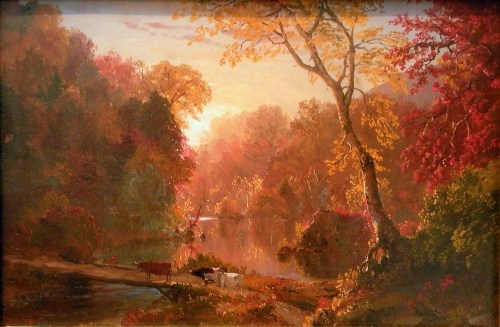
#FineArtFriday: Autumn in North America by Frederic Edwin Church 1896

Autumn_in_North_America-Frederic_ChurchArtist: Frederic Edwin Church  (1826–1900)
Title: Autumn in North America

Genre: landscape art

Date: 1856

Medium: oil on board

Dimensions: height: 28.5 cm (11.2 in); width: 43.1 cm (17 in)

Collection: Thyssen-Bornemisza Museum

What I love about this picture:

This is a New England autumn in full color, the way autumns never are here in my part of the world. Yes, non-native trees will turn these bright shades, but the only bright red fall color in native species will be vine maples. Staghorn Sumac is a non-native plant that has become a part of our local flora, and it turns bright red also. But we do have gorgeous golds and oranges beginning to show in our native deciduous forests.

Many years it is too wet for a colorful fall, and the leaves turn a soggy brown and drop off their trees, sodden masses nearly impossible to rake.

About the Artist, via Wikipedia:

Frederic Edwin Church (May 4, 1826 – April 7, 1900) was an American landscape painter born in Hartford, Connecticut. He was a central figure in the Hudson River School of American landscape painters, best known for painting large landscapes, often depicting mountains, waterfalls, and sunsets. Church’s paintings put an emphasis on realistic detail, dramatic light, and panoramic views. He debuted some of his major works in single-painting exhibitions to a paying and often enthralled audience in New York City. In his prime, he was one of the most famous painters in the United States. [1]


Credits and Attributions:

IMAGE: Wikimedia Commons contributors, “File:Autumn in North America-Frederic Church.jpg,” Wikimedia Commons, https://commons.wikimedia.org/w/index.php?title=File:Autumn_in_North_America-Frederic_Church.jpg&oldid=718218353 (accessed September 19, 2023).

[1] Wikipedia contributors, “Frederic Edwin Church,” Wikipedia, The Free Encyclopedia, https://en.wikipedia.org/w/index.php?title=Frederic_Edwin_Church&oldid=1162133197 (accessed September 19, 2023).

6 Comments

Filed under #FineArtFriday

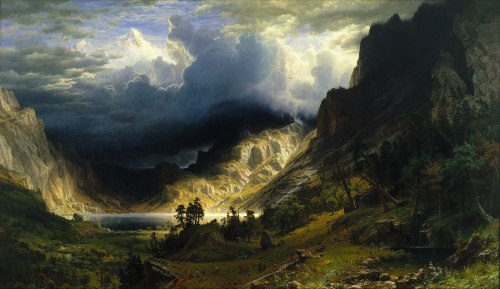
#FineArtFriday: A Storm in the Rocky Mountains – Mt. Rosalie by Albert Bierstadt 1866

Albert_Bierstadt_-_A_Storm_in_the_Rocky_Mountains,_Mt._Rosalie_-_Google_Art_ProjectArtist: Albert Bierstadt  (1830–1902)

Title: A Storm in the Rocky Mountains, Mt. Rosalie

Genre: landscape art

Date: 1866

Medium: oil on canvas

Dimensions: height: 210.8 cm (82.9 in); width: 361.3 cm (11.8 ft)

Collection: Brooklyn Museum: American Identities: A New Look, American Landscape, 5th Floor

What I love about this painting:

Albert Bierstadt painted his idea of what the American West of his time should be, grand, pristine, and wild. He painted what he saw, slightly fictionalized, so the viewer would see what he felt. He gave us entire stories on his canvas, epic explorations of the power and beauty of nature.

Bierstadt’s skies were imbued with high drama contrasted with peaceful vistas below. He took the places he had visited and made them bigger, grander, made the viewer feel the emotions he experienced when he first laid eyes on them.

About this painting via Wikipedia:

A Storm in the Rocky Mountains, Mt. Rosalie is an 1866 landscape oil painting by German-American painter Albert Bierstadt (1830-1902) which was inspired by sketches created on an 1863 expedition.

Bierstadt traveled to the Colorado Rocky Mountains where he was taken up to the Chicago Lakes beneath Mount Evans. The painting is named after Bierstadt’s mistress and, at the time, his friend’s wife, Rosalie Osborne Ludlow. The painting, measuring at 210.8 × 361.3 cm (83.0 × 142.2 in), is exhibited at the Brooklyn Museum, which acquired it in 1976.

The painting depicts Native American hunter/gatherers hunting deer in the foreground. A Native American encampment resides by a stream in the distance. The mountains are thrown into either sunlight or the darkness of a thunderstorm. In order to increase its dramatic value, Bierstadt exaggerated the scale of the Rocky Mountains.

Peering through a break in the clouds in the far distance is a snow-capped Mt. Rosalie, named after Bierstadt’s wife.

Upon its completion, the painting toured the United States for a year. On 7 February 1866, A Storm in the Rocky Mountains, Mount Rosalie exhibited for one day and evening at the Somerville Art Gallery in New York City as a benefit for the “Nursery and Child’s Hospital.” [1]

Quote from Wikimedia Commons: Albert Bierstadt enjoyed great success in the years surrounding the Civil War, producing finely detailed vistas of nature’s splendor in majestic canvases that were similarly invested with significance beyond their surface appearance.

The first technically advanced artist to portray the American West, Bierstadt offered to a rapidly transforming nation pictures whose spectacular size and fresh, dramatic subject matter supplied a visual correlative to notions of American exceptionalism, while also contributing to the developing concept of Manifest Destiny.

Trained in the highly finished manner of the Düsseldorf Academy, Bierstadt’s precise style imbued his works with a reassuring sense of veracity despite their sublime subjects and occasional liberties with geographic reality. [2]

About the Artist, via Wikipedia:

Albert Bierstadt (January 7, 1830 – February 18, 1902) was a German American painter best known for his lavish, sweeping landscapes of the American West. He joined several journeys of the Westward Expansion to paint the scenes. He was not the first artist to record the sites, but he was the foremost painter of them for the remainder of the 19th century.

Bierstadt was born in Prussia, but his family moved to the United States when he was one year old. He returned to study painting for several years in Düsseldorf. He became part of the second generation of the Hudson River School in New York, an informal group of like-minded painters who started painting along the Hudson River. Their style was based on carefully detailed paintings with romantic, almost glowing lighting, sometimes called luminism. Bierstadt was an important interpreter of the western landscape, and he is also grouped with the Rocky Mountain School.


Credits and Attributions:

Image: Wikimedia Commons contributors, ‘File:Albert Bierstadt – A Storm in the Rocky Mountains, Mt. Rosalie – Google Art Project.jpg’, Wikimedia Commons, 29 July 2023, 05:50 UTC, <https://commons.wikimedia.org/w/index.php?title=File:Albert_Bierstadt_-_A_Storm_in_the_Rocky_Mountains,_Mt._Rosalie_-_Google_Art_Project.jpg&oldid=787844562> [accessed 1 September 2023]

[1] Wikipedia contributors, “A Storm in the Rocky Mountains, Mt. Rosalie,” Wikipedia, The Free Encyclopedia, https://en.wikipedia.org/w/index.php?title=A_Storm_in_the_Rocky_Mountains,_Mt._Rosalie&oldid=1160866547 (accessed September 1, 2023).

[2] Wikimedia Commons contributors, “File:1875, Bierstadt, Albert, Mount Adams, Washington.jpg,” Wikimedia Commons, the free media repository, https://commons.wikimedia.org/w/index.php?title=File:1875,_Bierstadt,_Albert,_Mount_Adams,_Washington.jpg&oldid=272380899 (accessed March 9, 2018).

2 Comments

Filed under #FineArtFriday

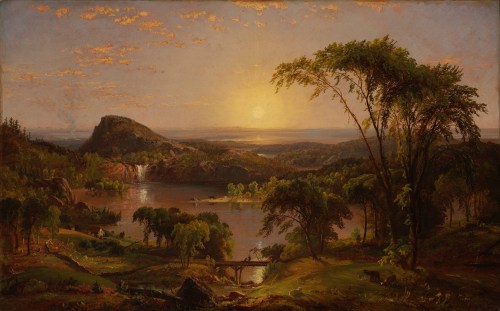
#FineArtFriday: Summer, Lake Ontario by Jasper Francis Cropsey 1857 (revisited)

Cropsey,_Jasper_Francis_-_Summer,_Lake_Ontario_-_Google_Art_ProjectTitle: Summer, Lake Ontario by Jasper Francis Cropsey (1823–1900)
Genre: landscape art

Date: 1857

Medium: oil on canvas

Collection: Indianapolis Museum of Art

What I love about this painting:

Cropsey paints a summer evening in New York State, along the shore of one of Lake Ontario’s bays. Near the bottom center, a pair of fishers are placed on the wooden bridge over a creek. This image has a fantasy quality, as if it depicts a dream or a fond memory.

Our point of view is from a hill, looking down to the creek, the bridge, and the bay shore, and then across low hills to the great lake beyond. Cropsey gives equal importance to the earth below and sky above.

Cropsey’s signature deep colors are featured in this panoramic view of a summer evening. Warm reds, browns, yellows, and dark greens are lightened by wispy mists rising in the early evening air, lit by the setting sun.

About the Artist, via Wikipedia:

Jasper Francis Cropsey (February 18, 1823 – June 22, 1900) was an important American landscape artist of the Hudson River School.

Cropsey was born on his father Jacob Rezeau Cropsey’s farm in Rossville on Staten Island, New York, the oldest of eight children. As a young boy, Cropsey had recurring periods of poor health. While absent from school, Cropsey taught himself to draw. His early drawings included architectural sketches and landscapes drawn on notepads and in the margins of his schoolbooks.

Trained as an architect, he set up his own office in 1843. Cropsey studied watercolor and life drawing at the National Academy of Design under the instruction of Edward Maury and first exhibited there in 1844. A year later he was elected an associate member and turned exclusively to landscape painting; shortly after he was featured in an exhibition entitled “Italian Compositions.”

Cropsey traveled in Europe from 1847–1849, visiting England, France, Switzerland, and Italy. He was elected a full member of the Academy in 1851. Cropsey was a personal friend of Henry Tappan, the president of the University of Michigan from 1852 to 1863. At Tappan’s invitation, he traveled to Ann Arbor in 1855 and produced two paintings, one of the Detroit Observatory, and a landscape of the campus. He went abroad again in 1856, and resided seven years in London, sending his pictures to the Royal Academy and to the International exhibition of 1862.

Returning home, he opened a studio in New York and specialized in autumnal landscape paintings of the northeastern United States, often idealized and with vivid colors. Cropsey co-founded, with ten fellow artists, the American Society of Painters in Watercolors in 1866. He also made the architectural designs for the stations of the elevated railways in New York. [1]


Credits and Attributions:

Image: Summer, Lake Ontario by Jasper Francis Cropsey 1857. Wikimedia Commons contributors, “File:Cropsey, Jasper Francis – Summer, Lake Ontario – Google Art Project.jpg,” Wikimedia Commons, the free media repository, https://commons.wikimedia.org/w/index.php?title=File:Cropsey,_Jasper_Francis_-_Summer,_Lake_Ontario_-_Google_Art_Project.jpg&oldid=618625179 (accessed June 30, 2022).

[1] Wikipedia contributors, “Jasper Francis Cropsey,” Wikipedia, The Free Encyclopedia, https://en.wikipedia.org/w/index.php?title=Jasper_Francis_Cropsey&oldid=1093620569 (accessed June 30, 2022).

2 Comments

Filed under #FineArtFriday, writing

#FineArtFriday: Mount Adams by Albert Bierstadt (revisited)


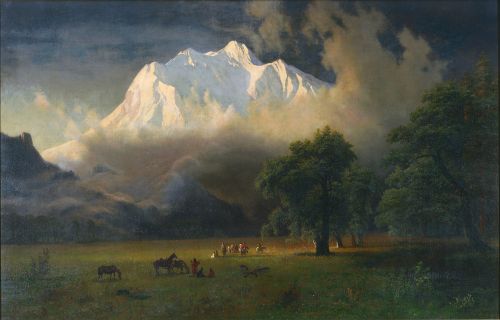
I live just north of Mount Adams. When you drive down past Mt. St. Helens, you often catch glimpses of this majestic volcano, but it is not usually on the tourist routes. Several of our native tribes call this mountain Klickitat, and some call it Pahto. Although Adams has not erupted in more than 1,000 years, it is not considered extinct.

I find it interesting that while it is the second-highest mountain in Washington State, after Mount Rainier, it is the least well-known to me. As a child, we stayed at Spirit Lake Resort (long before the 1980 eruption of Mt. St. Helens) and often camped at places near Goat Rocks. Sometimes I saw it from afar and wondered but never visited.

My father was an amputee, and 1940s prosthetics were rudimentary at best. He was unable to wear his prosthetic leg and walked on crutches. He adored fishing, but couldn’t hike for any distance, so we trailer-camped in places where he could fish from a boat. While there were camp sites in the Mt. Adams area, one often had to hike into them. But despite Dad’s disability, we traveled every summer and saw as much of our beautiful state as we could.

I don’t know if Bierstadt actually visited Mt. Adams, or painted this from what he was told–he was famous for painting scenery he had never seen and doing it with some accuracy.

Quote from Wikimedia Commons: Albert Bierstadt enjoyed great success in the years surrounding the Civil War, producing finely detailed vistas of nature’s splendor in majestic canvases that were similarly invested with significance beyond their surface appearance.

The first technically advanced artist to portray the American West, Bierstadt offered to a rapidly transforming nation pictures whose spectacular size and fresh, dramatic subject matter supplied a visual correlative to notions of American exceptionalism, while also contributing to the developing concept of Manifest Destiny.

Trained in the highly finished manner of the Düsseldorf Academy, Bierstadt’s precise style imbued his works with a reassuring sense of veracity despite their sublime subjects and occasional liberties with geographic reality. In Mount Adams, Washington, he characteristically combined an impressively scaled natural background with a foreground view of American Indian life, which serves to heighten the picture’s putative realism even as it enhances its exotic appeal.

The implied movement of the clouds and the sunlit figures on horseback similarly off to the right seems to open up the depicted space for the viewer to inhabit, providing an apt pictorial metaphor for the actual occupation and exploitation of the West by the eastern interests that constituted the artist’s clientele.


Credits and Attributions:

Mount Adams by Albert Bierstadt [Public domain], via Wikimedia Commons

Wikimedia Commons contributors, “File:1875, Bierstadt, Albert, Mount Adams, Washington.jpg,” Wikimedia Commons, the free media repository, https://commons.wikimedia.org/w/index.php?title=File:1875,_Bierstadt,_Albert,_Mount_Adams,_Washington.jpg&oldid=272380899 (accessed March 9, 2018).

4 Comments

Filed under #FineArtFriday

#FineArtFriday: On the Saco by Albert Bierstadt (revisited)

Bierstadt_Albert_On_the_SacoArtist: Albert Bierstadt (1830–1902)

Title: “On the Saco”

Genre: landscape art

Description: Of the Saco River, Maine.

Date: Unknown date (19th century)

Medium: oil painting.

What I love about this image:

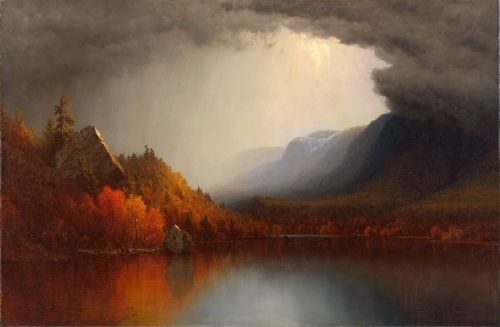
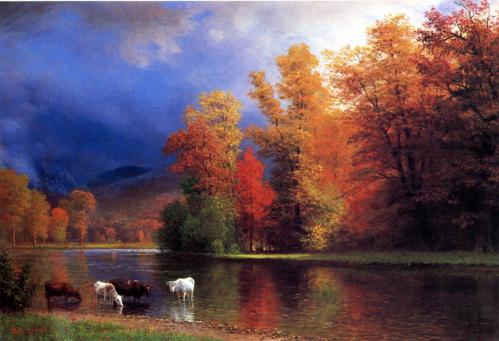
Bierstadt understood and respected the power of nature. The way he rendered the sky is wonderful. He captured that brilliant darkness of a distant storm against the bright sunshine of an autumn afternoon. I love contrasts in this painting, the bright foliage in every shade of red and yellow, the serenity of the cattle drinking in the shallows.

The heavy darkness of the storm in the hills seems to be pushed back by the serene glow of fall’s sunlight on the river. Will it rain itself out before it passes over the herd? Possibly.

About the Artist, via Wikipedia:

Albert Bierstadt (January 7, 1830 – February 18, 1902) was a German-American painter best known for his lavish, sweeping landscapes of the American West. He joined several journeys of the Westward Expansion to paint the scenes. He was not the first artist to record the sites, but he was the foremost painter of them for the remainder of the 19th century.

Bierstadt was born in Prussia, but his family moved to the United States when he was one year old. He returned to study painting for several years in Düsseldorf. He became part of the second generation of the Hudson River School in New York, an informal group of like-minded painters who started painting along the Hudson River. Their style was based on carefully detailed paintings with romantic, almost glowing lighting, sometimes called luminism. Bierstadt was an important interpreter of the western landscape, and he is also grouped with the Rocky Mountain School. [1]


Credits and Attributions:

Image: On the Saco by Albert Bierstadt, Wikimedia Commons contributors, “File:Bierstadt Albert On the Saco.jpg,” Wikimedia Commons, the free media repository, https://commons.wikimedia.org/w/index.php?title=File:Bierstadt_Albert_On_the_Saco.jpg&oldid=618723154 (accessed September 16, 2022).

[1] Wikipedia contributors, “Albert Bierstadt,” Wikipedia, The Free Encyclopedia, https://en.wikipedia.org/w/index.php?title=Albert_Bierstadt&oldid=1107140650 (accessed September 16, 2022).

Comments Off on #FineArtFriday: On the Saco by Albert Bierstadt (revisited)

Filed under #FineArtFriday

#FineArtFriday: On the Saco by Albert Bierstadt

Bierstadt_Albert_On_the_SacoArtist: Albert Bierstadt (1830–1902)

Title: “On the Saco”

Genre: landscape art

Description: Of the Saco River, Maine.

Date: Unknown date (19th century)

Medium: oil painting.

What I love about this image:

Bierstadt understood and respected the power of nature. The way he rendered the sky is wonderful. He captured that brilliant darkness of a distant storm against the bright sunshine of an autumn afternoon. I love contrasts in this painting, the bright foliage in every shade of red and yellow, the serenity of the cattle drinking in the shallows.

The heavy darkness of the storm in the hills seems to be pushed back by the serene glow of fall’s sunlight on the river. Will it rain itself out before it passes over the herd? Possibly.

About the Artist, via Wikipedia:

Albert Bierstadt (January 7, 1830 – February 18, 1902) was a German-American painter best known for his lavish, sweeping landscapes of the American West. He joined several journeys of the Westward Expansion to paint the scenes. He was not the first artist to record the sites, but he was the foremost painter of them for the remainder of the 19th century.

Bierstadt was born in Prussia, but his family moved to the United States when he was one year old. He returned to study painting for several years in Düsseldorf. He became part of the second generation of the Hudson River School in New York, an informal group of like-minded painters who started painting along the Hudson River. Their style was based on carefully detailed paintings with romantic, almost glowing lighting, sometimes called luminism. Bierstadt was an important interpreter of the western landscape, and he is also grouped with the Rocky Mountain School. [1]


Credits and Attributions:

Image: On the Saco by Albert Bierstadt, Wikimedia Commons contributors, “File:Bierstadt Albert On the Saco.jpg,” Wikimedia Commons, the free media repository, https://commons.wikimedia.org/w/index.php?title=File:Bierstadt_Albert_On_the_Saco.jpg&oldid=618723154 (accessed September 16, 2022).

[1] Wikipedia contributors, “Albert Bierstadt,” Wikipedia, The Free Encyclopedia, https://en.wikipedia.org/w/index.php?title=Albert_Bierstadt&oldid=1107140650 (accessed September 16, 2022).

5 Comments

Filed under #FineArtFriday

#FineArtFriday: Summer, Lake Ontario by Jasper Francis Cropsey 1857

Cropsey,_Jasper_Francis_-_Summer,_Lake_Ontario_-_Google_Art_ProjectTitle: Summer, Lake Ontario by Jasper Francis Cropsey (1823–1900)

Genre: landscape art

Date: 1857

Medium: oil on canvas

Collection: Indianapolis Museum of Art

What I love about this painting:

Cropsey paints a summer evening in New York State, along the shore of one of Lake Ontario’s bays. Near the bottom center, a pair of fishers are placed on the wooden bridge over a creek. This image has a fantasy quality, as if it depicts a dream or a fond memory.

Our point of view is from a hill, looking down to the creek, the bridge, and the bay shore, and then across low hills to the great lake beyond. Cropsey gives equal importance to the earth below and sky above.

Cropsey’s signature deep colors are featured in this panoramic view of a summer evening. Warm reds, browns, yellows, and dark greens are lightened by wispy mists rising in the early evening air, lit by the setting sun.

About the Artist, via Wikipedia:

Jasper Francis Cropsey (February 18, 1823 – June 22, 1900) was an important American landscape artist of the Hudson River School.

Cropsey was born on his father Jacob Rezeau Cropsey’s farm in Rossville on Staten Island, New York, the oldest of eight children. As a young boy, Cropsey had recurring periods of poor health. While absent from school, Cropsey taught himself to draw. His early drawings included architectural sketches and landscapes drawn on notepads and in the margins of his schoolbooks.

Trained as an architect, he set up his own office in 1843. Cropsey studied watercolor and life drawing at the National Academy of Design under the instruction of Edward Maury and first exhibited there in 1844. A year later he was elected an associate member and turned exclusively to landscape painting; shortly after he was featured in an exhibition entitled “Italian Compositions.”

Cropsey traveled in Europe from 1847–1849, visiting England, France, Switzerland, and Italy. He was elected a full member of the Academy in 1851. Cropsey was a personal friend of Henry Tappan, the president of the University of Michigan from 1852 to 1863. At Tappan’s invitation, he traveled to Ann Arbor in 1855 and produced two paintings, one of the Detroit Observatory, and a landscape of the campus. He went abroad again in 1856, and resided seven years in London, sending his pictures to the Royal Academy and to the International exhibition of 1862.

Returning home, he opened a studio in New York and specialized in autumnal landscape paintings of the northeastern United States, often idealized and with vivid colors. Cropsey co-founded, with ten fellow artists, the American Society of Painters in Watercolors in 1866. He also made the architectural designs for the stations of the elevated railways in New York. [1]


Credits and Attributions:

Image: Summer, Lake Ontario by Jasper Francis Cropsey 1857. Wikimedia Commons contributors, “File:Cropsey, Jasper Francis – Summer, Lake Ontario – Google Art Project.jpg,” Wikimedia Commons, the free media repository, https://commons.wikimedia.org/w/index.php?title=File:Cropsey,_Jasper_Francis_-_Summer,_Lake_Ontario_-_Google_Art_Project.jpg&oldid=618625179 (accessed June 30, 2022).

[1] Wikipedia contributors, “Jasper Francis Cropsey,” Wikipedia, The Free Encyclopedia, https://en.wikipedia.org/w/index.php?title=Jasper_Francis_Cropsey&oldid=1093620569 (accessed June 30, 2022).

2 Comments

Filed under #FineArtFriday, writing