Tag Archives: 19th century American landscapes

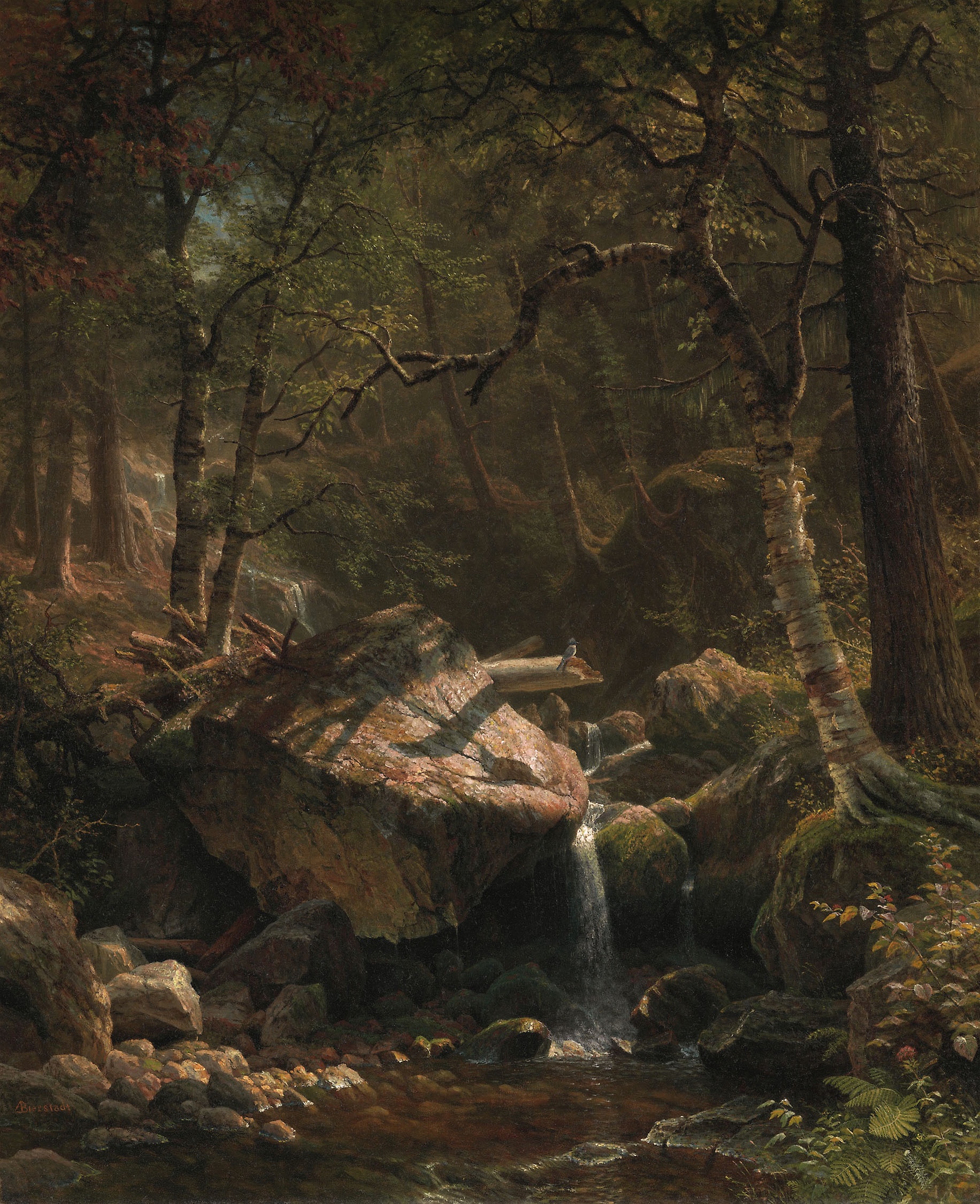
#FineArtFriday – the Mountain Brook by Albert Bierstadt 1863

Mountain_Brook_oil_1863_Albert_BierstadtArtist: Albert Bierstadt  (1830–1902)

Title: Mountain Brook

Genre: landscape painting

Date: 1863

Medium: oil on canvas

Dimensions: height: 111.8 cm (44 in); width: 91.4 cm (35.9 in)

Collection: Art Institute of Chicago

What I love about this painting:

This is an unusual subject for Albert Bierstadt. There is no immensity of sky watching over all who walk below. Instead, he gives us the immensity of a quiet wood and the solitude of a small mountain stream.

I love this peaceful glade, with the sun filtering through the forest canopy. I could sit there happily, writing the day away.

About the artist, via Wikipedia:

Albert Bierstadt (January 7, 1830 – February 18, 1902) was a German American painter best known for his lavish, sweeping landscapes of the American West. He joined several journeys of the Westward Expansion to paint the scenes. He was not the first artist to record the sites, but he was the foremost painter of them for the remainder of the 19th century.

Bierstadt was born in Prussia, but his family moved to the United States when he was one year old. He returned to study painting for several years in Düsseldorf. He became part of the second generation of the Hudson River School in New York, an informal group of like-minded painters who started painting along the Hudson River. Their style was based on carefully detailed paintings with romantic, almost glowing lighting, sometimes called luminism. Bierstadt was an important interpreter of the western landscape, and he is also grouped with the Rocky Mountain School.

In 1851, Bierstadt began to paint in oils. He returned to Germany in 1853 and studied painting for several years in Düsseldorf with members of its informal school of painting. After returning to New Bedford in 1857, he taught drawing and painting briefly before devoting himself full-time to painting.

Bierstadt’s popularity in the U.S. remained strong during his European tour. The publicity generated by his Yosemite Valley paintings in 1868 led a number of explorers to request his presence as part of their westward expeditions. The Atchison, Topeka, and Santa Fe Railroad also commissioned him to visit and paint the Grand Canyon and surrounding region.

Despite his popular success, Bierstadt was criticized by some contemporaries for the romanticism evident in his choice of subjects and for his use of light, which they found excessive.

Some critics objected to Bierstadt’s paintings of Native Americans based on their belief that including Indigenous Americans “marred” the “impression of solitary grandeur.” [1]


Credits and Attributions:

IMAGE: Wikimedia Commons contributors, Mountain Brook by Albert Bierstadt, Public domain, via Wikimedia Commons Commons, https://commons.wikimedia.org/w/index.php?title=File:Bierstadt_Albert_Bavarian_Landscape.jpg&oldid=823443562 (accessed July 25, 2024).

[1] Quote: Wikipedia contributors, “Albert Bierstadt,” Wikipedia, The Free Encyclopedia, https://en.wikipedia.org/w/index.php?title=Albert_Bierstadt&oldid=1210445403 (accessed July 25, 2024).
3 Comments

Filed under #FineArtFriday

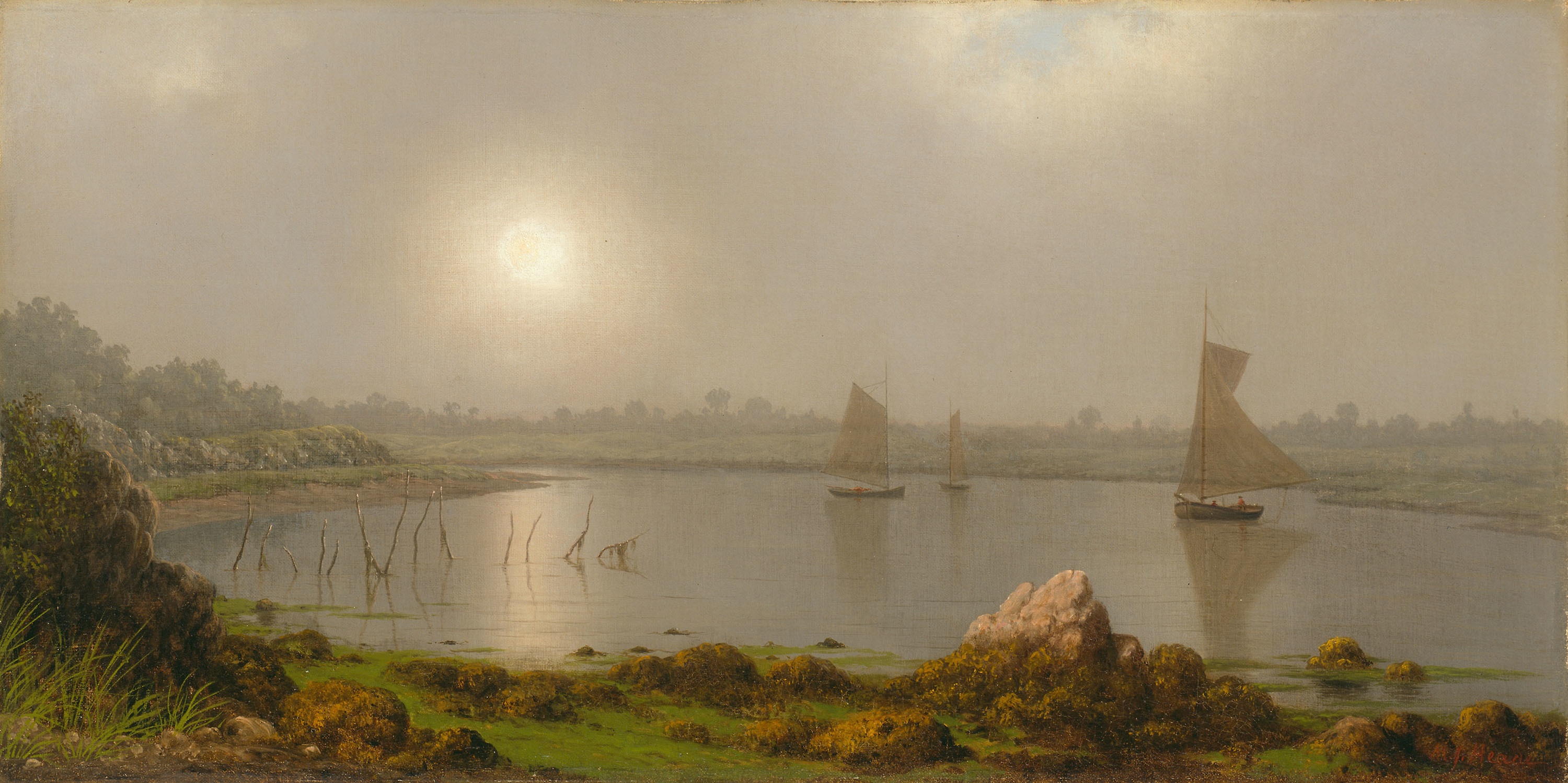
#FineArtFriday: York Harbor, Coast of Maine by Martin Johnson Heade 1877

Martin_Johnson_Heade_-_York_Harbor,_Coast_of_Maine_-_1999.291_-_Art_Institute_of_ChicagoArtist: Martin Johnson Heade  (1819–1904)

Title: York Harbor, Coast of Maine

Genre: marine art

Date: 1877

Medium: oil on canvas

Dimensions: height: 38.7 cm (15.2 in)

Collection: Art Institute of Chicago

What I love about this painting:

We see the sun rising, slowly burning off the morning mist–my favorite time of the day. I love the detail, the way Martin Johnson Heade shows us the truth about harbors that serve small communities in a low-tech world. They aren’t necessarily fancy, and they don’t accommodate large boats. Somewhere out of the picture is a simple wooden pier, a place for the fishing boats to offload their catch. Perhaps there is a sandy beach where fisherfolk can pull their boats above the waterline, resting them upside down when they’re not in use.

The scene he shows us is a salt marsh, alive with a thriving wildlife community.

The line of branches emerging from the water has been placed there by human hands, but for what purpose? Whatever they are meant to do, they have been there long enough that seaweed clings to them, nourished by the rise and fall of the tide.

About the Artist, via Wikipedia:

Martin Johnson Heade (August 11, 1819 – September 4, 1904) was an American painter known for his salt marsh landscapesseascapes, and depictions of tropical birds (such as hummingbirds), as well as lotus blossoms and other still lifes. His painting style and subject matter, while derived from the romanticism of the time, are regarded by art historians as a significant departure from those of his peers.

Heade’s primary interest in landscape, and the works for which he is perhaps best known today, was the New England coastal salt marsh. Contrary to typical Hudson River School displays of scenic mountains, valleys, and waterfalls, Heade’s marsh landscapes avoided depictions of grandeur. They focused instead on the horizontal expanse of subdued scenery, and employed repeating motifs that included small haystacks and diminutive figures. Heade also concentrated on the depiction of light and atmosphere in his marsh scenes. These and similar works have led some historians to characterize Heade as a Luminist painter. In 1883 Heade moved to Saint Augustine, Florida and took as his primary landscape subject the surrounding subtropical marshland. [1]

To read more about this Artist, go to Martin Johnson Heade – Wikipedia


Credits and Attributions:

IMAGE: Wikimedia Commons contributors, “File:Martin Johnson Heade – York Harbor, Coast of Maine – 1999.291 – Art Institute of Chicago.jpg,” Wikimedia Commons, https://commons.wikimedia.org/w/index.php?title=File:Martin_Johnson_Heade_-_York_Harbor,_Coast_of_Maine_-_1999.291_-_Art_Institute_of_Chicago.jpg&oldid=828607401 (accessed July 3, 2024).

[1] Wikipedia contributors, “Martin Johnson Heade,” Wikipedia, The Free Encyclopedia, https://commons.wikimedia.org/w/index.php?title=File:Martin_Johnson_Heade_-_York_Harbor,_Coast_of_Maine_-_1999.291_-_Art_Institute_of_Chicago.jpg&oldid=828607401 (accessed July 3, 2024).

8 Comments

Filed under #FineArtFriday, writing