
 Artist: Paul Cornoyer (1864–1923)
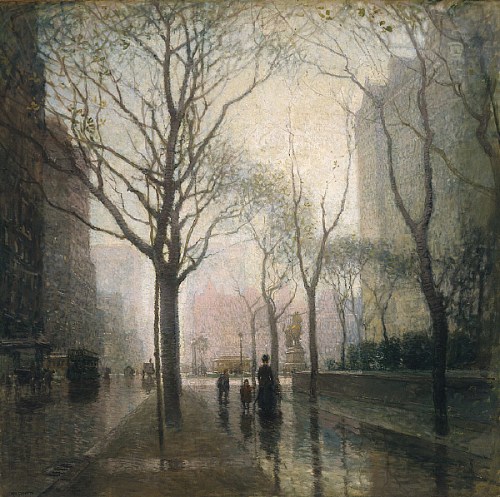
Title: The Plaza After Rain
Date: Before 1910
Medium: oil on canvas
Dimensions: 59 1/4 x 59 1/4 in. (150.5 x 150.5 cm)
Collection: Saint Louis Art Museum, Saint Louis, Missouri, United States
What I love about this painting:
This painting appeared here in January of 2024. Paul Cornoyer was a master at painting the way wet pavement looks, the reflections and the sheen. Rain is a near-constant companion during a Pacific Northwest winter and while it is now May, today is no exception.
Paul Cornoyer’s The Plaza After Rain depicts New York City, which is on the other side of the continent from me, and it takes place in a different era. But he shows the way rain is in early spring no matter where in the northern US you reside.
The sky is dark, but the trees are just beginning to leaf out. The rain is passing, and the streets are wet, but a hint of blue is showing through the dark sky. When you see this painting, you see the story of a cold spring day. Yet, one has the feeling that sunshine could happen any minute.
Impressionism is flash fiction on a canvas. All the important things are there, everything the eye needs to have a perfect vision of the mood, the setting, and characters at that moment in time. The important things at that moment are depicted within the piece, but with economy.
The St. Louis Art Museum says this about The Plaza After the Rain:
A drizzling rain creates watery reflections on the streets and sidewalks along the Grand Army Plaza in Manhattan. The rain hampers our view down the vista, though the moody tones of pinks, grays, and blues make up for this loss. The light in the distance offers a hazy glimpse of the southeast corner of Central Park, with its beloved bronze statue of Civil War general William Tecumseh Sherman. [2]
About the Author, via Wikipedia:
Paul Cornoyer (1864–1923) was an American painter, currently best known for his popularly reproduced painting in an Impressionist, tonalist, and sometimes pointillist style.
Born in St. Louis, Missouri, Cornoyer began painting in Barbizon style and first exhibited in 1887. In 1889, He moved to Paris, where he studied at the Académie Julian alongside Jules Lefebvre and Jean-Joseph Benjamin-Constant. After returning from his studies in Paris in 1894, Cornoyer was heavily influenced by the American tonalists. At the urging of William Merritt Chase, he moved to New York City in 1899. In 1908, the Albright–Knox Art Gallery (formerly the Albright Gallery) hosted a show of his work. In 1909, he was elected into the National Academy of Design as an Associate Academician. He taught at Mechanics Institute of New York and in 1917, he moved to Massachusetts, where he continued to teach and paint.
Cornoyer received a retrospective exhibition entitled Paul Cornoyer: American Impressionist at the Lakeview Center for the Arts and Sciences in Peoria, Illinois in 1973. The exhibit drew heavily from the collection of Dr. and Mrs. Lawrence Ashby, who loaned multiple paintings to the exhibit, as well as over 20 works on paper. [1]
Credits and Attributions:
IMAGE: The Plaza After the Rain by Paul Cornoyer PD|100, Wikimedia Commons contributors, “File:Paul Cornoyer – The Plaza After Rain.jpg,” Wikimedia Commons, https://commons.wikimedia.org/w/index.php?title=File:Paul_Cornoyer_-_The_Plaza_After_Rain.jpg&oldid=345336218 (accessed January 18, 2024).
[1] Wikipedia contributors, “Paul Cornoyer,” Wikipedia, The Free Encyclopedia, https://en.wikipedia.org/w/index.php?title=Paul_Cornoyer&oldid=1118249028 (accessed January 18, 2024).
[2] St. Louis Art Museum contributors, the Plaza After the Rain by Paul Cornoyer, The Plaza after the Rain – Saint Louis Art Museum (slam.org) (accessed January 18, 2024).
 Artist: August Fischer (1854–1921)
 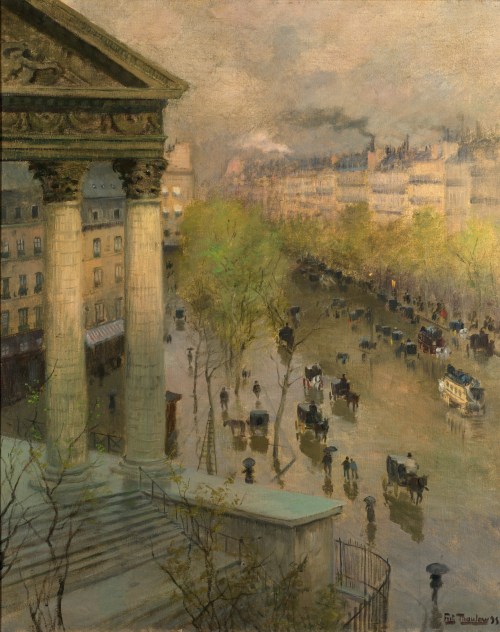 Title: Boulevard de la Madeleine in Paris by Frits Thaulow


 Life in the Realm of Fantasy
.jpg)