Tag Archives: 19th century Danish landscape art

#FineArtFriday: An autumn walk in the English Garden of Munich by Anders Andersen-Lundby 1887

Artist: Anders Andersen-Lundby (1841–1923)

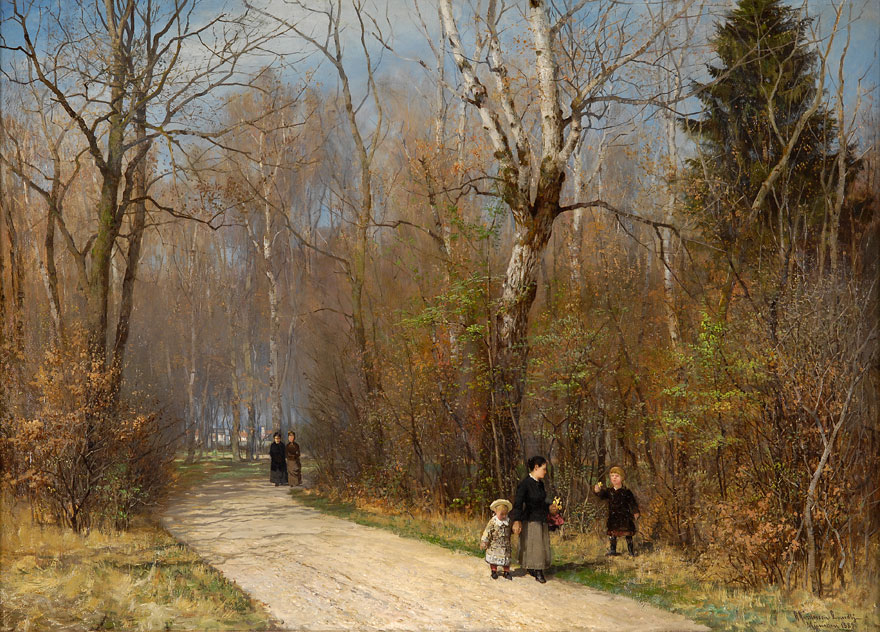
Title: English: An autumn walk in the English Garden of Munich. German: Herbstspaziergang im englischen Garten in München.

Date: 1887

Medium: oil on canvas

Dimensions: height: 77 cm (30.3 in); width: 106 cm (41.7 in)

Inscriptions: Signature and date: 1887

What I love about this painting:

Anders Anderson-Lundby shows us the perfect autumn day for a stroll. Truthfully, the day looks so pleasant that I’d like to be walking there. The leaves are nearly off the trees, and those that remain are golden and brown. Those who walk in these woods seem happy, content to be outdoors while the weather remains decent.

Autumn has arrived here in the Pacific Northwest. In a few weeks, this is how the deciduous trees in my part of the world will look. Right now the big-leaf maples are still holding fast to green but it’s shading toward brown and their leaves have begun falling. The Japanese maples and other non-native trees brightening gardens and public through-ways have turned a bright red. Soon our native vine maples and that (now undomesticated) decorative-plant-gone-native, staghorn sumac, will too.

About the Artist, via Wikipedia:

Anders Andersen-Lundby (December 16, 1841 – January 4, 1923) was a Danish landscape painter. He was most associated with winter landscapes.

(He) was born in Lundby, Denmark. He grew up in Lundby near Aalborg. In 1861, when he was twenty, Andersen-Lundby traveled to Copenhagen, and there he exhibited his works for the first time in 1864. By 1870, he gained popularity especially with his winter landscapes from both Denmark and southern Germany, most often with fallen snow or thaw.

In 1876, he moved to Munich with his family where he exhibited his paintings. He frequently visited Denmark and participated in exhibitions there. He exhibited at the Charlottenborg Spring Exhibition 1864–1913. [1]

To view more of Anders Anderson-Lundby’s work, go to Anders Andersen-Lundby – Wikipedia.


Credits and Attributions:

IMAGE: Wikimedia Commons contributors, “File:Anders Andersen-Lundby – Herbstspaziergang im Englischen Garten (1887).jpg,” Wikimedia Commons, https://commons.wikimedia.org/w/index.php?title=File:Anders_Andersen-Lundby_-_Herbstspaziergang_im_Englischen_Garten_(1887).jpg&oldid=1068508759 (accessed October 9, 2025).

[1] Wikipedia contributors, “Anders Andersen-Lundby,” Wikipedia, The Free Encyclopedia, https://en.wikipedia.org/w/index.php?title=Anders_Andersen-Lundby&oldid=1191864454 (accessed October 9, 2025).
5 Comments

Filed under #FineArtFriday

#FineArtFriday: Selling Christmas Trees by David Jacobsen 1853

Selling Christmas Trees by David Jacobsen 1853Title: Selling Christmas Trees

Artist: David Jacobsen

Date: 2 January 1853

Medium: oils on canvas

What I love about this painting:

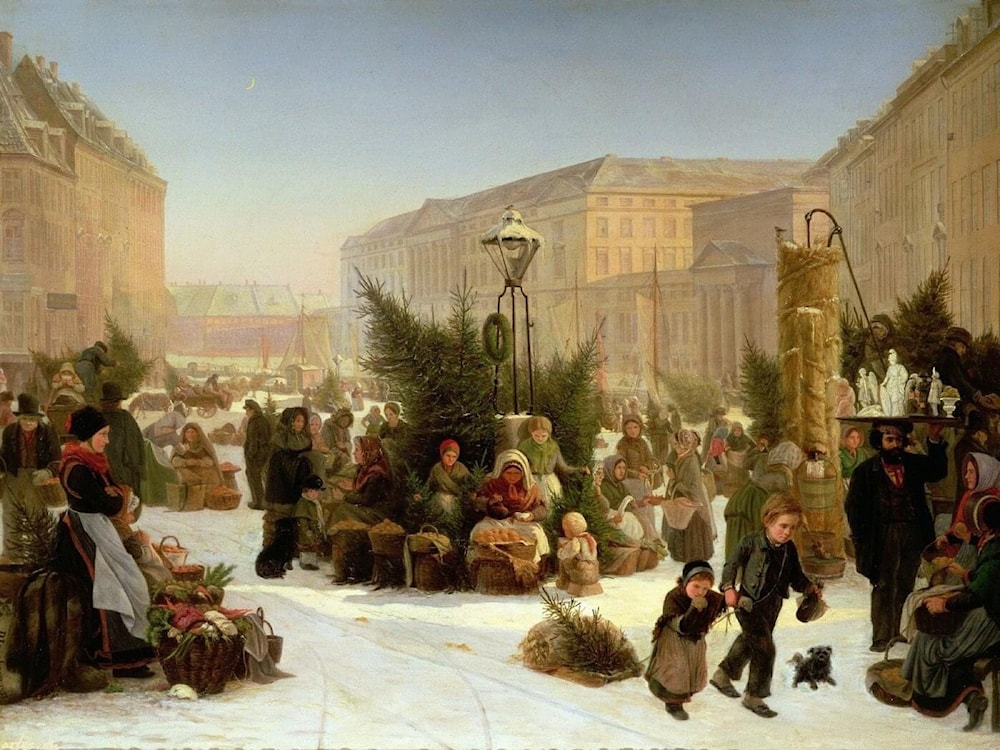
This painting was done early in Jacobsen’s career when he was still painting in the traditional style that he was taught at the Royal Danish Academy of Fine Arts. This scene shows us a time of year when woodcutters can count on a few extra coins to carry them through the winter. In addition to their regular work of cutting firewood, their families are bringing fresh-cut evergreens to the market, and they are quickly selling out.

There are many stories in this painting. The town square is decorated for the season with wreaths and a prominently displayed Nativity Scene. The market is busy, noisy, and filled with traders and shoppers. Some shoppers rest beside the frozen fountain, while others bargain for the best deals.

Who has the coins for a fine Christmas dinner, and who will go home empty-handed, unable to afford a family feast?

A pair of children, brother and sister, haul a small tree home, accompanied by the family dog. They will decorate it, and if they are fortunate, the dog will respect the tree and go out of its way to avoid knocking it over.

About the Artist:

David Jacob Jacobsen was a Danish 19th-century painter who was born in 1821 and died in 1871.[1] Jacobsen was the son of Jewish parents, Juda Jacobsen and Frederikke Jacobson. [2]

He was accepted into the Royal Danish Academy of Fine Arts in 1834 and began his education as a sculptor, studying under Herman Wilhelm Bissen. He switched to painting, preferring outdoor scenes.

His friendship with French artists like Camille Pissarro, with whom he shared a studio for a while, influenced Jacobsen’s art. Jacobsen was like many other Danish artists who traveled abroad. His choice of subject was not confined solely to the scenes of Danish life and landscape promoted by Danish critics such as NL Høyen. Despite Jacobsen’s efforts and his close friendships with the impressionists, he was unable to make a name for himself abroad.

Jacobsen’s work was exhibited at the Charlottenborg Spring Exhibition from 1849 until his death. He suffered from deep depression, exacerbated by the fact his work didn’t sell as well as he hoped.  He died by suicide in 1871 during a stay in Florence and was buried there. [1]


Credits and Attributions:

IMAGE: Wikimedia Commons contributors, “File:David Jacobsen – Selling Christmas Trees (1853).jpg,” Wikimedia Commons, https://commons.wikimedia.org/w/index.php?title=File:David_Jacobsen_-_Selling_Christmas_Trees_(1853).jpg&oldid=886774504 (accessed December 12, 2024).

[1] David Jacobsen – Artvee Artvee.com  © Artvee 2024 All Rights Reserved
[2] David Jacob Jacobsen | Biography © 2024 MutualArt Services, Inc.

3 Comments

Filed under #FineArtFriday

#FineArtFriday: View of Bruges with City Hall by August Fischer

August_Fischer_Ansicht_von_Brügge_mit_Rathaus_1905Artist: August Fischer  (1854–1921) 

Title: English: View of Bruges with City Hall, Dansk: Udsigt til Brügge

Date: 1905

Medium: oil on canvas

Dimensions: height: 45 cm (17.7 in); width: 59 cm (23.2 in)

Inscriptions: Signed and dated lower right: Aug. Fischer, Bruges 05.

What I love about this painting:

We see history here, the city of Bruges as it was in 1905, before the outbreak of WWI. It was a prosperous town with many churches and a large middle class.

The boatman has a story. How old is he? Does he support his wife and children with what he earns ferrying people to and from? Or is he just starting out in life, working to earn enough to marry a certain girl? This is a fairytale painting, serene and yet concealing many secrets. I think it’s the perfect setting for fantasy romance.

Perhaps the future looks bright to him now, but in less than a decade, our boatman will be thrown in the most horrific war the world had ever seen. If he is young, he will be sent to the front. If he is old, his boat will be conscripted to ferry soldiers and munitions, and he will do what he must to survive.

More than a century has passed since this scene was recorded. Bruges is now the capital and largest city of the province of West Flanders in the Flemish Region of Belgium.

About the Artist: I could find no Wikipedia article about Fischer, but random searches at the websites of several auction houses yielded some information.

Johannes August Fischer (1854–1921) was a Danish landscape and architecture painter and the elder brother of the Danish artist, Paul Fischer. His parents were the master painter and varnish manufacturer Philip August Fischer (1817—1907) and Gustafva Albertina Svedgren (1827—83). The family was well off, upper middle class. While his father had started as a painter, he became financially successful as a manufacturer of paints and lacquers.

August Fischer was first apprenticed to a sculptor, but at the age of nineteen, he applied to the Royal Danish Academy of Fine Arts, making the switch to painting. His work debuted at the Charlottenborg Spring Exhibition in 1874, where he exhibited until his death in 1921.

August Fischer traveled abroad for much of his career. He lived and worked in Spain and Italy from 1883 to 1884. After that, he traveled to southern Germany and Italy. Several of his more well-known paintings were of Nuremberg and Rothenburg on the Tauber, and Venice and Florence.


Credits and Attributions:

Wikimedia Commons contributors, “File:August Fischer Ansicht von Brügge mit Rathaus 1905.jpg,” Wikimedia Commons, https://commons.wikimedia.org/w/index.php?title=File:August_Fischer_Ansicht_von_Br%C3%BCgge_mit_Rathaus_1905.jpg&oldid=807392532 (accessed June 12, 2024).

3 Comments

Filed under #FineArtFriday

#FineArtFriday: In the Woodland Stream by Carl Bögh 1872

Artist: Carl Bögh  (1827–1893)

Title: In the Woodland Stream

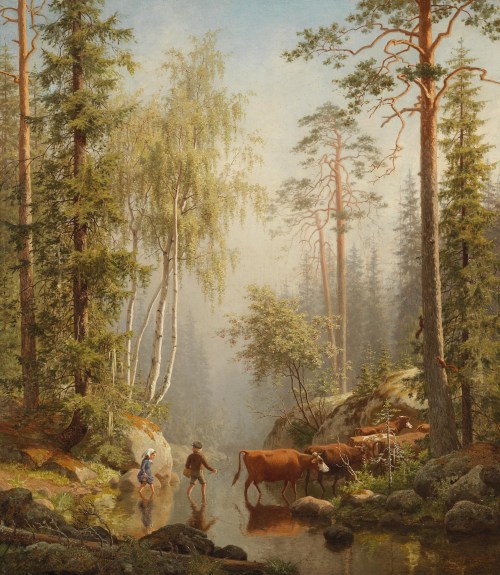
Description: Forest landscape with rising haze. Children drive cattle through a ford.

Date: 1872

Medium: oil on canvas

Dimensions: Height: 111 cm (43.7 in); Width: 96 cm (37.7 in)

Inscriptions: Signature and date at bottom right: Carl Bögh / 1872

What I love about this painting:

The level of detail here is impressive. The artist has faithfully recorded a perfect morning, the opening of a summer day. It’s all here in perfect historical accuracy, down to the lichen on the smallest of trees. The muddy tracks where the cattle daily walk, the moss on the stones, the reflections on the waters–all are shown with faithful attention to detail. The morning mist is rising, and the day is already beginning to warm.

A breeze gently moves through the branches of the white birch, stirring their shimmering leaves. In the stream below, two children attend the family’s wealth—their cattle. The children are well-behaved and dutifully follow the herd. The water is cool water on their feet as they cross, a slow-moving, gentle stream. Brother carries their midday meal in a covered basket. He keeps the cattle moving and urges his sister to keep up.

The forest is lush with fir, birch, and pine growing, and flowering shrubs. All the low-growing plants are here too—one can almost hear the hum of insects starting their day, and the birds’ gossiping among the branches.  The occasional lowing of the cattle as they head toward their meadow is a counterpoint to the ordinary sounds of the forest, filling the morning air with the promise of a fine summer day.

About the Artist, via Wikipedia:

Carl Henrik Bøgh (3 September 1827, Copenhagen – 19 October 1893, Copenhagen) was a Danish painter; best known for his scenes with animals. After serving as a soldier in the First Schleswig War, he attended the Royal Danish Academy of Fine Arts, where he studied with Johan Ludwig Lund, and decided to specialize in animal painting. He first had a showing in 1854, in the Spring Exhibition at Charlottenborg Palace. Three years later was awarded the Neuhausenske Prize [da].

From 1860 to 1861, he made a study trip abroad, with the travel scholarship from Academy; visiting Brussels and Antwerp, but spending most of his time in Paris. In 1870 and 1875, some of his works were purchased by the “Royal Painting Collection” (now the National Gallery of Denmark). In 1873, he became a Professor.

His paintings of deer were among his most popular. He also made painting expeditions to Norway and Sweden.


Credits and Attributions:

Wikimedia Commons contributors, “File:Carl Bøgh – In the Woodland Stream (1872).jpg,” Wikimedia Commons, the free media repository, https://commons.wikimedia.org/w/index.php?title=File:Carl_B%C3%B8gh_-_In_the_Woodland_Stream_(1872).jpg&oldid=368737131 (accessed December 10, 2020).

Wikipedia contributors, “Carl Bøgh,” Wikipedia, The Free Encyclopedia, https://en.wikipedia.org/w/index.php?title=Carl_B%C3%B8gh&oldid=944301648 (accessed December 10, 2020).

3 Comments

Filed under #FineArtFriday