Tag Archives: 19th century landscape paintings

#FineArtFriday: A closer look at “The Sycamores” by Alexandre Calame 1854

1175px-'The_Sycamores'_by_Alexandre_Calame,_Cincinnati_Art_MuseumTitle: The Sycamores by Alexandre Calame
Genre: landscape art

Date: 1854

Medium: oil on canvas

Dimensions: height: 54.3 cm (21.3 in)

Collection: Cincinnati Art Museum

What I love about this painting:

I live in the Pacific Northwest, a part of the world where sycamore trees do not grow in the wild. They are native to the eastern United States and are often featured as part of the landscape in 18th and 19th-century American literature.

The trees featured in this painting are European Sycamores. When I first came across this painting in 2022, I was impressed by both their size and the rough, boulder-strewn landscape that is their home.

These are trees with a presence. They grow on a sunlit hillside and seem as tough as the boulders surrounding them. Storms may come and go, but these trees remain.

Like people, these trees have seen some stuff. No delicate hothouse specimens here; these are sturdy peasant trees, able to make do with whatever nature throws at them.

About the Artist, via Wikipedia:

Alexandre Calame (28 May 1810 – 19 March 1864) was a Swiss landscape painter, associated with the Düsseldorf School.

He was born in Arabie at the time belonging to Corsier-sur-Vevey, today a part of Vevey. He was the son of a skillful marble worker in Vevey, but because his father lost the family fortune, Calame could not concentrate on art, but rather he was forced to work in a bank from the age of 15. When his father fell from a building and then died, it was up to the young Calame to provide for his mother.

In his spare time he began to practice drawing small views of Switzerland. In 1829 he met his patron, the banker Diodati, who made it possible for him to study under landscape painter François Diday. After a few months he decided to devote himself fully to art.

In 1835 he began exhibiting his Swiss-Alps and forest paintings in Paris and Berlin. He became quite well known, especially in Germany, although Calame was more a drawer than an illustrator. He is associated with the Düsseldorf school of painting. In 1842 he went to Paris and displayed his works Mont Blanc, the Jungfrau, the Brienzersee, the Monte Rosa and Mont Cervin.


Credits and Attributions:

Wikimedia Commons contributors, “File:’The Sycamores’ by Alexandre Calame, Cincinnati Art Museum.JPG,” Wikimedia Commons, the free media repository, https://commons.wikimedia.org/w/index.php?title=File:%27The_Sycamores%27_by_Alexandre_Calame,_Cincinnati_Art_Museum.JPG&oldid=618822225 (accessed December 4, 2025).

Wikipedia contributors, “Alexandre Calame,” Wikipedia, The Free Encyclopedia, https://en.wikipedia.org/w/index.php?title=Alexandre_Calame&oldid=1088977147 (accessed December 4, 2025).

5 Comments

Filed under #FineArtFriday

#FineArtFriday: An autumn walk in the English Garden of Munich by Anders Andersen-Lundby 1887

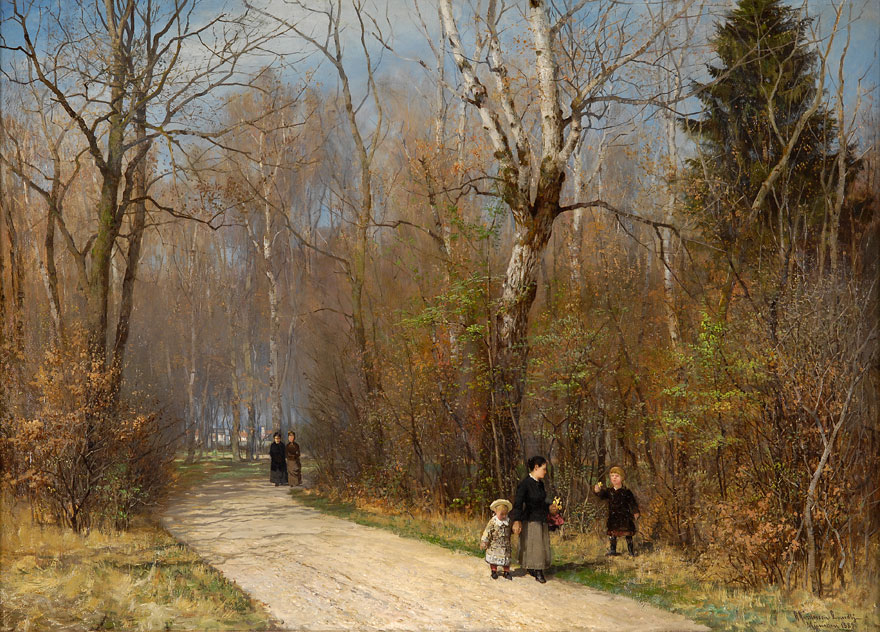
Artist: Anders Andersen-Lundby (1841–1923)

Title: English: An autumn walk in the English Garden of Munich. German: Herbstspaziergang im englischen Garten in München.

Date: 1887

Medium: oil on canvas

Dimensions: height: 77 cm (30.3 in); width: 106 cm (41.7 in)

Inscriptions: Signature and date: 1887

What I love about this painting:

Anders Anderson-Lundby shows us the perfect autumn day for a stroll. Truthfully, the day looks so pleasant that I’d like to be walking there. The leaves are nearly off the trees, and those that remain are golden and brown. Those who walk in these woods seem happy, content to be outdoors while the weather remains decent.

Autumn has arrived here in the Pacific Northwest. In a few weeks, this is how the deciduous trees in my part of the world will look. Right now the big-leaf maples are still holding fast to green but it’s shading toward brown and their leaves have begun falling. The Japanese maples and other non-native trees brightening gardens and public through-ways have turned a bright red. Soon our native vine maples and that (now undomesticated) decorative-plant-gone-native, staghorn sumac, will too.

About the Artist, via Wikipedia:

Anders Andersen-Lundby (December 16, 1841 – January 4, 1923) was a Danish landscape painter. He was most associated with winter landscapes.

(He) was born in Lundby, Denmark. He grew up in Lundby near Aalborg. In 1861, when he was twenty, Andersen-Lundby traveled to Copenhagen, and there he exhibited his works for the first time in 1864. By 1870, he gained popularity especially with his winter landscapes from both Denmark and southern Germany, most often with fallen snow or thaw.

In 1876, he moved to Munich with his family where he exhibited his paintings. He frequently visited Denmark and participated in exhibitions there. He exhibited at the Charlottenborg Spring Exhibition 1864–1913. [1]

To view more of Anders Anderson-Lundby’s work, go to Anders Andersen-Lundby – Wikipedia.


Credits and Attributions:

IMAGE: Wikimedia Commons contributors, “File:Anders Andersen-Lundby – Herbstspaziergang im Englischen Garten (1887).jpg,” Wikimedia Commons, https://commons.wikimedia.org/w/index.php?title=File:Anders_Andersen-Lundby_-_Herbstspaziergang_im_Englischen_Garten_(1887).jpg&oldid=1068508759 (accessed October 9, 2025).

[1] Wikipedia contributors, “Anders Andersen-Lundby,” Wikipedia, The Free Encyclopedia, https://en.wikipedia.org/w/index.php?title=Anders_Andersen-Lundby&oldid=1191864454 (accessed October 9, 2025).

5 Comments

Filed under #FineArtFriday

#FineArtFriday: A closer look at “The Alyscamps,” or “The Three Graces at the Temple of Venus” by Paul Gauguin 1888

Paul_Gauguin_les_alyscamps085

Artist: Paul Gauguin (1848–1903)

Title:  (English)The Alyscamps, or The Three Graces at the Temple of Venus

French: French: Les Alyscamps, ou Les Trois grâces au temple de Venus

Date: 1888

Medium: oil on canvas

Dimensions: height: 91.6 cm (36 in); width: 72.5 cm (28.5 in)

Collection: Musée d’Orsay

What I love about this painting:

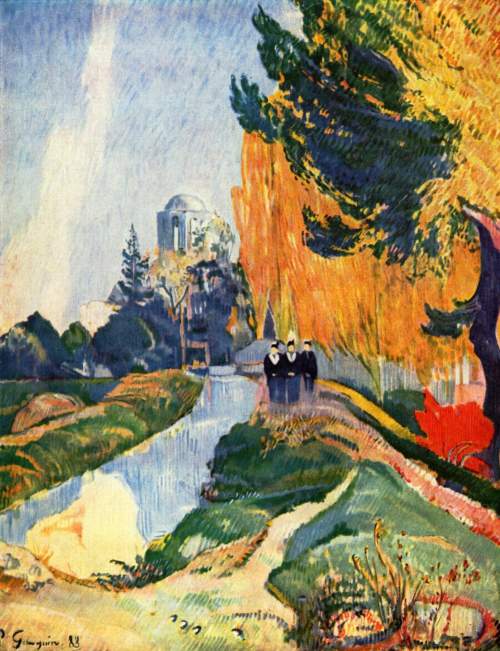
Color! I love the vivid colors contrasted against the pale sky. The Three Graces in classical mythology are the goddesses of charm, beauty, nature, human creativity, goodwill, and fertility. They have come to symbolize faith, hope, and charity.

According to the internet, the traditional mythology Paul Gauguin explores in this composition demonstrates his early education and his appreciation of classical art. And truthfully, although he never trained formally, he did know his stuff. Before he became an artist, he was both a stockbroker and an art dealer/collector.

Gauguin is known for his use of bold colors, simplified forms, and strong lines. Again, according to the internet, this painting is a prime example of his study of form and color.

And he tells us a story. First, the eye is drawn to the vertical lines of the temple standing tall on the hill behind the figures. They are also depicted with a sense of height, and the hills beyond are tall and narrow.

A calm stream flows from beneath the temple, the river of time. The three women stand almost in the background, yet they are commanding, observing us and our lives as time passes them. They are as strong and unmovable as the rocky hills and the temple.

Gauguin tells us that time may pass, and things may change, but the Temple of Venus rises above it all. Does this Temple of Venus represent “agape,” a love that is selfless and unconditional? A kind of love that is spiritual in nature?

Maybe, and maybe not.

Paul Gauguin was a famously complicated man, conflicted and tormented by the contrasts of 19th century morality and the realities of his life.

Who knows what that temple meant to him on the day he created it? Either way, Gauguin’s Three Graces, Faith, Hope, and Charity, stand almost in the shadows, offering him comfort. They are as solid and eternal as time.

And who or what, I wonder, is the immense dark, nearly indistinct fourth shadow who peers over their left shoulder? It seems like a person’s form. Is it another of the Fates? Is it Death? There is so much to consider in this painting.

Paul Gauguin lived an eventful life. For a wonderful documentary on the man and his life, go to:

Why Is Gauguin So Controversial? (Waldemar Januszczak Documentary) | Perspective – YouTube

Also, check out Paul Gauguin – Wikipedia.


Credits and Attributions:

Image: Wikimedia Commons contributors, “File:Paul Gauguin 085.jpg,” Wikimedia Commons, https://commons.wikimedia.org/w/index.php?title=File:Paul_Gauguin_085.jpg&oldid=710795058 (accessed September 24, 2025).

Comments Off on #FineArtFriday: A closer look at “The Alyscamps,” or “The Three Graces at the Temple of Venus” by Paul Gauguin 1888

Filed under #FineArtFriday

#FineArtFriday: Summer, field of poppies by Claude Monet 1875

Artist: Claude Monet (1840–1926)

Title: Français : L’été. Champ de coquelicots

English: Summer, field of poppies

Deutsch: Sommer. Klatschmohnfeld

Date:   1875

Medium: oil on canvas

Dimensions: height: 60 cm (23.6 in); width: 81 cm (31.8 in)

Collection: Private collection

What I love about this painting:

Claude Monet’s gift for bringing in the beauty of nature shines in this painting. He shows us a warm day in high summer, with fluffy white clouds sailing across blue skies. The wild poppies have taken root in a fallow field, and are mingled in with the tall field-grass. A woman and two children have come to pick wildflowers in the meadow. One can almost hear the buzzing of bees as they go about their business mingling with the occasional birdsong.

I would love to have walked in that field.

About the Artist, via Wikipedia:

Oscar-Claude Monet: 14 November 1840 – 5 December 1926) was a French painter and founder of Impressionism painting who is seen as a key precursor to modernism, especially in his attempts to paint nature as he perceived it.[1] During his long career, he was the most consistent and prolific practitioner of Impressionism’s philosophy of expressing one’s perceptions of nature, especially as applied to plein air (outdoor) landscape painting.[2] The term “Impressionism” is derived from the title of his painting Impression, soleil levant, which was exhibited in 1874 at the First Impressionist Exhibition, initiated by Monet and a number of like-minded artists as an alternative to the Salon.

Monet was raised in Le HavreNormandy, and became interested in the outdoors and drawing from an early age. Although his mother, Louise-Justine Aubrée Monet, supported his ambitions to be a painter, his father, Claude-Adolphe, disapproved and wanted him to pursue a career in business. He was very close to his mother, but she died in January 1857 when he was sixteen years old, and he was sent to live with his childless, widowed but wealthy aunt, Marie-Jeanne Lecadre. He went on to study at the Académie Suisse, and under the academic history painter Charles Gleyre, where he was a classmate of Auguste Renoir. His early works include landscapes, seascapes, and portraits, but attracted little attention. A key early influence was Eugène Boudin, who introduced him to the concept of plein air painting. From 1883, Monet lived in Giverny, also in northern France, where he purchased a house and property and began a vast landscaping project, including a water-lily pond.

Monet’s ambition to document the French countryside led to a method of painting the same scene many times so as to capture the changing of light and the passing of the seasons. Among the best-known examples are his series of haystacks (1890–1891), paintings of Rouen Cathedral (1892–1894), and the paintings of water lilies in his garden in Giverny, which occupied him for the last 20 years of his life. Frequently exhibited and successful during his lifetime, Monet’s fame and popularity soared in the second half of the 20th century when he became one of the world’s most famous painters and a source of inspiration for a burgeoning group of artists. [1]


Credits and Attributions:

IMAGE: Wikimedia Commons contributors, “File:Claude Monet – L’été – Champ de coquelicots.JPG,” Wikimedia Commons, https://commons.wikimedia.org/w/index.php?title=File:Claude_Monet_-_L%27%C3%A9t%C3%A9_-_Champ_de_coquelicots.JPG&oldid=1017229638 (accessed June 19, 2025).

[1] Wikipedia contributors, “Claude Monet,” Wikipedia, The Free Encyclopedia, https://en.wikipedia.org/w/index.php?title=Claude_Monet&oldid=1295997578 (accessed June 19, 2025).

1 Comment

Filed under #FineArtFriday

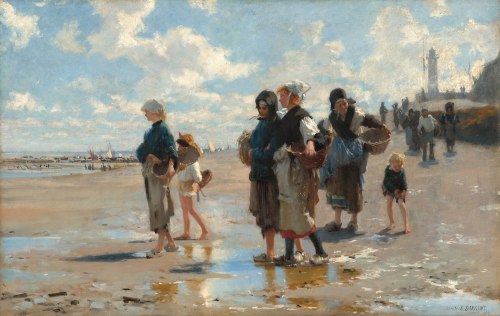
#FineArtFriday – a second look at “Fishing for Oysters at Cancale” by John Singer Sargent 1878

2560px-John_Singer_Sargent_-_CancaleArtist: John Singer Sargent (1856–1925)

Title: En route pour la pêche (Setting Out to Fish) Fishing for Oysters at Cancale

Date: 1878

Medium: oil on canvas

Dimensions: height: 77 cm (30.3 in); width: 121.6 cm (47.8 in)

Inscription: Signed and Dated: John S. Sargent Paris 1878

Collection: National Gallery of Art

What I love about this picture:

Every time I see a painting by John Singer Sargent, I love him more. He is rapidly becoming one of my favorite artists of all time. (Don’t be jealous, Rembrandt. You are still number one in my heart.)

Sargent paints a perfect summer day for us, a good day to be out near the water. John Singer Sargent was a complicated man, as most artists are. Famous as a portrait artist, he painted landscapes that conveyed a sense of mood and emotion that few of his contemporaries could match. One of Sargent’s great skills was the ability to convey the sensory impressions of an environment.

He found beauty and drama in the lives of ordinary people and showed his characters outdoors in all the seasons. His paintings of working-class people didn’t romanticize how they dressed, conveyed their moods. Sargent showed the environment they lived and worked in, no matter how good or bad the weather.

Sargent had a gift for painting rare and expensive fabrics, yet no one is dressed in finery in this painting. On the contrary, the women are dressed in shabby clothes that protect them from the sun and salty wind, garments that have seen a great deal of wear. The children are bare-legged and barefoot, while the fishers wear clogs. These women carry baskets and the hope that they will find enough oysters and other shellfish to not only feed their family but have plenty to sell to the fishmonger.

About this picture via MFA Boston: Sargent’s choice of subject was not revolutionary – a similar scene of oyster harvesters had previously won a medal at the Salon. However, his ability to paint the reflections in the tidal pools and the light sparkling on the figures and clouds dazzled viewers, clearly demonstrating that his talents extended beyond portraiture. [1]

About the artist, via Wikipedia:

John Singer Sargent (January 12, 1856 – April 14, 1925) was an American expatriate artist, considered the “leading portrait painter of his generation” for his evocations of Edwardian-era luxury. He created roughly 900 oil paintings and more than 2,000 watercolors, as well as countless sketches and charcoal drawings. His oeuvre documents worldwide travel, from Venice to the TyrolCorfu, Spain, the Middle East, MontanaMaine, and Florida.

Born in Florence to American parents, he was trained in Paris before moving to London, living most of his life in Europe. He enjoyed international acclaim as a portrait painter. An early submission to the Paris Salon in the 1880s, his Portrait of Madame X, was intended to consolidate his position as a society painter in Paris but instead resulted in scandal. During the year following the scandal, Sargent departed for England, where he continued a successful career as a portrait artist.

From the beginning, Sargent’s work is characterized by remarkable technical facility, particularly in his ability to draw with a brush, which in later years inspired admiration as well as criticism for its supposed superficiality. His commissioned works were consistent with the grand manner of portraiture, while his informal studies and landscape paintings displayed a familiarity with Impressionism. In later life, Sargent expressed ambivalence about the restrictions of formal portrait work and devoted much of his energy to mural painting and working en plein air. Art historians generally ignored society artists such as Sargent until the late 20th century.

The exhibition in the 1980s of Sargent’s previously hidden male nudes served to spark a reevaluation of his life and work, and its psychological complexity. In addition to the beauty, sensation and innovation of his oeuvre, his same-sex interests, unconventional friendships with women and engagement with race, gender nonconformity and emerging globalism are now viewed as socially and aesthetically progressive and radical.


Credits and Attributions:

IMAGE: Wikimedia Commons contributors, “File:John Singer Sargent – Cancale.jpg,” Wikimedia Commons, https://commons.wikimedia.org/w/index.php?title=File:John_Singer_Sargent_-_Cancale.jpg&oldid=745727074 (accessed April 25, 2025).

[1] Quote: MFABoston contributors, Fishing for Oysters at Cancale – Works – Museum of Fine Arts, Boston (mfa.org) (accessed April 25,2025).

[2] Wikipedia contributors, “John Singer Sargent,” Wikipedia, The Free Encyclopedia, https://en.wikipedia.org/w/index.php?title=John_Singer_Sargent&oldid=1223506386 (accessed April 25, 2025).

Comments Off on #FineArtFriday – a second look at “Fishing for Oysters at Cancale” by John Singer Sargent 1878

Filed under #FineArtFriday

#FineArtFriday: A closer look at “A Boating Party” by John Singer Sargent ca. 1889

RISDM 78-086

Artist: John Singer Sargent (1856–1925) 

Title: A Boating Party

Date: circa 1889

Dimensions: height: 88.3 cm (34.7 in) width: 91.4 cm (35.9 in)

Collection: Rhode Island School of Design Museum  

What I Love About this Painting:

This painting first appeared here in last autumn, and my mind keeps going back to it. This is one my favorite paintings by John Singer Sargent. He created this scene early in his career, but already his ability to show the many moods of water and the personalities of his characters is a strength.

Sargent painted portraits for commissions and was highly successful. However, he painted informal studies like today’s scene for himself, painting for sheer love of it. This scene seems like the perfect visual prompt for writers searching for inspiration.

We’re looking at a fine day toward the end of summer. The day is warm enough that light jackets are all that are needed. The trees along the riverbank have begun to turn, and some leaves have fallen. One thing that stands out to me is the way he shows the shrubbery along the bank. 

One thing I have always appreciated about John Singer Sargent’s subjects is the way he captures people in the act of doing something. The eye immediately goes to the lady in white who is carefully stepping from the riverbank and into a boat, aided by a man in the shadows on the bank. Her reflection on the still waters is masterfully done.

In the right foreground, a man lounges in another boat that is tied up at the pier, with his leg thrown over both the boat’s gunwale and the dock’s rail. Beside him, another lady sits on the pier. Judging from the way Sargent has positioned them, I feel they are a married couple, and they are in no hurry to go anywhere.

About the Artist, via Wikipedia:

[1] John Singer Sargent (January 12, 1856 – April 14, 1925) was an American expatriate artist, considered the “leading portrait painter of his generation” for his evocations of Edwardian-era luxury. He created roughly 900 oil paintings and more than 2,000 watercolors, as well as countless sketches and charcoal drawings. His oeuvre documents worldwide travel, from Venice to the Tyrol, Corfu, the Middle East, Montana, Maine, and Florida.

Born in Florence to American parents, he was trained in Paris before moving to London, living most of his life in Europe. He enjoyed international acclaim as a portrait painter. An early submission to the Paris Salon in the 1880s, his Portrait of Madame X, was intended to consolidate his position as a society painter in Paris, but instead resulted in scandal. During the next year following the scandal, Sargent departed for England where he continued a successful career as a portrait artist.

From the beginning, Sargent’s work is characterized by remarkable technical facility, particularly in his ability to draw with a brush, which in later years inspired admiration as well as criticism for a supposed superficiality. His commissioned works were consistent with the grand manner of portraiture, while his informal studies and landscape paintings displayed a familiarity with Impressionism. In later life Sargent expressed ambivalence about the restrictions of formal portrait work, and devoted much of his energy to mural painting and working en plein air. Art historians generally ignored artists who painted royalty and “society” – such as Sargent – until the late 20th century. [1]


Credits and Attributions:

IMAGE: Wikimedia Commons contributors, “File:John Singer Sargent – A Boating Party – 78.086 – Rhode Island School of Design Museum.jpg,” Wikimedia Commons, https://commons.wikimedia.org/w/index.php?title=File:John_Singer_Sargent_-_A_Boating_Party_-_78.086_-_Rhode_Island_School_of_Design_Museum.jpg&oldid=809452828 (accessed April 10, 2025).

[1]Wikipedia contributors, “John Singer Sargent,” Wikipedia, The Free Encyclopedia, https://en.wikipedia.org/w/index.php?title=John_Singer_Sargent&oldid=1283813769 (accessed April 11, 2025).

2 Comments

Filed under #FineArtFriday, writing

#FineArtFriday:  Green Wheat Field with Cypress by Vincent van Gogh 1889

Artist: Vincent van Gogh (1853–1890)

Title: Green Wheat Field with Cypress / Green Wheat

Date: mid June 1889

Medium: oil on canvas

Dimensions: height: 73 cm (28.7 in); width: 92.5 cm (36.4 in)

Collection: National Gallery Prague


What I love about this painting:

This painting is an example of the quintessential Vincent van Gogh view of his world. He shows us a sunny afternoon in swirls and strong colors, painting it the way he experienced it.

Vincent’s superpower was the ability to show us the emotions he felt as he painted a scene. In this case, I think he was feeling a sense of peace at being outdoors.

If you have stopped by this blog before, you know I am a writer. Art inspires me and I’m always imagining the story behind each painting I feature here. As a dedicated Vincent Fangirl, I can picture him having a good day, enjoying the harmony of a sunny afternoon in June, however fleeting those moments of peace were for him.

This painting was done one year before his suicide, during a brief a time when he was relatively happy, just before his final breakdown. The clouds, the blades of grass—each thing he saw that day is there, depicted with the emotions he experienced.

About this painting via Wikipedia:

The painting depicts golden fields of ripe wheat, a dark fastigiate Provençal cypress towering like a green obelisk to the right and lighter green olive trees in the middle distance, with hills and mountains visible behind, and white clouds swirling in an azure sky above. The first version (F717) was painted in late June or early July 1889, during a period of frantic painting and shortly after Van Gogh completed The Starry Night, at a time when he was fascinated by the cypress. It is likely to have been painted “en plein air“, near the subject, when Van Gogh was able to leave the precincts of the asylum. Van Gogh regarded this work as one of his best summer paintings. In a letter to his brother, Theo, written on 2 July 1889, Vincent described the painting: “I have a canvas of cypresses with some ears of wheat, some poppies, a blue sky like a piece of Scotch plaid; the former painted with a thick impasto like the Monticelli‘s, and the wheat field in the sun, which represents the extreme heat, very thick too.” [1]


Wheat fields via Wikipedia:

The wheat field with cypresses paintings were made when van Gogh was able to leave the asylum. Van Gogh had a fondness for cypresses and wheat fields of which he wrote: “Only I have no news to tell you, for the days are all the same, I have no ideas, except to think that a field of wheat or a cypress well worth the trouble of looking at closeup.”

In early July, Van Gogh wrote to his brother Theo of a work he began in June, Wheat Field with Cypresses: “I have a canvas of cypresses with some ears of wheat, some poppies, a blue sky like a piece of Scotch plaid; the former painted with a thick impasto … and the wheat field in the sun, which represents the extreme heat, very thick too.” Van Gogh who regarded this landscape as one of his “best” summer paintings made two additional oil paintings very similar in composition that fall. One of the two is in a private collection. London’s National Gallery A Wheat Field, with Cypresses painting was made in September which Janson & Janson 1977, p. 308 describes: “the field is like a stormy sea; the trees spring flamelike from the ground; and the hills and clouds heave with the same surge of motion. Every stroke stands out boldly in a long ribbon of strong, unmixed color.”

There is also another version of Wheat Fields with Cypresses made in September with a blue-green sky, reportedly held at the Tate Gallery in London. [2]


About the Artist, via Wikipedia:

Vincent Willem van Gogh, 30 March 1853 – 29 July 1890) was a Dutch Post-Impressionist painter who posthumously became one of the most famous and influential figures in Western art history. In a decade, he created about 2,100 artworks, including around 860 oil paintings, most of which date from the last two years of his life. They include landscapes, still lifes, portraits, and self-portraits, and are characterised by bold colours and dramatic, impulsive and expressive brushwork that contributed to the foundations of modern art. He was not commercially successful, struggled with severe depression and poverty, and committed suicide at the age of 37.

Van Gogh was born into an upper-middle-class family, While a child he drew and was serious, quiet and thoughtful. As a young man he worked as an art dealer, often traveling, but became depressed after he was transferred to London. He turned to religion and spent time as a Protestant missionary in southern Belgium. He drifted in ill health and solitude before taking up painting in 1881, having moved back home with his parents. His younger brother Theo supported him financially; the two kept a long correspondence by letter. His early works, mostly still lifes and depictions of peasant labourers, contain few signs of the vivid colour that distinguished his later work. In 1886, he moved to Paris, where he met members of the avant-garde, including Émile Bernard and Paul Gauguin, who were reacting against the Impressionist sensibility. As his work developed he created a new approach to still lifes and local landscapes. His paintings grew brighter as he developed a style that became fully realised during his stay in Arles in the South of France in 1888. During this period he broadened his subject matter to include series of olive trees, wheat fields and sunflowers.

Van Gogh suffered from psychotic episodes and delusions, and though he worried about his mental stability, he often neglected his physical health, did not eat properly and drank heavily. His friendship with Gauguin ended after a confrontation between the two when, in a rage, Van Gogh severed a part of his own left ear with a razor. He spent time in psychiatric hospitals, including a period at Saint-Rémy. After he discharged himself and moved to the Auberge Ravoux in Auvers-sur-Oise near Paris, he came under the care of the homeopathic doctor Paul Gachet. His depression persisted, and on 27 July 1890, Van Gogh is believed to have shot himself in the chest with a revolver, dying from his injuries two days later.  [3]


Credits and Attributions:

IMAGE: Wikimedia Commons contributors, “File:Vincent van Gogh – Green Wheat Field with Cypress (1889).jpg,” Wikimedia Commons, https://commons.wikimedia.org/w/index.php?title=File:Vincent_van_Gogh_-_Green_Wheat_Field_with_Cypress_(1889).jpg&oldid=670096634 (accessed March 13, 2025).

[1] Wikipedia contributors, “Wheat Field with Cypresses,” Wikipedia, The Free Encyclopedia, https://en.wikipedia.org/w/index.php?title=Wheat_Field_with_Cypresses&oldid=1222477822 (accessed March 13, 2025).

[2] Wikipedia contributors, “Wheat Fields,” Wikipedia, The Free Encyclopedia, https://en.wikipedia.org/w/index.php?title=Wheat_Fields&oldid=1277932418 (accessed March 13, 2025).

[3] Wikipedia contributors, “Vincent van Gogh,” Wikipedia, The Free Encyclopedia, https://en.wikipedia.org/w/index.php?title=Vincent_van_Gogh&oldid=1279502999 (accessed March 13, 2025).

2 Comments

Filed under #FineArtFriday, writing

#FineArtFriday: A Boating Party by John Singer Sargent ca. 1889

RISDM 78-086

Artist: John Singer Sargent (1856–1925) 

Title: A Boating Party

Date: circa 1889

Dimensions: height: 88.3 cm (34.7 in) width: 91.4 cm (35.9 in)

Collection: Rhode Island School of Design Museum  

What I Love About this Painting:

We’re looking at a fine day toward the end of summer. The day is warm enough that light jackets are all that are needed. The trees along the riverbank have begun to turn, and some leaves have fallen. 

One thing I have always appreciated about John Singer Sargent’s subjects is the way he captures people in the act of doing something. The eye immediately goes to the lady in white who is carefully stepping from the riverbank and into a boat, aided by a man in the shadows on the bank. Her reflection on the still waters is masterfully done.

In the right foreground, a man lounges in another boat that is tied up at the pier, with his leg thrown over both the boat’s gunwale and the dock’s rail. Beside him, another lady sits on the pier. Judging from the way Sargent has positioned them, I feel they are a married couple, and they are in no hurry to go anywhere.

About the Artist, via Wikipedia:

[1] John Singer Sargent (January 12, 1856 – April 14, 1925) was an American expatriate artist, considered the “leading portrait painter of his generation” for his evocations of Edwardian-era luxury. He created roughly 900 oil paintings and more than 2,000 watercolors, as well as countless sketches and charcoal drawings. His oeuvre documents worldwide travel, from Venice to the Tyrol, Corfu, the Middle East, Montana, Maine, and Florida.

Born in Florence to American parents, he was trained in Paris before moving to London, living most of his life in Europe. He enjoyed international acclaim as a portrait painter. An early submission to the Paris Salon in the 1880s, his Portrait of Madame X, was intended to consolidate his position as a society painter in Paris, but instead resulted in scandal. During the next year following the scandal, Sargent departed for England where he continued a successful career as a portrait artist.

From the beginning, Sargent’s work is characterized by remarkable technical facility, particularly in his ability to draw with a brush, which in later years inspired admiration as well as criticism for a supposed superficiality. His commissioned works were consistent with the grand manner of portraiture, while his informal studies and landscape paintings displayed a familiarity with Impressionism. In later life Sargent expressed ambivalence about the restrictions of formal portrait work, and devoted much of his energy to mural painting and working en plein air. Art historians generally ignored artists who painted royalty and “society” – such as Sargent – until the late 20th century. [1]


Credits and Attributions:

IMAGE: Wikimedia Commons contributors, “File:John Singer Sargent – A Boating Party – 78.086 – Rhode Island School of Design Museum.jpg,” Wikimedia Commons, https://commons.wikimedia.org/w/index.php?title=File:John_Singer_Sargent_-_A_Boating_Party_-_78.086_-_Rhode_Island_School_of_Design_Museum.jpg&oldid=809452828 (accessed October 24, 2024).

[1]Wikipedia contributors, “John Singer Sargent,” Wikipedia, The Free Encyclopedia, https://en.wikipedia.org/w/index.php?title=John_Singer_Sargent&oldid=1032671314 

(accessed Oct. 24, 2024).

5 Comments

Filed under #FineArtFriday, writing

#FineArtFriday: Undergrowth with Two Figures, Vincent van Gogh 1890, a second look

Vincent_van_Gogh_-_Undergrowth_with_Two_Figures_(F773)Artist: Vincent van Gogh (1853–1890)

Title: Undergrowth with Two Figures

Date: late June 1890

Medium: oil on canvas

Dimensions: height: 50 cm (19.6 in); width: 100.5 cm (39.5 in)

Collection: Cincinnati Art Museum

Two years ago, in April of 2022, I was privileged to attend an immersive exhibit of Vincent van Gogh’s life through his work. Viewers roamed freely inside an everchanging exhibit that flowed through many of his most famous works and zoomed in on bits one wouldn’t ordinarily notice.

I managed a few shots with my cell phone that offered some idea of what the exhibition was like, but sadly, the camera on that phone wasn’t the best. Here is the one that nearly shows what we experienced, a glimpse into van Gogh’s Starry Night:

Van Gogh immersive 1 connie j jasperson LIRF04072022

The exhibit was such a moving, emotional experience. It really brought you into touch with the man and his art. I became a Vincent van Gogh fangirl that day.

We were in, above, and surrounded by his work. The powerful soundtrack of classical music paired perfectly with the images, complementing them like fine wine does good food.

The link to what we saw at that exhibit is here: Van Gogh, The Immersive Experience.

What I love about Undergrowth with Two Figures:

This very late work was painted at the end of June 1890, a few weeks before Van Gogh’s death. It was one of several paintings in Auvers-sur-Oise, a commune on the northwestern outskirts of Paris, France. This was also the place where Vincent van Gogh died from injuries suffered in an attempted suicide.

This painting is one of several he made in the last weeks of his life using a double-square format. The double-square paintings were made on uncommonly large canvases, rectangular, twice as wide as they were tall. Vincent’s need to express his art couldn’t be contained on an ordinary canvas—he saw the world with a panoramic view.

One of the things I love about this painting is the use of violet and blue in the trunks of the poplars. They are tall, immense, like bars in a window framing the courting pair. The trees stand out against the black backdrop. They have power and are the soul of the painting, even more so than the flowers and undergrowth through which the couple walks.

I think it’s a wonderful composition, with strong brush strokes and deep, dark colors. He saw the beauty in life and painted it.

[1] About this painting, via Google Arts and Culture:

In a letter to his younger brother, Theo, dated June 30, 1890, van Gogh explained the structure and brilliant colors of “Undergrowth with Two Figures”: “The trunks of the violet poplars cross the landscape perpendicularly like columns,” adding “the depth of Sous Bois is blue, and under the big trunks the grass blooms with flowers in white, rose, yellow, and green.”

“Undergrowth with Two Figures” has a silvery tonality characteristic of van Gogh’s works from Auvers. His brushwork may be swift and visceral, his colors strong and biting, his emotion raw and visible, but the composition reveals no hint of psychological torment.

It is painted on a double square canvas, twice as wide as it is high. Van Gogh explored the artistic possibilities of this panoramic format in several of his last paintings. [1]


Credits and Attributions:

[1] Google Arts and Culture Contributors, Undergrowth with two Figures, Vincent van Gogh 1890, Accessed April 7, 2022.

Wikimedia Commons contributors, “File:Vincent van Gogh – Undergrowth with Two Figures (F773).jpg,” Wikimedia Commons, the free media repository, https://commons.wikimedia.org/w/index.php?title=File:Vincent_van_Gogh_-_Undergrowth_with_Two_Figures_(F773).jpg&oldid=618842665 (accessed April 8, 2022).

View of Vincent’s Starry Night, © 2022 Connie J. Jasperson, own work,

2 Comments

Filed under #FineArtFriday

#FineArtFriday – Fishing for Oysters at Cancale by John Singer Sargent 1878

2560px-John_Singer_Sargent_-_CancaleArtist: John Singer Sargent (1856–1925)

Title: En route pour la pêche (Setting Out to Fish) Fishing for Oysters at Cancale

Date: 1878

Medium: oil on canvas

Dimensions: height: 77 cm (30.3 in); width: 121.6 cm (47.8 in)

Inscription: Signed and Dated: John S. Sargent Paris 1878

Collection: National Gallery of Art

What I love about this picture:

This is a perfect summer day, a good day to be out near the water. John Singer Sargent was a complicated man, as most artists are. Famous as a portrait artist, he painted landscapes that conveyed a sense of mood and emotion that few of his contemporaries could match. One of Sargent’s great skills was the ability to convey the sensory impressions of an environment.

He found beauty and drama in the lives of ordinary people and showed his characters outdoors in all the seasons. His paintings of working-class people didn’t romanticize how they dressed, conveyed their moods. Sargent showed the environment they lived and worked in, no matter how good or bad the weather.

Sargent had a gift for painting rare and expensive fabrics, yet no one is dressed in finery in this painting. On the contrary, the women are dressed in shabby clothes that protect them from the sun and salty wind, garments that have seen a great deal of wear. The children are bare-legged and barefoot, while the fishers wear clogs. These women carry baskets and the hope that they will find enough oysters and other shellfish to not only feed their family but have plenty to sell to the fishmonger.

About this picture via MFA Boston: Sargent’s choice of subject was not revolutionary – a similar scene of oyster harvesters had previously won a medal at the Salon. However, his ability to paint the reflections in the tidal pools and the light sparkling on the figures and clouds dazzled viewers, clearly demonstrating that his talents extended beyond portraiture. [1]

About the artist, via Wikipedia:

John Singer Sargent (January 12, 1856 – April 14, 1925) was an American expatriate artist, considered the “leading portrait painter of his generation” for his evocations of Edwardian-era luxury. He created roughly 900 oil paintings and more than 2,000 watercolors, as well as countless sketches and charcoal drawings. His oeuvre documents worldwide travel, from Venice to the TyrolCorfu, Spain, the Middle East, MontanaMaine, and Florida.

Born in Florence to American parents, he was trained in Paris before moving to London, living most of his life in Europe. He enjoyed international acclaim as a portrait painter. An early submission to the Paris Salon in the 1880s, his Portrait of Madame X, was intended to consolidate his position as a society painter in Paris but instead resulted in scandal. During the year following the scandal, Sargent departed for England, where he continued a successful career as a portrait artist.

From the beginning, Sargent’s work is characterized by remarkable technical facility, particularly in his ability to draw with a brush, which in later years inspired admiration as well as criticism for its supposed superficiality. His commissioned works were consistent with the grand manner of portraiture, while his informal studies and landscape paintings displayed a familiarity with Impressionism. In later life, Sargent expressed ambivalence about the restrictions of formal portrait work and devoted much of his energy to mural painting and working en plein air. Art historians generally ignored society artists such as Sargent until the late 20th century.

The exhibition in the 1980s of Sargent’s previously hidden male nudes served to spark a reevaluation of his life and work, and its psychological complexity. In addition to the beauty, sensation and innovation of his oeuvre, his same-sex interests, unconventional friendships with women and engagement with race, gender nonconformity and emerging globalism are now viewed as socially and aesthetically progressive and radical.


Credits and Attributions:

[1] Quote: MFABoston contributors, Fishing for Oysters at Cancale – Works – Museum of Fine Arts, Boston (mfa.org) (accessed May 12, 2024).

[2] Wikipedia contributors, “John Singer Sargent,” Wikipedia, The Free Encyclopedia, https://en.wikipedia.org/w/index.php?title=John_Singer_Sargent&oldid=1223504088 (accessed May 12, 2024).

Comments Off on #FineArtFriday – Fishing for Oysters at Cancale by John Singer Sargent 1878

Filed under #FineArtFriday