Tag Archives: 19th century landscape paintings

#FineArtFriday: On the Saco by Albert Bierstadt (revisited)

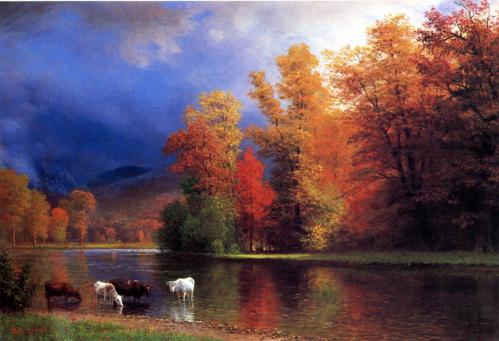
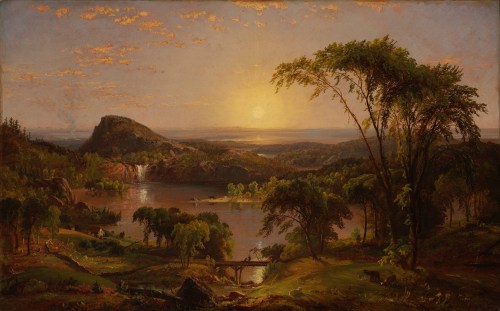
Bierstadt_Albert_On_the_SacoArtist: Albert Bierstadt (1830–1902)

Title: “On the Saco”

Genre: landscape art

Description: Of the Saco River, Maine.

Date: Unknown date (19th century)

Medium: oil painting.

What I love about this image:

Bierstadt understood and respected the power of nature. The way he rendered the sky is wonderful. He captured that brilliant darkness of a distant storm against the bright sunshine of an autumn afternoon. I love contrasts in this painting, the bright foliage in every shade of red and yellow, the serenity of the cattle drinking in the shallows.

The heavy darkness of the storm in the hills seems to be pushed back by the serene glow of fall’s sunlight on the river. Will it rain itself out before it passes over the herd? Possibly.

About the Artist, via Wikipedia:

Albert Bierstadt (January 7, 1830 – February 18, 1902) was a German-American painter best known for his lavish, sweeping landscapes of the American West. He joined several journeys of the Westward Expansion to paint the scenes. He was not the first artist to record the sites, but he was the foremost painter of them for the remainder of the 19th century.

Bierstadt was born in Prussia, but his family moved to the United States when he was one year old. He returned to study painting for several years in Düsseldorf. He became part of the second generation of the Hudson River School in New York, an informal group of like-minded painters who started painting along the Hudson River. Their style was based on carefully detailed paintings with romantic, almost glowing lighting, sometimes called luminism. Bierstadt was an important interpreter of the western landscape, and he is also grouped with the Rocky Mountain School. [1]


Credits and Attributions:

Image: On the Saco by Albert Bierstadt, Wikimedia Commons contributors, “File:Bierstadt Albert On the Saco.jpg,” Wikimedia Commons, the free media repository, https://commons.wikimedia.org/w/index.php?title=File:Bierstadt_Albert_On_the_Saco.jpg&oldid=618723154 (accessed September 16, 2022).

[1] Wikipedia contributors, “Albert Bierstadt,” Wikipedia, The Free Encyclopedia, https://en.wikipedia.org/w/index.php?title=Albert_Bierstadt&oldid=1107140650 (accessed September 16, 2022).

Comments Off on #FineArtFriday: On the Saco by Albert Bierstadt (revisited)

Filed under #FineArtFriday

#FineArtFriday: John Constable – Helmingham Dell

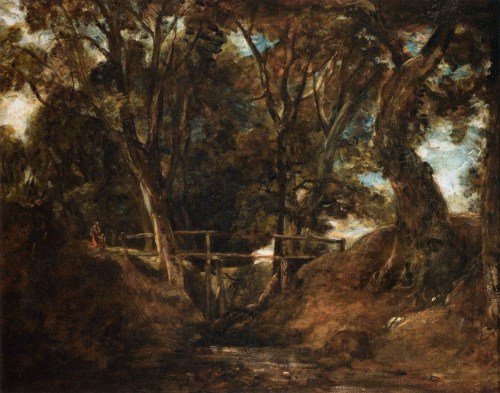
John_Constable_-_Helmingham_Dell_-_WGA5193Artist: John Constable (1776–1837)

Title: Helmingham Dell

Genre: landscape art

Date: first half of 19th century

Medium: oil on canvas

Dimensions: height: 103 cm (40.5 in); width: 129 cm (50.7 in)

Collection: Louvre Museum

Current location: Department of Paintings of the Louvre

What I love about this image:

For those of us who write fantasy set in low-tech worlds, this is a view of how people bridged a creek for thousands of years, using the materials at hand. The scene is beautiful, cool and serene. One can hear the quiet murmur of the brook, the calls of different birds, and the chatter of squirrels arguing over their territories.

But at night, the silence is broken by the occasional hoot of an owl, and the rustle of underbrush as the small nocturnal creatures go about their business. A fox might wander through the dell, looking for a meal.

The amazing sky can be seen through the leaves and branches. John Constable gives us a lovely day, a moment of serenity to enjoy across the centuries.

About the Artist, via Wikipedia:

John Constable RA , 11 June 1776 – 31 March 1837) was an English landscape painter in the Romantic tradition. Born in Suffolk, he is known principally for revolutionising the genre of landscape painting with his pictures of Dedham Vale, the area surrounding his home – now known as “Constable Country” – which he invested with an intensity of affection. “I should paint my own places best”, he wrote to his friend John Fisher in 1821, “painting is but another word for feeling”.

Constable’s most famous paintings include Wivenhoe Park (1816), Dedham Vale (1821) and The Hay Wain (1821). Although his paintings are now among the most popular and valuable in British art, he was never financially successful. He became a member of the establishment after he was elected to the Royal Academy of Arts at the age of 52. His work was embraced in France, where he sold more than in his native England and inspired the Barbizon school. [1]


Credits and Attributions:

Image: Wikimedia Commons contributors, “File:John Constable – Helmingham Dell – WGA5193.jpg,” Wikimedia Commons, https://commons.wikimedia.org/w/index.php?title=File:John_Constable_-_Helmingham_Dell_-_WGA5193.jpg&oldid=723632044 (accessed May 25, 2023).

[1] Wikipedia contributors, “John Constable,” Wikipedia, The Free Encyclopedia, https://en.wikipedia.org/w/index.php?title=John_Constable&oldid=1152514837 (accessed May 25, 2023).

Comments Off on #FineArtFriday: John Constable – Helmingham Dell

Filed under #FineArtFriday

#FineArtFriday:The Alyscamps, or The Three Graces at the Temple of Venus by Paul Gauguin 1888

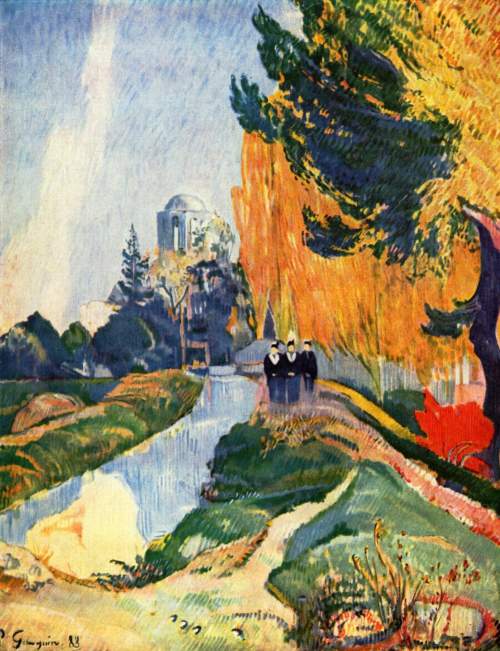
Paul_Gauguin_les_alyscamps085

Artist: Paul Gauguin (1848–1903)

Title:  (English)The Alyscamps, or The Three Graces at the Temple of Venus

French: French: Les Alyscamps, ou Les Trois grâces au temple de Venus

Date: 1888

Medium: oil on canvas

Dimensions: height: 91.6 cm (36 in); width: 72.5 cm (28.5 in)

Collection: Musée d’Orsay

What I love about this painting:

Color! I love the vivid colors contrasted against the pale sky. The Three Graces in classical mythology are the goddesses of charm, beauty, nature, human creativity, goodwill, and fertility. They have come to symbolize faith, hope, and charity.

The traditional mythology Paul Gauguin explores in this composition demonstrates his early education and his appreciation of classical art. Before he became an artist, he was both a stockbroker and an art dealer/collector.

Although he never trained formally, Gauguin is known for his use of bold colors, simplified forms, and strong lines. This painting is a prime example of his study of form and color.

The eye is drawn to the vertical lines of the temple standing tall on the hill behind the figures. They are also depicted with a sense of height, and the hills beyond are tall and narrow.

A calm stream flows from beneath the temple, the river of time. The three women stand almost in the background, yet impressive, observing as time passes them. They are as strong and unmovable as the rocky hills and the temple.

Gauguin tells us that time may pass, and things may change, but the Temple of Venus rises above it all. Does this Temple of Venus represent “agape,” a love that is selfless and unconditional? A kind of love that is spiritual in nature? Paul Gauguin was a complicated man, conflicted and tormented by the contrasts of morality and the realities of his life.

Who knows what that temple meant to him on the day he created it, but either way, Gauguin’s Three Graces, Faith, Hope, and Charity stand almost in the shadows, offering him comfort. They are as solid as the mountains and eternal as time. And who is the dark, mysterious fourth who peers over their shoulder?

Paul Gauguin lived an eventful life. For a wonderful documentary on the man and his life, go to:

Why Is Gauguin So Controversial? (Waldemar Januszczak Documentary) | Perspective – YouTube

Also, check out Paul Gauguin – Wikipedia.


Credits and Attributions:

Image: Wikimedia Commons contributors, “File:Paul Gauguin 085.jpg,” Wikimedia Commons, https://commons.wikimedia.org/w/index.php?title=File:Paul_Gauguin_085.jpg&oldid=710795058 (accessed April 6, 2023).

7 Comments

Filed under #FineArtFriday

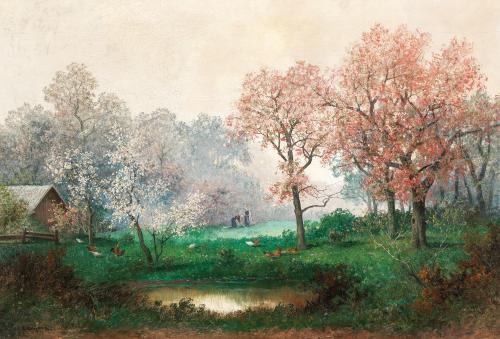
#FineArtFriday: Under flowering trees by Adolf Kaufmann

Adolf_Kaufmann_Under_the_treesjpgArtist: Adolf Kaufmann (1848–1916)

Title: Under flowering trees

Date: before 1916

Medium: oil on canvas

Inscription: signed A. Kaufmann

What I love about this painting:

Kaufmann gives us a beautiful spring day with apple trees and cherry trees in full bloom. The weather is misty, cool and damp the way spring mornings often are here in the Pacific Northwest.

Chickens roam the orchard, and two women are digging, breaking the ground for a spring garden.

To the left is a weathered building. Is it a barn? Is it their home? It’s hidden behind the shrubbery so it’s difficult to tell, but it has no window, so I think it may be a barn.

Nothing is romanticized—we see it the way the artist did on that spring day over a century ago.

About the Artist, via Wikipedia:

Adolf Kaufmann (15 May 1848, in Troppau – 25 November 1916, in Vienna) was an Austrian landscape and marine artist.

He was initially self-taught, but completed his studies with the animal painter, Émile van Marcke, in Paris and undertook several study trips, throughout Europe and the Middle East. His residence alternated between Paris, Berlin, Düsseldorf and Munich.

In 1890, he decided to settle in Vienna and opened a studio in the Wieden district. In 1900, together with Carl von Merode [de] and Heinrich Lefler, he opened an “Art School for Ladies”. He continued to visit Paris frequently and, when he painted there, signed his works with the pseudonym “A. Guyot”. Other names he signed with include “A. Papouschek”, “G. Salvi”, “A. Jarptmann”, “R. Neiber”, “J. Rollin” and “M. Bandouch”. Why he did this is unclear, although his choice of signature often reflects stylistic differences.

His landscapes were influenced by the Barbizon school and the style known as “paysage intime,” both of which he was exposed to in France during the 1870s. (The paysage intimate, French for “familiar landscape,” was a style of painting that dealt with simple, simple landscapes and emerged in the mid-19th century. It was the predecessor of the Impressionist style.) [1]


Credits and Attributions:

IMAGE: Wikimedia Commons contributors, “File:Adolf Kaufmann Unter blühenden Bäumen.jpg,” Wikimedia Commons, the free media repository, https://commons.wikimedia.org/w/index.php?title=File:Adolf_Kaufmann_Unter_bl%C3%BChenden_B%C3%A4umen.jpg&oldid=623159308 (accessed March 23, 2023).

[1] Wikipedia contributors, “Adolf Kaufmann,” Wikipedia, The Free Encyclopedia, https://en.wikipedia.org/w/index.php?title=Adolf_Kaufmann&oldid=1094252143 (accessed March 23, 2023).

7 Comments

Filed under #FineArtFriday

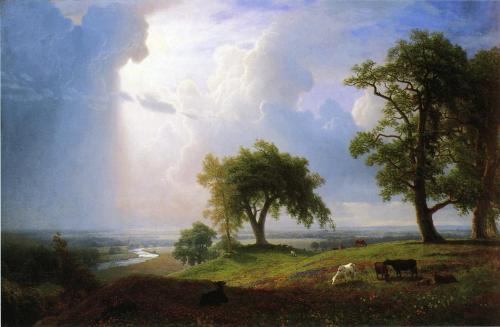
#FineArtFriday: California Spring by Albert Bierstadt 1875

Albert_Bierstadt_California_SpringArtist: Albert Bierstadt (1830–1902)

Title: California Spring

Genre: landscape art

Date: 1875

Medium: oil on canvas

Dimensions: height: 187.3 cm (73.7 in); width: 264.2 cm (104 in)

Current location: Fine Arts Museums of San Francisco

What I love about this painting:

I love this composition, the way everything is deliberately placed. Cattle graze on a hilltop beneath a grove of trees, uncaring of the rainstorm sweeping across the valley below, far off in the distance. The immensity of the sky is the focus of this scene, with the sun emerging from the clouds, a brief promise of warmer days. Spring has arrived on this hilltop.

Here at Casa del Jasperson, we’re tired of winter, done with rain and dark days. Albert Bierstadt paints us an idyllic scene of seasonal weather and the harmony of nature. The grass is green, the cattle are happy, and while rain may come, summer is around the corner.

About the artist, via Wikipedia:

Albert Bierstadt (January 7, 1830 – February 18, 1902) was a German American painter best known for his lavish, sweeping landscapes of the American West. He joined several journeys of the Westward Expansion to paint the scenes. He was not the first artist to record the sites, but he was the foremost painter of them for the remainder of the 19th century.

Bierstadt was born in Prussia, but his family moved to the United States when he was one year old. He returned to study painting for several years in Düsseldorf. He became part of the second generation of the Hudson River School in New York, an informal group of like-minded painters who started painting along the Hudson River. Their style was based on carefully detailed paintings with romantic, almost glowing lighting, sometimes called luminism. Bierstadt was an important interpreter of the western landscape, and he is also grouped with the Rocky Mountain School. [1]


Credits and Attributions:

Image: Wikimedia Commons contributors, “File:Albert Bierstadt California Spring.jpg,” Wikimedia Commons, the free media repository, https://commons.wikimedia.org/w/index.php?title=File:Albert_Bierstadt_California_Spring.jpg&oldid=701053175 (accessed February 9, 2023).

[1] Wikipedia contributors, “Albert Bierstadt,” Wikipedia, The Free Encyclopedia, https://en.wikipedia.org/w/index.php?title=Albert_Bierstadt&oldid=1137881139 (accessed February 9, 2023).

5 Comments

Filed under #FineArtFriday, writing

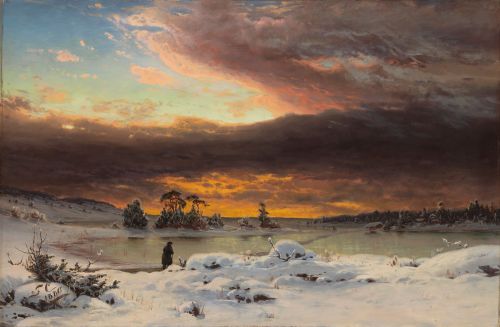
#FineArtFriday: Winter Landscape Evening Atmosphere by Fanny Churberg 1880 (revisited)

Title:  Winter Landscape, Evening Atmosphere

Artist: Fanny Churberg

Genre: landscape art

Date: 1880

Medium: oil on canvas

Dimensions     Height: 73.5 cm (28.9 in); Width: 105 cm (41.3 in)

Collection: Finnish National Gallery

What I love about this  painting:

Fanny Churberg (12 December 1845 Vaasa – 10 May 1892 Helsinki) was a Finnish painter and one of the great masters of her time. She is one of my favorite landscape artists. In terms of talent and technique, she is on a scale with the most renowned painters of all time in that genre.

She is generally considered by art historians as one of the greatest masters of landscape painting. She is relatively unknown as she only exhibited her work in Finland.

Winter Landscape, Evening Atmosphere is one of the last scenes Fanny Churberg ever painted. The impact of the angry sky is breathtaking. Churberg packs emotion into that sunset.

The snow on the vast Finnish countryside had fallen the day before, so the wind had a chance to sweep the ice clear. She perfectly captured the way snow looks when it’s had a chance to melt a bit and mold itself to the shrubs and grasses.

The winter-barren land reflects the tint of the sky, but the despite the transitory warmth of that rosy light, the world is frozen, shrouded in ice.

Above it all, the sky tells us the day was a brief respite. Dark clouds gather, looming and waiting for their chance to enshroud the world in new snow.

As you might guess, when I view art, I see it through the eyes of a storyteller. In my mind, the painting and the life of the artist are intimately connected. The events and passions of their lives are reflected in their work, in the same way as those of we who write books.

When I look at the emotion, raw and powerful, that has been instilled into this painting, I wonder if the scene is an allegory for her life. For reasons we may never know, Fanny stopped painting soon after this and never lifted a brush again.

Fanny had never married, and I suspect her art was her creative child. Many of the pressures that fell on women’s shoulders in that era must have led to this decision. Whatever her reason was, it must have felt like a deeply personal tragedy at the time.


About the Artist, via Wikipedia:

Fanny Churberg (1845–1892) started her artistic training in Helsinki in 1865 with private lessons from Alexandra Frosterus-SåltinEmma Gyldén, and Berndt Lindholm. Her studies continued in Düsseldorf, Germany, but she always returned to Finland to paint during the summer. She was also one of the first Finnish painters to study in Paris, France. Although Churberg remained to a large extent within the conventions of the Düsseldorf school of painting, she openly expressed her enthusiasm for the countryside and its dramatic situations, relying above all on colour and a fast brush technique to do so. The charged quality of her work differed sharply from that of her contemporaries, as did her subjects, for example the tense atmosphere before a thunderstorm in the open country or the deep, swampy heart of the forest. Churberg founded the Friends of Finnish Handicrafts in 1879. She urged Finnish women to join the Friends’ effort to revive textile practice in Finland.

Fanny Churberg’s career ended suddenly in 1880. Her health was weaker and she took care of her brother Torsten who was suffering from tuberculosis. Torsten’s death in 1882 made her quite lonely and her will to live lessened as did her energy. The other brother Waldemar, to whom she used to be very close, had married in 1877. The reason for ending her career might also have been the harsh criticism she had met before, but she never withdrew completely from the art circles. She did not however paint anymore after 1880, not even for her own amusement, but during her career she had still managed to produce over 300 paintings.


Credits and Attributions:

Wikimedia Commons contributors, “File:Fanny Churberg – Talvimaisema, auringon mailleen mentyä – A I 189 – Finnish National Gallery.jpg,” Wikimedia Commons, the free media repository, https://commons.wikimedia.org/w/index.php?title=File:Fanny_Churberg_-_Talvimaisema,_auringon_mailleen_menty%C3%A4_-_A_I_189_-_Finnish_National_Gallery.jpg&oldid=468220757 (accessed November 5, 2020).

Wikipedia contributors, “Fanny Churberg,” Wikipedia, The Free Encyclopedia, https://en.wikipedia.org/w/index.php?title=Fanny_Churberg&oldid=973669647 (accessed November 5, 2020).

7 Comments

Filed under writing

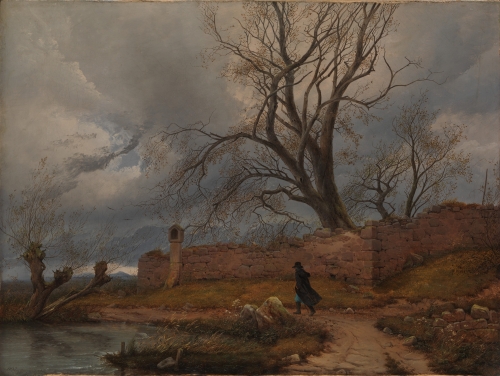
#FineArtFriday: Wanderer in the Storm by Carl Julius von Leypold 1835

Karl_Julius_von_Leypold_-_Wanderer_im_SturmArtist: Carl Julius von Leypold  (1806–1874)
Title: Wanderer in the Storm

Date: 1835

Medium: oil on canvas

Dimensions: height: 42.5 cm (16.7 in); width: 56.5 cm (22.2 in)

Collection: Metropolitan Museum of Art

What I love about this painting:

This painting completely describes the weather we’re experiencing this week in the cold, dark, and stormy Pacific Northwest—wind and rain and rain and wind. Winter is in full swing. Hopefully, we will avoid having more snow and ice, but it’s only January. Anything can be lurking around the corner.

I love the dark and moody sky that von Leypold paints for us. It has movement, a sense of life, of wind and rain gathering momentum, a small pause while it builds toward a tantrum of the wintery kind.

One can almost hear the water lapping at the shore. Beyond the muddy lane, the trees are like me, old but strong, holding their barren branches defiant before the storm. They seem to shout, “We will bend but never break!” and by bending with the winds, those trees will survive to see yet another blossoming of spring.

The ancient stone wall stands firm, still doing its duty despite being long neglected and left to ruin. It refuses to abandon its purpose, although it no longer remembers what that might be.

The man trudges purposefully, despite the wind that whips at his long coat. Does he feel the cold, or is he walking quickly enough that he is warm? And where is he going? Who is he so intent upon seeing that he would brave the storm on foot?

There is a story in this painting.

About the Artist, via Wikipedia:

Carl Julius von Leypold (1806–1874) was a German Romantic landscape painter known for his painting, “Wanderer in the Storm.”

Von Leypold studied landscape painting with Johan Christian Dahl at the Dresden Academy of Fine Arts between 1820 and 1829. From 1826 onwards, Caspar David Friedrich influenced his choice of subjects and painting style. His landscapes are characterized by “a painterly, but at the same time sharp-brushed style, in which high painting culture is combined with Biedermeier objectivity.”

On March 5, 1857, he became an honorary member of the Dresden Art Academy. [1]


Credits and Attributions:

Image: Wanderer in the Storm by Carl Julius von Leypold PD|100. Wikimedia Commons contributors, “File:Karl Julius von Leypold – Wanderer im Sturm.jpg,” Wikimedia Commons, the free media repository, https://commons.wikimedia.org/w/index.php?title=File:Karl_Julius_von_Leypold_-_Wanderer_im_Sturm.jpg&oldid=675091985 (accessed January 5, 2023).

[1] Wikipedia contributors, “Carl Julius von Leypold,” Wikipedia, The Free Encyclopedia, https://en.wikipedia.org/w/index.php?title=Carl_Julius_von_Leypold&oldid=1095364695 (accessed January 5, 2023).

4 Comments

Filed under #FineArtFriday, writing

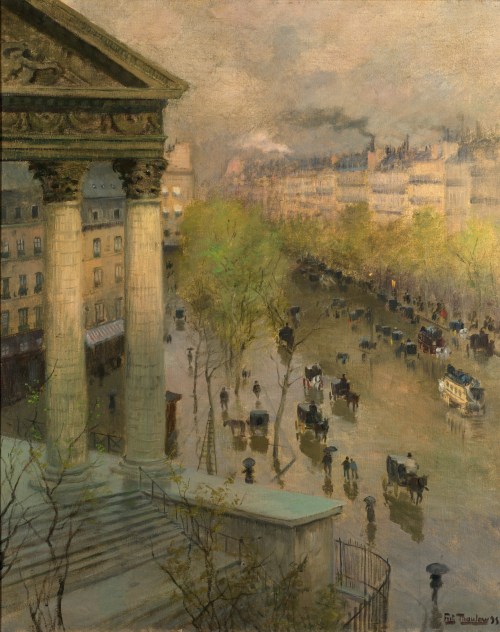
#FineArtFriday: Boulevard de la Madeleine in Paris by Frits Thaulow ca 1897 (revisited)

Frits_Thaulow_-_Boulevard_de_la_Madeleine_à_Paris_(1890s)Title: Boulevard de la Madeleine in Paris by Frits Thaulow

Date: circa 1896-1897

Medium: oil on canvas

Dimensions: Height: 88.2 cm (34.7 in); Width: 66.3 cm (26.1 in)

Collection: Pushkin Museum of Fine Arts

Inscriptions: Signature and date bottom right: Frits Thaulow (date is unclear)

What I like about this painting:

This is a street scene viewed from an angle we rarely see in paintings. The people and vehicles are small, insignificant in comparison with the size and grandeur of the buildings.

While Thaulow didn’t enjoy painting cityscapes, I think Boulevard de la Madeleine in Paris is one of the best of that era.

The soot from the chimneys in the distance, the wet street, the muted, watery colors of a rainy spring day, and the God’s-eye view of the busy street—it all comes together to present a powerful statement.

About the Artist, Via Wikipedia:

Thaulow was one of the earliest artists to paint in Skagen in the north of Jutland, soon to become famous for its Skagen Painters. He arrived there in 1879 with his friend Christian Krohg, who persuaded him to spend the summer and autumn there. They arrived from Norway in Thaulow’s little boat. Thaulow, who had specialized in marine painting, turned to Skagen’s favourite subjects, the fishermen and the boats on the shore.

Thaulow moved to France in 1892, living there until his death in 1906. He soon discovered that the cityscapes of Paris did not suit him. His best paintings were made in small towns such as Montreuil-sur-Mer (1892–94), Dieppe and surrounding villages (1894–98), Quimperle in Brittany (1901) and Beaulieu-sur-Dordogne in the Corrèze département (1903). One of his most famous works once he moved to france was A village street in France. In Dieppe Thaulow and his wife Alexandra made themselves popular: they were friends with artist Charles Conder, and they met Aubrey Beardsley. [1]


Credits and Attributions:

[1] Wikipedia contributors, “Frits Thaulow,” Wikipedia, The Free Encyclopedia, https://en.wikipedia.org/w/index.php?title=Frits_Thaulow&oldid=1026282924 (accessed June 10, 2021).

Boulevard de la Madeleine in Paris, ca 1896-97 by  Frits Thaulow, Public domain, via Wikimedia Commons. Wikimedia Commons contributors, “File:Frits Thaulow – Boulevard de la Madeleine à Paris (1890s).jpg,” Wikimedia Commons, the free media repository, https://commons.wikimedia.org/w/index.php?title=File:Frits_Thaulow_-_Boulevard_de_la_Madeleine_%C3%A0_Paris_(1890s).jpg&oldid=566337323 (accessed June 10, 2021).

7 Comments

Filed under #FineArtFriday

#FineArtFriday: On the Saco by Albert Bierstadt

Bierstadt_Albert_On_the_SacoArtist: Albert Bierstadt (1830–1902)

Title: “On the Saco”

Genre: landscape art

Description: Of the Saco River, Maine.

Date: Unknown date (19th century)

Medium: oil painting.

What I love about this image:

Bierstadt understood and respected the power of nature. The way he rendered the sky is wonderful. He captured that brilliant darkness of a distant storm against the bright sunshine of an autumn afternoon. I love contrasts in this painting, the bright foliage in every shade of red and yellow, the serenity of the cattle drinking in the shallows.

The heavy darkness of the storm in the hills seems to be pushed back by the serene glow of fall’s sunlight on the river. Will it rain itself out before it passes over the herd? Possibly.

About the Artist, via Wikipedia:

Albert Bierstadt (January 7, 1830 – February 18, 1902) was a German-American painter best known for his lavish, sweeping landscapes of the American West. He joined several journeys of the Westward Expansion to paint the scenes. He was not the first artist to record the sites, but he was the foremost painter of them for the remainder of the 19th century.

Bierstadt was born in Prussia, but his family moved to the United States when he was one year old. He returned to study painting for several years in Düsseldorf. He became part of the second generation of the Hudson River School in New York, an informal group of like-minded painters who started painting along the Hudson River. Their style was based on carefully detailed paintings with romantic, almost glowing lighting, sometimes called luminism. Bierstadt was an important interpreter of the western landscape, and he is also grouped with the Rocky Mountain School. [1]


Credits and Attributions:

Image: On the Saco by Albert Bierstadt, Wikimedia Commons contributors, “File:Bierstadt Albert On the Saco.jpg,” Wikimedia Commons, the free media repository, https://commons.wikimedia.org/w/index.php?title=File:Bierstadt_Albert_On_the_Saco.jpg&oldid=618723154 (accessed September 16, 2022).

[1] Wikipedia contributors, “Albert Bierstadt,” Wikipedia, The Free Encyclopedia, https://en.wikipedia.org/w/index.php?title=Albert_Bierstadt&oldid=1107140650 (accessed September 16, 2022).

5 Comments

Filed under #FineArtFriday

#FineArtFriday: The Sycamores by Alexandre Calame 1854

1175px-'The_Sycamores'_by_Alexandre_Calame,_Cincinnati_Art_MuseumTitle: The Sycamores by Alexandre Calame

Genre: landscape art

Date: 1854

Medium: oil on canvas

Dimensions: height: 54.3 cm (21.3 in)

Collection: Cincinnati Art Museum

What I love about this painting:

These are trees with a presence. They grow on a rocky, sunlit hillside and seem as tough as the boulders surrounding them. Like people, these trees have seen some stuff. No delicate hothouse specimens here – these are hardy peasant trees, able to make do with whatever nature throws at them.

About the Artist, via Wikipedia:

Alexandre Calame (28 May 1810 – 19 March 1864) was a Swiss landscape painter, associated with the Düsseldorf School.

He was born in Arabie at the time belonging to Corsier-sur-Vevey, today a part of Vevey. He was the son of a skillful marble worker in Vevey, but because his father lost the family fortune, Calame could not concentrate on art, but rather he was forced to work in a bank from the age of 15. When his father fell from a building and then died, it was up to the young Calame to provide for his mother.

In his spare time he began to practice drawing small views of Switzerland. In 1829 he met his patron, the banker Diodati, who made it possible for him to study under landscape painter François Diday. After a few months he decided to devote himself fully to art.

In 1835 he began exhibiting his Swiss-Alps and forest paintings in Paris and Berlin. He became quite well known, especially in Germany, although Calame was more a drawer than an illustrator. He is associated with the Düsseldorf school of painting. In 1842 he went to Paris and displayed his works Mont Blanc, the Jungfrau, the Brienzersee, the Monte Rosa and Mont Cervin.


Credits and Attributions:

Wikimedia Commons contributors, “File:’The Sycamores’ by Alexandre Calame, Cincinnati Art Museum.JPG,” Wikimedia Commons, the free media repository, https://commons.wikimedia.org/w/index.php?title=File:%27The_Sycamores%27_by_Alexandre_Calame,_Cincinnati_Art_Museum.JPG&oldid=618822225 (accessed July 15, 2022).

Wikipedia contributors, “Alexandre Calame,” Wikipedia, The Free Encyclopedia, https://en.wikipedia.org/w/index.php?title=Alexandre_Calame&oldid=1088977147 (accessed July 15, 2022).

4 Comments

Filed under #FineArtFriday