Tag Archives: 20th century art

#FineArtFriday: the Dragon’s Cave by Georg Janny 1917

Georg_Janny_-_The_Dragon's_Cave_1917Artist: Georg Janny  (1864–1935)

Title: The Dragon’s Cave (German: Drachenhöhle)

Date: 1917

Medium: oil on canvas

What I love about this painting:

What’s not to love about a dragon? Georg Janny gives us the beast in his natural environment. Our dragon is immense, gloriously armored with steel gray and silver scales. Twin streams of smoke rise from his nostrils, evidence of his fiery internal workings. The dragon sits at the entrance to his mountain aerie, surveying the world, and believes that he is the master.

I love fantasy paintings. The artists who painted scenery for the opera were, and are, incredibly skilled. The scenery painters of the early twentieth century were often influenced in their subject matter and style by the works of the pre-Raphaelites.

About the Artist, via Wikipedia:

Georg Janny (20 May 1864, Vienna – 21 February 1935, Vienna) was an Austrian landscape painter and set designer.

He worked as a scene painter in the studios of Carlo Brioschi and Johann Kautsky, alongside Alfons Mucha, and was a member of the Dürerbund.

In 1898, he participated in painting the “Eisernen Vorhang” (Iron Curtain) at the Vienna Volksoper for the 50th jubilee of Emperor Franz Joseph I. In 1904, he exhibited in the Austrian Pavilion at the St.Louis World’s Fair with scenes from the Imperial Royal Austrian State Railways (now at the Technisches Museum Wien). Two years later, he designed the stage for The Queen of Sheba by Karl Goldmark, one of the most popular operas of the late 19th century. Pictures from the second and third acts have been preserved.

He also painted landscapes and figures, including scenes from fairy-tales or imaginary worlds that are reminiscent of the works of Arnold Böcklin or Gustave Doré. [1]


Credits and Attributions:

Image: The Dragon’s Cave by Georg Janny. Wikimedia Commons contributors, “File:Georg Janny – The Dragon’s Cave 1917.jpg,” Wikimedia Commons, https://commons.wikimedia.org/w/index.php?title=File:Georg_Janny_-_The_Dragon%27s_Cave_1917.jpg&oldid=636191261 (accessed August 25, 2023).

[1] Wikipedia contributors, “Georg Janny,” Wikipedia, The Free Encyclopedia, https://en.wikipedia.org/w/index.php?title=Georg_Janny&oldid=1159021400 (accessed August 25, 2023).

Wikimedia Commons contributors, “File:Georg Janny – The Dragon’s Cave 1917.jpg,” Wikimedia Commons, https://commons.wikimedia.org/w/index.php?title=File:Georg_Janny_-_The_Dragon%27s_Cave_1917.jpg&oldid=636191261 (accessed August 25, 2023).

5 Comments

Filed under #FineArtFriday

#FineArtFriday: Hastings: the Front by Theodore Casmir Roussel 1908 (revisited)


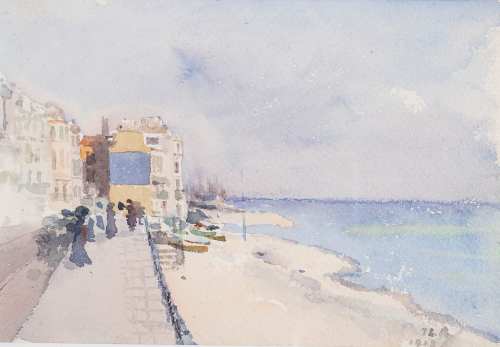
Title: Hastings: the Front.

Medium: Watercolor.

Signed and dated: Theodore Roussel 1908.

Dimensions: 6.75×10 inches. Framed: 13.75×16 inches.”

Summer is here, so today we’re taking a second look at this lovely dreamscape of Hastings, a seaside town in East Sussex on the south coast of England. It is southeast of London, and in the 19th and early 20th century, when this painting made, the railway enabled ordinary tourists and visitors to reach the town. Thus, it became a popular seaside resort.

Historically, Hastings is an ancient town. Wikipedia tell us that the start of the Norman Conquest was the Battle of Hastings, fought on 14 October 1066, although the battle itself took place 8 mi (13 km) to the north at Senlac Hill, and William had landed on the coast between Hastings and Eastbourne at Pevensey. It is thought that the Norman encampment was on the town’s outskirts, where there was open ground; a new town was already being built in the valley to the east. That “New Burgh” was founded in 1069 and is mentioned in the Domesday Book as such. William defeated and killed Harold Godwinson, the last Saxon King of England, and destroyed his army, thus opening England to the Norman conquest. [1]

What I love about this painting:

I love watercolors and especially love this scene. The medium allows for a dreamy atmosphere, and in this case, the artist has presented us with the impression of a sundrenched afternoon at the seashore. Roussel’s work grew more atmospheric as he grew older, but he was known more for his classically depicted nudes than as an impressionist. However, it’s clear he had an eye for impressionism and the ability to show a story with watercolors.

Tourists stroll along the breakwater in front of the hotels, wearing broad hats and coats. Like many days at the beach on the Washington Coast, where I live, even in summer the wind often carries a chill.

About the Artist, via Wikipedia:

Theodore Casimir Roussel (1847–1926) was a French-born English painter and graphic artist, best known for his landscapes and genre scenes. He came to painting late, in 1872, after his military service had ended, and he was entirely self-taught. His earliest works were scenes of daily life, rendered in the style of the Old Masters. In 1878, he moved to London and, two years later, married the widow Frances Amelia Smithson Bull (1844–1909), a distant collateral relative of James Smithson. In 1885, he met James McNeill Whistler, who became a lifelong friend and mentor. [2]


Credits and Attributions:

Hastings: the Front by Théodore Roussel, Public domain, via Wikimedia Commons

[1]Wikipedia contributors, “Hastings,” Wikipedia, The Free Encyclopedia, https://en.wikipedia.org/w/index.php?title=Hastings&oldid=1160573614 (accessed June 23, 2023).

[2]Wikipedia contributors, “Theodore Roussel,” Wikipedia, The Free Encyclopedia, https://en.wikipedia.org/w/index.php?title=Theodore_Roussel&oldid=896039278 (accessed December 3, 2020).

Comments Off on #FineArtFriday: Hastings: the Front by Theodore Casmir Roussel 1908 (revisited)

Filed under #FineArtFriday

#FineArtFriday: the Song of Love by Georgio de Chirico

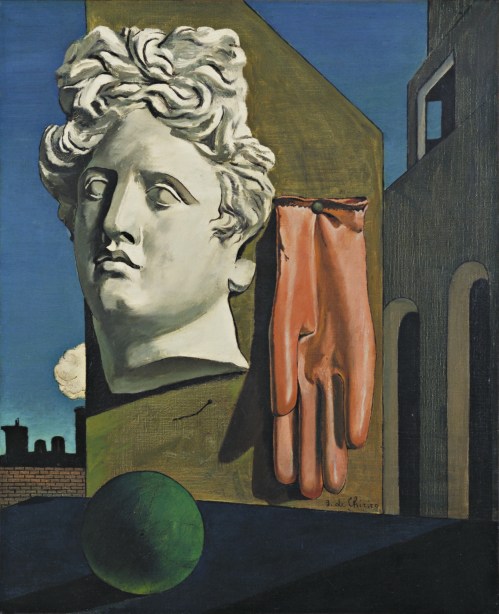
De_Chirico's_Love_SongArtist: Giorgio de Chirico, 1914,

Title: The Song of Love,

Genre: Metaphysical Art

Medium: oil on canvas, 73 x 59.1 cm,

Location: Museum of Modern Art, New York

About this painting, via Wikipedia:

Chirico presents a bust of a classical sculpture, a rubber ball, and a rubber glove on a canvas in between some buildings with a train passing by in a scene that spurs a sense of confusion. The bust could be a representation of Chirico’s love of classical art and a disappearing age. Chirico uses the rubber glove as a mold of a hand that implies the void of human presence. The buildings set up a scene that is reminiscent of the cityscapes of Chirico’s past. [1]

About the Artist,  via Wikipedia:

Giuseppe Maria Alberto Giorgio de Chirico; 10 July 1888 – 20 November 1978) was an Italian artist and writer born in Greece. In the years before World War I, he founded the scuola metafisica art movement, which profoundly influenced the surrealists. His best-known works often feature Roman arcades, long shadows, mannequins, trains, and illogical perspective. His imagery reflects his affinity for the philosophy of Arthur Schopenhauer and of Friedrich Nietzsche, and for the mythology of his birthplace.

After 1919, he became a critic of modern art, studied traditional painting techniques, and worked in a neoclassical or neo-Baroque style, while frequently revisiting the metaphysical themes of his earlier work.

The paintings de Chirico produced between 1909 and 1919, his metaphysical period, are characterized by haunted, brooding moods evoked by their images. At the start of this period, his subjects were motionless cityscapes inspired by the bright daylight of Mediterranean cities, but gradually he turned his attention to studies of cluttered storerooms, sometimes inhabited by mannequin-like hybrid figures. [2]

For more on the life and art of Georgio de Chirico, check out this video: Is This £1 Thrift Shop Painting By 20th Century Italian Master? | Fake Or Fortune | Perspective – YouTube


Credits and Attributions:

Image: Love Song by Georgio de Chirico, PD|100, courtesy Wikipedia Contributors, Wikipedia, The Free Encyclopedia https://en.wikipedia.org/wiki/File:De_Chirico%27s_Love_Song.jpg. (Accessed April 30, 2023.)

[1] Wikipedia contributors, “The Song of Love,” Wikipedia, The Free Encyclopedia, https://en.wikipedia.org/w/index.php?title=The_Song_of_Love&oldid=1146489854 (accessed April 30, 2023).

[2] Wikipedia contributors, “Giorgio de Chirico,” Wikipedia, The Free Encyclopedia, https://en.wikipedia.org/w/index.php?title=Giorgio_de_Chirico&oldid=1152305674 (accessed May 4, 2023).

2 Comments

Filed under #FineArtFriday

#FineArtFriday: Red hollyhocks in the garden of the Ancher family at Markvej in Skagen by Anna Ancher ca. 1916 (revisited)

Anna_Ancher_-_Røde_stokroser_i_haven_ved_Ancher-familiens_hus_på_Markvej_i_SkagenArtist: Anna Ancher  (1859–1935)

Title: English: Red hollyhocks in the garden of the Ancher family at Markvej in Skagen.

Date: circa 1916

Medium: oil on canvas

Dimensions: Height: 63 cm (24.8 in); Width: 47 cm (18.5 in)

Collection: Unknown

Inscriptions: Signature bottom right: A. Ancher

What I love about this painting:

Winters tends to be dark and rainy here in the Pacific Northwest. Sunshine is brief and gloomy skies seem eternal. I need a summer day! I found us this gorgeous painting last year and loved it so much. One of my favorite artists, Anna Ancher gives us a perfect day in Skagen a century ago.

She is mostly known for her interiors, but Anna Ancher captured the essence of summer in this painting. Along with foxgloves, hollyhocks are my favorite summer flowers. Anna’s are beautiful, contrasted against the blue sky. Her eye for color was amazing. The yellow and red flowers perfectly complement the color of the building behind the garden.

I feel so much better for having had this glorious day in Anna’s serene garden.

About the Artist via Wikimedia: Anna Ancher preferred to paint interiors and simple themes from the everyday lives of the Skagen people, especially fishermen, women, and children. She was intensely preoccupied with exploring light and color, as in Interior with Clematis (1913). She also created more complex compositions such as A Funeral (1891). Anna Ancher’s works often represented Danish art abroad. Ancher has been known for portraying similar civilians from the Skagen art colony in her works, including an old blind woman.

While she studied drawing for three years at the Vilhelm Kyhn College of Painting in Copenhagen, she developed her own style and was a pioneer in observing the interplay of different colors in natural light. She also studied drawing in Paris at the atelier of Pierre Puvis de Chavannes along with Marie Triepcke, who would marry Peder Severin Krøyer, another Skagen painter.

In 1880 she married fellow painter Michael Ancher, whom she met in Skagen. They had one child, daughter Helga Ancher. Despite pressure from society that married women should devote themselves to household duties, she continued painting after marriage. [1]


Credits and Attributions:

Anna Ancher, Public domain, via Wikimedia Commons. Wikimedia Commons contributors, “File:Anna Ancher – Røde stokroser i haven ved Ancher-familiens hus på Markvej i Skagen.jpg,” Wikimedia Commons, the free media repository, https://commons.wikimedia.org/w/index.php?title=File:Anna_Ancher_-_R%C3%B8de_stokroser_i_haven_ved_Ancher-familiens_hus_p%C3%A5_Markvej_i_Skagen.jpg&oldid=616771666 (accessed January 14, 2022).

[1] Wikipedia contributors, “Anna Ancher,” Wikipedia, The Free Encyclopedia, https://en.wikipedia.org/w/index.php?title=Anna_Ancher&oldid=1041257716 (accessed January 14, 2022).

5 Comments

Filed under #FineArtFriday, writing

#FineArtFriday: Santa Maria della Salute by Eduard Veith

Eduard_Veith_-_Venezia-Santa_Maria_della_Salute

Artist: Eduard Veith  (1858–1925)

Title: Italian: Venezia: Santa Maria della Salute

Date: by 1925

Medium: oil on canvas

Dimensions: height: 39.5 cm (15.5 in); width: 58 cm (22.8 in)

Collection: Private collection

What I love about this painting:

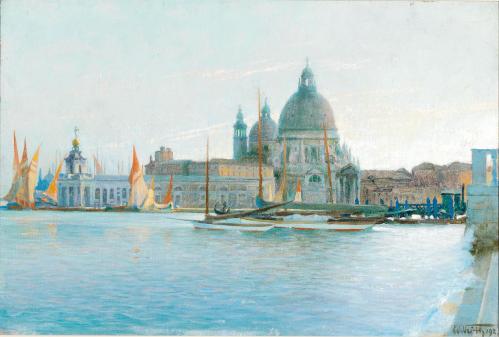
Veith has captured Venice on a beautiful morning. The sun is shining, the sky is blue and the waters of the canal are calm. Colorful sails are being raised as the fishers prepare to head out to San Marco basin for the day.

In the center is the domed basilica of Santa Maria della Salute (in English, Saint Mary of Health).

This is the sort of morning that makes one feel that all is right in the world.

About the Santa Maria della Salute, via Wikipedia:

Santa Maria della Salute (English: Saint Mary of Health), commonly known simply as the Salute, is a Roman Catholic church and minor basilica located at Punta della Dogana in the Dorsoduro sestiere of the city of VeniceItaly.

It stands on the narrow finger of Punta della Dogana, between the Grand Canal and the Giudecca Canal, at the Bacino di San Marco, making the church visible when entering the Piazza San Marco from the water. The Salute is part of the parish of the Gesuati and is the most recent of the so-called plague churches.

In 1630, Venice experienced an unusually devastating outbreak of the plague. As a votive offering for the city’s deliverance from the pestilence, the Republic of Venice vowed to build and dedicate a church to Our Lady of Health. The church was designed in the then fashionable Baroque style by Baldassare Longhena, who studied under the architect Vincenzo Scamozzi. Construction began in 1631. Most of the objects of art housed in the church bear references to the Black Death. [1]

About the artist, via Wikipedia:

Eduard Veith (30 March 1858, Neutitschein – 18 March 1925, Vienna) was an Austrian portrait painter and stage designer. Many of his works were influenced by Symbolism. He was born to the decorative painter, Julius Veith (1820–1887), and his wife Susanna, née Schleif (1827–1883).

At first, he received training to follow in his father’s profession. Later, he went to Vienna, where he took classes at the Museum of Applied Arts from Professor Ferdinand Laufberger. He capped off his studies by creating sgraffito for exhibition buildings at the Exposition Universelle in Paris.

He then returned home, where he assisted his father with painting churches, synagogues and other ceremonial buildings. This was followed by several study trips to Italy, Belgium and Tunisia. He finally settled in Vienna; becoming a free-lance artist and working mostly by commission.

From 1890, he was a member of the Vienna Künstlerhaus. In 1896, he received a gold medal at the Große Berliner Kunstausstellung. In 1905, he was appointed a Professor at the University of Technology.  In 1911, he married Bertha Griesbeck (1872–1952), from Augsburg. He later taught at the University of Applied Arts Museum of Applied Arts and became a professor there in 1920. During his years in Vienna, he maintained contact with his home town, and held exhibitions there.

He died shortly before his sixty-seventh birthday. [2]


Credits and Attributions:

Image: Wikimedia Commons contributors, “File:Eduard Veith – Venezia-Santa Maria della Salute.jpg,” Wikimedia Commons, the free media repository, https://commons.wikimedia.org/w/index.php?title=File:Eduard_Veith_-_Venezia-Santa_Maria_della_Salute.jpg&oldid=627297217 (accessed March 16, 2023).

[1] Wikipedia contributors, “Santa Maria della Salute,” Wikipedia, The Free Encyclopedia, https://en.wikipedia.org/w/index.php?title=Santa_Maria_della_Salute&oldid=1134116004 (accessed March 16, 2023).

[2] Wikipedia contributors, “Eduard Veith,” Wikipedia, The Free Encyclopedia, https://en.wikipedia.org/w/index.php?title=Eduard_Veith&oldid=1133038416 (accessed March 16, 2023).

5 Comments

Filed under #FineArtFriday

#FineArtFriday: Beneath the Snow Encumbered Branches by Joseph Farquharson 1903 (revisited)

Title: Beneath the Snow Encumbered Branches

Artist: Joseph Farquharson

Publisher: Hallmark Cards

Genre: landscape art

Date: Circa 1903

Medium: oil on canvas

Dimensions: 82 x 119.25 cm. (32 5/16 x 46 15/16 in.

What I love about this painting:

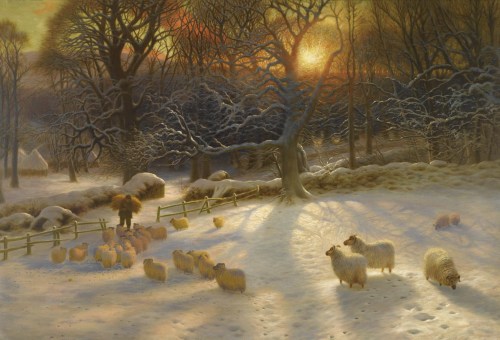
I first shared this painting in January of 2021. I found a haunting kind of nostalgia in it, an echo of times long gone. Joseph Farquharson perfectly captures the way the setting sun’s rays fall across the snow-covered landscape.

The snow is thick and heavy, and the sheep are fluffy in their long coats. Winter has come and the shadows are long, but the conical haystacks across the lane contain plenty to last through the harshest season.

I love how the afternoon light is reflected on the snowy landscape and in the branches. He shows it with a perfect golden luminosity, the hue that presages imminent dusk. 

About the Artist, via Wikipedia:

Joseph Farquharson DL RA (4 May 1846 – 15 April 1935) was a Scottish painter, chiefly of landscapes, mostly in Scotland and very often including animals. He is most famous for his snowy winter landscapes, often featuring sheep and often depicting dawn or dusk. The unusual titles of many of Farquharson’s paintings stand out and are sometimes long. Many of them were taken from poems by Burns, Milton, Shakespeare, and Gray. Farquharson was very patriotic and well versed in Scottish literature.

The remarkable realism of Farquharson’s work can be attributed to his desire to work en plein air. This had to be carried out in a unique way which was adapted to the harsh Scottish climate. Farquharson had constructed a painting hut on wheels, complete with a stove and large glass window for observing the landscape. Likewise to achieve as realistic a result as possible when painting the sheep which frequently appear in his snowscapes, he used a flock of “imitation” sheep which could be placed as required in the landscape of his choice. Farquharson painted so many scenes of cattle and sheep in snow he was nicknamed ‘Frozen Mutton Farquharson’.

Farquharson inherited the title of Laird in 1918 after the death of his elder brother Robert, a doctor and MP for West Aberdeenshire.

In 2008 the original of the 1901 painting Beneath the Snow Encumbered Branches came to light, for the first time in 40 years, when the lady owner put her house up for sale. The painting, which she had bought from a Bond Street dealer in the 1960s for £1,450, was expected to fetch up to £70,000 when it was offered for sale by auction at Lyon and Turnbull in Edinburgh. Nick Carnow, a director at the auctioneers, form said that the unnamed seller was moving to a smaller house and would not have room for the painting. In fact it sold for more than twice that estimate to another private collector in Scotland for £147,600.


Credits and Attributions:

Beneath the Snow Encumbered Branches Joseph Farquharson, Public domain, via Wikimedia Commons

Wikipedia contributors, “Joseph Farquharson,” Wikipedia, The Free Encyclopedia, https://en.wikipedia.org/w/index.php?title=Joseph_Farquharson&oldid=982764133 (accessed January 1, 2021).

Wikimedia Commons contributors, “File:The shortening winter’s day is near a close Farquharson.jpg,” Wikimedia Commons, the free media repository, https://commons.wikimedia.org/w/index.php?title=File:The_shortening_winter%27s_day_is_near_a_close_Farquharson.jpg&oldid=354603464 (accessed January 1, 2021).

2 Comments

Filed under #FineArtFriday

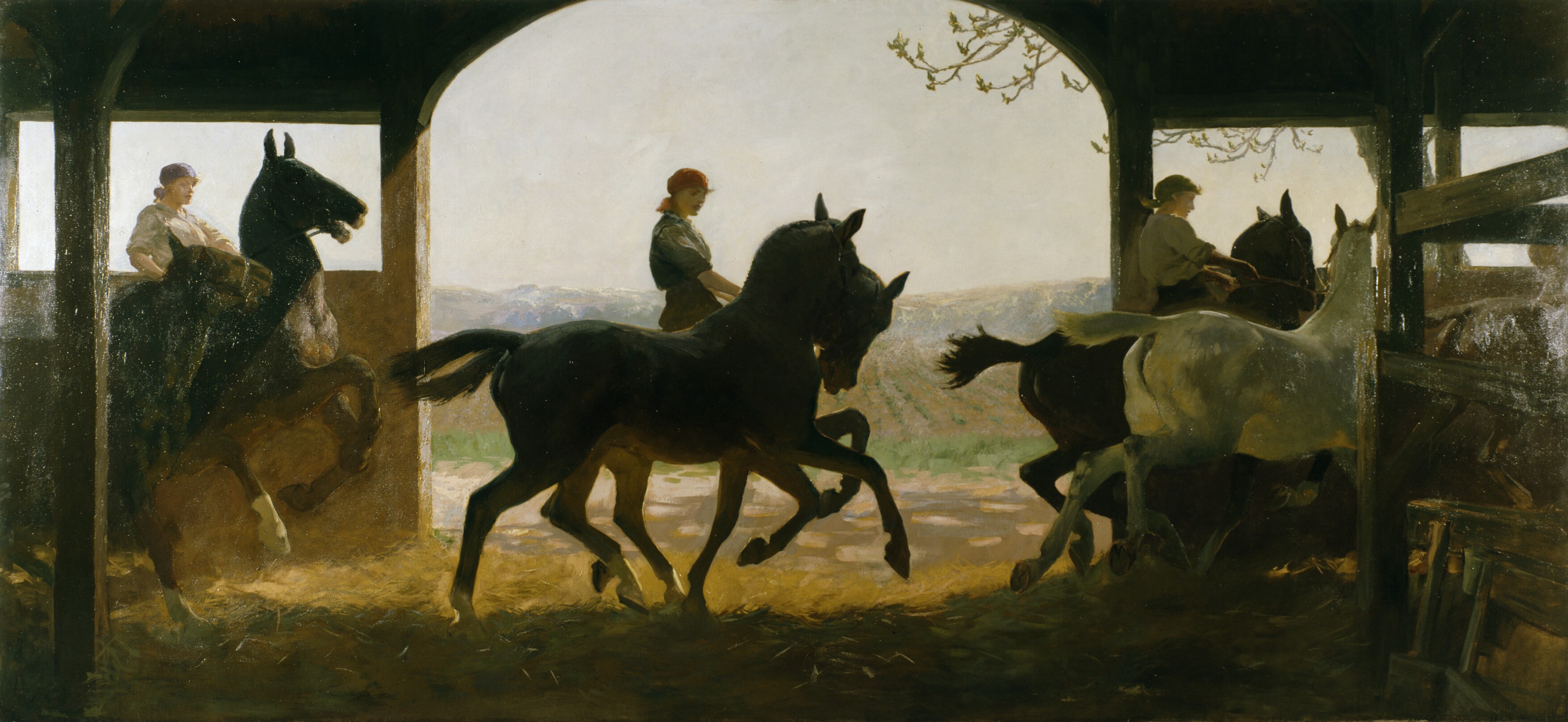
#FineArtFriday: The Straw Ride – Russley Park Remount Dep’t, Wiltshire by Lucy Kemp-Welch (revisited)

About this painting, via Wikipedia:

Three women exercising horses in a remount depot. They take their charges through their paces in an indoor straw ride. Each woman rides one horse and leads another.

During World War One women were employed at Army Remount Depots in training and preparing horses for military service. Kemp-Welch was commissioned by the Women’s Work Section of the Imperial War Museum to paint a scene at the largest such depot, one staffed entirely by women, at Russley Park in Wiltshire. The Museum authorities were unhappy with the painting, The Ladies Army Remount Depot, Russley Park, Wiltshire which Kemp-Welch first submitted but were aware of a larger and much better composition on the same subject that she had painted and intended to sell to a private client for £1,000. Kemp-Welch agreed that the second painting, The Straw-Ride- Russley Park, Remount Dep’t Wiltshire was the better of the two and agreed to sell it to the IWM to fulfill her commission. However, she was unable to agree a fee with the Women’s Work Section and after protracted discussions, donated it free of charge to the Museum.

About the Artist, via Wikipedia:

Lucy Elizabeth Kemp-Welch (20 June 1869 – 27 November 1958) was a British painter and teacher who specialized in painting working horses. She is best known for the paintings of horses in military service she produced during World War One and for her illustrations to the 1915 edition of Anna Sewell’s Black Beauty.

In 1924, for the Royal Exchange, Kemp-Welch designed and completed a large panel commemorating the work of women during World War One. From 1926 onwards she focussed on depicting scenes of gypsy and circus life and spent several summers following Sanger’s Circus, recording the horses.

She resided in Bushey, Hertfordshire for most of her life and a major collection of her works is in Bushey Museum. They include very large paintings of wild ponies on Exmoor, galloping polo ponies, the last horse-launched lifeboat being pulled into a boiling sea, heavy working horses pulling felled timber and hard-working farm horses trudging home at the end of the day.


Credits and Attributions:

Lucy Kemp-Welch, Public domain, via Wikimedia Commons

Wikimedia Commons contributors, “File:The Straw Ride- Russley Park Remount Dep’t, Wiltshire Art.IWMART3160.jpg,” Wikimedia Commons, the free media repository, https://commons.wikimedia.org/w/index.php?title=File:The_Straw_Ride-_Russley_Park_Remount_Dep%27t,_Wiltshire_Art.IWMART3160.jpg&oldid=262266456 (accessed March 18, 2021).

Wikipedia contributors, “Lucy Kemp-Welch,” Wikipedia, The Free Encyclopedia, https://en.wikipedia.org/w/index.php?title=Lucy_Kemp-Welch&oldid=996250015 (accessed March 18, 2021).

3 Comments

Filed under #FineArtFriday, writing

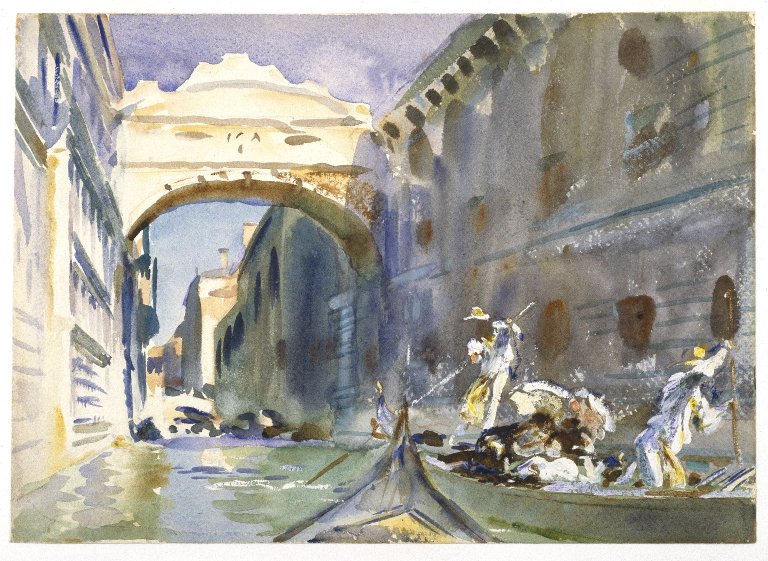
#FineArtFriday: The Bridge of Sighs, John Singer Sargent ca,1905 – 1908

John_Singer_Sargent_-_The_bridge_of_sighsArtist: John Singer Sargent (1856–1925)

Title: The Bridge of Sighs

Date: between 1905 and 1908

Medium: watercolor on paper

Dimensions: height: 25.4 cm (10 in); width: 35.6 cm (14 in)

Collection: Brooklyn Museum

Current location: American Art collection

What I love about this picture:

John Singer Sargent was known for his portraits, but it is his watercolors that fascinate me. This painting of Venice’s Bridge of Sighs is one of his finest. Done in every shade of blue and brown, he conveys the mood of an afternoon. He gives us the bridge as seen from a gondola, and the view of ladies beneath parasols going by, passing us in the opposite direction.

By his choice of colors, Sargent paints the atmosphere of a poignant, tragic place.

About this picture, via Wikipedia:

The Bridge of Sighs (Italian: Ponte dei Sospiri, Venetian: Ponte de i Sospiri) is a bridge in Venice, Italy. The enclosed bridge is made of white limestone, has windows with stone bars, passes over the Rio di Palazzo, and connects the New Prison (Prigioni Nuove) to the interrogation rooms in the Doge’s Palace.

The view from the Bridge of Sighs was the last view of Venice that convicts saw before their imprisonment. The bridge’s English name was bequeathed by Lord Byron in the 19th century as a translation from the Italian “Ponte dei sospiri”, from the suggestion that prisoners would sigh at their final view of beautiful Venice through the window before being taken down to their cells. [1]

About The Artist via Wikipedia:

John Singer Sargent (January 12, 1856 – April 14, 1925) was an American expatriate artist, considered the “leading portrait painter of his generation” for his evocations of Edwardian-era luxury. He created roughly 900 oil paintings and more than 2,000 watercolors, as well as countless sketches and charcoal drawings. His oeuvre documents worldwide travel, from Venice to the TyrolCorfu, the Middle East, Montana, Maine, and Florida.

Born in Florence to American parents, he was trained in Paris before moving to London, living most of his life in Europe. He enjoyed international acclaim as a portrait painter. An early submission to the Paris Salon in the 1880s, his Portrait of Madame X, was intended to consolidate his position as a society painter in Paris, but instead resulted in scandal. During the next year following the scandal, Sargent departed for England where he continued a successful career as a portrait artist.

From the beginning, Sargent’s work is characterized by remarkable technical facility, particularly in his ability to draw with a brush, which in later years inspired admiration as well as criticism for a supposed superficiality. His commissioned works were consistent with the grand manner of portraiture, while his informal studies and landscape paintings displayed a familiarity with Impressionism. In later life Sargent expressed ambivalence about the restrictions of formal portrait work and devoted much of his energy to mural painting and working en plein air. Art historians generally ignored society artists such as Sargent until the late 20th century.

With his watercolors, Sargent was able to indulge his earliest artistic inclinations for nature, architecture, exotic peoples, and noble mountain landscapes. And it is in some of his late works where one senses Sargent painting most purely for himself. His watercolors were executed with a joyful fluidness. He also painted extensively family, friends, gardens, and fountains. In watercolors, he playfully portrayed his friends and family dressed in Orientalist costume, relaxing in brightly lit landscapes that allowed for a more vivid palette and experimental handling than did his commissions (The Chess Game, 1906). His first major solo exhibit of watercolor works was at the Carfax Gallery in London in 1905. In 1909, he exhibited eighty-six watercolors in New York City, eighty-three of which were bought by the Brooklyn MuseumEvan Charteris wrote in 1927:

To live with Sargent’s water-colours is to live with sunshine captured and held, with the luster of a bright and legible world, ‘the refluent shade’ and ‘the Ambient ardours of the noon.’

Although not generally accorded the critical respect given Winslow Homer, perhaps America’s greatest watercolorist, scholarship has revealed that Sargent was fluent in the entire range of opaque and transparent watercolor technique, including the methods used by Homer. [2]


Credits and Attributions:

[1] Wikipedia contributors, “Bridge of Sighs,” Wikipedia, The Free Encyclopedia, https://en.wikipedia.org/w/index.php?title=Bridge_of_Sighs&oldid=1096829521 (accessed August 5, 2022).

[2] Wikipedia contributors, “John Singer Sargent,” Wikipedia, The Free Encyclopedia, https://en.wikipedia.org/w/index.php?title=John_Singer_Sargent&oldid=1099859237 (accessed August 5, 2022).

[Image] Wikimedia Commons contributors, “File:John Singer Sargent – The bridge of sighs.jpg,” Wikimedia Commons, the free media repository, https://commons.wikimedia.org/w/index.php?title=File:John_Singer_Sargent_-_The_bridge_of_sighs.jpg&oldid=660236372 (accessed August 5, 2022).

Comments Off on #FineArtFriday: The Bridge of Sighs, John Singer Sargent ca,1905 – 1908

Filed under #FineArtFriday

#FineArtFriday: Sailboats by Jacoba van Heemskerck

Sailboats by Jacoba van HeemskerckArtist: Jacoba van Heemskerck (1876–1923)

Title: Bild no. 15 (Segelboote) (English: Painting no, 15 – Sailboats)

Date: Circa 1914

Medium: oil on canvas

Dimensions: height: 97.5 cm (38.3 in); width: 113.5 cm (44.6 in)

Collection: Museum Boijmans Van Beuningen

What I love about this painting:

The sharp corners and geometry of this composition raises the viewer’s eye toward the horizon. It feels cubist, is abstract, and reflects a spiritual connection to her subject. I love the symbolism in this image. The sailboats are souls sailing toward the next life across a deep blue sea and beneath a golden sky. The island temple toward which the boats sail is shaped like a pyramid. The elongated sails of the many boats direct the eye up. Everything, including the island temple, points toward heaven.

In this painting, it is easy to see how she would later become involved in creating stained glass—the sharp black outlines and vivid colors of her paintings are perfect for that medium.

According to the Kunstmuseum Den Haag’s website:

“But whereas Mondrian’s artistic approach eventually became austerely geometrical, Van Heemskerck’s developed as a result of a variety of influences (including anthroposophy) into an open, unconstrained and intuitive style. Throughout her life, she would seek – like Kandinsky – to express spiritual experience. The recurring subjects in her oeuvre are therefore invariably symbolic in nature: sailing ships, bridges and trees, depicted in clear, vibrant colours and with firm outlines. Although she was never to abandon the representation of the real world, Van Heemskerck’s style was eventually so abstract that her subjects became virtually unrecognisable. This approach won her great success, especially in Germany, where she exhibited at the Berlin Expressionist gallery Der Sturm every year from 1913 until her death.” [1]

About the Artist, Via Wikipedia:

Jkvr. Jacoba Berendina van Heemskerck van Beest (1876-1923) was a Dutch painter, stained glass designer and graphic artist who worked in several modern genres. She specialized in landscapes and still-lifes.

Her first contact with Modern art came in Paris, where she took lessons from Eugène Carrière.[2][3] She remained in France until 1904, then went to live with her sister, Lucie, and was introduced to the art collector, Marie Tak van Poortvliet, who became her lifelong friend and later built a studio for her in the garden of her home.[1] After 1906, she spent her Summers in Domburg, where she came into contact with avant-garde painters such as Piet Mondrian[4] and Jan Toorop, who offered her advice. Around 1911, she was briefly interested in Cubism.

Shortly after, she became involved in Anthroposophy, possibly through the influence of her former teacher, Nibbrig, who was a Theosophist. She then became an avid follower of Der Sturm, an avant-garde art magazine founded by Herwarth Walden, and turned increasingly to Abstraction.[1] In 1913, she attended the Erster Deutscher Herbstsalon in Berlin, where she met Walden and started what would be a lifelong correspondence.[3] Thanks to his efforts, her work was popular in Germany, while it remained somewhat ignored in her home country.

After 1916, she developed an interest in stained glass windows, designing them for the naval barracks and the Municipal Health Department building in Amsterdam, as well as private residences.[1] From 1922, she lived in Domburg with her old friend and patron, Tak van Poortvliet.

She died suddenly, from an attack of angina.[3] Both Tak van Poortvliet and Walden mounted exhibitions of her work, in Amsterdam and Berlin respectively. In 2005, a major retrospective was held at the Gemeentemuseum Den Haag. [2]


Credits and Attributions:

[1] Kunstmuseum Den Haag contributors, “Jacoba van Heemskerck,” Jacoba van Heemskerck A REDISCOVERY, Jacoba van Heemskerck | Kunstmuseum Den Haag (accessed March 31, 2022).

[2]Wikipedia contributors, “Jacoba van Heemskerck,” Wikipedia, The Free Encyclopedia, https://en.wikipedia.org/w/index.php?title=Jacoba_van_Heemskerck&oldid=1078279427 (accessed March 31, 2022).

Comments Off on #FineArtFriday: Sailboats by Jacoba van Heemskerck

Filed under #FineArtFriday, writing

#FineArtFriday: Red hollyhocks in the garden of the Ancher family at Markvej in Skagen by Anna Ancher ca. 1916

Anna_Ancher_-_Røde_stokroser_i_haven_ved_Ancher-familiens_hus_på_Markvej_i_SkagenArtist: Anna Ancher  (1859–1935)

Title: English: Red hollyhocks in the garden of the Ancher family at Markvej in Skagen.

Date: circa 1916

Medium: oil on canvas

Dimensions: Height: 63 cm (24.8 in); Width: 47 cm (18.5 in)

Collection: Unknown

Inscriptions: Signature bottom right: A. Ancher

What I love about this painting:

January tends to be dark and rainy here in the Pacific Northwest. We were snowed and iced in for two weeks, and then four inches of rain fell in one day and the floods came—boy, do I need a summer day! So, I found us this one—a perfect day in Skagen a century ago.

She is mostly known for her interiors, but Anna Ancher captured the essence of summer in this painting. Along with foxgloves, hollyhocks are my favorite summer flowers. Hers are beautiful, juxtaposed against the blue sky. Her eye for color was amazing. The yellow and red flowers perfectly complement the color of the building behind the garden.

I feel so much better for having had this glorious day in Anna’s serene garden.

About the Artist via Wikimedia: Anna Ancher preferred to paint interiors and simple themes from the everyday lives of the Skagen people, especially fishermen, women, and children. She was intensely preoccupied with exploring light and color, as in Interior with Clematis (1913). She also created more complex compositions such as A Funeral (1891). Anna Ancher’s works often represented Danish art abroad. Ancher has been known for portraying similar civilians from the Skagen art colony in her works, including an old blind woman.

While she studied drawing for three years at the Vilhelm Kyhn College of Painting in Copenhagen, she developed her own style and was a pioneer in observing the interplay of different colors in natural light. She also studied drawing in Paris at the atelier of Pierre Puvis de Chavannes along with Marie Triepcke, who would marry Peder Severin Krøyer, another Skagen painter.

In 1880 she married fellow painter Michael Ancher, whom she met in Skagen. They had one child, daughter Helga Ancher. Despite pressure from society that married women should devote themselves to household duties, she continued painting after marriage. [1]


Credits and Attributions:

Anna Ancher, Public domain, via Wikimedia Commons. Wikimedia Commons contributors, “File:Anna Ancher – Røde stokroser i haven ved Ancher-familiens hus på Markvej i Skagen.jpg,” Wikimedia Commons, the free media repository, https://commons.wikimedia.org/w/index.php?title=File:Anna_Ancher_-_R%C3%B8de_stokroser_i_haven_ved_Ancher-familiens_hus_p%C3%A5_Markvej_i_Skagen.jpg&oldid=616771666 (accessed January 14, 2022).

[1] Wikipedia contributors, “Anna Ancher,” Wikipedia, The Free Encyclopedia, https://en.wikipedia.org/w/index.php?title=Anna_Ancher&oldid=1041257716 (accessed January 14, 2022).

Comments Off on #FineArtFriday: Red hollyhocks in the garden of the Ancher family at Markvej in Skagen by Anna Ancher ca. 1916

Filed under #FineArtFriday, writing