Tag Archives: 21st century art

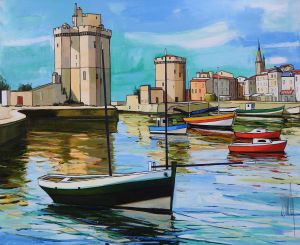
#FineArtFriday: La Rochelle, Charente-Maritime by Leon Zanella

Title: La Rochelle, Charente-Maritime

Artist: Leon Zanella

Date: 2018

What I love about this painting:

La Rochelle is a city on the west coast of France and a seaport on the Bay of Biscay, a part of the Atlantic Ocean. It is the capital of the Charente-Maritime department, a département in the Nouvelle-Aquitaine region on the southwestern coast of France.

Leon Zanella has captured the calm water of the ancient harbor on sunny day. Sailboats and motorboats are anchored there, floating serenely beneath the sky of many shades of blue. The bright colors of the modern boats and the soft, fluid motion of the waters are contrasted against the solid stone of the medieval architecture of the ancient town.

I love the simplicity of this scene, as well as the rich colors of the sea and sky.

About the artist:

Leon Zanella (1956 — present) was born in Marseille, France. He lives and works in the medieval town of Vaison La Romaine  a town in the Vaucluse department in the Provence-Alpes-Côte d’Azur region in southeastern France.

Zanella is deeply connected to his town and the surrounding countryside, which is featured in most of his work.

His work is straightforward and powerful, a clear depiction of each scene. The use of intense color celebrates the landscapes of his area of Provence. His style is bold and some have said it is reminiscent of the fauvist movement. And yet it is a unique interpretation of how he sees the world.

You can find his work at his website or view them in person at ARTE MUSEUM LAS VEGAS.


Credits and Attributions:

Wikimedia Commons contributors, “File:17-CHARENTE MARITIME-La Rochelle-20F-2018.jpg,” Wikimedia Commons, https://commons.wikimedia.org/w/index.php?title=File:17-CHARENTE_MARITIME-La_Rochelle-20F-2018.jpg&oldid=744455658 (accessed January 10, 2025).

4 Comments

Filed under #FineArtFriday, writing

FineArtFriday: Poder da Trinidad by Diego Mato Toledo

DIGITAL CAMERA

DIGITAL CAMERA

Artist: Diego Mato Toledo

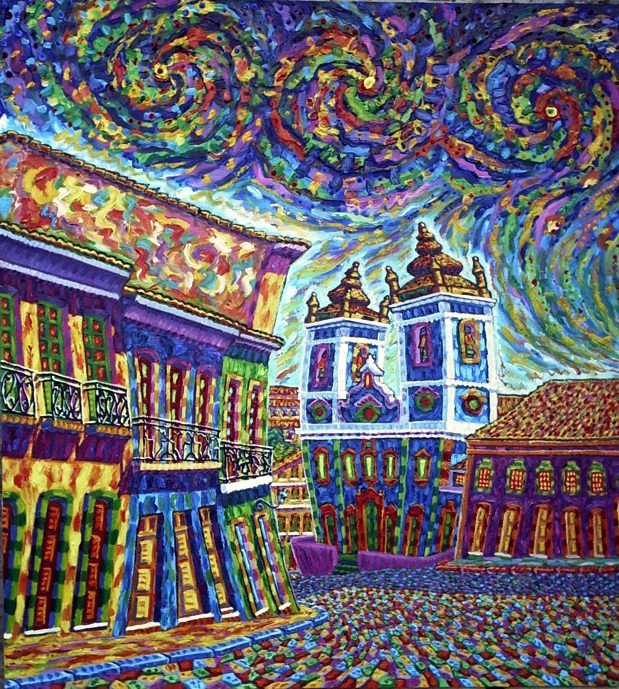
Title: Querétaro Otomi: Poder da Trinidad (English: The Power of Being a Trinity)

Spanish: Poder da Trinidad

Date: 02/06/07

Medium: oil on canvas

Dimensions: 100 × 90 cm (39.3 × 35.4 in)

What I love about this painting:

This is a wonderful exploration of form and color. The sky is powerful, the visual representation of the Triune God watching over the town and its people. I love the passion, the vibrancy of the town and the way Diego Mato Toledo brings life to this scene.

This painting tells the story of the spirit of the people of Central America, the mix of indigenous and Spanish religion that makes a culture that is so uniquely theirs.

It is an image that makes me happy.

About the Artist: Diego Gustavo Mato Toledo was born in 1978 in Montevideo, Uruguay. His work celebrates the life and culture of Uruguay and also that of Central America. You can visit his personal website at Ateliê Crea-Sion Artes Visuales. Also, you can find his art for sale at Artlista.com.


Credits and Attributions:

IMAGE: Poder da Trinidad by Diego Mato Diego. Uploaded to Wikimedia Commons 02-06-2007. Wikimedia Commons contributors. “File:116 – Poder da Trinidad – 100×90 cm.jpg,” Wikimedia Commons, https://commons.wikimedia.org/w/index.php?title=File:116_-_Poder_da_Trinidad_-_100x90_cm.jpg&oldid=764498925 (accessed August 7, 2024).

Comments Off on FineArtFriday: Poder da Trinidad by Diego Mato Toledo

Filed under #FineArtFriday

#FineArtFriday: African Violet Skies by Clark Thomas Carlton

African_Violet_Skies_by_Clark_Thomas_CarltonTITLE: African Violet Skies

BY: Clark Thomas Carlton

MEDIUM: Acrylics on canvas

DATE: ca. 2016

What I love about this painting:

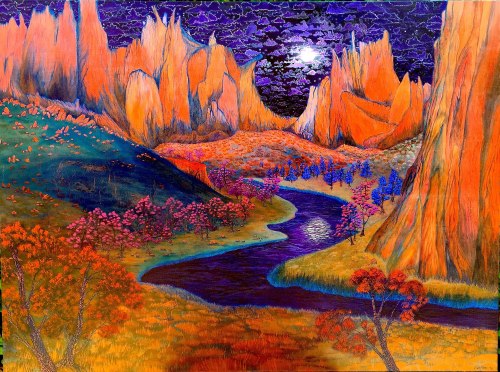
Today we’re dipping into 21st century fantasy landscape art. African Violet Skies by Clark Thomas Carlton is an explosion of color and form. The colors are so intense, I feel as if I could taste them.

I love how delicate the trees and foliage are as compared to the fierce thrust of the landscape. The mountains seem to burst through the earth at high speed, reaching for the incredible night sky, as if they would touch the moon.

This is true mastery of storytelling in an image as well as form and color. He gives us drama, and romance, and violence, and above it all, the moon softly gliding behind the delicate clouds, reflected on the serene stream below.

This painting is exactly what I need after four days of thick fog that refused to lift, followed by eternal rain.

About the Artist, via Wikipedia, the free encyclopedia

Clark Thomas Carlton is a novelist, playwright, and a screen and television writer living in Los Angeles. He has also worked as a producer of reality television. Carlton is best known for his science fiction/fantasy novel Prophets of the Ghost Ants published by HarperCollins Voyager in 2016.

Carlton is the author of Prophets of the Ghost Ants, Book 1 of the Antasy Series published by HarperCollins Voyage on December 13, 2016.  The indie version of the book was named a Best of 2011 by Kirkus Reviews.

In 1997, Carlton was awarded the Drama-Logue Critics Award for his play Self Help or the Tower of Psychobabble along with playwrights Neil Simon and Henry Ong. The play, a satire of the psychotherapy industry, was performed in Santa Monica, Palm Springs, Los Angeles and West Hollywood and directed by Michael Kearns and was also produced in Chicago.

Carlton is a painter who embraces the description of his work as “Grandma Moses on acid”. His work has been displayed through the Palm Springs Art Museum Annex through the Palm Springs Arts Council.

In December 1999, Carlton released an album of songs titled Salt Water through CD baby where he accompanied himself on acoustic guitar.  At present he is at work on Gardens of Babylon, a synth pop opera about the building of the Hanging Gardens of Babylon. The opera was written with his partner, Mike Dobson, an Emmy award winning music supervisor and composer on the daytime drama, the Young and the Restless. [1]


Credits and Attributions:

IMAGE: African Violet Skies by Clark Thomas Carlton. Wikimedia Commons contributors, “File:African Violet Skies by Clark Thomas Carlton.jpg,” Wikimedia Commons, https://commons.wikimedia.org/w/index.php?title=File:African_Violet_Skies_by_Clark_Thomas_Carlton.jpg&oldid=785979611 (accessed November 30, 2023).

[1] Wikipedia contributors, “Clark Thomas Carlton,” Wikipedia, The Free Encyclopedia, https://en.wikipedia.org/w/index.php?title=Clark_Thomas_Carlton&oldid=1171925222 (accessed November 30, 2023).

1 Comment

Filed under #FineArtFriday

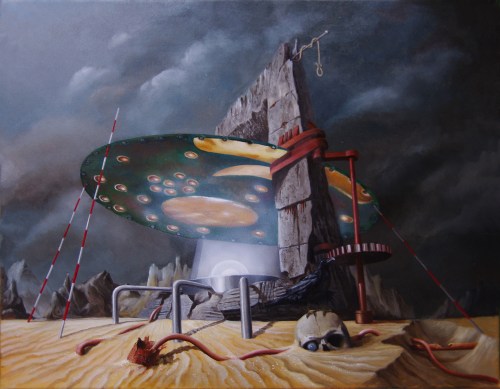
#FineArtFriday: What Remains? by Eberhard Marx 2016

Eberhard Marx

Title: (Deutsch) Was bleibt?

Title: (English) What remains?

Artist:  Eberhard Marx

Description: (Deutsch) surrealistisches Gemälde mit der Himmelsscheibe von Nebra

Description: (English) surrealist painting with the Nebra Sky Disc

Date:   19 May 2016

Today we are looking at Surrealism in art, as painted by a contemporary German artist, Eberhard Marx. This image comes from Wikimedia Commons, as does most of the work featured here.

When viewing surrealist art, the viewer can decide the intent of each element and how they are placed in the composition. The historical importance of the Nebra sky disc, the antiquity of the disc itself, and the craftsmanship that went into its making have always intrigued me, so this painting really caught my eye.

I visited the artist’s website and found where he offers us a way to view his works:

“Eberhard Marx wishes the viewer to take a walk in his paintings. The works are not botanical gardens with descriptions, but rather a bewitched park.” [1]

I have been enjoying doing just that!

About the Nebra sky disc, via Wikipedia:

The Nebra sky disc is a bronze disc of around 30 cm (12 in) diameter and a weight of 2.2 kg (4.9 lb), having a blue-green patina and inlaid with gold symbols. These symbols are interpreted generally as the Sun or full moon, a lunar crescent, and stars (including a cluster of seven stars interpreted as the Pleiades). Two golden arcs along the sides, interpreted to mark the angle between the solstices, were added later. A final addition was another arc at the bottom with internal parallel lines, which is usually interpreted as a solar boat with numerous oars, though some authors have also suggested that it may represent a rainbow, or the Aurora Borealis.
Nebra_disc_1The disc was found buried on the Mittelberg hill near Nebra in Germany. It is dated by archaeologists to c. 1800–1600 BCE and attributed to the Early Bronze Age Unetice culture.Various scientific analyses of the disc, the items found with the disc, and the find spot have confirmed the Early Bronze Age dating.

The Nebra sky disc features the oldest concrete depiction of astronomical phenomena known from anywhere in the world. In June 2013, it was included in the UNESCO Memory of the World Register and termed “one of the most important archaeological finds of the twentieth century.” [2]

About Surrealism in Art, via Wikipedia:

Surrealism is a cultural movement that developed in Europe in the aftermath of World War I in which artists depicted unnerving, illogical scenes and developed techniques to allow the unconscious mind to express itself. Its aim was, according to leader André Breton, to “resolve the previously contradictory conditions of dream and reality into an absolute reality, a super-reality”, or surreality. It produced works of painting, writing, theatre, filmmaking, photography, and other media.

Works of Surrealism feature the element of surprise, unexpected juxtapositions and non sequitur. However, many Surrealist artists and writers regard their work as an expression of the philosophical movement first and foremost (for instance, of the “pure psychic automatism” Breton speaks of in the first Surrealist Manifesto), with the works themselves being secondary, i.e., artifacts of surrealist experimentation. Leader Breton was explicit in his assertion that Surrealism was, above all, a revolutionary movement. At the time, the movement was associated with political causes such as communism and anarchism. It was influenced by the Dada movement of the 1910s.

The term “Surrealism” originated with Guillaume Apollinaire in 1917. However, the Surrealist movement was not officially established until after October 1924, when the Surrealist Manifesto published by French poet and critic André Breton succeeded in claiming the term for his group over a rival faction led by Yvan Goll, who had published his own surrealist manifesto two weeks prior. The most important center of the movement was Paris, France. From the 1920s onward, the movement spread around the globe, impacting the visual arts, literature, film, and music of many countries and languages, as well as political thought and practice, philosophy, and social theory. [3]

I highly recommend a visit to the artist’s website, HOME | EBERHARD MARX (eberhard-marx.eu). You will find many more of his amazing paintings, or you can purchase prints if something interests you.


Credits and Attributions:

Image: Was bleibt? ( English: what remains?). Wikimedia Commons contributors, “File:Was bleibt.jpg,” Wikimedia Commons, https://commons.wikimedia.org/w/index.php?title=File:Was_bleibt.jpg&oldid=528401859 (accessed April 27, 2023).

[1] Quote from Eberhard Marx website, HOME | EBERHARD MARX (eberhard-marx.eu) (accessed April 27, 2023)

2 Comments

Filed under #FineArtFriday

#FineArtFriday: Old Water Tank by Jaime Prosser

SONY DSC

Title: Old Water Tank

Medium: Oil Painting

Artist: Jaime Prosser

What I love about this painting:

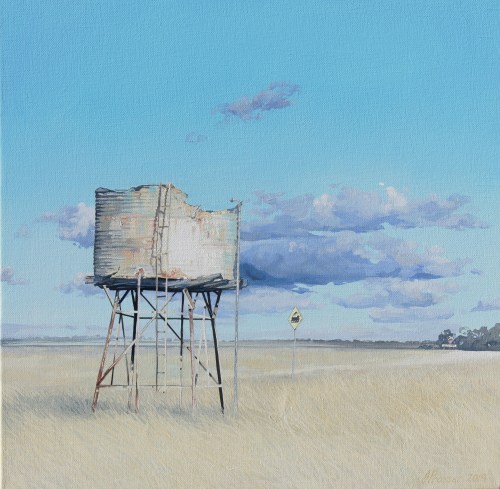
I love the stark realism, the derelict water tower rising from the sea of grass, silhouetted against the blue Australian sky. Prosser’s brush captures the wildness of the scene. There is a serenity to this scene, the sureness of mankind’s creation crumbling, slowly giving way to the inevitable. Nature always wins.

About the Artist:

Jaime Prosser is an Australian artist. Her work can be found at her website, https://jaimeprosserart.com.


Credits and Attributions:

Wikimedia Commons contributors, “File:’OLD WATERTANK’ OIL PAINTING BY JAIME PROSSER.jpg,” Wikimedia Commons, the free media repository, https://commons.wikimedia.org/w/index.php?title=File:%27OLD_WATERTANK%27_OIL_PAINTING_BY_JAIME_PROSSER.jpg&oldid=535927333 (accessed September 9, 2022).

3 Comments

Filed under writing

#FineArtFriday: Tokyo by Carl Randall 2011

Carl-randall-tokyo-painting-cityscapeArtist: Carl Randall (1975 – )

Title: Tokyo

Date: 2011

Medium: oil on canvas

Dimensions: Height: 150 cm (59 in); Width: 65 cm (25.5 in)

What I love about this image:

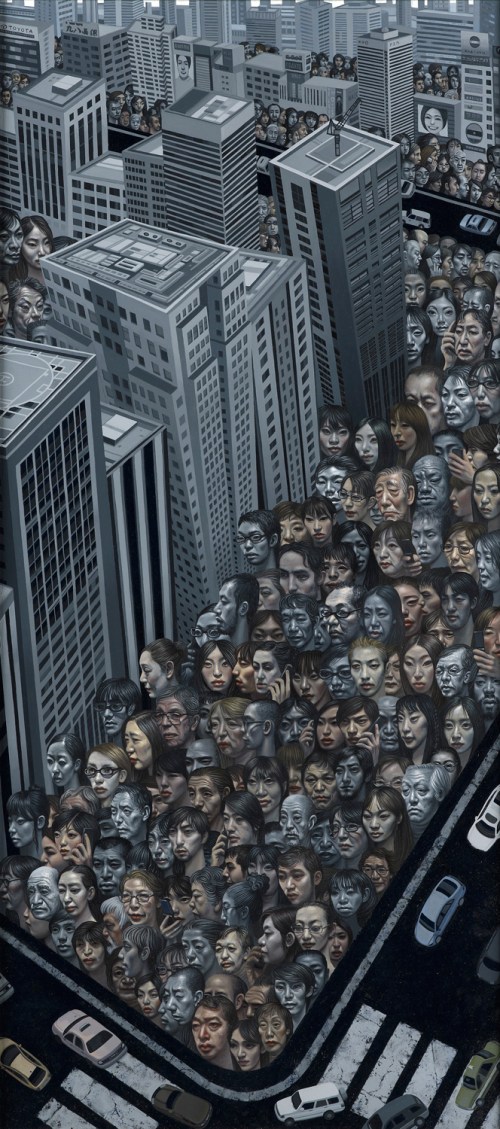
This image shows us the artist’s view of modern 21st Century society before the Covid-19 pandemic, painted predominantly in shades of gray. Technology is the all-knowing, ever-watchful god in this world.

Buildings, filled to capacity, loom over streets jammed with people, most talking into devices. Everyone goes forward, each individual focused on their own goal, unaware of the seething ocean of humanity around them, carried along on the currents and the tide.

About the artist (via Wikipedia):

Carl Randall was born in 1975, in the UK. He is a graduate of The Slade School of Fine Art London (BA Fine Art), the Royal Drawing School London (The Drawing Year), and Tokyo University of the Arts Japan (MFA & PhD Fine Art).

He was awarded The BP Travel Award 2012, for his proposal to walk in the footsteps of the Japanese ukiyo-e printmaker Andō Hiroshige, creating paintings of the people and places of contemporary Japan.  His project involved spending time in Japan resulting in a group of 15 paintings exhibited at the National Portrait Gallery in London as part of The 2013 BP Portrait Award exhibition, under the title “In the Footsteps of Hiroshige – The Tokaido Highway and Portraits of Modern Japan”. The exhibition subsequently toured to The Aberdeen Art Gallery Scotland, The Wolverhampton Art Gallery England, and then formed his solo exhibition in Japan ‘Portraits from Edo to the Present at The Shizuoka City Tokaido Hiroshige Museum, where the paintings were exhibited alongside Hiroshige’s original The Fifty-three Stations of the Tōkaidō woodblock prints. In conjunction with these exhibitions, the book Carl Randall – Japan Portraits was published, illustrating paintings and drawings made in Japan, with a foreword by British author Desmond Morris, and an introduction by the late American writer Donald Richie. A short documentary, Carl Randall – Japan Portraits was also made, showing the artist painting and drawing in Japan His Japan paintings were also the subject of a 2016 ‘World Update’ interview by the BBC World Service (titled ‘Painting the faces in Japan’s crowded cities’), and he was also interviewed by CNN about his Japanese work. [1]

To learn more about Carl Randall and his art, go to Carl Randall – Artist. Contemporary Figurative Painter.


Credits and Attributions:

[1] Wikipedia contributors, “Carl Randall,” Wikipedia, The Free Encyclopedia, https://en.wikipedia.org/w/index.php?title=Carl_Randall&oldid=1018005949 (accessed May 27, 2021).

Wikimedia Commons contributors, “File:Carl-randall-tokyo-painting-cityscape.jpg,” Wikimedia Commons, the free media repository, https://commons.wikimedia.org/w/index.php?title=File:Carl-randall-tokyo-painting-cityscape.jpg&oldid=504966563 (accessed May 27, 2021). This file is licensed under the Creative Commons Attribution-Share Alike 4.0 International lice

Comments Off on #FineArtFriday: Tokyo by Carl Randall 2011

Filed under #FineArtFriday

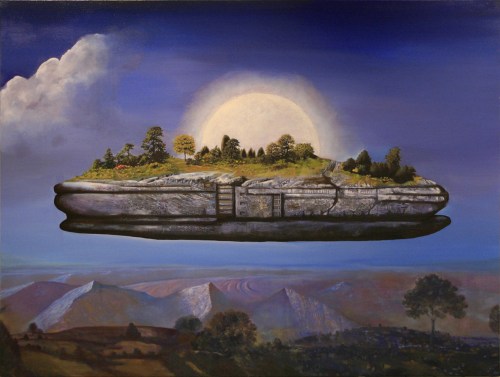
#FineArtFriday: Utopien 04 by Makis E. Warlamis 2007

Artist: Makis E. Warlamis

Title: Utopien 04

Medium: painting

Collection: Kunstmuseum Waldviertel

Source/Photographer: Own work, Daskunstmuseum, 2007-01-05

About the word “Utopia,” via Wikipedia:

The word utopia was coined from Ancient Greek by Sir Thomas More in 1516. “Utopia” comes from Greek: οὐ (“not”) and τόπος (“place”) which translates as “no-place” and literally means any non-existent society, when ‘described in considerable detail’. However, in standard usage, the word’s meaning has shifted and now usually describes a non-existent society that is intended to be viewed as considerably better than contemporary society.

In his original work, More carefully pointed out the similarity of utopia to eutopia, which is from Greek: εὖ (“good” or “well”) and τόπος (“place”), hence eutopia means “good place”, which ostensibly would be the more appropriate term for the concept the word “utopia” has in modern English. The pronunciations of eutopia and utopia in English are identical, which may have given rise to the change in meaning.

What I love about this painting:

This Utopia is unreachable, as all true Utopias are. It floats high above the mundane world, visible but just out of reach. The colors are intense, vibrantly moody. The landscape above which this perfect island floats is serene, a beautiful place.

Every idea of perfection is different. Warlamis’ Utopia is not the golden city many storytellers and writers of speculative fiction might imagine, but is instead an island of undisturbed landscape, looking almost like the untrammeled headland one might find beside the sea.

His Utopia is a step back to nature, to a simpler time.

In truth, it isn’t too different from the land over which it flies. And, if that is the case, why strive to reach it?

What story lurks within this painting? What a great visual prompt to jumpstart Nation Novel Writing Month.

About the Author via Wikipedia DE:

Efthymios “Makis” Warlamis (also: Efthymis, Efthymios Varlamis; born 1942 in Veria, in Central Macedonia, Greece; died 27 December 2016) was a Greek-Austrian architect, painter, poet, writer, educator and museum founder.

Warlamis was a versatile artist. In addition to his basic profession as an architect, he worked as a sculptor, painter, designer and writer. He had exhibitions in museums and exhibition centres in Europe, USA, Asia and Egypt. His works are represented in international public and private collections such as the Graphic Collection of the Albertina Vienna, Museum moderner Kunst Wien, DAM Deutsches Architekturmuseum Frankfurt, Collection Alexander Jolas, Collection of the State of Austria, Collection Liaunig.

In 1992, together with his wife Heide, he founded the International Center for Art and Design I.DE. A. in Schrems. He planned and built the Kunstmuseum Waldviertel, which opened in Schrems in 2009.


Credits and Attributions:

Wikimedia Commons contributors, “File:2010 Utopien arche04.jpg,” Wikimedia Commons, the free media repository, https://commons.wikimedia.org/w/index.php?title=File:2010_Utopien_arche04.jpg&oldid=501416249 (accessed October 30, 2020).

Wikipedia contributors, “Utopia,” Wikipedia, The Free Encyclopedia, https://en.wikipedia.org/w/index.php?title=Utopia&oldid=986041921 (accessed October 30, 2020).

Wikipedia DE Contributors, Efthymios Warlamis, Wikipedia the Free Encyclopedia, https://de.wikipedia.org/wiki/Efthymios_Warlamis (accessed October 30, 2020).

2 Comments

Filed under #FineArtFriday

#FineArtFriday: The Great Plague 1665 by Rita Greer 2009

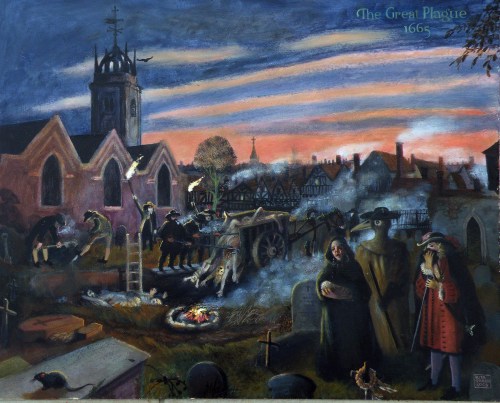
Title: The Great Plague 1665, by Rita Greer 2009

Description (via Wikimedia Commons): Like many who could afford to, Robert Hooke left London for six months during the worst of the bubonic plague. All cats and dogs were destroyed as a preventive measure. This allowed rats to flourish and spread the disease which was carried by their fleas. The image shows a scene of horror. After sunset carts were driven through the streets to collect the dead. They were taken to the nearest graveyard to be buried in plague pits. Fires burned to make smoke. Pipes of tobacco were smoked, posies of herbs worn, and faces covered with masks. This was thought to be protection against contagion. London was overwhelmed with fear, terror and grief. It is thought that as many as 100,000 perished in London alone.

Date: 2009

Source/Photographer: The original is an oil painting on board by Rita Greer, history painter, 2009. This was digitized by Rita and sent via email to the Department of Engineering Science, Oxford University, where it was subsequently uploaded to Wikimedia.

What I love about this painting:

Rita Greer paints history as if she lived it, with meticulous detail. In this street scene, she manages to capture the despair and hopelessness that pervaded London with the advent of the plague. This scene is dark, and filled with emotion. Death walks the smoke-hazed streets, feeding on tragedy. Grief and fear are the driving forces, and no one’s family is spared.

This year, 2020, feels like an apocalypse year, in many ways. It helps to keep in mind that for London and all the great cities of Europe, 1665 was worse.

About the artist:

Rita Greer is a history artist, goldsmith, graphic designer, food scientist and author/writer. On retirement in 2003 Rita began the Robert Hooke project, “to put him back into history.” Much her work is available to be viewed at Wikimedia Commons, Category: Paintings by Rita Greer.


Credits and Attributions:

Wikimedia Commons contributors, “File:20 The Great Plague.JPG,” Wikimedia Commons, the free media repository, https://commons.wikimedia.org/w/index.php?title=File:20_The_Great_Plague.JPG&oldid=450173019 (accessed September 24, 2020).

Comments Off on #FineArtFriday: The Great Plague 1665 by Rita Greer 2009

Filed under #FineArtFriday