Tag Archives: Aaron Volner

My favorite audiobook, “A Christmas Carol,” narrated by @AaronVolner

It’s that time of year when I seek out and enjoy every version of my favorite Christmas story of all time, A Christmas Carol, by Charles Dickens.

The best version is the original. My dear friend (and one of my favorite indie authors) Aaron Volner is an amazing narrator. In 2023, he posted his reading of the original manuscript of A Christmas Carol on YouTube. It is read exactly as written by Charles Dickens and is a wonderful rendition.
My Sister's Ornament, cjjaspAaron’s interpretation of this classic is spot on. He has gotten all the voices just right, from kindly Fred down to Tiny Tim.

I think this is by far my favorite version of A Christmas Carol as it is the original manuscript and I listen to it every year. I confess now: the rest of this post is basically a rehashing of my post from 2024, as I still love this narration more than any other. 

A small warning: the original version, as it fell out of Dicken’s pen and onto the paper, is far scarier than most modern versions, and Volner’s interpretation expresses that eeriness perfectly.

Scrooge’s horror is visceral, and his redemption is profound.

Charles Dickens would have greatly approved of this reading. I give Volner’s performance five stars, which is something I rarely do. You can find this wonderful reading via this link: “A Christmas Carol” by Charles Dickens – YouTube.

It is divided into staves (chapters) so that you can listen to one a day or binge them the way I do.

Aaron’s narration of this wonderful story prompts me to revisit (again) a post on what modern writers can learn from Dickens, one posted several years ago.

Each time I read this tale or listen to Aaron’s narration, I learn something new about story and structure. The opening act of this tale hooks the reader and keeps them hooked. It is a masterclass in how to structure a story.

Let’s have a look at the first lines of this tale:
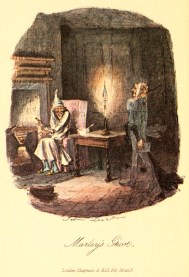
Christmascarol1843_--_040“Marley was dead, to begin with. There is no doubt whatever about that. The register of his burial was signed by the clergyman, the clerk, the undertaker, and the chief mourner. Scrooge signed it. And Scrooge’s name was good upon ‘Change for anything he chose to put his hand to. Old Marley was as dead as a doornail.”

In that first paragraph, Dickens offers us the bait. He sinks the hook and reels in the fish (the reader) by foreshadowing the story’s first plot point–the visitation by Marley’s ghost. We want to know why Marley’s unquestionable state of decay was so crucial that the conversation between us, the readers, and Dickens, the author, was launched with that topic.

Dickens doesn’t talk down to his readers. He uses the common phrasing of his time as if he were speaking to us over tea — “dead as a doornail,” a phrase that is repeated for emphasis. This places him on our level, a friend we feel comfortable gossiping with.

He returns to the thread of Marley several pages later, with the little scene involving the doorknocker. This is where Scrooge sees the face of his late business partner superimposed over the knocker and believes he is hallucinating. This is more foreshadowing, more bait to keep us reading.

At this point, we’ve followed Scrooge through several scenes, each introducing the subplots. We have met the man who, as yet, is named only as ‘the clerk’ in the original manuscript but whom we will later know to be Bob Cratchit. We’ve also met Scrooge’s nephew, Fred, who is a pleasant, likeable man.

These subplots are critical, as Scrooge’s redemption revolves around the ultimate resolution of those two separate mini stories. He must witness the joy and love in Cratchit’s family, who are suffering but happy despite living in grinding poverty (for which Scrooge bears a responsibility).

We see that his nephew, Fred, though orphaned, has his own business to run and is well off in his own right. Fred craves a relationship with his uncle and doesn’t care what he might gain from it financially.

By the end of the first act, all the characters are in place, and the setting is solidly in the reader’s mind. We’ve seen the city, cold and dark, with danger lurking in the shadows. We’ve observed how Scrooge interacts with everyone around him, strangers and acquaintances alike.

Now we come to the first plot point in Dickens’ story arc: Marley’s visitation. This moment in a story is also called “the inciting incident,” as this is the point of no return. Here is where the set-up ends, and the story takes off.

Dickens understood how to keep a reader enthralled. No words are wasted. Every scene is important, every scene leads to the ultimate redemption of the protagonist, Ebenezer Scrooge.

This is a short tale, a novella rather than a novel. But it is a profoundly moving allegory, a parable of redemption that remains pertinent in modern society.

In this tale, Dickens asks you to recognize the plight of those whom the Industrial Revolution has displaced and driven into poverty and the obligation of society to provide for them humanely.

This is a concept our society continues to struggle with and perhaps will for a long time to come. Cities everywhere struggle with the problem of homelessness and a lack of empathy for those unable to afford decent housing. Everyone is aware of this problem, but we can’t come to an agreement for resolving it.

A Christmas Carol remains relevant even in today’s hyper-connected world. It resonates with us because of that deep, underlying call for compassion that resounds through the centuries and is, unfortunately, timeless.
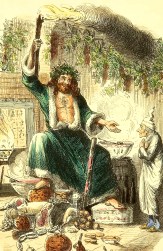
Ghost_of_Christmas_Present_John_Leech_1843As I mentioned before, this book is only a novella. It was comprised of 66 handwritten pages. Some people think they aren’t “a real author” if they don’t write a 900-page doorstop, but Dickens proves them wrong.

One doesn’t have to write a novel to be an author. Whether you write blog posts, poems, short stories, novellas, or 700-page epic fantasies, you are an author. Diarists are authors. Playwrights are authors. Authors write—the act of creative writing makes one an author.

And now, about the featured images. The two illustrations are by John Leech from the first edition of the novella published in book form in 1843.  We’re fortunate that the original art of John Leech, which Dickens himself chose to include in the book, has been uploaded to Wikimedia Commons. Thanks to the good people at Wikimedia, these prints are available for us all to enjoy.

From Wikipedia: John Leech (August 29, 1817 – October 29, 1864, in London) was a British caricaturist and illustrator. He is best known for his work for Punch, a humorous magazine for a broad middle-class audience, combining verbal and graphic political satire with light social comedy. Leech catered to contemporary prejudices, such as anti-Americanism and antisemitism, and supported acceptable social reforms. Leech’s critical yet humorous cartoons on the Crimean War help shape public attitudes toward heroism, warfare, and Britain’s role in the world. [1]

I love stories of redemption–and A Christmas Carol by Charles Dickens remains one of the most beloved tales of redemption in the Western canon. Written in 1843 as a serialized novella, A Christmas Carol has inspired a landslide of adaptations in both movies and books.

Dickens was an indie, as all writers were at that time. His essays and many short stories were published in several well-known magazines, but that paid little. He still worked hard to support his family with his writing, touring constantly to sell his work.

But we remember him and his works today. His great talent for storytelling gives us permission to write what we are inspired to.

And that brings me back to Aaron Volner. If you need a narrator, Aaron is amazing, and you can contact him at  https://aaronvolner.com/contact/. And if you’re interested in creative, well-written fantasy, his book page is https://aaronvolner.com/books/. I highly recommend his books!

May the holiday season and New Year find you and your loved ones happy and healthy, and may you have many opportunities to tell your stories.


CREDITS AND ATTRIBUTIONS:

[1] Wikipedia contributors, “John Leech (caricaturist),” Wikipedia, The Free Encyclopedia, https://en.wikipedia.org/w/index.php?title=John_Leech_(caricaturist)&oldid=871947694 (accessed December 20, 2025).

Wikimedia Commons contributors, “File:Christmascarol1843 — 040.jpg,” Wikimedia Commons, the free media repository, https://commons.wikimedia.org/w/index.php?title=File:Christmascarol1843_–_040.jpg&oldid=329166198 (accessed December 20, 2025)

A colourised edit of an engraving of Charles Dickens’ “Ghost of Christmas Present” character, by John Leech in 1843. Wikimedia Commons contributors, “File:Ghost of Christmas Present John Leech 1843.jpg,” Wikimedia Commons, the free media repository, https://commons.wikimedia.org/w/index.php?title=File:Ghost_of_Christmas_Present_John_Leech_1843.jpg&oldid=329172654 (accessed December 20, 2025).
3 Comments

Filed under writing

#Interview: @Aaron_Volner Gets Wild in Deadwood #writerlife

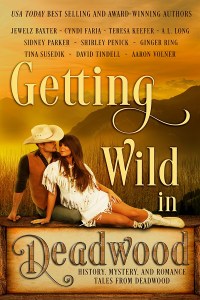
Today I am talking with fantasy author, Aaron Volner. Aaron has a story in the anthology, “Getting Wild in Deadwood,” and has kindly agreed to talk about the evolution of one of his most daring protagonists yet, Adalyne Huntsman. I was privileged to be an advance reader for Aaron, and loved his story, “For the Love of Gold.”


CJJ: Tell us about the theme of this anthology, and how you got involved.

AV: “Getting Wild in Deadwood” is all about the history, mystery and romance that surrounds the town of Deadwood, South Dakota. Every story ties in either to the town’s storied past or it’s exciting modern life. Each features a romance sure to sweep readers up and take them on an emotional ride.

There’s an interesting selection of authors here, so the book has a lot of variety. While my own contribution is a historical fantasy starring a bounty hunter, there are tales about wild west outlaws, a reincarnation romance, even a time travel story in there.

This project was put together by the wonderful folks in charge of Wild Deadwood Reads, a huge book event that takes place annually in Deadwood, South Dakota (this year’s event is Saturday, June 20th). I agreed to contribute a story when they put out a call for interested authors.

I’d like to make special mention of Cyndi Faria, the author who spearheaded this project. She really went out of her way to make this a good experience for the rest of us who contributed, and I really appreciate everything that she did to help this anthology become a reality.

CJJ: Let’s talk about your protagonist, Adalyne, in “For the Love of Gold.” I love her! How did she come to life?

AV: Adalyne Huntsman,  a strong-willed bounty hunter with an unfortunate darkness in her past, took a strange path to come to where she is as a character. For one thing, in my original conception of the story the protagonist was actually male.

The idea for this tale came to me one night while I was shooting pool with my dad. Many of my best ideas come to me in pool games with him. Alas, my game hasn’t improved from it nearly as much as my writing has. Anyway, I was discussing the anthology with him and the requirement that the story be set in or around the town of Deadwood, when he shared with me his own story that took place there.

Our family lived in North Dakota for a year due to my dad’s work in the oilfield service business, which often took him across the border into South Dakota. To make a long story short, he went on an unusual call to a mine near Deadwood where a fault line had opened up in a lower level and was spilling hot water like a faucet. The water wasn’t as much of a problem as the heat, which was making it dangerous for the miners to work. So the mine owners reached out to dad’s company about the possibility of using their equipment to seal the crack and get the mine functioning again.

My imagination took that idea and ran with it, wondering what otherworldly things could spill from a crack in a mine. Such a thing might try to use the miners to protect itself. Perhaps the danger of it was how it enthralled people who came within, including the hero’s lady love.

Something about the idea didn’t sit right, and I soon realized that the story held a lot more interest for me with a female protagonist. The next thing I needed to figure out was who she was. I knew I wanted her to be tough, and self-reliant, but the challenge was determining in what way.

As I read a bit on the history of Deadwood I came across some information about the Gem Theater, a brothel run by the notorious Al Swearengen. One of his secrets to success in his industry was a tendency to beat or blackmail women into working for him. I asked myself what would happen if he tried that with my heroine, and a scene popped into my head: one of Swearengen’s goons trying to ‘persuade’ her to work at the Gem, and her turning the tables on him with some impressive gun play and a witty remark that would sting his pride.

Adalyne Huntsman evolved from that scene as a bounty hunter with complicated reasons for pursuing her chosen path. She’s a tough-as-nails woman who enjoys showing up men who underestimate her.

This presented a problem, though. The story had to include a romance, and I wasn’t sure what type of man would earn Adalyne’s respect enough to win her heart. I needed to seek the advice a real-life bad-ass gun-toting lady to learn how my bad-ass gun-toting heroine would fall for someone.

For that I reached out to my friend Helen M. Pugsley, very much a real-life bad-ass gun-toting lady and author of “War and Chess.” After a lengthy conversation with her about Adalyne’s development up to that point and her relationship with some of the other characters who appear in the story, Helen had some excellent advice.

She suggested that the way for a man to win Adalyne’s affection would be if he could make her feel safe. Not physically safe, as Adalyne has that covered herself. But emotionally safe. Someone that she can let down her constant guard around and be her true self. Someone she can share things with and feel entirely confident that it will stay between them, and who will still accept her.

Armed with that advice, I built out a secret for Adalyne that she would only share with just such a person, and began constructing her love interest, David. A man who has seen some of the worst sides of humanity, yet still retains his sense of wonder and fascination about the world.

I really hope that readers will like Adalyne, as a lot of work went into making her a real and relatable heroine. I have to say, she’s fast become one of my favorite protagonists that I’ve written.

CJJ: How can we buy this book?

AV: Orders for “Getting Wild in Deadwood” can be placed via the online form here. You’ll need an email and a PayPal account to place the order.

The books are being hand-shipped so as to include an awesome extra goody. With every order you receive a full-color insert featuring the cover art and signatures of all ten contributing authors!

This anthology is a print exclusive and only available for a limited time, so be sure to order while you can.

CJJ: I loved The Roc Rider. I understand you have a sequel in the works. Can you tell us about it?

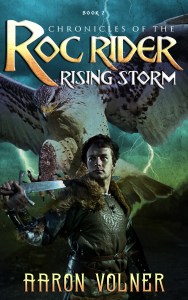
AV: Yes, the sequel to Roc Rider is finally coming! “Chronicles of the Roc Rider:  Rising Storm” picks up several months after where the first book leaves off. Tanin Stormrush, the titular roc rider, has been working with new allies to try and unlock secrets from the memories he acquired from his enemy at the end of the first book.

We quickly learn that the stakes are higher than Tanin realized. His enemy has a plan that could remake the very fabric of reality itself.

Tanin’s promise to his late wife that he would rescue the roc hatched from the egg that was stolen from her proves more difficult than he anticipated. It turns out the enemy has taken to riding the creature, and it may not be in the mood to be rescued!

I’m really excited about how Tanin and his roc Zera grow in this book. Yes, we get to see them take their first flight together which is super exciting! I’m also really jazzed for people to meet some of the other characters that are introduced.

Lana, a woman from Tanin’s past and who was his fellow apprentice during roc rider training, brings an interesting dynamic to this story.

We also get to meet two of the mysterious Narn. Mentioned briefly in the first book, the Narn were invaders from beyond the great northern desert whom Tanin spent nearly a decade fighting with his original roc partner. Now, to save the stolen roc and fulfill his promise to his wife, Tanin might just have to look past his own hatreds and work alongside one of them.

The ebook releases on May 9th, with the paperback coming hopefully the same day or not long after. I’ll be hosting an online launch party via Facebook Live at 6 pm that evening to celebrate the launch.

CCJ: Where can people buy your other books?

AV: You can find all of my titles for purchase via my author page on Amazon. I also recommend that readers sign-up for my newsletter for regular updates about future titles, first reveal on new covers, and more.

Thanks so much for taking the time to talk with me about all this, Connie. I really appreciate it.

CJJ: Thank YOU, Aaron, both for visiting today and for talking about Adalyne Huntsman, who is one of the strongest women I’ve ever met. And I can wait to read “Chronicles of the Roc Rider: Rising Storm.


About my guest today:

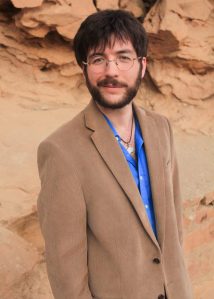
Aaron Volner is a guy who gets lost in worlds of his own creation and has to write books in order to escape. He lives in southwest Wyoming with his faithful dog, Andy, and a house full of plants from all over the globe.

Orders for “Getting Wild in Deadwood” can be placed via the online form here.

Purchase Chronicles of the Roc Rider 

Visit Aaron’s website at www.aaronvolner.com

2 Comments

Filed under writing

The author’s blog #amwriting

Today I want to encourage authors to make use of their websites, by blogging occasionally.

For an author, the goal of a website is not to gain “fans” – it is to gain readers. Your website is a resource that offers readers a place to meet you and see what you are interested in. It is also your storefront, a place where readers can find and buy your books.

Writing three times a week for this blog has helped me grow more confident as a writer. I can write using the “stream of consciousness” method, or I can write it several days in advance. Usually, I put together a quick outline and do the research on whatever aspect of writing has been on my mind, and soon I have written 700 or more words.

I have made many friends through blogging, people all over the world whom I may never meet in person, but who I am fond of, nevertheless. Readers love to talk about what they are reading, and authors want to talk about what they’re writing. Both subjects are obsessions for me.

And I can’t tell you how much I enjoy discussing my little passion for 16th and 17th century Netherlandish art. When I write about a particular artist or picture, I find some new bit of creativity to admire, things that make me almost feel the artist is someone I might know.

I think the best bloggers are those who are passionate about something and who have the courage to write about it. Here are only some blogs I follow:

Lee French – Finding Family in Strange Places

Sue Vincent’s Daily Echo

Aaron Volner

Stephen Swartz’s Deconstruction of the Sekuatean Empire

Chris the Story Reading Ape’s Blog

These are the just the blogs I can think of off the top of my head – in reality I follow many, many more. In fact, if you are already a regular blogger, I am probably following you and reading your posts!

Real life can be a rolling disaster, as everyone knows. This is why I occasionally write about the difficulties of traveling and how hard it is for a vegan to find food on a long road trip. At times, I write about the challenges of having two adult children with epilepsy.

I’ve sometimes written about the dysfunctionality of growing up with a father suffering from battle-related PTSD.

I have also talked about growing up in a family of word-nerds, and the shock of discovering we weren’t “normal.”

Whatever I am thinking about, I post a short piece on it.

If I can do it, so can you.

If you are an author, having a blog on your website and updating it at least twice a month is a good way to connect with your readers on a human level. Readers will enjoy hearing what your writing goals are.  They want to know where you will be signing books, or if you will be at a convention near them. Also, they love to know what you are reading.

I do recommend publishing short pieces occasionally. Bits of flash fiction are fun to write and readers enjoy them. These pieces can find their way into your larger work, as they are a great way to brainstorm ideas.

At the bottom of each flash-fiction piece, I post a disclaimer that it is copyrighted:

  • Bleakbourne on Heath, by Connie J. Jasperson, © 2016 All Rights Reserved

I suppose I am a compulsive blogger. I sometimes think about slowing down, but then I suddenly have an idea that I need to write about. In no time flat, I will have written 500 words. In fact, this post is around 600- 700 words long.

Not a bad length and not too long to write.


Image Credits:

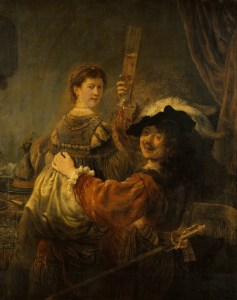
Wikimedia Commons contributors, “File:Rembrandt – Rembrandt and Saskia in the Scene of the Prodigal Son – Google Art Project.jpg,” Wikimedia Commons, the free media repository, https://commons.wikimedia.org/w/index.php?title=File:Rembrandt_-_Rembrandt_and_Saskia_in_the_Scene_of_the_Prodigal_Son_-_Google_Art_Project.jpg&oldid=340120613 (accessed April 17, 2019).

7 Comments

Filed under writing

#amwriting: #Interview with @Aaron_Volner, author

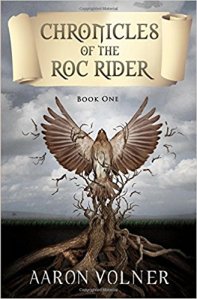
Today I am interviewing my good friend, indie author, Aaron Volner. A screenwriter, game designer, and playwright, Aaron is launching his first published novel, which I must say is an awesome debut. Chronicles of the Roc Rider has all the hallmarks of a great fantasy adventure, with the flavor of the wild west.

CJJ: Tell us a little of early life and how you began writing: What books influenced you most as young reader?

AV: Hi Connie! Thanks so much for taking the time to talk with me, I really appreciate it.

I was influenced by a wide range of titles as a youngster. My parents made sure I read widely, everything from “Hank the Cowdog” to “20,000 Leagues Under the Sea.” I would have to say one of the books that has had the largest lasting impact was “Watership Down” by Richard Adams. For a novel about rabbits, you can learn so much of human relationships from it, and it’s one of the few books I’ve reread multiple times. The “Animorphs” series by K.A. Applegate rings in right up there with it. However the books that really inspired me to start writing my own fantasy were “The Wheel of Time” series by Robert Jordan. My lifelong passion for fantasy began there.

Early life was spent buried in books and playing make believe a lot longer than most kids do, with a healthy dose of video games on the side. There were a number of factors that first influenced me to start writing, but one of the strongest was the example of my sister, Heather. She wrote what I remember as truly wonderful poetry when she was in Junior High/High School, even having some of it published. Much of it was serious, inspired by our pet rabbits and grandparents, and some of it was funny for the sake of it. Through her I learned how much fun playing with words and the language could be.

CJJ: How did these books influence your early writing?

AV:  The first novel I ever started writing (in about 5th or 6th grade) was a blatant Star Wars ripoff with my friends and I under different names as the swashbuckling crew of a rebel starship, one of whom could change into different space animals because of how obsessed I was with the “Animorphs” books.

My first completed novel was inspired by “The Eye of the World,” but I wanted to take a different spin on things. I chose to deliberately explore fantasy without “The Dark Lord,” but a regular, albeit unusually powerful, person with terrible ambitions as the antagonist. At the time, I thought this was a really new and novel idea, hahaha. I also have a scene in that book inspired by “Watership Down,” where one of the main heroes discovers he can communicate with animals to a degree. He strikes a bargain with a local rabbit warren to have his compatriot with plant-based magic provide them a great feast in a safe spot in exchange for sending a rabbit sentry forward to scout out information they need.

CJJ: What inspired you to write Roc Rider?

AV:  I’ve always had something of a fascination with falconry and birds of prey. I suppose, given my penchant for fantasy, it naturally followed that I fell in love with the idea of rocs, the elephant hunting birds of middle eastern legend, as well. I realized a few years back that there weren’t as many rocs in fantasy as I would like, and decided to do something about that. I started thinking about how humans and rocs would interact, where a roc would realistically fit in the food chain, how a human who rode rocs would be perceived by others. The characters and the story naturally flowed from those musings.

CJJ:  Tell us about your main character, Tanin Stormrush. Who is he as a person, and what is he capable of?

AV:  When we first meet him Tanin has suffered a terrible loss. His wife and his original roc partner have both passed away, leaving him to raise his new roc partner, Zera, alone. His first roc partner died laying her final clutch of eggs. His wife died protecting one of them from the man who murdered her. Tanin is on a quest to find the man who killed his wife and discover what happened to the other egg from the clutch, at her final request. So in Tanin we see a man who is undergoing several stages of grief at once, while trying to raise an animal partner with care and compassion at the same time. In a way his quest is a form of bargaining, in that he hopes to make everything right in his world if he can just find the egg. But in some ways, it’s also a form of denial.

Tanin comes from a proud tradition of warriors on the wing, but one that has been declining for many, many years. Tanin’s early life after learning the ways of the roc rider was spent flying campaigns with various armies to protect against invasion by the Narn, a mysterious religion that rules the lands beyond the desert to the north. It was there he developed his own code of honor, based on Roc Rider values but combined with his own worldview. Tanin doesn’t speak of this directly in the book, but we do see hints at it throughout. There are moments when Tanin is more than capable of muscling his way through a situation to get what he wants, but chooses a different path even if it costs him. I intend to explore this a bit more in the second book, with Tanin’s code being challenged more openly in situations where he must decide if it’s worth the pay off to break with it.

CJJ: Do you have a specific ‘Creative Process’ that you follow, such as outlining or do you ‘wing it’?

AV:  So far, my process changes quite a bit from book to book. I do wing it in a lot of respects, however I’ve always had a tendency to plan ahead at least somewhat. My first fantasy book began with me writing out the rules for the magic system and then diving in and discovering the character and story through a few chapters. Throughout that book I would periodically stop writing altogether to try and get my thoughts together in my head for where the story was going. I never wrote them down, just got a plan in my mind and then pressed forward a week or so later once I liked what I was thinking.

My second book, on advice from a writers conference, I wrote an outline before I started writing. That didn’t go so well. The book turned out good after major rewrites, but I discovered that written outlines and I have some issues and just don’t work well together.

With Roc Rider, I had a notebook and spent a few weeks riffing ideas in it. A lot of world building, character, and potential plot stuff. Whenever I faced a question I would write that question down and then riff possible answers. Obviously, the majority of what’s in that notebook never made it into the final product but it served as an invaluable resource when crafting the first draft of the story.

For the second Roc Rider novel, I’m going to do the same thing with one added step. Last year I took part in the 3-Day Novel Contest while Roc Rider was out with my beta readers. Since preparation is allowed for that contest, I tested out writing a story treatment for that book and loved what it added to the process.

A story treatment was something I had just recently learned about. A technique used mostly by screenwriters, it involves writing out the story in prose but in a succinct, descriptive fashion. I don’t have the space in this interview to explain it well, but I think of it as sort of a hybrid between writing an outline and simply diving into the first draft. You can dive into a story treatment like a ‘pantser’, but the treatment lets you see story problems and fix them before you start writing the first draft itself. Best of both worlds, in a way.

Anyway, after my notebook riffing I intend to do a story treatment for the second Roc Rider book as well. I believe it will help me get the book out more quickly and be better for the storytelling in the end.

CJJ: I love that. A story treatment is my way of getting a story off the launch pad too. But now, this is the question I hate to be asked, but here I am asking you: how does your work differ from others of its genre?

AV: This is a doozy of a question, isn’t it? But I’ll try.

I think my work is a little different in how it develops themes. A lot of fantasy is either aimed at a specific theme and the stories, characters, even sometimes the magic system is built around that theme. Other fantasy tries to be purely escapist and not speak to any specific theme at all.

I’ve always been dedicated to what I call organic theme development. This is a process that happens both in the writing and the reading of a work. I have certain ideas I want to explore. Not full themes, really, just human ideas. I attach them to elements I want to include in a story for escapist reasons and allow those ideas to develop as they will in the telling of the story. The result is generally a tale that can be interpreted any number of ways. The ideas get layered throughout the story in the writing, allowing themes to develop in the reader’s mind as they experience it.

Some read my first novel and see a story about the resilience of the human spirit. Others read the same book and see a cautionary tale about trusting your instincts and challenging authority.

Probably the best example, though, was my stage play “Behind Stone Masks”. That play follows a German soldier during WWII, who has a Jewish best friend and is later forced to take part in Kristallnacht (“The Night of Broken Glass”), when German soldiers were ordered to ransack Jewish neighborhoods in civilian clothing and the Holocaust began. Audiences had an almost staggering array of reactions to the play. Some saw it from a political perspective, others saw it through the lens of friendships and human relations. I had countless audience members express how they felt it was a poignant reflection of today’s world, but each in a different way.

I know organic theme development isn’t a unique idea and I’m sure there’s other fantasy authors who use it. But nevertheless, it’s what I feel sets my work apart.

CJJ: Why do you write what you do?

AV: I write fantasy because as a reader fantasy is what brings me the greatest joy. Creating it myself adds a whole new level of enjoyment, and allows me to hopefully bring some measure of that joy to other readers through my words.

CJJ: What are you working on now?

AV: I am already hard at work on the second Roc Rider book (notebook riffing stage), which I intend to release in 2018. I have also been working on a text-based choose your path adventure game for my website, but that project is in development limbo while I address some technical problems with it. I am toying with the notion of choosing one other prose project to write on the side. Maybe short stories or one of my other books. But I haven’t decided yet.

CJJ: When it comes to publishing, I know why I chose the indie route for my work, but I’m curious as to why you’ve chosen this path.

AV: I have a bumpy mental history with independent publishing. As a teen writer, I always swore I’d self-publish if I couldn’t find a publisher. I later became an indie skeptic after learning the ins and outs of traditional publishing and the view on indies at that time. Then along came the kindle and I once again got excited by the notion of going indie… until I learned that publishers at that time wouldn’t consider you if you had an independently published book.

However, once things changed and agents/publishers became more than willing to consider indie authors for traditional deals I started seriously considering it again. I guess at the end of the day I just didn’t want to pursue indie if it meant cutting out traditional as an option. I was sold when I realized there really is almost no downside to indie publishing anymore, as long as you put in the work to produce a quality product. Further, based on my research, the majority of writers these days who are breaking into fiction and being successful enough at it to make their living are the ones pursuing hybrid career models. Meaning they have both indie and traditionally published works. Why cut yourself off from either world when both have so much to offer?

CJJ: What advice would you offer an author trying to decide whether to go indie or take the traditional path?

AV:  Ask yourself why you want to go indie and why you want to go traditional, and how either is likely to impact your writing. Be as honest with yourself as possible. I want to stress that there’s nothing wrong with wanting success, but at the end of the day you should choose the path that’s better for your writing. For me, choosing to go indie with Roc Rider helped focus me in a way that really helped me improve as a writer in a number of ways. My productivity and decisiveness in editing being two major ones. However, I know there are some writers whose writing would suffer from the decision to go indie. They’d feel compelled to rush the process to get something out, for example. Once you have a good, completed book in hand you can always change course if the one you’re on isn’t working out for you.

>>><<<

Thank you, Aaron. You are a joy to know and to have as a friend, and are an integral part of my personal writing life. About Aaron Volner:

Aaron Volner spends a lot of time creating interesting places in his mind and getting irretrievably lost in them. Fortunately, he managed to find his way back long enough to write this book. He lives in the high desert of southwest Wyoming, where if you don’t like the weather, all you have to do is wait ten minutes.

Writer by night, librarian by day, Aaron also enjoys reading, acting, gaming, crocheting, golf, and doting on his dog.

He is also the author of Behind Stone Masks, a two-act stage play first performed in 2013 that follows a German soldier through the events of Kristallancht (the Night of Broken Glass) when the Holocaust began.

>>><<<

Aaron can be found at these places:

Website – http://www.aaronvolner.com/

Facebook – https://www.facebook.com/aaronvolnerauthor/

Twitter – https://twitter.com/aaron_volner

Google+ – https://plus.google.com/u/0/111301735131803935026

Amazon Book Page: Chronicles of the Roc Rider

Comments Off on #amwriting: #Interview with @Aaron_Volner, author

Filed under Fantasy, Publishing, writer