Tag Archives: Albert Bierstadt

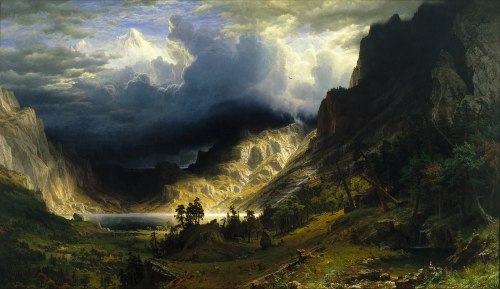
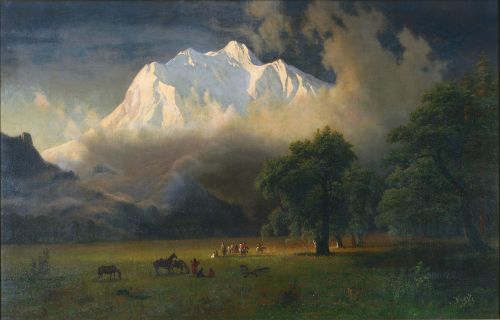
#FineArtFriday: A Storm in the Rocky Mountains – Mt. Rosalie by Albert Bierstadt 1866

Albert_Bierstadt_-_A_Storm_in_the_Rocky_Mountains,_Mt._Rosalie_-_Google_Art_ProjectArtist: Albert Bierstadt  (1830–1902)

Title: A Storm in the Rocky Mountains, Mt. Rosalie

Genre: landscape art

Date: 1866

Medium: oil on canvas

Dimensions: height: 210.8 cm (82.9 in); width: 361.3 cm (11.8 ft)

Collection: Brooklyn Museum: American Identities: A New Look, American Landscape, 5th Floor

What I love about this painting:

Albert Bierstadt painted his idea of what the American West of his time should be, grand, pristine, and wild. He painted what he saw, slightly fictionalized, so the viewer would see what he felt. He gave us entire stories on his canvas, epic explorations of the power and beauty of nature.

Bierstadt’s skies were imbued with high drama contrasted with peaceful vistas below. He took the places he had visited and made them bigger, grander, made the viewer feel the emotions he experienced when he first laid eyes on them.

About this painting via Wikipedia:

A Storm in the Rocky Mountains, Mt. Rosalie is an 1866 landscape oil painting by German-American painter Albert Bierstadt (1830-1902) which was inspired by sketches created on an 1863 expedition.

Bierstadt traveled to the Colorado Rocky Mountains where he was taken up to the Chicago Lakes beneath Mount Evans. The painting is named after Bierstadt’s mistress and, at the time, his friend’s wife, Rosalie Osborne Ludlow. The painting, measuring at 210.8 × 361.3 cm (83.0 × 142.2 in), is exhibited at the Brooklyn Museum, which acquired it in 1976.

The painting depicts Native American hunter/gatherers hunting deer in the foreground. A Native American encampment resides by a stream in the distance. The mountains are thrown into either sunlight or the darkness of a thunderstorm. In order to increase its dramatic value, Bierstadt exaggerated the scale of the Rocky Mountains.

Peering through a break in the clouds in the far distance is a snow-capped Mt. Rosalie, named after Bierstadt’s wife.

Upon its completion, the painting toured the United States for a year. On 7 February 1866, A Storm in the Rocky Mountains, Mount Rosalie exhibited for one day and evening at the Somerville Art Gallery in New York City as a benefit for the “Nursery and Child’s Hospital.” [1]

Quote from Wikimedia Commons: Albert Bierstadt enjoyed great success in the years surrounding the Civil War, producing finely detailed vistas of nature’s splendor in majestic canvases that were similarly invested with significance beyond their surface appearance.

The first technically advanced artist to portray the American West, Bierstadt offered to a rapidly transforming nation pictures whose spectacular size and fresh, dramatic subject matter supplied a visual correlative to notions of American exceptionalism, while also contributing to the developing concept of Manifest Destiny.

Trained in the highly finished manner of the Düsseldorf Academy, Bierstadt’s precise style imbued his works with a reassuring sense of veracity despite their sublime subjects and occasional liberties with geographic reality. [2]

About the Artist, via Wikipedia:

Albert Bierstadt (January 7, 1830 – February 18, 1902) was a German American painter best known for his lavish, sweeping landscapes of the American West. He joined several journeys of the Westward Expansion to paint the scenes. He was not the first artist to record the sites, but he was the foremost painter of them for the remainder of the 19th century.

Bierstadt was born in Prussia, but his family moved to the United States when he was one year old. He returned to study painting for several years in Düsseldorf. He became part of the second generation of the Hudson River School in New York, an informal group of like-minded painters who started painting along the Hudson River. Their style was based on carefully detailed paintings with romantic, almost glowing lighting, sometimes called luminism. Bierstadt was an important interpreter of the western landscape, and he is also grouped with the Rocky Mountain School.


Credits and Attributions:

Image: Wikimedia Commons contributors, ‘File:Albert Bierstadt – A Storm in the Rocky Mountains, Mt. Rosalie – Google Art Project.jpg’, Wikimedia Commons, 29 July 2023, 05:50 UTC, <https://commons.wikimedia.org/w/index.php?title=File:Albert_Bierstadt_-_A_Storm_in_the_Rocky_Mountains,_Mt._Rosalie_-_Google_Art_Project.jpg&oldid=787844562> [accessed 1 September 2023]

[1] Wikipedia contributors, “A Storm in the Rocky Mountains, Mt. Rosalie,” Wikipedia, The Free Encyclopedia, https://en.wikipedia.org/w/index.php?title=A_Storm_in_the_Rocky_Mountains,_Mt._Rosalie&oldid=1160866547 (accessed September 1, 2023).

[2] Wikimedia Commons contributors, “File:1875, Bierstadt, Albert, Mount Adams, Washington.jpg,” Wikimedia Commons, the free media repository, https://commons.wikimedia.org/w/index.php?title=File:1875,_Bierstadt,_Albert,_Mount_Adams,_Washington.jpg&oldid=272380899 (accessed March 9, 2018).
2 Comments

Filed under #FineArtFriday

#FineArtFriday: Mount Adams by Albert Bierstadt (revisited)


I live just north of Mount Adams. When you drive down past Mt. St. Helens, you often catch glimpses of this majestic volcano, but it is not usually on the tourist routes. Several of our native tribes call this mountain Klickitat, and some call it Pahto. Although Adams has not erupted in more than 1,000 years, it is not considered extinct.

I find it interesting that while it is the second-highest mountain in Washington State, after Mount Rainier, it is the least well-known to me. As a child, we stayed at Spirit Lake Resort (long before the 1980 eruption of Mt. St. Helens) and often camped at places near Goat Rocks. Sometimes I saw it from afar and wondered but never visited.

My father was an amputee, and 1940s prosthetics were rudimentary at best. He was unable to wear his prosthetic leg and walked on crutches. He adored fishing, but couldn’t hike for any distance, so we trailer-camped in places where he could fish from a boat. While there were camp sites in the Mt. Adams area, one often had to hike into them. But despite Dad’s disability, we traveled every summer and saw as much of our beautiful state as we could.

I don’t know if Bierstadt actually visited Mt. Adams, or painted this from what he was told–he was famous for painting scenery he had never seen and doing it with some accuracy.

Quote from Wikimedia Commons: Albert Bierstadt enjoyed great success in the years surrounding the Civil War, producing finely detailed vistas of nature’s splendor in majestic canvases that were similarly invested with significance beyond their surface appearance.

The first technically advanced artist to portray the American West, Bierstadt offered to a rapidly transforming nation pictures whose spectacular size and fresh, dramatic subject matter supplied a visual correlative to notions of American exceptionalism, while also contributing to the developing concept of Manifest Destiny.

Trained in the highly finished manner of the Düsseldorf Academy, Bierstadt’s precise style imbued his works with a reassuring sense of veracity despite their sublime subjects and occasional liberties with geographic reality. In Mount Adams, Washington, he characteristically combined an impressively scaled natural background with a foreground view of American Indian life, which serves to heighten the picture’s putative realism even as it enhances its exotic appeal.

The implied movement of the clouds and the sunlit figures on horseback similarly off to the right seems to open up the depicted space for the viewer to inhabit, providing an apt pictorial metaphor for the actual occupation and exploitation of the West by the eastern interests that constituted the artist’s clientele.


Credits and Attributions:

Mount Adams by Albert Bierstadt [Public domain], via Wikimedia Commons

Wikimedia Commons contributors, “File:1875, Bierstadt, Albert, Mount Adams, Washington.jpg,” Wikimedia Commons, the free media repository, https://commons.wikimedia.org/w/index.php?title=File:1875,_Bierstadt,_Albert,_Mount_Adams,_Washington.jpg&oldid=272380899 (accessed March 9, 2018).
4 Comments

Filed under #FineArtFriday

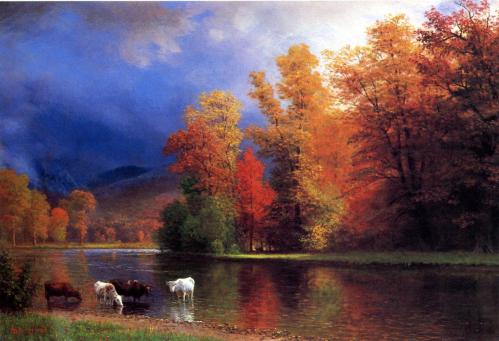
#FineArtFriday: On the Saco by Albert Bierstadt (revisited)

Bierstadt_Albert_On_the_SacoArtist: Albert Bierstadt (1830–1902)

Title: “On the Saco”

Genre: landscape art

Description: Of the Saco River, Maine.

Date: Unknown date (19th century)

Medium: oil painting.

What I love about this image:

Bierstadt understood and respected the power of nature. The way he rendered the sky is wonderful. He captured that brilliant darkness of a distant storm against the bright sunshine of an autumn afternoon. I love contrasts in this painting, the bright foliage in every shade of red and yellow, the serenity of the cattle drinking in the shallows.

The heavy darkness of the storm in the hills seems to be pushed back by the serene glow of fall’s sunlight on the river. Will it rain itself out before it passes over the herd? Possibly.

About the Artist, via Wikipedia:

Albert Bierstadt (January 7, 1830 – February 18, 1902) was a German-American painter best known for his lavish, sweeping landscapes of the American West. He joined several journeys of the Westward Expansion to paint the scenes. He was not the first artist to record the sites, but he was the foremost painter of them for the remainder of the 19th century.

Bierstadt was born in Prussia, but his family moved to the United States when he was one year old. He returned to study painting for several years in Düsseldorf. He became part of the second generation of the Hudson River School in New York, an informal group of like-minded painters who started painting along the Hudson River. Their style was based on carefully detailed paintings with romantic, almost glowing lighting, sometimes called luminism. Bierstadt was an important interpreter of the western landscape, and he is also grouped with the Rocky Mountain School. [1]


Credits and Attributions:

Image: On the Saco by Albert Bierstadt, Wikimedia Commons contributors, “File:Bierstadt Albert On the Saco.jpg,” Wikimedia Commons, the free media repository, https://commons.wikimedia.org/w/index.php?title=File:Bierstadt_Albert_On_the_Saco.jpg&oldid=618723154 (accessed September 16, 2022).

[1] Wikipedia contributors, “Albert Bierstadt,” Wikipedia, The Free Encyclopedia, https://en.wikipedia.org/w/index.php?title=Albert_Bierstadt&oldid=1107140650 (accessed September 16, 2022).

Comments Off on #FineArtFriday: On the Saco by Albert Bierstadt (revisited)

Filed under #FineArtFriday

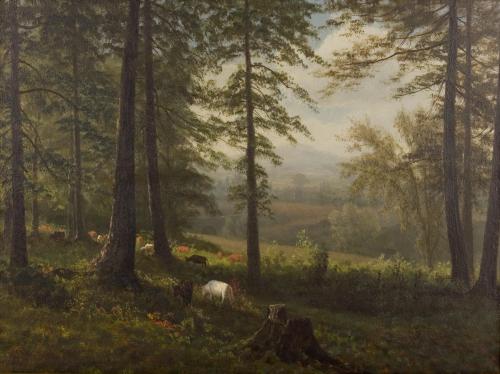
#FineArtFriday: View to a Clearing by Albert Bierstadt (revisited)

Title: View to a Clearing by Albert Bierstadt

Medium: oil on paper mounted on canvas

Dimensions: Height: 14 in (35.5 cm); Width: 19 in (48.2 cm)

Inscriptions: Signature bottom left: ABierstadt

What I love about this painting:

I first posted this painting a year ago. Sometimes life gets ahead of us, and we just need moment of serenity, a chance to relax and let go of stress. Life is a little hectic right now, with sorting through the possessions we’ve acquired over the years of living in this house. A box filled with corkscrews … how many does one family need?  A shopping bag packed with coaxial cables and no hint of what they were once connected to. What were we saving these for? And then there are the things people give you that you wouldn’t have bought for yourself, but which you now own and feel guilty for not appreciating.

We are moving those things on, donating them to Value Village, a store where someone else will want them and love them as they deserve. Today’s picture is a moment in time, a day long ago, but which is exactly what I needed on this dark and rainy March day.

I love the peace of this scene, one of Bierstadt’s quieter paintings.  The muted colors, the rising mist, the filtered light, and the cattle grazing show us a hazy afternoon. It was perfect for a picnic, for mind-wandering, and a good day for painting.

Bierstadt is one of my favorite artists because he was often over the top, a little fantastic, and usually epic. He saw drama in nature and painted it, and like every good storyteller, his imagination filled in the blanks, employing powerful imagery to show his stories.

About the artist, via Wikipedia:

Despite his popular success, Bierstadt was criticized by some contemporaries for the romanticism evident in his choices of subject and his use of light was felt to be excessive. Some critics objected to Bierstadt’s paintings of Native Americans on the grounds that Indians “marred” the “impression of solitary grandeur.”

Interest in Bierstadt’s work was renewed in the 1960s with the exhibition of his small oil studies.  Modern opinions of Bierstadt have been divided. Some critics have regarded his work as gaudy, oversized, extravagant champions of Manifest Destiny. Others have noted that his landscapes helped create support for the conservation movement and the establishment of Yellowstone National Park. Subsequent reassessment of his work has placed it in a favorable context, as stated in 1987:

The temptation (to criticize him) should be steadfastly resisted. Bierstadt’s theatrical art, fervent sociability, international outlook, and unquenchable personal energy reflected the epic expansion in every facet of western civilization during the second half of the nineteenth century.

Bierstadt was a prolific artist, having completed over 500 paintings during his lifetime.


Credits and Attributions:

Wikimedia Commons contributors, “File:Albert Bierstadt – View to a Clearing.jpg,” Wikimedia Commons, the free media repository, https://commons.wikimedia.org/w/index.php?title=File:Albert_Bierstadt_-_View_to_a_Clearing.jpg&oldid=343092014 (accessed March 5, 2021).

Wikipedia contributors, “Albert Bierstadt,” Wikipedia, The Free Encyclopedia, https://en.wikipedia.org/w/index.php?title=Albert_Bierstadt&oldid=1009967730 (accessed March 5, 2021).

12 Comments

Filed under writing

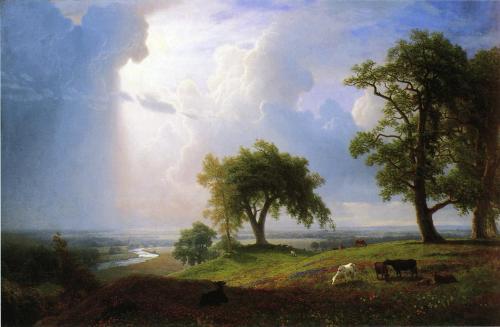
#FineArtFriday: California Spring by Albert Bierstadt 1875

Albert_Bierstadt_California_SpringArtist: Albert Bierstadt (1830–1902)

Title: California Spring

Genre: landscape art

Date: 1875

Medium: oil on canvas

Dimensions: height: 187.3 cm (73.7 in); width: 264.2 cm (104 in)

Current location: Fine Arts Museums of San Francisco

What I love about this painting:

I love this composition, the way everything is deliberately placed. Cattle graze on a hilltop beneath a grove of trees, uncaring of the rainstorm sweeping across the valley below, far off in the distance. The immensity of the sky is the focus of this scene, with the sun emerging from the clouds, a brief promise of warmer days. Spring has arrived on this hilltop.

Here at Casa del Jasperson, we’re tired of winter, done with rain and dark days. Albert Bierstadt paints us an idyllic scene of seasonal weather and the harmony of nature. The grass is green, the cattle are happy, and while rain may come, summer is around the corner.

About the artist, via Wikipedia:

Albert Bierstadt (January 7, 1830 – February 18, 1902) was a German American painter best known for his lavish, sweeping landscapes of the American West. He joined several journeys of the Westward Expansion to paint the scenes. He was not the first artist to record the sites, but he was the foremost painter of them for the remainder of the 19th century.

Bierstadt was born in Prussia, but his family moved to the United States when he was one year old. He returned to study painting for several years in Düsseldorf. He became part of the second generation of the Hudson River School in New York, an informal group of like-minded painters who started painting along the Hudson River. Their style was based on carefully detailed paintings with romantic, almost glowing lighting, sometimes called luminism. Bierstadt was an important interpreter of the western landscape, and he is also grouped with the Rocky Mountain School. [1]


Credits and Attributions:

Image: Wikimedia Commons contributors, “File:Albert Bierstadt California Spring.jpg,” Wikimedia Commons, the free media repository, https://commons.wikimedia.org/w/index.php?title=File:Albert_Bierstadt_California_Spring.jpg&oldid=701053175 (accessed February 9, 2023).

[1] Wikipedia contributors, “Albert Bierstadt,” Wikipedia, The Free Encyclopedia, https://en.wikipedia.org/w/index.php?title=Albert_Bierstadt&oldid=1137881139 (accessed February 9, 2023).

5 Comments

Filed under #FineArtFriday, writing

#FineArtFriday: On the Saco by Albert Bierstadt

Bierstadt_Albert_On_the_SacoArtist: Albert Bierstadt (1830–1902)

Title: “On the Saco”

Genre: landscape art

Description: Of the Saco River, Maine.

Date: Unknown date (19th century)

Medium: oil painting.

What I love about this image:

Bierstadt understood and respected the power of nature. The way he rendered the sky is wonderful. He captured that brilliant darkness of a distant storm against the bright sunshine of an autumn afternoon. I love contrasts in this painting, the bright foliage in every shade of red and yellow, the serenity of the cattle drinking in the shallows.

The heavy darkness of the storm in the hills seems to be pushed back by the serene glow of fall’s sunlight on the river. Will it rain itself out before it passes over the herd? Possibly.

About the Artist, via Wikipedia:

Albert Bierstadt (January 7, 1830 – February 18, 1902) was a German-American painter best known for his lavish, sweeping landscapes of the American West. He joined several journeys of the Westward Expansion to paint the scenes. He was not the first artist to record the sites, but he was the foremost painter of them for the remainder of the 19th century.

Bierstadt was born in Prussia, but his family moved to the United States when he was one year old. He returned to study painting for several years in Düsseldorf. He became part of the second generation of the Hudson River School in New York, an informal group of like-minded painters who started painting along the Hudson River. Their style was based on carefully detailed paintings with romantic, almost glowing lighting, sometimes called luminism. Bierstadt was an important interpreter of the western landscape, and he is also grouped with the Rocky Mountain School. [1]


Credits and Attributions:

Image: On the Saco by Albert Bierstadt, Wikimedia Commons contributors, “File:Bierstadt Albert On the Saco.jpg,” Wikimedia Commons, the free media repository, https://commons.wikimedia.org/w/index.php?title=File:Bierstadt_Albert_On_the_Saco.jpg&oldid=618723154 (accessed September 16, 2022).

[1] Wikipedia contributors, “Albert Bierstadt,” Wikipedia, The Free Encyclopedia, https://en.wikipedia.org/w/index.php?title=Albert_Bierstadt&oldid=1107140650 (accessed September 16, 2022).

5 Comments

Filed under #FineArtFriday

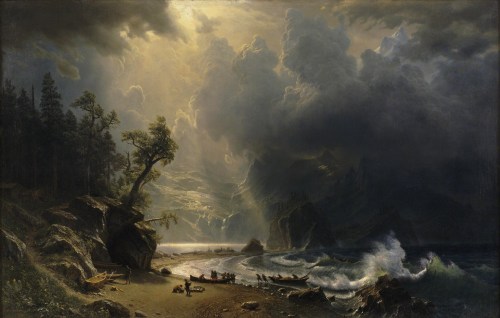
#FineArtFriday: Puget Sound on the Pacific Coast by Albert Bierstadt 1870 (reprise)

What I love about this painting:

I live on Puget Sound, and while the exact beach this image depicts likely does not exist, the cliffs are pretty accurate. I have seen many, many places here like it. The waters of the sound can get quite rough during storms, as this video shot three years ago by a storm chaser during a December storm shows: Wild Ferry Ride Across Puget Sound Dec. 16 2018.

Anyone who lives here will tell you, the view of the Olympic Mountains from over the sound is unparalleled.

At certain times of the year, rain sweeps in like a dark beast. I have often seen the sky as black and heavy as it is depicted in this painting. Shafts of sun between heavy rain squalls are frequent companions here. When the sun shines through the heavy clouds, the light looks very much the way he shows it.

A sky that looks like the one in this painting heralds a serious storm. If you are driving anywhere during this kind of weather, you are in for a slow, miserable trip.

Quote from http://www.SeattleArtMuseum.org, regarding Puget Sound on the Pacific Coast, 1870, which is now in their possession.

 “Bierstadt had likely not yet traveled to the Washington Territory in 1870. The painting was possibly a commission from a New York shipping magnate who had made his enormous fortune on the Pacific coast. Enterprising artist that he was, Bierstadt did not shy away from the challenge of painting a place he had not yet seen.”

I love that Bierstadt was a story teller as much as an entrepreneur in regard to his art. All the great artists were.

It has been suggested he put this picture together by piecing together places he had visited on the Lower Columbia River. Indeed, the trees and landscape there is much like that of Puget Sound, so it is possible. However, it would have been easy for him to have traveled north to the sound if he was on the  Lower Columbia—a matter of only eighty miles, so a week of travel for him by horse.

He was a man who traveled all over the west and painted what he felt as much as what he saw.

Wikipedia has this to say about Albert Bierstadt:

In 1867, Bierstadt traveled to London, where he exhibited two landscape paintings in a private reception with Queen Victoria. He traveled through Europe for two years, cultivating social and business contacts to sustain the market for his work overseas. His exhibition pieces were brilliant images, which glorified the American West as a land of promise and “fueled European emigration.” He painted Among the Sierra Nevada, California in his Rome studio, for example, showed it in Berlin and London before shipping it to the U.S. As a result of the publicity generated by his Yosemite Valley paintings in 1868, Bierstadt’s presence was requested by every explorer considering a westward expedition, and he was commissioned by the Atchison, Topeka, and Santa Fe Railroad to visit the Grand Canyon for further subject matter.

Bierstadt’s choice of grandiose subjects was matched by his entrepreneurial flair. His exhibitions of individual works were accompanied by promotion, ticket sales, and, in the words of one critic, a “vast machinery of advertisement and puffery.”

Bierstadt was highly successful in his day, which the more refined critics despised. Everything the critics mocked about his work are the aspects I love. The high contrasts of light and shadow, sweeping epic themes, and overblown romanticism—those are what I love about all his work.

In all his works, Bierstadt created an emotional landscape as much as a physical one.

Puget Sound on the Pacific Coast by Albert Bierstadt

  • Genre: landscape art
  • Date: 1870
  • Medium: oil on canvas
  • Dimensions: Height: 52.5 ″ (133.3 cm); Width: 82 ″ (208.2 cm)
  • Collection: Seattle Art Museum
  • Current location: Seattle Art Museum Downtown, Gallery Level 3, American Art

Credits and Attributions:

Puget Sound on the Pacific Coast, by Albert Bierstadt, signed and dated 1870 [Public domain]

Wikimedia Commons contributors, “File:Albert Bierstadt – Puget Sound on the Pacific Coast (1870).jpg,” Wikimedia Commons, the free media repository, https://commons.wikimedia.org/w/index.php?title=File:Albert_Bierstadt_-_Puget_Sound_on_the_Pacific_Coast_(1870).jpg&oldid=344396079 (accessed April 26, 2019).

Quote from the article: Puget Sound on the Pacific Coast, Seattle Art Museum website contributors, (accessed April 25, 2019).

5 Comments

Filed under #FineArtFriday

#FineArtFriday: View to a Clearing by Albert Bierstadt

Title: View to a Clearing by Albert Bierstadt

Medium: oil on paper mounted on canvas

Dimensions: Height: 14 in (35.5 cm); Width: 19 in (48.2 cm)

Inscriptions: Signature bottom left: ABierstadt

What I love about this painting:

I love the serenity of this scene, one of Bierstadt’s quieter paintings.  The muted colors, the rising mist, the filtered light, and the cattle grazing show us a hazy afternoon. It was perfect for a picnic, for mind-wandering, and a good day for painting.

Bierstadt is one of my favorite artists because he was often over the top, a little fantastic, and usually epic. He saw drama in nature and painted it, and like every good storyteller, his imagination filled in the blanks with with powerful imagery.

About the artist, via Wikipedia:

Despite his popular success, Bierstadt was criticized by some contemporaries for the romanticism evident in his choices of subject and his use of light was felt to be excessive. Some critics objected to Bierstadt’s paintings of Native Americans on the grounds that Indians “marred” the “impression of solitary grandeur.”

Interest in Bierstadt’s work was renewed in the 1960s with the exhibition of his small oil studies.  Modern opinions of Bierstadt have been divided. Some critics have regarded his work as gaudy, oversized, extravagant champions of Manifest Destiny. Others have noted that his landscapes helped create support for the conservation movement and the establishment of Yellowstone National Park. Subsequent reassessment of his work has placed it in a favorable context, as stated in 1987:

The temptation (to criticize him) should be steadfastly resisted. Bierstadt’s theatrical art, fervent sociability, international outlook, and unquenchable personal energy reflected the epic expansion in every facet of western civilization during the second half of the nineteenth century.

Bierstadt was a prolific artist, having completed over 500 paintings during his lifetime.


Credits and Attributions:

Wikimedia Commons contributors, “File:Albert Bierstadt – View to a Clearing.jpg,” Wikimedia Commons, the free media repository, https://commons.wikimedia.org/w/index.php?title=File:Albert_Bierstadt_-_View_to_a_Clearing.jpg&oldid=343092014 (accessed March 5, 2021).

Wikipedia contributors, “Albert Bierstadt,” Wikipedia, The Free Encyclopedia, https://en.wikipedia.org/w/index.php?title=Albert_Bierstadt&oldid=1009967730 (accessed March 5, 2021).

2 Comments

Filed under writing

#FineArtFriday: Puget Sound on the Pacific Coast by Albert Bierstadt 1870

What I love about this painting:

I live on Puget sound, and while the exact beach this image depicts likely does not exist, the cliffs are pretty accurate. I have seen many, many places here like it. The waters of the sound can get quite rough during storms, as this video shot by a storm chaser in December shows: Wild Ferry Ride Across Puget Sound Dec. 16 2018.

Anyone who lives here will tell you, the view of the Olympic Mountains from over the sound is unparalleled.

At certain times of the year, rain sweeps in like a dark beast. I have often seen the sky as black and heavy as it is depicted in this painting. Shafts of sun between heavy rain squalls are frequent companions here. When the sun shines through the heavy clouds, the light looks very much the way he shows it.

A sky that looks like the one in this painting heralds a serious storm. If you are driving anywhere during this kind of weather, you are in for a slow, miserable trip.

Quote from http://www.SeattleArtMuseum.org, regarding Puget Sound on the Pacific Coast, 1870, which is now in their possession.

 “Bierstadt had likely not yet traveled to the Washington Territory in 1870. The painting was possibly a commission from a New York shipping magnate who had made his enormous fortune on the Pacific coast. Enterprising artist that he was, Bierstadt did not shy away from the challenge of painting a place he had not yet seen.”

I love that Bierstadt was a story teller as much as an entrepreneur in regard to his art. All the great artists were.

It has been suggested he put this picture together by piecing together places he had visited on the Lower Columbia River. Indeed, the trees and landscape there is much like that of Puget Sound, so it is possible. However, it would have been easy for him to have traveled north to the sound if he was on the  Lower Columbia—a matter of only eighty miles, so a week of travel for him by horse.

He was a man who traveled all over the west and painted what he felt as much as what he saw.

Wikipedia has this to say about Albert Bierstadt:

In 1867, Bierstadt traveled to London, where he exhibited two landscape paintings in a private reception with Queen Victoria. He traveled through Europe for two years, cultivating social and business contacts to sustain the market for his work overseas. His exhibition pieces were brilliant images, which glorified the American West as a land of promise and “fueled European emigration.” He painted Among the Sierra Nevada, California in his Rome studio, for example, showed it in Berlin and London before shipping it to the U.S. As a result of the publicity generated by his Yosemite Valley paintings in 1868, Bierstadt’s presence was requested by every explorer considering a westward expedition, and he was commissioned by the Atchison, Topeka, and Santa Fe Railroad to visit the Grand Canyon for further subject matter.

Bierstadt’s choice of grandiose subjects was matched by his entrepreneurial flair. His exhibitions of individual works were accompanied by promotion, ticket sales, and, in the words of one critic, a “vast machinery of advertisement and puffery.”

Bierstadt was highly successful in his day, which the more refined critics despised. Everything the critics mocked about his work are the aspects I love. The high contrasts of light and shadow, sweeping epic themes, and overblown romanticism—those are what I love about all his work.

In all his works, Bierstadt created an emotional landscape as much as a physical one.

Puget Sound on the Pacific Coast by Albert Bierstadt

  • Genre: landscape art
  • Date: 1870
  • Medium: oil on canvas
  • Dimensions: Height: 52.5 ″ (133.3 cm); Width: 82 ″ (208.2 cm)
  • Collection: Seattle Art Museum
  • Current location: Seattle Art Museum Downtown, Gallery Level 3, American Art

Credits and Attributions:

Puget Sound on the Pacific Coast, by Albert Bierstadt, signed and dated 1870 [Public domain]

Wikimedia Commons contributors, “File:Albert Bierstadt – Puget Sound on the Pacific Coast (1870).jpg,” Wikimedia Commons, the free media repository, https://commons.wikimedia.org/w/index.php?title=File:Albert_Bierstadt_-_Puget_Sound_on_the_Pacific_Coast_(1870).jpg&oldid=344396079 (accessed April 26, 2019).

Quote from the article: Puget Sound on the Pacific Coast, Seattle Art Museum website contributors, (accessed April 25, 2019).

Comments Off on #FineArtFriday: Puget Sound on the Pacific Coast by Albert Bierstadt 1870

Filed under #FineArtFriday

#FineArtFriday: Mount Adams by Albert Bierstadt

Quote from Wikimedia Commons: Albert Bierstadt enjoyed great success in the years surrounding the Civil War, producing finely detailed vistas of nature’s splendor in majestic canvases that were similarly invested with significance beyond their surface appearance.

The first technically advanced artist to portray the American West, Bierstadt offered to a rapidly transforming nation pictures whose spectacular size and fresh, dramatic subject matter supplied a visual correlative to notions of American exceptionalism, while also contributing to the developing concept of Manifest Destiny.

Trained in the highly finished manner of the Düsseldorf Academy, Bierstadt’s precise style imbued his works with a reassuring sense of veracity despite their sublime subjects and occasional liberties with geographic reality. In Mount Adams, Washington, he characteristically combined an impressively scaled natural background with a foreground view of American Indian life, which serves to heighten the picture’s putative realism even as it enhances its exotic appeal.

The implied movement of the clouds and the sunlit figures on horseback similarly off to the right seems to open up the depicted space for the viewer to inhabit, providing an apt pictorial metaphor for the actual occupation and exploitation of the West by the eastern interests that constituted the artist’s clientele.


Credits and Attributions:

Mount Adams by Albert Bierstadt [Public domain], via Wikimedia Commons

Wikimedia Commons contributors, “File:1875, Bierstadt, Albert, Mount Adams, Washington.jpg,” Wikimedia Commons, the free media repository, https://commons.wikimedia.org/w/index.php?title=File:1875,_Bierstadt,_Albert,_Mount_Adams,_Washington.jpg&oldid=272380899 (accessed March 9, 2018).


3 Comments

Filed under #FineArtFriday