Tag Archives: Allegory in Art

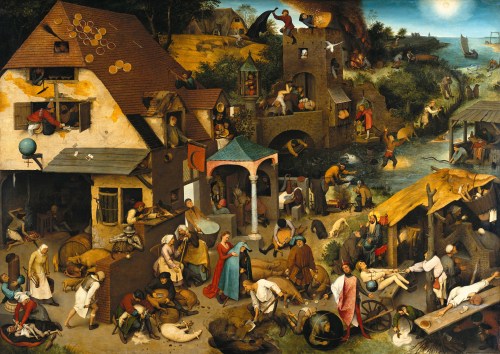
#FineArtFriday: a closer look at “The Netherlandish Proverbs” by Pieter Brueghel the Elder

I love this painting and all the crazy imagery that witty, sarcastic, and distinctly un-noble Pieter Brueghel the elder. stuffed into it. I first discussed this painting on May 4, 2018, but it has been on my mind since last week when we looked at a seascape by the same artist.

I love a good allegorical painting, especially when the artist has a point to make. Brueghel the Elder, had a wicked sense of humor, and he wasn’t shy about pointing out the many hypocrisies and foibles of the society around him.

I consider this one of the best, most hilarious allegorical paintings of all time. The Netherlandish Proverbs (also known as The Dutch Proverbs) by Pieter Brueghel the Elder, was painted in 1559. I’ll just say that Pieter Brueghel the Elder is one of my favorite artists.

Quote from Wikipedia:

Critics have praised the composition for its ordered portrayal and integrated scene. There are approximately 112 identifiable proverbs and idioms in the scene, although Bruegel may have included others which cannot be determined because of the language change. Some of those incorporated in the painting are still in popular use, for instance “Swimming against the tide”, “Banging one’s head against a brick wall” and “Armed to the teeth”. Many more have faded from use, which makes analysis of the painting harder. “Having one’s roof tiled with tarts”, for example, which meant to have an abundance of everything and was an image Bruegel would later feature in his painting of the idyllic Land of Cockaigne (1567).

The Blue Cloak, the piece’s original title, features in the centre of the piece and is being placed on a man by his wife, indicating that she is cuckolding him. Other proverbs indicate human foolishness. A man fills in a pond after his calf has died. Just above the central figure of the blue-cloaked man another man carries daylight in a basket. Some of the figures seem to represent more than one figure of speech (whether this was Bruegel’s intention or not is unknown), such as the man shearing a sheep in the centre bottom left of the picture. He is sitting next to a man shearing a pig, so represents the expression “One shears sheep and one shears pigs”, meaning that one has the advantage over the other, but may also represent the advice “Shear them but don’t skin them”, meaning make the most of available assets.

You can find all of the wonderful proverbs on the painting’s page on Wikipedia, along with the thumbnail that depicts the proverb.

My favorite proverbs in this wonderful allegory?

Horse droppings are not figs. It meant we should not be fooled by appearances.

He who eats fire, craps sparks. It meant we shouldn’t be surprised at the outcome if we attempt a dangerous venture.

Now THAT is wisdom!

ABOUT THE ARTIST, via Wikipedia:

Pieter Bruegel (also Brueghel or Breughelthe Elder, 1525–1530 to 9 September 1569) was among the most significant artists of Dutch and Flemish Renaissance painting, a painter and printmaker, known for his landscapes and peasant scenes (so-called genre painting); he was a pioneer in presenting both types of subject as large paintings.

Van Mander records that before he died he told his wife to burn some drawings, perhaps designs for prints, carrying inscriptions “which were too sharp or sarcastic … either out of remorse or for fear that she might come to harm or in some way be held responsible for them”, which has led to much speculation that they were politically or doctrinally provocative, in a climate of sharp tension in these areas. [2]


Credits and Attributions:

The Netherlandish Proverbs (Also known as The Dutch Proverbs) by Pieter Brueghel the Elder 1559 [Public domain], via Wikimedia Commons.

[1] Wikipedia contributors, “Netherlandish Proverbs,” Wikipedia, The Free Encyclopedia, https://en.wikipedia.org/w/index.php?title=Netherlandish_Proverbs&oldid=829168138  (accessed July 16, 2025).

[2] Wikipedia contributors, “Pieter Bruegel the Elder,” Wikipedia, The Free Encyclopedia, https://en.wikipedia.org/w/index.php?title=Pieter_Bruegel_the_Elder&oldid=1299614602 (accessed July 16, 2025).

Comments Off on #FineArtFriday: a closer look at “The Netherlandish Proverbs” by Pieter Brueghel the Elder

Filed under #FineArtFriday

#FineArtFriday – Children’s Games by Pieter Bruegel the Elder

Pieter_Bruegel_the_Elder_-_Children’s_Games_-_Google_Art_ProjectTitle: Children’s Games

Artist: Pieter Bruegel the Elder

Year: 1560

Type: Oil on panel

Dimensions: 118 cm × 161 cm (46 in × 63 in)

Location: Kunsthistorisches Museum, Vienna

What I love about this image:

Pieter Brugel the Elder was one of my first influences in the world of art appreciation. I love the chaos, the raucous jumble of humanity that Brugel always brought to a scene. It is as wild and noisy as his more famous composition, The Wedding Dance. Children have taken over the city and everything is fair game. Brugel’s depiction of village children and their play offered him an opportunity to shine a small light on the hubris and arrogance of mankind, using allegory and misdirection.

About this painting via Wikipedia:

The entire composition is full of children playing a wide variety of games. Over 90 different games that were played by children at the time have been identified.

The artist’s intention for this work is more serious than simply to compile an illustrated encyclopaedia of children’s games, though some eighty particular games have been identified. Bruegel shows the children absorbed in their games with the seriousness displayed by adults in their apparently more important pursuits. His moral is that in the mind of God, children’s games possess as much significance as the activities of their parents. This idea was a familiar one in contemporary literature: in an anonymous Flemish poem published in Antwerp in 1530 by Jan van Doesborch, mankind is compared to children who are entirely absorbed in their foolish games and concerns. [1]

About the Artist, via Wikipedia:

Pieter Bruegel (also Brueghel or Breughelthe Elder c. 1525–1530 – 9 September 1569) was the most significant artist of Dutch and Flemish Renaissance painting, a painter and printmaker from Brabant, known for his landscapes and peasant scenes (so-called genre painting); he was a pioneer in making both types of subject the focus in large paintings.

He was a formative influence on Dutch Golden Age painting and later painting in general in his innovative choices of subject matter, as one of the first generation of artists to grow up when religious subjects had ceased to be the natural subject matter of painting. He also painted no portraits, the other mainstay of Netherlandish art. After his training and travels to Italy, he returned in 1555 to settle in Antwerp, where he worked mainly as a prolific designer of prints for the leading publisher of the day. Only towards the end of the decade did he switch to make painting his main medium, and all his famous paintings come from the following period of little more than a decade before his early death, when he was probably in his early forties, and at the height of his powers.

Around 1563, Bruegel moved from Antwerp to Brussels, where he married Mayken Coecke, the daughter of the painter Pieter Coecke van Aelst and Mayken Verhulst. As registered in the archives of the Cathedral of Antwerp, their deposition for marriage was registered 25 July 1563. The marriage itself was concluded in the Chapel Church, Brussels in 1563. 

Pieter the Elder had two sons: Pieter Brueghel the Younger and Jan Brueghel the Elder (both kept their name as Brueghel). Their grandmother, Mayken Verhulst, trained the sons because “the Elder” died when both were very small children. The older brother, Pieter Brueghel copied his father’s style and compositions with competence and considerable commercial success. Jan was much more original, and very versatile. He was an important figure in the transition to the Baroque style in Flemish Baroque painting and Dutch Golden Age painting in a number of its genres. He was often a collaborator with other leading artists, including with Peter Paul Rubens on many works including the Allegory of Sight.

Other members of the family include Jan van Kessel the Elder (grandson of Jan Brueghel the Elder) and Jan van Kessel the Younger. Through David Teniers the Younger, son-in-law of Jan Brueghel the Elder, the family is also related to the whole Teniers family of painters and the Quellinus family of painters and sculptors, through the marriage of Jan-Erasmus Quellinus to Cornelia, daughter of David Teniers the Younger. [2]


Credits and Attributions:

IMAGE:  Children’s Games, Wikimedia Commons contributors, “File:Pieter Bruegel the Elder – Children’s Games – Google Art Project.jpg,” Wikimedia Commons, https://commons.wikimedia.org/w/index.php?title=File:Pieter_Bruegel_the_Elder_-_Children%E2%80%99s_Games_-_Google_Art_Project.jpg&oldid=725602746 (accessed April 26, 2024).

[1] Wikipedia contributors, “Children’s Games (Bruegel),” Wikipedia, The Free Encyclopedia, https://en.wikipedia.org/w/index.php?title=Children%27s_Games_(Bruegel)&oldid=1198935116 (accessed April 26, 2024).

[2] Wikipedia contributors, “Pieter Bruegel the Elder,” Wikipedia, The Free Encyclopedia, https://en.wikipedia.org/w/index.php?title=Pieter_Bruegel_the_Elder&oldid=1218696694 (accessed April 26, 2024).

1 Comment

Filed under #FineArtFriday

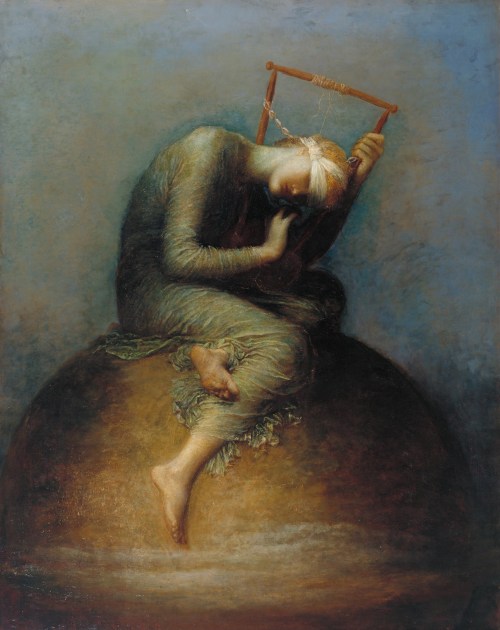
#FineArtFriday: Hope by George Frederic Watts 1886

Title: Hope, by George Frederic Watts

Date: 1886

Genre: allegory

Medium: oil on canvas

Dimensions Height: 142.2 cm (55.9 in); Width: 111.8 cm (44 in)

Collection:  Tate Britain

Notes: Presented by George Frederic Watts 1897

What I love about this painting:

This painting strikes home with me. Hope is blindfolded, battered, dressed in rags, and cast adrift in the universe. She clings to a lyre upon which only one string remains—yet Hope turns her head to hear the sound of that one string. The lone star in the sky is nearly invisible, yet it is there, deliberately placed. Watts’s choice of symbols for this allegory and the stark layout of the composition combine to create a powerful idea—Hope makes music with one string when nothing else remains.

About this painting (via Wikipedia):

Hope is a Symbolist oil painting by the English painter George Frederic Watts, who completed the first two versions in 1886. Radically different from previous treatments of the subject, it shows a lone blindfolded female figure sitting on a globe, playing a lyre that has only a single string remaining. The background is almost blank, its only visible feature a single star. Watts intentionally used symbolism not traditionally associated with hope to make the painting’s meaning ambiguous. While his use of colour in Hope was greatly admired, at the time of its exhibition many critics disliked the painting. Hope proved popular with the Aesthetic Movement, who considered beauty the primary purpose of art and were unconcerned by the ambiguity of its message. Reproductions in platinotype, and later cheap carbon prints, soon began to be sold.

Although Watts received many offers to buy the painting, he had agreed to donate his most important works to the nation and felt it would be inappropriate not to include Hope. Consequently, later in 1886 Watts and his assistant Cecil Schott painted a second version. On its completion Watts sold the original and donated the copy to the South Kensington Museum (now the Victoria and Albert Museum); thus, this second version is better known than the original. He painted at least two further versions for private sale.

About the Artist, via Wikipedia:

George Frederic Watts OM RA (23 February 1817, in London – 1 July 1904) was a British painter and sculptor associated with the Symbolist movement. He said “I paint ideas, not things.” Watts became famous in his lifetime for his allegorical works, such as Hope and Love and Life. These paintings were intended to form part of an epic symbolic cycle called the “House of Life”, in which the emotions and aspirations of life would all be represented in a universal symbolic language.


Credits and Attributions:

Hope, by George Frederic Watts 1885. Wikipedia contributors, “Hope (painting),” Wikipedia, The Free Encyclopedia, https://en.wikipedia.org/w/index.php?title=Hope_(painting)&oldid=946584185 (accessed March 27, 2020).

Wikipedia contributors, “Hope (painting),” Wikipedia, The Free Encyclopedia, https://en.wikipedia.org/w/index.php?title=Hope_(painting)&oldid=946584185 (accessed March 27, 2020).

Wikipedia contributors, “George Frederic Watts,” Wikipedia, The Free Encyclopedia, https://en.wikipedia.org/w/index.php?title=George_Frederic_Watts&oldid=947120342 (accessed March 27, 2020).

3 Comments

Filed under #FineArtFriday