Tag Archives: American Artists

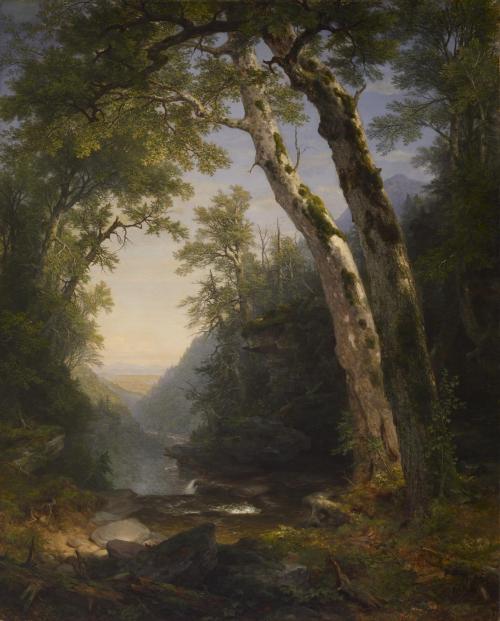
#FineArtFriday: a closer look at “The Catskills,” by Asher Brown Durand 1858

Artist: Asher Brown Durand (1796–1886)

Title: The Catskills

Date: 1859

Medium: oil on canvas

Dimensions: height: 158.8 cm (62.5 in); width: 128.3 cm (50.5 in)

What I love about this painting: 

I grew up in a forested place, not unlike that depicted here. That sentiment has endeared this style of art to me. I have become attached to the modern fantasy painters, those modern artists like Michael Whelan and the late Darrell K. Sweet, who paint images in this style for fantasy novels and RPG games. Their style is called Imaginative Realism.

What strikes me the most about this particular painting is not only the attention to detail, but the fairy-tale quality of Durand’s vision of realism. Viewed as a whole, this composition has an otherworldly quality to it, almost as if Elrond or Galadriel lurk just out of view, beyond the edges.

Quote from Wikimedia Commons on The Catskills: This painting was commissioned by William T. Walters in 1858, when the 62-year-old Durand was at the height of his fame and technical skill. The vertical format of the composition was a trademark of the artist, allowing him to exploit the grandeur of the sycamore trees as a means of framing the expansive landscape beyond. Durand’s approach to the “sublime landscape” was modeled on that of Thomas Cole (1801-48), founder of the Hudson River school of painting. The painters of this school explored the countryside of the eastern United States, particularly the Adirondack Mountains and the Catskills. Their paintings often reflect the Transcendental philosophy of Ralph Waldo Emerson (1803-82), who believed that all of nature bore testimony to a spiritual truth that could be understood through personal intuition.

>>><<<

Quote from Wikipedia (the fount of all knowledge): Asher Brown Durand is remembered particularly for his detailed portrayals of trees, rocks, and foliage. He was an advocate for drawing directly from nature with as much realism as possible. Durand wrote, “Let [the artist] scrupulously accept whatever [nature] presents him until he shall, in a degree, have become intimate with her infinity…never let him profane her sacredness by a willful departure from truth.”

Like other Hudson River School artists, Durand also believed that nature was an ineffable manifestation of God. He expressed this sentiment and his general opinions on art in his essay “Letters on Landscape Painting” in The Crayon, a mid-19th century New York art periodical. Wrote Durand, “[T]he true province of Landscape Art is the representation of the work of God in the visible creation…”


Credits and Attributions

[1] Wikimedia Commons contributors, “File:Asher Brown Durand – The Catskills – Walters 37122.jpg,” Wikimedia Commons, https://commons.wikimedia.org/w/index.php?title=File:Asher_Brown_Durand_-_The_Catskills_-_Walters_37122.jpg&oldid=354202161 (accessed August 21, 2025).

[2] Wikipedia contributors, “Asher Brown Durand,” Wikipedia, The Free Encyclopedia, https://en.wikipedia.org/w/index.php?title=Asher_Brown_Durand&oldid=1291945600 (accessed August 21, 2025)..
5 Comments

Filed under #FineArtFriday

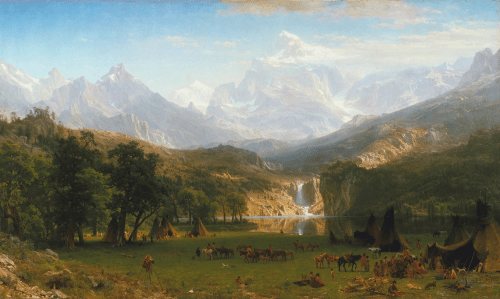
#FineArtFriday: Albert Bierstadt, The Rocky Mountains, Landers Peak 1860, revisited

When I sit down to write, my work is usually fiction. Even so, I want my work to have authenticity, although I might never have experienced what I am writing about. Whether a piece is set in an alternate world, or in this one, or if it is in the past, present, or future, a source of visual information you can use to fire your imagination exists on the internet–Wikimedia Commons.

For example, today’s image is a landscape painting by Albert Bierstadt, an American painter best known for his lavish, sweeping landscapes of the American West.  This painting shows what tribal life after a successful hunt might be like, and if you are writing about any group of people who hunt or gather food, this particular painting contain a wealth of historically accurate visual information. He painted what he saw. In all of Bierstadt’s work, you will find a world that existed 150 years ago, complete with children playing and dogs barking.

Wikipedia has this to say about the painter:

Born in Germany, Bierstadt was brought to the United States at the age of one by his parents. He later returned to study painting for several years in Düsseldorf. He became part of the Hudson River School in New York, an informal group of like-minded painters who started painting along the Hudson River. Their style was based on carefully detailed paintings with romantic, almost glowing lighting, sometimes called luminism. An important interpreter of the western landscape, Bierstadt, along with Thomas Moran, is also grouped with the Rocky Mountain School.

The life of the American West of the 19th century can be directly translated into a science fiction novel, or a fantasy novel–because the elements of hunting and gathering remain the same no matter what world you set it in. A great many people were involved in taking down a few animals–two antelope, one mountain sheep, and one bear. Hunts of this nature, even with modern weapons, are difficult and fraught with danger. For this reason, the take from this hunt will supply the entire camp of perhaps 100 people for one or two weeks., so foraging for roots, berries, and greens was an important task, as was fishing.

In this painting, you see how the tribe’s homes were constructed, and how the camp was laid out–the butchering party is well away from the rest of the camp, which is on the banks of a river. Everything that was important to the lives of these people is laid out in detail, exactly how it was the day the artist set up his easel in the wilderness and began painting.

Go to history for your world building, and go to art for your history. Don’t be afraid to ‘waste time’ looking at paintings and examining them for minute details, because your imagination will run with it, and your work will have a sense of realism.


Wikipedia contributors, “Albert Bierstadt,” Wikipedia, The Free Encyclopedia, https://en.wikipedia.org/w/index.php?title=Albert_Bierstadt&oldid=793302910 (accessed August 11, 2017).

The Rocky Mountains, Landers Peak; Albert Bierstadt 1863 [Public domain], via Wikimedia Commons, https://commons.wikimedia.org/wiki/File%3AAlbert_Bierstadt_-_The_Rocky_Mountains%2C_Lander’s_Peak.jpg, accessed August-11-2017.

3 Comments

Filed under #FineArtFriday, writing

#FineArtFriday: A second look at “The Plaza After the Rain” by Paul Cornoyer

Paul_Cornoyer_-_The_Plaza_After_RainArtist: Paul Cornoyer  (1864–1923)

Title: The Plaza After Rain

Date: Before 1910

Medium: oil on canvas

Dimensions: 59 1/4 x 59 1/4 in. (150.5 x 150.5 cm)

Collection: Saint Louis Art Museum, Saint Louis, Missouri, United States

What I love about this painting:

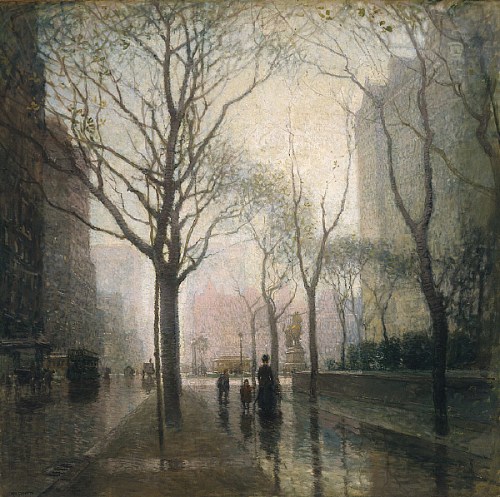
This painting appeared here in January of 2024. Paul Cornoyer was a master at painting the way wet pavement looks, the reflections and the sheen. Rain is a near-constant companion during a Pacific Northwest winter and while it is now May, today is no exception.

Paul Cornoyer’s The Plaza After Rain depicts New York City, which is on the other side of the continent from me, and it takes place in a different era. But he shows the way rain is in early spring no matter where in the northern US you reside.

The sky is dark, but the trees are just beginning to leaf out. The rain is passing, and the streets are wet, but a hint of blue is showing through the dark sky. When you see this painting, you see the story of a cold spring day. Yet, one has the feeling that sunshine could happen any minute.

Impressionism is flash fiction on a canvas. All the important things are there, everything the eye needs to have a perfect vision of the mood, the setting, and characters at that moment in time. The important things at that moment are depicted within the piece, but with economy.

The St. Louis Art Museum says this about The Plaza After the Rain:

A drizzling rain creates watery reflections on the streets and sidewalks along the Grand Army Plaza in Manhattan. The rain hampers our view down the vista, though the moody tones of pinks, grays, and blues make up for this loss. The light in the distance offers a hazy glimpse of the southeast corner of Central Park, with its beloved bronze statue of Civil War general William Tecumseh Sherman. [2]

About the Author, via Wikipedia:

Paul Cornoyer (1864–1923) was an American painter, currently best known for his popularly reproduced painting in an Impressionisttonalist, and sometimes pointillist style.

Born in St. Louis, Missouri, Cornoyer began painting in Barbizon style and first exhibited in 1887. In 1889, He moved to Paris, where he studied at the Académie Julian alongside Jules Lefebvre and Jean-Joseph Benjamin-Constant. After returning from his studies in Paris in 1894, Cornoyer was heavily influenced by the American tonalists. At the urging of William Merritt Chase, he moved to New York City in 1899. In 1908, the Albright–Knox Art Gallery (formerly the Albright Gallery) hosted a show of his work. In 1909, he was elected into the National Academy of Design as an Associate Academician. He taught at Mechanics Institute of New York and in 1917, he moved to Massachusetts, where he continued to teach and paint.

Cornoyer received a retrospective exhibition entitled Paul Cornoyer: American Impressionist at the Lakeview Center for the Arts and Sciences in Peoria, Illinois in 1973. The exhibit drew heavily from the collection of Dr. and Mrs. Lawrence Ashby, who loaned multiple paintings to the exhibit, as well as over 20 works on paper. [1]


Credits and Attributions:

IMAGE: The Plaza After the Rain by Paul Cornoyer PD|100, Wikimedia Commons contributors, “File:Paul Cornoyer – The Plaza After Rain.jpg,” Wikimedia Commons, https://commons.wikimedia.org/w/index.php?title=File:Paul_Cornoyer_-_The_Plaza_After_Rain.jpg&oldid=345336218 (accessed January 18, 2024).

[1] Wikipedia contributors, “Paul Cornoyer,” Wikipedia, The Free Encyclopedia, https://en.wikipedia.org/w/index.php?title=Paul_Cornoyer&oldid=1118249028 (accessed January 18, 2024).

[2] St. Louis Art Museum contributors, the Plaza After the Rain by Paul Cornoyer, The Plaza after the Rain – Saint Louis Art Museum (slam.org) (accessed January 18, 2024).

2 Comments

Filed under #FineArtFriday, writing

#FineArtFriday: revisiting After the Hurricane, Bahamas by Winslow Homer (and hurricane relief)

Artist: Winslow Homer (1836–1910)

Title: After the Hurricane

Date: 1899

Medium: Transparent watercolor, with touches of opaque watercolor, rewetting, blotting and scraping, over graphite, on moderately thick, moderately textured (twill texture on verso), ivory wove paper.

Dimensions: Height: 38 cm (14.9 in); Width: 54.3 cm (21.3 in)

Inscriptions: Signature and date bottom left: Homer 99

Current Location: Art Institute of Chicago, not on view

October 2024 has been a terrible month for the East Coast of the US. Two intense hurricanes swept up from the tropics, devastating the southern coastal region and bringing flooding inland.

The swath of death and destruction wrought by these storms is hard to describe. For those who lived through them but lost everything, life will always be defined in terms of “before the hurricane” and “after.”

In view of the deadly nature of these storms, I thought it appropriate to revisit “After the Hurricane, Bahamas” by Winslow Homer.

If you live in the US, Walmart and Kroger stores offer an option to donate a dollar or more to various hurricane relief organizations at checkout, as do many other grocery chains. Also, you can donate directly to the relief effort by going to How to help those impacted by Hurricane Helene: Charities, organizations to support relief efforts – ABC News (go.com).

About Hurricane Helene, via Wikipedia: Hurricane Helene – Wikipedia

In advance of Helene’s expected landfall, states of emergency were declared in Florida and Georgia due to the significant impacts expected, including very high storm surge along the coast and hurricane-force gusts as far inland as AtlantaHurricane warnings also extended further inland due to Helene’s fast motion. The storm caused catastrophic rainfall-triggered flooding, particularly in western North CarolinaEast Tennessee, and southwestern Virginia, and spawned numerous tornadoes. As of October 12, at least 252 deaths have been attributed to the storm. [1]

About Hurricane Milton, via Wikipedia: Hurricane Milton – Wikipedia

Ahead of the hurricane, Florida declared a state of emergency in which many coastal residents were ordered to evacuate. Preparations were also undertaken in Mexico’s Yucatán Peninsula. The hurricane spawned a deadly tornado outbreak and caused widespread flooding in Florida. As of October 14, 2024, Hurricane Milton killed at least 28 people: 25 in the United States and three in Mexico. Preliminary damage estimates place the total cost of destruction from the storm at over US $30 billion. [2]

What I love about this painting:

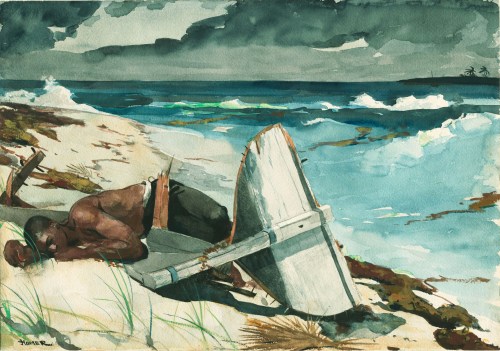
After the Hurricane, Bahamas is a watercolor painting by the American artist, Winslow Homer. It shows a man washed up on the beach after a storm, surrounded by the fragments of his shattered boat. The wreckage of the boat gives evidence of the severity of the powerful hurricane, which is retreating. Black clouds still billow but recede into the distance, and sunlight has begun to filter through the clouds.

The man may have lost his boat, but he has survived.

I love the way the whitecaps are depicted, and the colors of the sea are true to the way the ocean looks after a severe storm. Winslow Homer’s watercolor seascapes are especially intriguing to me as they are extremely dramatic and forceful expressions of nature’s power. The beauty and intensity of Homer’s vision of “ocean” are unmatched—in my opinion his seascapes are alive in a way few other artists can match.

This painting was done in 1899 and marked the end of Homer’s watercolor series depicting man against nature. That series was begun with Shark Fishing in 1885, the year he first visited the Caribbean and is comprised of at least six known paintings. The most famous of these watercolor paintings is The Gulf Stream, which was also painted in 1899. After the Hurricane, Bahamas is the last of the series.

About the artist, via Wikipedia

Winslow Homer (February 24, 1836 – September 29, 1910) was an American landscape painter and printmaker, best known for his marine subjects. He is considered one of the foremost painters in 19th-century America and a preeminent figure in American art.

Homer started painting with watercolors on a regular basis in 1873 during a summer stay in Gloucester, Massachusetts. From the beginning, his technique was natural, fluid and confident, demonstrating his innate talent for a difficult medium. His impact would be revolutionary. [3]


Credits and Attributions:

After the Hurricane, Bahamas by Winslow Homer, [Public domain], via Wikimedia Commons

[1] Wikipedia contributors, “Hurricane Helene,” Wikipedia, The Free Encyclopedia, https://en.wikipedia.org/w/index.php?title=Hurricane_Helene&oldid=1251667279 (accessed October 17, 2024).

[2] Wikipedia contributors, “Hurricane Milton,” Wikipedia, The Free Encyclopedia, https://en.wikipedia.org/w/index.php?title=Hurricane_Milton&oldid=1251634007 (accessed October 17, 2024).

[3] Wikipedia contributors, “Winslow Homer,” Wikipedia, The Free Encyclopedia, https://en.wikipedia.org/w/index.php?title=Winslow_Homer&oldid=1055649094 (accessed December 9, 2021).

IMAGE: Wikimedia Commons contributors, “File:Winslow Homer – After the Hurricane, Bahamas.jpg,” Wikimedia Commons, the free media repository, https://commons.wikimedia.org/w/index.php?title=File:Winslow_Homer_-_After_the_Hurricane,_Bahamas.jpg&oldid=428549979 (accessed December 9, 2021).

Comments Off on #FineArtFriday: revisiting After the Hurricane, Bahamas by Winslow Homer (and hurricane relief)

Filed under #FineArtFriday

#FineArtFriday: The Plaza After the Rain by Paul Cornoyer

Paul_Cornoyer_-_The_Plaza_After_RainArtist: Paul Cornoyer  (1864–1923)

Title: The Plaza After Rain

Date: Before 1910

Medium: oil on canvas

Dimensions: 59 1/4 x 59 1/4 in. (150.5 x 150.5 cm)

Collection: Saint Louis Art Museum, Saint Louis, Missouri, United States

What I love about this painting:

Rain is a near-constant companion during a Pacific Northwest winter. Paul Cornoyer’s The Plaza After Rain depicts New York City, which is on the other side of the continent from me, and it takes place in a different era. But he shows the way rain is in early spring no matter where in the northern US you reside.

The sky is dark, but the trees are just beginning to leaf out. The rain is passing and the streets are wet, but a hint of blue is showing through the dark sky. When you see this painting, you see the story of a cold spring day. Yet, one has the feeling that sunshine could happen any minute.

Impressionism is flash fiction on a canvas. All the important things are there, everything the eye needs to have a perfect vision of the mood, the setting, and characters at that moment in time. The important things at that moment are depicted within the piece, but with economy.

The St. Louis Art Museum says this about The Plaza After the Rain:

A drizzling rain creates watery reflections on the streets and sidewalks along the Grand Army Plaza in Manhattan. The rain hampers our view down the vista, though the moody tones of pinks, grays, and blues make up for this loss. The light in the distance offers a hazy glimpse of the southeast corner of Central Park, with its beloved bronze statue of Civil War general William Tecumseh Sherman. [2]

About the Author, via Wikipedia:

Paul Cornoyer (1864–1923) was an American painter, currently best known for his popularly reproduced painting in an Impressionisttonalist, and sometimes pointillist style.

Born in St. Louis, Missouri, Cornoyer began painting in Barbizon style and first exhibited in 1887. In 1889, He moved to Paris, where he studied at the Académie Julian alongside Jules Lefebvre and Jean-Joseph Benjamin-Constant. After returning from his studies in Paris in 1894, Cornoyer was heavily influenced by the American tonalists. At the urging of William Merritt Chase, he moved to New York City in 1899. In 1908, the Albright–Knox Art Gallery (formerly the Albright Gallery) hosted a show of his work. In 1909, he was elected into the National Academy of Design as an Associate Academician. He taught at Mechanics Institute of New York and in 1917, he moved to Massachusetts, where he continued to teach and paint.

Cornoyer received a retrospective exhibition entitled Paul Cornoyer: American Impressionist at the Lakeview Center for the Arts and Sciences in Peoria, Illinois in 1973. The exhibit drew heavily from the collection of Dr. and Mrs. Lawrence Ashby, who loaned multiple paintings to the exhibit, as well as over 20 works on paper. [1]


Credits and Attributions:

IMAGE: The Plaza After the Rain by Paul Cornoyer PD|100, Wikimedia Commons contributors, “File:Paul Cornoyer – The Plaza After Rain.jpg,” Wikimedia Commons, https://commons.wikimedia.org/w/index.php?title=File:Paul_Cornoyer_-_The_Plaza_After_Rain.jpg&oldid=345336218 (accessed January 18, 2024).

[1] Wikipedia contributors, “Paul Cornoyer,” Wikipedia, The Free Encyclopedia, https://en.wikipedia.org/w/index.php?title=Paul_Cornoyer&oldid=1118249028 (accessed January 18, 2024).

[2] St. Louis Art Museum contributors, the Plaza After the Rain by Paul Cornoyer, The Plaza after the Rain – Saint Louis Art Museum (slam.org) (accessed January 18, 2024).

Comments Off on #FineArtFriday: The Plaza After the Rain by Paul Cornoyer

Filed under #FineArtFriday, writing

#FineArtFriday: Mount Adams by Albert Bierstadt (revisited)


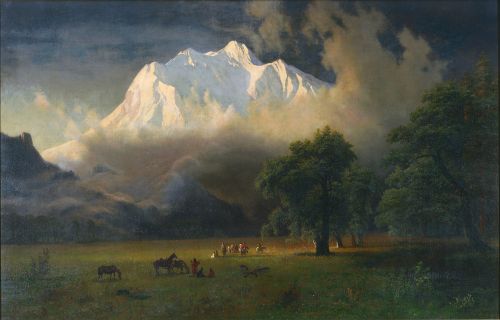
I live just north of Mount Adams. When you drive down past Mt. St. Helens, you often catch glimpses of this majestic volcano, but it is not usually on the tourist routes. Several of our native tribes call this mountain Klickitat, and some call it Pahto. Although Adams has not erupted in more than 1,000 years, it is not considered extinct.

I find it interesting that while it is the second-highest mountain in Washington State, after Mount Rainier, it is the least well-known to me. As a child, we stayed at Spirit Lake Resort (long before the 1980 eruption of Mt. St. Helens) and often camped at places near Goat Rocks. Sometimes I saw it from afar and wondered but never visited.

My father was an amputee, and 1940s prosthetics were rudimentary at best. He was unable to wear his prosthetic leg and walked on crutches. He adored fishing, but couldn’t hike for any distance, so we trailer-camped in places where he could fish from a boat. While there were camp sites in the Mt. Adams area, one often had to hike into them. But despite Dad’s disability, we traveled every summer and saw as much of our beautiful state as we could.

I don’t know if Bierstadt actually visited Mt. Adams, or painted this from what he was told–he was famous for painting scenery he had never seen and doing it with some accuracy.

Quote from Wikimedia Commons: Albert Bierstadt enjoyed great success in the years surrounding the Civil War, producing finely detailed vistas of nature’s splendor in majestic canvases that were similarly invested with significance beyond their surface appearance.

The first technically advanced artist to portray the American West, Bierstadt offered to a rapidly transforming nation pictures whose spectacular size and fresh, dramatic subject matter supplied a visual correlative to notions of American exceptionalism, while also contributing to the developing concept of Manifest Destiny.

Trained in the highly finished manner of the Düsseldorf Academy, Bierstadt’s precise style imbued his works with a reassuring sense of veracity despite their sublime subjects and occasional liberties with geographic reality. In Mount Adams, Washington, he characteristically combined an impressively scaled natural background with a foreground view of American Indian life, which serves to heighten the picture’s putative realism even as it enhances its exotic appeal.

The implied movement of the clouds and the sunlit figures on horseback similarly off to the right seems to open up the depicted space for the viewer to inhabit, providing an apt pictorial metaphor for the actual occupation and exploitation of the West by the eastern interests that constituted the artist’s clientele.


Credits and Attributions:

Mount Adams by Albert Bierstadt [Public domain], via Wikimedia Commons

Wikimedia Commons contributors, “File:1875, Bierstadt, Albert, Mount Adams, Washington.jpg,” Wikimedia Commons, the free media repository, https://commons.wikimedia.org/w/index.php?title=File:1875,_Bierstadt,_Albert,_Mount_Adams,_Washington.jpg&oldid=272380899 (accessed March 9, 2018).

4 Comments

Filed under #FineArtFriday

#FineArtFriday: View to a Clearing by Albert Bierstadt (revisited)

Title: View to a Clearing by Albert Bierstadt

Medium: oil on paper mounted on canvas

Dimensions: Height: 14 in (35.5 cm); Width: 19 in (48.2 cm)

Inscriptions: Signature bottom left: ABierstadt

What I love about this painting:

I first posted this painting a year ago. Sometimes life gets ahead of us, and we just need moment of serenity, a chance to relax and let go of stress. Life is a little hectic right now, with sorting through the possessions we’ve acquired over the years of living in this house. A box filled with corkscrews … how many does one family need?  A shopping bag packed with coaxial cables and no hint of what they were once connected to. What were we saving these for? And then there are the things people give you that you wouldn’t have bought for yourself, but which you now own and feel guilty for not appreciating.

We are moving those things on, donating them to Value Village, a store where someone else will want them and love them as they deserve. Today’s picture is a moment in time, a day long ago, but which is exactly what I needed on this dark and rainy March day.

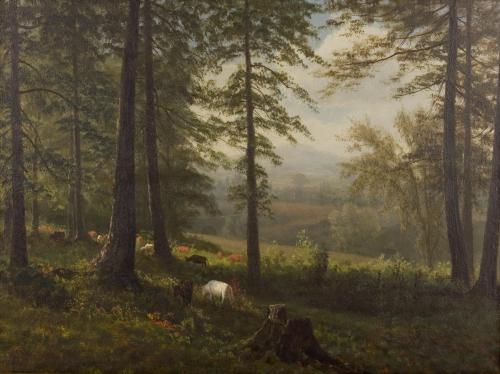
I love the peace of this scene, one of Bierstadt’s quieter paintings.  The muted colors, the rising mist, the filtered light, and the cattle grazing show us a hazy afternoon. It was perfect for a picnic, for mind-wandering, and a good day for painting.

Bierstadt is one of my favorite artists because he was often over the top, a little fantastic, and usually epic. He saw drama in nature and painted it, and like every good storyteller, his imagination filled in the blanks, employing powerful imagery to show his stories.

About the artist, via Wikipedia:

Despite his popular success, Bierstadt was criticized by some contemporaries for the romanticism evident in his choices of subject and his use of light was felt to be excessive. Some critics objected to Bierstadt’s paintings of Native Americans on the grounds that Indians “marred” the “impression of solitary grandeur.”

Interest in Bierstadt’s work was renewed in the 1960s with the exhibition of his small oil studies.  Modern opinions of Bierstadt have been divided. Some critics have regarded his work as gaudy, oversized, extravagant champions of Manifest Destiny. Others have noted that his landscapes helped create support for the conservation movement and the establishment of Yellowstone National Park. Subsequent reassessment of his work has placed it in a favorable context, as stated in 1987:

The temptation (to criticize him) should be steadfastly resisted. Bierstadt’s theatrical art, fervent sociability, international outlook, and unquenchable personal energy reflected the epic expansion in every facet of western civilization during the second half of the nineteenth century.

Bierstadt was a prolific artist, having completed over 500 paintings during his lifetime.


Credits and Attributions:

Wikimedia Commons contributors, “File:Albert Bierstadt – View to a Clearing.jpg,” Wikimedia Commons, the free media repository, https://commons.wikimedia.org/w/index.php?title=File:Albert_Bierstadt_-_View_to_a_Clearing.jpg&oldid=343092014 (accessed March 5, 2021).

Wikipedia contributors, “Albert Bierstadt,” Wikipedia, The Free Encyclopedia, https://en.wikipedia.org/w/index.php?title=Albert_Bierstadt&oldid=1009967730 (accessed March 5, 2021).

12 Comments

Filed under writing

#FineArtFriday: After the Hurricane, Bahamas by Winslow Homer, reprise

Artist: Winslow Homer (1836–1910)

Title: After the Hurricane

Date: 1899

Medium: Transparent watercolor, with touches of opaque watercolor, rewetting, blotting and scraping, over graphite, on moderately thick, moderately textured (twill texture on verso), ivory wove paper.

Dimensions: Height: 38 cm (14.9 in); Width: 54.3 cm (21.3 in)

Inscriptions: Signature and date bottom left: Homer 99

Current Location: Art Institute of Chicago, not on view

What I love about this painting:

After the Hurricane, Bahamas is a watercolor painting by the American artist, Winslow Homer. It shows a man washed up on the beach after a storm, surrounded by the fragments of his shattered boat. The wreckage of the boat gives evidence of the severity of the powerful hurricane, which is retreating. Black clouds still billow but recede into the distance, and sunlight has begun to filter through the clouds.

The man may have lost his boat, but he has survived.

I love the way the whitecaps are depicted, and the colors of the sea are true to the way the ocean looks after a severe storm. Winslow Homer’s watercolor seascapes are especially intriguing to me as they are extremely dramatic and forceful expressions of nature’s power. The beauty and intensity of Homer’s vision of “ocean” are unmatched—in my opinion his seascapes are alive in a way few other artists can match.

This painting was done in 1899 and marked the end of Homer’s watercolor series depicting man against nature. That series was begun with Shark Fishing in 1885, the year he first visited the Caribbean and is comprised of at least six known paintings. The most famous of these watercolor paintings is The Gulf Stream, which was also painted in 1899. After the Hurricane, Bahamas is the last of the series.

About the artist, via Wikipedia

Winslow Homer (February 24, 1836 – September 29, 1910) was an American landscape painter and printmaker, best known for his marine subjects. He is considered one of the foremost painters in 19th-century America and a preeminent figure in American art.

Homer started painting with watercolors on a regular basis in 1873 during a summer stay in Gloucester, Massachusetts. From the beginning, his technique was natural, fluid and confident, demonstrating his innate talent for a difficult medium. His impact would be revolutionary. [1]


Credits and Attributions:

After the Hurricane, Bahamas by Winslow Homer, [Public domain], via Wikimedia Commons

[1] Wikipedia contributors, “Winslow Homer,” Wikipedia, The Free Encyclopedia, https://en.wikipedia.org/w/index.php?title=Winslow_Homer&oldid=1055649094 (accessed December 9, 2021).

Wikimedia Commons contributors, “File:Winslow Homer – After the Hurricane, Bahamas.jpg,” Wikimedia Commons, the free media repository, https://commons.wikimedia.org/w/index.php?title=File:Winslow_Homer_-_After_the_Hurricane,_Bahamas.jpg&oldid=428549979 (accessed December 9, 2021).

6 Comments

Filed under #FineArtFriday

#FineArtFriday: View to a Clearing by Albert Bierstadt

Title: View to a Clearing by Albert Bierstadt

Medium: oil on paper mounted on canvas

Dimensions: Height: 14 in (35.5 cm); Width: 19 in (48.2 cm)

Inscriptions: Signature bottom left: ABierstadt

What I love about this painting:

I love the serenity of this scene, one of Bierstadt’s quieter paintings.  The muted colors, the rising mist, the filtered light, and the cattle grazing show us a hazy afternoon. It was perfect for a picnic, for mind-wandering, and a good day for painting.

Bierstadt is one of my favorite artists because he was often over the top, a little fantastic, and usually epic. He saw drama in nature and painted it, and like every good storyteller, his imagination filled in the blanks with with powerful imagery.

About the artist, via Wikipedia:

Despite his popular success, Bierstadt was criticized by some contemporaries for the romanticism evident in his choices of subject and his use of light was felt to be excessive. Some critics objected to Bierstadt’s paintings of Native Americans on the grounds that Indians “marred” the “impression of solitary grandeur.”

Interest in Bierstadt’s work was renewed in the 1960s with the exhibition of his small oil studies.  Modern opinions of Bierstadt have been divided. Some critics have regarded his work as gaudy, oversized, extravagant champions of Manifest Destiny. Others have noted that his landscapes helped create support for the conservation movement and the establishment of Yellowstone National Park. Subsequent reassessment of his work has placed it in a favorable context, as stated in 1987:

The temptation (to criticize him) should be steadfastly resisted. Bierstadt’s theatrical art, fervent sociability, international outlook, and unquenchable personal energy reflected the epic expansion in every facet of western civilization during the second half of the nineteenth century.

Bierstadt was a prolific artist, having completed over 500 paintings during his lifetime.


Credits and Attributions:

Wikimedia Commons contributors, “File:Albert Bierstadt – View to a Clearing.jpg,” Wikimedia Commons, the free media repository, https://commons.wikimedia.org/w/index.php?title=File:Albert_Bierstadt_-_View_to_a_Clearing.jpg&oldid=343092014 (accessed March 5, 2021).

Wikipedia contributors, “Albert Bierstadt,” Wikipedia, The Free Encyclopedia, https://en.wikipedia.org/w/index.php?title=Albert_Bierstadt&oldid=1009967730 (accessed March 5, 2021).

2 Comments

Filed under writing

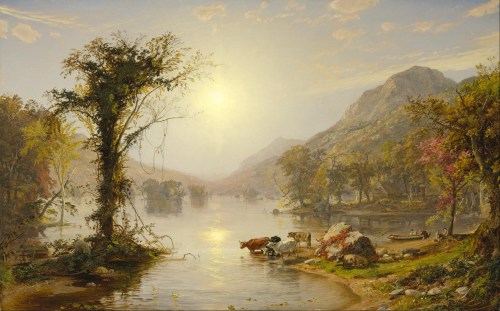
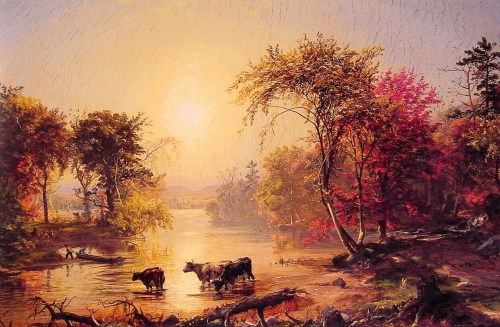
#FineArtFriday: Autumn On Greenwood Lake – two landscapes by Jasper Francis Cropsey (revisited)

This post first appeared here in October of 2018. It features two beautiful images of Autumn in New England in the mid-nineteenth century. I like both these paintings for the way the water is depicted, and the hazy hills.

Jasper Francis Cropsey created many paintings of Greenwood Lake, a freshwater lake on the border between New York State and New Jersey, beginning in 1843. Over the next few decades, Cropsey painted numerous scenes of the area, many from the same viewpoint on the lake as today’s featured paintings, each with varying intensities of color.

What I love about these two paintings, done years apart, is  difference in the quality of  the light. One is done in an early autumn, the other later in the season. The subject matter is similar, cows drinking at waters edge, fishers and their rowboat, but the trees are different, more mature in the second, and it is later in the evening. The autumn haze completely hides the hills.

Clearly, this was a place that was beloved by the artist, as he returned year after year, and made many landscapes of this beach and the surrounding area.

About the artist (Via Wikipedia):

Jasper Francis Cropsey (February 18, 1823 – June 22, 1900) was an important American landscape artist of the Hudson River School. He was best known for his lavish use of color and, as a first-generation member from the Hudson River School, painted autumn landscapes that startled viewers with their boldness and brilliance. As an artist, he believed landscapes were the highest art form and that nature was a direct manifestation of God. He also felt a patriotic affiliation with nature and saw his paintings as depicting the rugged and unspoiled qualities of America.

Jasper Cropsey died in anonymity but was rediscovered by galleries and collectors in the 1960s.


Credits and Attributions:

Autumn on Greenwood Lake, ca. 1861, by Jasper Francis Cropsey [Public domain], via Wikimedia Commons

Autumn in America, by Jasper Francis Cropsey [Public domain], via Wikimedia Commons

Wikipedia contributors, “Jasper Francis Cropsey,” Wikipedia, The Free Encyclopedia, https://en.wikipedia.org/w/index.php?title=Jasper_Francis_Cropsey&oldid=842742891 (accessed October 19, 2018).

Comments Off on #FineArtFriday: Autumn On Greenwood Lake – two landscapes by Jasper Francis Cropsey (revisited)

Filed under #FineArtFriday