Tag Archives: American Landscape Art

#FineArtFriday: a closer look at “The Beeches” by Asher Brown Durand 1845 #prompt

The_Beeches_MET_DT75Artist: Asher Brown Durand  (1796–1886)

Title: The Beeches

Genre: landscape art

Date: 1845

Medium: oil on canvas

Dimensions: 60 3/8 x 48 1/8 in. (153.4 x 122.2 cm)

Collection: Metropolitan Museum of Art

Current location: American Paintings and Sculpture

What I love about this painting:

It’s been raining cats and dogs here, a regular monsoon. There has been some minor flooding here as the street drains aren’t able to cope with the quantities of rain that has fallen for the last week. It seems like a good time to revisit one of my favorite paintings, one detailing a sunny day painted during a calmer time.

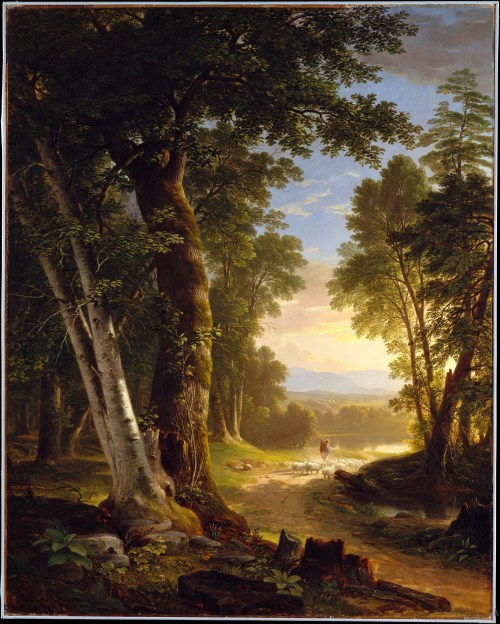
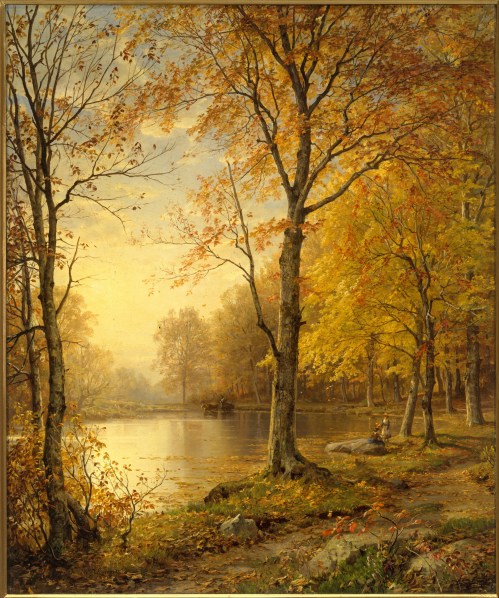
Asher Brown Durand gives us a summer day on the shore of a large pond, in a grove of beech and birch trees. The large beech tree is magnificent, with its rough, moss-covered bark commanding the center stage. In the distance, as if they were accidentally included, a shepherd leads a flock of sheep, a minor part of the scene as compared to the superb majesty of the beech tree.

Yet, nothing in this painting is accidental. The sheep and their shepherd are painted in exquisite detail, with as much attention as he gives to the texture of the bark and the moss. Each leaf, each blade of grass, each stone—every part of this scene is painted with intention. Each component of this landscape painting is as true and perfect as they were in real life.

I love the natural feeling of the plants, the intense colors of nature, the sense of a place that is vibrant and alive.

This painting is not merely a photographic representation of a summer morning in 1845. It has a life, a sense that you are there. We can almost feel the warming sunshine and slight breeze lifting the morning haze, hear the sheep as they walk to the water, perhaps even catch the earthy scent of the woods around us.

What story will you find in this scene? I think there are several. The observer has a story, but so does the shepherd and the sheep. The tree also has a story, but trees rarely tell what they know.

Durand was a master in the Hudson River School, a group of artists who believed that nature in the form of the American landscape was a reflection of God. Durand himself wrote, “The true province of Landscape Art is the representation of the work of God in the visible creation.” [1]

This painting demonstrates that conviction.

About the Artist, via Wikipedia:

Asher Brown Durand (August 21, 1796, – September 17, 1886). (He) was an American painter of the Hudson River School. was born in, and eventually died in, Maplewood, New Jersey (then called Jefferson Village). He was the eighth of eleven children. Durand’s father was a watchmaker and a silversmith.

Durand was apprenticed to an engraver from 1812 to 1817 and later entered into a partnership with the owner of the company, Charles Cushing Wright (1796–1854), who asked him to manage the company’s New York office. He engraved Declaration of Independence for John Trumbull during 1823, which established Durand’s reputation as one of the country’s finest engravers. Durand helped organize the New York Drawing Association in 1825, which would become the National Academy of Design; he would serve the organization as president from 1845 to 1861.

Asher’s engravings on bank notes were used as the portraits for America’s first postage stamps, the 1847 series. Along with his brother Cyrus he also engraved some of the succeeding 1851 issues.

Durand’s main interest changed from engraving to oil painting about 1830 with the encouragement of his patron, Luman Reed. In 1837, he accompanied his friend Thomas Cole on a sketching expedition to Schroon Lake in the Adirondacks Mountains, and soon after he began to concentrate on landscape painting. He spent summers sketching in the Catskills, Adirondacks, and the White Mountains of New Hampshire, making hundreds of drawings and oil sketches that were later incorporated into finished academy pieces which helped to define the Hudson River School.

Durand is remembered particularly for his detailed portrayals of trees, rocks, and foliage. He was an advocate for drawing directly from nature with as much realism as possible. [1]


Credits and Attributions:

Image:  The Beeches by Asher Brown Durand, PD|100. Wikimedia Commons contributors, “File:The Beeches MET DT75.jpg,” Wikimedia Commons, the free media repository, https://commons.wikimedia.org/w/index.php?title=File:The_Beeches_MET_DT75.jpg&oldid=617658539 (accessed November 6, 2025).

[1] Wikipedia contributors, “Asher Brown Durand,” Wikipedia, The Free Encyclopedia, https://en.wikipedia.org/w/index.php?title=Asher_Brown_Durand&oldid=1129313847 (accessed November 6, 2025).
2 Comments

Filed under #FineArtFriday

#FineArtFriday: revisiting Indian Summer by William Trost Richards 1875
Indian_Summer_MET_DT276257Title: Indian Summer by William Trost Richards

Genre: landscape art

Date: 1875

Medium: oil on canvas

Dimensions: 24 1/8 x 20 in. (61.3 x 50.8 cm)

Collection: Metropolitan Museum of Art

What I love about this painting:

Autumn is upon us once again. I was looking through the vault at Wikimedia Commons, and my eye kept being drawn to this painting by William Trost Richards. I featured this painting two years ago, and still love the feeling of “zen” that Trost Richards managed to instill into this scene.

He captured a singular moment of tranquility. A light breeze barely ruffles the surface of our pond. At the bottom right, two girls play beside a large boulder at the water’s edge.

Across the pond, in the center and nearly hidden in the shadows, a teamster and his oxen wade across the shallows.

Autumn’s haze lends a feeling of mystery to the scene, muting the reds, yellows, and oranges of leaves about to fall. This last burst of grandeur can’t hold back winter, though it tries. Soon, the forest will sleep, snow and ice will decorate barren limbs, and ice will stop the waters’ gentle motions.

But beneath the grasp of winter, new life will bide its time, and winter will fade into spring. The seasons will follow their course, but today is autumn’s day to shine, to go down in a blaze of golden glory.

A century ago, William Trost Richards painted a scene of peace and serenity, perfectly capturing it. He preserved the glory of the scenery, but more than that, he captured the mood and the atmosphere of a perfect autumn day. When we view this scene, we can sit back and admire the beauty of our world.

 >>><<<

About William Trost Richards via Wikipedia:

William Trost Richards (November 14, 1833 – November 8, 1905) was an American landscape artist. He was associated with both the Hudson River School and the American Pre-Raphaelite movement. [1]

In 1856, he married Anna Matlack Richards (1834–1900), a 19th-century American children’s author, poet and translator best known for her fantasy novel, A New Alice in the Old Wonderland. The couple had eight children, only five of whom lived past infancy. Anna educated the children at home to a pre-college level in the arts and sciences. [2]

One of the couple’s sons, Theodore William Richards, would later win the 1914 Nobel Prize in Chemistry. Anna Richards Brewster, their sixth child, went on to become an important painter in her own right, having received an early arts education from her father as well. [2]

Richards rejected the romanticized and stylized approach of other Hudson River painters and instead insisted on meticulous factual renderings. His views of the White Mountains are almost photographic in their realism. In later years, Richards painted almost exclusively marine watercolors. [1]


Credits and Attributions:

Indian Summer by William Trost Richards, Wikimedia Commons contributors, “File:Indian Summer MET DT276257.jpg,” Wikimedia Commons, the free media repository, https://commons.wikimedia.org/w/index.php?title=File:Indian_Summer_MET_DT276257.jpg&oldid=678817431 (accessed November 3, 2022). Public Domain.

[1] Wikipedia contributors, “William Trost Richards,” Wikipedia, The Free Encyclopedia, https://en.wikipedia.org/w/index.php?title=William_Trost_Richards&oldid=1089835304 (accessed November 3, 2022).

[2] Wikipedia contributors, “Anna Matlack Richards,” Wikipedia, The Free Encyclopedia, https://en.wikipedia.org/w/index.php?title=Anna_Matlack_Richards&oldid=1055684363 (accessed November 3, 2022).

4 Comments

Filed under #FineArtFriday, writing

#FineArtFriday: Hudson River at Croton Point by Julie Hart Beers 1869

JulieBeers-Hudson_River_at_Croton_Point_1869Artist: Julie Hart Beers  (1834–1913)

Title: Hudson River at Croton Point

Genre: landscape art

Date: 1869

Medium: oil on canvas

Dimensions: height: 12.2 in (31.1 cm); width: 20.2 in (51.4 cm)

What I love about this image:

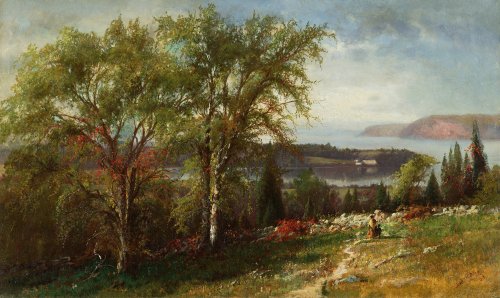
I love the way this scene is framed. We look downhill towards the Hudson River, seeing the rock outcroppings and stony land that is this part of New York State. Julie Hart Beers places a woman and child in this scene, rather than the usual men at work or draft and dairy animals that the male artists of the time usually placed in their work.

The trees at the edge of the meadow, birch and maples, are just beginning to turn red and gold—autumn is nearly here. I love the serenity of this scene, the peace of a day not too long after the end of the Civil War. It was a day of calm during a time when politics were still turbulent.

I love that Julie Hart Beers, a woman artist who was denied formal training solely because she was female, had brothers who gave her the education she needed. I love that they respected her as she made her way in an art world dominated by men jealous of their position, and achieved a grudging respect from the critics.

About the Artist, via Wikipedia:

Julie Hart Beers Kempson (1835 – August 13, 1913) was an American landscape painter associated with the Hudson River School who was one of the very few commercially successful professional women landscape painters of her day.

Born Julie Hart in Pittsfield, Massachusetts, she was the daughter of James Hart and Marion (Robertson) Hart, who had immigrated from Scotland in 1831. Her older brothers William Hart and James McDougal Hart were also important landscape painters of the Hudson River School, and her nieces Letitia Bonnet Hart and Mary Theresa Hart became well-known painters as well. Another niece, Annie L. Y. Orff, became an editor and publisher.

In 1853, she married journalist George Washington Beers. After his death in 1856 she and her two daughters moved to New York City, where her brothers had their studios. Like most women artists of the day, she had no formal art education, but it is thought that she was trained by her brothers.

Well into her forties, with her second husband, Peter Kempson, she moved to Metuchen, New Jersey, where she set up her own studio. She continued to use the surname Beers when signing her artwork.

At the time of her death she was living in Trenton.

By 1867, Beers was exhibiting her paintings. Although she had her own studio in New Jersey, she continued to use William’s studio on 10th Street in New York City as a showroom. She was one of very few women to become a professional landscape painter in the America of her day, in part because women were excluded from formal art education and exhibition opportunities.

Beers’s mature style balances sweeping, well-balanced compositions with telling details. In the 1870s and 1880s, she exhibited frequently at the National Academy of Design as well as at the Brooklyn Art Association, the Boston Athenæum, and the Pennsylvania Academy of Fine Arts. She was able to sell a good deal of work through the Brooklyn Art Association,  but she also took groups of women on sketching trips to the mountains of New York and New England to supplement her income.

She also painted some still lifes. [1]


Credits and Attributions

IMAGE: Hudson River at Croton Point by Julie Hart Beers. Wikimedia Commons contributors, “File:JulieBeers-Hudson River at Croton Point 1869.jpg,” Wikimedia Commons, https://commons.wikimedia.org/w/index.php?title=File:JulieBeers-Hudson_River_at_Croton_Point_1869.jpg&oldid=659236570 (accessed November 9, 2023).

[1] Wikipedia contributors, “Julie Hart Beers,” Wikipedia, The Free Encyclopedia, https://en.wikipedia.org/w/index.php?title=Julie_Hart_Beers&oldid=1163696436 (accessed November 9, 2023).

Comments Off on #FineArtFriday: Hudson River at Croton Point by Julie Hart Beers 1869

Filed under #FineArtFriday

#FineArtFriday: Cider Pressing by George Henry Durrie 1855 (revisited)
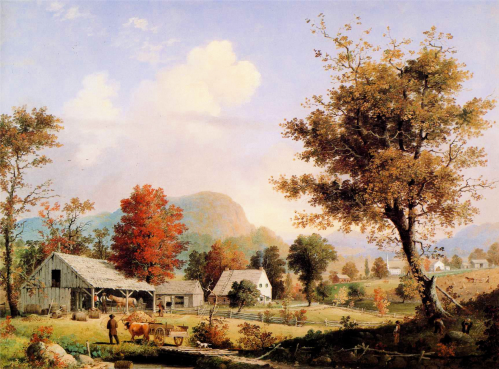
George_Henry_Durrie_-_Cider_PressingCider Pressing by George Henry Durrie 1855

Date: 1855

Medium: oil on canvas

Dimensions: Height: 22.2 in (56.5 cm); Width: 30.2 in (76.8 cm)

Collection: Private collection (Mr. & Mrs. Eugene Bugbee)

What I love about this painting:

We’re nearing the end of October, and autumn is fast sliding into the long dark of a northern November. Some trees are shedding their leaves here in the Pacific Northwest, but others are clinging to the last shreds of yellow and gold. Our native fall colors are less brilliant than those depicted in Durie’s work, but many non-native species have been introduced in the suburban landscape, offering bursts of scarlet and orange.

I love the simplicity of George Henry Durrie’s paintings. This one in particular deserves a second look. It first appeared here in September of 2021.

This is a quintessential, slightly romantic, view of history, a window into a New England day in autumn during the 19th century. A farmer leads his ox-drawn cart to the cider press. Is he selling them to the cider-man or just paying to have them juiced? Does he make his own apple jack, or is he a teamster, transporting goods for a fee?

A story can be found here, as in all Durrie’s paintings.

Juicing apples for unfermented ciders juices, jellies, and the highly fermented apple jack was an essential part of bringing in the harvest and preparing for winter, a part of the food chain we who get our food from the supermarket are disconnected from. But this was a scene that played out every fall, in every town and village.

Durrie’s colors are intensely vibrant, deep and rich, and each part of the scene is clear and placed with intent. The air is crisp and cool, but not yet cold. The leaves are turning all shades of red and gold, just as they are doing here today in the Pacific Northwest.

About the Artist, quoted from the National Gallery of Art:

Born in New Haven in 1820, the son of a Connecticut stationer, George Henry Durrie remained in that city virtually his entire life. Married to a choirmaster’s daughter, Sarah Perkins, in 1841, he immersed himself in the quiet pursuits of family and church. While he never achieved the fame of the most renowned nineteenth century American landscape painters, he appears to have had a fulfilling, productive career. His letters show that he never felt the need to move beyond his community, although he once briefly took a studio in New York and exhibited there regularly at the National Academy of Design.

Almost all of his compositions are relatively small in scale, few exceeding 18 x 24 inches, and his views are quiet and intimate. He knew and admired the works of Thomas Cole, and may have tried to emulate certain aspects of Cole’s style, yet he eschewed the Hudson River School’s compositional complexity and expansiveness. Because his paintings combined extensive genre elements with landscape they had a story-telling content that made them pleasant, accessible images to the average viewer.

The lithographic firm of Currier & Ives successfully reproduced ten of Durrie’s scenes and these, in turn, became popular calendar illustrations in the twentieth century. As a result, Durrie’s depictions of rural life in the mid-nineteenth century are now among the most familiar images in all of American art. As Martha Hutson has noted, however, these printed pictures do not convey the keen sensitivity to and understanding of conditions of atmosphere and light that are so pronounced in Durrie’s paintings. [1]

From Wikipedia:

In his teens the self-taught artist painted portraits in the New Haven area. In 1839 he received artistic instruction from Nathaniel Jocelyn, a local engraver and portrait painter. After 1842 he settled in New Haven, but made painting trips to New Jersey, New York, and Virginia. Around 1850, he began painting genre scenes of rural life, as well as the winter landscapes that became popular when Currier and Ives published them as lithographs. Four prints were published between 1860 and the artist’s death in New Haven in 1863; six additional prints were issued posthumously. The painter Jeanette Shepperd Harrison Loop studied with him. [2]


Credits and Attributions:

Wikimedia Commons contributors, “File:George Henry Durrie – Cider Pressing.JPG,” Wikimedia Commons, the free media repository, https://commons.wikimedia.org/w/index.php?title=File:George_Henry_Durrie_-_Cider_Pressing.JPG&oldid=369724230 (accessed September 15, 2021).

[1] National Gallery of Art contributors, “George Henry Durrie,” biography, © 2018 – 2021 National Gallery of Art, https://www.nga.gov/collection/artist-info.6397.html

[2] Wikipedia contributors, “George Henry Durrie,” Wikipedia, The Free Encyclopedia, https://en.wikipedia.org/w/index.php?title=George_Henry_Durrie&oldid=861433469 (accessed September 15, 2021).

2 Comments

Filed under #FineArtFriday, writing

#FineArtFriday: A Coming Storm by Sanford Robinson Gifford

Gifford_A_Coming_Storm_1863-1880_PMA

Artist: Sanford Robinson Gifford,

Title: A Coming Storm (1863)

Date: 1863 (retouched 1880)

Location: Philadelphia Museum of Art.

What I love about this painting:

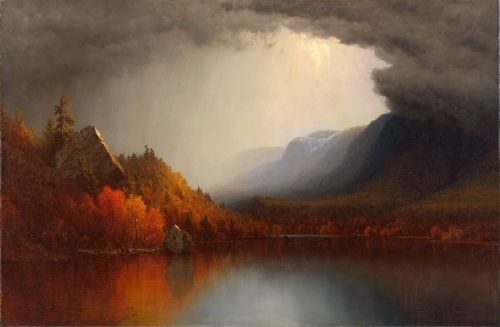
Gifford demonstrates his skill as a devotee of luminism and gives us the perfect view of a fine autumn day and the approaching storm. The way he contrasts the sun’s light against the ominous black clouds is true to nature, to how storms really look as they close in.

I like the way he shows the rock outcroppings, visible evidence of the hard stone of the mountains that lies beneath the lush finery of autumn foliage.

For the moment, the waters of the pond are quiet, reflecting the sky above. Rain cloaks the view of the distant valley, and soon we will feel the brunt of it. Enjoy the blaze of color while you can, as tomorrow those trees will be half-bare, and the ground will be covered in sodden tatters of red and gold.

While there appears to be some damage in the upper center, the integrity of the painting is still intact. It was retouched in 1880, but a modern retouching would likely bring it back to its original glory.

About the Artist, via Wikipedia:

Sanford Robinson Gifford (July 10, 1823 – August 29, 1880) was an American landscape painter and a leading member of the second generation of Hudson River School artists. A highly regarded practitioner of Luminism, his work was noted for its emphasis on light and soft atmospheric effects.

Although trained as a portrait painter, the first work Gifford exhibited at the National Academy was a landscape, in 1847. Thereafter, Gifford devoted himself primarily to landscape painting, becoming one of the finest artists of the Hudson River School. He was elected an Associate of the National Academy in 1851, and an Academician in 1854.

2008 National Academy of Design controversy:

In December 2008, one of Gifford’s paintings, Mount Mansfield, Vermont (1859), became part of a controversy over deaccessioning by the National Academy of Design. The Academy was a member of the Association of Art Museum Directors, whose policy stated that member museums could not sell works of art to cover operating expenses, only to purchase superior works or to weed out inferior or redundant ones. Prior to joining AAMD, the Academy had sold two Thomas Eakins works (including his “diploma painting,” Wrestlers) in the 1970s, and Richard Caton Woodville‘s War News from Mexico (1848) in 1994. According to its former curator, David Dearinger: “When the Academy later applied to the museum association for accreditation, Mr. Dearinger recalled, it was asked about the Woodville sale and promised not to repeat such a move.”

In a 2008 sale, the Academy quietly sold Frederic Edwin Church‘s Scene on the Magdalene (1854) and Sanford Gifford’s Mount Mansfield, Vermont (1859) to a private collector for US$13.5 million. The former was the Academy’s only painting by Church; the latter was its only painting by Gifford. Both had been “donated to the Academy in 1865 by another painter, James Augustus Suydam.” News of the sale was broken by arts blogger Lee Rosenbaum. As punishment for these actions, AAMD asked its other member museums to “cease lending artworks to the Academy and collaborating with it on exhibitions.” The Academy had contemplated selling additional paintings, but those plans were abandoned after being reported by Rosenbaum. [1]


Credits and Attributions:

IMAGE: A Coming Storm by Sanford Robinson Gifford. Wikimedia Commons contributors, “File:Gifford A Coming Storm 1863-1880 PMA.jpg,” Wikimedia Commons, https://commons.wikimedia.org/w/index.php?title=File:Gifford_A_Coming_Storm_1863-1880_PMA.jpg&oldid=803742381 (accessed October 5, 2023).

[1] Wikipedia contributors, “Sanford Robinson Gifford,” Wikipedia, The Free Encyclopedia, https://en.wikipedia.org/w/index.php?title=Sanford_Robinson_Gifford&oldid=1176083433 (accessed October 5, 2023).

Comments Off on #FineArtFriday: A Coming Storm by Sanford Robinson Gifford

Filed under #FineArtFriday

#FineArtFriday: A Storm in the Rocky Mountains – Mt. Rosalie by Albert Bierstadt 1866

Albert_Bierstadt_-_A_Storm_in_the_Rocky_Mountains,_Mt._Rosalie_-_Google_Art_ProjectArtist: Albert Bierstadt  (1830–1902)

Title: A Storm in the Rocky Mountains, Mt. Rosalie

Genre: landscape art

Date: 1866

Medium: oil on canvas

Dimensions: height: 210.8 cm (82.9 in); width: 361.3 cm (11.8 ft)

Collection: Brooklyn Museum: American Identities: A New Look, American Landscape, 5th Floor

What I love about this painting:

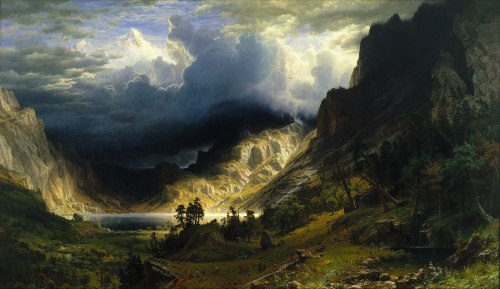
Albert Bierstadt painted his idea of what the American West of his time should be, grand, pristine, and wild. He painted what he saw, slightly fictionalized, so the viewer would see what he felt. He gave us entire stories on his canvas, epic explorations of the power and beauty of nature.

Bierstadt’s skies were imbued with high drama contrasted with peaceful vistas below. He took the places he had visited and made them bigger, grander, made the viewer feel the emotions he experienced when he first laid eyes on them.

About this painting via Wikipedia:

A Storm in the Rocky Mountains, Mt. Rosalie is an 1866 landscape oil painting by German-American painter Albert Bierstadt (1830-1902) which was inspired by sketches created on an 1863 expedition.

Bierstadt traveled to the Colorado Rocky Mountains where he was taken up to the Chicago Lakes beneath Mount Evans. The painting is named after Bierstadt’s mistress and, at the time, his friend’s wife, Rosalie Osborne Ludlow. The painting, measuring at 210.8 × 361.3 cm (83.0 × 142.2 in), is exhibited at the Brooklyn Museum, which acquired it in 1976.

The painting depicts Native American hunter/gatherers hunting deer in the foreground. A Native American encampment resides by a stream in the distance. The mountains are thrown into either sunlight or the darkness of a thunderstorm. In order to increase its dramatic value, Bierstadt exaggerated the scale of the Rocky Mountains.

Peering through a break in the clouds in the far distance is a snow-capped Mt. Rosalie, named after Bierstadt’s wife.

Upon its completion, the painting toured the United States for a year. On 7 February 1866, A Storm in the Rocky Mountains, Mount Rosalie exhibited for one day and evening at the Somerville Art Gallery in New York City as a benefit for the “Nursery and Child’s Hospital.” [1]

Quote from Wikimedia Commons: Albert Bierstadt enjoyed great success in the years surrounding the Civil War, producing finely detailed vistas of nature’s splendor in majestic canvases that were similarly invested with significance beyond their surface appearance.

The first technically advanced artist to portray the American West, Bierstadt offered to a rapidly transforming nation pictures whose spectacular size and fresh, dramatic subject matter supplied a visual correlative to notions of American exceptionalism, while also contributing to the developing concept of Manifest Destiny.

Trained in the highly finished manner of the Düsseldorf Academy, Bierstadt’s precise style imbued his works with a reassuring sense of veracity despite their sublime subjects and occasional liberties with geographic reality. [2]

About the Artist, via Wikipedia:

Albert Bierstadt (January 7, 1830 – February 18, 1902) was a German American painter best known for his lavish, sweeping landscapes of the American West. He joined several journeys of the Westward Expansion to paint the scenes. He was not the first artist to record the sites, but he was the foremost painter of them for the remainder of the 19th century.

Bierstadt was born in Prussia, but his family moved to the United States when he was one year old. He returned to study painting for several years in Düsseldorf. He became part of the second generation of the Hudson River School in New York, an informal group of like-minded painters who started painting along the Hudson River. Their style was based on carefully detailed paintings with romantic, almost glowing lighting, sometimes called luminism. Bierstadt was an important interpreter of the western landscape, and he is also grouped with the Rocky Mountain School.


Credits and Attributions:

Image: Wikimedia Commons contributors, ‘File:Albert Bierstadt – A Storm in the Rocky Mountains, Mt. Rosalie – Google Art Project.jpg’, Wikimedia Commons, 29 July 2023, 05:50 UTC, <https://commons.wikimedia.org/w/index.php?title=File:Albert_Bierstadt_-_A_Storm_in_the_Rocky_Mountains,_Mt._Rosalie_-_Google_Art_Project.jpg&oldid=787844562> [accessed 1 September 2023]

[1] Wikipedia contributors, “A Storm in the Rocky Mountains, Mt. Rosalie,” Wikipedia, The Free Encyclopedia, https://en.wikipedia.org/w/index.php?title=A_Storm_in_the_Rocky_Mountains,_Mt._Rosalie&oldid=1160866547 (accessed September 1, 2023).

[2] Wikimedia Commons contributors, “File:1875, Bierstadt, Albert, Mount Adams, Washington.jpg,” Wikimedia Commons, the free media repository, https://commons.wikimedia.org/w/index.php?title=File:1875,_Bierstadt,_Albert,_Mount_Adams,_Washington.jpg&oldid=272380899 (accessed March 9, 2018).

2 Comments

Filed under #FineArtFriday

#FineArtFriday: Mount Adams by Albert Bierstadt (revisited)


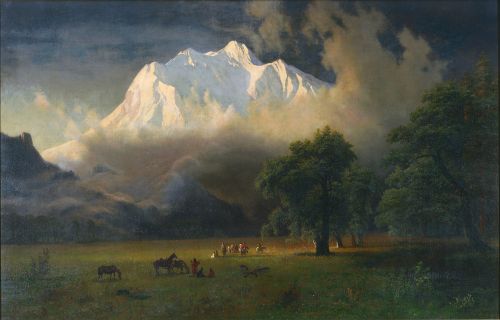
I live just north of Mount Adams. When you drive down past Mt. St. Helens, you often catch glimpses of this majestic volcano, but it is not usually on the tourist routes. Several of our native tribes call this mountain Klickitat, and some call it Pahto. Although Adams has not erupted in more than 1,000 years, it is not considered extinct.

I find it interesting that while it is the second-highest mountain in Washington State, after Mount Rainier, it is the least well-known to me. As a child, we stayed at Spirit Lake Resort (long before the 1980 eruption of Mt. St. Helens) and often camped at places near Goat Rocks. Sometimes I saw it from afar and wondered but never visited.

My father was an amputee, and 1940s prosthetics were rudimentary at best. He was unable to wear his prosthetic leg and walked on crutches. He adored fishing, but couldn’t hike for any distance, so we trailer-camped in places where he could fish from a boat. While there were camp sites in the Mt. Adams area, one often had to hike into them. But despite Dad’s disability, we traveled every summer and saw as much of our beautiful state as we could.

I don’t know if Bierstadt actually visited Mt. Adams, or painted this from what he was told–he was famous for painting scenery he had never seen and doing it with some accuracy.

Quote from Wikimedia Commons: Albert Bierstadt enjoyed great success in the years surrounding the Civil War, producing finely detailed vistas of nature’s splendor in majestic canvases that were similarly invested with significance beyond their surface appearance.

The first technically advanced artist to portray the American West, Bierstadt offered to a rapidly transforming nation pictures whose spectacular size and fresh, dramatic subject matter supplied a visual correlative to notions of American exceptionalism, while also contributing to the developing concept of Manifest Destiny.

Trained in the highly finished manner of the Düsseldorf Academy, Bierstadt’s precise style imbued his works with a reassuring sense of veracity despite their sublime subjects and occasional liberties with geographic reality. In Mount Adams, Washington, he characteristically combined an impressively scaled natural background with a foreground view of American Indian life, which serves to heighten the picture’s putative realism even as it enhances its exotic appeal.

The implied movement of the clouds and the sunlit figures on horseback similarly off to the right seems to open up the depicted space for the viewer to inhabit, providing an apt pictorial metaphor for the actual occupation and exploitation of the West by the eastern interests that constituted the artist’s clientele.


Credits and Attributions:

Mount Adams by Albert Bierstadt [Public domain], via Wikimedia Commons

Wikimedia Commons contributors, “File:1875, Bierstadt, Albert, Mount Adams, Washington.jpg,” Wikimedia Commons, the free media repository, https://commons.wikimedia.org/w/index.php?title=File:1875,_Bierstadt,_Albert,_Mount_Adams,_Washington.jpg&oldid=272380899 (accessed March 9, 2018).

4 Comments

Filed under #FineArtFriday

#FineArtFriday: California Spring by Albert Bierstadt 1875

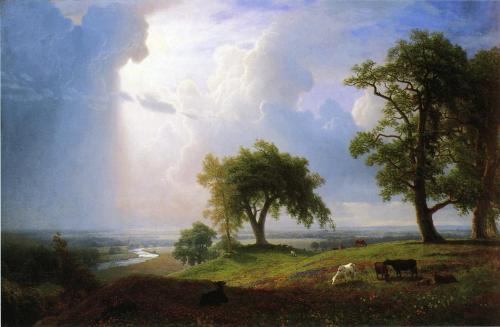
Albert_Bierstadt_California_SpringArtist: Albert Bierstadt (1830–1902)

Title: California Spring

Genre: landscape art

Date: 1875

Medium: oil on canvas

Dimensions: height: 187.3 cm (73.7 in); width: 264.2 cm (104 in)

Current location: Fine Arts Museums of San Francisco

What I love about this painting:

I love this composition, the way everything is deliberately placed. Cattle graze on a hilltop beneath a grove of trees, uncaring of the rainstorm sweeping across the valley below, far off in the distance. The immensity of the sky is the focus of this scene, with the sun emerging from the clouds, a brief promise of warmer days. Spring has arrived on this hilltop.

Here at Casa del Jasperson, we’re tired of winter, done with rain and dark days. Albert Bierstadt paints us an idyllic scene of seasonal weather and the harmony of nature. The grass is green, the cattle are happy, and while rain may come, summer is around the corner.

About the artist, via Wikipedia:

Albert Bierstadt (January 7, 1830 – February 18, 1902) was a German American painter best known for his lavish, sweeping landscapes of the American West. He joined several journeys of the Westward Expansion to paint the scenes. He was not the first artist to record the sites, but he was the foremost painter of them for the remainder of the 19th century.

Bierstadt was born in Prussia, but his family moved to the United States when he was one year old. He returned to study painting for several years in Düsseldorf. He became part of the second generation of the Hudson River School in New York, an informal group of like-minded painters who started painting along the Hudson River. Their style was based on carefully detailed paintings with romantic, almost glowing lighting, sometimes called luminism. Bierstadt was an important interpreter of the western landscape, and he is also grouped with the Rocky Mountain School. [1]


Credits and Attributions:

Image: Wikimedia Commons contributors, “File:Albert Bierstadt California Spring.jpg,” Wikimedia Commons, the free media repository, https://commons.wikimedia.org/w/index.php?title=File:Albert_Bierstadt_California_Spring.jpg&oldid=701053175 (accessed February 9, 2023).

[1] Wikipedia contributors, “Albert Bierstadt,” Wikipedia, The Free Encyclopedia, https://en.wikipedia.org/w/index.php?title=Albert_Bierstadt&oldid=1137881139 (accessed February 9, 2023).

5 Comments

Filed under #FineArtFriday, writing

#FineArtFriday: The Beeches by Asher Brown Durand 1845

The_Beeches_MET_DT75Artist: Asher Brown Durand  (1796–1886)

Title: The Beeches

Genre: landscape art

Date: 1845

Medium: oil on canvas

Dimensions: 60 3/8 x 48 1/8 in. (153.4 x 122.2 cm)

Collection: Metropolitan Museum of Art

Current location: American Paintings and Sculpture

What I love about this painting:

It’s been storming here on the west coast of the US, dumping rain. California has been hard hit with so much rain the soil can’t absorb it. Yet, though the snowpack will bring relief (if the state doesn’t wash away) the drought is not over. California Storms Help Relieve Drought, But How Much Is in Question – The New York Times (nytimes.com)

Here in the Puget Sound area, we’re experiencing the usual wind and rain of a Northwest winter, hopefully a respite from the droughts we’ve suffered in the past decade. So, it’s good time to enjoy the image of sunny day painted in a calmer time.

Asher Brown Durand gives us a summer day on the shore of a large pond, in a grove of beech and birch trees. The large beech tree is magnificent, with its rough, moss-covered bark commanding the center stage. In the distance, as if they were accidentally included, a shepherd leads a flock of sheep, a minor part of the scene as compared to the superb majesty of the beech tree.

Yet, nothing in this painting is accidental. The sheep and their shepherd are painted in exquisite detail, with as much attention as he gives to the texture of the bark and the moss. Each leaf, each blade of grass, each stone—every part of this scene is painted with intention. Each component of this landscape painting is as true and perfect as they were in real life.

I love the natural feeling of the plants, the intense colors of nature, the sense of a place that is vibrant and alive.

This painting is not merely a photographic representation of a summer morning in 1845. It has a life, a sense that you are there. We can almost feel the warming sunshine and slight breeze lifting the morning haze, hear the sheep as they walk to the water, perhaps even catch the earthy scent of the woods around us.

Durand was a master in the Hudson River School, a group of artists who believed that nature in the form of the American landscape was a reflection of God. Durand himself wrote, “The true province of Landscape Art is the representation of the work of God in the visible creation.” [1] This painting demonstrates that conviction.

About the Artist, via Wikipedia:

Asher Brown Durand (August 21, 1796, – September 17, 1886). (He) was an American painter of the Hudson River School. was born in, and eventually died in, Maplewood, New Jersey (then called Jefferson Village). He was the eighth of eleven children. Durand’s father was a watchmaker and a silversmith.

Durand was apprenticed to an engraver from 1812 to 1817 and later entered into a partnership with the owner of the company, Charles Cushing Wright (1796–1854), who asked him to manage the company’s New York office. He engraved Declaration of Independence for John Trumbull during 1823, which established Durand’s reputation as one of the country’s finest engravers. Durand helped organize the New York Drawing Association in 1825, which would become the National Academy of Design; he would serve the organization as president from 1845 to 1861.

Asher’s engravings on bank notes were used as the portraits for America’s first postage stamps, the 1847 series. Along with his brother Cyrus he also engraved some of the succeeding 1851 issues.

Durand’s main interest changed from engraving to oil painting about 1830 with the encouragement of his patron, Luman Reed. In 1837, he accompanied his friend Thomas Cole on a sketching expedition to Schroon Lake in the Adirondacks Mountains, and soon after he began to concentrate on landscape painting. He spent summers sketching in the Catskills, Adirondacks, and the White Mountains of New Hampshire, making hundreds of drawings and oil sketches that were later incorporated into finished academy pieces which helped to define the Hudson River School.

Durand is remembered particularly for his detailed portrayals of trees, rocks, and foliage. He was an advocate for drawing directly from nature with as much realism as possible. [1]


Credits and Attributions:

Image:  The Beeches by Asher Brown Durand, PD|100. Wikimedia Commons contributors, “File:The Beeches MET DT75.jpg,” Wikimedia Commons, the free media repository, https://commons.wikimedia.org/w/index.php?title=File:The_Beeches_MET_DT75.jpg&oldid=617658539 (accessed January 12, 2023).

[1] Wikipedia contributors, “Asher Brown Durand,” Wikipedia, The Free Encyclopedia, https://en.wikipedia.org/w/index.php?title=Asher_Brown_Durand&oldid=1129313847 (accessed January 12, 2023).

2 Comments

Filed under #FineArtFriday

#FineArtFriday: Indian Summer by William Trost Richards 1875

Indian_Summer_MET_DT276257Title: Indian Summer by William Trost Richards

Genre: landscape art

Date: 1875

Medium: oil on canvas

Dimensions: 24 1/8 x 20 in. (61.3 x 50.8 cm)

Collection: Metropolitan Museum of Art

What I love about this painting:

Richards has captured a singular moment of tranquility for us all to enjoy in these troubled times. A light breeze barely ruffles the surface of our pond. At the bottom right, two girls play beside a large boulder at the waters’ edge.

Across the pond, in the center and nearly hidden in the shadows, a teamster and his oxen wade across the shallows.

Autumn’s haze lends a feeling of mystery to the scene, muting the reds, yellows, and oranges of leaves about to fall. This last burst of grandeur can’t hold back winter, though it tries. Soon the forest will sleep, soon snow and ice will decorate barren limbs and ice will stop the waters’ gentle motions.

But beneath the grasp of winter, new life will bide its time, and winter will fade into spring. The seasons will follow their course, but today is autumn’s day to shine, to go down in a blaze of golden glory.

Richards paints a day of peace and serenity, a small pocket of time where one can just sit back and admire the beauty of our world.

 >>><<<

About William Trost Richards:

William Trost Richards (November 14, 1833 – November 8, 1905) was an American landscape artist. He was associated with both the Hudson River School and the American Pre-Raphaelite movement. [1]

1856 he married Anna Matlack Richards (1834–1900), a 19th-century American children’s author, poet and translator best known for her fantasy novel, A New Alice in the Old Wonderland. The couple had eight children, only five of whom lived past infancy. Anna educated the children at home to a pre-college level in the arts and sciences. [2]

One of the couple’s sons, Theodore William Richards, would later win the 1914 Nobel Prize in Chemistry. Anna Richards Brewster, their sixth child, went on to become an important painter in her own right, having received an early arts education from her father as well. [2]

Richards rejected the romanticized and stylized approach of other Hudson River painters and instead insisted on meticulous factual renderings. His views of the White Mountains are almost photographic in their realism. In later years, Richards painted almost exclusively marine watercolors. [1]


Credits and Attributions:

Indian Summer by William Trost Richards, Wikimedia Commons contributors, “File:Indian Summer MET DT276257.jpg,” Wikimedia Commons, the free media repository, https://commons.wikimedia.org/w/index.php?title=File:Indian_Summer_MET_DT276257.jpg&oldid=678817431 (accessed November 3, 2022). Public Domain.

[1] Wikipedia contributors, “William Trost Richards,” Wikipedia, The Free Encyclopedia, https://en.wikipedia.org/w/index.php?title=William_Trost_Richards&oldid=1089835304 (accessed November 3, 2022).

[2] Wikipedia contributors, “Anna Matlack Richards,” Wikipedia, The Free Encyclopedia, https://en.wikipedia.org/w/index.php?title=Anna_Matlack_Richards&oldid=1055684363 (accessed November 3, 2022).

1 Comment

Filed under #FineArtFriday, writing