Tag Archives: atmosphere in literature

The second draft – subtext #writing

Subtext is a complex but essential aspect of storytelling. As the word implies, subtext lies below the surface (sub) and supports the plot and the conversations (text).

It is the hidden story, an unstated knowledge embedded within the narrative.

Subtext can be inserted into the story through the layers of worldbuilding. It is conveyed by the images we place in the environment and how the setting influences our perception of the mood and atmosphere.

We all know good worldbuilding is more than simply detailing the setting. It starts there, but without the addition of mood and atmosphere, a coffee shop is just a room with a few tables and chairs. A reader’s perception of a gripping narrative’s reality is influenced by aspects of the setting that they may not consciously notice at the time.

How does good worldbuilding contribute to good subtext? The clues about mood and atmosphere combine on a subliminal level. This undercurrent shapes a reader’s emotional impressions of the story.

A brief mention of décor can convey atmosphere: Tess stood in line, looking around while Evan secured a table. Country-style furnishings lent a coziness to the room, a warm contrast to the rain pounding on the windows. Soon it was her turn to order. “Two large mochas, please.”

A view of the world from the characters’ point of view is essential, as it conveys mood.

“Why did they bother putting a sign on the dining hall? No matter what Temple you visit, every building is made of white sandstone and you always know where you are and what you are looking at.” Bryson’s scathing tones floated to the instructor, who glared at us all.
Afterward, while readers may not consciously remember details, they will remember what they felt as they read that novel. When asked who their favorite writer is, they will mention that author.

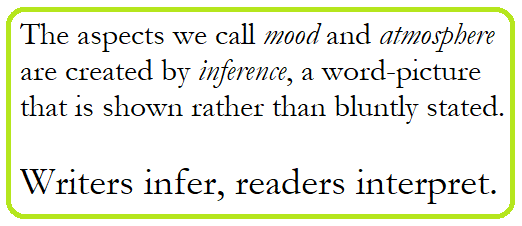
When we experience emotion, we are feeling the effect of contrasts, of transitioning from the positive (good) to the negative (bad) and back to the positive. Moodatmosphere, and emotion form the inferential layer of a story, part of the subtext. When an author has done their job well, those transitions feel personal to the reader.

Atmosphere has two aspects: overall and personal. The overall atmosphere of a story is long-term, an element of mood that is conveyed by the setting as well as by the actions and reactions of the characters.

The overall mood of a story is also long-term. It resides in the background, going almost unnoticed. Mood shapes (and is shaped by) the emotions evoked within the story.

The inferential layer of a story has another component, one we must look at in the second draft. This is where another aspect of worldbuilding, scene framing, comes into play. This component has two aspects: first, it involves the order in which we stage people and visual objects, as well as the sequence of events along the plot arc. It shapes the overall mood and atmosphere, contributing to the subtext.
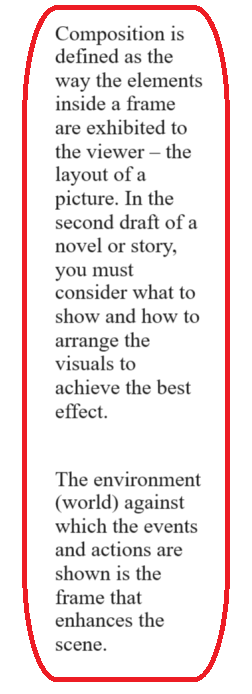
The second aspect of scene framing involves the plot arc and how we place the scenes and their transitions. We want them in a logical, sequential order.

Good worldbuilding can help us give backstory without an info dump, and symbolism is a key tool for this. Environmental symbols are subliminal landmarks for the reader. Thinking about and planning symbolism in an environment is crucial to developing the general atmosphere and affecting the overall mood.

For example, the word gothic in a novel’s description tells me it will be a dark, moody piece set in a stark, desolate environment. A cold, barren landscape, constant dampness, and continually gray skies set a somber tone to the background of the scene.

A setting like that underscores each of the main characters’ personal problems and evokes a general atmosphere of gloom.

Our characters’ emotions affect their attitudes toward each other and influence how they view their quest. This, in turn, shapes the overall mood of the characters as they move through the arc of the plot. And the visual atmosphere of a particular environment may affect our protagonist’s personal mood.

What tools in our writer’s toolbox are effective in conveying an atmosphere and a specific mood? Allegory and symbolism are two devices that are similar but different. The difference between them is how they are presented.

  • Allegoryis a moral lesson in the form of a story, heavy with symbolism.
  • Symbolismis a literary device that uses one thing throughout the narrative (perhaps shadows) to represent something else (grief).
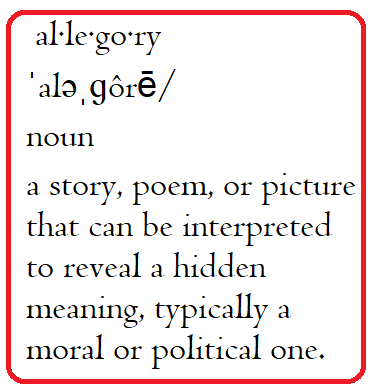
How can we use allegory and symbolism in modern genre fiction? Cyberpunk, as a subgenre of science fiction, is exceedingly atmosphere-driven. It is heavily symbolic in worldbuilding and often allegorical in the narrative. We see many features of the classic 18th and 19th-century Sturm und Drang literary themes but set in a dystopian society. The deities that humankind must battle are technology and industry. Corporate uber-giants are the gods whose knowledge mere mortals desire and whom they seek to replace.

The setting and worldbuilding in cyberpunk work together to convey a gothic atmosphere. This overall feeling is dark and disturbing. That aspect of subtext is reinforced by the dark nature of interpersonal relationships and the often criminal behaviors our characters engage in for survival.

No matter what genre we write in, the second draft is where we expand on our ideas and fill in the gaps of the rough first draft manuscript. We find words to show the setting more clearly and use visuals to hint at what is to come. We create an immersive atmosphere by including colors, scents, and ambient sounds.

We choose our words carefully as they determine how the visuals are shown. When we have no words and feel stuck, we go to the thesaurus and find them.

Authors are painters, creating worlds out of words. We strive to create an atmosphere and mood that underscores our themes and highlights plot points without resorting to info dumps. Each word is a brushstroke that can lighten the mood as easily as it can darken it.

  • When we create a setting, intense color brightens the visuals, and gray depresses them. Those tones affect the atmosphere and mood of the scene.

In the real world, sunshine, green foliage, blue skies, and birdsong go a long way toward lifting my spirits. When I read a scene set in that kind of environment, the mood of the narrative feels lighter to me.

Worldbuilding is complex. It can feel too difficult when we are trying to convey subtext, mood, and atmosphere, using slimmed down prose and power words rather than flowery. But keep at it because the reader won’t be aware of the complexities involved.

All they will know is how strongly the protagonist and her story affected them and how much they loved that novel.
3 Comments

Filed under writing

Layers of Depth – using atmosphere to emphasize emotion #amwriting

Writing emotions with depth is a balancing act, and simply showing the outward physical indicators of a particular emotion is only half the story. Every idea for a novel comes to me with an idea for the overall mood. That mood will underscore and emphasize the characters’ personal mood and changing emotions.

depth-of-characterIn his book, Story, Robert McKee tells us that emotion is the experience of transition, of the characters moving between a positive and negative. Beneath and behind the emotions that our characters experience is the atmosphere of the story, going unnoticed on the surface.

Atmosphere is the aspect of mood that setting conveys. It is only an ambiance, but it is a powerful tool for helping us show our characters’ emotional state.

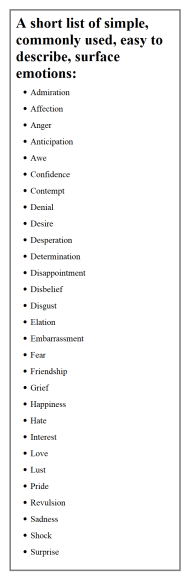
When creating our characters, we find it easy to connect with vivid emotions, such as hate, anger, desire, and passion. These are loud emotions.

Volume control is a crucial part of the overall pacing of our story. “Loud” deafens us and loses its power when it’s the only sound. So, like the opening movement of Beethoven’s 5th Symphony, we must contrast loud against quiet to create the texture of our story.

When we first begin as writers, we find it difficult to convey our characters’ emotions without telling the reader what to feel. After receiving our share of abuse from other writers, we swing toward showing their every mood in minuscule detail.

emotionwordslist01LIRF06232020Truthfully, I find detailed descriptions of facial expressions to be boring and sometimes off-putting. Every author armed with a little knowledge writes characters with curving lips, stretching lips, and lips doing many things over, and over, and over … with little variation.
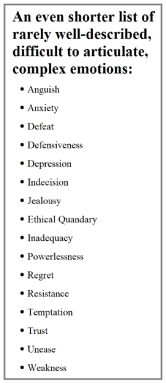
A happy medium between telling and showing can be achieved, but it takes work. We must choose words that show what we mean and use the environment to convey subtle feelings wherever possible. I say wherever possible because it is not practicable to always employ the setting in a narrative. We need to get inside the characters’ heads.

Severe emotional shock strikes us, and we have an immediate physical reaction.

Visceral reactions are involuntary—out of our control. We can’t stop our faces from flushing or our hearts from pounding. Visceral feelings are emotions we feel deeply. We find it difficult to control or ignore them because they are instinctive and not the result of thought.

We can pretend it didn’t happen or hide it, but we can’t stop it. An internal physical gut reaction is difficult to convey without offering the reader some information, a framework to hang the image on.

There will be an instant reaction. How does a “gut reaction” feel? We might experience nausea, gut punch, or a feeling of butterflies in our stomach. Think about how you respond to internal surprises, and write those feelings down.

I experience severe shocks this way:

  • disbelief—the OMG moment
  • a sinking feeling in the pit of my stomach, freezing in place, or a shout of “No!”
  • Years ago, on witnessing a horrific accident, I experienced disassociation or a feeling of viewing the scene from outside myself. This involuntary coping or defense mechanism is meant to minimize or help a person tolerate stress.

When we write mild reactions, offering a lot of emotional descriptions is unnecessary because mild is boring. A raised eyebrow, a sideways glance—small gestures show the attitude and mood of the character.

But good pacing requires balance. Quiet scenes enable us (and our characters) to process the events detailed in the louder scenes.

However, strong emotions are compelling. Highly charged situations are strengthened by the way we write the emotional experience. The way we show the setting reinforces each physical response.

The following is an excerpt from a work in progress:

Knowledge lay in Ivan’s belly, a cold ball of disaster. He had already failed as a shaman, and he wasn’t even a true seeker. But he couldn’t let Cai down, had to prove he could resolve it. He forced a smile, projecting confidence. “Look at that view. I’d heard the lake is so large one can’t see the southern shore from Neville, but I didn’t realize its truth. It seems as vast as the sky.”

As you can see, I struggle with these concepts as much as any other writer does. This scene is set on an early spring morning with cold winds shuttling heavy clouds across a blue sky. Rain moves in later in the day, underscoring Ivan’s dark mood. Sometimes I do well at conveying atmosphere and emotion; other times, I don’t. But I keep trying because it takes effort to succeed in anything.

When I write a scene, I ask myself why this character is reacting this way. Emotions without cause have no basis for existence, no foundation. They’re a lot of noise about nothing.

The emotion hits, and the character processes it. From a different work in progress:

It would have been the first battle spell John had cast in years, but no. His battle abilities were still gone, as if the inferno he’d unleashed in the culvert had burned them away.

Timing is crucial, and this is the moment to slip in a brief mention of the backstory. That way, we avoid an info dump, but the reader has the information needed to make the emotion tangible.

On the heels of that thought, John was overcome by the remembered sounds, the roar of flames, the shrieks of the enemy …. he sagged to the curb, gagging and gasping, unable to breathe properly, panicking under the weight of it.

emotionwordslist02LIRF06232020Simplicity has an impact, but I struggle to achieve balance. When looking for words with visceral and emotional power, consonants are your friend. Verbs that begin with consonants are powerful.
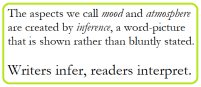
Use forceful words, and you won’t have to resort to a great deal of description. Weak word choices separate the reader from the experience, dulling the emotional impact of what could be an intense scene.

If you are between projects and don’t know what to write, a good exercise is to create an intense and dramatic scene for characters you currently have no story for. Give them a setting, and use it to emphasize how they feel.

The key to writing a good scene is to practice. You may find a later use for these characters, and that scene could be the seed of a longer story. The more we practice this aspect of the craft, the better we get at it.

And the more we write, the more individual and recognizable our writing voice becomes.

17 Comments

Filed under writing

Layers of Depth: Mood and Emotion #amwriting

Readers and authors often use the word mood interchangeably with atmosphere when describing a scene or passage. Like conjoined twins, mood and atmosphere march along together—separate but intertwined so closely that they seem as one.

mood-emotions-2-LIRF09152020Mood is long-term, a feeling residing in the background, going almost unnoticed. Mood affects (and is affected by) the emotions evoked within the story.

Atmosphere is also long-term but is sometimes more noticeable as it is a worldbuilding component. Atmosphere is the aspect of mood that setting conveys.

Emotion is immediate and short-term. It exists in the foreground but contributes to the overall atmosphere and mood.

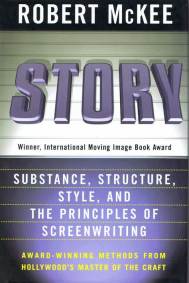
In his book, Story, Robert McKee tells us that emotion is the experience of transition, of the characters moving between a positive and negative. “Story” by Robert McKee,

Much of my information comes from seminar videos on the craft of writing found on YouTube and posted by Robert McKee. He is an excellent teacher, and his textbook is a core component of my personal library. A wonderful 6-minute lesson on the difference between mood and emotion can be found at:

Robert McKee, Q&A: What Is the Difference Between Mood and Emotion?

While emotions are immediate, they can be subtle. I look for books where emotions are dynamic, because that is when the character’s internal struggle becomes personal to me.

Mood is a large word serving several purposes. It is created by the setting (atmosphere), the exchanges of dialogue (conversation), and the tone of the narrative (word choices, descriptions). It is also affected by (and refers to) the emotional state of the characters—their personal mood.

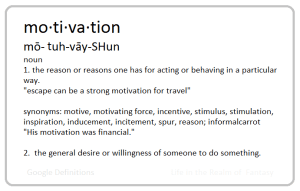
Mood-and-atmosphere-LIRF04302023Undermotivated emotions lack credibility and leave the reader feeling as if the story is flat. In real life, we have deep, personal reasons for our feelings, and so must our characters.
A woman shoots another woman. Why? Add in the factor of her child having been accidentally killed by the woman she murders, and you have high emotion and high drama. Therefore, just as in real life, the root cause for a character’s emotions is a fundamental motivation for their actions.

Which is more important, mood or emotion? Both and neither. Characters’ emotions affect the overall mood of a story. In turn, the atmosphere of a particular environment may affect the characters’ personal mood. Their individual attitudes affect the emotional state of the group.

Because emotion is the experience of transition from the negative to the positive and back again, emotion changes a character’s values, and they either grow or stagnate. This is part of the inferential layer, as the audience must infer (deduce) the experience. You can’t tell a reader how to feel. They must experience and understand (infer) what drives the character on a human level.

What is mood? Wikipedia says:

In literature, mood is the atmosphere of the narrative. Mood is created by means of setting (locale and surroundings in which the narrative takes place), attitude (of the narrator and of the characters in the narrative), and descriptions. Though atmosphere and setting are connected, they may be considered separately to a degree. Atmosphere is the aura of mood that surrounds the story. It is to fiction what the sensory level is to poetry.[1] Mood is established in order to affect the reader emotionally and psychologically and to provide a feeling for the narrative.

What is atmosphere? It is created by our word choices and is intangible, but it affects how the reader perceives the story. The setting contributes to the atmosphere, so it is a component of worldbuilding. But we should note that the setting is only a place; it is not atmosphere. Atmosphere comes into play when we place certain visual elements into the scenery with the intention of creating a mood in the reader.

  • Tumbleweeds rolling across a barren desert.
  • Waves crashing against cliffs.
  • Dirty dishes resting beside the sink.
  • A chill breeze wafting through a broken window.

Atmosphere is created as much by odors, scents, ambient sounds, and visuals as by the characters’ moods and emotions. It is a component of the environment but is also an ambiance because it is intentional.

We build atmosphere into a setting with the aim of creating a specific frame of mind or emotion in the reader.

I love it when an author drops me into an atmosphere that colors their world and shapes the characters’ moods.

So, now we know that atmosphere is environmental, separate but connected to the general emotional mood of a piece. From the story’s first paragraph, we want to establish a feeling of atmosphere, the general mood that will hint at what is to come.

storybyrobertmckeeRobert McKee tells us that the mood/dynamic of any story is there to make the emotional experience of our characters specific. It makes their emotions feel natural. After all, the mood and atmosphere Emily Brontë instilled into the setting of Wuthering Heights make the depictions of mental and physical cruelty seem like they would happen there.
Happy, sad, neutral—atmosphere and mood lend a flavor to the emotions our characters experience, giving them emphasis and making them real to the reader.

For me, as a writer, the inferential layer of a story is complicated. Creating a world-on-paper requires thought even when we live in that world. We know how the atmosphere and mood of our neighborhood feel when we walk to the store. But try conveying that mood and atmosphere in a letter to a friend – it’s harder than it looks.

Next up: a closer examination of emotions and why showing is so much more difficult (and sometimes dangerous) than telling.


Credits and Attributions:

Wikipedia contributors, “Mood (literature),” Wikipedia, The Free Encyclopedia, https://en.wikipedia.org/w/index.php?title=Mood_(literature)&oldid=1147399122 (accessed April 30, 2023).

13 Comments

Filed under writing

World-building, part 2: building reality #amwriting

When I write a world that my characters might live in, I want to express more than merely the sights, the sounds, and the smells. I want to convey the emotions that place evokes for me, the author.

The fact is, unless we are there physically, other places don’t really exist for us. For this reason, the only world that really exists in this incarnation is the space we physically occupy as individuals.

The only true reality is the space we can see, hear, smell, and touch. This is our setting, the world in which our life story plays out.

In literary terms, what is setting? It is the environment your characters live and interact with. It is scenery, topography, plants, and animals. The setting is also comprised of a place in time, defined by an era, or a level of technology.

These aspects of the setting are crucial to making a story real to a reader. However, if they are shown as unconnected elements, this setting lacks something. We must inject these elements with the indefinable fantasy thingamajig we call atmosphere.

Perhaps you experience a sense of longing when remembering a particular place.  For me, one place represents a feeling of home and lingers in my heart. When I am writing in my fictional world, I am drawing on the memory of that long-ago place.

That lost time and place has a hold on my emotions and is made brighter and shinier by the false lighting of memory. This is why, despite the fact my childhood home is a real place, it is also a fantasy.

A reader’s perception of a setting’s reality is affected by emotions they aren’t even aware of. We must give the reader something they can subliminally recognize, something they can relate to. We need to convey a sense of familiarity to a place the reader has never been.

“Familiar” does not mean safe or comforting. It means the elements of the environment are recognizable on a subconscious level, something the reader can understand without having experienced it, or being bluntly told.

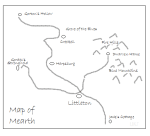
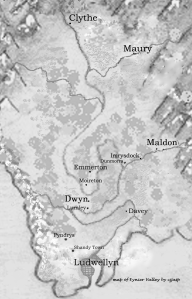
This is why I draw maps. If your characters must do any traveling in a fantasy world, you probably should make a rudimentary map. The map is my indispensable tool for keeping my story straight.

It doesn’t have to be fancy. All that is required is a pencil sketch showing a few lines for roads and the general location of any cities or topographical features that come into the story.

When your characters are traveling great distances, they may pass through villages on their way, and if these places figure in the events of the book, they should be noted on the map. This prevents you from:

  • accidentally naming a second village the same name later in the manuscript
  • misspelling the town’s name later in the narrative
  • forgetting where the characters were in chapter four

Perhaps the land itself will impede your characters. If geologic features are pertinent to the story, you will want to note their location on your map so that you don’t contradict yourself if your party must return the way they came:

  • rivers
  • swamps
  • mountains
  • hills
  • towns
  • forests
  • oceans

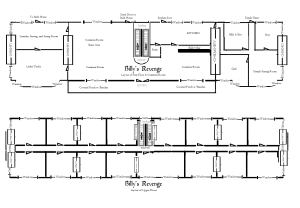
Even if your work is wholly set on a space station/ship, consider making a floor plan.

My novel, Billy Ninefingers, is set almost entirely in a wayside inn. I made a drawing of the floorplan for my purposes because that is the world in which the story takes place.

In the narrative, if you are writing fantasy, I suggest you keep the actual distances mushy because some readers will nitpick the details, no matter how accurate you are. Yes, you wrote it, but they don’t see it the way you do.

Using medieval distances won’t help, because they’re not concrete—a league might be three miles or one and a half, depending on the country and era. Some readers will argue that their version of a league is the only real version and blah blah blah….

When it comes to creating reality on paper, a perception of familiarity is everything. Use your memory to visualize the scenery:

Imagine the surface of a pond. On a windless day, the pool will be calm, still. The sky and any overhanging trees will be reflected in it.

Add in a storm, and things change. The waters move. Ripples and small waves stir the surface, which now only reflects the dark gray of the stormy sky.

Atmosphere is the part of a world that is created by colors, scents, ambient sounds, and how the visuals are shown. It is visual and tied to the setting, but the perception of it is affected by the moods and emotions of the characters.

From the first paragraph of a story, we want to use the setting to establish a feeling of atmosphere, the general mood that will hint at what is to come.

We do this by employing lighter or darker descriptions. A dark, gloomy setting created by “weighted words” establishes an ominous atmosphere, which will be reflected in the mood of your characters.

I think of “weighted words” as those with strong descriptive power, and which don’t need a lot of support from adjectives and adverbs to convey their intensity.

Lighter words will create an atmosphere that feels brighter.

We have mentioned before that while the two terms, mood and atmosphere, are usually used as synonyms, they are different from each other. In literature, mood refers to the internal feelings and emotions of an individual as often as it does the overall atmosphere of a piece. The term atmosphere is always associated with a setting.

Many sci-fi and fantasy novels are set in real-world environments. The settings are familiar, so close to what we know, that readers have no trouble accepting that world.

I love books where the author’s gift for world-building creates a layer of reality I can immediately “fall” into. Setting, action, interaction—these most obvious components combine to showcase the more profound aspects of the story.

I have been returning to the works of other authors to see how they create their worlds, how they choose words to build a setting and create atmosphere and mood.

Some of their tricks work, and some not so much, but I keep reading and learning. By figuring out what didn’t work for me in a novel, I hope to avoid those mistakes in my own work.

8 Comments

Filed under writing

The inferential layer of the Word-Pond: Mood and Emotion #amwriting

Today we go a little deeper into the Word-Pond that we call Story. In talking about literature, the word mood is sometimes used interchangeably with atmosphere. Like conjoined twins, mood and atmosphere march along together; separate, but intertwined so closely that they seem as one. Mood is long term in the background and makes the emotions evoked within the story specific. Atmosphere is also long term but is part of world-building. Atmosphere is the aspect of mood that setting conveys.

Emotion is immediate, short term. It exists in the foreground but works best when in conjunction with the overall atmosphere/mood.

Robert McKee, in his video seminars, tells us that emotion is the experience of transition, of the characters moving between a positive and negative.

While emotions are immediate, they can be subtle. I like books where emotions are dynamic, but where the character’s internal struggle becomes personal to me.

Mood is a large word serving several purposes. It is created by the setting (atmosphere), by the exchanges of dialogue (conversation), and the tone of the narrative (word choices, descriptions). It is also affected by (and refers to) the emotional state of the characters—their personal mood.

Emotions that are undermotivated lack credibility and leave us, the reader, feeling as if the story is flat. We have deep, personal reasons for our emotions, and so must our characters.

A woman shoots another woman. Why? Add in the factor of her child having been murdered by this woman, and you have high emotion, high drama. Therefore, motivation for a character’s emotions is fundamental to the motivation for their actions.

Which is more important, mood or emotion? Both and neither. Characters’ emotions affect the overall mood of a story. In turn, the atmosphere of a particular environment may affect the characters’ personal mood. Their individual moods affect the emotional state of the group.

Because emotion is the experience of transition from the negative to the positive and back again, emotion changes a character’s values, and they either grow or devolve. This is part of the inferential layer as the audience must infer (deduce) the experience.

You can’t tell a reader how to feel—they must experience what the character feels and understand (infer) the character on a human level.

What is mood? Wikipedia says:

In literature, mood is the atmosphere of the narrative. Mood is created by means of setting (locale and surroundings in which the narrative takes place), attitude (of the narrator and of the characters in the narrative), and descriptions. Though atmosphere and setting are connected, they may be considered separately to a degree. Atmosphere is the aura of mood that surrounds the story. It is to fiction what the sensory level is to poetry.[1] Mood is established in order to affect the reader emotionally and psychologically and to provide a feeling for the narrative

SO:

Setting can contribute to atmosphere, but in itself, the setting is only a place, not atmosphere.

What is atmosphere? Atmosphere is associated with the environment but is an ambiance that pervades a literary piece with the intention of evoking a certain frame of mind or emotion in the reader. Atmosphere is created as much by odors, scents, ambient sounds, and visuals as it is by the characters’ moods and emotions.

Now we know that atmosphere is environmental, separate but connected to the general emotional mood of a piece. From the first paragraph of a story, we want to establish a feeling of atmosphere, the general mood that will hint at what is to come.

PEDIAA https://pediaa.com/difference-between-mood-and-atmosphere/  says:

Mood vs. Atmosphere

Although the two terms, mood and atmosphere, are usually used as synonyms, there is a subtle difference between mood and atmosphere in a general sense. Mood can refer to the internal feelings and emotions of an individual. However, the term atmosphere is always associated with a venue. But, the mood and atmosphere are interrelated in this aspect as well. For example, a gloomy and dark setting in a play creates an ominous atmosphere. This atmosphere can also affect the mood of the characters as well as the audience.

Difference Between Mood and Atmosphere

  • Mood refers to the internal emotions of an individual.
  • Atmosphere is usually linked to a place.
  • However, both mood and atmosphere are used as synonyms in literature.   
  • They refer to the emotional feelings inspired by a piece of literary work.
  • Mood and atmosphere are created by diction, dialogues, descriptions, tone, setting, etc.

Robert McKee tells us that the mood/dynamic of any story is there to make the emotional experience of our characters specific. Happy, sad, neutral—the overall emotional mood is no substitute for the characters’ emotions, but the two, overall mood and emotion must work together to draw the reader in.

This inferential layer of the Word-Pond we call Story is the place where we realize that creating this pond requires thought on our part. Like a diver seeing an undiscovered shipwreck for the first time, the story is still waiting to be uncovered. The bottom of this pond is still distant, and we have a lot of deep water to travel before we get there. On our way down, we have more denizens of the deep to examine.

Next up: a closer examination of Writing Emotions: the sharks of the Word-Pond.


Credits and Attributions:

Much of my information comes from watching seminar-videos on the craft of writing found on YouTube, and posted by Robert McKee. He is an excellent teacher, and YouTube University is a free resource for the struggling author. His book,  “Story” by Robert McKee, is a core textbook of my personal library. Robert McKee on YouTube

Wikipedia contributors, “Mood (literature),” Wikipedia, The Free Encyclopedia, https://en.wikipedia.org/w/index.php?title=Mood_(literature)&oldid=895686542 (accessed July 7, 2019).

Difference Between Mood and Atmosphere, by Hasa © 2017 PEDIIA https://pediaa.com/difference-between-mood-and-atmosphere/ (accessed July 7, 2019).

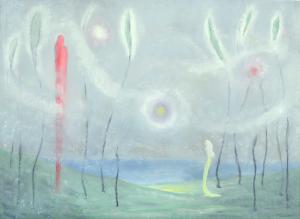
Wikimedia Commons contributors, “File:The Oracle – Hawaiian Symbolist by Marguerite Blasingame.jpg,” Wikimedia Commons, the free media repository, https://commons.wikimedia.org/w/index.php?title=File:The_Oracle_-_Hawaiian_Symbolist_by_Marguerite_Blasingame.jpg&oldid=276120985 (accessed June 27, 2019).

Ruins of the Oybin (Dreamer) – Caspar David Friedrich 1835 [Public domain]
Wikimedia Commons contributors, “File:Caspar David Friedrich 011.jpg,” Wikimedia Commons, the free media repository, https://commons.wikimedia.org/w/index.php?title=File:Caspar_David_Friedrich_011.jpg&oldid=326731449  (accessed May 24, 2019).

3 Comments

Filed under writing