
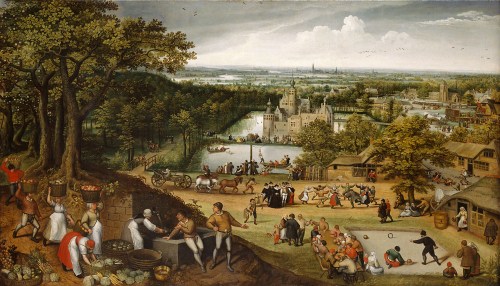
Artist: Lucas van Valckenborch (1535–1597)
Title: Autumn Landscape (September)
Date: 1585
Medium: oil on canvas
Dimensions: 116 x 198 cm Rahmenmaße: 131,5 x 214 x 6,5 cm
Collection: Kunsthistorisches Museum
What I love about this painting:
We see an entire view of ordinary autumn life in the 16th century, but better than that, Lucas van Valckenborch shows us the passage of time. He depicts the chronology of how people lived and celebrated each week of the changing season by showing us September in the Netherlands.
The way he shows us this chronology is ingenious and is a signature of his work. The early weeks of September are shown in the left foreground, with laborers bringing in the harvest. Others are working to dry and preserve foods. The colors he uses are vivid, the last shades of summer.
In the bottom to middle right, he shows us mid-September with people relaxing, feasting, bowling, and dancing. The harvest is in, and people have a little time to enjoy the last days of good weather. The colors he uses are more muted, with shades of brown dominating. The leaves are brown and falling. Yet, there is a vibrancy about it, a sense of life. People celebrate a successful harvest one last time before winter’s cold grip closes in.
In late September, people fish, and the market becomes the center of village life. People are less active, but the market draws customers. The end of September presages colder weather and hints at the beginning of winter. This is shown in cool shades of gray, as if in a black-and-white photograph.
He is known for using this trick of color to denote receding distances. But he deliberately places figures performing specific activities within those colors, showing us how people lived and the passage of their days as well as distance.
The first days of September are bright, days of plenty. Yes, we’re working hard, but we’ll be grateful for the bounty when winter comes.
We look forward to the middle of September, because once the rush of harvest is over we will party like it’s 1585.
In the distance, we know the cold dark days loom, but we are prepared. Our cellars will be full and we will hunt and fish while we can.
Lucas van Valckenborch’s body of work shows us that he was a brilliant storyteller as well as an artist. Many paintings of that time show us the poverty, but here we see the prosperity of a village during the early renaissance. It wasn’t all doom and gloom after all.
About the Artist and his work, via Wikipedia:
Lucas van Valckenborch or Lucas van Valckenborch the Elder (c. 1535 in Leuven – 2 February 1597 in Frankfurt am Main) was a Flemish painter, mainly known for his landscapes. He also made contributions to portrait painting, and allegorical and market scenes. Court painter to Archduke Matthias, the governor of the Spanish Netherlands in Brussels, he later migrated to Austria and then Germany where he joined members of his extended family of artists who had moved there for religious reasons.
In their mixture of fantasy and accurate topographical details, van Valckenborch’s landscape paintings offer a view of the world and man’s relationship to it. This is particularly clear in his rocky landscapes in which the diminutive people on the winding path are reduced by the monumental cliffs. An example is the Rocky Landscape with Travelers on a Path (c. 1570, Sotheby’s 6 July 2016, London lot 3) where the distant goatherd and the silhouettes of his charges seem ant-like in comparison to the vast distance, and the vertiginous perspective of the scene. This dramatic visual depiction is clearly intended as a commentary on man’s place within the universe.
He also painted, between 1584 and 1587, a series of large pictures depicting the labours of the months, probably on commission for Archduke Matthias. These compositions, of which seven survive (five of which are in the Kunsthistorische Museum), present the various months of the year by showing the changing landscape and the traditional activities of humans during each month. It is not clear whether the five missing paintings were never painted or are lost.[4] Due to their realistic setting these compositions carry a documentary interest. The work of Pieter Bruegel the elder, who had painted a series of 6 on the times of the year, was influential on van Valckenborch. Lucas van Valckenborch moved away from the tradition of painting the landscape in three cascading distances that were rendered in three different colours: brown, green and blue for each receding plane. Rather he often left out the green tone for the middle distance. He also innovated the thematic scenes by developing them into genre scenes with a stronger narrative depth. [1]
Credits and Attributions:
[1] Wikipedia contributors, “Lucas van Valckenborch,” Wikipedia, The Free Encyclopedia, https://en.wikipedia.org/w/index.php?title=Lucas_van_Valckenborch&oldid=1173224796 (accessed September 14, 2023).
IMAGE: Autumn Landscape (September) by Lucas van Valckenborch. Wikimedia Commons contributors, “File:Lucas van Valckenborch – Autumn landscape (September).jpg,” Wikimedia Commons, https://commons.wikimedia.org/w/index.php?title=File:Lucas_van_Valckenborch_-_Autumn_landscape_(September).jpg&oldid=618977280 (accessed September 14, 2023).


 Life in the Realm of Fantasy
.jpg&oldid=618977280)