Tag Archives: Autumn Landscapes

#FineArtFriday: Cider Pressing by George Henry Durrie 1855 (revisited)

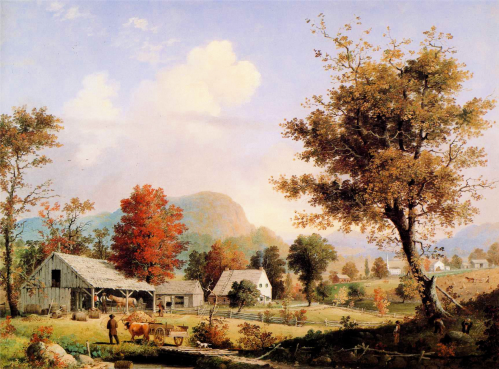
George_Henry_Durrie_-_Cider_PressingCider Pressing by George Henry Durrie 1855

Date: 1855

Medium: oil on canvas

Dimensions: Height: 22.2 in (56.5 cm); Width: 30.2 in (76.8 cm)

Collection: Private collection (Mr. & Mrs. Eugene Bugbee)

What I love about this painting:

We’re nearing the end of October, and autumn is fast sliding into the long dark of a northern November. Some trees are shedding their leaves here in the Pacific Northwest, but others are clinging to the last shreds of yellow and gold. Our native fall colors are less brilliant than those depicted in Durie’s work, but many non-native species have been introduced in the suburban landscape, offering bursts of scarlet and orange.

I love the simplicity of George Henry Durrie’s paintings. This one in particular deserves a second look. It first appeared here in September of 2021.

This is a quintessential, slightly romantic, view of history, a window into a New England day in autumn during the 19th century. A farmer leads his ox-drawn cart to the cider press. Is he selling them to the cider-man or just paying to have them juiced? Does he make his own apple jack, or is he a teamster, transporting goods for a fee?

A story can be found here, as in all Durrie’s paintings.

Juicing apples for unfermented ciders juices, jellies, and the highly fermented apple jack was an essential part of bringing in the harvest and preparing for winter, a part of the food chain we who get our food from the supermarket are disconnected from. But this was a scene that played out every fall, in every town and village.

Durrie’s colors are intensely vibrant, deep and rich, and each part of the scene is clear and placed with intent. The air is crisp and cool, but not yet cold. The leaves are turning all shades of red and gold, just as they are doing here today in the Pacific Northwest.

About the Artist, quoted from the National Gallery of Art:

Born in New Haven in 1820, the son of a Connecticut stationer, George Henry Durrie remained in that city virtually his entire life. Married to a choirmaster’s daughter, Sarah Perkins, in 1841, he immersed himself in the quiet pursuits of family and church. While he never achieved the fame of the most renowned nineteenth century American landscape painters, he appears to have had a fulfilling, productive career. His letters show that he never felt the need to move beyond his community, although he once briefly took a studio in New York and exhibited there regularly at the National Academy of Design.

Almost all of his compositions are relatively small in scale, few exceeding 18 x 24 inches, and his views are quiet and intimate. He knew and admired the works of Thomas Cole, and may have tried to emulate certain aspects of Cole’s style, yet he eschewed the Hudson River School’s compositional complexity and expansiveness. Because his paintings combined extensive genre elements with landscape they had a story-telling content that made them pleasant, accessible images to the average viewer.

The lithographic firm of Currier & Ives successfully reproduced ten of Durrie’s scenes and these, in turn, became popular calendar illustrations in the twentieth century. As a result, Durrie’s depictions of rural life in the mid-nineteenth century are now among the most familiar images in all of American art. As Martha Hutson has noted, however, these printed pictures do not convey the keen sensitivity to and understanding of conditions of atmosphere and light that are so pronounced in Durrie’s paintings. [1]

From Wikipedia:

In his teens the self-taught artist painted portraits in the New Haven area. In 1839 he received artistic instruction from Nathaniel Jocelyn, a local engraver and portrait painter. After 1842 he settled in New Haven, but made painting trips to New Jersey, New York, and Virginia. Around 1850, he began painting genre scenes of rural life, as well as the winter landscapes that became popular when Currier and Ives published them as lithographs. Four prints were published between 1860 and the artist’s death in New Haven in 1863; six additional prints were issued posthumously. The painter Jeanette Shepperd Harrison Loop studied with him. [2]


Credits and Attributions:

Wikimedia Commons contributors, “File:George Henry Durrie – Cider Pressing.JPG,” Wikimedia Commons, the free media repository, https://commons.wikimedia.org/w/index.php?title=File:George_Henry_Durrie_-_Cider_Pressing.JPG&oldid=369724230 (accessed September 15, 2021).

[1] National Gallery of Art contributors, “George Henry Durrie,” biography, © 2018 – 2021 National Gallery of Art, https://www.nga.gov/collection/artist-info.6397.html

[2] Wikipedia contributors, “George Henry Durrie,” Wikipedia, The Free Encyclopedia, https://en.wikipedia.org/w/index.php?title=George_Henry_Durrie&oldid=861433469 (accessed September 15, 2021).
2 Comments

Filed under #FineArtFriday, writing

#FineArtFriday: A Coming Storm by Sanford Robinson Gifford

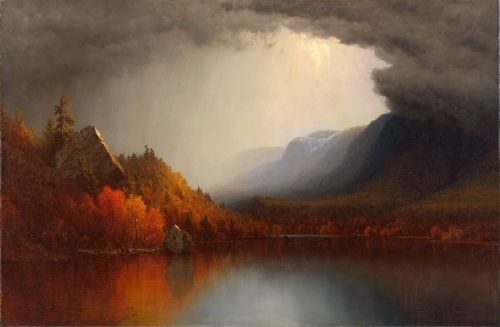
Gifford_A_Coming_Storm_1863-1880_PMA

Artist: Sanford Robinson Gifford,

Title: A Coming Storm (1863)

Date: 1863 (retouched 1880)

Location: Philadelphia Museum of Art.

What I love about this painting:

Gifford demonstrates his skill as a devotee of luminism and gives us the perfect view of a fine autumn day and the approaching storm. The way he contrasts the sun’s light against the ominous black clouds is true to nature, to how storms really look as they close in.

I like the way he shows the rock outcroppings, visible evidence of the hard stone of the mountains that lies beneath the lush finery of autumn foliage.

For the moment, the waters of the pond are quiet, reflecting the sky above. Rain cloaks the view of the distant valley, and soon we will feel the brunt of it. Enjoy the blaze of color while you can, as tomorrow those trees will be half-bare, and the ground will be covered in sodden tatters of red and gold.

While there appears to be some damage in the upper center, the integrity of the painting is still intact. It was retouched in 1880, but a modern retouching would likely bring it back to its original glory.

About the Artist, via Wikipedia:

Sanford Robinson Gifford (July 10, 1823 – August 29, 1880) was an American landscape painter and a leading member of the second generation of Hudson River School artists. A highly regarded practitioner of Luminism, his work was noted for its emphasis on light and soft atmospheric effects.

Although trained as a portrait painter, the first work Gifford exhibited at the National Academy was a landscape, in 1847. Thereafter, Gifford devoted himself primarily to landscape painting, becoming one of the finest artists of the Hudson River School. He was elected an Associate of the National Academy in 1851, and an Academician in 1854.

2008 National Academy of Design controversy:

In December 2008, one of Gifford’s paintings, Mount Mansfield, Vermont (1859), became part of a controversy over deaccessioning by the National Academy of Design. The Academy was a member of the Association of Art Museum Directors, whose policy stated that member museums could not sell works of art to cover operating expenses, only to purchase superior works or to weed out inferior or redundant ones. Prior to joining AAMD, the Academy had sold two Thomas Eakins works (including his “diploma painting,” Wrestlers) in the 1970s, and Richard Caton Woodville‘s War News from Mexico (1848) in 1994. According to its former curator, David Dearinger: “When the Academy later applied to the museum association for accreditation, Mr. Dearinger recalled, it was asked about the Woodville sale and promised not to repeat such a move.”

In a 2008 sale, the Academy quietly sold Frederic Edwin Church‘s Scene on the Magdalene (1854) and Sanford Gifford’s Mount Mansfield, Vermont (1859) to a private collector for US$13.5 million. The former was the Academy’s only painting by Church; the latter was its only painting by Gifford. Both had been “donated to the Academy in 1865 by another painter, James Augustus Suydam.” News of the sale was broken by arts blogger Lee Rosenbaum. As punishment for these actions, AAMD asked its other member museums to “cease lending artworks to the Academy and collaborating with it on exhibitions.” The Academy had contemplated selling additional paintings, but those plans were abandoned after being reported by Rosenbaum. [1]


Credits and Attributions:

IMAGE: A Coming Storm by Sanford Robinson Gifford. Wikimedia Commons contributors, “File:Gifford A Coming Storm 1863-1880 PMA.jpg,” Wikimedia Commons, https://commons.wikimedia.org/w/index.php?title=File:Gifford_A_Coming_Storm_1863-1880_PMA.jpg&oldid=803742381 (accessed October 5, 2023).

[1] Wikipedia contributors, “Sanford Robinson Gifford,” Wikipedia, The Free Encyclopedia, https://en.wikipedia.org/w/index.php?title=Sanford_Robinson_Gifford&oldid=1176083433 (accessed October 5, 2023).

Comments Off on #FineArtFriday: A Coming Storm by Sanford Robinson Gifford

Filed under #FineArtFriday

#FineArtFriday: Peace at Sunset (Evening in the White Mountains) by Thomas Cole, ca 1827

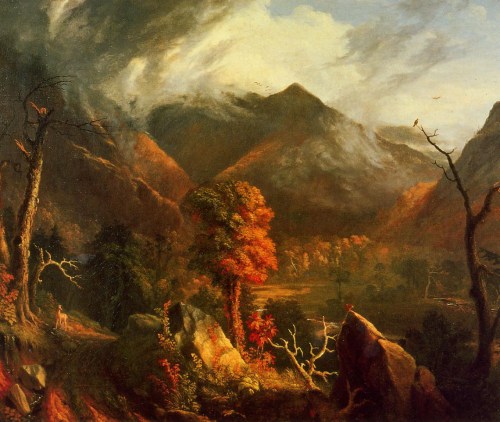
Peace_at_Sunset_(Evening_in_the_White_Mountains)_Thomas_ColeArtist: Thomas Cole (1801–1848)

Title: Peace at Sunset (Evening in the White Mountains)

Date: circa 1827

Medium: oil on canvas

Dimensions: height: 68.9 cm (27.1 in); width: 81.9 cm (32.2 in)

Collection: Fine Arts Museums of San Francisco

What I love about this painting:

This is one of Cole’s early works. He was able to show us the kind of autumn day we love, with rain trying to sweep in, but held back by the sunshine. It’s good day, despite the chill breeze attempting to scour the leaves from the trees. Clouds brush the hilltops, but the reds and golds seem to glow in the sunlight.

About the Artist, via Wikipedia:

Thomas Cole (February 1, 1801 – February 11, 1848) was an English-American painter known for his landscape and history paintings. He is regarded as the founder of the Hudson River School, an American art movement that flourished in the mid-19th century. Cole’s work is known for its romantic portrayal of the American wilderness.

After 1827 Cole maintained a studio at the farm called Cedar Grove, in the town of Catskill, New York. He painted a significant portion of his work in this studio. In 1836, he married Maria Bartow of Catskill, a niece of the owners, and became a year-round resident. Thomas and Maria had five children. Cole’s daughter Emily was a botanical artist who worked in watercolor and painted porcelain. Cole’s sister, Sarah Cole, was also a landscape painter.

Additionally, Cole held many friendships with important figures in the art world including Daniel Wadsworth, with whom he shared a close friendship. Proof of this friendship can be seen in the letters that were unearthed in the 1980s by the Trinity College Watkinson Library. Cole emotionally wrote Wadsworth in July 1832: “Years have passed away since I saw you & time & the world have undoubtedly wrought many changes in both of us; but the recollection of your friendship… [has] never faded in my mind & I look at those pleasures as ‘flowers that never will in other garden grow-‘”

Thomas Cole died at Catskill on February 11, 1848, of pleurisy. The fourth highest peak in the Catskills is named Thomas Cole Mountain in his honor. Cedar Grove, also known as the Thomas Cole House, was declared a National Historic Site in 1999 and is now open to the public.


Credits and Attributions:

Peace at Sunset (Evening in the White Mountains) by Thomas Cole PD|100 via Wikimedia Commons.

Wikipedia contributors, “Thomas Cole,” Wikipedia, The Free Encyclopedia, https://en.wikipedia.org/w/index.php?title=Thomas_Cole&oldid=1120453843 (accessed November 10, 2022).

Comments Off on #FineArtFriday: Peace at Sunset (Evening in the White Mountains) by Thomas Cole, ca 1827

Filed under #FineArtFriday

#FineArtFriday: Cider Pressing by George Henry Durrie 1855

George_Henry_Durrie_-_Cider_PressingCider Pressing by George Henry Durrie 1855

Date: 1855

Medium: oil on canvas

Dimensions: Height: 22.2 in (56.5 cm); Width: 30.2 in (76.8 cm)

Collection: Private collection (Mr. & Mrs. Eugene Bugbee)

What I love about this painting:

This is a quintessential, slightly romantic, view of history, a window into a New England day in autumn during the 19th century. A farmer leads his ox-drawn cart to the cider press. Is he selling them to the cider-man or just paying to have them juiced? Does he make his own apple jack, or is he a teamster, transporting goods for a fee?

A story can be found here, as in all Durrie’s paintings.

Juicing apples for unfermented ciders juices, jellies, and the highly fermented apple jack was an essential part of bringing in the harvest and preparing for winter, a part of the food chain we who get our food from the supermarket are disconnected from. But this was a scene that played out every fall, in every town and village.

Durrie’s colors are intensely vibrant, deep and rich, and each part of the scene is clear and placed with intent. The air is crisp and cool, but not yet cold. The leaves are turning all shades of red and gold, just as they are doing here today in the Pacific Northwest.

About the Artist, quoted from the National Gallery of Art:

Born in New Haven in 1820, the son of a Connecticut stationer, George Henry Durrie remained in that city virtually his entire life. Married to a choirmaster’s daughter, Sarah Perkins, in 1841, he immersed himself in the quiet pursuits of family and church. While he never achieved the fame of the most renowned nineteenth century American landscape painters, he appears to have had a fulfilling, productive career. His letters show that he never felt the need to move beyond his community, although he once briefly took a studio in New York and exhibited there regularly at the National Academy of Design.

Almost all of his compositions are relatively small in scale, few exceeding 18 x 24 inches, and his views are quiet and intimate. He knew and admired the works of Thomas Cole, and may have tried to emulate certain aspects of Cole’s style, yet he eschewed the Hudson River School’s compositional complexity and expansiveness. Because his paintings combined extensive genre elements with landscape they had a story-telling content that made them pleasant, accessible images to the average viewer.

The lithographic firm of Currier & Ives successfully reproduced ten of Durrie’s scenes and these, in turn, became popular calendar illustrations in the twentieth century. As a result, Durrie’s depictions of rural life in the mid-nineteenth century are now among the most familiar images in all of American art. As Martha Hutson has noted, however, these printed pictures do not convey the keen sensitivity to and understanding of conditions of atmosphere and light that are so pronounced in Durrie’s paintings. [1]

From Wikipedia:

In his teens the self-taught artist painted portraits in the New Haven area. In 1839 he received artistic instruction from Nathaniel Jocelyn, a local engraver and portrait painter. After 1842 he settled in New Haven, but made painting trips to New Jersey, New York, and Virginia. Around 1850, he began painting genre scenes of rural life, as well as the winter landscapes that became popular when Currier and Ives published them as lithographs. Four prints were published between 1860 and the artist’s death in New Haven in 1863; six additional prints were issued posthumously. The painter Jeanette Shepperd Harrison Loop studied with him. [2]


Credits and Attributions:

Wikimedia Commons contributors, “File:George Henry Durrie – Cider Pressing.JPG,” Wikimedia Commons, the free media repository, https://commons.wikimedia.org/w/index.php?title=File:George_Henry_Durrie_-_Cider_Pressing.JPG&oldid=369724230 (accessed September 15, 2021).

[1] National Gallery of Art contributors, “George Henry Durrie,” biography, © 2018 – 2021 National Gallery of Art, https://www.nga.gov/collection/artist-info.6397.html

[2] Wikipedia contributors, “George Henry Durrie,” Wikipedia, The Free Encyclopedia, https://en.wikipedia.org/w/index.php?title=George_Henry_Durrie&oldid=861433469 (accessed September 15, 2021).
2 Comments

Filed under #FineArtFriday, writing