
We who are indies know we should have our work edited, and most of us aren’t that good at self-editing. So, we find someone we can work with. But hiring an editor is expensive, so before we send our manuscript off, we should take the time to make it as clean as possible. It will greatly speed up the process if the editor doesn’t have to wade through a mess.
 One of my favorite authors writes great storylines and creates wonderful characters. Unfortunately, the quality of his work has deteriorated over the last decade. It’s clear that he has succumbed to the pressure from his publisher, as he is putting out four or more books a year.
While I can write that many first drafts in one year, I could never make more than one book ready for a reader every two or three years. For that reason, I have manuscripts in various stages of completion and try to publish one a year. However, I often can’t keep to that schedule.
Taking the manuscript from the first draft to the finished product is a long and involved process. The author I mentioned above has his characters repeat what has already happened every time they meet someone new.
 This frequently happens to me in a first draft, but whoever is editing for him is letting it slide, as it pads the word count, making his books novel-length. I suspect they don’t have time to do any significant revisions.
The Big Traditional Publishing Giants are just as tempted to rush a manuscript to publication as we indies are, and editing sometimes falls by the way. However, if an indie publishes work as poorly edited as what is being sold by the big publishers, the entire indie community looks bad.
Since the large publishing houses aren’t as concerned about their editing as we always thought they were, it’s up to us to find the flaws before we submit our work to them. This means you should prepare the manuscript as thoroughly as if you intended to publish it yourself.
 When we lay down the first draft, the story emerges from our imagination and falls onto the paper (or keyboard). Even with an outline, the story forms in our heads as we write it. While we think it is perfect as is, it probably isn’t.
The revision process is about far more than merely grammar and word placement. It is about ensuring the story arc doesn’t flat-line and that inadvertent repetition of entire ideas doesn’t bog it down.
Those who regularly read my blog know I frequently repeat an idea phrased a bit differently further down the post. My elderly brain seems determined to make that point, no matter what.
We all do this in our first drafts, and very few things are more “first draft” than a blog post.
 Inadvertent repetition causes the story arc to dip. It takes us backward rather than forward. In my work, I have discovered that the second version of that idea is usually better than the first.
One way to minimize the number of flaws in your work is to print it out and read it aloud. Mark each place where you stumble or the passages don’t make sense with a highlighter.
You will find run-on sentences, spell-check errors, and many small things you don’t notice when it’s on the computer screen.
At this point, since you have already printed out each chapter, read it aloud, and highlighted what you stumbled over, you could take the time to go a little deeper into the revision process.
It’s already printed, so I don’t have to waste more ink or paper.
- I turn to the last paragraph on each chapter’s last page.
- Working my way forward with a yellow highlighter, I make notes in the margins.
 You see things from a different angle when you start reading the chapter from the end and work your way toward the beginning. It’s amazing how many bloopers show up when you do this, even though you have already read it aloud. When you read it aloud you were going the direction you always go, the way you know so well. The mind tricks us, and we read what should be there instead of what is.
This admittedly involved process works for me because we don’t notice wonky grammar and mechanics as much when we see them on a computer screen.
Once I have printed out my manuscript chapter by chapter and finished going over it, I put the hand-corrected copy on a recipe stand beside my computer. I begin making revisions in a new file labeled with the date. The date in the file label tells me which is the most recent version of a manuscript.
BoH_revised_07-01-2023
(I never delete the old files because we never know when we might need something we have already written.)
 Here are a few things that stand out when I do this:
- Inadvertent shifts in the spelling of names for people and places, such as Moran becoming Muran. (Keeping a style sheet of how names and created words are spelled and doing a global search for each before publishing resolves that.)
- Places where I have contradicted myself, such as a town being northof the main character’s location, but they travel south to get there. Making a simple hand-drawn map resolves the location problem (if I remember to look at it).
- Punctuation errors and missing quotation marks also stand out when I see them printed.
My editor keeps me aware of inadvertent shifts in spelling. Years ago, she taught me to make a style sheet for each project.
The style sheet can take several forms. Even a simple handwritten list will do, as it’s only a visual guide to print out or keep minimized on my desktop until needed. I was a bookkeeper, so I use Excel to copy and paste every invented name, hyphenated word, or placename the first time they appear in my manuscript.
- I sometimes forget to make a note of made-up words and usages when I am really into writing. (Oops.)
My editor takes my list of invented words and adds the ones I overlooked to it during her part of the process.
 If you have the resource of a good writing group, you are a bit ahead of the game. I suggest you run each revised chapter by your group and listen to what they say. Some of what you hear won’t be useful, but much will be.
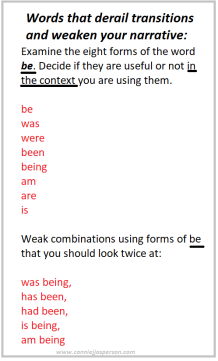
Many years ago, a friend who read my work gave me a list of weak words to watch for.
Another friend trained me out of using “that” as a crutch word—a word I use too often in my everyday speech.
Constructive criticism is a good thing.
I have discovered that the real work of writing a novel comes after I have written the story.


 Life in the Realm of Fantasy