
Things have been hopping here at Casa del Jasperson. We finally have all the furniture we need, so Grandma has a comfy chair in the living room as well as here in the Fortress of Write. This is the best workspace I’ve ever had.
 I have been busy on the domestic side of things and enjoying life as a Townie. Lovely Instacart delivers my groceries from any store I choose. If we have to be out after dark and it’s raining, I can’t see well, so Uber does the driving. We are living a life of luxury and grateful for it. I have a “passel” of grandbabies and great-grandbabies, so when I have nothing to write, I have needlework projects to keep me busy.
With the dark of winter, jigsaw puzzles returned to the new and improved Casa del Jasperson. We bought a wooden rotating puzzle board with pull-out drawers to set on top of our card table. It rotates like a Lazy Susan but has drawers for sorting the puzzle pieces. The cover keeps things clean when we aren’t working on it. We feel pretty fancy, thank you.
 And speaking of fancy, we had a chance to spend time with two great-grandbabies this weekend. The best part of being a grandma is when the little one starts crying or needs changing, someone else takes over, and grandma shuffles off to the kitchen to stir the soup and make another cup of tea. Yay for old age!
So, let’s talk about the writing front. This is the time of year when I concentrate on short stories, preparing them to send to contests and magazines. Writing short fiction forces the author to develop an economy of words. You have a finite number of words to tell what happened, so only the important stuff fits within that space.
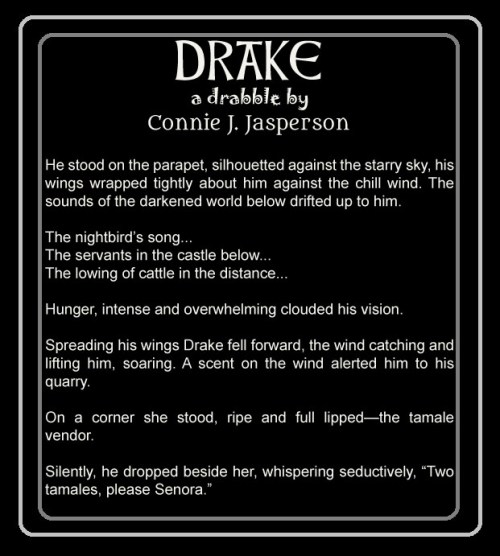
A side-effect of building a backlog of short stories is the supply of ready-made characters and premade settings to draw on when you need a longer story to submit to a contest. And when you look on the internet, you’ll find many contests for drabbles, some offering cash prizes.
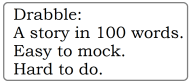 Writing drabbles means your narrative will be limited to one or two characters. There is no room for anything that does not advance the plot or affect the story’s outcome. Also, while a 100-word story takes less time than a 3,000-word story, all writing is a time commitment. I will spend an hour or more getting a drabble to fit within the 100-word constraint.
To write a drabble, we need the same fundamental components as we do for a longer story:
- A setting
- One or more characters
- A conflict
- A resolution.
First, we need a prompt, a jumping-off point. We have 100 words to write a scene that tells the entire story of a moment in a character’s life.
Some contests give whole sentences for prompts, others offer one word, and others may offer no prompt at all. If you are new to the writing world, a prompt is a word or visual image that kick-starts the story in your head. An excellent site for finding ideas is 700+ Weekly Writing Prompts.
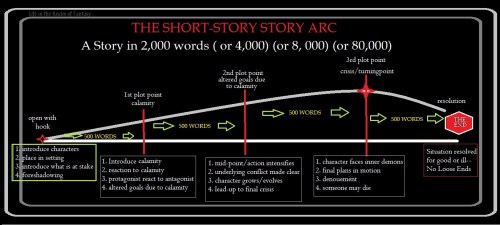
I have found that dividing the required count into three acts makes the plot outline more manageable when a contest has a rigid word count requirement. I assign a certain number of words for each act. (I’ve included that graphic at the bottom of this post.)
I give about 25 words for act one to open the story and set the scene. Act two is longer, around 50 – 60 for the story’s heart. That leaves 10 – 25 words to conclude it.
Sometimes (okay, lately), I’m too scattered to make progress on a longer work in progress, and at that point, I write myself into a corner. Maybe I can’t even come up with a drabble. That’s when I “mind wander” about the work that has me flummoxed, thinking out loud on paper.
I don’t know about you, but it helps me to spend fifteen minutes writing info dumps about random side characters’ history and lay down a trail of breadcrumbs that lead to nowhere. These exercises aren’t a waste of time because visualizing anything about those characters and that world helps to solidify world-building and ids character development.
Writing info dumps in a separate document helps me identify the themes and subthemes I need to expand on for depth. It gives me the important info but keeps the fluff out of the narrative.
Tidying the house allows me to rest my mind, and I feel incredibly noble at the same time.
Seriously, when our mind is actively focused on a task that takes all our creative attention, we sometimes tune out the ideas and don’t quite hear the prompts that “the back of our mind” whispers to us.
We know those ideas are there, lurking just out of reach. Being able to almost see what we need to do next is frustrating, like looking through a fogged-up window. Focusing on a physical task like laundry or cooking relaxes my creative mind.
Daydreaming is good for you. Allowing the mind to wander allows a kind of ‘default neural network’ to do its job. This kicks into gear when our brain is at wakeful rest, like in meditation.
It boosts the brain, making our thought process more effective.
Yes, I spend an astounding amount of time daydreaming. Crocheting or making maps for my friends makes me look productive (when I’m on a mental vacation). I would hate to be simply wasting time.
It may feel like the Titanic that is your novel is going down, but we who write are all in the same lifeboat. If you’re stuck, I hope what works for me will work for you. Remember, if you suffer from a temporary dry spell, you are not alone.


 Life in the Realm of Fantasy